REVIEW 3 major objections 4 minor 72 references
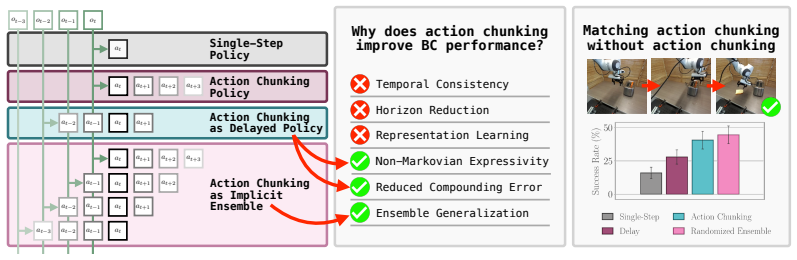
Action chunking's real benefits are delayed prediction plus implicit ensembling, not temporal consistency or horizon reduction.
Reviewed by Pith at T0; open to challenge. T0 means a machine referee read the full paper against a public rubric. the ladder, T0–T4 →
T0 review · deepseek-v4-flash
2026-08-04 04:58 UTC pith:KY2RIHDI
load-bearing objection Action chunking's gains mostly come from predicting on stale observations plus an implicit ensemble effect; the paper matches action chunking with randomized-delay deployment, but the 'temporal consistency is unnecessary' claim only holds in the 15–20 Hz regime it tests. the 3 major comments →
Why Does Action Chunking Improve Behavioral Cloning Performance in Robotic Control?
The pith
A machine-rendered reading of the paper's core claim, the machinery that carries it, and where it could break.
Core claim
Action chunking succeeds, the paper argues, because of three mechanisms: non-Markovian expressivity, reduced compounding error from predicting on past observations, and implicit ensembling. The first two are already captured by a simple delayed policy predicting a single action from an observation several steps back. The third is the new ingredient: a chunked policy modeling a_t,...,a_{t+k-1}|o_t doubles as a collection of delayed predictors a_t|o_t, a_t|o_{t-1}, ..., a_t|o_{t-k+1}, so aggregating them at test time reproduces ensemble robustness. Randomized delay deployment of the chunked policy matches or exceeds full action chunking in simulation and on a real robot, and explicit ensembles
What carries the argument
The central objects are delayed policies, π(a_t|o_{t-d}), which predict a single action from an observation d steps in the past, and the implicit-ensemble reading of an action-chunked policy: a chunk covering k steps decomposes into k temporal relationships a_t|o_t, a_t|o_{t-1}, ..., a_t|o_{t-k+1}. The load-bearing mechanism is the randomized delay ensemble (RDE): at each step, sample a delay uniformly and act according to the corresponding delayed prediction. Because the chunked policy already contains all these delayed predictors, RDE recreates the ensemble behavior without ever executing a chunk, which is what lets the paper match action chunking without action chunking.
Load-bearing premise
The equivalence between action chunking and randomized-delay ensembles is demonstrated only at the 15–20 Hz control rates used in the experiments; the paper's own Section 8 reports that at 50–60 Hz delayed policies cannot replicate chunking, so the claim that temporal consistency is unnecessary is load-bearing on the low-frequency regime.
What would settle it
Run the same delayed-policy versus action-chunking comparison at 50–60 Hz on a fast manipulation task; if the randomized-delay ensemble fails to match chunking there (as the paper's Section 8 hints), the universality of the claim is refuted and the mechanism is frequency-limited.
If this is right
- Practitioners can match action chunking performance with a single-step delayed policy in low-control-frequency settings, so chunk execution itself is not the source of the gains.
- Randomized delay deployment of an already-trained chunked policy recovers the ensemble benefit; no retraining is needed to gain robustness.
- Explicitly ensembling delayed policies goes further, improving success rates on challenging tasks beyond the chunked policy.
- The failure of the delayed-policy equivalence at 50–60 Hz implies temporal consistency is genuinely needed in that regime, so control frequency should be reported when comparing policies.
- The three-mechanism account (non-Markovian expressivity, compounding reduction, implicit ensembling) can replace the older hypotheses as the working explanation for chunking.
Where Pith is reading between the lines
- If delayed prediction plus ensembling is the mechanism, then chunk length should be matched to the demonstrator's natural action-update delay (roughly 5–15 steps in the paper's data) rather than treated as a free hyperparameter; this gives a principled tuning rule the paper does not state.
- The ensemble view suggests that other sources of temporal diversity—for example, training on observation subsampling or dropout over history—might reproduce the chunking benefit, a testable alternative to action chunking.
- The control-frequency dependence found by the authors implies that benchmark comparisons of imitation-learning methods are confounded by the robot's loop rate; standardizing effective control frequency would make results comparable across labs.
- One could test the implicit-ensemble hypothesis directly by ablating the delay distribution: if ensembling is causal, performance should degrade when the delay spread is narrowed, holding fixation quality fixed.
Editorial analysis
A structured set of objections, weighed in public.
Referee Report
Summary. The paper investigates why action chunking improves behavioral cloning in robotic control. It argues that the commonly cited explanations—temporal consistency, horizon reduction, and representation learning—are inadequate. Instead, it proposes that action-chunked policies succeed primarily through (a) expressing non-Markovian demonstrator behavior by predicting actions from past observations, which also reduces compounding error, and (b) implicitly ensembling over multiple temporal relationships (a_t|o_t, a_t|o_{t-1}, ...). The paper provides theoretical results (Theorems 1–3) and extensive experiments on Libero, Robomimic, and real Franka tasks. The central empirical claim is that deploying an action-chunking policy as a randomized-delay ensemble (RDE) matches or exceeds action chunking without executing chunks, and that explicit delayed-policy ensembles can further improve performance.
Significance. If the paper's central claim holds, it substantially reframes how the community should think about action chunking: chunk execution itself is not the essential ingredient; delayed prediction plus an ensemble-like effect suffices in many settings. The paper has notable strengths: it compares deployment modes of the same policy (AC vs. delayed vs. RDE), providing a controlled test of the mechanism; Appendix D contains self-contained proofs that delayed and chunked policies achieve the same compounding-error bound under explicit Lipschitz assumptions; the real-world experiments extend the conclusions beyond simulation; and the proposed explicit ensemble is a practical, falsifiable contribution. However, the central claim is scoped to 10–20 Hz control in the paper's own Section 8, and the main tables use best-case hyperparameters, so the headline 'temporal consistency is not necessary' needs qualification.
major comments (3)
- [§8, 'The Role of Control Frequency'] The paper's own caveat states that at 50–60 Hz control, delayed policies cannot replicate action chunking, while sub-chunking to 10–20 Hz effective actions restores performance. This directly conflicts with the unqualified claim in §4.1 (Takeaway 1) and the abstract that 'temporal consistency is not necessary.' The response that high-frequency correlation is 'simply another form of non-Markovian behavior' is not sufficient: the paper's central equivalence is specifically that a fixed observation delay captures the relevant non-Markovianity, and that equivalence fails in this regime. The claim must be explicitly scoped to roughly human-timescale 10–20 Hz control, or the mechanism must be extended to explain why high-frequency temporal correlation requires chunk execution.
- [Tables 1–2 and §5] The main comparison tables report 'best-case' chunk lengths and delays selected post hoc. Appendix A.4.8 shows, for Robomimic, AC(n) was evaluated at n ∈ {1,5,10} and Delay(n) at n ∈ {3,5}, with the main table reporting the best value; Table 2 explicitly says results are 'best-case delay or action chunk length, and ensemble aggregation approach.' This post hoc selection can inflate the reported performance of individual methods and makes the 'matches action chunking' claim less robust. The authors should report results for fixed, pre-specified hyperparameters, or present all configurations with an appropriate multiple-comparison correction or sensitivity analysis.
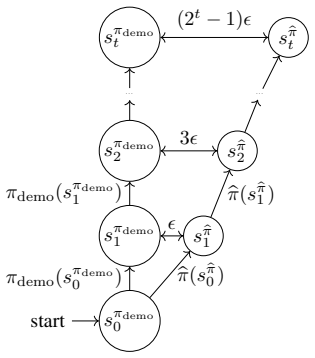
- [Theorem 2 and Lemma D.1] The statement of Theorem 2 does not include the condition k ≥ 1. For k = 0, the delayed policy is a Markovian policy, and the claimed bound O((k+1)^{H/k} ε) is not valid—it would incorrectly suggest only polynomial compounding in H, whereas Theorem 1 and the proof's own recursion give exponential compounding. Lemma D.1 explicitly assumes k ≥ 1. The theorem statement should be corrected to state k ≥ 1, with the k = 0 case handled by Theorem 1.
minor comments (4)
- [Figure 10 (Section 6)] The real-world success-rate bars have no error bars or confidence intervals, despite 50 rollouts per method. Reporting binomial confidence intervals or per-seed variation would strengthen the claim that RDE matches action chunking.
- [Section 3 and Theorem 2] The notation for action-chunked policies is inconsistent: pπ_k vs. pπ_n^k and the induced delayed policy notation are introduced informally and then used in theorems. A concise formal definition before Theorem 2 would improve readability.
- [Figure 4] The text says there is 'little correlation' between the non-Markovianness proxy ΔL_val and ΔJ, but only a fitted line and scatter are shown. Reporting the correlation coefficient and its uncertainty would make the claim quantitatively precise.
- [Section A.5] The real-world experiments use an additional delay of 1 timestep for all policies, so the labels in Figure 10 (e.g., AC(10), Delay(2)) do not exactly match the deployed policies. Clarifying this in the main text or figure legend would avoid confusion.
Circularity Check
No significant circularity: theory is proven, RDE is an empirical control, and the high-frequency caveat is a scope limitation.
full rationale
The paper's derivation chain is self-contained and falsifiable. The central theoretical results (Theorems 1 and 2, Section 4.2 and Appendix D) are proven from explicit Lipschitz/smoothness assumptions and do not assume the conclusion; the same compounding-error bound is derived for both chunked and delayed policies, and the lower bound in Theorem 3 rules out a benefit for chunking in that model. The empirical 'implicit ensembling' claim is not asserted by definition: AC(n)-TE and RDE are constructed from the induced delayed policies of a trained AC policy, but whether these deployments match or exceed AC(n) is measured against held-out success/validation data, and in Robomimic delayed policies alone fail to match AC(n)—RDE matching is therefore an empirical result, not a tautology. The paper also contains a genuine limiting check: Section 8 ('The Role of Control Frequency') reports that at 50–60 Hz delayed policies cannot replicate action chunking, which scopes the headline claim but is an external falsification attempt rather than a circular step. Self-citations (e.g., [40], [6]) are peripheral and not load-bearing; the main external baselines and benchmarks (Diffusion Policy, ACT, LIBERO, Robomimic, pi0.5) provide independent grounding. No prediction is a renamed fit, and no uniqueness or ansatz is imported from the authors' prior work.
Axiom & Free-Parameter Ledger
free parameters (3)
- Best-case chunk length and delay for reported results =
Chunk/delay n selected from {1,5,10,...} per benchmark; e.g., n=10 for AC and RDE, delay ~5-6 for Delay
- Control frequency =
15-20 Hz
- Ensemble size for explicit ensembles =
m=5 seeds grouped from 15 trained policies
axioms (4)
- domain assumption Environment dynamics and reward/policies are 1-Lipschitz (Assumptions D.1-D.4)
- domain assumption Human demonstrator behavior at 15-20 Hz contains non-Markovian structure that a single-step delayed policy can capture
- domain assumption Diffusion policies trained here are effectively unimodal, so mean-action validation error is a meaningful measure
- domain assumption Independent random seeds yield sufficiently diverse policies for explicit ensembling
read the original abstract
Action chunking---predicting and executing multiple actions instead of a single action---has proven to be a critical component for learning effective robotic control policies. However, our precise understanding of why action chunking improves performance has remained limited. In this work we seek to close this gap. Through rigorous experimental evaluations in both simulated and real-world settings, we show that existing hypotheses for the success of action chunking---temporal consistency, horizon reduction, and representation learning---fail to explain the success of action chunking. Instead, we find that action chunking benefits from greater non-Markovian expressivity and reduced compounding error compared to Markovian policies, but, in many settings of interest, these effects can be fully captured by delayed policies, which at each step predict a single action based on the observation $k$ steps in the past. We then show that there exists an additional benefit of action chunking that we refer to as implicit ensembling. In particular, by learning a diversity of temporal relationships (that is, $a_t | o_t, a_t | o_{t-1}, \ldots$), action-chunked policies exhibit behavior matching that of a model ensemble, increasing their robustness and generalization ability over policies that only learn a single temporal relationship. Building on these insights, we show that in simulated and real-world robotic control settings, we can match the performance of action chunking without action chunking---by deploying an action chunking policy as an ensemble of policies with randomized delays. Furthermore, we propose a policy class that amplifies the benefits of action chunking by explicitly instantiating an ensemble, and which we show significantly improves over the performance of action chunking in many domains.
Figures




Reference graph
Works this paper leans on
-
[1]
T. Z. Zhao, V . Kumar, S. Levine, and C. Finn. Learning fine-grained bimanual manipulation with low-cost hardware, 2023. URLhttps://arxiv.org/abs/2304.13705
Pith/arXiv arXiv 2023
-
[2]
C. Chi, Z. Xu, S. Feng, E. Cousineau, Y . Du, B. Burchfiel, R. Tedrake, and S. Song. Diffusion policy: Visuomotor policy learning via action diffusion.The International Journal of Robotics Research, page 02783649241273668, 2023
2023
-
[4]
K. Pertsch, K. Stachowicz, B. Ichter, D. Driess, S. Nair, Q. Vuong, O. Mees, C. Finn, and S. Levine. Fast: Efficient action tokenization for vision-language-action models, 2025. URL https://arxiv.org/abs/2501.09747
Pith/arXiv arXiv 2025
-
[5]
T. Z. Zhao, J. Tompson, D. Driess, P. Florence, K. Ghasemipour, C. Finn, and A. Wahid. Aloha unleashed: A simple recipe for robot dexterity.arXiv preprint arXiv:2410.13126, 2024
Pith/arXiv arXiv 2024
-
[6]
Q. Li, Z. Zhou, and S. Levine. Reinforcement learning with action chunking.arXiv preprint arXiv:2507.07969, 2025
Pith/arXiv arXiv 2025
-
[7]
M. Torne, A. Tang, Y . Liu, and C. Finn. Learning long-context diffusion policies via past-token prediction.arXiv preprint arXiv:2505.09561, 2025
Pith/arXiv arXiv 2025
-
[8]
Krogh and J
A. Krogh and J. Vedelsby. Neural network ensembles, cross validation, and active learning. Advances in neural information processing systems, 7, 1994
1994
-
[9]
T. K. Ho. The random subspace method for constructing decision forests.IEEE transactions on pattern analysis and machine intelligence, 20(8):832–844, 1998
1998
-
[10]
L. Breiman. Random forests.Machine learning, 45(1):5–32, 2001
2001
-
[11]
D. A. Pomerleau. Alvinn: An autonomous land vehicle in a neural network. In D. Touretzky, editor,Advances in Neural Information Processing Systems, volume 1. Morgan-Kaufmann,
-
[12]
B. D. Argall, S. Chernova, M. Veloso, and B. Browning. A survey of robot learning from demonstration.Robotics and autonomous systems, 57(5):469–483, 2009
2009
-
[13]
S. Ross, G. Gordon, and D. Bagnell. A reduction of imitation learning and structured prediction to no-regret online learning. In G. Gordon, D. Dunson, and M. Dud ´ık, editors,Proceedings of the Fourteenth International Conference on Artificial Intelligence and Statistics, volume 15 ofProceedings of Machine Learning Research, pages 627–635, Fort Lauderdale...
2011
-
[14]
M. Bojarski. End to end learning for self-driving cars.arXiv preprint arXiv:1604.07316, 2016. 15
Pith/arXiv arXiv 2016
-
[15]
Zhang, Z
T. Zhang, Z. McCarthy, O. Jow, D. Lee, X. Chen, K. Goldberg, and P. Abbeel. Deep imita- tion learning for complex manipulation tasks from virtual reality teleoperation. In2018 IEEE international conference on robotics and automation (ICRA), pages 5628–5635. IEEE, 2018
2018
-
[16]
Rahmatizadeh, P
R. Rahmatizadeh, P. Abolghasemi, L. B ¨ol¨oni, and S. Levine. Vision-based multi-task manip- ulation for inexpensive robots using end-to-end learning from demonstration. In2018 IEEE international conference on robotics and automation (ICRA), pages 3758–3765. IEEE, 2018
2018
-
[18]
H. R. Walke, K. Black, T. Z. Zhao, Q. Vuong, C. Zheng, P. Hansen-Estruch, A. W. He, V . My- ers, M. J. Kim, M. Du, et al. Bridgedata v2: A dataset for robot learning at scale. InConference on Robot Learning, pages 1723–1736. PMLR, 2023
2023
-
[19]
O’Neill, A
A. O’Neill, A. Rehman, A. Maddukuri, A. Gupta, A. Padalkar, A. Lee, A. Pooley, A. Gupta, A. Mandlekar, A. Jain, et al. Open x-embodiment: Robotic learning datasets and rt-x models: Open x-embodiment collaboration 0. In2024 IEEE International Conference on Robotics and Automation (ICRA), pages 6892–6903. IEEE, 2024
2024
-
[20]
Khazatsky, K
A. Khazatsky, K. Pertsch, S. Nair, A. Balakrishna, S. Dasari, S. Karamcheti, S. Nasiriany, M. K. Srirama, L. Y . Chen, K. Ellis, P. D. Fagan, J. Hejna, M. Itkina, M. Lepert, Y . J. Ma, P. T. Miller, J. Wu, S. Belkhale, S. Dass, H. Ha, A. Jain, A. Lee, Y . Lee, M. Memmel, S. Park, I. Radosavovic, K. Wang, A. Zhan, K. Black, C. Chi, K. B. Hatch, S. Lin, J. ...
2024
-
[21]
N. M. Shafiullah, Z. Cui, A. A. Altanzaya, and L. Pinto. Behavior transformers: Cloningk modes with one stone.Advances in neural information processing systems, 35:22955–22968, 2022
2022
-
[22]
Z. J. Cui, Y . Wang, N. M. M. Shafiullah, and L. Pinto. From play to policy: Conditional behavior generation from uncurated robot data.arXiv preprint arXiv:2210.10047, 2022
Pith/arXiv arXiv 2022
-
[23]
S. Dasari, O. Mees, S. Zhao, M. K. Srirama, and S. Levine. The ingredients for robotic diffu- sion transformers.arXiv preprint arXiv:2410.10088, 2024
Pith/arXiv arXiv 2024
-
[24]
Ankile, A
L. Ankile, A. Simeonov, I. Shenfeld, and P. Agrawal. Juicer: Data-efficient imitation learning for robotic assembly. In2024 IEEE/RSJ International Conference on Intelligent Robots and Systems (IROS), pages 5096–5103. IEEE, 2024
2024
-
[25]
Y . Ze, G. Zhang, K. Zhang, C. Hu, M. Wang, and H. Xu. 3d diffusion policy: Generalizable visuomotor policy learning via simple 3d representations.arXiv preprint arXiv:2403.03954, 2024
Pith/arXiv arXiv 2024
-
[26]
Sridhar, D
A. Sridhar, D. Shah, C. Glossop, and S. Levine. Nomad: Goal masked diffusion policies for navigation and exploration. In2024 IEEE International Conference on Robotics and Automa- tion (ICRA), pages 63–70. IEEE, 2024. 16
2024
-
[27]
A. Brohan, N. Brown, J. Carbajal, Y . Chebotar, J. Dabis, C. Finn, K. Gopalakrishnan, K. Haus- man, A. Herzog, J. Hsu, et al. Rt-1: Robotics transformer for real-world control at scale.arXiv preprint arXiv:2212.06817, 2022
Pith/arXiv arXiv 2022
-
[28]
J. Gu, S. Kirmani, P. Wohlhart, Y . Lu, M. G. Arenas, K. Rao, W. Yu, C. Fu, K. Gopalakrishnan, Z. Xu, et al. Rt-trajectory: Robotic task generalization via hindsight trajectory sketches.arXiv preprint arXiv:2311.01977, 2023
Pith/arXiv arXiv 2023
-
[29]
O. M. Team, D. Ghosh, H. Walke, K. Pertsch, K. Black, O. Mees, S. Dasari, J. Hejna, T. Kreiman, C. Xu, et al. Octo: An open-source generalist robot policy.arXiv preprint arXiv:2405.12213, 2024
Pith/arXiv arXiv 2024
-
[30]
M. J. Kim, K. Pertsch, S. Karamcheti, T. Xiao, A. Balakrishna, S. Nair, R. Rafailov, E. Foster, G. Lam, P. Sanketi, et al. Openvla: An open-source vision-language-action model.arXiv preprint arXiv:2406.09246, 2024
Pith/arXiv arXiv 2024
-
[31]
K. Black, N. Brown, D. Driess, A. Esmail, M. Equi, C. Finn, N. Fusai, L. Groom, K. Hausman, B. Ichter, et al.π 0: A vision-language-action flow model for general robot control.arXiv preprint arXiv:2410.24164, 2024
Pith/arXiv arXiv 2024
-
[32]
J. Bjorck, F. Casta ˜neda, N. Cherniadev, X. Da, R. Ding, L. Fan, Y . Fang, D. Fox, F. Hu, S. Huang, et al. Gr00t n1: An open foundation model for generalist humanoid robots.arXiv preprint arXiv:2503.14734, 2025
Pith/arXiv arXiv 2025
-
[33]
P. Intelligence, K. Black, N. Brown, J. Darpinian, K. Dhabalia, D. Driess, A. Esmail, M. Equi, C. Finn, N. Fusai, et al.π 0.5: a vision-language-action model with open-world generalization. arXiv preprint arXiv:2504.16054, 2025
Pith/arXiv arXiv 2025
-
[34]
L. Zha, A. J. Hancock, M. Zhang, T. Yin, Y . Huang, D. Shah, A. Z. Ren, and A. Majum- dar. Lap: Language-action pre-training enables zero-shot cross-embodiment transfer.arXiv preprint arXiv:2602.10556, 2026
arXiv 2026
-
[35]
H. Fang, J. Duan, D. Clay, S. Wang, S. Liu, W. Huang, X. Fan, W.-C. Tsai, S. Chen, Y . R. Wang, S. Xing, J. Cho, J. S. Park, A. Eftekhar, P. Sushko, K. Farley, A. Wadhwa, C. Harrison, W. Han, Y .-C. Lee, E. VanderBilt, R. Hendrix, S. Ellawela, L. Ngoo, J. Chai, Z. Ren, A. Farhadi, D. Fox, and R. Krishna. Molmoact2: Action reasoning models for real-world d...
Pith/arXiv arXiv 2026
-
[36]
Gemini robotics: Bringing ai into the physical world.arXiv preprint arXiv:2503.20020, 2025
Gemini Robotics Team. Gemini robotics: Bringing ai into the physical world.arXiv preprint arXiv:2503.20020, 2025
Pith/arXiv arXiv 2025
-
[37]
TRI LBM Team. A careful examination of large behavior models for multitask dexterous manipulation.arXiv preprint arXiv:2507.05331, 2025. URLhttps:// toyotaresearchinstitute.github.io/lbm1/
Pith/arXiv arXiv 2025
-
[38]
J. Pai, L. Achenbach, V . Montesinos, B. Forrai, O. Mees, and E. Nava. mimic-video: Video- action models for generalizable robot control beyond vlas.arXiv preprint arXiv:2512.15692,
-
[39]
T. Z. Zhao, J. Tompson, D. Driess, P. Florence, K. Ghasemipour, C. Finn, and A. Wahid. Aloha unleashed: A simple recipe for robot dexterity. InProceedings of The 8th Conference on Robot Learning, volume 270 ofProceedings of Machine Learning Research. PMLR, 2025. URLhttps://proceedings.mlr.press/v270/zhao25b.html
2025
-
[40]
A. Wagenmaker, P. Dong, R. Tsao, C. Finn, and S. Levine. Posterior behavioral cloning: Pretraining bc policies for efficient rl finetuning.arXiv preprint arXiv:2512.16911, 2025
arXiv 2025
-
[41]
M. Janner, Y . Du, J. B. Tenenbaum, and S. Levine. Planning with diffusion for flexible behavior synthesis.arXiv preprint arXiv:2205.09991, 2022. 17
Pith/arXiv arXiv 2022
-
[42]
Y . Liu, J. Hamid, A. Xie, Y . Lee, M. Du, and C. Finn. Bidirectional decoding: Improving action chunking via guided test-time sampling. InInternational Conference on Learning Rep- resentations, volume 2025, pages 4594–4627, 2025
2025
-
[43]
R. Malhotra, Y . Liu, and C. Finn. Self-guided action diffusion.arXiv preprint arXiv:2508.12189, 2025
Pith/arXiv arXiv 2025
-
[44]
M. Park, K. Kim, J. Hyung, H. Jang, H. Jin, J. Yun, H. Lee, and J. Choo. Acg: Action coherence guidance for flow-based vla models.arXiv preprint arXiv:2510.22201, 2025
arXiv 2025
-
[45]
Black, M
K. Black, M. Galliker, and S. Levine. Real-time execution of action chunking flow policies. Advances in Neural Information Processing Systems, 38:33383–33407, 2026
2026
- [46]
-
[47]
D. Jing, G. Wang, J. Liu, W. Tang, Z. Sun, Y . Yao, Z. Wei, Y . Liu, Z. Lu, and M. Ding. Mixture of horizons in action chunking.arXiv preprint arXiv:2511.19433, 2025
Pith/arXiv arXiv 2025
-
[48]
Y . Weng, X. Zhang, Y . Mu, Y . Zhu, and Y . Li. Temporal action selection for action chunking. arXiv preprint arXiv:2511.04421, 2025
Pith/arXiv arXiv 2025
-
[49]
W. Chen, K. Zhang, C. Lin, Z. Zhang, Y . She, Y . Liu, R. A. Yeh, S. Mou, and Y . Gu. Dream- chunk: Reactive action chunking with latent world model.arXiv preprint arXiv:2606.18589, 2026
Pith/arXiv arXiv 2026
-
[50]
M. Simchowitz, D. Pfrommer, and A. Jadbabaie. The pitfalls of imitation learning when actions are continuous.arXiv preprint arXiv:2503.09722, 2025
Pith/arXiv arXiv 2025
-
[51]
T. T. Zhang, D. Pfrommer, N. Matni, and M. Simchowitz. Imitation learning in continuous action spaces: mitigating compounding error without interaction.arXiv preprint arXiv, 2507, 2025
2025
-
[52]
C. Pan, G. Anantharaman, N.-C. Huang, C. Jin, D. Pfrommer, C. Yuan, F. Permenter, G. Qu, N. Boffi, G. Shi, et al. Much ado about noising: Dispelling the myths of generative robotic control.arXiv preprint arXiv:2512.01809, 2025
arXiv 2025
-
[53]
B. Liu, Y . Zhu, C. Gao, Y . Feng, Q. Liu, Y . Zhu, and P. Stone. Libero: Benchmarking knowl- edge transfer for lifelong robot learning.arXiv preprint arXiv:2306.03310, 2023
Pith/arXiv arXiv 2023
-
[54]
A. Mandlekar, D. Xu, J. Wong, S. Nasiriany, C. Wang, R. Kulkarni, L. Fei-Fei, S. Savarese, Y . Zhu, and R. Mart´ın-Mart´ın. What matters in learning from offline human demonstrations for robot manipulation. InarXiv preprint arXiv:2108.03298, 2021
Pith/arXiv arXiv 2021
-
[55]
D. J. Foster, A. Block, and D. Misra. Is behavior cloning all you need? understanding hori- zon in imitation learning.Advances in Neural Information Processing Systems, 37:120602– 120666, 2024
2024
-
[56]
T. T. Zhang, D. Pfrommer, C. Pan, N. Matni, and M. Simchowitz. Action chunking and ex- ploratory data collection yield exponential improvements in behavior cloning for continuous control, 2025. URLhttps://arxiv.org/abs/2507.09061
arXiv 2025
- [57]
-
[58]
M. S. Mark, J. Liang, M. Attarian, C. Fu, D. Dwibedi, D. Shah, and A. Kumar. Bpp: Long-context robot imitation learning by focusing on key history frames.arXiv preprint arXiv:2602.15010, 2026. 18
arXiv 2026
-
[59]
Day and I
B. Day and I. Lyon. V oluntary modification of automatic arm movements evoked by motion of a visual target.Experimental Brain Research, 130(2):159–168, 2000
2000
-
[60]
Susilaradeya, W
D. Susilaradeya, W. Xu, T. M. Hall, F. Galan, K. Alter, and A. Jackson. Extrinsic and intrinsic dynamics in movement intermittency.Elife, 8:e40145, 2019
2019
-
[61]
Black, M
K. Black, M. Y . Galliker, and S. Levine. Real-time execution of action chunking flow policies,
-
[62]
Y . Zhu, J. Wong, A. Mandlekar, R. Mart´ın-Mart´ın, A. Joshi, K. Lin, A. Maddukuri, S. Nasiri- any, and Y . Zhu. robosuite: A modular simulation framework and benchmark for robot learn- ing, 2025. URLhttps://arxiv.org/abs/2009.12293
Pith/arXiv arXiv 2025
-
[63]
C. Chi, Z. Xu, S. Feng, E. Cousineau, Y . Du, B. Burchfiel, R. Tedrake, and S. Song. Diffusion policy: Visuomotor policy learning via action diffusion.The International Journal of Robotics Research, 2023
2023
-
[64]
URLhttps://arxiv.org/abs/2506.07339
-
[65]
Dosovitskiy, L
A. Dosovitskiy, L. Beyer, A. Kolesnikov, D. Weissenborn, X. Zhai, T. Unterthiner, M. De- hghani, M. Minderer, G. Heigold, S. Gelly, J. Uszkoreit, and N. Houlsby. An image is worth 16x16 words: Transformers for image recognition at scale. InInternational Con- ference on Learning Representations, 2021. URLhttps://openreview.net/forum?id= YicbFdNTTy
2021
-
[66]
D. Misra. Mish: A self regularized non-monotonic activation function, 2020. URLhttps: //arxiv.org/abs/1908.08681
Pith/arXiv arXiv 2020
-
[67]
J. Ho, A. Jain, and P. Abbeel. Denoising diffusion probabilistic models. In H. Larochelle, M. Ranzato, R. Hadsell, M. Balcan, and H. Lin, editors,Advances in Neural In- formation Processing Systems, volume 33, pages 6840–6851. Curran Associates, Inc.,
-
[68]
Loshchilov and F
I. Loshchilov and F. Hutter. SGDR: Stochastic gradient descent with warm restarts. InInter- national Conference on Learning Representations, 2017. URLhttps://openreview.net/ forum?id=Skq89Scxx
2017
-
[69]
200successful trajectories collected by a “single, experienced teleoperator
R. Laroche and R. Tachet Des Combes. On the occupancy measure of non-Markovian policies in continuous MDPs. In A. Krause, E. Brunskill, K. Cho, B. Engelhardt, S. Sabato, and J. Scarlett, editors,Proceedings of the 40th International Conference on Machine Learning, volume 202 ofProceedings of Machine Learning Research, pages 18548–18562. PMLR, 23– 29 Jul 2...
2023
-
[71]
I. Loshchilov and F. Hutter. Decoupled weight decay regularization, 2019. URLhttps: //arxiv.org/abs/1711.05101
Pith/arXiv arXiv 2019
-
[74]
Note that this fine-tuned policy has an overall chunk size of 10
As you can see, they are compatible with those we obtained by training our own DDPM [64] policies. Note that this fine-tuned policy has an overall chunk size of 10. We also conjecture that the performance of the Markovian policy is much better here because, i.a., a pre-processing of the demonstration data removing pauses has been applied. 28 Algorithm SR ...
-
[1988]
URLhttps://proceedings.neurips.cc/paper_files/paper/1988/file/ 812b4ba287f5ee0bc9d43bbf5bbe87fb-Paper.pdf
1988
-
[2020]
URLhttps://proceedings.neurips.cc/paper_files/paper/2020/file/ 4c5bcfec8584af0d967f1ab10179ca4b-Paper.pdf
2020
-
[2025]
URLhttps://mimic-video.github.io/
discussion (0)
Sign in with ORCID, Apple, or X to comment. Anyone can read and Pith papers without signing in.