REVIEW 3 major objections 5 minor 42 references
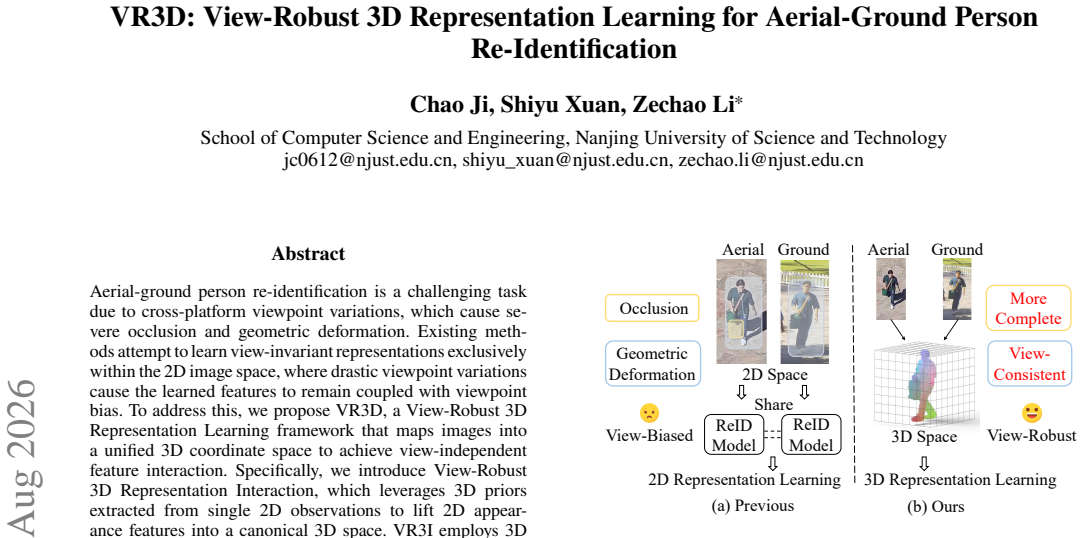
VR3D claims that by aligning 2D appearance with 3D voxels in a canonical space, aerial-ground person re-identification can be made robust to viewpoint changes.
Reviewed by Pith at T0; open to challenge. T0 means a machine referee read the full paper against a public rubric. the ladder, T0–T4 →
T0 review · deepseek-v4-flash
2026-08-04 03:14 UTC pith:RAZF2BND
load-bearing objection Interesting and solidly ablated 3D-lifting method for aerial-ground ReID with real gains; main weakness is unverified coordinate alignment in the 3D geometry prior. the 3 major comments →
VR3D: View-Robust 3D Representation Learning for Aerial-Ground Person Re-Identification
The pith
A machine-rendered reading of the paper's core claim, the machinery that carries it, and where it could break.
Core claim
VR3D's central claim is that mapping images from different viewpoints into a shared canonical 3D space, guided by single-image 3D reconstruction, reduces the viewpoint bias that limits 2D-only person re-identification. Concretely, the method lifts local 2D patch features into 3D using per-patch coordinates and camera pose, then computes attention between those patches and 3D voxels using both semantic correlation and a geometric bias based on physical distance. The resulting spatially grounded fused feature, together with the original 2D appearance feature and a global 3D structural feature, are aggregated by reliability-aware cross-attention. The paper reports state-of-the-art Rank-1 and mA
What carries the argument
The load-bearing mechanism is 3D Geometry-Semantic Attention (3D-GSA). It starts with a canonical 3D space populated by voxels and by 2D patches lifted through the transform P̂ = (P − T)R^T / s. Attention weights take the form Softmax(S + γG), where S is semantic correlation between patch and voxel features and G is a negative squared-distance geometric bias −||P̂_m − C_n||² / τ. Adding G forces patches to attend mainly to voxels belonging to the same body part in physical space, grounding appearance semantics in 3D structure. A second mechanism, Reliability-Aware Fusion (RAF), builds a view-conditioned routing query from the three feature streams plus a view-classification feature, and uses
Load-bearing premise
The whole approach rests on the assumption that single-image 3D reconstruction yields physically accurate 3D coordinates and voxels for people seen from extreme aerial and ground viewpoints, so that the geometric bias aligns the correct body parts.
What would settle it
Compare VR3D's performance when the 3D prior is replaced with ground-truth geometry (for example, from a synthetic dataset with known meshes) versus the current predicted geometry; a large performance gap would indicate the bottleneck is reconstruction quality. Alternatively, perturb the estimated camera pose or scale factor s during evaluation and measure the Rank-1 drop.
If this is right
- If the central claim is correct, 2D-only view-invariance strategies have an inherent ceiling imposed by viewpoint coupling, and 3D lifting offers a viable alternative.
- The reported improvements across synthetic (CARGO) and real-world (AG-ReID.v1, AG-ReID.v2) datasets indicate the advantage generalizes across different capture conditions.
- RAF's gains over average fusion show that adaptive reliability weighting is important: naively combining 2D and 3D features can be less effective than estimating each sample's trustworthiness.
- The method's success suggests that single-image 3D reconstruction, used as an offline preprocessing step, can bring practical benefits to cross-view retrieval systems.
- VR3D's superiority over generative-data-augmentation baselines implies that operating in 3D feature space may be more effective than synthesizing novel 2D views.
Where Pith is reading between the lines
- A natural extension the paper does not explore is a sensitivity analysis of the 3D prior: if the reconstructed coordinates are perturbed, how quickly does Rank-1 degrade? Such an analysis would reveal how much of the gain depends on reconstruction quality.
- The same 2D-3D spatial-grounding mechanism could transfer to other cross-view tasks, such as vehicle re-identification or drone-view object search, where single-image 3D priors are also obtainable; this is left implicit.
- Because the geometric bias term is a distance-based regularizer, it could be adapted to video input, using temporally tracked 3D positions to stabilize attention; the paper does not address video or temporal consistency.
- The offline reconstruction could be replaced by a jointly trained depth or volume predictor, making the whole pipeline end-to-end and potentially reducing reliance on a fixed pretrained model.
Editorial analysis
A structured set of objections, weighed in public.
Referee Report
Summary. The paper proposes VR3D, a framework for aerial-ground person re-identification that lifts 2D image features into a canonical 3D space using 3D priors from SAM3D and SAM3. The core contribution is View-Robust 3D Representation Interaction (VR3I), a 3D Geometry-Semantic Attention (3D-GSA) module that combines semantic correlation with a geometric bias computed from Euclidean distances between lifted 2D patch coordinates and 3D voxel centers. A Reliability-Aware Fusion (RAF) module adaptively aggregates the resulting 2D, fused, and 3D features. The method is evaluated on CARGO, AG-ReID.v1, and AG-ReID.v2, reporting state-of-the-art or improved results, e.g., 5.63% Rank-1 improvement on CARGO under A↔G. The paper includes ablations of 3D-GSA and RAF components, a hyperparameter analysis for the geometric weight, and qualitative visualizations of retrieval, attention, and routing weights.
Significance. If the reported results are reliable, the paper makes a meaningful contribution by demonstrating that 2D–3D feature interaction in a shared coordinate space can reduce the cross-view appearance gap in aerial-ground person re-identification. The idea of using a pretrained single-image 3D reconstructor to provide geometric grounding is timely, and the modular design (3D-GSA plus RAF) is well motivated. The ablation study is thorough and the visualizations of RAF routing and 3D-GSA attention support the internal consistency of the framework. However, the central claim rests on an unverified assumption about the shared coordinate frame and geometric accuracy of SAM3D, and the experimental evidence is weakened by single-run reporting with mostly quoted baselines. The work is potentially publishable but requires substantial strengthening of both the geometric validation and the experimental rigor.
major comments (3)
- [§View-Robust 3D Representation Interaction, Eq. (6)–(10)] The central 3D-GSA mechanism assumes that the lifted patch coordinates \hat{P}_m from Eq. (6) and the voxel centers C_n in Eq. (9) are expressed in the same coordinate frame with consistent units and origin. This is never stated or verified. SAM3D reconstructs each image independently, so the per-image scale s and pose parameters {R,T} will carry view-dependent errors; if those errors are large, the geometric bias G will align incorrect body parts and the attention in Eq. (7) will degrade toward the semantic correlation S. Table 5 does not resolve this issue, because both 'Geometry' and 'Geo.+Sem.' use the same estimated geometry. Please specify the exact coordinate conventions for C_n and \hat{P}_m, and provide a sensitivity analysis (e.g., perturbing s, R, T, or the person mask) to demonstrate that 3D-GSA tolerates reconstruction noise. On CARGO, where synthetic ground truth may be ava
- [§Supplementary Material, Fig. 10; §Method, Eq. (1)] The paper acknowledges in the supplementary visualization that SAM3D sometimes produces 'inaccurate 3D reconstruction' (CARGO example), and shows that RAF down-weights f3D in that case. However, the geometric bias G and the fused feature f_fuse are still computed through that same unverified geometry, so the failure is not isolated. The paper provides no reconstruction-quality metric, no comparison of estimated 3D coordinates to ground-truth body geometry, and no analysis of how mask errors from SAM3 affect the pipeline. Given that the view-robustness claim depends on the physical accuracy of the lifted coordinates, this is a load-bearing omission. Please quantify reconstruction errors (e.g., against SMPL fits or CARGO's synthetic meshes) and report how they affect Rank-1/mAP across samples.
- [§Experiments, Tables 1–3] All reported results are single runs without error bars, standard deviations, or significance tests, and most baselines are quoted from prior papers rather than re-evaluated under the same protocol (only ViSA is re-run). This is particularly problematic for Table 3 on AG-ReID.v2, where several improvements are small (e.g., A→C Rank-1 is 89.98 vs. 89.43 for ViSA, a 0.55% gap) and could easily lie within run-to-run variance. Please report mean±std over at least three seeds for the main tables and the key ablations, and either re-run the main competing methods under the same training setup or clearly state the differences in backbones and preprocessing. The current evidence for state-of-the-art status is plausible but not statistically supported.
minor comments (5)
- [Eq. (6)] The formula \hat{P}_m = (P_m - T) R^⊤ / s is ambiguous regarding row/column vector conventions and whether the scale factor should divide or multiply. Please clarify the orientation of R and the definition of s (e.g., whether s converts camera units to canonical voxel units).
- [Eq. (14), §Training Loss] The view loss L_view is said to consist of a view classification loss and an orthogonality loss, but neither is defined in the main text. Please provide the exact functional form, as this loss is part of the training objective and the disentanglement claim depends on it.
- [Table 1 footnote] The footnote says that only ViSA is re-evaluated and 'the remaining results are previously reported results.' Please specify which backbone and training settings were used for the ViSA re-evaluation, and list the version of the CARGO protocol used, so that readers can compare with the original papers.
- [Fig. 3 and Table 5] The hyperparameter analysis in Fig. 3 shows that γ=0.25 and γ=0.75 yield nearly identical values in some curves; please add a brief explanation or error bars to clarify whether these differences are meaningful. Also, in Table 5 the 'Coarse' row should clearly state whether it uses f2D+f3D or another feature combination, since the text is ambiguous.
- [General] The paper would benefit from a short discussion of the computational cost and runtime of the offline SAM3D/SAM3 pipeline, especially since the method is evaluated on large datasets (CARGO has over 100k images).
Circularity Check
No significant circularity: VR3D is an empirical 2D-3D interaction framework evaluated on external benchmarks with external 3D priors.
full rationale
VR3D's derivation chain is an empirical architecture plus benchmark evaluation, not a derivation in which outputs reduce to inputs. The 3D priors enter from external models SAM3 and SAM3D via Eq. (1), and the 2D encoder is the externally published VDT (Eq. 4). The geometric alignment in Eqs. (6)-(9) uses those external outputs; no parameter is fit to the reported test quantities and then renamed as a prediction. The claimed improvements (e.g., 5.63% Rank-1 on CARGO) are measured against independently published baselines on external benchmarks, with the only re-evaluation (ViSA) using released code. The paper does not invoke the present authors' prior work to justify its central premise; the view-robustness motivation is supported by an external citation (Shang, Das, and Ryoo 2022). The admitted sensitivity to SAM3D reconstruction quality (supplementary Fig. 10: 'inaccurate 3D reconstruction leads to a low weight for f3D') is a robustness concern about an external component, not a circular step. Therefore no circularity is present.
Axiom & Free-Parameter Ledger
free parameters (3)
- γ (geometric weight) =
0.5
- τ (distance temperature) =
0.03
- λ (view loss weight) =
not specified
axioms (3)
- domain assumption SAM3D's single-image 3D reconstruction supplies accurate canonical 3D coordinates and voxels for people under aerial-ground viewpoint changes.
- domain assumption 3D representations are intrinsically more viewpoint-robust than 2D representations for identity.
- domain assumption Previously reported baseline numbers in Tables 1-3 are comparable under the same protocols.
read the original abstract
Aerial-ground person re-identification is a challenging task due to cross-platform viewpoint variations, which cause severe occlusion and geometric deformation. Existing methods attempt to learn view-invariant representations exclusively within the 2D image space, where drastic viewpoint variations cause the learned features to remain coupled with viewpoint bias. To address this, we propose VR3D, a View-Robust 3D Representation Learning framework that maps images into a unified 3D coordinate space to achieve view-independent feature interaction. Specifically, we introduce View-Robust 3D Representation Interaction, which leverages 3D priors extracted from single 2D observations to lift 2D appearance features into a canonical 3D space. VR3I employs 3D Geometry-Semantic Attention to establish interactions between 2D patches and 3D voxels from corresponding body parts based on their 3D spatial locations, effectively grounding 2D semantics within a 3D framework. In addition, as the reliability of these representations varies across samples due to viewpoint changes and 3D reconstruction errors, we introduce Reliability-Aware Fusion, which estimates sample-specific reliability and adaptively aggregates the multi-source representations. Extensive experiments on three benchmark datasets (CARGO, AG-ReID.v1, and AG-ReID.v2) demonstrate that VR3D outperforms recent methods. For example, it achieves a 5.63% improvement in Rank-1 on CARGO. Our code will be released.
Figures


Reference graph
Works this paper leans on
-
[1]
The Fourteenth International Conference on Learning Representations , year=
Nicolas Carion and Laura Gustafson and Yuan-Ting Hu and Shoubhik Debnath and Ronghang Hu and Didac Suris Coll-Vinent and Chaitanya Ryali and Kalyan Vasudev Alwala and Haitham Khedr and Andrew Huang and Jie Lei and Tengyu Ma and Baishan Guo and Arpit Kalla and Markus Marks and Joseph Greer and Meng Wang and Peize Sun and Roman R. The Fourteenth Internation...
-
[2]
Proceedings of the IEEE/CVF Conference on Computer Vision and Pattern Recognition (CVPR) , month =
Chen, Xingyu and CHU, FU-JEN and Gleize, Pierre and Liang, Kevin J and Sax, Alexander and Tang, Hao and Wang, Weiyao and Guo, Michelle and Hardin, Thibaut and Li, Xiang and Lin, Aohan and Liu, Jia-Wei and Ma, Ziqi and Sagar, Anushka and Song, Bowen and Wang, Xiaodong and Yang, Jianing and Zhang, Bowen and Doll\'ar, Piotr and Gkioxari, Georgia and Feiszli,...
2026
-
[3]
2023 IEEE International Conference on Multimedia and Expo (ICME) , pages=
Aerial-ground person re-id , author=. 2023 IEEE International Conference on Multimedia and Expo (ICME) , pages=. 2023 , organization=
2023
-
[4]
v2: Bridging aerial and ground views for person re-identification , author=
AG-ReID. v2: Bridging aerial and ground views for person re-identification , author=. IEEE Transactions on Information Forensics and Security , volume=. 2024 , publisher=
2024
-
[5]
Proceedings of the IEEE/CVF Conference on Computer Vision and Pattern Recognition , pages=
View-decoupled transformer for person re-identification under aerial-ground camera network , author=. Proceedings of the IEEE/CVF Conference on Computer Vision and Pattern Recognition , pages=
-
[6]
2025 IEEE International Conference on Multimedia and Expo (ICME) , pages=
Dynamic Token Selective Transformer for Aerial-Ground Person Re-Identification , author=. 2025 IEEE International Conference on Multimedia and Expo (ICME) , pages=. 2025 , organization=
2025
-
[7]
Proceedings of the IEEE/CVF Conference on Computer Vision and Pattern Recognition , pages=
SeCap: self-calibrating and adaptive prompts for cross-view person re-identification in aerial-ground networks , author=. Proceedings of the IEEE/CVF Conference on Computer Vision and Pattern Recognition , pages=
-
[8]
Proceedings of the IEEE/CVF International Conference on Computer Vision , pages=
Bridging the sky and ground: Towards view-invariant feature learning for aerial-ground person re-identification , author=. Proceedings of the IEEE/CVF International Conference on Computer Vision , pages=
-
[9]
Proceedings of the IEEE/CVF Conference on Computer Vision and Pattern Recognition , pages=
View-Aware Semantic Alignment for Aerial-Ground Person Re-Identification , author=. Proceedings of the IEEE/CVF Conference on Computer Vision and Pattern Recognition , pages=
-
[10]
Proceedings of the AAAI Conference on Artificial Intelligence , volume=
Semantic-Driven Visual Progressive Refinement for Aerial-Ground Person ReID: A Challenging Large-Scale Benchmark , author=. Proceedings of the AAAI Conference on Artificial Intelligence , volume=
-
[11]
IEEE Transactions on Image Processing , year=
SD-ReID: View-aware Stable Diffusion for Aerial-Ground Person Re-Identification , author=. IEEE Transactions on Image Processing , year=
-
[12]
arXiv preprint arXiv:2604.26520 , year=
3D-LENS: A 3D Lifting-based Elevated Novel-view Synthesis method for Single-View Aerial-Ground Re-Identification , author=. arXiv preprint arXiv:2604.26520 , year=
-
[13]
IEEE transactions on neural networks and learning systems , volume=
Parameter-Efficient Person Re-Identification in the 3D Space , author=. IEEE transactions on neural networks and learning systems , volume=
-
[14]
Proceedings of the IEEE/CVF conference on computer vision and pattern recognition , pages=
Learning 3d shape feature for texture-insensitive person re-identification , author=. Proceedings of the IEEE/CVF conference on computer vision and pattern recognition , pages=
-
[15]
Proceedings of the IEEE/CVF international conference on computer vision , pages=
Learning clothing and pose invariant 3d shape representation for long-term person re-identification , author=. Proceedings of the IEEE/CVF international conference on computer vision , pages=
-
[16]
Proceedings of the IEEE/CVF Conference on Computer Vision and Pattern Recognition , pages=
Seas: Shape-aligned supervision for person re-identification , author=. Proceedings of the IEEE/CVF Conference on Computer Vision and Pattern Recognition , pages=
-
[17]
Proceedings of the IEEE/CVF international conference on computer vision , pages=
Transreid: Transformer-based object re-identification , author=. Proceedings of the IEEE/CVF international conference on computer vision , pages=
-
[18]
Proceedings of the AAAI conference on artificial intelligence , volume=
Clip-reid: exploiting vision-language model for image re-identification without concrete text labels , author=. Proceedings of the AAAI conference on artificial intelligence , volume=
-
[19]
Proceedings of the IEEE/CVF Conference on Computer Vision and Pattern Recognition , pages=
Instruct-reid: A multi-purpose person re-identification task with instructions , author=. Proceedings of the IEEE/CVF Conference on Computer Vision and Pattern Recognition , pages=
-
[20]
Proceedings of the Computer Vision and Pattern Recognition Conference , pages=
From poses to identity: Training-free person re-identification via feature centralization , author=. Proceedings of the Computer Vision and Pattern Recognition Conference , pages=
-
[21]
Proceedings of the AAAI Conference on Artificial Intelligence , volume=
Hierarchical prompt learning for image-and text-based person re-identification , author=. Proceedings of the AAAI Conference on Artificial Intelligence , volume=
-
[22]
Proceedings of the IEEE/CVF conference on computer vision and pattern recognition , pages=
Part-based pseudo label refinement for unsupervised person re-identification , author=. Proceedings of the IEEE/CVF conference on computer vision and pattern recognition , pages=
-
[23]
Proceedings of the IEEE/CVF International Conference on Computer Vision , pages=
Camera-driven representation learning for unsupervised domain adaptive person re-identification , author=. Proceedings of the IEEE/CVF International Conference on Computer Vision , pages=
-
[24]
IEEE Transactions on Information Forensics and Security , year=
Breaking the paired sample barrier in person re-identification: Leveraging unpaired samples for domain generalization , author=. IEEE Transactions on Information Forensics and Security , year=
-
[25]
Proceedings of the Computer Vision and Pattern Recognition Conference , pages=
Idea: Inverted text with cooperative deformable aggregation for multi-modal object re-identification , author=. Proceedings of the Computer Vision and Pattern Recognition Conference , pages=
-
[26]
Proceedings of the 31st ACM International Conference on Multimedia , pages=
Ground-to-aerial person search: Benchmark dataset and approach , author=. Proceedings of the 31st ACM International Conference on Multimedia , pages=
-
[27]
Proceedings of the Computer Vision and Pattern Recognition Conference , pages=
Ag-vpreid: A challenging large-scale benchmark for aerial-ground video-based person re-identification , author=. Proceedings of the Computer Vision and Pattern Recognition Conference , pages=
-
[28]
arXiv preprint arXiv:2503.23722 , year=
Latex: Leveraging attribute-based text knowledge for aerial-ground person re-identification , author=. arXiv preprint arXiv:2503.23722 , year=
-
[29]
Advances in Neural Information Processing Systems , volume=
Learning viewpoint-agnostic visual representations by recovering tokens in 3d space , author=. Advances in Neural Information Processing Systems , volume=
-
[30]
Proceedings of the IEEE/CVF conference on computer vision and pattern recognition workshops , pages=
Bag of tricks and a strong baseline for deep person re-identification , author=. Proceedings of the IEEE/CVF conference on computer vision and pattern recognition workshops , pages=
-
[31]
Proceedings of the 26th ACM international conference on Multimedia , pages=
Learning discriminative features with multiple granularities for person re-identification , author=. Proceedings of the 26th ACM international conference on Multimedia , pages=
-
[32]
International Conference on Learning Representations , year=
An Image is Worth 16x16 Words: Transformers for Image Recognition at Scale , author=. International Conference on Learning Representations , year=
-
[33]
International conference on machine learning , pages=
Learning transferable visual models from natural language supervision , author=. International conference on machine learning , pages=. 2021 , organization=
2021
-
[34]
arXiv preprint arXiv:2501.12202 , year=
Hunyuan3d 2.0: Scaling diffusion models for high resolution textured 3d assets generation , author=. arXiv preprint arXiv:2501.12202 , year=
-
[35]
Proceedings of the IEEE/CVF conference on computer vision and pattern recognition , pages=
High-resolution image synthesis with latent diffusion models , author=. Proceedings of the IEEE/CVF conference on computer vision and pattern recognition , pages=
-
[36]
arXiv preprint arXiv:2508.09071 , year=
Geovla: Empowering 3d representations in vision-language-action models , author=. arXiv preprint arXiv:2508.09071 , year=
-
[37]
arXiv preprint arXiv:2606.02274 , year=
Dexterity-BEV: Aligning 3D World and Actions for Generalizable Robot Policies Learning , author=. arXiv preprint arXiv:2606.02274 , year=
-
[38]
Proceedings of The 8th Conference on Robot Learning , pages =
3D Diffuser Actor: Policy Diffusion with 3D Scene Representations , author =. Proceedings of The 8th Conference on Robot Learning , pages =. 2025 , editor =
2025
-
[39]
Proceedings of the IEEE/CVF Conference on Computer Vision and Pattern Recognition , pages=
NPTFace: Native Pose-aligned Transformer for Face Recognition , author=. Proceedings of the IEEE/CVF Conference on Computer Vision and Pattern Recognition , pages=
-
[40]
2025 IEEE 19th International Conference on Automatic Face and Gesture Recognition (FG) , pages=
2D-3D Attention and Entropy for Pose Robust 2D Facial Recognition , author=. 2025 IEEE 19th International Conference on Automatic Face and Gesture Recognition (FG) , pages=. 2025 , organization=
2025
-
[41]
Proceedings of the IEEE/CVF Conference on Computer Vision and Pattern Recognition , pages=
Geo2: Geometry-Guided Cross-view Geo-Localization and Image Synthesis , author=. Proceedings of the IEEE/CVF Conference on Computer Vision and Pattern Recognition , pages=
-
[42]
Proceedings of the 31st ACM international conference on multimedia , pages=
Fastreid: A pytorch toolbox for general instance re-identification , author=. Proceedings of the 31st ACM international conference on multimedia , pages=
discussion (0)
Sign in with ORCID, Apple, or X to comment. Anyone can read and Pith papers without signing in.