REVIEW 2 major objections 3 minor 24 references
AccelNet: Exact backward-compatible acceleration of polynomial angular descriptors through Cartesian moment factorization
T0 review · 2 major / 3 minor · reviewed 2026-08-05 · deepseek-v4-flash
Pith's one-line read AccelNet shows that polynomial angular descriptors used by trained aenet and n2p2 neural-network potentials are exactly equal to one-neighbor Cartesian moment contractions, and uses this identity to accelerate molecular-dynamics evaluations
desk verdict A clean, exact algebraic reformulation of standard angular descriptors that does what it claims; the n2p2 drop-in claim is slightly broader than the tests support. read the letter →
The pith
A machine-rendered reading of the paper's core claim, the machinery that carries it, and where it could break.
The reading
What carries the argument
The Cartesian moment factorization identity. For $P(c)=\sum_{p=0}^{P_{\max}} a_p c^p$ with $c_{ijk}=u_{ij}\cdot u_{ik}$, the descriptor $G_{i\gamma}=\sum_{j<k} h_{ij}^{(\gamma)} h_{ik}^{(\gamma)} P(c_{ijk})$ equals $\frac{1}{2}\left[\sum_p a_p \sum_{\ell_x+\ell_y+\ell_z=p} \frac{p!}{\ell_x!\ell_y!\ell_z!}(M_{i,\ell}^{(\gamma)})^2 - P(1)D_i^{(\gamma)}\right]$. This replaces $O(z_i^2)$ neighbor-pair enumeration with $O(z_i)$ moment accumulation, while the contraction step costs depend on the polynomial degree but not on the neighbor count.
What would settle it
Load a supported n2p2 model with positive-integer angular symmetry functions and compare AccelNet's moment path against n2p2 at full double precision on configurations with all species channels active; any energy or force difference above about $10^{-12}$ eV or eV/Å would show a compatibility gap not visible in LAMMPS output precision. Likewise, evaluate an aenet Chebyshev model with angular order beyond four and compare descriptor derivatives against direct pair-sum evaluation.
Extended reading notes
Core claim
For angular descriptors of the form $G_{i\gamma}=\sum_{j<k} h_{ij}^{(\gamma)} h_{ik}^{(\gamma)} P(c_{ijk})$ with $P$ a finite polynomial and $c_{ijk}=u_{ij}\cdot u_{ik}$, the unordered neighbor-pair sum is exactly equal to the moment contraction $\frac{1}{2}\left[\sum_p a_p \sum_{\ell_x+\ell_y+\ell_z=p} \frac{p!}{\ell_x!\ell_y!\ell_z!}(M_{i,\ell}^{(\gamma)})^2 - P(1)D_i^{(\gamma)}\right]$, where $M_{i,\ell}^{(\gamma)}=\sum_j h_{ij}^{(\gamma)} u_{ij,x}^{\ell_x}u_{ij,y}^{\ell_y}u_{ij,z}^{\ell_z}$ and $D_i^{(\gamma)}=\sum_j (h_{ij}^{(\gamma)})^2$. No approximation enters; only the summation order changes. The paper applies this identity to the Artrith–Urban–Ceder Chebyshev angular descriptor us
Load-bearing premise
That the three tested models (H2O Chebyshev, TiO2 Chebyshev, and TiO2 n2p2) exercise every descriptor, scaling, and network convention a supported aenet or n2p2 model can use, so the roundoff-level agreement extends to all compatible models.
Editorial extensions
If this is right
- Existing trained aenet and n2p2 models can be run through AccelNet in LAMMPS without retraining or refitting, with energies and forces preserving their original values to roundoff.
- The speedup from moment evaluation grows with local neighbor count relative to polynomial degree, so dense environments with large cutoffs benefit most.
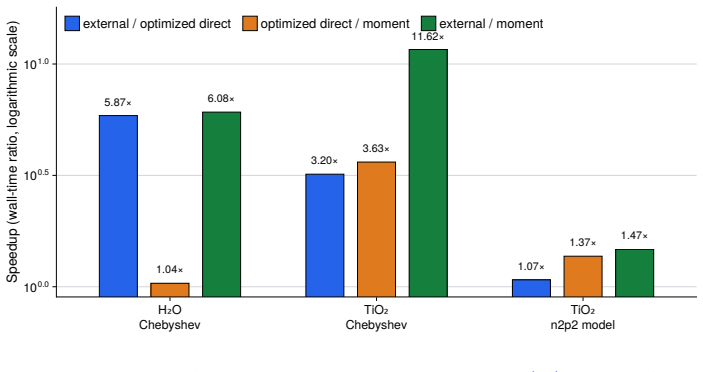
- For the supported n2p2 polynomial angular functions, moment evaluation is 1.371 times faster than the optimized direct path even when the reference is an independently optimized modern implementation.
- Angular functions that do not satisfy the separability or polynomial conditions are detected and evaluated directly, so unsupported terms never change the model's semantics.
- The direct-versus-moment crossover is model-dependent; AccelNet's automatic policy is a heuristic threshold, not a universal optimal point.
Reading between the lines
- The same factorization should apply to any legacy angular descriptor whose angle dependence is a finite polynomial in $\cos\theta$ with separable one-neighbor weights, so other radial/angle symmetry-function families may also have hidden finite-rank structure exploitable without refitting.
- The identity is the same kind of density trick used by moment tensor potentials and atomic cluster expansions, which suggests that other existing descriptor families could be reformulated as internally evaluated moments rather than as new fitted bases.
- A production code could extend AccelNet's static crossover by routing per atom or per frame based on instantaneous neighbor counts, which the paper does not implement.
- The 3.629x factor is for a single core; combining the moment formulation with multi-core or GPU neighbor loops may yield larger end-to-end gains in production simulations.
Editorial analysis
A structured set of objections, weighed in public.
Referee Report
Summary. This paper derives an exact algebraic identity for angular descriptor components of the form of Eq. (15), where the angular kernel is a finite polynomial of cos(theta) and the remaining weight factorizes into one-neighbor terms. Under these conditions, the unordered pair sum is shown to equal one-half the contraction of one-neighbor Cartesian moments (Eq. (23)) minus a diagonal self-term. The multinomial expansion in Eq. (18) is correct, as are the specializations to the aenet Chebyshev descriptor (Eq. (28)) and to n2p2 wide angular functions with integer zeta (Eq. (36)), including species masks, the 1/(1+delta) normalization, and the (1+lambda)^zeta self-term subtraction. The authors implement this in the AccelNet inference engine, read trained aenet and n2p2 models, and validate energies and forces against the external packages and by finite differences. Single-core LAMMPS benchmarks carefully decompose the observed speedup into engine and algorithmic contributions; the moment algorithm is 3.629x faster than optimized direct evaluation for the dense TiO2 Chebyshev model and 1.371x faster for the TiO2 n2p2 model.
Significance. If the breadth claims can be supported, this is a practically valuable contribution: it accelerates existing trained neural-network potentials without retraining, with an exactness guarantee that is established algebraically rather than by fitting. The derivation is self-contained and parameter-free, the timing decomposition in Eq. (49) is honest about which gains come from the algorithm and which from the implementation, and the open-source release of the code, converters, and LAMMPS interfaces strengthens reproducibility. The main evidential weakness is the narrowness of the external verification for n2p2: the central exact identity is proved, but the claim that AccelNet is a drop-in evaluator across the full advertised set of n2p2 conventions is supported by only one end-to-end model and by output-precision-limited comparisons.
major comments (2)
- [Section 4.1 vs Section 3.2, Table 2] The paper claims support for n2p2 symmetry-function types 2, 3, and 9, cutoff types 0-8 plus the fractional cutoff, documented scaling modes, energy normalization, atomic reference energies, global or element-specific topologies, and normalize_nodes. The only end-to-end n2p2 comparison in Table 2 is a single 192-atom TiO2 model with 16 type-2 radial and 54 type-9 angular functions. No end-to-end test is reported for other cutoff types, other scaling modes, normalize_nodes enabled, element-specific topologies, or type-3 functions. The descriptor-level tests in Section 3.3 are useful but do not exercise the full model-loading, descriptor-ordering, and network-weight path. Because exact backward compatibility is the central claim, this breadth gap is load-bearing. I would be satisfied either by adding a small compatibility matrix of n2p2 models covering these conventions or by explicitly re
- [Abstract and Section 3.2, Table 2] The abstract states that AccelNet reproduces descriptors, energies, and forces to floating-point roundoff, while Section 3.2 reports for the n2p2 model that the comparisons agree at the precision of LAMMPS log and dump files. The zero entries in Table 2 therefore do not demonstrate full machine-precision agreement for the n2p2 path; they only show agreement at the printed precision. This is a weaker statement than the abstract makes. The Chebyshev rows, with force differences around 1e-14 eV/A, do support the roundoff wording, but the n2p2 comparison should either be repeated with higher-precision output (for example, many-digit ASCII output) or the claim should be qualified as holding to the printed precision for this model.
minor comments (3)
- [Section 4.5] The sentence 'The H2O and Chebyshev TiO2 systems were propagated with NVE integration and canonical stochastic velocity rescaling at 300 K' combines two incompatible ensembles. Please clarify whether the thermostat is applied after NVE integration or whether these are separate protocols.
- [Section 4.4] Minor typo: 'A n2p2 model is specified' should read 'An n2p2 model is specified.'
- [Section 3.1 / Table 1] The phrase 'second-generation TiO2 model' is vague; replacing it with 'the n2p2 TiO2 model' would make the table and surrounding text easier to follow.
Circularity Check
No significant circularity: the moment factorization is a self-contained algebraic identity, and the backward-compatibility/speedup claims rest on external comparisons and empirical timing.
full rationale
The central derivation (Sections 2.3–2.5) is an exact algebraic reformulation of the descriptor definitions. Eq. (23) follows from the multinomial expansion Eq. (18), the ordered-pair sum Eq. (20), and the self-term subtraction Eqs. (21)–(22); no parameter is fitted and no target result is assumed. The n2p2 wide angular function is reduced to Eq. (36) using the polynomial expansion Eq. (32) and species-resolved moments, with the 1/(1+δ) factor and self-term handled explicitly. The backward-compatibility claim is verified against external ænet and n2p2 implementations (Table 2), and the paper explicitly separates engine gains from moment-algorithm gains via Eq. (49), so the measured speedups are empirical rather than constructed by definition. Section 6.5 states the applicability limits (finite polynomial in cosθ, separable one-neighbor weights) and says unsupported terms remain on the direct evaluation path, which is an honest scoping statement rather than a circular escape. The only caveat is that n2p2 breadth is tested on one model at LAMMPS output precision; that is a verification-breadth concern, not circularity. No load-bearing self-citation or imported uniqueness theorem appears in the derivation chain.
Assumptions & free parameters
assumptions (5)
- standard math Multinomial theorem expansion of dot-product powers, Eq. (18).
- standard math Chebyshev polynomials have finite degree n and satisfy the recurrence used in Eq. (27), with T_n(1)=1.
- domain assumption The aenet Chebyshev angular descriptor and the supported n2p2 wide angular function are exactly represented by Eq. (15) with no r_jk dependence and separable one-neighbor weights.
- domain assumption The external aenet and n2p2 implementations provide the correct reference descriptor, energy, and force values for the test models.
- domain assumption Benchmark hardware, compiler, and simulation settings are representative and correctly configured.
Cite this review
Pith. "Pith review of AccelNet: Exact backward-compatible acceleration of polynomial angular descriptors through Cartesian moment factorization." pith.science (2026). https://pith.science/paper/W57R5FSO
@misc{pith2026260803280,
  author       = {Pith},
  title        = {Pith review of: AccelNet: Exact backward-compatible acceleration of polynomial angular descriptors through Cartesian moment factorization},
  year         = {2026},
  howpublished = {\url{https://pith.science/paper/W57R5FSO}},
  note         = {Machine review of arXiv:2608.03280}
}
abstract
We present AccelNet, an exact, backward-compatible method for accelerating existing trained aenet and n2p2 neural-network potentials without retraining. For angular terms with separable one-neighbor weights and a finite polynomial dependence on $\cos \theta$, the method exploits their hidden finite-rank structure to replace explicit neighbor-pair loops by one-neighbor Cartesian moments. AccelNet reads models trained with either package and reproduces their descriptors, energies, and analytic forces to floating-point roundoff. We verified this equivalence for H$_2$O and TiO$_2$ models and tested the resulting potentials in LAMMPS molecular-dynamics simulations. The implementation, model-conversion tools, and LAMMPS interfaces are released as open-source software.
Figures

Reference graph
Works this paper leans on
-
[1]
A. Rahman, Correlations in the motion of atoms in liquid argon, Physical Review 136 (2A) (1964) A405–A411.doi:10.1103/PhysRev.136.A405
-
[2]
F. H. Stillinger, T. A. Weber, Computer simulation of local order in condensed phases of silicon, Physical Review B 31 (8) (1985) 5262–5271. doi:10.1103/PhysRevB.31.5262
-
[3]
W. D. Cornell, P. Cieplak, C. I. Bayly, I. R. Gould, K. M. Merz, D. M. Ferguson, D. C. Spellmeyer, T. Fox, J. W. Caldwell, P. A. Kollman, A second generation force field for the simulation of proteins, nucleic acids, and organic molecules, Journal of the American Chemical Society 117 (19) (1995) 5179–5197.doi:10.1021/ja00124a002
-
[4]
R. Car, M. Parrinello, Unified approach for molecular dynamics and density-functional theory, Physical Review Letters 55 (22) (1985) 2471– 2474.doi:10.1103/PhysRevLett.55.2471
-
[5]
J. Behler, M. Parrinello, Generalized neural-network representation of high-dimensional potential-energy surfaces, Physical Review Letters 98 (14) (2007) 146401.doi:10.1103/PhysRevLett.98.146401
-
[6]
A. P. Bartok, M. C. Payne, R. Kondor, G. Csanyi, Gaussian ap- proximation potentials: The accuracy of quantum mechanics, with- out the electrons, Physical Review Letters 104 (13) (2010) 136403. doi:10.1103/PhysRevLett.104.136403
- [7]
-
[8]
I. Batatia, et al., A foundation model for atomistic materials chemistry, The Journal of Chemical Physics 163 (18) (2025) 184110.doi:10.1063/ 5.0297006
work page 2025
Show all 24 references
- [9]
-
[10]
Behler, Atom-centered symmetry functions for constructing high- dimensional neural network potentials, The Journal of Chemical Physics 134 (7) (2011) 074106.doi:10.1063/1.3553717
J. Behler, Atom-centered symmetry functions for constructing high- dimensional neural network potentials, The Journal of Chemical Physics 134 (7) (2011) 074106.doi:10.1063/1.3553717
2011 doi
- [11]
-
[12]
Artrith, A
N. Artrith, A. Urban, An implementation of artificial neural-network potentials for atomistic materials simulations: Performance for TiO2, Computational Materials Science 114 (2016) 135–150.doi:10.1016/j. commatsci.2015.11.047
2016 doi
-
[13]
Singraber, J
A. Singraber, J. Behler, C. Dellago, Library-based LAMMPS imple- mentation of high-dimensional neural network potentials, Journal of Chemical Theory and Computation 15 (3) (2019) 1827–1840. doi: 10.1021/acs.jctc.8b00770
2019 doi
-
[14]
Singraber, T
A. Singraber, T. Morawietz, J. Behler, C. Dellago, Parallel multi- stream training of high-dimensional neural network potentials, Jour- nal of Chemical Theory and Computation 15 (5) (2019) 3075–3092. doi:10.1021/acs.jctc.8b01092
2019 doi
-
[15]
M. S. Chen, T. Morawietz, H. Mori, T. E. Markland, N. Artrith, AENET- LAMMPS and AENET-TINKER: Interfaces for accurate and efficient molecular dynamics simulations with machine learning potentials, The 26 Journal of Chemical Physics 155 (7) (2021) 074801.doi:10.1063/5. 0063880
2021 doi
-
[16]
Y. Zuo, C. Chen, X. Li, Z. Deng, Y. Chen, J. Behler, G. Csányi, A. V. Shapeev, A. P. Thompson, M. A. Wood, S. P. Ong, Performance and cost assessment of machine learning interatomic potentials, The Journal of Physical Chemistry A 124 (4) (2020) 731–745.doi:10.1021/acs.jpca. 9b08723
2020 doi
-
[17]
S. R. Xie, M. Rupp, R. G. Hennig, Ultra-fast interpretable machine- learning potentials, npj Computational Materials 9 (2023) 162.doi: 10.1038/s41524-023-01092-7
2023 doi
-
[18]
Artrith, A
N. Artrith, A. Urban, G. Ceder, Efficient and accurate machine-learning interpolation of atomic energies in compositions with many species, Physical Review B 96 (1) (2017) 014112.doi:10.1103/PhysRevB.96. 014112
2017 doi
-
[19]
Plimpton, Fast parallel algorithms for short-range molecular dynamics, Journal of Computational Physics 117 (1) (1995) 1–19.doi:10.1006/ jcph.1995.1039
S. Plimpton, Fast parallel algorithms for short-range molecular dynamics, Journal of Computational Physics 117 (1) (1995) 1–19.doi:10.1006/ jcph.1995.1039
1995
-
[20]
A. V. Shapeev, Moment tensor potentials: A class of systematically improvable interatomic potentials, Multiscale Modeling & Simulation 14 (3) (2016) 1153–1173.doi:10.1137/15M1054183
2016 doi
-
[21]
Drautz, Atomic cluster expansion for accurate and transferable in- teratomic potentials, Physical Review B 99 (1) (2019) 014104
R. Drautz, Atomic cluster expansion for accurate and transferable in- teratomic potentials, Physical Review B 99 (1) (2019) 014104. doi: 10.1103/PhysRevB.99.014104
2019 doi
-
[22]
Dusson, M
G. Dusson, M. Bachmayr, G. Csanyi, R. Drautz, S. Etter, C. van der Oord, C. Ortner, Atomic cluster expansion: Completeness, efficiency and stability, Journal of Computational Physics 454 (2022) 110946. doi:10.1016/j.jcp.2022.110946
2022
-
[23]
Cheng, Cartesian atomic cluster expansion for machine learning interatomic potentials, npj Computational Materials 10 (2024) 157.doi: 10.1038/s41524-024-01332-4
B. Cheng, Cartesian atomic cluster expansion for machine learning interatomic potentials, npj Computational Materials 10 (2024) 157.doi: 10.1038/s41524-024-01332-4
2024 doi
-
[24]
H. Mori, T. Tsuru, M. Okumura, D. Matsunaka, Y. Shiihara, M. Itakura, Dynamic interaction between dislocations and obstacles in BCC iron 27 based on atomic potentials derived using neural networks, Physical Review Materials 7 (6) (2023) 063605.doi:10.1103/PhysRevMaterials. 7.0...
2023 doi
Reviewed August 5, 2026 · model on record in the stance chip above.
Discussion (0). Continue with ORCID to comment.