REVIEW 2 major objections 4 minor 126 references
How a bounding-box coordinate is tokenized is a major source of error in generative visual grounding, and splitting each coordinate into axis-specific hundreds, tens, and ones tokens largely fixes it under matched training.
Reviewed by Pith at T0; open to challenge. T0 means a machine referee read the full paper against a public rubric. the ladder, T0–T4 →
Representing bounding-box coordinates as axis-specific hundreds, tens, and ones tokens, plus a geometry-aware GRPO reward, improves generative visual grounding accuracy.
T0 review reviewed 2026-08-05 challenge →
load-bearing objection A genuinely useful coordinate-tokenization idea with a solid controlled comparison, temporarily undermined by an undefined evaluation split that makes the headline benchmark table internally inconsistent. the 2 major comments →
Hi-Token: Hierarchical Coordinate Tokenization for Generative Visual Grounding
The pith
A machine-rendered reading of the paper's core claim, the machinery that carries it, and where it could break.
The reading
Core claim
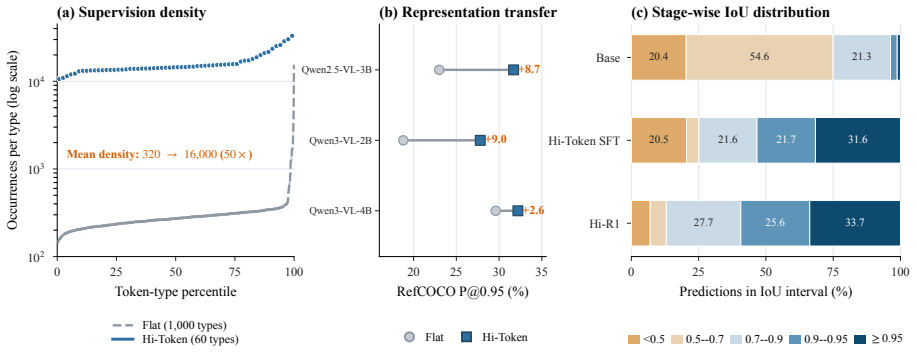
On its own terms, the discovery is that coordinate representation is a large, fixable source of error in generative visual grounding. Hi-Token quantizes each normalized coordinate to 0..999 and decomposes it into axis-specific hundreds, tens, and ones tokens, generating a box as 12 tokens from 60 types instead of 4 from 1,000; the model learns coarse region, refined interval, and final alignment as ordered decisions. Under identical backbone, data, optimizer, decoding, and evaluator, this alone raises RefCOCO mIoU, P@0.5, and P@0.95 by 14.1, 14.9, and 8.7 points over flat tokens. The gated Hi-GAR reward — IoU plus tiered coordinate checks and strict-IoU bonuses, off below 0.01 overlap — then
What carries the argument
The carrying object is the Hi-Token vocabulary: per axis, three digit-role token sets — hundreds, tens, ones — for x and for y, giving 60 coordinate types in place of 1,000 flat atomic tokens. The carrying identity is the decomposition tau_a^v = (w_h^a, w_t^a, w_o^a) after quantization I_v = floor(v(M-1)), M = 1000, turning one categorical prediction into three ordered ones and multiplying mean supervision density fiftyfold: (12N/60)/(4N/1000) = 50. On the optimization side, the gated reward R = lambda_fmt R_fmt + lambda_iou R_iou + I_gate (lambda_hier R_hier + lambda_bonus R_bonus) uses I_gate = 1{IoU > 0.01} to silence coordinate-level rewards for near-zero-overlap boxes. The paper ascribe
Load-bearing premise
The load-bearing premise is that the held-out evaluation split is fair and comparable to the baselines': the paper never defines exactly what "RefCOCO" means in its tables (merged testA+testB, their average, or a custom partition), and every reported gain and baseline comparison rests on that unstated protocol.
What would settle it
Train the same fixed-recipe, 80k-sample pipeline with Hi-Token's 60-type vocabulary but randomly permuted digit values within each level, so axis decoupling and supervision density survive while numerical order is destroyed. If P@0.95 stays near the 31.7 Hi-Token level, digit order is not the mechanism; if it sags toward the 23.0 flat-token level, the coarse-to-fine story is confirmed. Independently, re-running the matched Flat-versus-Hi-Token comparison on a precisely defined testA+testB split of RefCOCO would settle whether the headline 14.1/14.9/8.7-point gaps are real or an artifact of the
If this is right
- Coordinate format becomes a controllable training decision: with backbone, data, optimizer, decoding, and evaluator fixed, switching from flat location tokens to Hi-Token moves RefCOCO P@0.95 from 23.0 to 31.7, with similar gains in mIoU and P@0.5.
- The gain transfers across models: under the same fixed-recipe comparison, Hi-Token beats flat tokens by 8.7 points on Qwen2.5-VL-3B, 9.0 on Qwen3-VL-2B, and 2.6 on Qwen3-VL-4B, so the benefit is not an artifact of one backbone.
- Reward shaping can rescue coarse localization without regressing strict metrics: Hi-GAR reduces the IoU<0.5 mass from 20.5% to 7.0% and adds 11.9 mIoU points, while P@0.95 still rises 1.7 points — where IoU-only GRPO would drop P@0.95 to 30.3.
- The validity gate is load-bearing for the reward: removing it costs 3.9 mIoU points and 2.1 P@0.95 points, showing coordinate-level rewards must be suppressed when the predicted box barely overlaps the target.
- A 3B model trained on 80k grounding samples can lead the RefCOCO family on most reported columns, with inference latency effectively unchanged because the reward is used only during training.
Where Pith is reading between the lines
- The paper deliberately leaves the three candidate causes of its representation gain entangled — smaller vocabulary, axis decoupling, and digit-level order. My reading is that in this 80k-sample regime, reuse dominates: a matched 60-type flat vocabulary with permuted digit roles would directly test how much of the 8.7-point P@0.95 gain comes from numerical order at all.
- If representation is what carries grounding quality, the same 12-token decomposition should transfer to other continuous coordinate outputs in VLMs — detection boxes, OCR regions, keypoints. The fixed 1000-bin grid marks the current ceiling: small objects reach only 1.30 P@0.95, so adaptive or scale-conditioned grids are the natural next step.
- The stage-wise results carry an ordering signal: the representation alone added 8.7 P@0.95 points, while the reward added only 1.7. If that ordering holds, strict-threshold localization is set by how coordinates are expressed rather than by reward design, and further strict-metric gains may come cheaper from tokenization and data than from RL.
- The near-tens boundary shows no drop (+0.6 points) while the near-hundreds boundary drops 2.4 points, which hints that residual failures are coarse-region mistakes rather than fine rounding — suggesting a coarser anchoring mechanism, not finer digits, as the next improvement lever.
Editorial analysis
A structured set of objections, weighed in public.
Referee Report
Summary. The paper proposes Hi-Token, a coordinate representation that decomposes each normalized bounding-box coordinate into axis-specific hundreds/tens/ones tokens, and Hi-GAR, a GRPO reward combining box IoU, tiered coordinate verification, strict-IoU bonuses, and a validity gate. The method is evaluated on RefCOCO, RefCOCO+, and RefCOCOg with Qwen2.5-VL-3B and two Qwen3-VL backbones. The authors report that Hi-Token improves RefCOCO mIoU/P@0.5/P@0.95 by 14.1/14.9/8.7 points over a flat token baseline under matched training conditions, and that the full Hi-R1 model achieves the best value in eight of nine benchmark columns compared with specialist grounding models. The paper also provides supervision-density analyses, stage-wise IoU distributions, object-scale diagnostics, and an honest handling of an extra-tuning stress test.
Significance. If the benchmark numbers are measured on standard, comparable splits, the paper presents a useful and simple contribution: changing the output tokenization while keeping the architecture fixed produces substantial localization gains, and the proposed reward avoids the strict-metric regression seen with generic IoU-only RL. The matched Flat-versus-Hi-Token comparison in Table 2 and the explicit caveats about causal attribution are methodological strengths. The central reservation is that the evaluation split is undefined and the internal numbers are inconsistent, which prevents verification of the headline benchmark-level claims until this is resolved.
major comments (2)
- [Section 4.1 / Appendix A.4, Tables 1 and 10] The evaluation split for the RefCOCO family is never specified. Table 10's Base row (IoU intervals 20.4, 54.6, 21.3, 2.5, 1.2) implies P@0.5=79.6 and P@0.95=1.2 for Qwen2.5-VL-3B, but Table 1 reports the same model at P@0.5=60.2 and P@0.95=3.8. The Hi-R1 row likewise implies P@0.5=93.0 and P@0.95=33.7 versus 93.1 and 33.4 in Table 1. These are not rounding differences. Because Table 1 is the basis for the 'eight of nine columns' claim, the paper must state which split (testA, testB, merged testA+testB, or custom partition) is used for each table and make the benchmark comparison verifiable.
- [Section 4.3 / Table 1] The cross-model comparisons with Rex-Omni, VLM-R1, and GLM-family baselines are only valid if the evaluation split and coordinate conversion match those in the original publications. Appendix A.4 states only that 'the same parser and evaluator' is used for every compared model, not that the split matches the baselines' reported testA/testB protocol. If Hi-R1's numbers come from a merged or custom split while the cited baselines report conventional splits, the 'eight of nine' claim is not a valid comparison. Please report results separately for testA/testB (or justify why a merged split is comparable) and reconcile Table 10's implied P@0.5/P@0.95 with Table 1.
minor comments (4)
- [Section 3.2, Eq. (3)] The reconstruction formula is ambiguous as typeset: the numerator should be parenthesized as (100·val(w_h) + 10·val(w_t) + val(w_o)) / (M−1).
- [Section 1 / Related Work] Typo: 'LLaV A-style models' should be 'LLaVA-style models'.
- [Appendix A.1] Minor formatting: 'learning rate of 5×10 −6' has a missing space, and 'bfloat16' should be 'BF16' for consistency.
- [Table 4] The header row is confusing: 'Setting RefCOCO P@.95' is separated from the column labels 'mIoU P@.5 P@.95 RefCOCO+ RefCOCOg'. Please reformat so it is clear that the first group of columns refers to RefCOCO.
Circularity Check
No circularity: the claimed gains are empirical matched comparisons, not consequences of the definitions.
full rationale
The paper's central claims are controlled empirical comparisons. Table 2 compares Hi-Token SFT against a flat-token SFT baseline under the same backbone, 80k split, optimizer, schedule, decoding, and evaluator; the improvement (14.1 mIoU, 14.9 P@0.5, 8.7 P@0.95) is measured, not derived. Hi-GAR is an RL reward whose weights and thresholds are fixed a priori (Appendix A.3) rather than fitted to the test set; reporting P@0.5/P@0.95 after optimizing a reward that includes those thresholds is a normal training/evaluation loop, not a prediction that reduces to its own input. The 50x supervision-density ratio is an algebraic identity of the two tokenizations, but the paper explicitly labels it descriptive ('does not causally separate reuse from hierarchical position and axis-specific vocabularies'), so it is not used to manufacture a result. The only self-citation (Jiao et al. 2026, 'Smooth Operator') appears in related work and is not load-bearing. The undefined RefCOCO-family evaluation split is a reproducibility concern and should be corrected, but it is not circularity under the review's definitions.
Axiom & Free-Parameter Ledger
free parameters (5)
- Quantization resolution M =
1000
- Reward weights lambda_fmt, lambda_iou, lambda_hier, lambda_bonus =
0.5, 1.0, 0.5, 2.0
- Coordinate tolerances tau_h, tau_t, tau_o =
50, 10, 3 bins
- Strict-IoU milestone set and bonus weights =
M={0.5,0.9,0.95}
- Validity gate threshold =
0.01 IoU
axioms (4)
- domain assumption A standard autoregressive VLM can learn the 60-token axis-specific digit vocabulary with the same architecture and fine-tuning pipeline.
- domain assumption 1000-bin quantization of normalized coordinates is a sufficient representation for grounding accuracy across object scales.
- domain assumption The evaluation protocol is consistent with that used by the cited baselines, including an unspecified split for 'RefCOCO'.
- domain assumption Reward hyperparameters do not overfit the test sets.
Cite this review
Pith. "Pith review of Hi-Token: Hierarchical Coordinate Tokenization for Generative Visual Grounding." pith.science (2026). https://pith.science/paper/RGSRCDLC
@misc{pith2026260803471,
  author       = {Pith},
  title        = {Pith review of: Hi-Token: Hierarchical Coordinate Tokenization for Generative Visual Grounding},
  year         = {2026},
  howpublished = {\url{https://pith.science/paper/RGSRCDLC}},
  note         = {Machine review of arXiv:2608.03471}
}
read the original abstract
Generative Vision-Language Models (VLMs) commonly treat bounding-box coordinates as independent output symbols, leaving numerical order and axis semantics implicit. We identify this representation as an important source of error in visual grounding. Hi-Token encodes each coordinate with axis-specific tokens for the hundreds, tens, and ones digits, which adds coarse-to-fine structure and increases token reuse while retaining the existing VLM architecture. Hi-GAR complements this representation with a geometry-based reward for Group Relative Policy Optimization (GRPO), using box overlap and coordinate accuracy at multiple scales. Controlled comparisons under matched training conditions show that Hi-Token improves localization throughout the evaluated IoU range. Hi-GAR further reduces low-overlap predictions and is used only during training. Experiments on three VLM backbones and the RefCOCO family show consistent gains across models and benchmarks. Hi-R1 achieves higher values than strong specialist baselines on most reported metrics. Analyses of token frequency, digit boundaries, object scale, and IoU distributions explain the effects of coordinate representation and reward training. The results show that structured coordinate generation provides an effective approach to generative visual grounding.
Figures




Reference graph
Works this paper leans on
-
[1]
Aho and Jeffrey D
Alfred V. Aho and Jeffrey D. Ullman , title =. 1972
1972
-
[2]
Publications Manual , year = "1983", publisher =
1983
-
[3]
Ashok K. Chandra and Dexter C. Kozen and Larry J. Stockmeyer , year = "1981", title =. doi:10.1145/322234.322243
arXiv 1981
-
[4]
Scalable training of
Andrew, Galen and Gao, Jianfeng , booktitle=. Scalable training of
-
[5]
Dan Gusfield , title =. 1997
1997
-
[6]
Tetreault , title =
Mohammad Sadegh Rasooli and Joel R. Tetreault , title =. Computing Research Repository , volume =. 2015 , url =
2015
-
[7]
A Framework for Learning Predictive Structures from Multiple Tasks and Unlabeled Data , Volume =
Ando, Rie Kubota and Zhang, Tong , Issn =. A Framework for Learning Predictive Structures from Multiple Tasks and Unlabeled Data , Volume =. Journal of Machine Learning Research , Month = dec, Numpages =
-
[8]
arXiv preprint arXiv:2306.15195 , year=
Shikra: Unleashing multimodal llm's referential dialogue magic , author=. arXiv preprint arXiv:2306.15195 , year=
-
[9]
International Conference on Learning Representations , year=
Pix2seq: A Language Modeling Framework for Object Detection , author=. International Conference on Learning Representations , year=
-
[10]
arXiv preprint arXiv:2306.14824 , year=
Kosmos-2: Grounding multimodal large language models to the world , author=. arXiv preprint arXiv:2306.14824 , year=
-
[11]
Advances in Neural Information Processing Systems , volume=
Cogvlm: Visual expert for pretrained language models , author=. Advances in Neural Information Processing Systems , volume=
-
[12]
Ferret: Refer and Ground Anything Anywhere at Any Granularity , author=
-
[13]
European Conference on Computer Vision , pages=
Griffon: Spelling out all object locations at any granularity with large language models , author=. European Conference on Computer Vision , pages=. 2024 , organization=
2024
-
[14]
3D Gaussian Splatting for Real-Time Radiance Field Rendering , journal =
Kerbl, Bernhard and Kopanas, Georgios and Leimk. 3D Gaussian Splatting for Real-Time Radiance Field Rendering , journal =
-
[15]
Proceedings of the IEEE/CVF Conference on Computer Vision and Pattern Recognition (CVPR) , month =
Wu, Guanjun and Yi, Taoran and Fang, Jiemin and Xie, Lingxi and Zhang, Xiaopeng and Wei, Wei and Liu, Wenyu and Tian, Qi and Wang, Xinggang , title =. Proceedings of the IEEE/CVF Conference on Computer Vision and Pattern Recognition (CVPR) , month =. 2024 , pages =
2024
-
[16]
European Conference on Computer Vision , pages=
Citygaussian: Real-time high-quality large-scale scene rendering with gaussians , author=. European Conference on Computer Vision , pages=. 2025 , organization=
2025
-
[17]
arXiv preprint arXiv:2404.14249 , year=
CLIP-GS: CLIP-Informed Gaussian Splatting for Real-time and View-consistent 3D Semantic Understanding , author=. arXiv preprint arXiv:2404.14249 , year=
-
[18]
ECCV , year=
CompGS: Smaller and Faster Gaussian Splatting with Vector Quantization , author=. ECCV , year=
-
[19]
Proceedings of the IEEE/CVF Conference on Computer Vision and Pattern Recognition , pages=
Feature 3dgs: Supercharging 3d gaussian splatting to enable distilled feature fields , author=. Proceedings of the IEEE/CVF Conference on Computer Vision and Pattern Recognition , pages=
-
[20]
European Conference on Computer Vision (ECCV) , year=
Language-Driven Physics-Based Scene Synthesis and Editing via Feature Splatting , author=. European Conference on Computer Vision (ECCV) , year=
-
[21]
ECCV , year=
Gaussian Grouping: Segment and Edit Anything in 3D Scenes , author=. ECCV , year=
-
[22]
2024 , booktitle =
Fang, Jiemin and Wang, Junjie and Zhang, Xiaopeng and Xie, Lingxi and Tian, Qi , title =. 2024 , booktitle =
2024
- [23]
-
[24]
2024 , eprint=
SAM 2: Segment Anything in Images and Videos , author=. 2024 , eprint=
2024
-
[25]
arXiv preprint arXiv:2303.05499 , year=
Grounding dino: Marrying dino with grounded pre-training for open-set object detection , author=. arXiv preprint arXiv:2303.05499 , year=
-
[26]
2024 , eprint=
Grounded SAM: Assembling Open-World Models for Diverse Visual Tasks , author=. 2024 , eprint=
2024
-
[27]
Proceedings of the IEEE/CVF Conference on Computer Vision and Pattern Recognition (CVPR) , month =
Zhou, Hongyu and Shao, Jiahao and Xu, Lu and Bai, Dongfeng and Qiu, Weichao and Liu, Bingbing and Wang, Yue and Geiger, Andreas and Liao, Yiyi , title =. Proceedings of the IEEE/CVF Conference on Computer Vision and Pattern Recognition (CVPR) , month =. 2024 , pages =
2024
-
[28]
Proceedings of the IEEE/CVF Conference on Computer Vision and Pattern Recognition (CVPR) , month =
Qin, Minghan and Li, Wanhua and Zhou, Jiawei and Wang, Haoqian and Pfister, Hanspeter , title =. Proceedings of the IEEE/CVF Conference on Computer Vision and Pattern Recognition (CVPR) , month =. 2024 , pages =
2024
-
[29]
Proceedings of the IEEE/CVF Conference on Computer Vision and Pattern Recognition (CVPR) , month =
Shi, Jin-Chuan and Wang, Miao and Duan, Hao-Bin and Guan, Shao-Hua , title =. Proceedings of the IEEE/CVF Conference on Computer Vision and Pattern Recognition (CVPR) , month =. 2024 , pages =
2024
-
[30]
International Conference on Computer Vision (ICCV) , year =
Kerr, Justin* and Kim, Chung Min* and Goldberg, Ken and Kanazawa, Angjoo and Tancik, Matthew , title =. International Conference on Computer Vision (ICCV) , year =
-
[31]
Proceedings of the Winter Conference on Applications of Computer Vision (WACV) , month =
Chacko, Rohan and Haeni, Nicolai and Khaliullin, Eldar and Sun, Lin and Lee, Douglas , title =. Proceedings of the Winter Conference on Applications of Computer Vision (WACV) , month =. 2025 , pages =
2025
-
[32]
The Thirty-eighth Annual Conference on Neural Information Processing Systems , year=
OpenGaussian: Towards Point-Level 3D Gaussian-based Open Vocabulary Understanding , author=. The Thirty-eighth Annual Conference on Neural Information Processing Systems , year=
-
[33]
ECCV , year =
Pixel-GS: Density Control with Pixel-aware Gradient for 3D Gaussian Splatting , author =. ECCV , year =
-
[34]
arXiv preprint arXiv:2411.19290 , year=
SADG: Segment Any Dynamic Gaussian Without Object Trackers , author=. arXiv preprint arXiv:2411.19290 , year=
-
[35]
2023 , journal=
Segment Any 3D Gaussians , author=. 2023 , journal=
2023
-
[36]
2024 , eprint=
Semantic Gaussians: Open-Vocabulary Scene Understanding with 3D Gaussian Splatting , author=. 2024 , eprint=
2024
-
[37]
European Conference on Computer Vision , year=
Mini-Splatting: Representing Scenes with a Constrained Number of Gaussians , author=. European Conference on Computer Vision , year=
-
[38]
2024 , journal =
TRIPS: Trilinear Point Splatting for Real-Time Radiance Field Rendering , author=. 2024 , journal =
2024
-
[39]
arXiv preprint arXiv:2403.19615 , year=
SA-GS: Scale-Adaptive Gaussian Splatting for Training-Free Anti-Aliasing , author=. arXiv preprint arXiv:2403.19615 , year=
-
[40]
Proceedings of the IEEE/CVF Conference on Computer Vision and Pattern Recognition , pages=
Multi-scale 3d gaussian splatting for anti-aliased rendering , author=. Proceedings of the IEEE/CVF Conference on Computer Vision and Pattern Recognition , pages=
-
[41]
Qiu, Shi and Xie, Binzhu and Liu, Qixuan and Heng, Pheng-Ann , booktitle =. 2025 , volume =. doi:10.1109/AIxVR63409.2025.00039 , publisher =
arXiv 2025
-
[42]
Proceedings of the IEEE/CVF Conference on Computer Vision and Pattern Recognition , pages=
Drivinggaussian: Composite gaussian splatting for surrounding dynamic autonomous driving scenes , author=. Proceedings of the IEEE/CVF Conference on Computer Vision and Pattern Recognition , pages=
-
[43]
The Thirteenth International Conference on Learning Representations , year=
OmniRe: Omni Urban Scene Reconstruction , author=. The Thirteenth International Conference on Learning Representations , year=
-
[44]
Proceedings of the IEEE/CVF Conference on Computer Vision and Pattern Recognition (CVPR) , month =
Yang, Ziyi and Gao, Xinyu and Zhou, Wen and Jiao, Shaohui and Zhang, Yuqing and Jin, Xiaogang , title =. Proceedings of the IEEE/CVF Conference on Computer Vision and Pattern Recognition (CVPR) , month =. 2024 , pages =
2024
-
[45]
Proceedings of the IEEE/CVF Conference on Computer Vision and Pattern Recognition (CVPR) , month =
Huang, Yi-Hua and Sun, Yang-Tian and Yang, Ziyi and Lyu, Xiaoyang and Cao, Yan-Pei and Qi, Xiaojuan , title =. Proceedings of the IEEE/CVF Conference on Computer Vision and Pattern Recognition (CVPR) , month =. 2024 , pages =
2024
-
[46]
Proceedings of the IEEE Conference on Computer Vision and Pattern Recognition (CVPR) , year=
PointGroup: Dual-Set Point Grouping for 3D Instance Segmentation , author=. Proceedings of the IEEE Conference on Computer Vision and Pattern Recognition (CVPR) , year=
-
[47]
Zhao, Mengyang and Liu, Quan and Jha, Aadarsh and Deng, Ruining and Yao, Tianyuan and Mahadevan-Jansen, Anita and Tyska, Matthew J. and Millis, Bryan A. and Huo, Yuankai , title =. 2021 , isbn =. doi:10.1007/978-3-030-87589-3_45 , booktitle =
-
[48]
Proceedings of the IEEE/CVF International Conference on Computer Vision (ICCV) , month =
Kerr, Justin and Kim, Chung Min and Goldberg, Ken and Kanazawa, Angjoo and Tancik, Matthew , title =. Proceedings of the IEEE/CVF International Conference on Computer Vision (ICCV) , month =. 2023 , pages =
2023
-
[49]
European Conference on Computer Vision (ECCV) , year =
Anpei Chen and Zexiang Xu and Andreas Geiger and Jingyi Yu and Hao Su , title =. European Conference on Computer Vision (ECCV) , year =
-
[50]
Thirty-seventh Conference on Neural Information Processing Systems , year=
Weakly Supervised 3D Open-vocabulary Segmentation , author=. Thirty-seventh Conference on Neural Information Processing Systems , year=
-
[51]
Proceedings of the 38th International Conference on Machine Learning , pages =
Learning Transferable Visual Models From Natural Language Supervision , author =. Proceedings of the 38th International Conference on Machine Learning , pages =. 2021 , editor =
2021
-
[52]
and Tancik, Matthew and Barron, Jonathan T
Mildenhall, Ben and Srinivasan, Pratul P. and Tancik, Matthew and Barron, Jonathan T. and Ramamoorthi, Ravi and Ng, Ren , title =. 2021 , issue_date =. doi:10.1145/3503250 , journal =
doi:10.1145/3503250 2021
- [53]
-
[54]
and Kowalski, Marek and Johnson, Matthew and Shotton, Jamie and Valentin, Julien , title =
Garbin, Stephan J. and Kowalski, Marek and Johnson, Matthew and Shotton, Jamie and Valentin, Julien , title =. Proceedings of the IEEE/CVF International Conference on Computer Vision (ICCV) , month =. 2021 , pages =
2021
-
[55]
2022 , booktitle=
Plenoxels: Radiance Fields without Neural Networks , author=. 2022 , booktitle=
2022
-
[56]
DSEM-NeRF: Multimodal feature fusion and global–local attention for enhanced 3D scene reconstruction , journal =. 2025 , issn =. doi:https://doi.org/10.1016/j.inffus.2024.102752 , author =
-
[57]
Pumarola, Albert and Corona, Enric and Pons-Moll, Gerard and Moreno-Noguer, Francesc , booktitle=
-
[58]
Lin, Youtian , title =. 2024 , isbn =. doi:10.1609/aaai.v38i4.28138 , booktitle =
-
[59]
ICCV , year=
Mip-NeRF: A Multiscale Representation for Anti-Aliasing Neural Radiance Fields , author=. ICCV , year=
-
[60]
Conference on Computer Vision and Pattern Recognition (CVPR) , year =
Yu, Zehao and Chen, Anpei and Huang, Binbin and Sattler, Torsten and Geiger, Andreas , title =. Conference on Computer Vision and Pattern Recognition (CVPR) , year =
-
[61]
CVPR , year=
SuGaR: Surface-Aligned Gaussian Splatting for Efficient 3D Mesh Reconstruction and High-Quality Mesh Rendering , author=. CVPR , year=
-
[62]
arXiv preprint arXiv:2403.06908 , year=
FreGS: 3D Gaussian Splatting with Progressive Frequency Regularization , author=. arXiv preprint arXiv:2403.06908 , year=
- [63]
-
[64]
VastGaussian: Vast 3D Gaussians for Large Scene Reconstruction , author =. CVPR , year =
-
[65]
A Hierarchical Compression Technique for 3D Gaussian Splatting Compression , author=. 2025 , eprint=
work page 2025
-
[66]
arXiv preprint arXiv:2403.17898 , year=
Octree-gs: Towards consistent real-time rendering with lod-structured 3d gaussians , author=. arXiv preprint arXiv:2403.17898 , year=
-
[67]
Proceedings of the IEEE/CVF International Conference on Computer Vision , pages=
Matrixcity: A large-scale city dataset for city-scale neural rendering and beyond , author=. Proceedings of the IEEE/CVF International Conference on Computer Vision , pages=
-
[68]
Proceedings of the IEEE/CVF Conference on Computer Vision and Pattern Recognition (CVPR) , month =
Turki, Haithem and Ramanan, Deva and Satyanarayanan, Mahadev , title =. Proceedings of the IEEE/CVF Conference on Computer Vision and Pattern Recognition (CVPR) , month =. 2022 , pages =
work page 2022
-
[69]
A density-based algorithm for discovering clusters in large spatial databases with noise , year =
Ester, Martin and Kriegel, Hans-Peter and Sander, J\"". A density-based algorithm for discovering clusters in large spatial databases with noise , year =. Proceedings of the Second International Conference on Knowledge Discovery and Data Mining , pages =
-
[70]
doi:10.21105/joss.00205 , year =
Leland McInnes and John Healy and Steve Astels , title =. doi:10.21105/joss.00205 , year =
-
[71]
Xu and Jun-Mei Song and Mingchuan Zhang and Y
Zhihong Shao and Peiyi Wang and Qihao Zhu and R. Xu and Jun-Mei Song and Mingchuan Zhang and Y. K. Li and Yu Wu and Daya Guo , booktitle =. ArXiv , title =
-
[72]
Nature , volume=
Deepseek-r1 incentivizes reasoning in llms through reinforcement learning , author=. Nature , volume=. 2025 , publisher=
2025
-
[73]
Proceedings of the IEEE/CVF Conference on Computer Vision and Pattern Recognition (CVPR) , month =
Alvar, Saeed Ranjbar and Singh, Gursimran and Akbari, Mohammad and Zhang, Yong , title =. Proceedings of the IEEE/CVF Conference on Computer Vision and Pattern Recognition (CVPR) , month =. 2025 , pages =
2025
-
[74]
European conference on computer vision , pages=
Mmbench: Is your multi-modal model an all-around player? , author=. European conference on computer vision , pages=. 2024 , organization=
2024
-
[75]
2024 , eprint=
MME: A Comprehensive Evaluation Benchmark for Multimodal Large Language Models , author=. 2024 , eprint=
2024
-
[76]
arXiv preprint arXiv:2506.10967 , year=
Beyond Attention or Similarity: Maximizing Conditional Diversity for Token Pruning in MLLMs , author=. arXiv preprint arXiv:2506.10967 , year=
-
[77]
Proceedings of the IEEE/CVF Winter Conference on Applications of Computer Vision , year=
FairFace: Face Attribute Dataset for Balanced Race, Gender, and Age for Bias Measurement and Mitigation , author=. Proceedings of the IEEE/CVF Winter Conference on Applications of Computer Vision , year=
-
[78]
arXiv preprint arXiv:2411.19930 , year=
On Domain-Adaptive Post-Training for Multimodal Large Language Models , author=. arXiv preprint arXiv:2411.19930 , year=
-
[79]
arXiv preprint arXiv:2412.05271 , year=
Expanding Performance Boundaries of Open-Source Multimodal Models with Model, Data, and Test-Time Scaling , author=. arXiv preprint arXiv:2412.05271 , year=
-
[80]
arXiv preprint arXiv:2411.10442 , year=
Enhancing the Reasoning Ability of Multimodal Large Language Models via Mixed Preference Optimization , author=. arXiv preprint arXiv:2411.10442 , year=
This paper was first reviewed by deepseek-v4-flash on August 5, 2026.
discussion (0)
Sign in with ORCID, Apple, or X to comment. Anyone can read and Pith papers without signing in.