REVIEW 3 major objections 4 minor 53 references
Finite-spectrum Lorentz integral transform calculation of the $^{4}$He photoabsorption cross section in the no-core shell model
T0 review · 3 major / 4 minor · reviewed 2026-08-05 · deepseek-v4-flash
Pith's one-line read A finite-spectrum Lorentz integral transform built from explicitly computed 1^- eigenstates and E1 strengths recovers the 4He photoabsorption cross section, matching giant-dipole data and exposing Hamiltonian sensitivity at high energy.
desk verdict Finite-spectrum LIT is a genuinely useful incremental method, and the 4He Daejeon16 cross section is a solid benchmark; the high-energy shoulder is interesting but not fully pinned down because of inversion non-uniqueness. read the letter →
The pith
A machine-rendered reading of the paper's core claim, the machinery that carries it, and where it could break.
The reading
What carries the argument
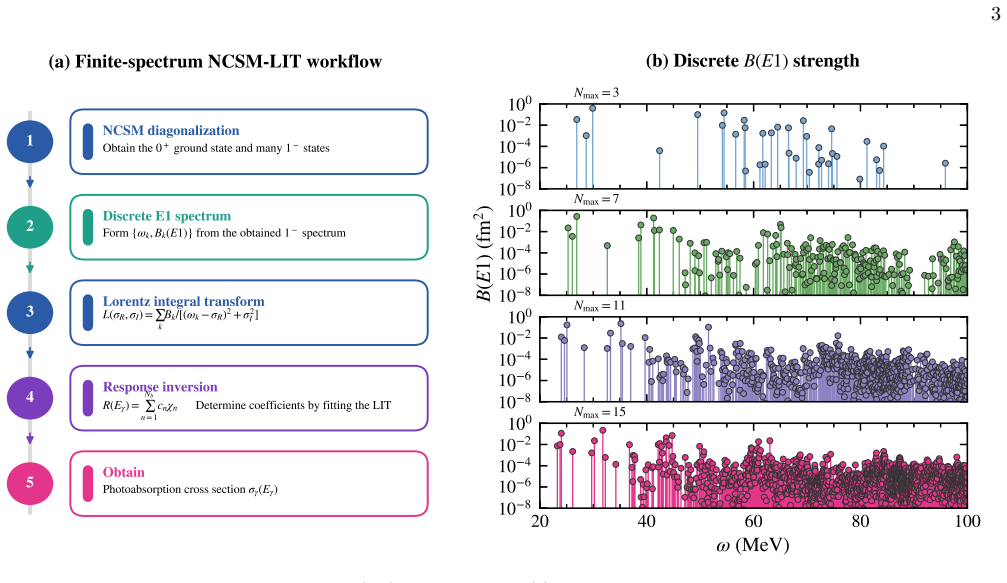
The load-bearing object is the finite-spectrum Lorentz integral transform: a Lorentz-smoothed sum over the explicitly computed NCSM 1^- excitation energies and E1 strengths, replacing the usual inhomogeneous-equation or Lanczos evaluation of the LIT. The inversion basis χ_n(E)=E^{3/2}exp[−E/(nβ)] with a non-negativity constraint converts this finite sum into a smooth response; its parameters (Nb, β, σ_I, and the excitation-energy cutoff ω_cut) are set inside stability plateaus identified through the fitting error, coefficient norm, peak position, and cutoff scans.
What would settle it
An independent ab initio continuum calculation using the same Daejeon16 Hamiltonian (for example, a direct treatment of the p+3H and n+3He channels) that disagrees with the inverted cross section beyond the quoted parameter-stability windows, or a high-precision measurement of the 4He(γ,p)3H and 4He(γ,n)3He channels from roughly 30 to 80 MeV that rules out the pronounced high-energy shoulder, would settle whether the finite-spectrum LIT reconstruction captures the true cross section.
Extended reading notes
Core claim
The central claim is that the finite-spectrum LIT is a controlled bridge between finite-basis ab initio spectral information and the continuum photonuclear response. Starting from NCSM eigenstates of 4He (0+ ground state and up to hundreds of 1^- states below an excitation-energy cutoff), the authors form the Lorentz transform as a sum over discrete E1 strengths, L(σ_R,σ_I)=Σ_k B_k(E1)/[(ω_k−σ_R)^2+σ_I^2], and invert it using a non-negative expansion in basis functions χ_n(E)=E^{3/2}e^{−E/(nβ)}. With parameters chosen inside identified stability windows (Nb=6, β=4 MeV, σ_I=20 MeV, ω_cut=100 MeV), the inverted cross section is stable against model-space size, oscillator frequency, cutoff, and
Load-bearing premise
The load-bearing assumption is that the inversion of the finite-spectrum LIT with the chosen basis and parameters returns the true continuum response, not merely a smooth curve that fits the finite discrete points; the stability scans and sum-rule checks support this but do not establish it by an independent continuum calculation.
Editorial extensions
If this is right
- A resolved finite E1 spectrum below a cutoff can serve as a controlled input for a continuum cross section, provided the Lorentz width and cutoff lie on a stability plateau.
- The inverted cross section preserves integrated E1 strength in the calculated window: the E1 polarizability and bremsstrahlung sum rule agree at subpercent level for Nmax ≥ 7, so such sum rules can serve as internal validation of future LIT inversions.
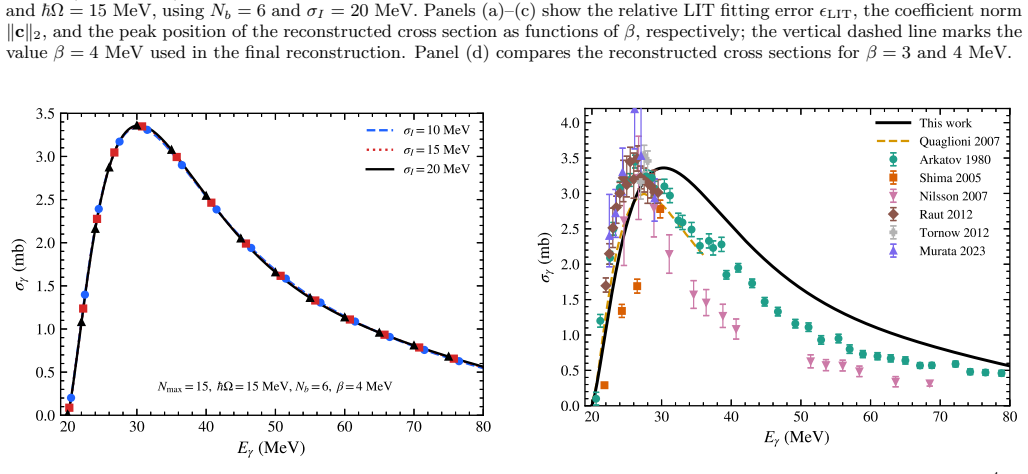
- The 4He photoabsorption peak region is robust across interactions, but the high-energy side is sensitive: Daejeon16 redistributes strength into a more pronounced shoulder relative to chiral two-plus-three-body interaction results, making high-energy photonuclear data a discriminating benchmark.
- The finite-spectrum LIT offers a complementary check on conventional LIT implementations, since it uses the same transform but evaluates it from explicitly resolved eigenstates rather than from a Krylov or inhomogeneous-equation route.
Reading between the lines
- If this route generalizes, any inclusive response expressible as a transition-strength distribution—monopole, Gamow-Teller, or electron-scattering responses—could be extracted from the same kind of explicit NCSM eigenstate data.
- The high-energy shoulder is the paper's sharpest testable signature: a high-precision measurement of the 4He(γ,p)3H and 4He(γ,n)3He channels between roughly 30 and 80 MeV, or a direct continuum calculation with the identical Daejeon16 Hamiltonian, would either confirm or rule out that this is a physical interaction effect rather than an inversion artifact.
- One could benchmark the inversion's resolution by feeding synthetic discrete spectra generated from known continuum responses and checking that the extracted cross section returns the input within the stated parameter windows, turning the stability scans into a quantitative resolution statement.
Editorial analysis
A structured set of objections, weighed in public.
Referee Report
Summary. The paper presents a finite-spectrum implementation of the Lorentz integral transform (LIT) within the no-core shell model and applies it to the 4He photoabsorption cross section. The authors explicitly diagonalize 4He with the Daejeon16 interaction, retain a large set of 1^- eigenstates below an excitation-energy cutoff, construct the finite-spectrum LIT from the resulting discrete energies and E1 strengths, and invert it using a constrained exponential basis. They report convergence with Nmax and harmonic-oscillator frequency, stability scans over the inversion parameters Nb, β, and σI, internal sum-rule consistency checks for the E1 polarizability and bremsstrahlung sum rule, and a comparison with available photonuclear data and with the earlier chiral-interaction calculation of Quaglioni et al. The central physics claim is that the Daejeon16 interaction yields a more pronounced high-energy shoulder than the chiral result, and that the finite-spectrum NCSM-LIT route is a controlled way to extract continuum photonuclear observables from discrete many-body spectra.
Significance. If the result holds, the finite-spectrum LIT provides a practical and complementary alternative to inhomogeneous-equation and Lanczos-based LIT implementations, particularly for methods where explicit eigenstates and transition strengths are available. The paper has clear strengths: no quantity is fitted to the 4He photoabsorption data; the E1 operator and Hamiltonian are external inputs; the convergence and stability diagnostics are extensive; and the internal sum-rule agreement is subpercent for Nmax ≥ 7. The paper also honestly labels its sum-rule test as an internal check. The main scientific value lies in demonstrating that a large but finite NCSM spectrum can be stably transformed into a smooth cross section, and in exposing sensitivity of the high-energy E1 response to the Hamiltonian. The principal weakness is that the inversion is an ill-posed deconvolution, and the stability scans do not yet quantify the resulting ambiguity in the recovered response.
major comments (3)
- [Sec. II, Eq. (6)-(10); Sec. III, Figs. 5-7] The stability scans vary Nb, β, and σI within the single exponential basis family of Eq. (7). They establish a flat region of that particular ansatz, but not uniqueness of the recovered response. The inversion of a finite-width LIT from a truncated discrete spectrum is an ill-posed deconvolution: a different admissible response—for example, one with more strength moved into the 40–70 MeV shoulder—could reproduce L(σR, σI) with similar fitting error. The final high-energy shoulder highlighted in Fig. 8 is exactly the kind of shape feature that could be affected. To support the central claim that this shoulder is a Hamiltonian effect rather than an inversion artifact, the authors should add a genuine uniqueness test: invert with an independent basis family (e.g., B-splines or wavelets with the same non-negativity constraint), perform a synthetic test with a known continuum response, or ben
- [Table I, Eqs. (12)-(13)] The sum-rule consistency check is internal by construction: both the direct discrete sums and the integrals over the inverted cross section use the same finite spectrum truncated at the same upper limit ω̄ = 100 MeV. Agreement therefore demonstrates that the inversion preserves the integrated strength within the retained window, not that the energy-dependent shape is correct. The text acknowledges this, but the Summary refers to the subpercent agreement as 'a direct validation of the reconstructed cross section at the sum-rule level.' Please rephrase this claim or supplement it with a shape-sensitive test that is not blinded by the matched cutoff.
- [Sec. III, Fig. 8] The final cross section is presented as a single curve with no uncertainty band. Given the multiple choices of Nmax, ℏΩ, ωcut, Nb, β, and σI, the central comparison with data and with Quaglioni et al. remains qualitative. An uncertainty envelope built by stacking the variations around the adopted parameter set would allow the reader to judge whether the high-energy shoulder is statistically meaningful and would make the 'controlled route' claim quantitatively assessable.
minor comments (4)
- [Figs. 5 and 7] In Fig. 5 the axis label appears as 'Nγ' while the text uses Nb; please unify. In Fig. 7 the legend entries appear as 'σβ = 10 MeV' etc., but the text uses σI; please correct the labels.
- [Sec. II, text near Eq. (5)] The sentence 'The inverted transform yields the energy-dependent E1 strength distribution' should read 'the reconstructed response' or 'the inversion of the transform yields...' to avoid the implication that the transform itself directly gives the strength distribution.
- [Fig. 8 and surrounding text] The comparison mixes total photoabsorption data with exclusive two-body breakup data, and the mirror-doubling of single-channel data is only a valid proxy below the three-body breakup threshold. The text states this, but the figure would benefit from marking the three-body threshold so that the partial nature of the high-energy data is visually clear.
- [General] The phrase 'controlled route' is used prominently in the abstract and summary. It would be more precise to say 'a route whose convergence and internal consistency have been examined,' since the inversion-uniqueness question is not yet fully resolved.
Circularity Check
No significant circularity: the reported cross section is derived from an external Hamiltonian and standard E1 operator; the sum-rule checks are internal consistency tests and are labeled as such.
full rationale
The derivation chain is: (i) the Daejeon16 NN interaction and the standard one-body E1 operator (Eq. 2) are external inputs; (ii) NCSM diagonalization supplies a finite set of 1^- states with excitation energies and B(E1) strengths; (iii) the finite-spectrum LIT is built directly from those discrete data via Eq. (5); (iv) a smooth response R(E_gamma) is obtained by fitting the coefficients c_n of the standard Efros-type basis (Eqs. (6)-(10)) to this LIT, with a non-negativity constraint; and (v) the photoabsorption cross section is obtained from R via Eq. (11). No experimental photoabsorption datum is used to set any parameter; the inversion parameters (Nb = 6, beta = 4 MeV, sigma_I = 20 MeV) are selected from internal stability scans, not fitted to data. The sum-rule comparison in Table I uses the same finite spectrum on both sides, but the paper explicitly states that the matched upper limit makes it "an internal test of the inversion for the retained finite spectrum, rather than an estimate of the complete infinite-energy sum rules," so it is not presented as an independent confirmation. The comparison with Quaglioni et al. and with experimental data (Fig. 8) is an external benchmark, not an input. Any concern about the ill-posedness of the LIT inversion or the uniqueness of the high-energy shoulder is a robustness/correctness issue, not circularity. No load-bearing self-citation chain is present: citations to the authors' prior work (e.g., Ref. [34]) provide methodological continuity and a high-energy correction estimate, but the central extraction is independently performed here. Therefore no circular step can be exhibited, and the score is 0.
Assumptions & free parameters
free parameters (7)
- Harmonic-oscillator frequency ℏΩ =
15 MeV (final); 17.5 and 20 MeV for convergence tests
- Model-space truncation Nmax =
15 (odd Nmax for 1- states; convergence from 3 to 15)
- Excitation-energy cutoff ωcut =
100 MeV
- Lorentz width σI =
20 MeV
- Inversion basis scale β =
4 MeV
- Number of inversion basis functions Nb =
6
- Angular-momentum filter strength λ =
25 MeV
assumptions (5)
- domain assumption Daejeon16 NN interaction provides an adequate Hamiltonian for 4He, representing three-nucleon dynamics through fitted off-shell modifications.
- domain assumption The one-body E1 operator in the long-wavelength approximation (Eq. 2) describes the photoabsorption strength fully.
- domain assumption A finite set of 1- eigenstates below 100 MeV in the HO basis is sufficiently complete to represent the continuum E1 response (Eq. 4).
- domain assumption The inversion basis χ_n of Eq. (7) with a non-negativity constraint yields a unique and physically meaningful response.
- standard math The angular-momentum filter HJ^2 = λ(J^2 - 2) with λ = 25 MeV leaves J=1 states unchanged while shifting other J states, and the Lawson prescription removes spurious center-of-mass excitations.
Cite this review
Pith. "Pith review of Finite-spectrum Lorentz integral transform calculation of the $^{4}$He photoabsorption cross section in the no-core shell model." pith.science (2026). https://pith.science/paper/NMR27BEW
@misc{pith2026260803686,
  author       = {Pith},
  title        = {Pith review of: Finite-spectrum Lorentz integral transform calculation of the $^4$He photoabsorption cross section in the no-core shell model},
  year         = {2026},
  howpublished = {\url{https://pith.science/paper/NMR27BEW}},
  note         = {Machine review of arXiv:2608.03686}
}
abstract
We develop and validate a finite-spectrum implementation of the Lorentz integral transform (LIT) within the \textit{ab initio} no-core shell model (NCSM) for calculating the photoabsorption cross section of $^4$He. A large set of $1^-$ eigenstates is explicitly calculated in the NCSM, and the LIT is constructed from their excitation energies and the corresponding $E1$ transition strengths. This finite-spectrum approach is complementary to conventional inhomogeneous-equation and Lanczos-based implementations of the LIT method for photoabsorption cross sections. Using the Daejeon16 interaction, we extract the photoabsorption cross section and examine its stability with respect to the model-space truncation, excitation-energy cutoff, and LIT parameters. The reliability of the finite-spectrum extraction is assessed by comparing the $E1$ polarizability and bremsstrahlung sum rule obtained from the discrete NCSM spectrum with the same quantities obtained by integrating the extracted cross section. The extracted cross section captures the principal features of the available $^4$He photonuclear data in the giant-dipole-resonance region and is consistent, in the low-energy rise and main-peak region, with earlier chiral-interaction NCSM-LIT results obtained from Lanczos-based evaluations, while the present calculation with the Daejeon16 interaction exhibits a more pronounced high-energy shoulder. The present work provides a controlled finite-spectrum NCSM-LIT route from explicitly calculated many-body eigenstates and transition strengths to photoabsorption cross sections.
Figures


Figures from the paper (3 more)


Reference graph
Works this paper leans on
-
[1]
The Lorentz integral transform (LIT) method and its applications to perturbation-induced reactions,
V. D. Efros, W. Leidemann, G. Orlandini, and N. Barnea, “The Lorentz integral transform (LIT) method and its applications to perturbation-induced reactions,” J. Phys. G 34, R459 (2007)
work page 2007
-
[2]
Modern ab initio ap- proaches and applications in few-nucleon physics with A ≥ 4,
W. Leidemann and G. Orlandini, “Modern ab initio ap- proaches and applications in few-nucleon physics with A ≥ 4,” Prog. Part. Nucl. Phys. 68, 158 (2013)
work page 2013
-
[3]
Electromagnetic reactions on light nuclei,
S. Bacca and S. Pastore, “Electromagnetic reactions on light nuclei,” J. Phys. G 41, 123002 (2014)
work page 2014
-
[4]
Measurements of the gi- ant dipole resonance with monoenergetic photons,
B. L. Berman and S. C. Fultz, “Measurements of the gi- ant dipole resonance with monoenergetic photons,” Rev. Mod. Phys. 47, 713 (1975)
work page 1975
-
[5]
M. N. Harakeh and A. van der Woude,Giant Resonances: Fundamental High-Frequency Modes of Nuclear Excita- tion (Oxford University Press, Oxford, 2001)
work page 2001
-
[6]
Photonuclear sum rules and the tetrahe- dral configuration of 4He,
D. Gazit, N. Barnea, S. Bacca, W. Leidemann, and G. Orlandini, “Photonuclear sum rules and the tetrahe- dral configuration of 4He,” Phys. Rev. C 74, 061001(R) (2006)
work page 2006
-
[7]
Benchmark calculation of inclusive elec- tromagnetic responses in the four-body nuclear system,
I. Stetcu, S. Quaglioni, S. Bacca, B. R. Barrett, C. W. Johnson, P. Navr´ atil, N. Barnea, W. Leidemann, and G. Orlandini, “Benchmark calculation of inclusive elec- tromagnetic responses in the four-body nuclear system,” Nucl. Phys. A 785, 307 (2007)
work page 2007
-
[8]
S. Quaglioni and P. Navr´ atil, “The 4He total photo- absorption cross section with two- plus three-nucleon in- teractions from chiral effective field theory,” Phys. Lett. B 652, 370 (2007)
work page 2007
Show all 53 references
-
[9]
Measurement of the α-particle monopole transition form factor challenges theory: A low-energy puzzle for nuclear forces?
S. Kegel et al., “Measurement of the α-particle monopole transition form factor challenges theory: A low-energy puzzle for nuclear forces?” Phys. Rev. Lett. 130, 152502 (2023)
2023
-
[10]
The isoscalar monopole resonance of the alpha particle: A prism to nuclear Hamiltonians,
S. Bacca, N. Barnea, W. Leidemann, and G. Orlandini, “The isoscalar monopole resonance of the alpha particle: A prism to nuclear Hamiltonians,” Phys. Rev. Lett. 110, 042503 (2013)
2013
-
[11]
Descrip- tion of the proton-decaying 0 + 2 resonance of the α par- ticle,
N. Michel, W. Nazarewicz, and M. P/suppress loszajczak, “Descrip- tion of the proton-decaying 0 + 2 resonance of the α par- ticle,” Phys. Rev. Lett. 131, 242502 (2023); Erratum, Phys. Rev. Lett. 133, 239901 (2024)
2023
-
[12]
Ab initio calculation of the alpha-particle monopole transi- tion form factor,
U.-G. Meißner, S. Shen, S. Elhatisari, and D. Lee, “Ab initio calculation of the alpha-particle monopole transi- tion form factor,” Phys. Rev. Lett. 132, 062501 (2024)
2024
-
[13]
Study of the alpha-particle monopole transition form factor,
M. Viviani, A. Kievsky, L. E. Marcucci, and L. Girlanda, “Study of the alpha-particle monopole transition form factor,” Few-Body Syst. 65, 74 (2024)
2024
-
[14]
α-particle monopole form fac- tors within the ab initio no-core shell model,
P. Yin, A. M. Shirokov, H. Li, B. Zhou, X. Zhao, S. Bacca, and J. P. Vary, “α-particle monopole form fac- tors within the ab initio no-core shell model,” Phys. Rev. C 112, L031303 (2025)
2025
-
[15]
Photoabsorption on 4He with a Realis- tic Nuclear Force,
D. Gazit, S. Bacca, N. Barnea, W. Leidemann, and G. Orlandini, “Photoabsorption on 4He with a Realis- tic Nuclear Force,” Phys. Rev. Lett. 96, 112301 (2006)
2006
-
[16]
Experimental verifica- tion of the sum rules for photodisintegration of He-4,
Y. M. Arkatov, P. I. Vatset, V. I. Voloshchuk, V. A. Zolenko, and I. M. Prokhorets, “Experimental verifica- tion of the sum rules for photodisintegration of He-4,” Yad. Fiz. 31, 1400 (1980) [Sov. J. Nucl. Phys. 31, 726 (1980)]
1980
-
[17]
Im- plications of the experimental results on the photodisin- tegration of 4He,
J. R. Calarco, B. L. Berman, and T. W. Donnelly, “Im- plications of the experimental results on the photodisin- tegration of 4He,” Phys. Rev. C 27, 1866 (1983)
1983
-
[18]
Si- multaneous measurement of the photodisintegration of 4He in the giant dipole resonance region,
T. Shima, S. Naito, Y. Nagai, T. Baba, K. Tamura, T. Takahashi, T. Kii, H. Ohgaki, and H. Toyokawa, “Si- multaneous measurement of the photodisintegration of 4He in the giant dipole resonance region,” Phys. Rev. C 72, 044004 (2005)
2005
-
[19]
A measurement of the 4He(γ, n) reac- tion from 23 < E γ < 70 MeV,
B. Nilsson et al. , “A measurement of the 4He(γ, n) reac- tion from 23 < E γ < 70 MeV,” Phys. Rev. C 75, 014007 (2007)
2007
-
[20]
Photodisintegration cross section of the reaction 4He(γ, p)3H at the giant dipole resonance peak,
R. Raut et al. , “Photodisintegration cross section of the reaction 4He(γ, p)3H at the giant dipole resonance peak,” Phys. Rev. Lett. 108, 042502 (2012)
2012
-
[21]
Photodisintegration cross section of the reaction 4He(γ, n)3He at the giant dipole resonance peak,
W. Tornow, J. H. Kelley, R. Raut, G. Rusev, A. P. Tonchev, M. W. Ahmed, A. S. Crowell, and S. C. Stave, “Photodisintegration cross section of the reaction 4He(γ, n)3He at the giant dipole resonance peak,” Phys. Rev. C 85, 061001(R) (2012)
2012
-
[22]
Photodisintegration cross section of 4He in the giant dipole resonance energy region,
M. Murata et al. , “Photodisintegration cross section of 4He in the giant dipole resonance energy region,” Phys. Rev. C 107, 064317 (2023)
2023
-
[23]
Response functions from integral transforms with a Lorentz ker- nel,
V. D. Efros, W. Leidemann, and G. Orlandini, “Response functions from integral transforms with a Lorentz ker- nel,” Phys. Lett. B 338, 130 (1994)
1994
-
[24]
New inversion methods for the Lorentz integral trans- form,
D. Andreasi, W. Leidemann, C. Reiss, and M. Schwamb, “New inversion methods for the Lorentz integral trans- form,” Eur. Phys. J. A 24, 361 (2005)
2005
-
[25]
The Lorentz integral transform and its inversion,
N. Barnea, V. D. Efros, W. Leidemann, and G. Orlandini, “The Lorentz integral transform and its inversion,” Few- Body Syst. 47, 201 (2010)
2010
-
[26]
Energy resolution with the Lorentz in- tegral transform,
W. Leidemann, “Energy resolution with the Lorentz in- tegral transform,” Phys. Rev. C 91, 054001 (2015)
2015
-
[27]
Efficient Method for Lorentz Integral Trans- forms of Reaction Cross Sections,
M. A. Marchisio, N. Barnea, W. Leidemann, and G. Or- landini, “Efficient Method for Lorentz Integral Trans- forms of Reaction Cross Sections,” Few-Body Syst. 33, 259 (2003)
2003
-
[28]
Microscopic calculation of six-body inelastic reactions with complete final state interaction: Photoabsorption of 6He and 6Li,
S. Bacca, M. A. Marchisio, N. Barnea, W. Leidemann, and G. Orlandini, “Microscopic calculation of six-body inelastic reactions with complete final state interaction: Photoabsorption of 6He and 6Li,” Phys. Rev. Lett. 89, 052502 (2002)
2002
-
[29]
Effect of P -wave interaction in 6He and 6Li photoab- 10 sorption,
S. Bacca, N. Barnea, W. Leidemann, and G. Orlandini, “Effect of P -wave interaction in 6He and 6Li photoab- 10 sorption,” Phys. Rev. C 69, 057001 (2004)
2004
-
[30]
Operator evolution for ab ini- tio electric dipole transitions of 4He,
M. D. Schuster, S. Quaglioni, C. W. Johnson, E. D. Jur- genson, and P. Navr´ atil, “Operator evolution for ab ini- tio electric dipole transitions of 4He,” Phys. Rev. C 92, 014320 (2015)
2015
-
[31]
First principles description of the giant dipole resonance in 16O,
S. Bacca, N. Barnea, G. Hagen, G. Orlandini, and T. Pa- penbrock, “First principles description of the giant dipole resonance in 16O,” Phys. Rev. Lett. 111, 122502 (2013)
2013
-
[32]
Electric dipole polarizability from first principles calculations,
M. Miorelli, S. Bacca, N. Barnea, G. Hagen, G. R. Jansen, G. Orlandini, and T. Papenbrock, “Electric dipole polarizability from first principles calculations, ” Phys. Rev. C 94, 034317 (2016)
2016
-
[33]
Coupling the Lorentz integral transform (LIT) and the coupled cluster (CC) methods: A way towards continuum spectra of “not-so- few-body
G. Orlandini, S. Bacca, N. Barnea, G. Hagen, M. Miorelli, and T. Papenbrock, “Coupling the Lorentz integral transform (LIT) and the coupled cluster (CC) methods: A way towards continuum spectra of “not-so- few-body” systems,” Few-Body Syst. 55, 907 (2014)
2014
-
[34]
Direct ab initio calculation of the 4He nuclear electric dipole polarizabil- ity,
P. Yin, A. M. Shirokov, P. Maris, P. J. Fasano, M. A. Caprio, H. Li, W. Zuo, and J. P. Vary, “Direct ab initio calculation of the 4He nuclear electric dipole polarizabil- ity,” Phys. Lett. B 855, 138857 (2024)
2024
-
[35]
Ab initio no core shell model,
B. R. Barrett, P. Navr´ atil, and J. P. Vary, “Ab initio no core shell model,” Prog. Part. Nucl. Phys.69, 131 (2013)
2013
-
[36]
Properties of 4He and 6Li with improved chiral EFT interactions,
P. Maris et al., “Properties of 4He and 6Li with improved chiral EFT interactions,” EPJ Web Conf. 113, 04015 (2016)
2016
-
[37]
Light nuclei with semilocal momentum-space regularized chiral inter- actions up to third order,
P. Maris et al. (LENPIC Collaboration), “Light nuclei with semilocal momentum-space regularized chiral inter- actions up to third order,” Phys. Rev. C 103, 054001 (2021)
2021
-
[38]
Nuclear prop- erties with semilocal momentum-space regularized chiral interactions beyond N 2LO,
P. Maris et al. (LENPIC Collaboration), “Nuclear prop- erties with semilocal momentum-space regularized chiral interactions beyond N 2LO,” Phys. Rev. C 106, 064002 (2022)
2022
-
[39]
Ab initio study of Z(N) = 6 magicity,
H. Li, H. J. Ong, D.-L. Fang, I. A. Mazur, I. J. Shin, A. M. Shirokov, J. P. Vary, P. Yin, X.-B. Zhao, and W. Zuo, “Ab initio study of Z(N) = 6 magicity,” Chin. Phys. C 48, 124103 (2024)
2024
-
[40]
Quadrupole dynamics of carbon isotopes and 10Be,
H. Li, D. Fang, H. J. Ong, A. M. Shirokov, J. P. Vary, P. Yin, and X. Zhao, “Quadrupole dynamics of carbon isotopes and 10Be,” Phys. Rev. C 110, 064325 (2024)
2024
-
[41]
Halo structure of 6He from ab initio two-nucleon spatial correlations,
M. Huang, T. Frederico, P. Yin, R. A. M. Basili, P. J. Fasano and J. P. Vary, “Halo structure of 6He from ab initio two-nucleon spatial correlations,” Phys. Rev. C 113, 064318 (2026)
2026
-
[42]
N3LO NN interaction adjusted to light nuclei in ab exitu approach,
A. M. Shirokov, I. J. Shin, Y. Kim, M. Sosonkina, P. Maris, and J. P. Vary, “N3LO NN interaction adjusted to light nuclei in ab exitu approach,” Phys. Lett. B 761, 87 (2016)
2016
-
[43]
Scaling of ab-initio nuclear physics calculations on mul- ticore computer architectures,
P. Maris, M. Sosonkina, J. P. Vary, E. Ng, and C. Yang, “Scaling of ab-initio nuclear physics calculations on mul- ticore computer architectures,” Procedia Comput. Sci. 1, 97–106 (2010)
2010
-
[44]
Improving the scalability of a symmetric iterative eigensolver for multi-core platforms,
H. M. Aktulga, C. Yang, E. G. Ng, P. Maris, and J. P. Vary, “Improving the scalability of a symmetric iterative eigensolver for multi-core platforms,” Concurr. Comput. Pract. Exp. 26, 2631–2651 (2014)
2014
-
[45]
Accelerating nuclear configuration inter- action calculations through a preconditioned block iter- ative eigensolver,
M. Shao, H. M. Aktulga, C. Yang, E. G. Ng, P. Maris, and J. P. Vary, “Accelerating nuclear configuration inter- action calculations through a preconditioned block iter- ative eigensolver,” Comput. Phys. Commun. 222, 1–13 (2018)
2018
-
[46]
Accel- erating an iterative eigensolver for nuclear structure con- figuration interaction calculations on GPUs using Ope- nACC,
P. Maris, C. Yang, D. Oryspayev, and B. Cook, “Accel- erating an iterative eigensolver for nuclear structure con- figuration interaction calculations on GPUs using Ope- nACC,” J. Comput. Sci. 59, 101554 (2022)
2022
-
[47]
Accelerating quantum many-body configuration interaction with directives,
B. G. Cook, P. J. Fasano, P. Maris, C. Yang, and D. Orys- payev, “Accelerating quantum many-body configuration interaction with directives,” Lect. Notes Comput. Sci. 13194, 112–132 (2022)
2022
-
[48]
P. J. Fasano and P. Maris, mfdn-transitions, version 1.0.0, Zenodo (2025), doi:10.5281/zenodo.18013362
2025 doi
-
[49]
Spurious center-of- mass motion,
D. H. Gloeckner and R. D. Lawson, “Spurious center-of- mass motion,” Phys. Lett. B 53, 313 (1974)
1974
-
[50]
Computational methods for shell-model calculations,
R. R. Whitehead, A. Watt, B. J. Cole, and I. Morrison, “Computational methods for shell-model calculations,” Adv. Nucl. Phys. 9, 123 (1977)
1977
-
[51]
The AME 2020 atomic mass evaluation (II). Tables, graphs and references,
M. Wang, W. J. Huang, F. G. Kondev, G. Audi, and S. Naimi, “The AME 2020 atomic mass evaluation (II). Tables, graphs and references,” Chin. Phys. C45, 030003 (2021)
2020
-
[52]
Accurate charge- dependent nucleon-nucleon potential at fourth order of chiral perturbation theory,
D. R. Entem and R. Machleidt, “Accurate charge- dependent nucleon-nucleon potential at fourth order of chiral perturbation theory,” Phys. Rev. C 68, 041001(R) (2003)
2003
-
[53]
Structure of A = 10–13 nuclei with two- plus three-nucleon interactions from chiral effective field theory,
P. Navr´ atil, V. G. Gueorguiev, J. P. Vary, W. E. Ormand, and A. Nogga, “Structure of A = 10–13 nuclei with two- plus three-nucleon interactions from chiral effective field theory,” Phys. Rev. Lett. 99, 042501 (2007)
2007
Reviewed August 5, 2026 · model on record in the stance chip above.
Discussion (0). Continue with ORCID to comment.