REVIEW 3 major objections 6 minor 49 references
KnowHal claims knowledge hallucination is the hardest failure mode for multimodal LLMs, and false-premise questions expose large robustness gaps.
Reviewed by Pith at T0; open to challenge. T0 means a machine referee read the full paper against a public rubric. the ladder, T0–T4 →
KnowHal is a new benchmark that jointly tests entity, attribute, relation, and knowledge hallucinations in multimodal language models using paired true/false questions on shared images.
T0 review reviewed 2026-08-05 challenge →
load-bearing objection Useful four-dimension hallucination benchmark, but the Knowledge dimension's image-grounding is unverified and the dataset is unreleased, making the main empirical claim conditional. the 3 major comments →
KnowHal: A Knowledge-Driven Benchmark for Comprehensive Multimodal Hallucination Evaluation
The pith
A machine-rendered reading of the paper's core claim, the machinery that carries it, and where it could break.
The reading
Core claim
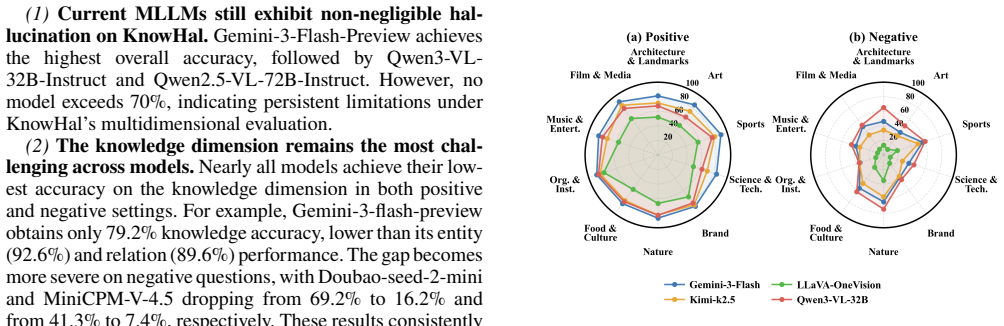
On its own terms, KnowHal establishes that knowledge hallucination is not a side phenomenon but the hardest of four hallucination dimensions for 14 tested MLLMs. With paired positive and negative questions over the same images and entities, nearly every model scores lowest on Knowledge in both settings, and negative questions cause steep drops—the paper's clearest example is Doubao-Seed-2-Mini falling from 69.2% to 16.2% on knowledge negatives. The paper also finds that no evaluated model exceeds 70% overall accuracy, and that closed-source models lead on positive questions while the Qwen open-source family is competitive on negative robustness. The intended contribution is a diagnostic inst
What carries the argument
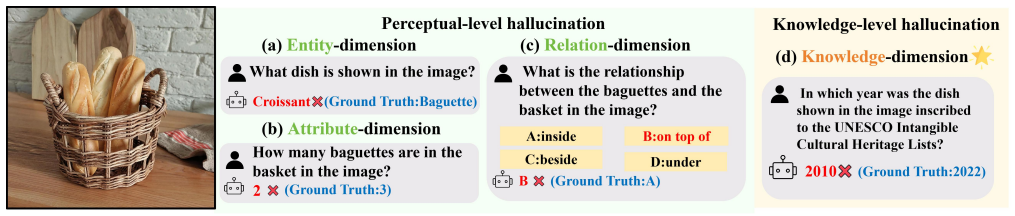
The load-bearing mechanism is the paired positive–negative question over a shared entity–image sample. Every entity gets four positive questions (Entity, Attribute, Relation, Knowledge) and four matched negative questions built from Attribute Variant, Object Substitution, Spatial Relation, or Action Fabrication. The pairing is what makes the four dimensions comparable: the same visual input and the same entity carry both a true query and a false-premise query, so a model's perceptual accuracy, knowledge accuracy, and false-premise rejection are measured under controlled conditions. The construction pipeline—LLM-assisted generation, CLIP-based image–text filtering, and three-annotator human v
Load-bearing premise
For the Knowledge dimension to test multimodal hallucination, the image must be needed to answer the question; the paper states the facts are image-grounded but gives no evidence that a text-only model could not answer them.
What would settle it
Run KnowHal's Knowledge split (positive and negative) with images removed. If a text-only model reaches or exceeds the image-conditioned accuracy reported in Table 2, the Knowledge dimension is not image-grounded and the paper's central claim collapses.
If this is right
- If KnowHal is right, knowledge hallucination is the dominant failure mode in current MLLMs, so improving encyclopedic knowledge grounding should take priority over further perceptual tuning.
- Positive accuracy alone is not a reliable health metric; the paired negative questions show that even models with strong positive accuracy can accept false premises, so evaluations should report a robustness term such as HPS alongside accuracy.
- Scaling model size helps both factual accuracy and false-premise robustness, but the knowledge gap persists across scales, indicating that scale alone will not close it.
- Because the Knowledge dimension is image-grounded by design, failures on it point to a particular mechanism—the model knows the entity but does not retrieve the fact, or retrieves it but cannot bind it to the visual referent—that finer-grained benchmarks can isolate.
- The 1,800-sample, four-dimension protocol gives a reusable diagnostic: any new MLLM can be assessed on all four dimensions under matched conditions, which is what the paper claims existing benchmarks cannot do.
Where Pith is reading between the lines
- A text-only control would settle whether the Knowledge dimension is truly multimodal: run the Knowledge split with the image absent, and compare accuracy to the image-conditioned numbers in Table 2. If a strong language-only model matches the multimodal accuracy, the Knowledge dimension measures text QA, not visual hallucination.
- The Hallucination Proneness Score is a ratio, so it can rank a model with high positive accuracy above one with lower positive but better absolute negative accuracy; users should normalize it against one of the components before using it as a single number. The paper reports components, but the composite invites misuse.
- The 90.6% acceptance rate in the reconstruction audit covers 100 entities and 800 QA pairs; extending the pipeline to broader knowledge types (temporal, procedural, commonsense) would test whether the construction quality and the knowledge-hallucination gap persist at scale.
- The case study suggests knowledge failures often follow entity-recognition failures. If that cascade is real, entity accuracy is a confound when comparing knowledge accuracy across models; a stratified analysis by entity-recognition success would separate vision-induced errors from genuine knowledge gaps.
Editorial analysis
A structured set of objections, weighed in public.
Referee Report
Summary. KnowHal is a benchmark for multimodal hallucination evaluation. It contains 1,800 entity–image samples and 14,400 QA pairs, organized as paired positive and negative questions in four dimensions: Entity, Attribute, Relation, and Knowledge. The construction pipeline uses LLM-assisted generation, CLIP-based image filtering, and three-annotator human validation with reported Fleiss' kappa and a reconstruction audit. The authors evaluate 14 MLLMs zero-shot, reporting positive and negative accuracy separately, an overall score, and a Hallucination Proneness Score (HPS). The main claims are that the Knowledge dimension is consistently the most challenging across all models, that negative questions sharply reduce accuracy, and that closed-source models are generally stronger. The paper also provides domain-wise, scaling, and case analyses.
Significance. If the benchmark is valid, KnowHal addresses a real gap: prior hallucination benchmarks cover Entity, Attribute, and Relation dimensions but do not jointly evaluate Knowledge alongside them under shared images and entities. The paired positive/negative question design is a useful instrument for measuring false-premise acceptance, and the human-verification protocol (kappa = 0.854, 90.6% reconstruction acceptance) is a strength. The empirical finding that all 14 evaluated models are weakest on Knowledge in both polarities is potentially important and actionable. The scaling analysis across Qwen3-VL and InternVL3.5 is also informative. However, the central validity question—whether the Knowledge questions are genuinely image-grounded—is not answered, and the dataset is not released. These issues must be resolved before the benchmark's main conclusions can be credited.
major comments (3)
- [Step3-1 (Knowledge Dimension); Table 2] The paper's central claim is that Knowledge hallucination is a multimodal failure mode and 'consistently the most challenging' across models. This requires that the Knowledge QA pairs are image-grounded. The text only asserts that Wikipedia facts are 'transformed into image-grounded QA pairs' and provides no example, no check that the image is necessary, and no text-only baseline. For an image of a well-known entity, many encyclopedic questions are answerable from the entity name alone. Without a condition in which the image is withheld, the Knowledge column in Table 2 may measure parametric text QA and memorized Wikipedia knowledge rather than multimodal hallucination. The case study's conclusion that 'knowledge hallucination results from the interaction between visual understanding and factual reasoning' is asserted, not demonstrated. Please add concrete Knowledge QA pairs, a text-only
- [Availability (throughout)] This is a benchmark paper, but no dataset release, URL, or availability statement is provided. The full 14,400 QA pairs are needed to verify the construction pipeline, the paired design, and especially the image-grounding of the Knowledge dimension. In the absence of release, the experimental results and the reconstruction audit cannot be independently checked. A benchmark contribution should include at least an anonymized sample and a clear release plan.
- [Automatic-judge reliability paragraph] All negative open-ended responses (Entity, Attribute, Knowledge) are evaluated by GPT-4o-mini as an automatic judge, and this judge is the basis for the negative-accuracy and HPS conclusions. The manual re-evaluation covers only 100 responses from one model, Doubao-Seed-2-Mini, with 94.3% agreement. This is a useful sanity check, but the judge prompt, scoring rubric, and failure examples are not reported. Since the central 'limited robustness' claim rests on negative accuracy, the judge's behavior across models and dimensions should be documented more fully.
minor comments (6)
- [Table 2 and text] Please add confidence intervals or standard errors to the per-dimension accuracies. The differences between dimensions are large, but point estimates without uncertainty make it impossible to assess small gaps, especially in the negative columns.
- [Step3-2 (Negative QA Pair Construction)] The four negative induction strategies are described generally, but it is not stated how they are allocated across the four dimensions. For the Knowledge dimension, what does a negative question look like, and how does it differ from a simple factual contradiction? Provide at least one explicit example per strategy.
- [Equation (1)] HPS is undefined when Accpos = 0 and can be unstable for very low positive accuracy. Consider also reporting the raw difference Accpos - Accneg, which is more interpretable.
- [Human validation] Report the number of annotators and the exact protocol for Fleiss' kappa (number of items, categories, and whether disagreement resolution was used). The single kappa value is not fully interpretable without this context.
- [Throughout] Use consistent capitalization and naming for models (e.g., 'Gemini-3-Flash-Preview' vs 'Gemini-3-flash-preview' in the text; 'Doubao-Seed-2-Mini' vs 'Doubao-seed-2-mini'). There is also a typo in the conclusion: 'i.e., ,'.
- [Figures 4, 6, 7] The manuscript refers to these figures but does not include the underlying values in the text. For a benchmark paper, provide exact per-domain or per-size numbers in a supplementary table so that the scaling and domain claims can be checked.
Circularity Check
No significant circularity: KnowHal's construction and evaluation are empirical, not derived from fitted inputs or self-citation chains.
full rationale
KnowHal is a benchmark-construction and evaluation paper. It contains no predictive derivation, no fitted parameters, and no uniqueness theorem imported from prior work by the same authors. The construction pipeline (entity selection, image retrieval, CLIP filtering, LLM-assisted QA generation, human validation) is a data-creation procedure, not a chain of equations in which a target quantity is shown to equal its input. The main experimental findings—models score lowest on Knowledge and degrade on negative questions—are measurements over 14 MLLMs; they are not forced by construction, because the QA labels are human-verified and accuracy is computed by direct answer matching or an independently validated automatic judge. The closest concerns (Wikipedia as knowledge source overlapping MLLM pretraining, and LLM-assisted generation being evaluated by an LLM) are data-contamination and evaluation-validity issues, not circularity: the benchmark's ground truth does not reduce to the evaluated models' outputs. The only apparent self-citation, POPE (Li et al. 2023b) including co-author Y. Du, is used solely as related-work context and is not load-bearing. No quoted passage exhibits an equation reducing to its own input, so no circular step is identified.
Axiom & Free-Parameter Ledger
axioms (3)
- domain assumption Images retrieved via Google Image Search and filtered by CLIP correctly depict the target entity and its associated entities.
- domain assumption Wikipedia facts used for Knowledge QA are correct, temporally stable, and unambiguously linked to the entity.
- domain assumption The automatic judge GPT-4o-mini correctly evaluates negative answers, with acceptable error on the order of 5.7%.
Cite this review
Pith. "Pith review of KnowHal: A Knowledge-Driven Benchmark for Comprehensive Multimodal Hallucination Evaluation." pith.science (2026). https://pith.science/paper/XVRA4SEX
@misc{pith2026260803782,
  author       = {Pith},
  title        = {Pith review of: KnowHal: A Knowledge-Driven Benchmark for Comprehensive Multimodal Hallucination Evaluation},
  year         = {2026},
  howpublished = {\url{https://pith.science/paper/XVRA4SEX}},
  note         = {Machine review of arXiv:2608.03782}
}
read the original abstract
Hallucination remains a critical challenge for developing trustworthy Multimodal Large Language Models (MLLMs). While existing benchmarks mainly focus on entity, attribute, and relation hallucinations, knowledge-related failures are often investigated separately, lacking a unified evaluation framework across different hallucination dimensions. To overcome this, we propose \textbf{KnowHal}, a benchmark that explicitly incorporates knowledge hallucination into multimodal hallucination evaluation spanning four dimensions: entity, attribute, relation, and knowledge. KnowHal constructs paired positive and negative questions over shared images and entities, enabling controlled comparisons among perceptual errors, knowledge-related errors, and false-premise acceptance. The benchmark contains 1,800 samples across 10 domains and 50 categories, constructed through a semi-automated pipeline combining LLM assistance, CLIP-based filtering, and human verification. We evaluate 14 representative MLLMs on KnowHal and conduct extensive analyses. Results show that the knowledge dimension consistently presents the greatest challenge for nearly all evaluated models, while most models exhibit substantial performance degradation on negative questions, revealing limited robustness to false premises. By unifying four hallucination dimensions with paired question design, KnowHal addresses an important gap in existing evaluation frameworks and enables a more comprehensive assessment of hallucinations in MLLMs.
Figures




Reference graph
Works this paper leans on
-
[1]
FirstName Alpher , title =
-
[2]
Journal of Foo , volume = 13, number = 1, pages =
FirstName Alpher and FirstName Fotheringham-Smythe , title =. Journal of Foo , volume = 13, number = 1, pages =
-
[3]
Journal of Foo , volume = 14, number = 1, pages =
FirstName Alpher and FirstName Fotheringham-Smythe and FirstName Gamow , title =. Journal of Foo , volume = 14, number = 1, pages =
-
[4]
FirstName Alpher and FirstName Gamow , title =
-
[5]
Computer Vision -- ECCV 2022 , year =
2022
-
[6]
Proceedings of the 2023 conference on empirical methods in natural language processing , pages=
Evaluating object hallucination in large vision-language models , author=. Proceedings of the 2023 conference on empirical methods in natural language processing , pages=
2023
-
[7]
Proceedings of the 2018 Conference on Empirical Methods in Natural Language Processing , pages=
Object hallucination in image captioning , author=. Proceedings of the 2018 Conference on Empirical Methods in Natural Language Processing , pages=
2018
-
[8]
Chaoyou Fu and Peixian Chen and Yunhang Shen and Yulei Qin and Mengdan Zhang and Xu Lin and Jinrui Yang and Xiawu Zheng and Ke Li and Xing Sun and Yunsheng Wu and Rongrong Ji and Caifeng Shan and Ran He , booktitle=
-
[9]
Proceedings of the Computer Vision and Pattern Recognition Conference , pages=
Phd: A chatgpt-prompted visual hallucination evaluation dataset , author=. Proceedings of the Computer Vision and Pattern Recognition Conference , pages=
-
[10]
Proceedings of the 41st International Conference on Machine Learning , articleno =
Wu, Mingrui and Ji, Jiayi and Huang, Oucheng and Li, Jiale and Wu, Yuhang and Sun, Xiaoshuai and Ji, Rongrong , title =. Proceedings of the 41st International Conference on Machine Learning , articleno =. 2024 , publisher =
work page 2024
-
[11]
Findings of the Association for Computational Linguistics: ACL 2025 , pages=
Reefknot: A comprehensive benchmark for relation hallucination evaluation, analysis and mitigation in multimodal large language models , author=. Findings of the Association for Computational Linguistics: ACL 2025 , pages=
2025
-
[12]
arXiv preprint arXiv:2311.07397 , year=
Amber: An llm-free multi-dimensional benchmark for mllms hallucination evaluation , author=. arXiv preprint arXiv:2311.07397 , year=
-
[13]
Findings of the Association for Computational Linguistics: ACL 2024 , pages=
Aligning large multimodal models with factually augmented rlhf , author=. Findings of the Association for Computational Linguistics: ACL 2024 , pages=
2024
-
[14]
International conference on machine learning , pages=
Learning transferable visual models from natural language supervision , author=. International conference on machine learning , pages=. 2021 , organization=
2021
-
[15]
International conference on machine learning , pages=
Blip-2: Bootstrapping language-image pre-training with frozen image encoders and large language models , author=. International conference on machine learning , pages=. 2023 , organization=
2023
-
[16]
Proceedings of the IEEE/CVF conference on computer vision and pattern recognition , pages=
Improved baselines with visual instruction tuning , author=. Proceedings of the IEEE/CVF conference on computer vision and pattern recognition , pages=
-
[17]
arXiv preprint arXiv:2511.21631 , year=
Qwen3-vl technical report , author=. arXiv preprint arXiv:2511.21631 , year=
-
[18]
5: Advancing open-source multimodal models in versatility, reasoning, and efficiency , author=
Internvl3. 5: Advancing open-source multimodal models in versatility, reasoning, and efficiency , author=. arXiv preprint arXiv:2508.18265 , year=
-
[19]
arXiv preprint arXiv:2303.08774 , year=
Gpt-4 technical report , author=. arXiv preprint arXiv:2303.08774 , year=
-
[20]
arXiv preprint arXiv:2507.06261 , year=
Gemini 2.5: Pushing the frontier with advanced reasoning, multimodality, long context, and next generation agentic capabilities , author=. arXiv preprint arXiv:2507.06261 , year=
-
[21]
arXiv preprint arXiv:2509.23661 , year=
Llava-onevision-1.5: Fully open framework for democratized multimodal training , author=. arXiv preprint arXiv:2509.23661 , year=
-
[22]
LLaVA-NeXT: Improved reasoning, OCR, and world knowledge , url=
Liu, Haotian and Li, Chunyuan and Li, Yuheng and Li, Bo and Zhang, Yuanhan and Shen, Sheng and Lee, Yong Jae , month=. LLaVA-NeXT: Improved reasoning, OCR, and world knowledge , url=
-
[23]
arXiv preprint arXiv:2509.18154 , year=
Minicpm-v 4.5: Cooking efficient mllms via architecture, data, and training recipe , author=. arXiv preprint arXiv:2509.18154 , year=
-
[24]
5: Visual Agentic Intelligence , author=
Kimi K2. 5: Visual Agentic Intelligence , author=. arXiv preprint arXiv:2602.02276 , year=
-
[25]
2025 , eprint=
GLM-4.5V and GLM-4.1V-Thinking: Towards Versatile Multimodal Reasoning with Scalable Reinforcement Learning , author=. 2025 , eprint=
2025
-
[26]
International Journal of Computer Vision , volume=
A survey of multimodal hallucination evaluation and detection , author=. International Journal of Computer Vision , volume=. 2026 , publisher=
work page 2026
-
[27]
arXiv preprint arXiv:2410.21276 , year=
Gpt-4o system card , author=. arXiv preprint arXiv:2410.21276 , year=
-
[28]
arXiv preprint arXiv:2412.18947 , year=
Medhallbench: A new benchmark for assessing hallucination in medical large language models , author=. arXiv preprint arXiv:2412.18947 , year=
-
[29]
Proceedings of the 31st international conference on computational linguistics , pages=
Fine-tuning large language models for improving factuality in legal question answering , author=. Proceedings of the 31st international conference on computational linguistics , pages=
-
[30]
Drive-P2D: A Progressive Perception-to-Decision Benchmark for VLMs in Autonomous Driving
AutoDriDM: An Explainable Benchmark for Decision-Making of Vision-Language Models in Autonomous Driving , author=. arXiv preprint arXiv:2601.14702 , year=
work page internal anchor Pith review Pith/arXiv arXiv
-
[31]
arXiv preprint arXiv:2404.18930 , year=
Hallucination of multimodal large language models: A survey , author=. arXiv preprint arXiv:2404.18930 , year=
-
[32]
Findings of the Association for Computational Linguistics: ACL 2025 , pages=
MHALO: Evaluating MLLMs as Fine-grained Hallucination Detectors , author=. Findings of the Association for Computational Linguistics: ACL 2025 , pages=
work page 2025
-
[33]
2025 , eprint=
Qwen2.5-VL Technical Report , author=. 2025 , eprint=
2025
-
[34]
arXiv preprint arXiv:2411.06284 , year=
A comprehensive survey and guide to multimodal large language models in vision-language tasks , author=. arXiv preprint arXiv:2411.06284 , year=
-
[35]
arXiv preprint arXiv:2408.15769 , year=
A survey on evaluation of multimodal large language models , author=. arXiv preprint arXiv:2408.15769 , year=
-
[36]
Proceedings of the Computer Vision and Pattern Recognition Conference , pages=
Ode: Open-set evaluation of hallucinations in multimodal large language models , author=. Proceedings of the Computer Vision and Pattern Recognition Conference , pages=
-
[37]
2025 , howpublished =
OpenAI , title =. 2025 , howpublished =
2025
-
[38]
2026 , howpublished =
OpenAI , title =. 2026 , howpublished =
2026
-
[39]
Seth, Ashish and Manocha, Dinesh and Agarwal, Chirag , journal=
-
[40]
arXiv preprint arXiv:2408.01355 , year=
Hallu-PI: Evaluating Hallucination in Multi-modal Large Language Models within Perturbed Inputs , author=. arXiv preprint arXiv:2408.01355 , year=
-
[41]
Yin, Zhihan and Liang, Jianxin and Wang, Yueqian and Yao, Yifeng and Zhang, Huishuai and Zhao, Dongyan , journal=
-
[42]
arXiv preprint arXiv:2310.14566 , year=
HallusionBench: An Advanced Diagnostic Suite for Entangled Language Hallucination and Visual Illusion in Large Vision-Language Models , author=. arXiv preprint arXiv:2310.14566 , year=
-
[43]
Liu, Yuan and Duan, Haodong and Zhang, Yuanhan and Li, Bo and Zhang, Songyang and Zhao, Wangbo and Yuan, Yike and Wang, Jiaqi and He, Conghui and Liu, Ziwei and Chen, Kai and Lin, Dahua , journal=
-
[44]
Conference on Language Modeling , year=
Fine-grained Hallucination Detection and Editing for Language Models , author=. Conference on Language Modeling , year=
-
[45]
Wada, Yuiga and Matsuda, Kazuki and Sugiura, Komei and Neubig, Graham , journal=
-
[46]
Proceedings of the IEEE/CVF Conference on Computer Vision and Pattern Recognition , year=
HalLoc: Token-level Localization of Hallucinations for Vision Language Models , author=. Proceedings of the IEEE/CVF Conference on Computer Vision and Pattern Recognition , year=
-
[47]
2025 , month = dec, howpublished =
2025
-
[48]
2023 , howpublished =
2023
-
[49]
2026 , month = feb, howpublished =
2026
This paper was first reviewed by deepseek-v4-flash on August 5, 2026.
discussion (0)
Sign in with ORCID, Apple, or X to comment. Anyone can read and Pith papers without signing in.