REVIEW 5 major objections 6 minor 25 references
Evaluating LLMs in Database Scenarios: A Lifecycle Benchmark for Assessing Their Potential in Core Database Tasks
T0 review · 5 major / 6 minor · reviewed 2026-08-05 · deepseek-v4-flash
Pith's one-line read Fine-tuned SQL models forget design and maintenance, new benchmark shows
desk verdict The benchmark concept is genuinely useful, but the catastrophic-forgetting headline overclaims what the data can show, and the P-Text2SQL comparison is biased as presented. read the letter →
The pith
A machine-rendered reading of the paper's core claim, the machinery that carries it, and where it could break.
The reading
What carries the argument
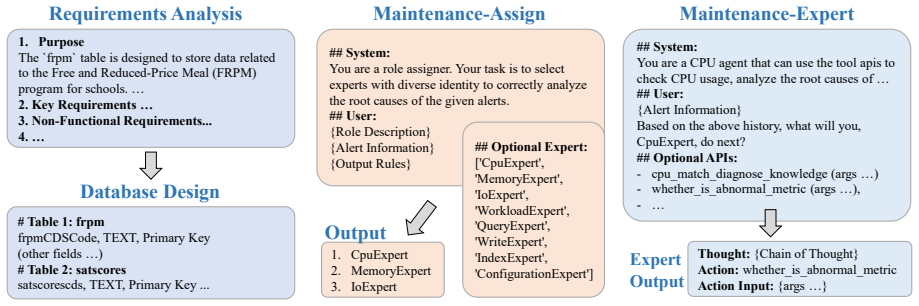
The core artifact is DBLifeBench itself: a five-phase task suite with per-phase metrics (ACC entity/type/key, T-Level/F-Level table and field accuracy, Execution Accuracy and Graph Execution Accuracy, debugging pass rate, maintenance assignment and tool-call accuracy). The load-bearing mechanism for the Operation phase is the SQL Reasoning Graph in Progressive-Text2SQL: nodes are sub-task SQL fragments with natural-language descriptions, edges are logical dependencies, and the final node is the full query. A two-stage validation pipeline (SQLite execution plus human graph reconstruction with Fleiss' kappa) ensures the graphs are executable and structurally agreed-upon.
What would settle it
Re-annotate a random sample of design, debugging, and maintenance tasks with independent database experts and check inter-rater agreement; if agreement is low or the metric scores do not track expert judgment, the benchmark's rankings are called into question. Additionally, take a base model and compare it to the same model fine-tuned on SQL data on design and maintenance; if the fine-tuned version does not score worse, the forgetting claim fails. A further check: recompute ACCi-Entity with precision-aware scoring; if model rankings reshuffle, the metric is not stable.
Extended reading notes
Core claim
The paper's central discovery is that evaluating LLMs on a single Text-to-SQL task overstates their readiness for real database administration. DBLifeBench covers Design (schema entity/type/key accuracy), Implementation (executable DDL), Operation (standard Text2SQL plus Progressive-Text2SQL with graph-structured reasoning), Debugging (repairing flawed SQL), and Maintenance (expert assignment and tool-use diagnosis). Across these phases, general-purpose models like GPT-4o show balanced scores, whereas SQL-fine-tuned models such as SQLCoder collapse in implementation and maintenance, and Llama3-sqlcoder degrades in design. The paper attributes this to task-specific fine-tuning that overfits s
Load-bearing premise
The central finding assumes the benchmark's annotations and metrics faithfully capture database skills, and that the gap between specialized and general models is caused by fine-tuning; if the labels are unreliable or the gap reflects base-model differences, the 'catastrophic forgetting' conclusion does not follow.
Editorial extensions
If this is right
- Benchmark suites for LLM database ability should cover the full lifecycle, not just query generation, or they will miss systematic capability gaps.
- Fine-tuning a general model on SQL or code data can actively reduce performance in non-coding database phases such as design and maintenance.
- Structured, step-by-step reasoning graphs improve execution accuracy on complex SQL and make model performance more robust to schema variations.
- Model rankings change substantially when non-SQL tasks are included, so leaderboards based only on Text-to-SQL do not reflect real database usefulness.
Reading between the lines
- The 'catastrophic forgetting' conclusion would be stronger if the same model were compared before and after its SQL fine-tuning; the paper's design compares specialized against general models, so confounding factors like base-model size or pre-training data are not fully controlled.
- The design-phase metrics use a recall-style formula (predicted set in numerator over ground-truth set in denominator), so models that output many plausible entities can inflate scores; a precision-aware variant would give a more balanced view.
- Because the maintenance Expert scores are uniformly low, the current benchmark may be more useful as a floor for tool-use capability than as a ranking instrument; future versions could increase the share of easily-verifiable API-call outcomes.
Editorial analysis
A structured set of objections, weighed in public.
Referee Report
Summary. The paper introduces DBLifeBench, a benchmark intended to evaluate LLMs across five database lifecycle phases (Design, Implementation, Operation, Debugging, Maintenance) rather than Text2SQL alone. It also proposes Progressive-Text2SQL (P-Text2SQL), a task that augments complex SQL queries with LLM-generated, human-validated reasoning graphs. The authors report experiments on 11 models, claiming that general-purpose models show balanced performance while specialized Text-to-SQL models exhibit 'catastrophic forgetting' in non-coding phases such as design and maintenance.
Significance. If validated, DBLifeBench would fill a real gap: existing benchmarks like Spider and BIRD do not cover schema design, debugging, or maintenance. The P-Text2SQL graph construction, with Fleiss' kappa and explicit human validation, is a useful step toward structured reasoning evaluation. However, the headline conclusion about catastrophic forgetting is not supported by the experimental design, and the P-Text2SQL comparison in Figure 4 is biased by construction. The benchmark itself may still be a useful community resource, but the paper's central claims require substantial reworking.
major comments (5)
- [§4.3, Abstract, Table 2] The claim that specialized Text-to-SQL models suffer 'catastrophic forgetting' in design and maintenance is not supported by the reported experiments. No model is compared before and after its SQL/code fine-tuning; Table 2 compares independently trained models of different families, sizes, and pretraining data. For example, SQLCoder and Llama3-sqlcoder are not shown alongside their base checkpoints, and DeepSeek-Coder is code-fine-tuned, not SQL-fine-tuned. Lower scores on design/maintenance could be due to architecture, model size, or base capabilities. A paired base-vs-fine-tuned comparison is necessary to attribute any difference to fine-tuning. This is load-bearing because the abstract and conclusion state this as the central empirical finding.
- [§2.2.2, §5.3, Figure 4, Table 2] The P-Text2SQL dataset is constructed by deliberately selecting 'examples from Text2SQL that are more difficult and where the misalignment between the natural language description and SQL has been manually identified.' Therefore, comparing P-Text2SQL EX against the full Text2SQL set, as in Figure 4(a), is biased: the two sets are not matched in difficulty. Moreover, Table 2 shows that in the main experiment P-Text2SQL scores are lower than Text2SQL for several models (e.g., GPT-4o: 53.79 vs 56.19; DeepSeek: 26.81 vs 17.54? Actually DeepSeek is 26.81 vs 17.54, higher; but GPT-4o and ChatGLM-4 are lower). This contradicts the blanket statement in §5.3 that 'graphs significantly improve the Execution Accuracy of all baseline models.' The authors must report a comparable, matched evaluation and clarify the discrepancy between the main results and Figure 4.
- [§3, Eq. (1)] The design-phase metric ACCi-Entity (and analogously ACCi-Data and ACCi-Key) uses the denominator |E_t|, which the text defines as the set of entity names predicted by the model, not the ground truth. Thus it is a precision measure, not an accuracy or recall measure. A model can inflate the score by outputting very few, high-confidence entities. Additionally, the default value i=2 is arbitrary, and Figure 5 changes i without explaining whether the metric is recomputed identically. Since design-phase rankings in Table 2 rely on this metric, the design conclusions are not robust.
- [§5.4, Table 4] The robustness numbers are inconsistent with the main results. For example, Llama3 Text2SQL is 30.51 in Table 2 but 28.85 in Table 4; Llama3 P-Text2SQL is 45.63 in Table 2 but 46.76 in Table 4; Llama3-sqlcoder P-Text2SQL is 39.43 in Table 2 but 44.03 in Table 4. The paper does not explain whether Table 4 uses the same examples, a subset, or different settings. Without this clarification, the claim that perturbed graphs 'still outperform baseline Text2SQL' is not interpretable.
- [§4.1, Table 2] The 'specialized' category mixes SQL-fine-tuned models (SQLCoder, Llama3-sqlcoder) with code-fine-tuned models (DeepSeek-Coder, CodeQwen). The 'curse of specialization' argument conflates these distinct types of fine-tuning. The analysis and conclusions should be restricted to the SQL-specialized models, or the difference between SQL and code specialization should be explicitly discussed.
minor comments (6)
- [§3, Eq. (1)] The notation for E_t and \hat{E}_t is confusingly defined in the text: the sentence says '\hat{E}_t represents the ground-truth set' and 'E_t represents the set of entity names predicted' but the equation then uses |E_t| in the denominator. Please define both clearly and check direction of the analogy for ACCi-Data and ACCi-Key.
- [§5.1, Table 3] The coefficient-of-variation values for Qwen2.5 and CodeQwen are identical (13.42 and 5.80) though the models differ; this looks like a copy/paste error. Also the row labels in Table 3 model names are inconsistent with the rest of the paper (e.g., 'DeepSeek-Coder' appears while the earlier tables use 'DeepSeek-Coder' and 'CodeQwen').
- [§5.3, Figure 4(b)] The 'growth rate' computation is not defined. State whether it is (P-Text2SQL EX - Text2SQL EX)/Text2SQL EX, and report the underlying EX values for simple/moderate/challenging splits.
- [§2.2.1, Table 1] The dataset statistics table has a formatting artifact: the 'P2' entry in the P1 row appears to be a cell overflow. Also the number of examples for Text2SQL (1,534) and P-Text2SQL (1,149) should be accompanied by the number of databases and domains to assess diversity.
- [§4.3, 'Some models lack the ability...'] The claim that DeepSeek 'lacks' multi-round debugging ability is based on no improvement in Table 2, but the paper does not report statistical significance or variance across runs. Since temperature is 0.3 and top-p 0.2, a single run may not be reliable.
- [Limitations] The Limitations section concedes that 'some tasks, particularly in design and maintenance, may be challenging to define and evaluate accurately.' This is in tension with the strength of the conclusions drawn from those phases and should be integrated into the main discussion.
Circularity Check
Progressive-Text2SQL's benefit is built in: the graph input contains the gold SQL, so the reported EX improvement is by construction.
-
self definitional
[Section 2.2.2 / Appendix A.2 (graph construction prompt) and Section 5.3 (result)]
"Each node in the graph represents a SQL statement , which is a subsequence of a given SQL statement , and the edge represents the execution order . ... Subsequent nodes are the progression of the previous node . ( please attention the last node should be the original given SQL statement . )"
The P-Text2SQL reasoning graph is constructed from the gold SQL itself: nodes are SQL subsequences and the final node is forced to be the original statement. The task input (Listing 4) then exposes each node's 'sql statement' verbatim. Thus the model is given the answer decomposed, and any EX improvement over Text2SQL, where SQL must be generated from scratch, is guaranteed by information leakage. Section 5.3's conclusion that graphs 'effectively simulate incremental user input' and improve reasoning is therefore circular: the incremental input is the gold SQL itself. This does not by itself invalidate the distinct 'catastrophic forgetting' comparison, but it makes the P-Text2SQL contribution self-confirming.
full rationale
The paper's headline 'catastrophic forgetting' claim is not circular: it is a cross-sectional comparison of specialized vs. general models, and while it lacks a before/after fine-tuning control, that is a validity/confound issue, not a reduction of the conclusion to the inputs. No self-citation chain or uniqueness theorem is load-bearing. The one genuine circularity is in the Progressive-Text2SQL evaluation: the graph given to models is literally constructed from the target SQL, with the final node being the original SQL, and the prompt includes the node-level SQL fragments. Therefore the finding in Section 5.3 that graphs improve EX is forced by construction rather than being independent evidence for the reasoning-graph approach. The limitations section correctly acknowledges that design/maintenance tasks are hard to evaluate, and the inter-annotator agreement provides external validation for graph structure, but it does not remove the leakage of the gold SQL into the task input. Overall, partial circularity in a secondary contribution, while the central forgetting claim has independent (though imperfectly supported) content.
Assumptions & free parameters
free parameters (2)
- Default number of tables i in design metrics =
2
- Jaccard consensus threshold for graph validation =
0.8
assumptions (4)
- domain assumption SQL execution in SQLite is a valid proxy for semantic correctness of generated SQL.
- domain assumption The ground-truth schemas, SQL queries, and expert assignment labels are correct and unambiguous.
- ad hoc to paper The reasoning graphs generated by LLMs and validated by graduate students faithfully decompose the original SQL logic.
- ad hoc to paper Performance differences between specialized and general models are caused by SQL fine-tuning rather than model family, size, or training data.
Cite this review
Pith. "Pith review of Evaluating LLMs in Database Scenarios: A Lifecycle Benchmark for Assessing Their Potential in Core Database Tasks." pith.science (2026). https://pith.science/paper/6KQKUIOZ
@misc{pith2026260803794,
  author       = {Pith},
  title        = {Pith review of: Evaluating LLMs in Database Scenarios: A Lifecycle Benchmark for Assessing Their Potential in Core Database Tasks},
  year         = {2026},
  howpublished = {\url{https://pith.science/paper/6KQKUIOZ}},
  note         = {Machine review of arXiv:2608.03794}
}
read the original abstract
Large Language Models (LLMs) are transforming database interaction paradigms, evolving from simple query translators to autonomous database administrators (DBAs). However, current evaluation benchmarks remain disproportionately fixated on Text-to-SQL tasks, neglecting the holistic Database Lifecycle-from initial schema design to post-deployment maintenance. This narrow focus fails to capture the diverse capabilities required for real-world database management. To bridge this gap, we introduce DBLifeBench, the first benchmark to evaluate LLMs across five critical lifecycle phases: Design, Implementation, Operation, Debugging, and Maintenance. Furthermore, addressing the cognitive mismatch between ambiguous natural language and complex SQL logic, we propose Progressive-Text2SQL, a novel task utilizing structured reasoning graphs to mimic human iterative problem-solving. Our extensive evaluation reveals a critical insight: while general-purpose models demonstrate balanced performance, specialized Text-to-SQL models suffer from ``catastrophic forgetting'' in non-coding phases like design and maintenance. DBLifeBench serves as a foundational step toward evaluating and building true full-stack database intelligence.
Figures


Figures from the paper (3 more)


Reference graph
Works this paper leans on
-
[1]
arXiv preprint arXiv:2406.08426 , year=
Next-Generation Database Interfaces: A Survey of LLM-based Text-to-SQL , author=. arXiv preprint arXiv:2406.08426 , year=
-
[2]
arXiv preprint arXiv:2402.02643 , year=
LLM-Enhanced Data Management , author=. arXiv preprint arXiv:2402.02643 , year=
-
[3]
SURGENT: A Surgical Multi-Agent Assistance System Across the Perioperative Workflow
SURGENT: A Surgical Multi-Agent Assistance System Across the Perioperative Workflow , author=. arXiv preprint arXiv:2605.29368 , year=
-
[4]
Reinforcement Learning for Large Language Model Selective Evidence Adoption from Contaminated Retrieval Results , author=. arXiv preprint arXiv:2607.20090 , year=
-
[5]
arXiv preprint arXiv:2605.00136 , year=
Are tools all we need? unveiling the tool-use tax in llm agents , author=. arXiv preprint arXiv:2605.00136 , year=
-
[6]
A Survey on Evaluating Quality and Trustworthiness in LLM-Generated Data , author=. 2026 , eprint=
work page 2026
-
[7]
Proceedings of the VLDB Endowment , volume=
LLM for Data Management , author=. Proceedings of the VLDB Endowment , volume=. 2024 , publisher=
work page 2024
-
[8]
Data Science and Engineering , volume=
Db-gpt: Large language model meets database , author=. Data Science and Engineering , volume=. 2024 , publisher=
2024
Show all 25 references
-
[9]
S pider: A Large-Scale Human-Labeled Dataset for Complex and Cross-Domain Semantic Parsing and Text-to- SQL Task
Yu, Tao and Zhang, Rui and Yang, Kai and Yasunaga, Michihiro and Wang, Dongxu and Li, Zifan and Ma, James and Li, Irene and Yao, Qingning and Roman, Shanelle and Zhang, Zilin and Radev, Dragomir. S pider: A Large-Scale Human-Labeled Dataset for Complex and Cross-Domain Semanti...
2018 doi
-
[10]
2023 , eprint=
Can LLM Already Serve as A Database Interface? A BIg Bench for Large-Scale Database Grounded Text-to-SQLs , author=. 2023 , eprint=
2023
-
[11]
arXiv preprint arXiv:2403.02951 , year=
Benchmarking the text-to-sql capability of large language models: A comprehensive evaluation , author=. arXiv preprint arXiv:2403.02951 , year=
-
[12]
NeurIPS 2023 Foundation Models for Decision Making Workshop , year=
Tptu: Task planning and tool usage of large language model-based ai agents , author=. NeurIPS 2023 Foundation Models for Decision Making Workshop , year=
2023
-
[13]
2023 , eprint=
TPTU-v2: Boosting Task Planning and Tool Usage of Large Language Model-based Agents in Real-world Systems , author=. 2023 , eprint=
2023
-
[14]
Proceedings of the national conference on artificial intelligence , pages=
Learning to parse database queries using inductive logic programming , author=. Proceedings of the national conference on artificial intelligence , pages=
-
[15]
arXiv preprint arXiv:1711.04436 , year=
Sqlnet: Generating structured queries from natural language without reinforcement learning , author=. arXiv preprint arXiv:1711.04436 , year=
-
[16]
Yaghmazadeh, Navid and Wang, Yuepeng and Dillig, Isil and Dillig, Thomas , title =. Proc. ACM Program. Lang. , month = oct, articleno =. 2017 , issue_date =. doi:10.1145/3133887 , abstract =
2017 doi
-
[17]
Handbook of linguistic annotation , pages=
Inter-annotator agreement , author=. Handbook of linguistic annotation , pages=. 2017 , publisher=
2017
-
[18]
DATABASE DEVELOPMENT LIFE CYCLE , volume =
Gupta, Pranshu and Mata-Toledo, Ramon and Monger, Morgan , year =. DATABASE DEVELOPMENT LIFE CYCLE , volume =
-
[19]
Statistical methods for rates and proportions , volume=
The measurement of interrater agreement , author=. Statistical methods for rates and proportions , volume=. 1981 , publisher=
1981
-
[20]
arXiv preprint arXiv:2402.08349 , year=
Evaluating the data model robustness of text-to-SQL systems based on real user queries , author=. arXiv preprint arXiv:2402.08349 , year=
-
[21]
Clinical and Vaccine Immunology , volume=
Use of coefficient of variation in assessing variability of quantitative assays , author=. Clinical and Vaccine Immunology , volume=. 2002 , publisher=
2002
-
[22]
2024 , eprint=
Spider 2.0: Evaluating Language Models on Real-World Enterprise Text-to-SQL Workflows , author=. 2024 , eprint=
2024
-
[23]
arXiv preprint arXiv:1909.05378 , year=
Cosql: A conversational text-to-sql challenge towards cross-domain natural language interfaces to databases , author=. arXiv preprint arXiv:1909.05378 , year=
1909 arXiv
-
[24]
Proceedings of the VLDB Endowment , volume=
Sqlstorm: Taking database benchmarking into the llm era , author=. Proceedings of the VLDB Endowment , volume=. 2025 , publisher=
2025
-
[25]
Proceedings of the 31st ACM SIGKDD Conference on Knowledge Discovery and Data Mining V
Revolutionizing Database Q&A with Large Language Models: Comprehensive Benchmark and Evaluation , author=. Proceedings of the 31st ACM SIGKDD Conference on Knowledge Discovery and Data Mining V. 2 , pages=
Reviewed August 5, 2026 · model on record in the stance chip above.
Discussion (0). Sign in to comment.