REVIEW 4 major objections 5 minor 48 references
GeoMAR restores blurry faces by first reading geometry, then refining codes stepwise.
Reviewed by Pith at T0; open to challenge. T0 means a machine referee read the full paper against a public rubric. the ladder, T0–T4 →
T0 review · deepseek-v4-flash
2026-08-05 05:40 UTC pith:DXXPHZTR
load-bearing objection The MAR module is a genuinely useful plug-in, but the paper's own Table 6 shows DAEFR+MAR beats full GeoMAR on two benchmarks, so the geometric-prior framing is not supported by the reported numbers. the 4 major comments →
GeoMAR: Unleashing Geometrically Aligned Features for Masked Autoregressive Blind Face Restoration
The pith
A machine-rendered reading of the paper's core claim, the machinery that carries it, and where it could break.
Core claim
The paper claims that blind face restoration improves when the conditioning features are geometrically aligned and when prediction is multi-step. A dual-input extraction pipeline feeds a VLM both the degraded RGB image and a face-parsing map, forcing it to generate component-wise geometric descriptions (shape, open/closed state, relative size) anchored to the parsing map while appearance attributes (color, texture) come from the RGB image. These text embeddings are integrated with low-quality visual features through an Aligned Geometric Priors Injector that modulates features via Spatial Feature Transform (SFT) and then uses the prior-aligned features as queries in a KV-Q exchange cross-atte
What carries the argument
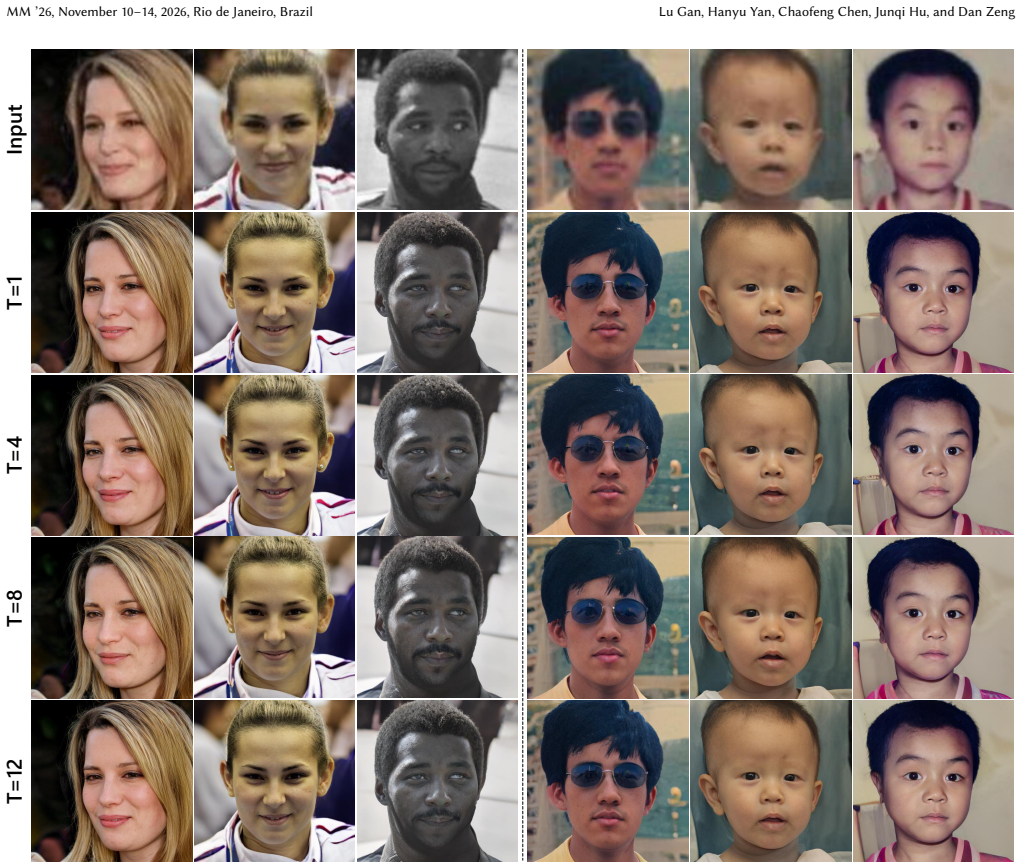
The central object is the Aligned Geometric Priors Injector with a KV-Q exchange strategy, together with the Masked Autoregressive (MAR) token prediction module. The injector uses a dual-input VLM (RGB image plus parsing map) to produce component-wise geometric text priors, encodes them with Flan-T5, then applies a Spatial Feature Transform (SFT) to modulate LQ features and a cross-attention where the SFT-enhanced features form Q and the original LQ features form K,V. The MAR transformer, following MaskGIT, iteratively masks and regenerates the least-confident tokens over 8 steps with a cosine schedule, conditioned on the output of the injector.
Load-bearing premise
The pipeline assumes the parsing map produced from the degraded image is reliable enough to anchor the VLM's geometric descriptions, so that incorrect geometry does not poison the conditioning features.
What would settle it
Run GeoMAR on the CelebA-Test FID=144 setting but with the parsing map explicitly corrupted (e.g., swapping eyes and mouth regions). If FID does not degrade substantially relative to removing the geometric prior entirely, the geometric prior is not the source of the gain; alternatively, if using ground-truth parsing (already shown: 39.07 vs 39.61) yields only marginal improvement, the geometric prior's contribution is small.
If this is right
- Blind face restoration systems can gain from explicit geometric language priors that survive severe degradation better than raw visual features.
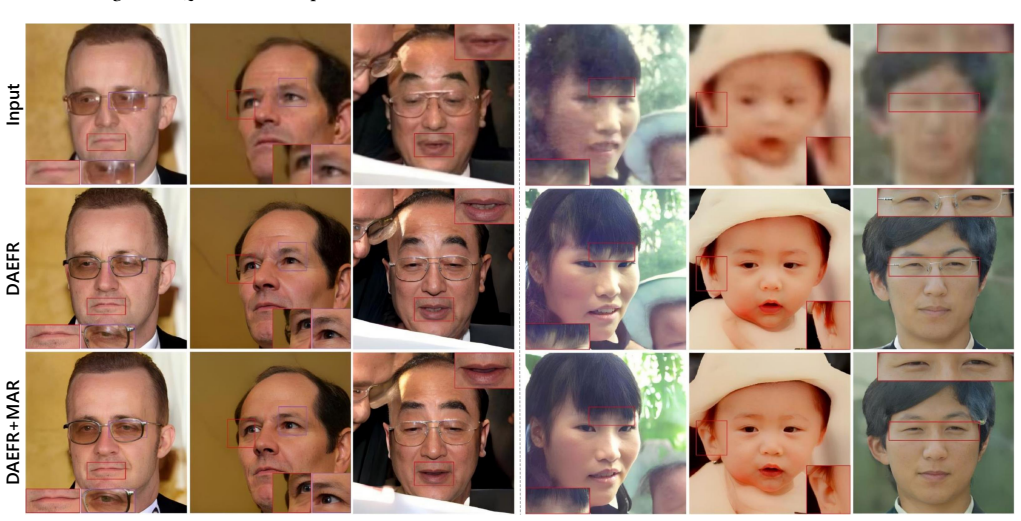
- The masked autoregressive refinement module is plug-and-play and yields consistent FID improvements over one-step codebook methods, e.g., DAEFR improves from 47.69 to 45.77 FID on LFW-Test.
- Because the geometric priors come from a VLM with a parsing map, future work can extend this to occlusion-aware parsing and confidence-guided prior selection.
- The approach suggests that the common one-step code estimation paradigm is comparatively fragile under severe degradation, challenging a core design choice in existing codebook-based BFR systems.
Where Pith is reading between the lines
- If the geometric-prior extractor is the true gain source, then a cheaper surrogate (e.g., a parsing-map-conditioned embedding) might replace the VLM text description without much loss, since the paper itself shows low sensitivity to the VLM choice.
- The KV-Q exchange design may have broader relevance: any image restoration pipeline with severely corrupted features could benefit from using semantically enriched features as queries while keeping the original features as key/value to avoid prior overriding.
- The paper's own ablation suggests that while geometric priors help, the largest single gain comes from MAR; a pure MAR-based BFR system without text priors might capture much of the improvement at lower cost.
- If the codebook is the bottleneck for fine-grained accessories, extending MAR to operate on a learned continuous latent (instead of discrete codes) could preserve the iterative-refinement advantage while avoiding codebook capacity limits.
Editorial analysis
A structured set of objections, weighed in public.
Referee Report
Summary. GeoMAR is a codebook-based blind face restoration method that combines (i) a dual-input VLM/parsing-map pipeline that produces component-level geometric text descriptions and injects them through an SFT + KV-Q-exchange cross-attention injector, and (ii) a MaskGIT-style masked autoregressive (MAR) transformer that iteratively refines VQ codebook predictions over T steps. The paper evaluates on CelebA-Test, LFW-Test, WebPhoto-Test, and WIDER-Test, reporting FID/NIQE/MANIQA and, on synthetic data, PSNR/SSIM/LMD. The central claim is that the geometric priors and MAR refinement synergistically improve perceptual quality over one-step codebook restoration. The manuscript includes extensive ablations, generalization of MAR to DAEFR and CodeFormer, and detailed supplementary architecture and latency information.
Significance. If the claims are sustained, the paper would make two useful contributions to codebook-based blind face restoration: a structured VLM-based geometric prior that is spatially grounded via parsing maps, and a MAR-based multi-step token refinement that transfers from MaskGIT to the restoration setting. The work has several strengths: the plug-and-play MAR experiments on DAEFR and CodeFormer are informative, the supplementary provides concrete architecture and parameter breakdowns, the authors are transparent about failure cases and latency, and code is promised. However, the central value proposition is currently not established because the most relevant baseline, DAEFR+MAR, is omitted from the main comparison and in fact outperforms the full GeoMAR pipeline on two of the three real-world benchmarks in Table 6.
major comments (4)
- [Tables 1, 2 and 6; Section 4.2] The strongest competing configuration, DAEFR+MAR, is absent from Tables 1 and 2, which is the basis for the main quantitative claims. Table 6 shows DAEFR+MAR achieves FID 45.77 on LFW-Test and 73.13 on WebPhoto-Test, both better than full GeoMAR (46.87 and 75.73). Consequently, the sentence in Section 4.2 that GeoMAR 'achieves the lowest FID on WebPhoto-Test (75.73)' is contradicted by the paper's own Table 6. Similarly, DAEFR without MAR (47.69 LFW, 75.79 WebPhoto) beats GeoMAR without MAR (53.42, 76.81), so the performance of the full system is not attributable to the geometric priors alone. DAEFR+MAR must be added to the main tables and the discussion revised accordingly.
- [Tables 3 and 6; Section 4.3] The ablation in Table 3 starts from a one-step model with generic caption-style priors (model (a), FID 42.38 on CelebA-Test), but Table 6 shows that a much stronger base model, DAEFR without any geometric prior, already gives LFW FID 47.69 while GeoMAR without MAR gives 53.42. This means the 'synergy' attributed to geometric priors plus MAR in Section 4.3 may be an artifact of the weak baseline used in the ablation. The paper should report a factorial ablation on the DAEFR and/or CodeFormer backbone: base, base+Geo, base+MAR, base+Geo+MAR, and the same ladder for GeoMAR's backbone. Without this, the claim that geometric priors are beneficial, rather than merely the MAR module applied to a stronger base, is unsupported.
- [Section 4.1; Tables 1 and 2] No uncertainty quantification is given for any metric. Several of the reported advantages are extremely small: WebPhoto FID is 75.73 vs. 75.79 for DAEFR (0.06), NIQE is 3.930 vs. 3.933 (0.003), and LFW FID is 46.87 vs. 47.53 for DAEFR (0.66). FID estimates on a single test set are subject to sampling noise, and the paper does not report standard deviations, confidence intervals, or multiple seeds. The authors should provide repeated-run statistics or, at minimum, report the established variance for these benchmarks, and should avoid drawing conclusions from differences below the noise level.
- [Fig. 8; Section 5; Supplementary Table 15] The oracle experiment with ground-truth parsing maps improves CelebA-Test FID only from 39.61 to 39.07 (0.54), which weakens the paper's emphasis on geometric-prior reliability. The authors do acknowledge in Section 5 that extreme occlusions break the dual-input assumption and can cause input-inconsistent restorations, and the supplementary failure cases in Fig. 11 confirm this. This limitation is acceptable if framed as a scope restriction, but the main text currently claims robustness on the basis of a very small oracle gain. Please integrate the component-dropout robustness study from the supplementary into the main evaluation and discuss how small the upper bound of the geometric prior actually is.
minor comments (5)
- [Table 1 and Section 4.1 (Implementation details)] The 'Time (s)' column reports 0.24† for GeoMAR, which excludes the 3.63s VLM prompt generation and 0.03s BiSeNet parsing, while Section 4.1 gives a total end-to-end latency of 3.91s. The table caption should state clearly which pipeline stages are included; otherwise the comparison with methods that report full end-to-end time is misleading.
- [Table 4] The column layout of Table 4 is hard to read, particularly the WebPhoto-Test block: the values 75.85, 77.74, 75.73 appear under 'w/o', 'concat-style', 'Ours' but the ordering is ambiguous. Please reformat with explicit column headers.
- [Fig. 8] The star marker denoting the 'upper-bound' GT-parsing setting is used in the figure but not defined in the caption or text; please name it explicitly in the caption and in Section 4.4.
- [Eq. (5)-Eq. (8)] The text says λ_feat is empirically set to 10, but no sensitivity analysis around this value is provided. Since L_feat is a central part of the injector training, a one-line discussion of its sensitivity would be useful.
- [Supplementary Table 11] The CodeFormer+MAR results are reported in the supplementary but not in the main paper; given that Table 6 is central to the claims, at least a mention of CodeFormer+MAR in the main text would help the reader assess the generality of MAR.
Circularity Check
No circularity: the geometric-prior and MAR conditioning chain is a supervised function of the LQ input; the only self-citation is non-load-bearing.
full rationale
The derivation chain is not circular by construction. The geometric priors are obtained by a VLM conditioned on the LQ image and its predicted parsing map, i.e., functions of the observed input, not of the target HQ code sequence. Eq. (8) trains the MAR transformer to predict masked HQ tokens from the masked sequence and Z_enh under negative log-likelihood; Z_enh itself is trained against the frozen codebook features via Eq. (7) with stop-gradient, so the output is not defined as the input. The claimed synergy in Table 3 is an empirical interaction (FID 42.38 -> 42.23 with priors, 42.36 with MAR, 39.61 with both), not an identity. The self-citation is limited to a related-work list entry [3] (PSFRGAN) that is not used in any ablation, baseline table, or derivation; it is not load-bearing. The omission of DAEFR+MAR from the main tables is a comparison-quality concern, and the small gain from GT vs predicted parsing (39.61 vs 39.07, Fig. 8) concerns effectiveness, not circularity. No fitted parameter is renamed as a prediction, and no uniqueness claim or ansatz is imported from the authors' prior work.
Axiom & Free-Parameter Ledger
free parameters (5)
- lambda_feat =
10
- refinement steps T =
8
- contrastive temperature tau =
init 0.07, learnable
- masking ratio schedule gamma(r) =
cos(pi/2 * r)
- number of T5 text tokens =
128
axioms (5)
- domain assumption The frozen VQGAN codebook from DAEFR is a sufficient discrete face prior for restoring HQ faces.
- domain assumption BiSeNet parsing maps of degraded inputs provide spatially faithful geometric anchors.
- domain assumption Qwen3-VL-8B-Instruct produces accurate component-based descriptions when prompted with RGB plus parsing map.
- ad hoc to paper SFT-modulated LQ features are better cross-attention queries than raw LQ features (KV-Q exchange).
- ad hoc to paper MaskGIT's cosine masking schedule transfers to BFR token prediction.
Cite this review
Pith. "Pith review of GeoMAR: Unleashing Geometrically Aligned Features for Masked Autoregressive Blind Face Restoration." pith.science (2026). https://pith.science/paper/DXXPHZTR
@misc{pith2026260803923,
  author       = {Pith},
  title        = {Pith review of: GeoMAR: Unleashing Geometrically Aligned Features for Masked Autoregressive Blind Face Restoration},
  year         = {2026},
  howpublished = {\url{https://pith.science/paper/DXXPHZTR}},
  note         = {Machine review of arXiv:2608.03923}
}
read the original abstract
Codebook-based blind face restoration (BFR) often suffers from ambiguous conditioning features and a fragile prediction mechanism under severe degradation. To address these challenges, we propose GeoMAR, a framework designed to unleash geometrically aligned features with masked autoregressive (MAR) refinement for robust face restoration. For feature conditioning, we introduce a dual-input extraction pipeline to extract component-based geometric descriptions with explicit, spatially faithful anchors. These textual priors are integrated with low-quality (LQ) features via an Aligned Geometric Priors Injector, which employs a KV-Q exchange strategy to generate geometrically aligned features. For prediction mechanism, we reformulate the one-step mapping into a multi-step MAR process. This coarse-to-fine generation progressively refines complex facial regions based on increasingly reliable context. Experiments on one synthetic and three real-world benchmarks demonstrate that GeoMAR achieves highly competitive perceptual quality and coherent visual structures compared with existing methods. The code is available at https://github.com/BRL-SYSU/GeoMAR.git.
Figures





Reference graph
Works this paper leans on
-
[1]
Shuai Bai, Yuxuan Cai, Ruizhe Chen, Keqin Chen, Xionghui Chen, Zesen Cheng, Lianghao Deng, Wei Ding, Chang Gao, Chunjiang Ge, and et al. 2025. Qwen3-VL Technical Report.arXiv preprint arXiv:2511.21631(2025)
Pith/arXiv arXiv 2025
-
[2]
Huiwen Chang, Han Zhang, Lu Jiang, Ce Liu, and William T Freeman. 2022. Maskgit: Masked generative image transformer. InProceedings of the IEEE/CVF Conference on Computer Vision and Pattern Recognition. 11315–11325
work page 2022
-
[3]
Chaofeng Chen, Xiaoming Li, Lingbo Yang, Xianhui Lin, Lei Zhang, and Kwan- Yee K Wong. 2021. Progressive semantic-aware style transformation for blind face restoration. InProceedings of the IEEE/CVF Conference on Computer Vision and Pattern Recognition. 11896–11905
work page 2021
-
[4]
Mark Chen, Alec Radford, Rewon Child, Jeffrey Wu, Heewoo Jun, David Luan, and Ilya Sutskever. 2020. Generative Pretraining From Pixels. InProceedings of the 37th International Conference on Machine Learning. 1691–1703
2020
-
[5]
Hyung Won Chung, Le Hou, Shayne Longpre, Barret Zoph, Yi Tay, William Fedus, Yunxuan Li, Xuezhi Wang, Mostafa Dehghani, Siddhartha Brahma, et al. 2024. Scaling instruction-finetuned language models.Journal of Machine Learning Research25, 70 (2024), 1–53
2024
-
[6]
Jacob Devlin, Ming-Wei Chang, Kenton Lee, and Kristina Toutanova. 2019. Bert: Pre-training of deep bidirectional transformers for language understanding. In Proceedings of the 2019 conference of the North American chapter of the association for computational linguistics: human language technologies, volume 1 (long and short papers). 4171–4186
2019
-
[7]
Patrick Esser, Robin Rombach, and Bjorn Ommer. 2021. Taming transformers for high-resolution image synthesis. InProceedings of the IEEE/CVF Conference on Computer Vision and Pattern Recognition. 12873–12883
work page 2021
-
[8]
Yuchao Gu, Xintao Wang, Liangbin Xie, Chao Dong, Gen Li, Ying Shan, and Ming-Ming Cheng. 2022. Vqfr: Blind face restoration with vector-quantized dictionary and parallel decoder. InEuropean Conference on Computer Vision. Springer, 126–143
work page 2022
-
[9]
Martin Heusel, Hubert Ramsauer, Thomas Unterthiner, Bernhard Nessler, and Sepp Hochreiter. 2017. Gans trained by a two time-scale update rule converge to a local nash equilibrium. InAdvances in Neural Information Processing Systems, Vol. 30
work page 2017
-
[10]
Yujie Hu, Yinhuai Wang, and Jian Zhang. 2023. Dear-gan: Degradation-aware face restoration with gan prior.IEEE Transactions on Circuits and Systems for Video Technology33, 9 (2023), 4603–4615
work page 2023
-
[11]
Gary B Huang, Marwan Mattar, Tamara Berg, and Eric Learned-Miller. 2008. La- beled faces in the wild: A database for studying face recognition in unconstrained environments. InWorkshop on Faces in’Real-Life’Images: Detection, Alignment, and Recognition
work page 2008
-
[12]
Aiwen Jiang, Zhi Wei, Long Peng, Feiqiang Liu, and Mingwen Wang. 2026. Dalpsr: Leverage degradation-aligned language prompt for real-world image super-resolution.Image and Vision Computing170 (2026), 105978
work page 2026
-
[13]
Tero Karras, Timo Aila, Samuli Laine, and Jaakko Lehtinen. 2018. Progressive growing of gans for improved quality, stability, and variation. InProceedings of International Conference on Learning Representations
work page 2018
-
[14]
Tero Karras, Samuli Laine, and Timo Aila. 2019. A style-based generator ar- chitecture for generative adversarial networks. InProceedings of the IEEE/CVF conference on computer vision and pattern recognition. 4401–4410
2019
-
[15]
Kingma and Jimmy Ba
Diederik P. Kingma and Jimmy Ba. 2015. Adam: A Method for Stochastic Opti- mization. InInternational Conference on Learning Representations
2015
- [16]
-
[17]
Guoqiang Liang, Qingnan Fan, Bingtao Fu, Jinwei Chen, Hong Gu, and Lin Wang
-
[18]
Wanglong Lu, Jikai Wang, Tao Wang, Kaihao Zhang, Xianta Jiang, and Hanli Zhao. 2025. Visual style prompt learning using diffusion models for blind face restoration.Pattern Recognition161 (2025), 111312
work page 2025
-
[19]
Xiaobin Lu, Xiaobin Hu, Jun Luo, Ben Zhu, Yaping Ruan, and Wenqi Ren. 2024. 3d priors-guided diffusion for blind face restoration. InProceedings of the 32nd ACM International Conference on Multimedia. 1829–1838
work page 2024
-
[20]
Sachit Menon, Alexandru Damian, Shijia Hu, Nikhil Ravi, and Cynthia Rudin
-
[21]
Anish Mittal, Rajiv Soundararajan, and Alan C. Bovik. 2013. Making a “completely blind” image quality analyzer.IEEE Signal Processing Letters20, 3 (2013), 209–212
work page 2013
-
[22]
Alec Radford, Jong Wook Kim, Chris Hallacy, Aditya Ramesh, Gabriel Goh, Sandhini Agarwal, Girish Sastry, Amanda Askell, Pamela Mishkin, Jack Clark, Gretchen Krueger, and Ilya Sutskever. 2021. Learning transferable visual mod- els from natural language supervision. InInternational conference on machine learning. PMLR, 8748–8763
work page 2021
-
[23]
Sucheng Ren, Qihang Yu, Ju He, Xiaohui Shen, Alan Yuille, and Liang-Chieh Chen. 2025. Beyond next-token: Next-x prediction for autoregressive visual generation. InProceedings of the IEEE/CVF International Conference on Computer Vision. 15781–15791
work page 2025
-
[24]
Robin Rombach, Andreas Blattmann, Dominik Lorenz, Patrick Esser, and Björn Ommer. 2022. High-resolution image synthesis with latent diffusion models. In Proceedings of the IEEE/CVF conference on computer vision and pattern recognition. 10684–10695
2022
-
[25]
Keyu Tian, Yi Jiang, Zehuan Yuan, Bingyue Peng, and Liwei Wang. 2024. Visual autoregressive modeling: Scalable image generation via next-scale prediction. In Proceedings of the 38th International Conference on Neural Information Processing Systems. 84839–84865
work page 2024
-
[26]
Yu-Ju Tsai, Yu-Lun Liu, Lu Qi, Kelvin C.K. Chan, and Ming-Hsuan Yang. 2024. Dual associated encoder for face restoration. InThe Twelfth International Conference on Learning Representations
work page 2024
-
[27]
Aäron Van Den Oord, Nal Kalchbrenner, and Koray Kavukcuoglu. 2016. Pixel recurrent neural networks. InProceedings of International Conference on Machine Learning. PMLR, 1747–1756
work page 2016
-
[28]
Aaron van den Oord, Oriol Vinyals, and Koray Kavukcuoglu. 2017. Neural discrete representation learning. InProceedings of the 31st International Conference on Neural Information Processing Systems. 6309–6318
work page 2017
-
[29]
Ashish Vaswani, Noam Shazeer, Niki Parmar, Jakob Uszkoreit, Llion Jones, Aidan N Gomez, Łukasz Kaiser, and Illia Polosukhin. 2017. Attention is all you need.Advances in neural information processing systems30 (2017)
2017
-
[30]
Xintao Wang, Yu Li, Honglun Zhang, and Ying Shan. 2021. Towards real-world blind face restoration with generative facial prior. InProceedings of the IEEE/CVF Conference on Computer Vision and Pattern Recognition. 9168–9178
work page 2021
-
[31]
Xintao Wang, Ke Yu, Chao Dong, and Chen Change Loy. 2018. Recovering realistic texture in image super-resolution by deep spatial feature transform. In Proceedings of the IEEE Conference on Computer Vision and Pattern Recognition. 606–615
work page 2018
-
[32]
Zhou Wang, Alan C Bovik, Hamid R Sheikh, and Eero P Simoncelli. 2004. Image quality assessment: From error visibility to structural similarity.IEEE Transactions on Image Processing13, 4 (2004), 600–612
2004
-
[33]
Zhouxia Wang, Jiawei Zhang, Runjian Chen, Wenping Wang, and Ping Luo. 2022. Restoreformer: High-quality blind face restoration from undegraded key-value pairs. InProceedings of the IEEE/CVF Conference on Computer Vision and Pattern Recognition. 17512–17521
work page 2022
-
[34]
Zhixin Wang, Ziying Zhang, Xiaoyun Zhang, Huangjie Zheng, Mingyuan Zhou, Ya Zhang, and Yanfeng Wang. 2023. Dr2: Diffusion-based robust degradation remover for blind face restoration. InProceedings of the IEEE/CVF Conference on Computer Vision and Pattern Recognition. 1704–1713
work page 2023
-
[35]
Hongyang Wei, Shuaizheng Liu, Chun Yuan, and Lei Zhang. 2025. Perceive, understand and restore: Real-world image super-resolution with autoregres- sive multimodal generative models. InProceedings of the IEEE/CVF International Conference on Computer Vision. 18640–18650
work page 2025
-
[36]
Bin Wu, Wei Wang, Yahui Liu, Zixiang Li, and Yao Zhao. 2025. Diffusionre- ward: Enhancing blind face restoration through reward feedback learning.arXiv preprint arXiv:2505.17910(2025)
Pith/arXiv arXiv 2025
-
[37]
Rongyuan Wu, Tao Yang, Lingchen Sun, Zhengqiang Zhang, Shuai Li, and Lei Zhang. 2024. Seesr: Towards semantics-aware real-world image super-resolution. InProceedings of the IEEE/CVF conference on computer vision and pattern recogni- tion. 25456–25467
work page 2024
-
[38]
Chengxing Xie, Qian Ning, Weisheng Dong, and Guangming Shi. 2023. Tfrgan: Leveraging text information for blind face restoration with extreme degrada- tion. In2023 IEEE/CVF Conference on Computer Vision and Pattern Recognition Workshops. 2535–2545
work page 2023
-
[39]
Lianxin Xie, Csbingbing Zheng, Wen Xue, Le Jiang, Cheng Liu, Si Wu, and Hau San Wong. 2024. Learning degradation-unaware representation with prior- based latent transformations for blind face restoration. InProceedings of the IEEE/CVF Conference on Computer Vision and Pattern Recognition. 9120–9129
work page 2024
-
[40]
Shuo Yang, Ping Luo, Chen-Change Loy, and Xiaoou Tang. 2016. Wider face: A face detection benchmark. InProceedings of the IEEE conference on computer vision and pattern recognition. 5525–5533
2016
-
[41]
Sidi Yang, Tianhe Wu, Shuwei Shi, Shanshan Lao, Yuan Gong, Mingdeng Cao, Jia- hao Wang, and Yujiu Yang. 2022. Maniqa: Multi-dimension attention network for no-reference image quality assessment. InProceedings of the IEEE/CVF Conference on Computer Vision and Pattern Recognition Workshops. 1191–1200
work page 2022
-
[42]
Tao Yang, Peiran Ren, Xuansong Xie, and Lei Zhang. 2021. Gan prior embedded network for blind face restoration in the wild. InProceedings of the IEEE/CVF Conference on Computer Vision and Pattern Recognition. 672–681
work page 2021
-
[43]
Changqian Yu, Jingbo Wang, Chao Peng, Changxin Gao, Gang Yu, and Nong Sang. 2018. Bisenet: Bilateral segmentation network for real-time semantic MM ’26, November 10–14, 2026, Rio de Janeiro, Brazil Lu Gan, Hanyu Yan, Chaofeng Chen, Junqi Hu, and Dan Zeng segmentation. InProceedings of the European conference on computer vision. 325– 341
work page 2018
-
[44]
Fanghua Yu, Jinjin Gu, Zheyuan Li, Jinfan Hu, Xiangtao Kong, Xintao Wang, Jingwen He, Yu Qiao, and Chao Dong. 2024. Scaling up to excellence: Practicing model scaling for photo-realistic image restoration in the wild. InProceedings of the IEEE/CVF Conference on Computer Vision and Pattern Recognition. 25669– 25680
work page 2024
-
[45]
Zongsheng Yue and Chen Change Loy. 2024. Difface: Blind face restoration with diffused error contraction.IEEE Transactions on Pattern Analysis and Machine Intelligence46, 12 (2024), 9991–10004
work page 2024
-
[46]
Shangchen Zhou, Kelvin Chan, Chongyi Li, and Chen Change Loy. 2022. Towards robust blind face restoration with codebook lookup transformer.Advances in Neural Information Processing Systems35 (2022), 30599–30611. GeoMAR: Unleashing Geometrically Aligned Features for Masked Autoregressive Blind Face Restoration MM ’26, November 10–14, 2026, Rio de Janeiro, ...
-
[2020]
InProceedings of the IEEE/CVF Conference on Computer Vision and Pattern Recognition
Pulse: Self-supervised photo upsampling via latent space exploration of generative models. InProceedings of the IEEE/CVF Conference on Computer Vision and Pattern Recognition. 2437–2445
-
[2025]
InProceedings of the 33rd ACM International Conference on Multimedia
Authface: Towards authentic blind face restoration with face-oriented generative diffusion prior. InProceedings of the 33rd ACM International Conference on Multimedia. 9842–9851
discussion (0)
Sign in with ORCID, Apple, or X to comment. Anyone can read and Pith papers without signing in.