REVIEW 3 major objections 5 minor 53 references
Separating quantum circuits from classical LLMs
T0 review · 3 major / 5 minor · reviewed 2026-08-15 · deepseek-v4-flash
Pith's one-line read This paper proves unconditional separations between shallow quantum circuits and bounded classical LLM architectures, both for function computation and for distribution sampling.
desk verdict First QNC^0-vs-LLM separations with real content, but the transformer lower bound has a bandwidth-regime gap at the CPW25 invocation and the DLM result is narrower than the title suggests. read the letter →
The pith
A machine-rendered reading of the paper's core claim, the machinery that carries it, and where it could break.
The reading
What carries the argument
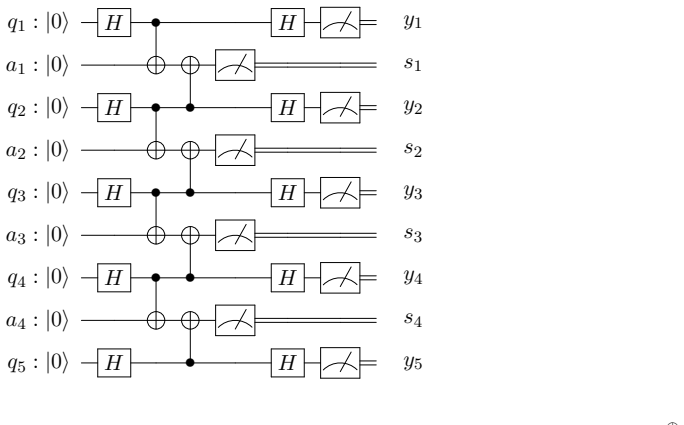
Two mechanisms carry the arguments. For the functional separation: the iterated multi-index function bundles $t$ copies of an iterated-index instance behind a consistency predicate, so a quantum circuit can verify all candidate computation histories in parallel, checking equality and index lookups with $O(\log n)$-depth Toffoli-based equality subcircuits and a single final AND gate, while the $t$-fold copy structure lets the transformer lower bound reduce to a known iterated-index communication lower bound. For the distributional separation: the poor man's cat state, starting from $|+\rangle^{\otimes B}$, measuring the commuting parity observables $Z_i Z_{i+1}$, and applying Hadamards, samples the uniform even-parity distribution exactly in constant depth; on the classical side, the defining structural axiom that a denoising round samples updated coordinates independently conditioned on the transcript makes each round's output law a small convex mixture of product distributions, and a mixture-of-products lower bound shows that approximating a product of parity cosets requires $2^{\Omega(\sum_b (r_b - 1))}$ components. An entropy-deficit accounting then forces most blocks to be completed one bit at a time, reducing the last-bit completion to a parity prediction that contradicts known GC$^0[\log n]$ parity lower bounds.
What would settle it
Run a masked discrete diffusion model and, at a single denoising round, condition on the current partially generated sequence; record the values of two tokens unmasked in the same round and repeat many times. A statistically significant correlation between those values would show that the paper's within-round conditional-independence axiom is not satisfied by that architecture, marking exactly where the lower bound does not apply. Conversely, any constant-round shallow DLM that satisfies the axiom and yet samples the block-parity distribution within constant total variation distance would directly refute Theorem 4.1.
Extended reading notes
Core claim
The central discovery is that both canonical LLM capabilities, prediction and generation, meet a hard wall when implemented by bounded-depth classical layers, while shallow quantum circuits clear that wall. Concretely, the iterated multi-index function IterMultInx, which checks that $t$ copies of an iterated-index instance agree and then outputs the iterated index, lies in $\wedge\circ \textsf{QNC}^0[\log\log K]$: a quantum circuit of depth $O(\log\log K)$ whose measurement outcomes are classically ANDed together. Yet any constant-depth decoder-only transformer solving it needs width $Hdp = n^{2^{-O(L)}}$. Separately, the block-parity distribution $D_{\mathrm{blk}} = \bigotimes_{b=1}^{M} U^{\oplus}_B$, uniform over even-parity $B$-bit strings in each of $M$ blocks, is exactly sampleable by a QNC$^0$ circuit that prepares a poor man's cat state per block and measures in the Hadamard basis; no constant-round shallow diffusion language model with GC$^0[\log n]$ schedulers and denoisers, sublinear chain-of-thought, and sublinear revision/remasking can approximate it within constant total variation distance. The lower bound rests on the observation that each denoising round induces only a small mixture of product distributions over fresh coordinates, whereas the target conditional law is a product of affine parity cosets that requires exponentially many product components to approximate.
Load-bearing premise
The distributional separation stands on the modeling axiom that, conditioned on the current transcript, the coordinates updated in one denoising round are sampled independently from coordinate-wise marginals; without that within-round independence, for example if a joint denoiser couples coordinates through shared latent noise, the mixture-of-products entropy argument collapses.
Editorial extensions
If this is right
- Any exact constant-depth decoder-only transformer computing IterMultInx must have width polynomial in the input length, so the problem separates all subpolynomial-width transformers from $\wedge\circ \textsf{QNC}^0[\log\log n]$.
- The block-parity distribution gives an unconditional sampling separation: QNC$^0$ samples it exactly in constant depth, while constant-round shallow DLM samplers fail even when given $n^{0.9}$ chain-of-thought tokens and $n^{0.9}$ revision/remasking events.
- The distributional lower bound is robust to sublinear revision/remasking: since each event touches one coordinate and $R = o(M)$, only $o(M)$ blocks can be affected, and the untouched blocks are governed by the monotone argument.
- The functional separation is essentially tight: any function deterministically computed by a $\wedge\circ \textsf{QNC}^0[d]$ circuit with advice and $d \le \log\log n + O(1)$ is already in AC$^0$, so the depth bound cannot be relaxed to a smaller constant multiple.
- The DLM lower bound holds against GC$^0[\log n]$ schedulers and denoisers, a strictly stronger class than the AC$^0$ circuits previously analyzed, implying the obstruction is structural rather than an artifact of weak denoisers.
Reading between the lines
- The paper's closing remarks imply that linear rather than sublinear chain-of-thought would plausibly make both tasks easy for classical LLMs; if so, the demonstrated advantage is confined to the sublinear-workspace parallel-generation regime, not a blanket statement about real LLM deployments.
- A direct test of the distributional claim in practice is to measure within-round statistical independence of simultaneously unmasked tokens in a running diffusion model; any coupling would show the model lives outside the paper's defining axiom, so the lower bound would not describe it.
- The same mixture-of-products entropy argument should transfer to any target distribution built from many independent small affine constraints, such as per-block mod-3 or mod-k parity, yielding a family of sampling separations with different block sizes.
- The functional separation suggests a concrete hybrid recipe, delegating the consistency check and index lookup to a shallow quantum coprocessor and keeping the transformer for the surrounding language tasks, whose success on IterMultInx-style instances would be a testable consequence of the paper's upper bound.
Signed reviews
Editorial analysis
A structured set of objections, weighed in public.
Referee Report
Summary. The paper proves two unconditional separations between low-depth quantum circuits and classical large-language-model architectures. First, it exhibits the block-parity distribution D_blk, uniform over M blocks of B bits with even parity, and shows that it is exactly sampleable by constant-depth QNC^0 circuits (Lemma 4.2), while any constant-round shallow diffusion language model with GC^0[log n] denoisers, s=n^0.9 chain-of-thought/workspace tokens, and R=n^0.9 output-token revision/remasking events fails to sample it within constant total variation distance (Theorem 4.1). Second, it defines the iterated multi-index function IterMultInx, proves a quantum upper bound in ∧∘QNC^0[log log K] (Theorem 3.7), and claims that any constant-depth decoder-only transformer computing it must have width T ≥ n^{2^{-O(L)}} (Theorem 3.10). The transformer lower bound imports the CPW25 autoregressive-protocol lower bound, and the DLM lower bound builds an entropy-based obstruction against mixtures of product distributions, ultimately reducing to Kumar's parity lower bound.
Significance. If the results hold, they would initiate a rigorous complexity-theoretic comparison between shallow quantum circuits and practical LLM architectures, going beyond earlier separations against NC^0/AC^0/GC^0. The quantum upper bounds are self-contained and the distributional lower bound introduces a novel entropy-mixture framework that quantifies the cost of many simultaneous parity constraints. The paper is transparent about its model assumptions and its dependence on prior work. However, the functional separation currently hinges on applying the CPW25 lower bound in a bandwidth regime the quoted theorem does not cover, and the DLM separation is conditional on a strong within-round independence axiom. The revision/remasking extension is sketched rather than fully proved. These issues are load-bearing for the paper's central claims.
major comments (3)
- [§3.4.2, Theorem 3.10, Eq. (36)] The proof of Theorem 3.10 applies Lemma 3.9 to obtain an autoregressive protocol Π_orig for IterInx with bandwidth B = Tt, and then invokes Theorem 3.5 to conclude Tt ≥ n_orig^{α_L}. However, Theorem 3.5 is stated only for protocols with bandwidth B ≤ T. By Lemma 3.8, t = C_L T^{c_L} with c_L = 2^{O(L)} (a positive exponent for constant L), so B = Tt exceeds T by a polynomial factor for all sufficiently large T. The hypothesis of Theorem 3.5 is therefore not satisfied, and the inequality in Eq. (36) does not follow from the quoted statement. This is a load-bearing gap: without a valid lower bound for the reduced protocol, the conclusion T ≥ n^{2^{-O(L)}} is unsupported. The authors need to verify whether the CPW25 lower bound actually holds for arbitrary bandwidth (and if so, state that version explicitly), or else provide a modified reduction that respects the B ≤ T regime.
- [§4.4.3] The extension of the DLM lower bound to revision/remasking is presented as follows: after the execution, delete all touched blocks, apply Lemma 4.7 to the 'induced monotone execution' on untouched blocks, and assert that the same counting argument goes through with 'only routine bookkeeping.' This is not routine: the set of touched blocks is determined only at the end of the execution, so it is a future event relative to the adaptive DLM process. Conditioning on this post hoc event changes the conditional law of the untouched blocks in a way that the entropy chain rule and the product-mixture argument of Lemmas 4.5 and 4.7 are not designed to handle. A rigorous proof showing that the bounds survive with s,R = o(M) is needed; as written, the advertised robustness to R = n^0.9 revision/remasking events is not established.
- [§2.3.2, Theorem 4.1] The distributional separation depends critically on the axiom that, conditioned on the current transcript, the coordinates updated in one denoising round are sampled independently from coordinate-wise marginals. This assumption is essential to the entire lower bound: without it, the mixture-of-products structure in Theorem 4.4 and the entropy accounting in Lemma 4.7 collapse. The paper calls this the defining property of a 'standard DLM,' but the abstract and introduction state the separation for 'no constant-round diffusion language model' without this qualification. Since models with joint denoisers or shared latent noise would fall outside the axiom, the claimed separation is substantially narrower than the unqualified statements suggest. The authors should restrict all statements to their standard model, or extend the lower bound to permit within-round coupling.
minor comments (5)
- [§3.4.2, just before Theorem 3.10] The sentence 'Since we prove lower bounds against determiistictransformer models (for which we showed the ∧◦QNC0[log logn] upper bound.' contains typos and an unclosed parenthesis; it should be rewritten for clarity.
- [Lemma 4.9] The description of the input x as 'the uniform bits inserted into block b* before completion' is confusing: the completion coordinate's bit is not inserted but generated by the DLM, and the circuit outputs G ⊕ x_J. The proof should clarify that x_J is the input bit at the completion position, which is XORed with the generated bit G.
- [Theorems 3.6 and 3.7] The notation 'K O(L8L)' is garbled in several places; it should be typeset as a power such as K^{2^{O(L)}} or K^{O(L·8^L)} so the copy complexity and gate complexity are unambiguous.
- [Lemma 2.2 and Theorem 4.4] Lemma 2.2 gives the bound |H(P)-H(W)| ≤ 2ε log|X| + 1, but the proof of Theorem 4.4 uses the stronger inequality |H(P)-H(W)| ≤ η log|X| + h_2(η). The authors should state the stronger form (and cite it) to avoid an apparent mismatch.
- [Footnote 17, p. 38] The adaptation of Lemma 2.4 from IterInx to IterMultInx is stated to hold 'with no change in the proof' but this is used as a central step in Theorem 3.10. The adaptation should be stated as an explicit lemma with a proof sketch, since the input structure of IterMultInx differs from that of IterInx.
Circularity Check
No significant circularity: upper bounds are self-contained; lower bounds reduce to independent published results (CPW25, Kumar) rather than to the paper's own definitions or fitted parameters.
full rationale
The paper's central quantities are defined independently of the models under attack: D_blk is a product of uniform even-parity blocks, and IterMultInx is a consistent-copy extension of CPW25's IterInx with an explicit quantum circuit in AND∘QNC^0[log log K] (Theorem 3.7). The quantum samplers and circuits are explicit constructions (Lemmas 4.2, Claims 3.1-3.4, Theorems 3.6-3.7), not definitions that presuppose the target separations. The classical lower bounds are imported from external black boxes: the transformer width bound invokes Theorem 3.5 from CPW25, and the DLM sampling bound invokes Kumar's parity correlation theorem (Theorem 4.3); neither theorem is authored by the present authors, and the paper does not prove or assume these theorems by assuming its own conclusions. The mixture-of-product lower bound (Theorem 4.4) is a genuine entropy argument, not a fitted parameter renamed as a prediction: it starts from an explicit parity-coset support and an entropy lower bound, and derives a log K lower bound independent of any fitted value. The distributional result does rely on the within-round conditional independence axiom of the DLM model (Section 2.3.2), but this is an explicitly stated modeling assumption, not a circular definition of the target. A possible correctness gap exists in the functional reduction: Lemma 3.9 produces a protocol of bandwidth Tt while Theorem 3.5 is stated only for bandwidth B≤T, so invoking Theorem 3.5 on that protocol may exceed the stated hypothesis. That issue concerns the soundness of an external-theorem application, not circularity: no step backs the target claim by its own definition or by a self-citation chain. Remasking/revision handling (Section 4.4.3) is likewise a bookkeeping extension, not a circular step. Overall, the derivation chain is self-contained against external benchmarks and exhibits no definitional or statistical circularity.
Assumptions & free parameters
free parameters (7)
- B =
n^0.01
- M =
n^0.99
- s =
n^0.9
- R =
n^0.9
- K(T,L) =
(TL)^8
- t =
K^{O(L 8^L)}
- eta =
small constant epsilon*(T)
assumptions (5)
- standard math Kumar's GC^0[log m] parity lower bound (Theorem 4.3)
- standard math CPW25 iterated index communication lower bound (Theorem 3.5)
- domain assumption DLM conditional independence: each denoising round samples newly revealed coordinates independently given the current transcript
- domain assumption Decoder-only transformer model with softmax attention, width Hdp, constant depth, and no chain-of-thought
- ad hoc to paper Input copies in IterMultInx are part of the input and can be used by the quantum circuit
Cite this review
Pith. "Pith review of Separating quantum circuits from classical LLMs." pith.science (2026). https://pith.science/paper/2LH55IH4
@misc{pith2026260803962,
  author       = {Pith},
  title        = {Pith review of: Separating quantum circuits from classical LLMs},
  year         = {2026},
  howpublished = {\url{https://pith.science/paper/2LH55IH4}},
  note         = {Machine review of arXiv:2608.03962}
}
abstract
Modern large language models - transformers and diffusion language models - are built around two canonical algorithmic tasks: prediction and generation. We prove unconditional separations between low-depth quantum computation and the corresponding bounded-resource classical language-model architectures in both regimes. Concretely, we exhibit the following: 1. Distributional separation. We give a distribution that is sampleable by $\textsf{QNC}^0$ circuits (i.e., a family of constant-depth quantum circuits consisting of bounded fan-in gates) that no constant-round diffusion language model ($\textsf{DLM}$) with shallow scheduling and denoising can sample within constant distance, even when allowed sublinear chain-of-thought and output-token revision/remasking events, the very features modern $\textsf{DLM}$s rely on. 2. Functional separation. We exhibit a function computable in $\land \circ \textsf{QNC}^0[\log\log n]$ (i.e., a family of O$(\log\log n)$-depth $\textsf{QNC}^0$ circuits, where $n$ is the input length, followed by a single classical $\mathsf{AND}$ gate) such that any constant-depth decoder-only transformer computing the function must be large: it would have to have width $n^{\Omega(1)}$. Together, our work initiates the study of quantum advantage in the era of large language models.
Figures


Figures from the paper (3 more)


Reference graph
Works this paper leans on
-
[1]
Proceedings of the 40th International Conference on Machine Learning , pages =
Tighter Bounds on the Expressivity of Transformer Encoders , author =. Proceedings of the 40th International Conference on Machine Learning , pages =. 2023 , publisher =
work page 2023
-
[2]
Overcoming a Theoretical Limitation of Self-Attention , author =. Proceedings of the 60th Annual Meeting of the Association for Computational Linguistics (Volume 1: Long Papers) , pages =. 2022 , publisher =. doi:10.18653/v1/2022.acl-long.527 , url =
-
[3]
Kumar, Vinayak M. , booktitle =. Tight Correlation Bounds for Circuits Between. 2023 , publisher =. doi:10.4230/LIPIcs.CCC.2023.18 , url =
-
[4]
Improved Circuit Lower Bounds and Quantum-Classical Separations , author =. 2024 , eprint =
work page 2024
-
[5]
Quantum Advantage with Shallow Circuits , author =. Science , volume =. 2018 , doi =
work page 2018
-
[6]
Proceedings of the 51st Annual ACM SIGACT Symposium on Theory of Computing , pages =
Exponential Separation Between Shallow Quantum Circuits and Unbounded Fan-In Shallow Classical Circuits , author =. Proceedings of the 51st Annual ACM SIGACT Symposium on Theory of Computing , pages =. 2019 , publisher =. doi:10.1145/3313276.3316404 , url =
-
[7]
Nadimpalli, Shivam and Parham, Natalie and Vasconcelos, Francisca and Yuen, Henry , booktitle =. On the. 2024 , publisher =. doi:10.1145/3618260.3649662 , url =
arXiv 2024
-
[8]
Anshu, Anurag and Dong, Yangjing and Ou, Fengning and Yao, Penghui , booktitle =. On the Computational Power of. 2025 , publisher =. doi:10.1145/3717823.3718189 , url =
arXiv 2025
Show all 53 references
-
[9]
Advances in Neural Information Processing Systems , volume =
Attention Is All You Need , author =. Advances in Neural Information Processing Systems , volume =. 2017 , publisher =
2017
-
[10]
Gretta, Lucas and Gupta, Meghal and Joshi, Malvika Raj , booktitle =. Parity. 2026 , publisher =. 2604.02793 , archivePrefix =
2026 arXiv
-
[11]
Super-Constant Weight
Gretta, Lucas and Gupta, Meghal and Joshi, Malvika Raj , year =. Super-Constant Weight. 2604.15298 , archivePrefix =
-
[12]
Improved Lower Bounds for
Joshi, Malvika Raj and Tal, Avishay and Vasconcelos, Francisca and Wright, John , booktitle =. Improved Lower Bounds for. 2026 , publisher =. doi:10.1145/3798129.3800922 , url =
2026
-
[13]
Learning Junta Distributions, Quantum Junta States, and
Bao, Jinge and Escudero-Guti. Learning Junta Distributions, Quantum Junta States, and. Proceedings of the 43rd International Conference on Machine Learning , series =. 2026 , publisher =. 2410.15822 , archivePrefix =
2026 arXiv
-
[14]
and Grier, Daniel and Pad
Fenner, Stephen A. and Grier, Daniel and Pad. Tight Bounds on Depth-2. 2025 , eprint =
2025
-
[15]
Proceedings of Thirty Eighth Conference on Learning Theory , pages =
Learning Shallow Quantum Circuits with Many-Qubit Gates , author =. Proceedings of Thirty Eighth Conference on Learning Theory , pages =. 2025 , publisher =
2025
-
[16]
Bounds on the
Rosenthal, Gregory , booktitle =. Bounds on the. 2021 , publisher =. doi:10.4230/LIPIcs.ITCS.2021.32 , url =
2021 doi
-
[17]
Counting, Fanout, and the Complexity of Quantum
Green, Frederic and Homer, Steven and Moore, Cristopher and Pollett, Christopher , journal =. Counting, Fanout, and the Complexity of Quantum. 2002 , doi =
2002
-
[18]
1991 , publisher =
Elements of Information Theory , author =. 1991 , publisher =
1991
-
[19]
17th Innovations in Theoretical Computer Science Conference (ITCS 2026) , pages =
Quantum Advantage from Sampling Shallow Circuits: Beyond Hardness of Marginals , author =. 17th Innovations in Theoretical Computer Science Conference (ITCS 2026) , pages =. 2026 , publisher =. doi:10.4230/LIPIcs.ITCS.2026.73 , url =
2026 doi
-
[20]
Nature Physics , volume =
Quantum Advantage with Noisy Shallow Circuits , author =. Nature Physics , volume =. 2020 , doi =
2020
-
[21]
Communications in Mathematical Physics , volume =
Trading Locality for Time: Certifiable Randomness from Low-Depth Circuits , author =. Communications in Mathematical Physics , volume =. 2021 , doi =
2021
-
[22]
34th Computational Complexity Conference (CCC 2019) , pages =
Average-Case Quantum Advantage with Shallow Circuits , author =. 34th Computational Complexity Conference (CCC 2019) , pages =. 2019 , publisher =. doi:10.4230/LIPIcs.CCC.2019.21 , url =
2019 doi
-
[23]
Transactions of the Association for Computational Linguistics , volume =
Saturated Transformers Are Constant-Depth Threshold Circuits , author =. Transactions of the Association for Computational Linguistics , volume =. 2022 , doi =
2022
-
[24]
Quantum Generalizations of the Polynomial Hierarchy with Applications to
Gharibian, Sevag and Santha, Miklos and Sikora, Jamie and Sundaram, Aarthi and Yirka, Justin , journal =. Quantum Generalizations of the Polynomial Hierarchy with Applications to. 2022 , doi =
2022
-
[25]
39th Computational Complexity Conference (CCC 2024) , pages =
The Entangled Quantum Polynomial Hierarchy Collapses , author =. 39th Computational Complexity Conference (CCC 2024) , pages =. 2024 , publisher =. doi:10.4230/LIPIcs.CCC.2024.6 , url =
2024 doi
-
[26]
17th Innovations in Theoretical Computer Science Conference (ITCS 2026) , pages =
Oracle Separations for the Quantum-Classical Polynomial Hierarchy , author =. 17th Innovations in Theoretical Computer Science Conference (ITCS 2026) , pages =. 2026 , publisher =. doi:10.4230/LIPIcs.ITCS.2026.2 , url =
2026 doi
-
[27]
Proceedings of Thirty Eighth Conference on Learning Theory , pages =
Quantum State and Unitary Learning Implies Circuit Lower Bounds , author =. Proceedings of Thirty Eighth Conference on Learning Theory , pages =. 2025 , publisher =
2025
-
[28]
2021 IEEE 62nd Annual Symposium on Foundations of Computer Science (FOCS) , pages =
Quantum Learning Algorithms Imply Circuit Lower Bounds , author =. 2021 IEEE 62nd Annual Symposium on Foundations of Computer Science (FOCS) , pages =. 2022 , publisher =. doi:10.1109/FOCS52979.2021.00062 , url =
2021
-
[29]
13th Innovations in Theoretical Computer Science Conference (ITCS 2022) , pages =
Quantum Meets the Minimum Circuit Size Problem , author =. 13th Innovations in Theoretical Computer Science Conference (ITCS 2022) , pages =. 2022 , publisher =. doi:10.4230/LIPIcs.ITCS.2022.47 , url =
2022 doi
-
[30]
31st Conference on Computational Complexity (CCC 2016) , pages =
Learning Algorithms from Natural Proofs , author =. 31st Conference on Computational Complexity (CCC 2016) , pages =. 2016 , publisher =. doi:10.4230/LIPIcs.CCC.2016.10 , url =
2016 doi
-
[31]
The Twelfth International Conference on Learning Representations , year =
The Expressive Power of Transformers with Chain of Thought , author =. The Twelfth International Conference on Learning Representations , year =
-
[32]
2023 , eprint =
Average-Hard Attention Transformers Are Constant-Depth Uniform Threshold Circuits , author =. 2023 , eprint =
2023
-
[33]
Advances in Neural Information Processing Systems , volume =
Masked Hard-Attention Transformers Recognize Exactly the Star-Free Languages , author =. Advances in Neural Information Processing Systems , volume =. 2024 , publisher =. doi:10.52202/079017-0327 , url =
2024 doi
-
[34]
Proceedings of the 32nd International Conference on Machine Learning , pages =
Deep Unsupervised Learning Using Nonequilibrium Thermodynamics , author =. Proceedings of the 32nd International Conference on Machine Learning , pages =. 2015 , publisher =
2015
-
[35]
Advances in Neural Information Processing Systems , volume =
Denoising Diffusion Probabilistic Models , author =. Advances in Neural Information Processing Systems , volume =. 2020 , publisher =
2020
-
[36]
The Twelfth International Conference on Learning Representations , year =
Chain of Thought Empowers Transformers to Solve Inherently Serial Problems , author =. The Twelfth International Conference on Learning Representations , year =
-
[37]
2026 , publisher =
Grier, Daniel and Morris, Jackson and Wu, Kewen , booktitle =. 2026 , publisher =. 2601.03243 , archivePrefix =
2026
-
[38]
The Fourteenth International Conference on Learning Representations , year =
Diffusion Language Models Are Provably Optimal Parallel Samplers , author =. The Fourteenth International Conference on Learning Representations , year =
-
[39]
SIAM Journal on Computing , volume =
On the Correlation of Parity and Small-Depth Circuits , author =. SIAM Journal on Computing , volume =. 2014 , doi =
2014
-
[40]
Advances in Neural Information Processing Systems , volume =
Chain-of-Thought Prompting Elicits Reasoning in Large Language Models , author =. Advances in Neural Information Processing Systems , volume =. 2022 , publisher =
2022
-
[41]
First Conference on Language Modeling , year =
On Limitations of the Transformer Architecture , author =. First Conference on Language Modeling , year =
-
[42]
Advances in Neural Information Processing Systems , volume =
Separations in the Representational Capabilities of Transformers and Recurrent Architectures , author =. Advances in Neural Information Processing Systems , volume =. 2024 , publisher =
2024
-
[43]
Interactive Shallow
Grier, Daniel and Schaeffer, Luke , booktitle =. Interactive Shallow. 2020 , publisher =. doi:10.1145/3357713.3384332 , url =
2020
-
[44]
2024 , eprint =
Gemini 1.5: Unlocking Multimodal Understanding Across Millions of Tokens of Context , author =. 2024 , eprint =
2024
-
[45]
2025 , eprint =
Wavefunction Flows: Efficient Quantum Simulation of Continuous Flow Models , author =. 2025 , eprint =
2025
-
[46]
2021 , url =
A Mathematical Framework for Transformer Circuits , author =. 2021 , url =
2021
-
[47]
2024 , url =
Introducing. 2024 , url =
2024
-
[48]
2019 , url =
Language Models Are Unsupervised Multitask Learners , author =. 2019 , url =
2019
-
[49]
Advances in Neural Information Processing Systems , volume =
Representational Strengths and Limitations of Transformers , author =. Advances in Neural Information Processing Systems , volume =. 2023 , publisher =
2023
-
[50]
17th Innovations in Theoretical Computer Science Conference (ITCS 2026) , pages =
Unconditional Quantum Advantage for Sampling with Shallow Circuits , author =. 17th Innovations in Theoretical Computer Science Conference (ITCS 2026) , pages =. 2026 , publisher =. doi:10.4230/LIPIcs.ITCS.2026.17 , url =
2026 doi
-
[51]
2025 , eprint =
Seed Diffusion: A Large-Scale Diffusion Language Model with High-Speed Inference , author =. 2025 , eprint =
2025
-
[52]
Advances in Neural Information Processing Systems , volume =
Large Language Diffusion Models , author =. Advances in Neural Information Processing Systems , volume =. 2025 , publisher =
2025
-
[53]
2025 IEEE 66th Annual Symposium on Foundations of Computer Science (FOCS) , pages =
Theoretical Limitations of Multi-Layer Transformer , author =. 2025 IEEE 66th Annual Symposium on Foundations of Computer Science (FOCS) , pages =. 2025 , publisher =. doi:10.1109/FOCS63196.2025.00136 , url =
2025
Reviewed August 15, 2026 · model on record in the stance chip above.
Discussion (0). Continue with ORCID to comment.