REVIEW 4 major objections 5 minor 38 references
Profile Reconstruction from Temporally Stable Emission Components for Timing PSR J1713+0747
T0 review · 4 major / 5 minor · reviewed 2026-08-15 · deepseek-v4-flash
Pith's one-line read The two central Gaussian components of PSR J1713+0747's low-frequency pulse profile stay phase-stable across the 2021 profile-change event, and timing on profiles rebuilt from only those components stays phase-connected at 4.454…
desk verdict Low-frequency profile-domain timing for J1713+0747 is promising but its validation loop needs an external post-event check before I'd trust it in PTA pipelines. read the letter →
The pith
A machine-rendered reading of the paper's core claim, the machinery that carries it, and where it could break.
The reading
What carries the argument
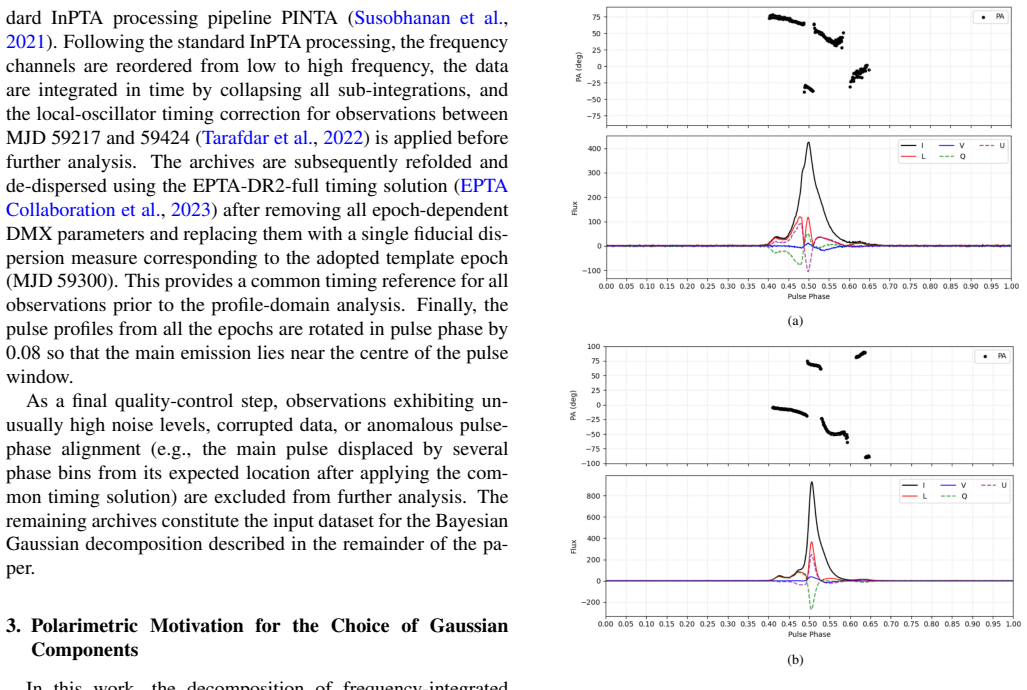
Five Gaussian components fitted to each frequency-resolved (eight sub-bands) pulse profile via Bayesian inference, with informative but flexible phase priors derived from high-frequency polarization morphology. The load-bearing assumption is the component identity across frequency and time: the two central components G2 and G3 are allowed overlapping phase priors because they occupy nearly the same phase range at low frequency, yet their amplitudes and widths are tracked independently. The reconstruction step then discards the unstable outer components and writes only G2+G3 back into the data archives, preserving the metadata and noise characteristics, so that standard cross-correlation timing can proceed.
What would settle it
Take a single high-signal-to-noise post-event epoch, fit the five-component model with the central-component phase priors removed or widened far beyond the adopted ranges, and check whether the recovered G2/G3 centroids remain inside the original prior range at all eight sub-bands; if they drift out of that range, the reported stability is an artifact of the priors. A stronger test is to compare the reconstructed low-frequency timing solution epoch-by-epoch against simultaneous high-frequency (around 1.4 GHz) timing across the profile-change event: any frequency-dependent jump or drift in the residuals would show that the stable components are not a rotational-phase invariant.
Extended reading notes
Core claim
The central claim is that the centroid phases of the two central Gaussian components, G2 and G3, are stable to within their posterior uncertainties across the October 2019–September 2025 baseline, including across the 2021 profile-change event, while the outer components G1, G4, and G5 wander more widely. Because the pulse profile is modeled as a sum of components anchored to persistent emission regions, the phase of the stable central pair can serve as a rotational-phase reference. Reconstructing each frequency sub-band profile as just G2+G3, with realistic noise restored, and carrying that reconstruction through standard dispersion-measure estimation and timing, produces a phase-connected timing solution with a post-fit WRMS residual of 4.454 microseconds. The paper presents this as a physically motivated route to precision timing for pulsars with evolving profiles.
Load-bearing premise
The five Gaussian components fitted at 300–500 MHz correspond to the same persistent emission regions identified in the high-frequency polarization profiles, so the phase priors carry that identity into the low-frequency data; if radius-to-frequency mapping changes which physical region dominates the central components at low frequency, the 'stable' reference is not a true rotational-phase invariant.
Editorial extensions
If this is right
- Post-event observations of PSR J1713+0747 can be kept in pulsar-timing-array datasets rather than flagged, because the reconstructed profiles yield a phase-connected solution across the 2021 event.
- Epoch-wise dispersion measures, including the annual solar-wind signature, are recoverable from the reconstructed profiles, so chromatic propagation information survives the reconstruction.
- The timing signature of the profile-change event, an exponential dip seen in the original time-of-arrival residuals, disappears from the reconstructed residuals, indicating that the reconstruction removes the profile-change timing bias.
- The methodology transfers to other pulsars with abrupt or gradual profile variability, as long as polarization data exist to define the component priors.
Reading between the lines
- If the central components trace the core emission close to the stellar surface, this method effectively turns pulsar timing into core-component timing, which may be inherently more robust to magnetospheric reconfigurations that mostly alter conal emission.
- A natural extension is to fit the Gaussian decomposition and the dispersion measure simultaneously rather than sequentially, which could remove any residual covariance between chromatic delays and component centroid shifts.
- Applying the same reconstruction to simultaneous high-frequency (around 1.4 GHz) data and checking cross-band consistency would test whether the selected components are true rotational-phase invariants, and would generalize the method to broadband pulsar-timing-array use.
- The achieved 4.454 microsecond residual, compared with 2.505 microseconds pre-event from the full profile, suggests a modest precision cost for using only two components; the trade-off between stability and lost signal-to-noise could be quantified for other pulsars.
Signed reviews
Editorial analysis
A structured set of objections, weighed in public.
Referee Report
Summary. The paper presents a Bayesian five-Gaussian decomposition of frequency-resolved uGMRT Band-3 (300-500 MHz) pulse profiles of PSR J1713+0747, with phase priors informed by EPN polarization profiles at higher frequencies. Tracking the centroids of the five components across the observing baseline, the authors identify the two central components G2 and G3 as being phase-stable across the 2021 profile-change event, reconstruct frequency-resolved profiles using only these components while adding realistic noise, and then estimate epoch-wise dispersion measures and perform conventional tempo2 timing. The central claim is that profiles reconstructed from G2 and G3 preserve the rotational phase information and yield a phase-connected timing solution across the event, with a post-fit WRMS residual of 4.454 microseconds, thereby demonstrating a physically motivated mitigation of pulse-profile variability.
Significance. If the central claim is validated, this is a useful contribution to PTA data-analysis methodology: it addresses the well-known J1713+0747 profile-change event at low radio frequencies, where chromatic effects are severe, and it makes explicit use of physically motivated priors from polarization data. The recovery of the expected annual DM variations near solar conjunction and the pre-event comparison between original and reconstructed ToAs are constructive validation steps. The paper is also clearly written and the decomposition is carefully described. However, the key validation is largely self-referential: the stability of G2 and G3 is assessed with the same priors that constrain them to a narrow phase interval, and the post-event timing solution is evaluated only against profiles reconstructed from those very components. The external checks cover only the pre-event interval or test chromatic delay rather than absolute rotational phase. These issues are addressable, but they are load-bearing for the main claim.
major comments (4)
- [Section 5 and Table 1] The claim that G2 and G3 are intrinsically phase-stable is partly an artifact of the priors. The centroid priors for phi2 and phi3 are both U(0.47,0.52), a support of only 0.05 in pulse phase, and the constraint phi1 < phi2,phi3 < phi4 < phi5 is imposed. Any event-induced shift larger than this support cannot appear as a centroid shift; it will be absorbed into the amplitudes and widths or into an interchange between G2 and G3. The paper should demonstrate that the posterior widths for phi2 and phi3 are substantially narrower than the prior widths, and should test sensitivity to a wider prior (for example U(0.44,0.55) with the ordering constraint only). Without such a test, the stability shown in Fig. 5 does not establish that these components are an invariant rotational-phase reference.
- [Section 8 and Figure 9] The timing validation is circular in a way that matters. The post-event phase-connected solution is obtained exclusively from reconstructed profiles built from G2 and G3, the same components selected for stability in Section 5. Fitting only F0 to a smoothly varying phase curve will always produce a phase-connected solution, so the 4.454 microsecond WRMS measures scatter rather than absolute phase accuracy. The pre-event comparison in Fig. 8 does not cover the post-event interval, and the recovered DM variations in Fig. 7 test the chromatic delay, not the rotational-phase reference. The absence of an exponential-dip signature is likewise expected if the dip is carried by the outer components that were removed by construction, so it is not an independent confirmation. To support the central claim, the authors should compare the reconstructed post-event ToAs against an independent phase reference, such as simultaneous Band-5 or L-band observations, or perform an injection-recovery test with a simulated event-induced phase step.
- [Section 3 and Table 1] The priors are transferred from EPN polarization profiles at 728-1369 MHz to the 300-500 MHz Band-3 data. The paper itself notes that radius-to-frequency mapping shifts the apparent locations of components with frequency, and that one leading feature is displaced at low frequency. This raises the risk that the physical emission regions associated with G2 and G3 at 300-500 MHz are not the same regions identified at higher frequencies. The eight sub-bands within Band-3 span 200 MHz, so the authors should quantify how the posterior centroids of G2 and G3 evolve across sub-bands. If the centroids drift systematically with frequency, the reconstructed template carries a chromatic phase offset that the subsequent DM fit cannot absorb, and the timing solution would inherit a frequency-dependent bias.
- [Section 8 and Figure 8] The pre-event comparison shows a substantial degradation in timing precision: the WRMS increases from 2.505 microseconds for the original profiles to 3.707 microseconds for the reconstructed profiles, a factor of about 1.5. The paper presents this as a successful validation, but for a method intended to improve precision timing it should discuss whether this loss is acceptable and what fraction of the S/N is removed when G1, G4, and G5 are discarded. In addition, the comparison is not strictly like-for-like because the original and reconstructed analyses use independent sub-band flagging and quality filtering, so the WRMS difference may partly reflect different ToA sets rather than the reconstruction alone. A quantitative statement of the median ToA offset and its scatter between the two analyses would be more informative.
minor comments (5)
- [Section 4.4] The sentence 'As an example of our successful bayesian gaussian decomposition of a post-event epoch (MJD=59551) together with its associated AD statistic (see Fig.3) - the corresponding p-value is 0.528' is grammatically incomplete; the main clause is missing.
- [Section 7 and Figure 7] The DM time series is shown without error bars, so the significance of the annual solar-wind variations cannot be assessed. Please include uncertainties on the DM points or state that they are smaller than the plotted markers.
- [Section 2] The data set mixes profiles with N_bin=128, 256, and 512 phase bins. The paper does not discuss whether the different phase resolutions affect the Gaussian decomposition or the reconstructed-profile timing, particularly for the narrow G3 component whose width prior extends down to sigma=0.002.
- [Section 8] The claim that 'no discernible systematic offsets' exist between original and reconstructed ToAs is only qualitative. A quantitative offset estimate with an uncertainty would strengthen the pre-event validation.
- [Section 1 and Discussion] The related work by Nichols et al. (2026) on Gaussian-component modeling of the same profile-change event is cited only once. Given the direct overlap in methodology and target, a more explicit comparison of the low-frequency approach with that high-frequency analysis would help the reader understand the novel contribution.
Circularity Check
Stability selection and the no-dip validation are partly constructed from the same prior-constrained Gaussian decomposition; external EPN priors and DM checks keep the result from being wholly forced.
-
fitted input called prediction
[Section 4.2, Table 1; Section 5; Section 6, Eq. 5]
"we adopt a common set of centroid-phase priors for each component throughout the entire dataset ... The only relaxation to the exclusivity of the priors is made for the central components, G2 and G3 ... assigned overlapping centroid-phase priors [Table 1: phi2 U(0.47,0.52), phi3 U(0.47,0.52)] ... The recovered centroid phases, therefore, demonstrate that G2 and G3 are the most consistently localized components recovered by the Bayesian decomposition over the full observing baseline. Hereafter, we refer to G2 and G3 as the stable central components ..."
The stability claim is read from posteriors obtained under priors that fix phi2 and phi3 to the same narrow U(0.47,0.52) interval for every epoch and that enforce component ordering. An event-induced phase shift larger than this prior support cannot appear as a centroid shift; it must be absorbed into the free amplitudes and widths or into interchange between the overlapping G2/G3 pair. The same prior-constrained components are then used to build the reconstructed profiles (Eq. 5) and to produce the timing solution, so the timing validation is not independent of the stability-selection step. The EPN priors are external, but their applicability at 300-500 MHz is assumed.
-
self definitional
[Section 8, final paragraph; Section 6, Eq. 5]
"We find no evidence for the exponential dip signal in our TOAs, unlike in Singha et al. (2021), consistent with our reconstruction substantially mitigating the timing signature associated with the profile-change event."
The ToAs tested for the exponential dip are generated exclusively from reconstructed profiles P_rec = G2 + G3, which by construction discard the outer components (G1, G4, G5) that the paper finds exhibit the largest phase excursions across the event. The Singha et al. dip was a timing signature of the full-profile shape change; removing the varying components removes the very signal this check is meant to validate. The absence of the dip therefore confirms internal consistency of the reconstruction rather than providing an external test of absolute rotational-phase accuracy across the profile-change event.
full rationale
The paper is not a pure tautology: the five-Gaussian priors are anchored to external EPN polarization profiles (Dai et al. 2015), the pre-event reconstructed residuals track the original residuals (Fig. 8), and the recovered solar-wind DM excursions (Fig. 7) are an independent physical check. These elements give the method real content. However, the central claim—that G2 and G3 are phase-stable across the 2021 event and can support unbiased timing—is not independently tested. The stability is read off posteriors obtained under priors that lock phi2 and phi3 into the same narrow U(0.47,0.52) interval at every epoch, so an event-induced excursion larger than the prior support cannot register as a centroid shift; it can be absorbed into amplitudes and widths or into the overlapping G2/G3 pair. The same prior-selected components are then used to build the reconstructed profiles (Eq. 5), and the only post-event validation, the exponential-dip test, is applied to ToAs from those reconstructed profiles from which the strongly varying outer components were discarded by construction. The pre-event comparison and DM recovery do not cover post-event rotational-phase accuracy, and a phase-connected F0-only solution can be obtained for any smooth phase series, so the 4.454 microsecond WRMS measures scatter rather than absolute phase fidelity. Thus the derivation chain contains a partially self-referential loop, though with enough external anchoring that the result is not entirely forced.
Assumptions & free parameters
free parameters (4)
- Number of Gaussian components =
5
- Gaussian prior ranges (Table 1) =
e.g., phi2,phi3 ~ U(0.47,0.52); sigma3 ~ log10U(0.002,0.010)
- Number of frequency sub-bands =
8
- Template epoch =
MJD 59300
assumptions (5)
- ad hoc to paper The total intensity profile is exactly representable as the sum of five Gaussian components (Eq. 1).
- domain assumption Gaussian components map one-to-one to persistent emission regions whose phase ordering is fixed across epochs and frequencies.
- domain assumption Phase priors inferred from EPN polarization data at 728-1369 MHz remain valid for 300-500 MHz Band-3 profiles.
- standard math Noise in each phase bin is independent and Gaussian with known off-pulse rms (Eq. 2).
- domain assumption The EPTA-DR2 timing solution with a single fiducial DM provides an unbiased phase reference for refolding before the profile decomposition.
Cite this review
Pith. "Pith review of Profile Reconstruction from Temporally Stable Emission Components for Timing PSR J1713+0747." pith.science (2026). https://pith.science/paper/GCCESSOR
@misc{pith2026260804108,
  author       = {Pith},
  title        = {Pith review of: Profile Reconstruction from Temporally Stable Emission Components for Timing PSR J1713+0747},
  year         = {2026},
  howpublished = {\url{https://pith.science/paper/GCCESSOR}},
  note         = {Machine review of arXiv:2608.04108}
}
read the original abstract
The assumption of long-term pulse-profile stability underpins high-precision pulsar timing and forms the basis of pulsar timing array experiments. However, several millisecond pulsars exhibit temporal profile variability that can introduce systematic biases in pulse time of arrival measurements and compromise timing precision. We present a profile-domain analysis of PSR J1713+0747 at low radio frequencies, in the 300-500 MHz band, using upgraded GMRT observations for the Indian Pulsar Timing Array experiment. We model frequency-resolved pulse profiles using a Bayesian Gaussian decomposition framework in which individual Gaussian components are associated with persistent emission regions through informative phase priors that permit modest temporal variations. By tracking the evolution of the decomposed components across observing epochs and frequency sub-bands, we identify central Gaussian components that remain precisely localized despite changes in the integrated pulse morphology. We then reconstruct pulse profiles with realistic noise using these central components and perform timing analysis. Our approach provides a physically motivated framework for mitigating pulse-profile variability and offers a generic methodology for recovering robust timing information from pulsars exhibiting profile evolution.
Figures


Figures from the paper (5 more)


Reference graph
Works this paper leans on
-
[1]
2015, , 579, A101
Aladro, R., Martín, S., Riquelme, D., et al. 2015, , 579, A101
2015
-
[2]
Pulsar Timing and Relativistic Gravity. Philosophical Transactions of the Royal Society of London Series A , year = 1992, month = oct, volume =. doi:10.1098/rsta.1992.0088 , adsurl =
arXiv 1992
-
[3]
Handbook of Pulsar Astronomy
-
[4]
The NANOGrav 15 yr and 20 yr Datasets: Timing Events and Pulse Shape Changes
The NANOGrav 15 yr and 20 yr Datasets: Timing Events and Pulse Shape Changes. arXiv e-prints , keywords =. doi:10.48550/arXiv.2604.05453 , archivePrefix =. 2604.05453 , primaryClass =
-
[5]
Switched Magnetospheric Regulation of Pulsar Spin-Down. Science , keywords =. doi:10.1126/science.1186683 , archivePrefix =. 1006.5184 , primaryClass =
-
[6]
Systematic and Stochastic Variations in Pulsar Dispersion Measures. , keywords =. doi:10.3847/0004-637X/821/1/66 , archivePrefix =. 1512.02203 , primaryClass =
-
[7]
A Second Chromatic Timing Event of Interstellar Origin toward PSR J1713+0747. , keywords =. doi:10.3847/1538-4357/aac770 , archivePrefix =. 1712.03651 , primaryClass =
-
[8]
Toward an Empirical Theory of Pulsar Emission. VII. On the Spectral Behavior of Conal Beam Radii and Emission Heights. , keywords =. doi:10.1086/342136 , archivePrefix =. astro-ph/0205356 , primaryClass =
Show all 38 references
-
[9]
, keywords =
Emission-rotation correlation in pulsars: new discoveries with optimal techniques. , keywords =. doi:10.1093/mnras/stv2715 , archivePrefix =. 1511.05481 , primaryClass =
-
[10]
, keywords =
An Unusual Pulse Shape Change Event in PSR J1713+0747 Observed with the Green Bank Telescope and CHIME. , keywords =. doi:10.3847/1538-4357/ad2930 , archivePrefix =. 2210.12266 , primaryClass =
-
[11]
, keywords =
Profile changes associated with dispersion measure events in PSR J1713+0747. , keywords =. doi:10.1093/mnras/stab2529 , archivePrefix =. 2106.09851 , primaryClass =
-
[12]
, keywords =
Ultra-wideband polarimetry of the April 2021 profile change event in PSR J1713+0747. , keywords =. doi:10.1017/pasa.2025.10099 , archivePrefix =. 2509.18972 , primaryClass =
2021
-
[13]
, keywords =
Evidence for profile changes in PSR J1713+0747 using the uGMRT. , keywords =. doi:10.1093/mnrasl/slab098 , archivePrefix =. 2107.04607 , primaryClass =
-
[14]
arXiv e-prints , keywords =
Mitigating the Timing Impact of Anomalous Pulse Profile Shape Variability in PSR J1713+0747 with Gaussian Component Modeling. arXiv e-prints , keywords =
-
[15]
, keywords =
pinta: The uGMRT data processing pipeline for the Indian Pulsar Timing Array. , keywords =. doi:10.1017/pasa.2021.12 , archivePrefix =. 2007.02930 , primaryClass =
2021 arXiv
-
[16]
, keywords =
The Indian Pulsar Timing Array: First data release. , keywords =. doi:10.1017/pasa.2022.46 , archivePrefix =. 2206.09289 , primaryClass =
2022 arXiv
-
[17]
Dataset and timing analysis
The Indian Pulsar Timing Array data release 2: I. Dataset and timing analysis. , keywords =. doi:10.1017/pasa.2025.10066 , archivePrefix =. 2506.16769 , primaryClass =
2025
-
[18]
, keywords =
A study of multifrequency polarization pulse profiles of millisecond pulsars. , keywords =. doi:10.1093/mnras/stv508 , archivePrefix =. 1503.01841 , primaryClass =
-
[19]
, keywords =
High precision measurements of interstellar dispersion measure with the upgraded GMRT. , keywords =. doi:10.1051/0004-6361/202140340 , archivePrefix =. 2101.05334 , primaryClass =
-
[20]
Journal of Astrophysics and Astronomy , keywords =
Nanohertz gravitational wave astronomy during SKA era: An InPTA perspective. Journal of Astrophysics and Astronomy , keywords =. doi:10.1007/s12036-022-09869-w , archivePrefix =. 2207.06461 , primaryClass =
-
[21]
and Ananthakrishnan, S
Swarup, G. and Ananthakrishnan, S. and Kapahi, V. K. and Rao, A. P. and Subrahmanya, C. R. and Kulkarni, V. K. , month =. 1991 , journal =
1991
-
[22]
Current Science , year = 2017, month = aug, volume =
The upgraded GMRT: opening new windows on the radio Universe. Current Science , year = 2017, month = aug, volume =. doi:10.18520/cs/v113/i04/707-714 , adsurl =
2017 doi
-
[23]
Toward an empirical theory of pulsar emission. I. Morphological taxonomy. , keywords =. doi:10.1086/161450 , adsurl =
-
[24]
, keywords =
Improving pulsar-timing solutions through dynamic pulse fitting. , keywords =. doi:10.1093/mnras/stad1660 , archivePrefix =. 2304.02793 , primaryClass =
-
[25]
The Astrophysical Journal Letters , keywords =
A New Binary Millisecond Pulsar. The Astrophysical Journal Letters , keywords =. doi:10.1086/186887 , adsurl =
-
[26]
The Astrophysical Journal Letters , keywords =
The NANOGrav 15 yr Data Set: Evidence for a Gravitational-wave Background. The Astrophysical Journal Letters , keywords =. doi:10.3847/2041-8213/acdac6 , archivePrefix =. 2306.16213 , primaryClass =
-
[27]
, keywords =
MULTINEST: an efficient and robust Bayesian inference tool for cosmology and particle physics. , keywords =. doi:10.1111/j.1365-2966.2009.14548.x , archivePrefix =. 0809.3437 , primaryClass =
2009
-
[28]
, keywords =
X-ray spectral modelling of the AGN obscuring region in the CDFS: Bayesian model selection and catalogue. , keywords =. doi:10.1051/0004-6361/201322971 , archivePrefix =. 1402.0004 , primaryClass =
-
[29]
, keywords =
Measuring pulsar profile variations with 2D Gaussian process regression. , keywords =. doi:10.1093/mnras/staf886 , archivePrefix =. 2505.23413 , primaryClass =
-
[31]
, keywords =
Generative pulsar timing analysis. , keywords =. doi:10.1093/mnras/stu2611 , archivePrefix =. 1412.1427 , primaryClass =
-
[32]
, keywords =
Profile stochasticity in PSR J1909-3744. , keywords =. doi:10.1093/mnras/stv2089 , archivePrefix =. 1509.07505 , primaryClass =
-
[33]
The second data release from the European Pulsar Timing Array. I. The dataset and timing analysis. , keywords =. doi:10.1051/0004-6361/202346841 , archivePrefix =. 2306.16224 , primaryClass =
-
[34]
and Wright, David and Johnson, Aaron D
Vallisneri, Michele and Meyers, Patrick M. and Wright, David and Johnson, Aaron D. and Baier, Jeremy G. and van Haasteren, Rutger ,doi =
- [35]
-
[36]
, keywords =
Prospects for high-precision pulsar timing. , keywords =. doi:10.1111/j.1365-2966.2011.19452.x , archivePrefix =. 1107.3086 , primaryClass =
2011
-
[37]
, keywords =
Measurements of pulse jitter and single-pulse variability in millisecond pulsars using MeerKAT. , keywords =. doi:10.1093/mnras/stab037 , archivePrefix =. 2101.08531 , primaryClass =
-
[38]
, keywords =
PSRCHIVE and PSRFITS: An Open Approach to Radio Pulsar Data Storage and Analysis. , keywords =. doi:10.1071/AS04022 , archivePrefix =. astro-ph/0404549 , primaryClass =
-
[39]
The timing model and precision estimates
TEMPO2, a new pulsar timing package - II. The timing model and precision estimates. , keywords =. doi:10.1111/j.1365-2966.2006.10870.x , archivePrefix =. astro-ph/0607664 , primaryClass =
2006
Reviewed August 15, 2026 · model on record in the stance chip above.
Discussion (0). Continue with ORCID to comment.