REVIEW 3 major objections 5 minor 62 references
Measurement-based simulation of lattice gauge theory dynamics with adaptive quantum circuits on a trapped-ion processor
T0 review · 3 major / 5 minor · reviewed 2026-08-15 · deepseek-v4-flash
Pith's one-line read The paper reports the first experimental realization of measurement-based quantum simulation of real-time (2+1)-dimensional Z2 lattice gauge theory dynamics on a trapped-ion processor, using one-form-symmetry syndromes for postselection.
desk verdict First real hardware realization of measurement-based simulation of (2+1)D Z2 lattice gauge theory dynamics, with careful statistics and an honest limitations section; the load-bearing weak spot is the Appendix D boundary edge-Z idealization, which is not directly tested on the 2x2 run. read the letter →
The pith
A machine-rendered reading of the paper's core claim, the machinery that carries it, and where it could break.
The reading
What carries the argument
The load-bearing object is the three-dimensional cluster state whose qubits sit on the edges and faces of a cubic lattice, with controlled-$Z$ entanglements between incident face-edge pairs; its edge stabilizers $K_e = X_e \prod_{f \supset e} Z_f$ generate the one-form symmetries $U(S) = \prod_{e \in S} X_e$. Measuring edge qubits in the fixed $X$ basis consumes the resource while producing syndromes, while face qubits are measured in bases whose signs are set by classical feedforward from tracked Pauli byproducts, so each retained trajectory realizes the same Trotter step. Qubit recycling is justified by a block decomposition showing that stitching instantaneous blocks with reset and re-entanglement reproduces the full-resource outcome distribution for block-causal adaptive measurements. Postselection keeps only shots with trivial syndromes, and the authors independently verify gauge invariance by measuring the Gauss-law generators of the output state.
What would settle it
A decisive check: run the same MBQS protocol and, in a separate calibration, measure the phase-error rate on the output-boundary edge qubits. If the measured boundary error rate is not negligible, the proof that trivial syndromes imply gauge invariance fails, and Gauss-law violations among accepted shots should track roughly $3L_xL_y p$ rather than vanish.
Extended reading notes
Core claim
The central claim is that MBQS can run real-time (2+1)-dimensional $\mathbb{Z}_2$ lattice gauge theory on present-day hardware, and that the resource state's one-form symmetry can be read out for free during the computation. By consuming a three-dimensional cluster state (virtual sizes $N_q = 200$ for the $2\times2$ lattice and $N_q = 288$ for the $3\times3$ lattice within the coherence window), generated by stitching 48- and 54-qubit instantaneous blocks on a 56-qubit register, the authors implement second-order Trotterized evolution of $H = -\sum_{\ell} X_\ell - \lambda \sum_p \prod_{\ell \subset p} Z_\ell$. They report coherent evolution of gauge-invariant observables (Wilson loops, electric energy density, and Gauss-law averages) matching the exact Trotterized reference, and postselection on trivial one-form-symmetry syndromes $U(S_v)=+1$ suppresses Gauss-law violations and lowers the RMSE to the reference for all ten non-diagnostic curves. The authors present this as, to their knowledge, the first experimental realization of MBQS of real-time lattice-gauge-theory dynamics, and as evidence that the measurement-based, recycling architecture is viable and symmetry-aware.
Load-bearing premise
The argument assumes that no phase errors occur on the cluster-state edges at the output boundary; if they do, the syndrome record can look clean while the simulated state still violates Gauss's law.
Editorial extensions
If this is right
- MBQS can be implemented with only a fraction of the resource-state qubits simultaneously present, so current mid-circuit-reset devices can realize virtual cluster states of hundreds of qubits (200 and 288 within the demonstrated coherence window).
- Postselection on one-form-symmetry syndromes is a practical error-suppression tool: all ten non-diagnostic curves show lower RMSE after postselection, with five improvements statistically resolved at 95% bootstrap confidence.
- The protocol produces symmetry diagnoses at no extra measurement cost, turning the simulation record itself into a gauge-invariance check for the output state.
- The same construction extends theoretically to $\mathbb{Z}_N$ qudit cluster states, higher-dimensional Wegner models, and Abelian gauge theories with matter, giving concrete next hardware targets.
- Without active correction, acceptance rate decays roughly as $\exp(-q_{\mathrm{eff}} N_{\mathrm{syn}})$; in the deepest run only 11 of 100 shots were retained, so scalable use will require moving from postselection to online syndrome decoding.
Reading between the lines
- If boundary edge-$Z$ errors are not negligible, postselection can admit gauge-violating states; a direct test would be to measure stabilizers on the output boundary plane and correlate their violations with residual Gauss-law violations in accepted shots.
- The block-decomposition equivalence suggests that similar stitched-resource protocols could be designed for other sparse resource states, e.g. those for fermionic or qudit models, with only an interface-connectivity check.
- The exponential acceptance-rate estimate implies a sharp, testable scaling: at current per-check error rates, pushing to longer evolution times at a fixed accepted-shot budget requires exponentially more raw shots, so the practical limit of postselection-based protection should appear as a steep rise in sampling cost with depth.
- A natural next step would be to add a boundary-plane stabilizer measurement as an additional postselection or correction layer, which could close the main theoretical gap without requiring active decoding.
Signed reviews
Editorial analysis
A structured set of objections, weighed in public.
Referee Report
Summary. This paper reports an experimental implementation of measurement-based quantum simulation (MBQS) of real-time dynamics of the (2+1)-dimensional Z2 lattice gauge theory on the Quantinuum System Model H2 trapped-ion processor. The authors realize virtual three-dimensional cluster states of up to 774 resource qubits by recycling a 56-qubit register, implement adaptive measurement patterns that realize second-order Trotter time evolution, and use mid-circuit measurement outcomes as one-form-symmetry syndromes for postselection. They report coherent evolution of gauge-invariant observables (Wilson loops, electric energy, 't Hooft loop) on 2x2 and 3x3 spatial lattices within a 68% bootstrap-confidence deviation bound of 0.20, and they compare against an exact Trotterized reference and a gate-based implementation. Extensive appendices provide the measurement pattern, a formal argument for block-recycling equivalence, the syndrome-postselection error analysis, device benchmarks, a noisy-emulator study, and paired bootstrap statistics.
Significance. If the claims hold, this is the first experimental implementation of measurement-based real-time simulation of a lattice gauge theory in more than one spatial dimension, and the demonstration that resource-state symmetry syndromes can be used for postselection is a useful step toward symmetry-aware quantum simulation. The paper is careful in several respects: the resource-state construction is parameter-free, the reference curves are independent exact Trotter evolutions, the statistical analysis uses paired shot-level bootstrapping, and the authors explicitly disclaim an end-to-end advantage over gate-based simulation. The gate-based comparison and noisy-emulator benchmark add useful context. The work is therefore a substantive experimental contribution to the growing effort in quantum simulation of gauge theories.
major comments (3)
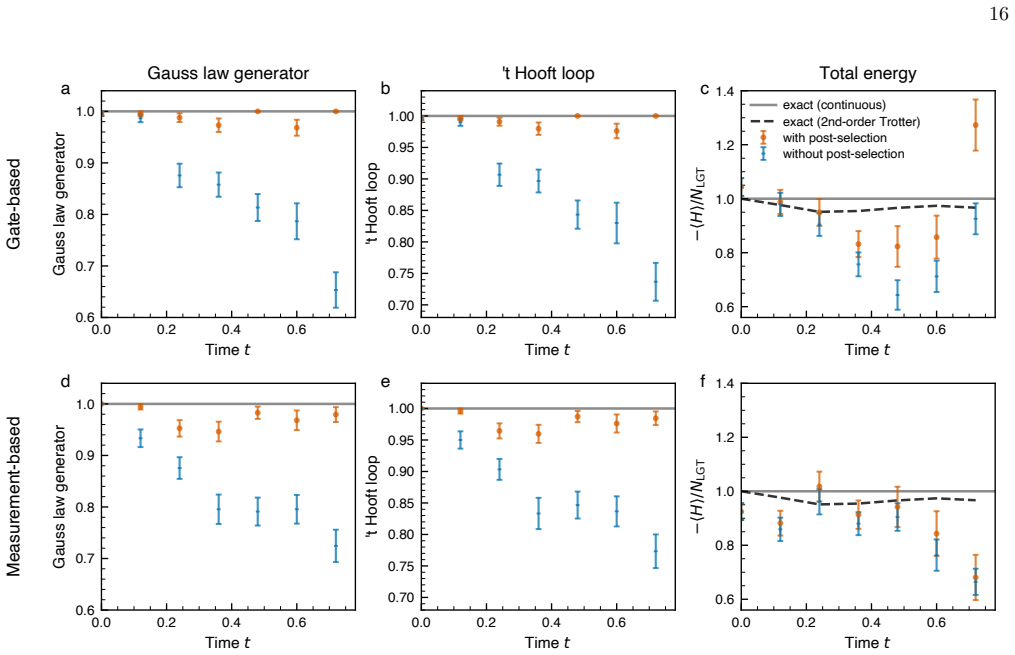
- [Appendix D / Section IV] The proof that trivial one-form-symmetry syndromes imply a gauge-invariant output state relies on the idealization t_e = 0 for all resource edges incident on the output boundary plane (Appendix D, paragraph following Eq. D2). The hardware implementation does not enforce this idealization: the final stitch S_{R,R+1} in Appendix C applies CZ gates with a reported error rate of about 8e-4, and no syndrome is evaluated at k = N_t. Boundary edge-Z errors are therefore undetected by the postselection flag and can teleport to single-link Z errors that violate Gauss's law. The independent Gauss-law measurement in Fig. 3b is the only direct check on this mechanism, but it is reported only for the (3,3,1) configuration, and at the final time N_acc = 11 gives a wide confidence interval; no Gauss-law diagnostic is reported for the (2,2,2) run behind the headline t = 0.96 window. The abstract's claim that postselection 'strongly suppresses observed Gauss-law violations' is therefore not established under the paper's own stated idealization. Please either provide a boundary-error analysis (for example, an estimated upper bound on the contribution of undetected boundary Z errors to the Gauss-law violation rate), add a Gauss-law diagnostic for the (2,2,2) data, or appropriately qualify the claim.
- [Section IV / Table II / Appendix I] The claim that postselection 'improves aggregate agreement with ideal Trotterized dynamics' appears in the abstract and Section IV. The supporting evidence in Table II shows observed RMSE decreases for all ten non-diagnostic curves, but only five have a 95% bootstrap interval entirely above zero; the other five are inconclusive, and the authors themselves note that the rows are not independent tests. As written, the unconditional phrasing in the abstract overstates the statistical support. I recommend either stating in the abstract and body that five of ten curve-level improvements are bootstrap-resolved, or adding data that resolve the inconclusive comparisons.
- [Section VI / Table III] The statistical basis for the late-time claims is thin: N_shot = 100 raw shots, N_acc falls to 11 at the final Trotter step of the (3,3,1) diagnostic run, and the coherence windows in Table III are based on a chosen threshold of 0.20 with a 68% bootstrap bound. While this is a legitimate demonstration metric, the headline 'coherent evolution' is therefore weaker than a claim of close agreement at all displayed times. The text should make clear that the window is a statistical upper bound under the chosen threshold, not a statement about the physical error per time step, and should state the accepted-shot counts at the window endpoints.
minor comments (5)
- [Section IV / Table III] The sentence 'These windows are unchanged at the looser threshold 0.25' is confusing because Table III shows T*_{0.25} = 0.96 for row (d), whereas T*_{0.20} = 0.84; the statement is true only for the minimum over observables, not for each individual curve. Please rephrase.
- [Appendix G / Fig. 6] The layer-resolved stabilizer data contain no output-boundary point, so they do not directly probe the boundary edges that are relevant to the Appendix D idealization. Please state this explicitly so that readers do not infer experimental support for the boundary assumption from Fig. 2d or Fig. 6.
- [Section III / Appendix E] The paper does not explicitly state the number of accepted shots for each curve at the coherence-window endpoints in Table III. Reporting N_acc alongside T* would help readers gauge the statistical weight of the headline windows.
- [Appendix D] The estimate 1 - (1-p)^{3LxLy} for near-boundary edge-Z errors warrants a brief derivation; the factor 3LxLy should be checked against the boundary edge count in the resource lattice, and the independence assumption should be stated.
- [Section VI / Appendix J] The noisy-emulator benchmark in Appendix J studies the (1+1)D transverse-field Ising model rather than the (2+1)D Z2 lattice gauge theory used in the main experiment. Its relevance to the boundary-error mechanism and to the syndrome-postselection protocol of the main text is therefore indirect; please state this limitation where the benchmark is invoked.
Circularity Check
No significant circularity: the experimental derivation is self-contained and checked against independent references.
full rationale
The paper's central claims are experimental: it implements a previously proposed MBQS protocol (Ref. [18]) on Quantinuum H2-2 and compares the measured observables against exact second-order Trotterized reference curves. The resource-state construction is parameter-free (Eq. (3) defines the cluster state; Eqs. (B3)-(B5) specify the measurement pattern with only the physical parameters lambda and delta-t), and no fitted parameter is renamed as a prediction. The postselection claim is checked independently: the one-form-symmetry syndromes are measured from edge-qubit outcomes in the resource, while the Gauss-law generators of the output state are measured in a separate final readout, so the suppression of Gauss-law violations is not imposed by construction. The cited prior work [18] supplies the theory, but the experimental validation stands on device data and independent benchmarks (edge stabilizers in Fig. 2d, Gauss-law diagnostics in Fig. 3b, and the gate-based comparison in Appendix H). Appendix D explicitly idealizes t_e = 0 on the output boundary; this is a stated limitation and a legitimate target for future work, but it is not an input-output identification or a fitted prediction, so it does not make the derivation circular. Self-citations to [18]-[20] are present but are not used to forbid alternatives or to smuggle in an unverified ansatz; the one-form-symmetry implication is itself tested by the Gauss-law measurements. Accordingly no specific circular step can be quoted, and the score is 0.
Assumptions & free parameters
free parameters (3)
- Z2 gauge theory coupling lambda =
2.0
- Trotter time step delta_t =
0.12
- Coherence-window threshold Delta68 =
0.20
assumptions (4)
- ad hoc to paper Boundary idealization: edge-Z errors are absent on resource edges incident on the boundary plane where the output state is induced (t_e=0 for these edges).
- domain assumption The noisy MBQS evolution is modeled by an ideal 3D cluster state corrupted by stochastic independent Pauli X/Z errors on resource qubits, with ideal measurements.
- standard math The Euclidean action Eq. (A1) is related to the target Hamiltonian Eq. (1) via the transfer-matrix formalism, so the cluster-state connectivity follows the spacetime locality of the gauge theory.
- standard math Block-decomposable resource graphs satisfying conditions (i)-(v) of Appendix C make the recycled-block implementation equivalent to the full-resource implementation.
Cite this review
Pith. "Pith review of Measurement-based simulation of lattice gauge theory dynamics with adaptive quantum circuits on a trapped-ion processor." pith.science (2026). https://pith.science/paper/DTNVPLXE
@misc{pith2026260804290,
  author       = {Pith},
  title        = {Pith review of: Measurement-based simulation of lattice gauge theory dynamics with adaptive quantum circuits on a trapped-ion processor},
  year         = {2026},
  howpublished = {\url{https://pith.science/paper/DTNVPLXE}},
  note         = {Machine review of arXiv:2608.04290}
}
abstract
Measurement-based quantum simulation (MBQS)---a recently proposed architecture for simulating lattice gauge theories---implements Hamiltonian dynamics by consuming a model-specific entangled resource state with adaptive mid-circuit measurements, rather than by a gate-based circuit. The local constraints in lattice gauge theories are mirrored by the higher-form symmetries of the resource state. Here we report, to our knowledge, the first experimental realization of MBQS of real-time dynamics in the $(2+1)$-dimensional $\mathbb{Z}_2$ gauge theory using the Quantinuum System Model H2 trapped-ion processor. We observe coherent evolution of gauge-invariant observables on $2\times2$ and $3\times3$ spatial lattices, consuming virtual three-dimensional cluster states of 200 and 288 resource-state qubits that are generated from instantaneous blocks of 48 and 54 qubits within the 56-qubit register by measurement, reset, and re-entanglement. The measurement record that drives the evolution simultaneously provides one-form-symmetry syndromes at no additional cost, enabling postselection that strongly suppresses observed Gauss-law violations and improves aggregate agreement with ideal Trotterized dynamics. Our results demonstrate that MBQS is a viable, symmetry-aware architecture for simulating lattice field theories on present-day hardware.
Figures


Figures from the paper (9 more)




Reference graph
Works this paper leans on
-
[18]
Measurement-based quantum simulation of Abelian lattice gauge theories
H. Sukeno and T. Okuda, SciPost Physics14, 129 (2023), arXiv:2210.10908 [quant-ph]
work page Pith review arXiv 2023
-
[1]
K. G. Wilson, Phys. Rev. D10, 2445 (1974)
1974
-
[2]
Creutz,Quarks, Gluons and Lattices, Cambridge Monographs on Mathematical Physics (Cambridge Uni- versity Press, 2023)
M. Creutz,Quarks, Gluons and Lattices, Cambridge Monographs on Mathematical Physics (Cambridge Uni- versity Press, 2023)
2023
-
[3]
A. S. Kronfeld, Ann. Rev. Nucl. Part. Sci.62, 265 (2012), arXiv:1203.1204 [hep-lat]
arXiv 2012
-
[4]
Aokiet al.(Flavour Lattice Averaging Group (FLAG)), Phys
Y. Aokiet al.(Flavour Lattice Averaging Group (FLAG)), Phys. Rev. D113, 014508 (2026), arXiv:2411.04268 [hep-lat]
arXiv 2026
-
[5]
G. Aarts and D. Sexty, Lattice field theories with a sign problem (2026), chapter for the Encyclopedia of Nuclear Physics, arXiv:2604.24290 [hep-lat]
arXiv 2026
-
[6]
M. C. Ba˜ nulset al., Eur. Phys. J. D74, 165 (2020), arXiv:1911.00003 [quant-ph]
arXiv 2020
-
[7]
C. W. Baueret al., PRX Quantum4, 027001 (2023), arXiv:2204.03381 [quant-ph]
arXiv 2023
Show all 62 references
-
[8]
C. W. Bauer, Z. Davoudi, N. Klco, and M. J. Savage, Nature Rev. Phys.5, 420 (2023), arXiv:2404.06298 [hep- ph]
2023 arXiv
-
[9]
E. A. Martinez, C. A. Muschik, P. Schindler, D. Nigg, A. Erhard, M. Heyl, P. Hauke, M. Dalmonte, T. Monz, P. Zoller, and R. Blatt, Nature (London)534, 516 (2016), arXiv:1605.04570 [quant-ph]
2016 arXiv
-
[10]
Mueller, T
N. Mueller, T. Wang, O. Katz, Z. Davoudi, and M. Cetina, Nature Communications16, 5492 (2025), arXiv:2408.00069 [quant-ph]
2025
-
[11]
Cobos, J
J. Cobos, J. Fraxanet, C. Benito, F. di Marcanto- nio, P. Rivero, K. Kap´ as, M. A. Werner, ¨O. Leg- eza, A. Bermudez, and E. Rico, arXiv e-prints , arXiv:2507.08088 (2025), arXiv:2507.08088 [quant-ph]
2025 arXiv
-
[12]
M. Meth, J. Zhang, J. F. Haase, C. Edmunds, L. Postler, A. J. Jena, A. Steiner, L. Dellantonio, R. Blatt, P. Zoller, T. Monz, P. Schindler, C. Muschik, and M. Ringbauer, Nature Physics21, 570 (2025)
2025
-
[13]
Weinberg,The Quantum theory of fields
S. Weinberg,The Quantum theory of fields. Vol. 1: Foun- dations(Cambridge University Press, 2005)
2005
-
[14]
Zohar, J
E. Zohar, J. I. Cirac, and B. Reznik, Reports on Progress in Physics79, 014401 (2016), arXiv:1503.02312 [quant- ph]
2016 arXiv
-
[15]
J. C. Halimeh and P. Hauke, Phys. Rev. Lett.125, 030503 (2020), arXiv:2001.00024 [cond-mat.quant-gas]. 0.0 0.2 0.4 0.6 0.8 1.0 1.2 1.4 1.6 Time t 0.3 0.4 0.5 0.6 0.7 0.8 0.9 1.0 1.1 −⟨H⟩/Lx exact first-order Trotter (t = n δt) all error two-qubit error only measurement error o...
2020 arXiv
-
[16]
H. J. Briegel and R. Raussendorf, Phys. Rev. Lett.86, 910 (2001), arXiv:quant-ph/0004051 [quant-ph]
2001 arXiv
-
[17]
Raussendorf, D
R. Raussendorf, D. E. Browne, and H. J. Briegel, Phys. Rev. A68, 022312 (2003), arXiv:quant-ph/0301052 [quant-ph]
2003 arXiv
-
[19]
Okuda, A
T. Okuda, A. Parayil Mana, and H. Sukeno, Physical Re- view Research6, 043018 (2024), arXiv:2402.08720 [cond- mat.str-el]
2024 arXiv
-
[20]
Okuda, A
T. Okuda, A. Parayil Mana, and H. Sukeno, SciPost 19 Physics17, 113 (2024), arXiv:2405.15853 [quant-ph]
2024
-
[21]
W.-R. Lee, Z. Qin, R. Raussendorf, E. Sela, and V. W. Scarola, Physical Review Research4, L032013 (2022), arXiv:2110.14642 [quant-ph]
2022 arXiv
-
[22]
A. Chan, Z. Shi, L. Dellantonio, W. D¨ ur, and C. A. Muschik, Phys. Rev. Lett.132, 240601 (2024), arXiv:2305.19200 [quant-ph]
2024 arXiv
-
[23]
Schuster, S
S. Schuster, S. K¨ uhn, L. Funcke, T. Hartung, M.-O. Pleinert, J. von Zanthier, and K. Jansen, Phys. Rev. D 109, 114508 (2024), arXiv:2311.14825 [hep-lat]
2024 arXiv
-
[24]
J. M. Pino, J. M. Dreiling, C. Figgatt, J. P. Gaebler, S. A. Moses, M. S. Allman, C. H. Baldwin, M. Foss-Feig, D. Hayes, K. Mayer, C. Ryan-Anderson, and B. Neyen- huis, Nature (London)592, 209 (2021), arXiv:2003.01293 [quant-ph]
2021 arXiv
-
[25]
S. A. Moses, , C. H. Baldwin, M. S. Allman, R. An- cona, L. Ascarrunz, C. Barnes, J. Bartolotta, B. Bjork, P. Blanchard, M. Bohn, J. G. Bohnet, N. C. Brown, N. Q. Burdick, W. C. Burton, S. L. Campbell, J. P. Campora, C. Carron, J. Chambers, J. W. Chan, Y. H. Chen, A. Chernoguz...
2023
-
[26]
J. B. Kogut, Rev. Mod. Phys.51, 659 (1979)
1979
-
[27]
Raussendorf, S
R. Raussendorf, S. Bravyi, and J. Harrington, Phys. Rev. A71, 062313 (2005), arXiv:quant-ph/0407255 [quant- ph]
2005 arXiv
-
[28]
Tantivasadakarn, R
N. Tantivasadakarn, R. Thorngren, A. Vishwanath, and R. Verresen, Physical Review X14, 021040 (2024), arXiv:2112.01519 [cond-mat.str-el]
2024 arXiv
-
[29]
Iqbal, N
M. Iqbal, N. Tantivasadakarn, T. M. Gatterman, J. A. Gerber, K. Gilmore, D. Gresh, A. Hankin, N. Hewitt, C. V. Horst, M. Matheny, T. Mengle, B. Neyenhuis, A. Vishwanath, M. Foss-Feig, R. Verresen, and H. Dreyer, Communications Physics7, 205 (2024), arXiv:2302.01917 [quant-ph]
2024 arXiv
-
[30]
DeCross, E
M. DeCross, E. Chertkov, M. Kohagen, and M. Foss- Feig, Phys. Rev. X13, 041057 (2023), arXiv:2210.08039 [quant-ph]
2023 arXiv
-
[31]
Yoshida, Phys
B. Yoshida, Phys. Rev. B93, 155131 (2016), arXiv:1508.03468 [cond-mat.str-el]
2016 arXiv
-
[32]
Walther, K
P. Walther, K. J. Resch, T. Rudolph, E. Schenck, H. We- infurter, V. Vedral, M. Aspelmeyer, and A. Zeilinger, Na- ture (London)434, 169 (2005), arXiv:quant-ph/0503126 [quant-ph]
2005 arXiv
-
[33]
B. P. Lanyon, P. Jurcevic, M. Zwerger, C. Hempel, E. A. Martinez, W. D¨ ur, H. J. Briegel, R. Blatt, and C. F. Roos, Phys. Rev. Lett.111, 210501 (2013), arXiv:1308.5102 [quant-ph]
2013 arXiv
-
[34]
Ringbauer, M
M. Ringbauer, M. Hinsche, T. Feldker, P. K. Faehrmann, J. Bermejo-Vega, C. L. Edmunds, L. Postler, R. Stricker, C. D. Marciniak, M. Meth, I. Pogorelov, R. Blatt, P. Schindler, J. Eisert, T. Monz, and D. Hangleiter, Na- ture Communications16, 106 (2025), arXiv:2307.14424 [quant-ph]
2025 arXiv
-
[35]
Gustiani, D
C. Gustiani, D. Leichtle, J. Miller, R. Grassie, D. Mills, and E. Kashefi, Phys. Rev. Lett.135, 160801 (2025), arXiv:2410.24133 [quant-ph]
2025 arXiv
-
[36]
H. Kang, J. F. Kam, G. J. Mooney, and L. C. L. Hollen- berg, Scientific Reports16, 689 (2026)
2026
-
[37]
Jiang, J
T. Jiang, J. Cai, J. Huang, N. Zhou, Y. Zhang, J. Bei, G. Cai, S. Cao, F. Chen, J. Chen, K. Chen, X. Chen, X. Chen, Z. Chen, Z. Chen, Z. Chen, W. Chu, H. Deng, Z. Deng, P. Ding, X. Ding, Z. Ding, S. Dong, B. Fan, D. Fan, Y. Fu, D. Gao, L. Ge, J. Gui, C. Guo, S. Guo, X. Guo, L....
2026 arXiv
-
[38]
Edmonds, Canadian Journal of Mathematics17, 449 (1965)
J. Edmonds, Canadian Journal of Mathematics17, 449 (1965)
1965
-
[39]
Dennis, A
E. Dennis, A. Kitaev, A. Landahl, and J. Preskill, Journal of Mathematical Physics43, 4452 (2002), arXiv:quant-ph/0110143 [quant-ph]
2002 arXiv
-
[40]
F. J. Wegner, Journal of Mathematical Physics12, 2259 (1971)
1971
-
[41]
Ringbauer, M
M. Ringbauer, M. Meth, L. Postler, R. Stricker, R. Blatt, P. Schindler, and T. Monz, Nature Physics18, 1053 (2022), arXiv:2109.06903 [quant-ph]
2022 arXiv
-
[42]
P. Hrmo, B. Wilhelm, L. Gerster, M. W. van Mourik, M. Huber, R. Blatt, P. Schindler, T. Monz, and M. Ringbauer, Nature Communications14, 2242 (2023), arXiv:2206.04104 [quant-ph]
2023 arXiv
-
[43]
T. V. Zache, D. Gonz´ alez-Cuadra, and P. Zoller, Phys. Rev. Lett.131, 171902 (2023), arXiv:2304.02527 [quant- ph]
2023 arXiv
-
[44]
Hayata and Y
T. Hayata and Y. Hidaka, Journal of High Energy Physics2023, 126 (2023), arXiv:2305.05950 [hep-lat]
2023 arXiv
-
[45]
Hayata and Y
T. Hayata and Y. Hidaka, Journal of High Energy Physics2023, 123 (2023), arXiv:2306.12324 [hep-lat]
2023 arXiv
-
[46]
Hayata, Y
T. Hayata, Y. Hidaka, and Y. Kikuchi, arXiv e-prints , arXiv:2601.13530 (2026), arXiv:2601.13530 [hep-lat]
2026
-
[47]
Yu, Z.-H
C.-C. Yu, Z.-H. Chen, Y.-H. Deng, C.-Y. Lu, M.-C. Chen, and J.-W. Pan, Phys. Rev. Lett.136, 160601 (2026), arXiv:2411.04664 [quant-ph]
2026 arXiv
-
[48]
L. M. Stewart, G. Baranes, J. Ramette, J. Sinclair, 20 and V. Vuleti´ c, arXiv e-prints , arXiv:2507.20009 (2025), arXiv:2507.20009 [quant-ph]
2025 arXiv
-
[49]
O. Lib, H. Timme, M. Ammenwerth, F. Gyger, R. Tao, S. Sun, I. Bloch, and J. Zeiher, arXiv e-prints , arXiv:2603.15561 (2026), arXiv:2603.15561 [quant-ph]
2026
-
[50]
M. V. den Nest, W. D¨ ur, and H. J. Briegel, Phys. Rev. Lett.98, 117207 (2007), arXiv:quant-ph/0610157 [quant- ph]
2007 arXiv
-
[51]
Gaiotto, A
D. Gaiotto, A. Kapustin, N. Seiberg, and B. Wil- lett, Journal of High Energy Physics2015, 172 (2015), arXiv:1412.5148 [hep-th]
2015 arXiv
-
[52]
M. A. Nielsen and I. L. Chuang,Quantum Computation and Quantum Information: 10th Anniversary Edition (Cambridge University Press, 2010)
2010
-
[53]
D. J. Wineland, C. Monroe, W. M. Itano, D. Leibfried, B. E. King, and D. M. Meekhof, J. Res. Natl. Inst. Stand. Tech.103, 259 (1998), arXiv:quant-ph/9710025
1998 arXiv
-
[54]
Kielpinski, C
D. Kielpinski, C. Monroe, and D. J. Wineland, Nature 417, 709 (2002)
2002
-
[55]
Quantinuum, Performance validation,https: //docs.quantinuum.com/systems/user_guide/ hardware_user_guide/performance_validation.html (2026), H2-2 hardware-specification data set dated 2025-08-28; accessed 2026-06-03
2026
-
[56]
Sivarajah, S
S. Sivarajah, S. Dilkes, A. Cowtan, W. Simmons, A. Edg- ington, and R. Duncan, Quantum Sci. Technol.6, 014003 (2020), arXiv:2003.10611 [quant-ph]
2020 arXiv
-
[57]
A. H. Rubin, B. Marinelli, V. A. Norman, Z. Rizvi, A. D. Burch, R. K. Naik, J. M. Kreikebaum, M. N. H. Chow, D. S. Lobser, M. C. Revelle,et al., Quantum Science and Technology10, 10.1088/2058-9565/ae0af0 (2025)
2025 doi
-
[58]
T. E. O’Brien, G. Anselmetti, F. Gkritsis, V. E. Elfving, S. Polla, W. J. Huggins, O. Oumarou, K. Kechedzhi, D. Abanin, R. Acharya, I. Aleiner, R. Allen, T. I. An- dersen, K. Anderson, M. Ansmann, F. Arute, K. Arya, A. Asfaw, J. Atalaya, J. C. Bardin, A. Bengtsson, G. Bor- tol...
2023
-
[59]
W. Chen, S. Zhang, J. Zhang, X. Su, Y. Lu, K. Zhang, M. Qiao, Y. Li, J.-N. Zhang, and K. Kim, npj Quantum Information9, 122 (2023)
2023
-
[60]
Efron and R
B. Efron and R. J. Tibshirani,An Introduction to the Bootstrap, 1st ed. (Chapman and Hall/CRC, 1994)
1994
-
[61]
A. C. Davison and D. V. Hinkley,Bootstrap Methods and their Application, Cambridge Series in Statistical and Probabilistic Mathematics (Cambridge University Press, 1997)
1997
-
[2026]
These values are taken from Quantinuum’s H2-2 hardware-specification data set dated 2025-08-28, as re- ported in the performance-validation documentation [55]
Table I lists representative component-level per- formance metrics reported by Quantinuum for the de- vice. These values are taken from Quantinuum’s H2-2 hardware-specification data set dated 2025-08-28, as re- ported in the performance-validation documentation [55]. We use th...
2025
Reviewed August 15, 2026 · model on record in the stance chip above.
Discussion (0). Continue with ORCID to comment.