REVIEW 4 major objections 4 minor 51 references
Deliberate Before You Fly: Vision-Guided Spatial Deliberation for UAV See-and-Reach Navigation
T0 review · 4 major / 4 minor · reviewed 2026-08-06 · deepseek-v4-flash
Pith's one-line read The paper claims that explicitly reasoning about target direction, spatial diagnosis, and maneuver before generating waypoints substantially improves UAV see-and-reach navigation, lifting success rates by an average of 25.07 percentage…
desk verdict A well-described and genuinely new deliberation framework for UAV see-and-reach, but the headline 25-point gain rests on a single-run evaluation and an unisolated stopping module, so it needs independent confirmation before I'd trust the magnitude. read the letter →
The pith
A machine-rendered reading of the paper's core claim, the machinery that carries it, and where it could break.
The reading
What carries the argument
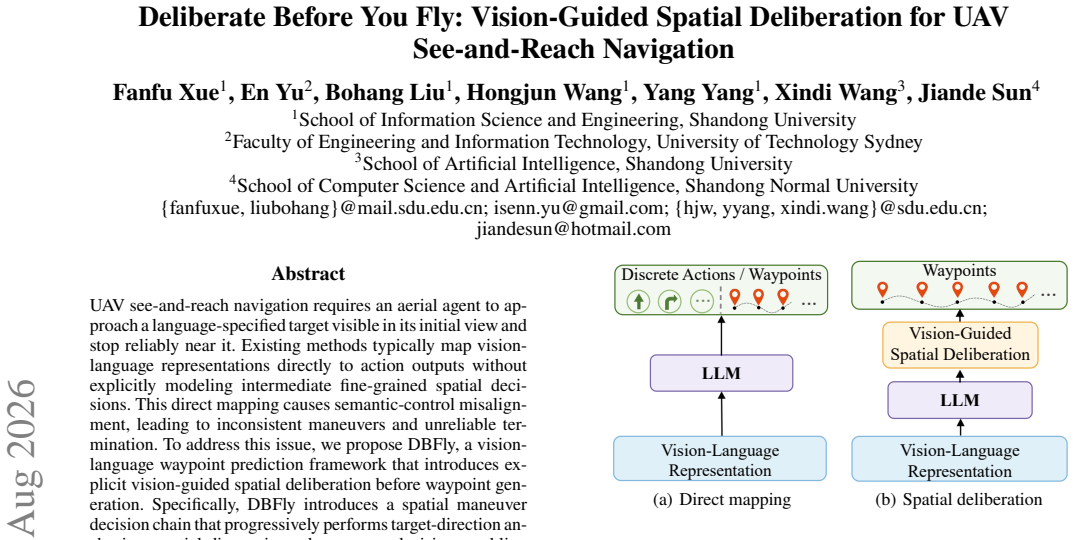
The key machinery is the vision-guided spatial deliberation scaffold. It comprises: (1) a spatial maneuver decision chain that progressively predicts the target's coarse direction in the body frame, the dominant navigation requirement (spatial diagnosis), and a high-level maneuver action; (2) an implicit flight corridor, a geometric reference derived from the initial target direction and the UAV's current horizontal displacement and azimuth, which provides a soft corridor state (centered, left/right deviation, down approach) that conditions the diagnosis; and (3) a terminal-convergence-aware stopping strategy that flags "stop" only when the final expert waypoint lies within the success radius AND the short-horizon motion is small and contracting. All five output fields are serialized and supervised with a standard autoregressive language-model objective, so the maneuver decision conditions the waypoint generation.
What would settle it
Run DBFly on a test set with known target positions and compare its predicted stop flag against the ground-truth conjunction rule (final waypoint within the success radius and contracting motion); if the model frequently issues "yes" when the final waypoint is outside the radius, or "no" when it is well inside and settling, the claimed terminal-convergence learning is not actually working. A quantitative real-world benchmark reporting success rate and navigation error would also test the transfer claim.
Extended reading notes
Core claim
On the paper's own terms, the central discovery is that explicitly predicting intermediate spatial decisions—target direction, spatial diagnosis, maneuver action, and a stopping flag—before generating short-horizon waypoints substantially improves see-and-reach navigation. DBFly is built on a pretrained vision-language model and fine-tuned with LoRA to output the structured sequence (direction, diagnosis, action, stop, waypoints) in a single autoregressive decode. Evaluated on the UAV-VLN-FOV benchmark, DBFly raises success rate from 38.82 to 62.50 on the seen test set, from 28.05 to 51.83 on unseen objects, and from 21.39 to 49.13 on unseen scenes relative to the previous SOTA baseline, with comparable gains in success-weighted path length. Real-world flights show the same deliberation behavior: the UAV keeps adjusting its maneuver toward the target and stops with a stable contraction rather than a premature halt.
Load-bearing premise
The load-bearing premise is that the model can estimate how close it is to the target and whether its motion is converging from egocentric images alone at test time, even though the stopping labels during training come from ground-truth expert waypoints; if that visual proximity and convergence estimate is unreliable, the stopping strategy cannot fire correctly and the reported gains may not transfer outside the exact simulation conditions.
Editorial extensions
If this is right
- If the claim holds, inserting explicit spatial deliberation before action generation becomes a design pattern for UAV vision-and-language navigation, potentially improving approach-and-stop reliability in real flights.
- The conjunction stopping rule should reduce both premature stops and late overshoots, which are the dominant failure modes in close-range target approach.
- Because the gains persist on unseen objects and scenes, the deliberation supervision appears to teach generalizable spatial reasoning rather than memorization of training scenes.
- The structured-output formulation is compatible with any modern vision-language model, so the framework can be dropped into other vision-and-language navigation pipelines that currently use direct mapping.
Reading between the lines
- This suggests the same deliberate-before-act pattern may improve other embodied navigation tasks, such as indoor ground robots or manipulation, where perception-to-action shortcuts also fail at the last meter.
- The hand-crafted corridor rule could be replaced by a learned geometric prior, which would let the model adapt to dynamic obstacles or target motion without re-engineering the corridor.
- A promising extension is to couple the stopping decision with a world model that predicts future visual states, as the paper itself notes; if the model could "imagine" the next viewpoint, it could refuse unsafe actions before executing them.
- A direct, testable extension is to vary the success radius and measure how the stopping strategy degrades; a graceful decline would confirm that the convergence evidence, not memorized distances, drives termination.
Editorial analysis
A structured set of objections, weighed in public.
Referee Report
Summary. The paper proposes DBFly, a vision-language waypoint prediction framework for UAV see-and-reach navigation. The key idea is to insert an explicit vision-guided spatial deliberation stage before waypoint generation, comprising a spatial maneuver decision chain (target-direction anchoring, spatial diagnosis, maneuver decision) and a terminal-convergence-aware stopping strategy. An implicit flight corridor, derived from the initial target-direction prior and online UAV position, provides soft geometric guidance. The model is fine-tuned on the UAV-VLN-FOV benchmark by autoregressively serializing the structured outputs and waypoints. The experiments report large success-rate gains over a 3DG-VLN baseline (average 25.07 percentage points across seen, unseen-object, and unseen-scene sets), supported by ablations and illustrative real-world flights.
Significance. If the reported gains are robust, the paper makes a useful contribution by demonstrating that explicit intermediate spatial reasoning can improve both maneuver consistency and termination reliability in UAV see-and-reach navigation. The framework is clearly described, the structured-output supervision is principled, and the sampling ablation in Table 3 is a welcome attempt to disentangle training-strategy effects. The paper also provides a project homepage and concrete implementation details. However, the central quantitative claim rests on a single evaluation run with small test sets, and the stopping-strategy evidence is not isolated from the waypoint-generation improvements, so the magnitude of the headline effect is not yet fully established.
major comments (4)
- [Appendix A.1 and Table 1] All reported test results are from a single evaluation run, and the test sets contain only 152, 164, and 173 trajectories. The paper should report variance over multiple seeds or, at minimum, binomial confidence intervals for the success-rate differences, and ideally a paired significance test for the 23-28 percentage-point gaps over the strongest baseline. Without this, a reader cannot assess whether the headline 25.07-point gain is stable or partly a product of seed selection.
- [Terminal-Convergence-Aware Stopping Strategy (Eqs. 10-12) and Table 2 (w/o Stop)] The stopping supervision S_t is constructed from ground-truth expert waypoint geometry via b_prox = I[d_tar_{t,K} < delta] and b_conv = I[m_K < epsilon_m AND kappa_t > epsilon_kappa]. At test time, the model must infer the same proximity and convergence evidence from egocentric images plus the odometry-derived corridor state, but the paper never measures the accuracy of that inference in isolation. Table 2's w/o Stop row removes the entire stop module, which conflates stop-decision misclassification with any effect on waypoint generation. The real-world section also reports no terminal distances, stop-decision accuracy, or success counts. I would like to see a standalone evaluation of stop decisions (e.g., precision/recall against expert labels, or a comparison with fixed-threshold terminal triggers using the same waypoint policy), because an improperly calibrated learned stop could account for a substantial part of the reported SR gain without the deliberation improving waypoint generation.
- [Table 3 and Experiments (Sampling ablation)] The sampling ablation shows that removing the sampling strategy from the full DBFly model reduces SR by 29.61, 30.49, and 26.59 percentage points on Test, Test UO, and Test US, respectively. These drops are comparable to or larger than the drops from removing VGSD in Table 2, which makes the claim that the gains 'do not stem from sampling itself' difficult to support from the reported numbers. The result is better described as a strong interaction between sampling and the deliberation supervision; the paper should either provide a fuller ablation matrix (e.g., with and without sampling under each component) or weaken the attribution claim.
- [Real-World Experiments (Section Experiments, Real-World Experiments)] The real-world deployment is presented only through qualitative snapshots and narrative descriptions. The conclusion states that real-world tests confirm 'operational reliability' and 'practical deployability,' but no quantitative evidence is given: no number of flights, success rate, terminal position error, or comparison with a baseline. This is especially relevant because the simulated results heavily depend on the learned stopping trigger, and the real-world setting is where that trigger's calibration would be most consequential. Please report concrete measurements or substantially soften the deployability claim.
minor comments (4)
- [Appendix A.1] The list of hand-set thresholds (alpha, gamma, epsilon_c, epsilon_d, epsilon_f, epsilon_m, epsilon_s, epsilon_l, epsilon_r, epsilon_kappa, epsilon_mu_x, epsilon_mu_z) is concrete, but the paper gives no sensitivity analysis. A brief study varying a few of these thresholds would help establish that the results are not brittle to their exact values.
- [Section Terminal-Convergence-Aware Stopping Strategy] The heading 'T erminal-Convergence Evidence' contains an unusual spacing; it should read 'Terminal-Convergence Evidence.'
- [Table 1] In the Random row, the column alignment appears off for the Test UO and Test US blocks; please ensure each metric value is aligned with its column header.
- [Figure 2] The figure contains the label 'Teminal Diagnosis' and 'Teminal' in the stopping-strategy block; this should be corrected to 'Terminal.'
Circularity Check
No circular derivation found; the 25.07 pp gain is an empirical supervised-learning comparison, with only a minor same-author benchmark/baseline overlap.
full rationale
The paper contains no derivation step in which a predicted quantity is defined in terms of the target quantity or fitted to the test outcome. The stopping supervision (Eqs. 10-12) labels expert waypoints by target proximity (b_prox = I[d_tar_{t,K}<delta]) and motion convergence (b_conv = I[m_K<epsilon_m and kappa_t>epsilon_kappa]), and the success metric (Eq. 3) uses the same delta = 10 m radius; this is an alignment between task definition and training label, not a circular reduction, because at test time the model must infer stop and waypoints from egocentric images without access to d_tar or expert waypoints, and the reported SR is an empirical closed-loop outcome. The maneuver-decision labels (Eqs. 6-9) are also derived from expert waypoint geometry to supervise the model, and the evaluation does not reuse those labels. The main self-reference is that the UAV-VLN-FOV benchmark and the strongest baseline (3DG-VLN) come from the same author group (Xue et al. 2026), so the SOTA comparison is in-house; however, no uniqueness theorem or ansatz is imported from that citation, and the metric is an objective distance-based success rate. The lack of an isolated quantitative validation of the learned visual stop inference is a robustness/correctness risk, not a circularity, because it concerns whether the inferred proximity evidence generalizes rather than whether the prediction reduces to its inputs. Ablations and real-world flights provide independent empirical content. I therefore find no circular step, only a minor same-author benchmark/baseline overlap, reflected in the score.
Assumptions & free parameters
free parameters (3)
- Threshold set {alpha, gamma, epsilon_c, epsilon_d, epsilon_f, epsilon_m, epsilon_s, epsilon_l, epsilon_r… =
alpha=pi/2, gamma=pi/6, epsilon_kappa=0, epsilon_l=epsilon_mu_z=epsilon_r=0.25…
- Short-horizon waypoint length K =
5
- Training sampling retention rates =
downsample forward samples by 50%, oversample other categories below 10% of retained count up to 10%, seed 42
assumptions (4)
- domain assumption The initial target-direction prior D0 is correct and available at every deployment.
- domain assumption Automatically thresholded expert waypoints produce valid spatial deliberation labels.
- domain assumption Simulation success with a 10 m radius transfers to real-world see-and-reach navigation.
- domain assumption Qwen3-VL can estimate 3D target proximity from egocentric images implicitly.
Cite this review
Pith. "Pith review of Deliberate Before You Fly: Vision-Guided Spatial Deliberation for UAV See-and-Reach Navigation." pith.science (2026). https://pith.science/paper/2IZOLS3H
@misc{pith2026260804825,
  author       = {Pith},
  title        = {Pith review of: Deliberate Before You Fly: Vision-Guided Spatial Deliberation for UAV See-and-Reach Navigation},
  year         = {2026},
  howpublished = {\url{https://pith.science/paper/2IZOLS3H}},
  note         = {Machine review of arXiv:2608.04825}
}
read the original abstract
UAV see-and-reach navigation requires an aerial agent to approach a language-specified target visible in its initial view and stop reliably near it. Existing methods typically map vision-language representations directly to action outputs without explicitly modeling intermediate fine-grained spatial decisions. This direct mapping causes semantic-control misalignment, leading to inconsistent maneuvers and unreliable termination. To address this issue, we propose DBFly, a vision-language waypoint prediction framework that introduces explicit vision-guided spatial deliberation before waypoint generation. Specifically, DBFly introduces a spatial maneuver decision chain that progressively performs target-direction anchoring, spatial diagnosis, and maneuver decision, enabling high-level maneuver intent to explicitly guide continuous waypoint generation. DBFly further constructs an implicit flight corridor by transforming the initial target-direction prior into a persistent geometric reference and deriving an online corridor state from the UAV's current position, thereby providing soft geometric guidance for spatial diagnosis and maneuver correction. In addition, DBFly develops a terminal-convergence-aware stopping strategy that characterizes terminal states through both target proximity and short-horizon motion convergence, enabling more reliable stopping near the target. Extensive experiments across seen, unseen-object, and unseen-scene test sets demonstrate that DBFly improves the success rate over the SOTA baseline by an average of 25.07 percentage points. The project homepage is available at https://xuefanfu.github.io/DBFly-Page.
Figures


Figures from the paper (6 more)


Reference graph
Works this paper leans on
-
[1]
Proceedings of the IEEE/CVF International Conference on Computer Vision , pages=
Aerialvln: Vision-and-language navigation for uavs , author=. Proceedings of the IEEE/CVF International Conference on Computer Vision , pages=
-
[2]
Proceedings of the IEEE/CVF International Conference on Computer Vision , pages=
Citynav: A large-scale dataset for real-world aerial navigation , author=. Proceedings of the IEEE/CVF International Conference on Computer Vision , pages=
-
[3]
arXiv preprint arXiv:2602.07399 , year=
VGAS: value-guided action-chunk selection for few-shot vision-language-action adaptation , author=. arXiv preprint arXiv:2602.07399 , year=
-
[4]
Yu, En and Lu, Jie and Zhang, Guangquan , title =. 2026 , booktitle =
work page 2026
-
[5]
arXiv preprint arXiv:2410.08500 , year=
Aerial vision-and-language navigation via semantic-topo-metric representation guided LLM reasoning , author=. arXiv preprint arXiv:2410.08500 , year=
-
[6]
arXiv preprint arXiv:2503.11091 , year=
Aerial Vision-and-Language Navigation with Grid-based View Selection and Map Construction , author=. arXiv preprint arXiv:2503.11091 , year=
-
[7]
International Conference on Learning Representations , volume=
Towards realistic uav vision-language navigation: Platform, benchmark, and methodology , author=. International Conference on Learning Representations , volume=
-
[8]
Findings of the Association for Computational Linguistics: ACL 2023 , pages=
Aerial vision-and-dialog navigation , author=. Findings of the Association for Computational Linguistics: ACL 2023 , pages=
2023
Show all 51 references
-
[9]
arXiv preprint arXiv:2603.14363 , year=
AerialVLA: A Vision-Language-Action Model for UAV Navigation via Minimalist End-to-End Control , author=. arXiv preprint arXiv:2603.14363 , year=
-
[10]
arXiv preprint arXiv:2506.10756 , year=
Grounded Vision-Language Navigation for UAVs with Open-Vocabulary Goal Understanding , author=. arXiv preprint arXiv:2506.10756 , year=
-
[11]
arXiv preprint arXiv:2504.09587 , year=
Geonav: Empowering mllms with explicit geospatial reasoning abilities for language-goal aerial navigation , author=. arXiv preprint arXiv:2504.09587 , year=
-
[12]
Proceedings of the AAAI Conference on Artificial Intelligence , volume=
History-enhanced two-stage transformer for aerial vision-and-language navigation , author=. Proceedings of the AAAI Conference on Artificial Intelligence , volume=
-
[13]
Proceedings of the IEEE/CVF Conference on Computer Vision and Pattern Recognition , pages=
HTNav: A Hybrid Navigation Framework with Tiered Structure for Urban Aerial Vision-and-Language Navigation , author=. Proceedings of the IEEE/CVF Conference on Computer Vision and Pattern Recognition , pages=
-
[14]
2025 20th ACM/IEEE International Conference on Human-Robot Interaction (HRI) , pages=
UAV-VLA: Vision-language-action system for large scale aerial mission generation , author=. 2025 20th ACM/IEEE International Conference on Human-Robot Interaction (HRI) , pages=. 2025 , organization=
2025
-
[15]
2025 IEEE International Conference on Robotics and Biomimetics (ROBIO) , pages=
Uav-vlpa*: Vision-language guided global-local uav mission planning from satellite imagery , author=. 2025 IEEE International Conference on Robotics and Biomimetics (ROBIO) , pages=. 2025 , organization=
2025
-
[16]
arXiv preprint arXiv:2308.11561 , year=
Target-grounded graph-aware transformer for aerial vision-and-dialog navigation , author=. arXiv preprint arXiv:2308.11561 , year=
-
[17]
Proceedings of the AAAI Conference on Artificial Intelligence , volume=
Learning fine-grained alignment for aerial vision-dialog navigation , author=. Proceedings of the AAAI Conference on Artificial Intelligence , volume=
-
[18]
Proceedings of the AAAI Conference on Artificial Intelligence , volume=
AerialVLA: A Vision-Language-Action Model for Aerial Navigation with Online Dialogue , author=. Proceedings of the AAAI Conference on Artificial Intelligence , volume=
-
[19]
Proceedings of the IEEE/CVF Conference on Computer Vision and Pattern Recognition , pages=
Parse, Search, and Confirmation: Training-Free Aerial Vision-and-Dialog Navigation with Chain-of-Thought Reasoning and Structured Spatial Memory , author=. Proceedings of the IEEE/CVF Conference on Computer Vision and Pattern Recognition , pages=
-
[20]
arXiv preprint arXiv:2603.21046 , year=
SpatialFly: Geometry-Guided Representation Alignment for UAV Vision-and-Language Navigation in Urban Environments , author=. arXiv preprint arXiv:2603.21046 , year=
-
[21]
arXiv preprint arXiv:2511.06182 , year=
OpenVLN: Open-world Aerial Vision-Language Navigation , author=. arXiv preprint arXiv:2511.06182 , year=
-
[22]
arXiv preprint arXiv:2606.31654 , year=
DynFly: Dynamic-Aware Continuous Trajectory Generation for UAV Vision-Language Navigation in Urban Environments , author=. arXiv preprint arXiv:2606.31654 , year=
-
[23]
arXiv preprint arXiv:2606.20045 , year=
See-and-Reach: Precise Vision-Language Navigation for UAVs within the Field of View , author=. arXiv preprint arXiv:2606.20045 , year=
-
[24]
Proceedings of the 63rd Annual Meeting of the Association for Computational Linguistics (Volume 1: Long Papers) , pages=
Citynavagent: Aerial vision-and-language navigation with hierarchical semantic planning and global memory , author=. Proceedings of the 63rd Annual Meeting of the Association for Computational Linguistics (Volume 1: Long Papers) , pages=
-
[25]
Proceedings of the IEEE/CVF Conference on Computer Vision and Pattern Recognition , pages=
LookasideVLN: direction-aware aerial vision-and-language navigation , author=. Proceedings of the IEEE/CVF Conference on Computer Vision and Pattern Recognition , pages=
-
[26]
Proceedings of the IEEE/CVF Conference on Computer Vision and Pattern Recognition , pages=
CoTFly: Making UAVs Think Where to Fly Next Through Visual Chain-of-Thought Reasoning , author=. Proceedings of the IEEE/CVF Conference on Computer Vision and Pattern Recognition , pages=
-
[27]
arXiv preprint arXiv:2606.06836 , year=
Think Like a Pilot: Fine-Grained Long-Horizon UAV Navigation , author=. arXiv preprint arXiv:2606.06836 , year=
-
[28]
Proceedings of the 33rd ACM International Conference on Multimedia , pages=
AeroDuo: Aerial Duo for UAV-based Vision and Language Navigation , author=. Proceedings of the 33rd ACM International Conference on Multimedia , pages=
-
[29]
Advances in Neural Information Processing Systems , volume=
Uav-flow colosseo: A real-world benchmark for flying-on-a-word uav imitation learning , author=. Advances in Neural Information Processing Systems , volume=
-
[30]
arXiv preprint arXiv:2511.21631 , year=
Qwen3-vl technical report , author=. arXiv preprint arXiv:2511.21631 , year=
-
[31]
2025 , eprint=
Qwen2.5-VL Technical Report , author=. 2025 , eprint=
2025
-
[32]
arXiv e-prints , pages=
OpenFly: A versatile toolchain and large-scale benchmark for aerial vision-language navigation , author=. arXiv e-prints , pages=
-
[33]
International Journal of Computer Vision , volume=
Sensaturban: Learning semantics from urban-scale photogrammetric point clouds , author=. International Journal of Computer Vision , volume=. 2022 , publisher=
2022
-
[34]
Proceedings of the 33rd ACM International Conference on Multimedia , pages=
Uav-on: A benchmark for open-world object goal navigation with aerial agents , author=. Proceedings of the 33rd ACM International Conference on Multimedia , pages=
-
[35]
NavCoT: Boosting LLM-Based Vision-and-Language Navigation via Learning Disentangled Reasoning , year=
Lin, Bingqian and Nie, Yunshuang and Wei, Ziming and Chen, Jiaqi and Ma, Shikui and Han, Jianhua and Xu, Hang and Chang, Xiaojun and Liang, Xiaodan , journal=. NavCoT: Boosting LLM-Based Vision-and-Language Navigation via Learning Disentangled Reasoning , year=
-
[36]
Proceedings of the IEEE/CVF Conference on Computer Vision and Pattern Recognition , pages=
Decovln: Decoupling observation, reasoning, and correction for vision-and-language navigation , author=. Proceedings of the IEEE/CVF Conference on Computer Vision and Pattern Recognition , pages=
-
[37]
Proceedings of the IEEE/CVF Conference on Computer Vision and Pattern Recognition , pages=
Cross from left to right brain: Adaptive text dreamer for vision-and-language navigation , author=. Proceedings of the IEEE/CVF Conference on Computer Vision and Pattern Recognition , pages=
-
[38]
Proceedings of the Computer Vision and Pattern Recognition Conference , pages=
Citywalker: Learning embodied urban navigation from web-scale videos , author=. Proceedings of the Computer Vision and Pattern Recognition Conference , pages=
-
[39]
IEEE Transactions on Multimedia , volume=
Vision-and-language navigation via latent semantic alignment learning , author=. IEEE Transactions on Multimedia , volume=. 2024 , publisher=
2024
-
[40]
, author=
Lora: Low-rank adaptation of large language models. , author=. International Conference on Learning Representations , year=
-
[41]
Proceedings of the 2025 Conference on Empirical Methods in Natural Language Processing , pages=
Flightgpt: Towards generalizable and interpretable uav vision-and-language navigation with vision-language models , author=. Proceedings of the 2025 Conference on Empirical Methods in Natural Language Processing , pages=
2025
-
[42]
IEEE Transactions on Pattern Analysis and Machine Intelligence , year=
Fine-grained alignment supervision matters in vision-and-language navigation , author=. IEEE Transactions on Pattern Analysis and Machine Intelligence , year=
-
[43]
arXiv preprint arXiv:2603.10682 , year=
OnFly: Onboard Zero-Shot Aerial Vision-Language Navigation toward Safety and Efficiency , author=. arXiv preprint arXiv:2603.10682 , year=
-
[44]
arXiv preprint arXiv:2512.15258 , year=
VLA-AN: An Efficient and Onboard Vision-Language-Action Framework for Aerial Navigation in Complex Environments , author=. arXiv preprint arXiv:2512.15258 , year=
-
[45]
arXiv preprint arXiv:2602.00551 , year=
APEX: A Decoupled Memory-based Explorer for Asynchronous Aerial Object Goal Navigation , author=. arXiv preprint arXiv:2602.00551 , year=
-
[46]
arXiv preprint arXiv:2606.01205 , year=
ImagineUAV: Aerial Vision-Language Navigation via World-Action Modeling and Kinodynamic Planning , author=. arXiv preprint arXiv:2606.01205 , year=
-
[47]
arXiv preprint arXiv:2606.06147 , year=
WorldFly: A World-Model-Based Vision-Language-Action Model for UAV Navigation , author=. arXiv preprint arXiv:2606.06147 , year=
-
[48]
arXiv preprint arXiv:2602.09657 , year=
Autofly: Vision-language-action model for UAV autonomous navigation in the wild , author=. arXiv preprint arXiv:2602.09657 , year=
-
[49]
Procedia Computer Science , volume=
A systematic literature review of A* pathfinding , author=. Procedia Computer Science , volume=. 2021 , publisher=
2021
-
[50]
Proceedings of the IEEE/CVF Conference on Computer Vision and Pattern Recognition , pages=
Memory-Augmented Scene Understanding and Exploration for Open-World Aerial Object-Goal Navigation , author=. Proceedings of the IEEE/CVF Conference on Computer Vision and Pattern Recognition , pages=
-
[51]
arXiv preprint arXiv:2411.08579 , year=
Navagent: Multi-scale urban street view fusion for uav embodied vision-and-language navigation , author=. arXiv preprint arXiv:2411.08579 , year=
Reviewed August 6, 2026 · model on record in the stance chip above.
Discussion (0). Sign in to comment.