REVIEW 3 major objections 4 minor
Nonparametric Goodness-of-fit Testing under Covariate Shift
T0 review · 3 major / 4 minor · reviewed 2026-08-06 · deepseek-v4-flash
Pith's one-line read Truncated importance weighting with multiplier bootstrap produces asymptotically valid $L^2(Q)$ confidence balls for the regression function under covariate shift, with explicit nonasymptotic coverage-error rates.
desk verdict Genuinely new target-metric inference under covariate shift, with an honest conditional theorem — but the explicit coverage rates rest on an unverified covariance non-degeneracy condition that truncation can break. read the letter →
The pith
A machine-rendered reading of the paper's core claim, the machinery that carries it, and where it could break.
The reading
What carries the argument
The central mechanism is a comparison of two Hilbert-space geometries: the target $L^2(Q)$ geometry and the truncated weighted-source geometry induced by $w_n=\min\{\rho,\tau_n\}$. These are encoded by the kernel integral operators $L_Q$ and $L_{P_w}$, and the paper uses the unitary isomorphism $L_Q^{1/2}: \mathrm{Ran}(L_Q)\to H$ to compare Gaussian and bootstrap processes inside a common reproducing-kernel-Hilbert-space operator calculus. Two operator-level compatibility conditions carry the argument: Assumption 4.4 (regularized transfer coverage, $L_Q\preceq C_1^2(L_{P_w}+\lambda_n I)$) transfers source-side risk, bias, and bootstrap errors into the target norm, while Assumption 4.5 (non-degenerate covariance) keeps the Gaussian covariance from degenerating in $L^2(Q)$ and supplies anti-concentration. The multiplier bootstrap is made computationally feasible by sampling $z\sim N(0,I_n-\mathbf{1}\mathbf{1}^\top/n)$ and writing $\|B\|^2_{L^2(Q)}=n a^\top K_Q a$ with $a=(K+n\lambda W^{-1})^{-1}\mathrm{diag}(\hat{\varepsilon})z$, so each bootstrap draw is a matrix-vector multiplication once $K_Q$ is formed.
What would settle it
Choose a compact domain and Gaussian kernel, take $P$ uniform on $[0,1]$ and $Q$ with density ratio $\rho(x)$ large on a tiny interval and small elsewhere but with finite second moment, set $f^*(x)=x$, and simulate with $n=10^4$ using the truncation and regularization choices prescribed by the paper. If the empirical frequency of $f^*\in \mathrm{CS}_\alpha(\hat f)$ over many repetitions is systematically below $1-\alpha$ by more than the stated rate, the regularized transfer coverage constant is effectively large and the bound fails; alternatively, compute the ratio $\sup_{f\in H}\|f\|_{L^2(Q)}^2/(E[w_n(X)f(X)^2]+\lambda\|f\|_H^2)$ and check whether it matches the assumed $C_1$.
Extended reading notes
Core claim
On the paper's own terms: given source observations $(X_i,Y_i)$ from $P$ and a target covariate measure $Q$ with known density ratio $\rho=dQ/dP$, the paper constructs the confidence ball $\mathrm{CS}_\alpha(\hat f)=\{f:\|\hat f-f\|_{L^2(Q)}\le \hat c_{\alpha,n}\}$ using truncated importance-weighted kernel ridge regression with $w_n=\min\{\rho,\tau_n\}$ and a multiplier bootstrap. Theorem 4.1 states that, under the paper's Assumptions 4.1--4.5 and spectral conditions on the kernel integral operator, the miscoverage satisfies $|P(f^*\notin \mathrm{CS}_\alpha(\hat f))-\alpha|\lesssim \eta+\sqrt{\tau_n}(\Delta_G+\Delta_B+\Delta_{\mathrm{bias}})$. Consequently, if the probability tolerance and all three error components shrink fast enough after scaling by $\sqrt{\tau_n}$, the coverage converges to $1-\alpha$. The paper also gives explicit finite-sample rates for bounded, sub-exponential, and heavy-tailed density ratios under polynomial or exponential eigenvalue decay, and shows that inverting the ball yields a goodness-of-fit test with power tending to one under fixed alternatives.
Load-bearing premise
The load-bearing premise is that every direction of variation that the target distribution sees is dominated, up to a constant and a small ridge penalty, by the truncated weighted source distribution; this operator-level condition is not directly checkable and can fail even when the density ratio has finite moments.
Editorial extensions
If this is right
- If the paper's rates hold, a practitioner can test $H_0:\|f_0-f^*\|_{L^2(Q)}=0$ by checking whether $f_0$ lies in the bootstrap $L^2(Q)$ ball, with asymptotically controlled size.
- The same confidence ball yields confidence intervals for projection distances such as $d_Q(f^*,M)$ for composite hypotheses, by the triangle inequality.
- Under a fixed target separation $\delta=\|f^*-f_0\|_{L^2(Q)}>0$, the inverted test has power tending to one whenever the estimation error and the scaled critical radius vanish.
- The explicit rates make the tuning regime usable in principle: for example, a bounded density ratio with polynomial spectral decay $\beta>5$ gives miscoverage error of order $n^{-(\beta-5)(\beta+10)/(6(\beta+3)(2\beta+5))}\log^3 n$ with a specified choice of $\lambda_n$.
- Truncation stabilizes both the estimator and the bootstrap calibration, so the procedure remains applicable even when the density ratio has heavy tails, provided the kernel eigenvalues decay fast enough.
Reading between the lines
- One can read the paper as saying that the right summary of distribution shift for inference is a regularized operator domination ratio, not a scalar density-ratio bound; an inference-friendly replacement for the transfer exponent would be $\sup_f \|f\|_{L^2(Q)}^2/(E[w_n(X)f(X)^2]+\lambda\|f\|_H^2)$.
- The known-density-ratio assumption is the main practical bottleneck: plugging in an estimated ratio would perturb the first-order bootstrap approximation, and quantifying that perturbation is a natural next step; simulations could test coverage sensitivity to estimation error in $\log\rho$.
- The same operator-comparison machinery likely extends to two-sample tests and to sub-Gaussian kernels, as sketched in the paper's appendices, but the rate comparisons suggest the method is most attractive when $L_Q$ has fast spectral decay.
Editorial analysis
A structured set of objections, weighed in public.
Referee Report
Summary. The paper develops a nonparametric goodness-of-fit procedure under covariate shift. Given source-labelled data and a known target-to-source density ratio, the authors construct L2(Q)-norm confidence balls for the regression function using truncated importance-weighted kernel ridge regression, with the radius calibrated by a multiplier bootstrap. The main theoretical result, Theorem 4.1, expresses the coverage error of the confidence ball as an explicit nonasymptotic bound of order η + sqrt(τ_n) Δ, where Δ is the sum of bias, Gaussian approximation, and bootstrap approximation errors, under two operator compatibility conditions (Assumptions 4.4 and 4.5). Corollaries 4.2–4.4 provide explicit convergence rates under bounded, sub-exponential, and heavy-tailed density ratios combined with polynomial or exponential spectral decay of the kernel integral operator. The paper also reports numerical experiments, an application to Survey of Consumer Finances data, and extensions to sub-Gaussian kernels, bias correction, and residual bootstrap. The main theorem is honestly presented as conditional on approximation inequalities, and the proofs are detailed.
Significance. If the stated results hold, the paper gives a practically relevant and computationally feasible method for function-level inference under covariate shift: the bootstrap is cheap after a single IWKRR fit, and the coverage-error decomposition is explicit rather than asymptotic in name only. The paper also makes a genuine effort to handle heavy-tailed density ratios through truncation, which is a common and important scenario. The inclusion of real-data applications and the extensive technical appendix are strengths. However, the advertised heavy-tail rates and the claimed 'sharpness' are not fully supported: Assumption 4.5 is never verified in the corollary regimes, and no lower bounds are proved. The contribution is therefore conditional rather than unconditional as currently written.
major comments (3)
- [Section 4.1.2, Assumption 4.5; Lemma 4.1; Corollaries 4.2–4.4] Assumption 4.5 is load-bearing for the coverage guarantee and is never verified in any of the explicit rate regimes. Lemma 4.1 uses Assumption 4.5 through Lemma F.8 to lower-bound the Gaussian covariance V, and that lower bound produces the uniform density bound sqrt(τ_n) that enters the quantile comparison in Theorem 4.1. The sufficient conditions in Remark 1 and in Lemmas F.29 and F.31 verify only Assumption 4.4. In Corollary 4.4, τ_n grows as n^{3/(5θ-2)}, so the truncated region {ρ > τ_n} remains visible to the target measure Q for every n; if the target spectral mass in that region is not dominated by the truncated weighted-source operator, the constant C_2 in Assumption 4.5 must diverge with n. Since Section 4.3.4 explicitly 'ignores constants C1,C2,ρ', the displayed rates do not follow from the stated assumptions unless Assumption 4.5 is verified with a uniformly bounded C_2. Please either prove Assumption 4.5 under explicit conditions on ρ, τ_n, λ_n, and the kernel, or replace it by a verifiable sufficient condition, and then re-check the corollary rates.
- [Abstract; Section 4.2] The abstract claims 'sharpness' of the resulting confidence sets, but the paper contains no lower bound, minimax argument, or other notion of optimality for the coverage error. The only theoretical statement is the upper bound on |P(f* notin CS_α(bf)) - α|. I recommend either proving a matching lower bound or replacing 'sharpness' with a description such as 'explicit nonasymptotic coverage error'.
- [Section 4.3.4 and Corollaries 4.2–4.4; Appendix A and D] The same unverified Assumption 4.5 propagates into Corollaries A.1–A.3 and D.1. The sub-Gaussian and heavy-tail extensions repeat the strategy of the main text, but they never establish that the covariance lower bound holds with a constant independent of n under the chosen truncation and regularization sequences. Consequently, the asymptotic coverage conclusions in those corollaries inherit the gap identified above.
minor comments (4)
- [Section 6.3 and Figure 6] The text reports d(bf,M↑)=0.0151 and ĉ_{0.10}=0.0252, while the figure caption reports an observed distance of 0.0190 and a 90% radius of 0.0256; these numbers should be reconciled.
- [Theorem 4.2] The displayed convergence 'P− →0' appears to be a typographical corruption of '→_P 0'; please fix the notation.
- [Notation throughout] The symbol C_1 is used both for the compatibility constant in Assumption 4.4 and for the generic constant in Lemma 4.1; using different symbols would prevent confusion.
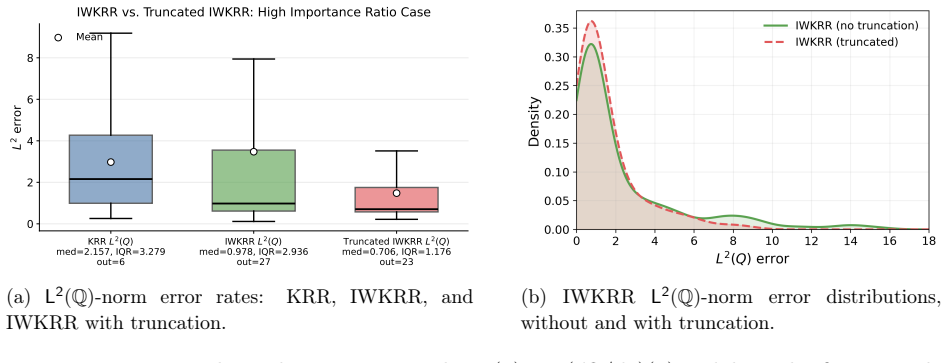
- [Figure 1] The labels 'out=6', 'out=27', and 'out=23' in the caption are unexplained; please clarify what these counts represent.
Circularity Check
The coverage guarantee is derived from explicit stated assumptions and error bounds, with no equation reducing to the target claim; the paper is not circular.
full rationale
The central coverage theorem, Theorem 4.1, is proved from the three approximation inequalities (4.1)-(4.3) together with Lemma 4.1's anti-concentration bound, and the bootstrap radius is defined as an empirical quantile of the bootstrap statistic ||B||_{L2(Q)}. No step fits the estimator, tuning parameters, or bootstrap quantile to match the claimed coverage; lambda_n and tau_n are chosen by rate conditions, and the constants C1 and C2 are assumed rather than fitted. The compatibility conditions are stated assumptions whose role is explicit: Assumption 4.4 enables transfer of errors to the target L2(Q) geometry and is verified under concrete density-ratio regimes in Remark 1 and Lemmas F.29-F.31, while Assumption 4.5 is a lower-bound condition used for anti-concentration. Neither condition is equivalent to the theorem's conclusion, and neither is imported solely from a self-citation. The only self-citation, to Xia and Yuan [2021] as an example of a typical variance lower-bound condition, is motivational and not load-bearing. The skeptic's concern that Assumption 4.5 is not verified in the rate corollaries is a potential correctness or completeness gap, not a circular reduction from outputs back to inputs. Accordingly, no circular step is identified and the paper is assessed as self-contained in its derivation.
Assumptions & free parameters
free parameters (2)
- truncation level tau_n =
tau_n asymptotic to n^c in corollaries; tuned by cross-validation in experiments
- regularization lambda_n =
lambda_n asymptotic to n^{-a} in corollaries; tuned by cross-validation
assumptions (8)
- domain assumption Assumption 4.1: |epsilon| <= sigma and E[epsilon^2|X] >= sigma^2 almost surely
- domain assumption Assumption 4.2: f* = L_{P_{w0}}^s(g*) with s in [0,1]
- domain assumption Assumption 4.3: effective dimension N_lambda <= E_d^2 lambda^{-d}
- ad hoc to paper Assumption 4.4: regularized transfer coverage L_Q <= C_1^2(L_{P_w} + lambda_n I)
- ad hoc to paper Assumption 4.5: rho(X) >= rho > 0 and regularized covariance lower bound
- domain assumption Known density ratio rho(x) = dQ/dP
- domain assumption Compact X and bounded kernel k(x,x) <= kappa^2
- domain assumption Spectral decay mu_i asymptotic to i^{-beta} or exp(-beta i^gamma)
Cite this review
Pith. "Pith review of Nonparametric Goodness-of-fit Testing under Covariate Shift." pith.science (2026). https://pith.science/paper/7O7BTNET
@misc{pith2026260804860,
  author       = {Pith},
  title        = {Pith review of: Nonparametric Goodness-of-fit Testing under Covariate Shift},
  year         = {2026},
  howpublished = {\url{https://pith.science/paper/7O7BTNET}},
  note         = {Machine review of arXiv:2608.04860}
}
read the original abstract
This paper develops procedures for nonparametric goodness-of-fit testing under covariate shift, where labelled data are drawn from a source population but goodness-of-fit is evaluated for a target population. The distribution mismatch is quantified by either a bounded moment condition or a sub-exponential tail condition on the target-to-source density ratio. Our method combines truncated importance-weighting kernel ridge regression with a multiplier bootstrap to construct confidence sets for the regression function. The truncation stabilizes the importance- weighting kernel ridge regression as well as the bootstrap calibration, making our approach applicable even when the density ratio has heavy tails. We prove nonasymptotic validity and sharpness of the resulting confidence sets under suitable operator compatibility conditions, and establish explicit error rates for coverage probability under specific conditions on the target- to-source density ratio and on the spectral decay of the kernel integral operator. Numerical experiments corroborate our theoretical findings.
Figures


Figures from the paper (10 more)


Reviewed August 6, 2026 · model on record in the stance chip above.
Discussion (0). Continue with ORCID to comment.