REVIEW 3 major objections 4 minor 36 references
Cluster-Cluster model in $\mathbb{Z}^d$
T0 review · 3 major / 4 minor · reviewed 2026-08-06 · deepseek-v4-flash
Pith's one-line read This paper maps, for the Cluster-Cluster model on $\mathbb{Z}^d$, exactly when the dynamics creates an infinite cluster in finite time, and gives the full one-dimensional phase diagram when all sites are occupied.
desk verdict Real original content, especially the 1D fully packed analysis, but Theorem 2(2)'s percolation coupling is invalid and Corollary 1.1 contradicts Theorem 4; this needs major revision, not rejection. read the letter →
The pith
A machine-rendered reading of the paper's core claim, the machinery that carries it, and where it could break.
The reading
What carries the argument
The carrying object is a pair of exact reductions in the fully packed one-dimensional model. A renewal-structure lemma shows that, conditioned on a closed edge, the cluster lengths on the two sides are independent and identically distributed; this turns the evolution into a system of coagulation equations for cluster densities $c_k(t)$ with kernel $K_\alpha(i,j)=i^{-\alpha}+j^{-\alpha}$, together with a deterministic time change that recovers physical time from coagulation time. In higher dimensions the argument uses auxiliary mechanisms: a density-flux estimate over dyadic cluster-size scales that bounds how much mass moves between scales and rules out blowup for $\alpha\ge0$, a coupling of the $\alpha=-1$ fully packed process to bond percolation that is meant to force an infinite cluster once the percolation parameter exceeds the critical value, and a renormalization-based construction of special starting configurations for $\alpha\in(-1,0)$.
What would settle it
Run the stated graphical construction for the fully packed $\alpha=-1$ model on a small two-dimensional torus, and at a fixed time $t_0$ compare the cluster memberships of the endpoints of every edge that received a percolation-opening event by $t_0$. If any such edge has endpoints in different clusters, the coupling assertion that open percolation components are contained in single clusters is false; the true transition rule can add a different boundary edge than the one that rang, so such a configuration should be reachable.
Extended reading notes
Core claim
The central claim is that the blowup threshold for the Cluster-Cluster model is $\alpha=0$ in every dimension: the upper and lower critical values for blowup coincide at $0$, so for $\alpha\ge0$ every stationary ergodic starting configuration keeps all clusters finite, while for every $\alpha<0$ there exists a stationary ergodic starting configuration that produces an infinite cluster at every positive time. For sparse initial configurations with density $p\in(0,1)$ and strong speedup $\alpha<-1-2/d$, the paper proves almost-sure finite-time blowup. In the fully packed one-dimensional case the paper gives the exact phase diagram: $\mu(t)\asymp(1+t)^{1/\alpha}$ for $\alpha>0$, $\mu(t)=e^t$ for $\alpha=0$, finite gelation time with explicit two-sided bounds for $-1<\alpha<0$, gelation at $T^{-1}=1$ with $\mu(t)=(1-t)^{-1}$ for $\alpha=-1$, and immediate gelation for $\alpha<-1$, where $\mu(t)=\mathbb{E}|C_0(t)|$ is the expected size of the cluster containing the origin.
Load-bearing premise
The proof that the fully packed $\alpha=-1$ process in $d>1$ blows up in finite time assumes that when a site clock rings and selects a direction, the edge added is exactly that site's edge in that direction; the actual rule picks a uniformly random boundary edge of the whole cluster in that direction, and a cluster with several boundary edges in the same direction breaks the claimed coupling to bond percolation.
Editorial extensions
If this is right
- If Theorem 1 is correct, then for every $\alpha\ge0$ and every stationary ergodic starting configuration, the cluster containing a fixed point stays finite at all finite times, so no gelation occurs in the no-speedup regime.
- If Theorem 2(3) is correct, then for $p\in(0,1)$ and $\alpha<-1-2/d$, finite-time blowup occurs almost surely even when the initial configuration is sparse.
- The one-dimensional formulas imply quantitative growth control: $\mu(t)\asymp(1+t)^{1/\alpha}$ for $\alpha>0$, $\mu(t)=e^t$ for $\alpha=0$, and finite gelation time with explicit bounds for $-1<\alpha<0$.
- At $\alpha=-1$ in one dimension, $\mu(t)=(1-t)^{-1}$ on $[0,1)$ and every edge is open at time $1$, giving gelation time exactly $1$.
- Since the upper and lower blowup critical values coincide at $\alpha=0$, in the intermediate regime $\alpha\in(-1,0)$ the occurrence of blowup is determined by the initial configuration, not by the density parameter alone.
Reading between the lines
- Beyond the paper: the exact one-dimensional results suggest that in sparse one-dimensional systems, where clusters must diffuse across vacant gaps, the characteristic cluster size grows like $t^{1/(\alpha+2)}$ rather than $t^{1/\alpha}$; the paper states this as a heuristic, and extending the exact machinery to $p<1$ would test it.
- Beyond the paper: if the $\alpha=-1$ percolation coupling can be repaired, it would identify the gelation time in $d\ge2$ with the time at which the percolation parameter $1-e^{-t/d}$ crosses the bond-percolation threshold, a concrete numerical prediction.
- Beyond the paper: the two special starting configurations for $\alpha\in(-1,0)$ lie at opposite extremes, but they are highly engineered; characterizing which stationary ergodic measures blow up in this regime is a natural open problem suggested by the constructions.
- Beyond the paper: the renewal reduction in one dimension hinges on clusters being intervals and may carry over to other interval-coalescence processes with mass-dependent rates, yielding exact phase diagrams in related one-dimensional models.
Editorial analysis
A structured set of objections, weighed in public.
Referee Report
Summary. The paper studies a continuous-time cluster-cluster aggregation process on Z^d in which each finite cluster performs a rate |C|^{-\alpha} simple random walk and, when a move is blocked, merges with another cluster by adding a uniformly chosen boundary edge. The main claims are: for \alpha >= 0 no infinite cluster forms in finite time (Theorem 1); for sufficiently negative \alpha there is finite-time or immediate blowup, with the critical value \alpha=0 for d>1 (Theorem 2 and Corollary 1.1); in the intermediate regime \alpha\in(-1,0) the behavior depends on the initial configuration (Theorems 3 and 4); and for the fully packed one-dimensional model an exact phase diagram, including the gelation time T^\alpha, is established from a renewal structure and Smoluchowski-type equations (Theorem 5).
Significance. If the results were correct, they would give a fairly complete qualitative picture of blowup in a natural spatial coagulation model and, in one dimension, an unusually exact phase diagram. The paper contains several interesting and potentially reusable ideas: the density-flux estimate of Section 3, the renewal reduction of Section 7, and the multi-scale constructions of Section 6. The 1D derivation of the coagulation equation from the renewal structure is elegant and appears to be sound in its internal steps. However, two load-bearing pieces are not established in the submitted form: the proof of Theorem 2(2) uses a percolation coupling that is not faithful to the dynamics, and the statement of Theorem 5 is internally inconsistent with the quantity actually computed in Section 7. These are not merely presentation issues, so the main theorems as stated are not currently supported.
major comments (3)
- [Section 4.1, proof of Theorem 2(2)] The coupling to Bernoulli bond percolation is invalid. When a site clock at x rings and chooses direction r, the definition of the model (Definition 1.2) does not add the edge {x,x+r}; it selects an edge uniformly from the full boundary set B_r^C. If |B_r^C|>1, the percolation edge can be open while the dynamics adds a different edge. A concrete d=2 configuration is C={(0,0),(0,1),(1,0),(1,1)} with direction +e_1: the boundary is {(1,0)-(2,0),(1,1)-(2,1)}. If the clock at (1,0) opens the percolation edge (1,0)-(2,0) but the uniform choice selects (1,1)-(2,1), then the percolation edge is open but its endpoints are not connected in the cluster process. Consequently the inductive claim that every open percolation edge joins vertices in one cluster is false already at the first such event, and the existence of an infinite Bernoulli percolation cluster does not imply an infinite cluster in the Cluster-Cluster model. Theorem 2(2) is therefore unproved by this argument.
- [Section 7 and Theorem 5] The quantity called \mu(t) in Theorem 5 is not the quantity computed in the proofs. Theorem 5 defines \mu(t):=E|C_0(t)|, and Section 7 identifies V_k(t)=P(|C_0(t)|=k)=k c_k(t), so C_0 is the size-biased cluster containing the origin. But the \mu(t) used in Propositions 7.3 and 7.4 is \mu(t)=\sum_k k p_k(t)=1/d(t), the mean of the uniformly chosen cluster law. The inconsistency is visible inside Section 7.2.2, where the text first derives \mu(t)=e^t and then states that the cluster containing the origin satisfies E|C_0(t)|=2e^t-1; similarly Section 7.2.4 gives \mu(t)=(1-t)^{-1} but E|C_0(t)|=(1-t)^{-2}. Thus Theorem 5(2) and (4), as stated, contradict the derivation, and the proofs of (1) and (3) establish bounds for a different random variable. This needs a systematic correction, not a local typo fix.
- [Section 3, proof of Theorem 1] The proof begins with 'For simplifying notations we assume w.l.o.g. p=1', but p is the initial density and this is not a harmless normalization: for p<1 the total occupied density is p, so \sum_k V_k(t)=p and the final step of the proof, which uses \sum_{n\ge0} W_n(0)=1 and concludes \sum_k V_k(T)=1, does not apply. Theorem 1 is stated for every stationary and ergodic starting configuration, including p<1, so the proof as written covers only the fully occupied case. The argument appears to be adaptable by carrying p through the estimates and proving \sum_k V_k(T)=p, but this must be written out.
minor comments (4)
- [Definition 1.2] The 'target vacant' condition in (1) only requires C'_V to be disjoint from all clusters other than C, so a move with C'_V\cap C_V\neq\emptyset is not explicitly forbidden even though it would produce an overlapping cluster; please clarify that self-overlap is treated as a blocked move or otherwise handled.
- [Throughout] The notation C_0(t) and K_x(t) is used in different places for the cluster containing a point and for a 'cluster started closest to 0'; please define these consistently, especially because Theorem 5's \mu(t) depends on which cluster is meant.
- [Throughout] There are numerous typographical artifacts in the text, such as 'c` adl` ag' for 'c\`adl\`ag', and several displayed formulas have corrupted symbols; a careful proofreading pass is needed.
- [Section 7.2.2] The sentence 'the cluster containing the origin ... hence \mu(t)=E|C_0(t)|=2e^t-1' directly contradicts the preceding line \mu(t)=e^t; this is part of the major inconsistency flagged above, but it should be resolved explicitly in any revision.
Circularity Check
No significant circularity: each central claim is derived from the stochastic dynamics, and external coagulation results are used only after the model-to-Smoluchowski reduction is proved.
full rationale
No load-bearing circular step can be exhibited. Theorem 1 is proved by a density-flux estimate starting from the generator and yielding differential inequalities; it does not assume the absence of infinite clusters. Theorem 2(1) and (3) use explicit couplings and Borel-Cantelli estimates; Theorem 2(2) contains a coupling to Bernoulli percolation that has a genuine mathematical gap (the uniformly chosen boundary edge need not equal the percolation edge), but this is a correctness flaw, not a reduction of a prediction to its inputs. The one-dimensional analysis derives, rather than assumes, the coagulation description: Lemma 4 and Corollary 7.1 establish the renewal structure from the actual cluster clocks, Proposition 7.1 derives the physical-time Smoluchowski equations, and Proposition 7.2 derives the triangular equation. Classical results [2,8,9,18,28] are invoked for deterministic coagulation equations only after this derivation, i.e., as external benchmarks, not as a substitute for the target statements. Self-citations such as [3,6] are contextual or forward references and are not load-bearing for Theorems 1-5. No fitted parameter is relabeled as a prediction, and no uniqueness theorem from the authors' prior work is imported to force the chosen construction. The paper is therefore self-contained with respect to the circularity concerns raised.
Assumptions & free parameters
assumptions (6)
- domain assumption Initial configuration is stationary and ergodic with vertex density p
- standard math Liggett's construction theorem for interacting particle systems with bounded rates
- standard math Mass-conserving solutions of discrete Smoluchowski coagulation equations exist for kernels of at most linear growth
- standard math Carr-da Costa instantaneous gelation theorem for product kernels with an exponent larger than one
- standard math Discrete capacity lower bounds for large sets in d≥3
- ad hoc to paper For α=−1, p=1, the percolation coupling is an exact graphical representation: a site clock ring and direction r causes the specific edge from that site in direction r to be added
Cite this review
Pith. "Pith review of Cluster-Cluster model in $\mathbb{Z}^d$." pith.science (2026). https://pith.science/paper/4VKUGFR3
@misc{pith2026260805105,
  author       = {Pith},
  title        = {Pith review of: Cluster-Cluster model in $\mathbbZ^d$},
  year         = {2026},
  howpublished = {\url{https://pith.science/paper/4VKUGFR3}},
  note         = {Machine review of arXiv:2608.05105}
}
abstract
We consider a stochastic process on $\mathbb{Z}^d$ for $d \geq 1$. Given a translation invariant and ergodic starting configuration of finite clusters, each cluster $C$ performs a continuous time simple random walk with rate $|C|^{-\alpha}$. If it attempts to move to a vertex occupied by another cluster, it does not move, and instead the two clusters connect via a new edge. In all dimensions, we show that if $\alpha\ge 0$, there is almost surely no spontaneous creation of an infinite cluster within finite time. Moreover, for any $\alpha\le-1-2/d$ there is a finite-time blowup almost surely. In the regime $\alpha\in(-1,0)$ we show that the behavior greatly depends on the initial configuration. In addition, in dimension one, we establish the exact phase diagram.
Figures
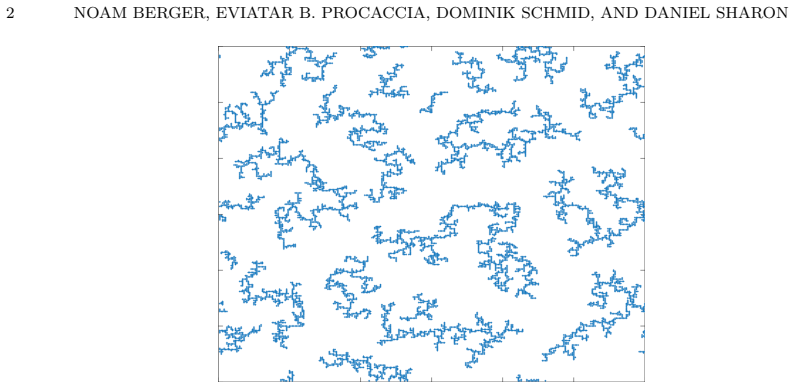


Figures from the paper (3 more)


Reference graph
Works this paper leans on
-
[1]
The standard additive coalescent.Annals of Probability, pages 1703– 1726, 1998
David Aldous and Jim Pitman. The standard additive coalescent.Annals of Probability, pages 1703– 1726, 1998
work page 1998
-
[2]
John M. Ball and Jack Carr. The discrete coagulation–fragmentation equations: Existence, unique- ness, and density conservation.Journal of Statistical Physics, 61(1–2):203–234, 1990
work page 1990
- [3]
- [4]
-
[5]
Logarithmic fluctuations of stationary hastings-levitov.arXiv preprint arXiv:2502.03554, 2025
Noam Berger and Eviatar B Procaccia. Logarithmic fluctuations of stationary hastings-levitov.arXiv preprint arXiv:2502.03554, 2025
arXiv 2025
-
[6]
Noam Berger, Eviatar B. Procaccia, and Daniel Sharon. On one-dimensional cluster-cluster model. Journal of Statistical Physics, 193(5):53, 2026
work page 2026
-
[7]
Pool model: a mass preserving multi particle aggregation process
Zhenhao Cai, Eviatar B Procaccia, and Yuan Zhang. Pool model: a mass preserving multi particle aggregation process.arXiv preprint arXiv:2604.14851, 2026
work page Pith review arXiv 2026
- [8]
Show all 36 references
-
[9]
Madalina Deaconu and Etienne Tanr´ e. Smoluchowski’s coagulation equation: Probabilistic interpre- tation of solutions for constant, additive and multiplicative kernels.Annali della Scuola Normale Superiore di Pisa, Classe di Scienze, 29(3):549–579, 2000
2000
-
[10]
The critical one-dimensional multi-particle DLA.arXiv preprint arXiv:2009.02761, 2020
Dor Elboim, Danny Nam, and Allan Sly. The critical one-dimensional multi-particle DLA.arXiv preprint arXiv:2009.02761, 2020
2009 arXiv
-
[11]
Nicolas Fournier and Philippe Lauren¸ cot. Local properties of self-similar solutions to smoluchowski’s coagulation equation with sum kernels.Proceedings of the Royal Society of Edinburgh, Section A: Mathematics, 136(3):485–508, 2006
2006
-
[12]
Protein aggregation processes: In search of the mechanism.Protein Science, 16(11):2334– 2344, 2007
Carl Frieden. Protein aggregation processes: In search of the mechanism.Protein Science, 16(11):2334– 2344, 2007
2007
-
[13]
Coagulation and diffusion: a probabilistic perspective on the smoluchowski PDE
Alan Hammond. Coagulation and diffusion: a probabilistic perspective on the smoluchowski PDE
-
[14]
The kinetic limit of a system of coagulating brownian particles.Archive for Rational Mechanics and Analysis, 185(1):1–67, 2007
Alan Hammond and Fraydoun Rezakhanlou. The kinetic limit of a system of coagulating brownian particles.Archive for Rational Mechanics and Analysis, 185(1):1–67, 2007
2007
-
[15]
Moment bounds for the smoluchowski equation and their consequences.Communications in Mathematical Physics, 276(3):645–670, 2007
Alan Hammond and Fraydoun Rezakhanlou. Moment bounds for the smoluchowski equation and their consequences.Communications in Mathematical Physics, 276(3):645–670, 2007
2007
-
[16]
H. Kesten. How long are the arms in DLA?Journal of Physics A: Mathematical and General, 20(1):L29, 1987
1987
-
[17]
Spatial Coagulation Systems with Mercer Kernels: Replicator Dynamics and Gelation.arXiv preprint arXiv:2606.22967, 2026
Ivan Kryven and Elena Magnanini. Spatial Coagulation Systems with Mercer Kernels: Replicator Dynamics and Gelation.arXiv preprint arXiv:2606.22967, 2026. 30 NOAM BERGER, EVIATAR B. PROCACCIA, DOMINIK SCHMID, AND DANIEL SHARON
2026 arXiv
-
[18]
The discrete coagulation equations with multiple fragmentation.Proceedings of the Edinburgh Mathematical Society, 45(1):67–82, 2002
Philippe Lauren¸ cot. The discrete coagulation equations with multiple fragmentation.Proceedings of the Edinburgh Mathematical Society, 45(1):67–82, 2002
2002
-
[19]
Lawler and Vlada Limic.Random Walk: A Modern Introduction, volume 123 ofCambridge Studies in Advanced Mathematics
Gregory F. Lawler and Vlada Limic.Random Walk: A Modern Introduction, volume 123 ofCambridge Studies in Advanced Mathematics. Cambridge University Press, Cambridge, 2010
2010
-
[20]
Scaling theory and exactly solved models in the kinetics of irreversible aggregation
Francois Leyvraz. Scaling theory and exactly solved models in the kinetics of irreversible aggregation. Physics Reports, 383(2-3):95–212, 2003
2003
-
[21]
Liggett.Interacting Particle Systems, volume 276 ofGrundlehren der mathematischen Wissenschaften
Thomas M. Liggett.Interacting Particle Systems, volume 276 ofGrundlehren der mathematischen Wissenschaften. Springer-Verlag, New York, 1985
1985
-
[22]
How Long are the Arms in DBM?Communications in Mathematical Physics, 406(4):1–16, 2025
Ilya Losev and Stanislav Smirnov. How Long are the Arms in DBM?Communications in Mathematical Physics, 406(4):1–16, 2025
2025
-
[23]
Gelation in coagulating systems.Physica D: Nonlinear Phenomena, 222(1-2):37–53, 2006
Alex A Lushnikov. Gelation in coagulating systems.Physica D: Nonlinear Phenomena, 222(1-2):37–53, 2006
2006
-
[24]
Coagulation in finite systems.Journal of Colloid and interface science, 65(2):276– 285, 1978
Alexei A Lushnikov. Coagulation in finite systems.Journal of Colloid and interface science, 65(2):276– 285, 1978
1978
-
[25]
Diffusion-limited aggregation in three dimensions: results from a new cluster-cluster aggregation model.Journal of colloid and interface science, 102(2):491–504, 1984
Paul Meakin. Diffusion-limited aggregation in three dimensions: results from a new cluster-cluster aggregation model.Journal of colloid and interface science, 102(2):491–504, 1984
1984
-
[26]
Paul Meakin. Effects of cluster trajectories on cluster-cluster aggregation: A comparison of linear and Brownian trajectories in two-and three-dimensional simulations.Physical Review A, 29(2):997, 1984
1984
-
[27]
Dynamic cluster-size distribution in cluster-cluster aggregation: Effects of cluster diffusivity.Physical Review B, 31(1):564, 1985
Paul Meakin, Tam´ as Vicsek, and Fereydoon Family. Dynamic cluster-size distribution in cluster-cluster aggregation: Effects of cluster diffusivity.Physical Review B, 31(1):564, 1985
1985
-
[28]
James R. Norris. Smoluchowski’s coagulation equation: Uniqueness, nonuniqueness and a hydrody- namic limit for the stochastic coalescent.The Annals of Applied Probability, 9(1):78–109, 1999
1999
-
[29]
Wilhelm Ostwald.Lehrbuch der allgemeinen Chemie, volume 1. W. Engelmann, 1903
1903
-
[30]
Coalescent random forests.Journal of Combinatorial Theory, Series A, 85(2):165–193, 1999
Jim Pitman. Coalescent random forests.Journal of Combinatorial Theory, Series A, 85(2):165–193, 1999
1999
-
[31]
Dimension of diffusion-limited aggregates grown on a line
Eviatar B Procaccia and Itamar Procaccia. Dimension of diffusion-limited aggregates grown on a line. Physical Review E, 103(2):L020101, 2021
2021
-
[32]
Exact calculation of the probabilities of rare events in cluster-cluster aggregation.Physical Review Letters, 133(9):097101, 2024
R Rajesh, V Subashri, and Oleg Zaboronski. Exact calculation of the probabilities of rare events in cluster-cluster aggregation.Physical Review Letters, 133(9):097101, 2024
2024
-
[33]
One-dimensional Multi-particle DLA–a PDE approach.arXiv preprint arXiv:1709.00484, 2017
Vladas Sidoravicius and Balazs Rath. One-dimensional Multi-particle DLA–a PDE approach.arXiv preprint arXiv:1709.00484, 2017
2017 arXiv
-
[34]
On one-dimensional multi-particle diffusion limited aggregation
Allan Sly. On one-dimensional multi-particle diffusion limited aggregation. InIn and Out of Equilib- rium 3: Celebrating Vladas Sidoravicius, pages 755–774. Springer, 2020
2020
-
[35]
M. V. Smoluchowski. Versuch einer mathematischen Theorie der Koagulationskinetik kolloider L¨ osungen.Zeitschrift f¨ ur physikalische Chemie, 92(1):129–168, 1918
1918
-
[36]
The theory of Ostwald ripening.Journal of Statistical Physics, 38:231–252, 1985
Peter W Voorhees. The theory of Ostwald ripening.Journal of Statistical Physics, 38:231–252, 1985. AppendixA.Alternative proof for absence of blow-up We establish that there is no blowup in the caseαě1. While only treating a sub-regime of Theorem 1, this route has the advantag...
1985
Reviewed August 6, 2026 · model on record in the stance chip above.
Discussion (0). Continue with ORCID to comment.