REVIEW 4 major objections 4 minor 165 references
Self-dual $S_3$ gauge theory in 2+1d: lattice model and topological phase transitions
T0 review · 4 major / 4 minor · reviewed 2026-08-08 · deepseek-v4-flash
Pith's one-line read This paper constructs the first lattice model of a non-Abelian topological order, the $S_3$ quantum double, whose electric--magnetic self-duality is realized exactly as lattice translation, and it uses that symmetry to pin the edge to…
desk verdict A genuinely new self-dual D(S3) lattice model with a solid bulk construction, but the advertised 'without fine-tuning' boundary CFT rests on an imported result the paper never directly verifies. read the letter →
The pith
A machine-rendered reading of the paper's core claim, the machinery that carries it, and where it could break.
The reading
What carries the argument
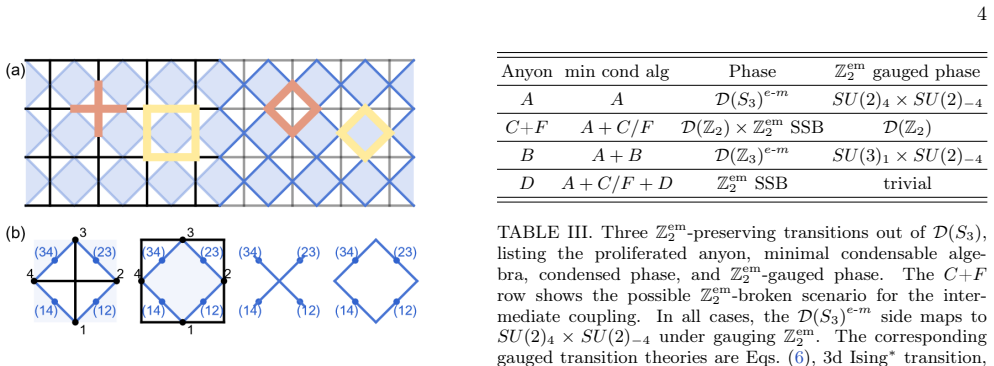
The machinery is the quantum-double construction for the group $S_3$, enriched by a $\mathbb{Z}_2$ anyon-permutation symmetry that is geometric rather than on-site: translation by half a primitive cell exchanges the qutrit star and plaquette operators while leaving the qubit operators fixed. A local unitary transformation converts the model into a non-Abelian Wen-plaquette form in which the symmetry is pure translation, and it is this translation that acts as Kramers-Wannier duality on the zigzag boundary spin chain. The second load-bearing object is the minimal condensable algebra: for each proliferated boson $b$, the nearby gapped phase is predicted to be the quotient of $\mathcal{D}(S_3)$ by the smallest condensable algebra containing $b$. The third is the gauging of the infrared $\mathbb{Z}_2^{\mathrm{em}}$ symmetry, which maps $\mathcal{D}(S_3)$ to $SU(2)_4 \times SU(2)_{-4}$ and converts the transitions into Chern-Simons-Higgs theories with bi-adjoint, Ising, and bifundamental scalars.
What would settle it
Numerically compute the low-energy spectrum of the zigzag boundary, for example with density-matrix renormalization group on the sign-problem-free Hamiltonian: the central charge should be $4/5$ and the boundary should have no relevant symmetric operator, so observing a different central charge or a symmetric relevant perturbation would falsify the no-fine-tuning claim.
Extended reading notes
Core claim
The paper's central claim is that electric--magnetic self-duality, previously realized microscopically only for $\mathbb{Z}_2$ gauge theory, has a non-Abelian generalization in the $S_3$ quantum double $\mathcal{D}(S_3)$. The microscopic $\mathbb{Z}_2^{\mathrm{em}}$ symmetry that swaps the non-Abelian anyons $C$ and $F$ is implemented as a half-lattice translation together with local unitaries, and after a local unitary change of basis it acts as pure translation in a non-Abelian Wen-plaquette model. Because translation on the zigzag boundary acts like a generalized Kramers-Wannier duality, the boundary spin chain is pinned to the self-dual point of the $\mathrm{Rep}(S_3)$-symmetric chain, which is argued to be the tetracritical Ising CFT $\mathcal{M}(6,5)$ without fine-tuning. In the bulk, the three perturbations $\lambda_1,\lambda_2,\lambda_3$ proliferate respectively $C+F$, $B$, and $D$ and drive transitions to $\mathcal{D}(\mathbb{Z}_2)$, $\mathcal{D}(\mathbb{Z}_3)$, and a phase with spontaneously broken $\mathbb{Z}_2^{\mathrm{em}}$; gauging $\mathbb{Z}_2^{\mathrm{em}}$ maps $\mathcal{D}(S_3)$ to $SU(2)_4 \times SU(2)_{-4}$ and turns the transitions into Chern-Simons-Higgs problems. All three analyses agree, and the examples motivate the minimal-condensation principle.
Load-bearing premise
The edge-pinning claim assumes that the combination of $\mathrm{Rep}(S_3)$ symmetry and lattice-translation self-duality eliminates every relevant symmetric perturbation of the boundary spin chain, an assumption imported from a previous classification and not verified by direct numerical simulation in this paper.
Editorial extensions
If this is right
- The Hamiltonian is stoquastic in the computational basis, so the full phase diagram of $\mathcal{D}(S_3)$ with self-duality is accessible to sign-problem-free quantum Monte Carlo.
- The zigzag boundary provides a lattice realization of the tetracritical Ising CFT $\mathcal{M}(6,5)$ with an emergent self-duality, extending the $\mathbb{Z}_2$ edge-pinning mechanism to non-Abelian anyon permutation.
- The three symmetric perturbations connect $\mathcal{D}(S_3)$ to $\mathcal{D}(\mathbb{Z}_2)$, $\mathcal{D}(\mathbb{Z}_3)$, and a $\mathbb{Z}_2^{\mathrm{em}}$-broken trivial phase, and gauging maps these transitions to $SU(2)_4\times SU(2)_{-4}$ Chern-Simons-Higgs theories.
- The construction extends to an infinite family of dihedral quantum doubles $\mathcal{D}(D_{2n})$ for odd $n$, all sign-problem-free, whose gauged phases are described by $\mathrm{Spin}(n)_2\times \mathrm{Spin}(n)_{-2}$.
- The minimal-condensation principle, if correct, gives a general selection rule for which gapped phase a given bosonic anyon proliferation drives a topological order toward, including degenerate vacua that break anyon-permutation symmetry.
Reading between the lines
- A direct numerical test of the intermediate-$\lambda_1$ regime would settle whether the $\mathbb{Z}_2^{\mathrm{em}}$-broken phase predicted by analogy with the Fradkin-Shenker model actually appears, and whether the self-dual multicritical point broadens into a critical line.
- The minimal-condensation principle could be used as a predictive shortcut for other non-Abelian topological orders: list the minimal condensable algebras containing each low-lying bosonic anyon and compare the candidate phases before solving a lattice model.
- The same two-sublattice translation mechanism may pin edges of other quantum doubles $\mathcal{D}(G)$ with anyon-permutation symmetries to self-dual points of the corresponding $\mathrm{Rep}(G)$ chains, possibly producing further minimal-model boundary CFTs.
- Because the models are sign-problem-free, this construction offers a way to numerically study Chern-Simons-Higgs theories that currently lack lattice regulators.
Editorial analysis
A structured set of objections, weighed in public.
Referee Report
Summary. This paper constructs an explicit lattice Hamiltonian for the S3 quantum double D(S3) on a tensor-product Hilbert space, with the Z2^em anyon-permutation symmetry implemented as a lattice translation (composed with local unitaries), and converts it into a non-Abelian Wen-plaquette form where the symmetry is pure translation. The authors claim that the zigzag boundary then realizes, without fine-tuning, a critical edge described by the tetracritical Ising CFT M(6,5). They study three Z2^em-preserving perturbations that drive the bulk into D(Z2), D(Z3), and a Z2^em-spontaneously-broken phase, analyze the transitions by anyon condensation, lattice strong-coupling limits, and Chern-Simons-Higgs theory, and propose a minimal-condensation principle. The construction is generalized to dihedral quantum doubles D(D2n) for odd n, and each model is argued to be sign-problem-free.
Significance. If the central claims hold, this is a valuable advance: it provides the first non-Abelian counterpart of the Wen-plaquette self-duality construction, a concrete sign-problem-free lattice model for non-Abelian topological phase transitions, and a unifying categorical principle for anyon proliferation. The stabilizer construction, the strong-coupling projections, and the detailed category-theoretic data in the Supplemental Material are explicit and carefully presented. The paper also ships a substantial quantum-to-classical mapping and a useful catalog of gauged anyon-permutation data. The main advertised consequences, however, depend on several unverified links, especially the boundary fixed point and the intermediate-coupling phase structure.
major comments (4)
- [Non-Abelian Wen-plaquette and its edge; End Matter Eq. (11), Table IV, footnote [90]] The abstract's headline claim that the zigzag boundary realizes tetracritical Ising M(6,5) 'without fine-tuning' rests on two imported assumptions: that boundary translation acts as the generalized Kramers-Wannier duality pinning the chain to J1=J2=J4=1, J3=0, and that the combined Rep(S3) plus self-duality constraints eliminate all relevant M(6,5) operators. The first is asserted rather than derived for this specific boundary termination, and the second is stated only in footnote [90] without proof. No numerical or analytic check of the boundary fixed point is provided in this paper. Since this is the advertised central consequence, the authors should either supply a direct derivation or a numerical verification (e.g., DMRG or transfer-matrix study of Eq. (11) at the self-dual point), or clearly demote the claim to a conjecture based on Ref. [68].
- [C+F phase (λ1→∞) and Field theory of the transitions] The paper does not establish the λ1 transition as a Z2^em-preserving transition to D(Z2). The strong-coupling limit is identified correctly, but the intermediate Z2^em-broken regime is explicitly described as 'expected', and the accompanying bi-adjoint Chern-Simons-Higgs theory may have a first-order transition due to the symmetry-allowed cubic term. The phrase in the abstract and introduction that the model drives D(S3) into three distinct gapped phases via three independent perturbations is therefore too strong for λ1. The authors should either add numerical evidence for the phase structure along λ1 or qualify the claims to reflect that only the λ2 and λ3 routes are currently supported by the lattice analysis.
- [D phase (λ3→∞) and Supplemental Material Sec. VI] The spontaneous Z2^em breaking in the λ3 phase rests on exact diagonalization of periodic tori up to 3×3, with a two-parameter exponential fit to the energy splitting and no extrapolation to the thermodynamic limit. The Perron-Frobenius and charge-conjugation arguments are useful, but the system sizes are very small for a non-commuting, frustrated Hamiltonian. Since the model is sign-problem-free and the authors advertise large-scale numerical exploration as an outlook, a quantum Monte Carlo or larger-scale tensor-network check of the two-fold degeneracy and the splitting scaling would be needed to make this phase identification load-bearing.
- [Minimal-condensation principle; Supplemental Material Eq. (S10)] The minimal-condensation principle is tested only on the D(S3) and dihedral quantum doubles that motivated it, so it does not yet constitute independent evidence. Moreover, for the non-simple boson C+F the paper itself acknowledges that dynamics may select a single component and that realizing degenerate vacua generally requires fine-tuning. This weakens the chain of reasoning from the strong-coupling λ1 limit to a Z2^em-SSB phase. The principle should be presented more cautiously as a conjecture supported by a limited set of examples, not as a general law.
minor comments (4)
- [Lattice model, Eq. (1)] The same symbol B_p is used for both the qutrit plaquette and the qubit plaquette stabilizer; using distinct notations (e.g., calligraphic versus barred symbols) would improve readability.
- [End Matter, Table IV] The table entry 'TetraIsing' and the phrase '4Rep(S3) symmetric gapped phases' contain formatting issues; 'Tetracritical Ising' and 'Rep(S3)-symmetric' should be spelled out consistently.
- [End Matter, D2n generalization] The notation D6 = S3 is potentially confusing because D6 sometimes denotes the dihedral group of order 12; a parenthetical clarification would avoid ambiguity.
- [General] Footnote [88] contains an important caveat about the microscopic versus infrared Z2^em action; this caveat deserves to be stated in the main text, since several statements about symmetry acting 'trivially' in the IR rely on it.
Circularity Check
The explicit lattice construction is independent; the only circularity is the minimal-condensation principle, which is motivated by the same D(S3) transitions it then claims to account for.
-
fitted input called prediction
[Introduction (Minimal-condensation principle); Supplemental Material Sec. I, Eq. (S10)]
"Motivated by the examples below, we propose the following working principle: Minimal-condensation principle. ... proliferating a simple bosonic anyon b ... generically drives it to a nearby gapped phase described by anyon condensation of a minimal condensable algebra A_b^min containing b ... We find that this principle accounts for all three transitions in the D(S3) lattice model and their dihedral-group D2n generalizations."
The principle is introduced after and because of the D(S3) examples, and the same three transitions are then quoted as evidence that it 'accounts for' them. The minimal algebras are chosen to match strong-coupling phase identifications already obtained by projection, so the agreement is a consistency loop rather than an independent test. This is a transparently labeled working principle, not a fitted parameter used to define the central lattice model, and it does not force the explicit Hamiltonian or the boundary CFT claim.
full rationale
The central claim, an explicit sign-problem-free D(S3) lattice model with Z2^em realized by lattice translation, is derived from a concrete gauging construction with stabilizers written out in Eqs. (1)-(3); the strong-coupling phases (D(Z2), D(Z3), and Z2^em-SSB) are identified by independent projection and exact diagonalization. The boundary tetracritical-Ising claim is imported from external Ref. [68]. It is not independently verified in this paper, but it is a citation to other authors and not a self-citation chain, so it is a support gap rather than circularity. Self-citations to Refs. [42,75,105] share authors with the present paper, but they are not load-bearing in a circular way: the lattice construction is explicit, and the Chern-Simons-Higgs field-theory discussion is supplementary. The only genuine circularity is the minimal-condensation principle, which is explicitly motivated by the same examples it then claims to explain; this is a minor epistemological weakness, not a forcing of the main results. Score 2.
Assumptions & free parameters
free parameters (1)
- ED splitting fit amplitude and decay rate =
12.44 exp(-0.447 N)
assumptions (4)
- domain assumption Anyon condensation is a valid characterization of the resulting gapped phases via condensable algebras.
- domain assumption Twisted gauging of Z2^em maps D(S3) to SU(2)4 x SU(2)-4, and similarly maps dihedral doubles to Spin(n)2 x Spin(n)-2.
- domain assumption The charge-conjugation-gauged Z3 transverse-field Ising chain at its self-dual point flows to the tetracritical Ising CFT M(6,5).
- domain assumption Gauging a finite 0-form symmetry commutes with the renormalization group flow and does not alter transition dynamics.
Cite this review
Pith. "Pith review of Self-dual $S_3$ gauge theory in 2+1d: lattice model and topological phase transitions." pith.science (2026). https://pith.science/paper/WX6WKTCM
@misc{pith2026260805294,
  author       = {Pith},
  title        = {Pith review of: Self-dual $S_3$ gauge theory in 2+1d: lattice model and topological phase transitions},
  year         = {2026},
  howpublished = {\url{https://pith.science/paper/WX6WKTCM}},
  note         = {Machine review of arXiv:2608.05294}
}
abstract
Electric-magnetic self-duality of the $\mathbb{Z}_2$ gauge theory, realized microscopically as a half-lattice-translation exchanging electric charge and magnetic flux, has been an influential example of a duality symmetry with an exact lattice realization. We construct the first non-Abelian generalization of this construction: a lattice model of the $S_3$ quantum double $\mathcal{D}(S_3)$ on a tensor product Hilbert space in which the $\mathbb{Z}^{\mathrm{em}}_2$ anyon-permutation symmetry, exchanging the non-Abelian chargeon $C$ and fluxon $F$, is realized via lattice translation. Consequently we find that the zigzag boundary termination of the model realizes, without fine-tuning, a gapless critical edge state described by the tetracritical Ising CFT. The bulk admits three independent $\mathbb{Z}_2^{\mathrm{em}}$-preserving bosonic perturbations, driving $\mathcal{D}(S_3)$ into distinct gapped phases. We analyze these transitions by three independent methods: category-theoretic anyon condensation, microscopic lattice Hamiltonians, and Chern-Simons-Higgs theory, which all agree, yielding a unified picture. These examples motivate a minimal-condensation principle: proliferating a bosonic anyon generically drives condensation of a minimal condensable algebra containing it, with symmetry-related condensates appearing as degenerate vacua that spontaneously break the anyon-permutation symmetry. Our model construction extends to an infinite family of self-dual dihedral quantum doubles $\mathcal{D}(D_{2n})$. Notably, each model is sign-problem-free, opening the door to large-scale numerical exploration of the phases of non-Abelian Chern-Simons-Higgs theories.
Figures

Reference graph
Works this paper leans on
- [68]
-
[90]
C.-M. Chang, Y.-H. Lin, S.-H. Shao, Y. Wang, and X. Yin, JHEP01, 026 (2019), arXiv:1802.04445 [hep- th]
arXiv 2019
-
[1]
F. A. Bais, B. J. Schroers, and J. K. Slingerland, Phys. Rev. Lett.89, 181601 (2002), arXiv:hep-th/0205117
arXiv 2002
-
[2]
F. A. Bais and J. K. Slingerland, Phys. Rev. B79, 045316 (2009), arXiv:0808.0627 [cond-mat.mes-hall]
arXiv 2009
- [3]
-
[4]
In a purelyscalarLandautheory, suchacubicinvariantwould generically drive the transition first order
The cu- bic invariantκ 3 is symmetry-allowed, with its sign se- lecting the orientation of the Higgs configuration. In a purelyscalarLandautheory, suchacubicinvariantwould generically drive the transition first order. However, in the strongly coupled gauge theory this conclusion need not apply: Ref. [105] argues that the cubic term may be irrelevant in a ...
-
[5]
I. S. Eliëns, J. C. Romers, and F. A. Bais, Phys. Rev. B90, 195130 (2014), arXiv:1310.6001 [cond-mat.str-el]
arXiv 2014
- [6]
Show all 165 references
-
[7]
Y. Zeng, Z. Xia, K. Kang, J. Zhu, P. Knüppel, C. Vaswani, K. Watanabe, T. Taniguchi, K. F. Mak, and J. Shan, Nature622, 69 (2023)
2023
-
[8]
J. Cai, E. Anderson, C. Wang, X. Zhang, X. Liu, W. Holtzmann, Y. Zhang, F. Fan, T. Taniguchi, K. Watanabe,et al., Nature622, 63 (2023)
2023
-
[9]
H. Park, J. Cai, E. Anderson, Y. Zhang, J. Zhu, X. Liu, C. Wang, W. Holtzmann, C. Hu, Z. Liu,et al., Nature 622, 74 (2023)
2023
-
[10]
F. Xu, Z. Sun, T. Jia, C. Liu, C. Xu, C. Li, Y. Gu, K. Watanabe, T. Taniguchi, B. Tong,et al., Physical Review X13, 031037 (2023)
2023
-
[11]
Z. D. Shi, C. Zhang, and S. Todadri, SciPost Phys.19, 150 (2025), arXiv:2505.02893 [cond-mat.str-el]
2025 arXiv
-
[12]
Pichler, C
F. Pichler, C. Kuhlenkamp, M. Knap, and A. Vishwanath, (2025), 10.1016/j.newton.2025.100340, arXiv:2506.08000 [cond-mat.str-el]
2025
-
[13]
Z. Han, T. Wang, Z. Dong, M. P. Zaletel, and A. Vish- wanath, arXiv preprint arXiv:2508.14894 (2025)
2025 arXiv
-
[14]
Dijkgraaf and E
R. Dijkgraaf and E. Witten, Communications in Math- ematical Physics129, 393 (1990)
1990
-
[15]
Discrete gauge the- ories,
M. d. W. Propitius and F. A. Bais, “Discrete gauge the- ories,” (1996), arXiv:hep-th/9511201
1996 arXiv
-
[16]
Topological interactions in broken gauge theories,
M. d. W. Propitius, “Topological interactions in broken gauge theories,” (1995), arXiv:hep-th/9511195
1995 arXiv
-
[17]
A. Y. Kitaev, Annals of physics303, 2 (2003)
2003
-
[18]
M. A. Levin and X.-G. Wen, Phys. Rev. B71, 045110 (2005), arXiv:cond-mat/0404617
2005 arXiv
-
[19]
C. Song, D. Xu, P. Zhang, J. Wang, Q. Guo, W. Liu, K. Xu, H. Deng, K. Huang, D. Zheng,et al., Physical Review Letters121, 030502 (2018)
2018
-
[20]
Verresen, M
R. Verresen, M. D. Lukin, and A. Vishwanath, Phys. Rev. X11, 031005 (2021), arXiv:2011.12310 [cond- mat.str-el]
2021 arXiv
-
[21]
Semeghiniet al., Science374, abi8794 (2021), arXiv:2104.04119 [quant-ph]
G. Semeghiniet al., Science374, abi8794 (2021), arXiv:2104.04119 [quant-ph]
2021 arXiv
-
[22]
Iqbalet al., Nature626, 505 (2024), arXiv:2305.03766 [quant-ph]
M. Iqbalet al., Nature626, 505 (2024), arXiv:2305.03766 [quant-ph]
2024 arXiv
-
[23]
Xu, Z.-Z
S. Xu, Z.-Z. Sun, K. Wang, H. Li, Z. Zhu, H. Dong, J. Deng, X. Zhang, J. Chen, Y. Wu,et al., Nature Physics20, 1469 (2024)
2024
-
[24]
Witten, Communications in mathematical physics 121, 351 (1989)
E. Witten, Communications in mathematical physics 121, 351 (1989)
1989
-
[25]
Girvin and A
S. Girvin and A. H. MacDonald, Physical review letters 58, 1252 (1987)
1987
-
[26]
S. C. Zhang, T. H. Hansson, and S. Kivelson, Physical review letters62, 82 (1989)
1989
-
[27]
Read, Physical Review Letters62, 86 (1989)
N. Read, Physical Review Letters62, 86 (1989)
1989
-
[28]
Lopez and E
A. Lopez and E. Fradkin, Physical Review B44, 5246 (1991)
1991
-
[29]
Ezawa and A
Z. Ezawa and A. Iwazaki, Physical Review B43, 2637 (1991)
1991
-
[30]
B. I. Halperin, P. A. Lee, and N. Read, Physical Review B47, 7312 (1993)
1993
-
[31]
Wen and A
X.-G. Wen and A. Zee, Physical Review B46, 2290 (1992)
1992
-
[32]
Z. Zhou, C. Wang, and Y.-C. He, arXiv e-prints , arXiv:2507.19580 (2025), arXiv:2507.19580 [cond- mat.str-el]
2025 arXiv
-
[33]
Barkeshli, P
M. Barkeshli, P. Bonderson, M. Cheng, and Z. Wang, Physical Review B100, 115147 (2019)
2019
-
[34]
Bombin, Phys
H. Bombin, Phys. Rev. Lett.105, 030403 (2010), arXiv:1004.1838 [cond-mat.str-el]
2010 arXiv
-
[35]
Barkeshli, C.-M
M. Barkeshli, C.-M. Jian, and X.-L. Qi, Phys. Rev. B 87, 045130 (2013), arXiv:1208.4834 [cond-mat.str-el]
2013 arXiv
-
[36]
Barkeshli, C.-M
M. Barkeshli, C.-M. Jian, and X.-L. Qi, Phys. Rev. B 88, 235103 (2013), arXiv:1305.7203 [cond-mat.str-el]
2013 arXiv
-
[37]
E. H. Fradkin and S. H. Shenker, Phys. Rev. D19, 3682 (1979)
1979
-
[38]
Trebst, P
S. Trebst, P. Werner, M. Troyer, K. Shtengel, and C. Nayak, Phys. Rev. Lett.98, 070602 (2007), arXiv:cond-mat/0609048
2007 arXiv
-
[39]
Vidal, S
J. Vidal, S. Dusuel, and K. P. Schmidt, Phys. Rev. B 79, 033109 (2009), arXiv:0807.0487 [cond-mat.other]
2009 arXiv
-
[40]
I. S. Tupitsyn, A. Kitaev, N. V. Prokof’ev, and P. C. E. Stamp, Phys. Rev. B82, 085114 (2010), arXiv:0804.3175 [cond-mat.stat-mech]
2010 arXiv
-
[41]
F. Wu, Y. Deng, and N. Prokof’ev, Phys. Rev. B85, 195104 (2012), arXiv:1201.6409 [cond-mat.stat-mech]
2012 arXiv
-
[42]
A. M. Somoza, P. Serna, and A. Nahum, Phys. Rev. X11, 041008 (2021), arXiv:2012.15845 [cond-mat.stat- mech]. 7
2021 arXiv
-
[43]
W. Ji, R. A. Lanzetta, Z. Zhou, and C. Wang, (2026), arXiv:2601.20945 [cond-mat.str-el]
2026
-
[44]
Mochon, Physical Review A69, 032306 (2004)
C. Mochon, Physical Review A69, 032306 (2004)
2004
-
[45]
S. X. Cui and Z. Wang, J. Math. Phys.56, 032202 (2015), arXiv:1401.7096 [quant-ph]
2015 arXiv
-
[46]
L. Chen, Y. Ren, R. Fan, and A. Jaffe, npj Quantum Inf.11, 112 (2025), arXiv:2411.09697 [quant-ph]
2025 arXiv
-
[47]
C. F. B. Loet al., (2026), arXiv:2601.20956 [quant-ph]
2026 arXiv
-
[48]
M. B. Hastings, C. Nayak, and Z. Wang, Phys. Rev. B 87, 165421 (2013), arXiv:1210.5477 [cond-mat.str-el]
2013 arXiv
-
[49]
M. B. Hastings, C. Nayak, and Z. Wang, Com- mun. Math. Phys.330, 45 (2014), arXiv:1303.1202 [math.QA]
2014 arXiv
-
[50]
Gustafson, E
P. Gustafson, E. C. Rowell, and Y. Ruan, Tohoku Mathematical Journal, Second Series72, 411 (2020)
2020
-
[51]
Deaton, P
A. Deaton, P. Gustafson, L. Mavrakis, E. C. Row- ell, S. Poltoratski, S. Timmerman, B. Warren, and Q. Zhang, Journal of Knot Theory and Its Ramifica- tions29, 2050032 (2020)
2020
-
[52]
Ardonne, P
E. Ardonne, P. E. Finch, and M. Titsworth, Symmetry 13, 2102 (2021)
2021
-
[53]
Z. D. Shi, Z. Han, S. Raghu, and A. Vishwanath, (2026), arXiv:2602.06963 [cond-mat.str-el]
2026
-
[54]
Barkeshli and X.-G
M. Barkeshli and X.-G. Wen, Phys. Rev. Lett.105, 216804 (2010), arXiv:1007.2030 [cond-mat.mes-hall]
2010 arXiv
-
[55]
Barkeshli and X.-G
M. Barkeshli and X.-G. Wen, Phys. Rev. B84, 115121 (2011), arXiv:1010.4270 [cond-mat.str-el]
2011 arXiv
-
[56]
A.VaeziandM.Barkeshli,Phys.Rev.Lett.113,236804 (2014), arXiv:1403.3383 [cond-mat.str-el]
2014 arXiv
-
[57]
Hermanns, Phys
M. Hermanns, Phys. Rev. Lett.104, 056803 (2010), arXiv:0906.2073 [cond-mat.str-el]
2010 arXiv
-
[58]
Zhang, A
C. Zhang, A. Vishwanath, and X.-G. Wen, Phys. Rev. B112, 125116 (2025), arXiv:2406.12068 [cond-mat.str- el]
2025 arXiv
-
[59]
Yutushui, M
M. Yutushui, M. Hermanns, and D. F. Mross, Phys. Rev. Lett.135, 056501 (2025), arXiv:2502.12245 [cond- mat.str-el]
2025 arXiv
-
[60]
Lopez and E
A. Lopez and E. Fradkin, Physical Review B51, 4347 (1995)
1995
-
[61]
Rajaraman, Physical Review B56, 6788 (1997)
R. Rajaraman, Physical Review B56, 6788 (1997)
1997
-
[62]
S. H. Simon, E. Rezayi, and N. R. Cooper, Physical Re- view B—Condensed Matter and Materials Physics75, 195306 (2007)
2007
-
[63]
Barkeshli and X.-G
M. Barkeshli and X.-G. Wen, Physical Review B—Condensed Matter and Materials Physics81, 045323 (2010)
2010
-
[64]
Papić, M
Z. Papić, M. Goerbig, N. Regnault, and M. Milo- vanović, Physical Review B—Condensed Matter and Materials Physics82, 075302 (2010)
2010
-
[65]
M. R. Peterson, Y.-L. Wu, M. Cheng, M. Barkeshli, Z. Wang, and S. Das Sarma, Physical Review B92, 035103 (2015)
2015
-
[66]
Voinea, W
C. Voinea, W. Zhu, N. Regnault, and Z. Papić, Physical Review Letters136, 076601 (2026)
2026
-
[67]
Beigi, P
S. Beigi, P. W. Shor, and D. Whalen, Commun. Math. Phys.306, 663 (2011), arXiv:1006.5479 [quant-ph]
2011 arXiv
-
[69]
Chatterjee, Ö
A. Chatterjee, Ö. M. Aksoy, and X.-G. Wen, SciPost Physics17, 115 (2024), arXiv:2405.05331 [cond-mat.str- el]
2024 arXiv
-
[70]
Kitaev and L
A. Kitaev and L. Kong, Communications in Mathemat- ical Physics313, 351 (2012)
2012
-
[71]
Davydov, M
A. Davydov, M. Mueger, D. Nikshych, and V. Ostrik, (2010), arXiv:1009.2117 [math.QA]
2010 arXiv
-
[72]
Neupert, H
T. Neupert, H. He, C. Von Keyserlingk, G. Sierra, and B. A. Bernevig, Physical Review B93, 115103 (2016)
2016
-
[73]
F. J. Burnell, Annual Review of Condensed Matter Physics9, 307 (2018), arXiv:1706.04940 [cond-mat]
2018 arXiv
-
[74]
We thank Meng Cheng and Sahand Seifnashri for dis- cussing the general case
-
[75]
G. K. Brennen, M. Aguado, and J. I. Cirac, New J. Phys.11, 053009 (2009), arXiv:0901.1345 [quant-ph]
2009 arXiv
-
[76]
Verresen, N
R. Verresen, N. Tantivasadakarn, and A. Vish- wanath, arXiv e-prints , arXiv:2112.03061 (2021), arXiv:2112.03061 [quant-ph]
2021 arXiv
-
[77]
H. Wang, Y. Li, Y. Hu, and Y. Wan, JHEP02, 030 (2020), arXiv:1910.13441 [cond-mat.str-el]
2020 arXiv
-
[78]
Heinrich, F
C. Heinrich, F. Burnell, L. Fidkowski, and M. Levin, Phys. Rev. B94, 235136 (2016), arXiv:1606.07816 [cond-mat.str-el]
2016 arXiv
-
[79]
Cheng, Z.-C
M. Cheng, Z.-C. Gu, S. Jiang, and Y. Qi, Phys. Rev. B 96, 115107 (2017), arXiv:1606.08482 [cond-mat.str-el]
2017 arXiv
-
[80]
Y. Ren, N. Tantivasadakarn, and D. J. Williamson, Phys. Rev. X15, 031060 (2025), arXiv:2411.04985 [quant-ph]
2025 arXiv
-
[81]
N. Fu, Y. Zhao, and Y. Wan, JHEP05, 016 (2026), arXiv:2508.08245 [cond-mat.str-el]
2026 arXiv
-
[82]
W.-T. Xu, J. Garre-Rubio, and N. Schuch, Phys. Rev. B106, 205139 (2022), arXiv:2208.13200 [cond-mat.str- el]
2022 arXiv
-
[83]
Bombin and M
H. Bombin and M. A. Martin-Delgado, Phys. Rev. B 78, 115421 (2008), arXiv:0712.0190 [cond-mat.str-el]
2008 arXiv
-
[84]
P. Chen, S. X. Cui, and B. Yan, J. Phys. A55, 185201 (2022), arXiv:2105.08202 [cond-mat.str-el]
2022 arXiv
-
[85]
Y. Hu, N. Geer, and Y.-S. Wu, Phys. Rev. B97, 195154 (2018), arXiv:1502.03433 [cond-mat.str-el]
2018 arXiv
-
[86]
C.-H. Lin, M. Levin, and F. J. Burnell, Phys. Rev. B 103, 195155 (2021), arXiv:2012.14424 [cond-mat.str-el]
2021 arXiv
-
[87]
Christian, D
J. Christian, D. Green, P. Huston, and D. Penneys, JHEP09, 055 (2023), arXiv:2303.04711 [cond-mat.str- el]
2023 arXiv
- [88]
-
[89]
However, in the infrared, the translation symmetry acts trivially, and only theZ2 acts faithfully on the anyon content
The microscopicZ em 2 permutation symmetry acts as translation by( 1 2 , 1 2 )composed with possible local uni- taries, and thus it is squared to translation rather than an identity. However, in the infrared, the translation symmetry acts trivially, and only theZ2 acts faithfu...
-
[91]
With onlyZ2 symmetry, tetracritical Ising has threeZ2 symmetric relevant operators,Rep(S3)forbids two and the self-duality forbids the remaining one
-
[92]
Lyons, C
A. Lyons, C. F. B. Lo, N. Tantivasadakarn, A. Vish- wanath, and R. Verresen, Phys. Rev. Lett.135, 200405 (2025), arXiv:2411.04181 [quant-ph]
2025
-
[93]
H. W. J. Blöte and R. H. Swendsen, Phys. Rev. Lett. 43, 799 (1979)
1979
-
[94]
Gavai, F
R. Gavai, F. Karsch, and B. Petersson, Nuclear Physics B322, 738 (1989)
1989
-
[95]
Janke and R
W. Janke and R. Villanova, Nuclear Physics B489, 679 (1997). 8
1997
-
[96]
S. M. Chester and N. Su, Phys. Rev. D111, L121701 (2025), arXiv:2210.09091 [hep-th]
2025 arXiv
-
[97]
Yang, Y.-G
S. Yang, Y.-G. Yue, Y. Tang, C. Han, W. Zhu, and Y. Chen, Phys. Rev. B112, 024436 (2025), arXiv:2501.14320 [cond-mat.stat-mech]
2025 arXiv
-
[98]
T. Lan, L. Kong, and X.-G. Wen, Commun. Math. Phys.351, 709 (2017), arXiv:1602.05936 [math.QA]
2017 arXiv
-
[99]
Due to the non-Abelian anyon condensation, the re- sultingD(Z 2)possesses a non-invertible 0-form symme- try [120–123]
-
[100]
Gaiotto, A
D. Gaiotto, A. Kapustin, N. Seiberg, and B. Willett, JHEP02, 172 (2015), arXiv:1412.5148 [hep-th]
2015 arXiv
-
[101]
Delcamp and A
C. Delcamp and A. Tiwari, SciPost Phys.16, 110 (2024), arXiv:2301.01259 [hep-th]
2024 arXiv
-
[102]
D.-C. Lu, Z. Sun, and Y.-Z. You, SciPost Phys.17, 136 (2024), arXiv:2405.14939 [cond-mat.str-el]
2024 arXiv
-
[103]
Vancraeynest-De Cuiper and C
B. Vancraeynest-De Cuiper and C. Delcamp, SciPost Phys.19, 054 (2025), arXiv:2501.16301 [cond-mat.str- el]
2025 arXiv
-
[104]
The un- twisted gauging instead mapsD(S 3)toJ K 4 ⊠ J K4, which does not admit a Lagrangian description [32, 68]
The twisted gauging sends the trivial product state to the double-semion topological order in2 + 1d. The un- twisted gauging instead mapsD(S 3)toJ K 4 ⊠ J K4, which does not admit a Lagrangian description [32, 68]
-
[105]
SinceZ em 2 acts trivially onD(Z 2), the gauged descrip- tion does not involveSU(2)2 ×SU(2) −2
-
[106]
Gazit, F
S. Gazit, F. F. Assaad, S. Sachdev, A. Vishwanath, and C. Wang, Proceedings of the National Academy of Science115, E6987 (2018), arXiv:1804.01095 [cond- mat.str-el]
2018 arXiv
-
[107]
Shackleton and S
H. Shackleton and S. Sachdev, Journal of High En- ergy Physics2022, 141 (2022), arXiv:2203.01962 [cond- mat.str-el]
2022 arXiv
-
[108]
Aharony, S
O. Aharony, S. S. Razamat, N. Seiberg, and B. Willett, JHEP08, 099 (2013), arXiv:1307.0511 [hep-th]
2013 arXiv
-
[109]
E. Dyer, M. Mezei, and S. S. Pufu, (2013), arXiv:1309.1160 [hep-th]
2013 arXiv
-
[110]
The combination of monopole operator and the scalar mass term may keep the system on the nearby transition lines
Only introducing the monopole operator will generally induce symmetric scalar mass termϕϕ⊺ and drive the multicritical point to a gapped phase. The combination of monopole operator and the scalar mass term may keep the system on the nearby transition lines
-
[111]
A continuum realization is obtained fromCS[aU(2) ]4,0 + 1 2π c dTr(a) +|Dcφ|2 +V: for massiveφ,cenforces Tr(a) = 0and givesSU(2) 4; for condensedφ, the re- mainingU(1)is confined by the allowed monopole op- erator, givingSU(2) 4/Z2 [5]
-
[112]
S. X. Cui, C. Galindo, J. Y. Plavnik, and Z. Wang, Communications in Mathematical Physics348, 1043 (2016), arXiv:1510.03475 [math.QA]
2016 arXiv
- [113]
- [114]
-
[115]
Non-Invertible Anyon Condensation and Level-Rank Dualities,
C. Cordova and D. García-Sepúlveda, “Non-Invertible Anyon Condensation and Level-Rank Dualities,” (2024), arXiv:2312.16317 [hep-th]
2024 arXiv
-
[116]
Z.-Q. Gao, C. Liu, and J. E. Moore, (2025), arXiv:2511.19589 [cond-mat.str-el]
2025
- [117]
-
[118]
Z. D. Shi and A. Chatterjee, Phys. Rev. B112, L081111 (2025), arXiv:2407.07941 [cond-mat.str-el]
2025 arXiv
-
[119]
[124] studies a staggered Fradkin- Shenker variant whose continuum description is more closely related to DQCP constructions [125–130]
Relatedly, Ref. [124] studies a staggered Fradkin- Shenker variant whose continuum description is more closely related to DQCP constructions [125–130]. The ordinary Fradkin-Shenker problem is recovered only by adding monopole perturbations, which are expected to make the conti...
-
[120]
Cordova, P.-S
C. Cordova, P.-S. Hsin, and N. Seiberg, SciPost Phys. 4, 021 (2018), arXiv:1711.10008 [hep-th]
2018 arXiv
-
[121]
S. X. Cui, M. S. Zini, and Z. Wang, Sci. China Math. 62, 417 (2019), arXiv:1809.00245 [math.QA]
2019 arXiv
-
[122]
M. K. N. Balasubramanian, M. Buican, C. Delcamp, and R. Radhakrishnan, (2025), arXiv:2507.01142 [hep- th]
2025 arXiv
-
[123]
L. Eck, P. Huston, K. Kawagoe, and D. Penneys, (2026), arXiv:2605.28794 [cond-mat.str-el]
2026 arXiv
-
[124]
L. E. Bottini, C. Delcamp, E. Heng, C. K. McLauchlan, and D. J. Williamson, (2026), arXiv:2605.28688 [cond- mat.str-el]
2026 arXiv
-
[125]
T. T. Dumitrescu, P. Niro, and R. Thorngren, (2026), arXiv:2602.23420 [cond-mat.str-el]
2026
-
[126]
Senthil, A
T. Senthil, A. Vishwanath, L. Balents, S. Sachdev, and M. P. Fisher, Science303, 1490 (2004)
2004
-
[127]
Xu and Y.-Z
C. Xu and Y.-Z. You, Phys. Rev. B92, 220416 (2015), arXiv:1510.06032 [cond-mat.str-el]
2015 arXiv
-
[128]
C. Wang, A. Nahum, M. A. Metlitski, C. Xu, and T. Senthil, Phys. Rev. X7, 031051 (2017), arXiv:1703.02426 [cond-mat.str-el]
2017 arXiv
-
[129]
C.-M. Jian, A. Rasmussen, Y.-Z. You, and C. Xu, (2017), arXiv:1708.03050 [cond-mat.str-el]
2017 arXiv
-
[130]
D.-C. Lu, C. Xu, and Y.-Z. You, Phys. Rev. B104, 205142 (2021), arXiv:2104.05147 [cond-mat.str-el]
2021 arXiv
-
[131]
Senthil, 50 Years of the Renormalization Group: Dedicated to the Memory of Michael E Fisher , 169 (2024)
T. Senthil, 50 Years of the Renormalization Group: Dedicated to the Memory of Michael E Fisher , 169 (2024)
2024
-
[132]
Cordova, D
C. Cordova, D. García-Sepúlveda, and J. A. Harvey, (2025), arXiv:2512.24419 [hep-th]
2025
-
[133]
Nikshych and B
D. Nikshych and B. Riepel, Journal of Algebra411, 191 (2014)
2014
-
[134]
For odd prime powersp a, the group isZφ(pa)/2, whereφis the Euler’s totient function
For odd primep,n=p,Z × n /{±1}=Z (p−1)/2. For odd prime powersp a, the group isZφ(pa)/2, whereφis the Euler’s totient function
-
[135]
The Tambara-Yamagami fusion category ofZ2 ×Z 2 with di- agonal bicharacter is gauging equivalent to theD8 with 3-cocycle twist
Equivalently,D(D 8)γ ∼= Z(TY(Z 2 ×Z2, χdiag,+1)). The Tambara-Yamagami fusion category ofZ2 ×Z 2 with di- agonal bicharacter is gauging equivalent to theD8 with 3-cocycle twist
-
[136]
Tambara and S
D. Tambara and S. Yamagami, Journal of Algebra209, 692 (1998)
1998
- [137]
- [138]
-
[139]
Diatlyk, C
O. Diatlyk, C. Luo, Y. Wang, and Q. Weller, JHEP 03, 127 (2024), arXiv:2311.17044 [hep-th]
2024
-
[140]
D.-C. Lu, Z. Sun, and Z. Zhang, (2025), arXiv:2501.07787 [hep-th]
2025 arXiv
-
[141]
D.-C. Lu, A. Chatterjee, and N. Tantivasadakarn, (2026), arXiv:2602.10183 [cond-mat.str-el]
2026
-
[142]
P.Bantay,JHEP10,020(2016),arXiv:1603.05511[hep- th]
2016 arXiv
-
[143]
Benjamin, S
N. Benjamin, S. Bintanja, Y.-J. Chen, M. Gutperle, C. Luo, and D. Rathore, JHEP04, 008 (2026), arXiv:2509.12180 [hep-th]
2026
-
[144]
P. H. Ginsparg, Nucl. Phys. B295, 153 (1988). 9
1988
-
[145]
Xu and H
R. Xu and H. Yang, arXiv e-prints , arXiv:2403.19779 (2024), arXiv:2403.19779 [cond-mat.str-el]
2024 arXiv
-
[146]
Lin and F
C.-H. Lin and F. J. Burnell, Phys. Rev. B110, 115127 (2024), arXiv:2303.07291 [cond-mat.str-el]
2024 arXiv
-
[147]
Ng and P
S.-H. Ng and P. Schauenburg, Advances in Mathematics 211, 34 (2007)
2007
- [148]
-
[149]
Dijkgraaf, C
R. Dijkgraaf, C. Vafa, E. P. Verlinde, and H. L. Ver- linde, Commun. Math. Phys.123, 485 (1989)
1989
-
[150]
Perez-Lona, D
A. Perez-Lona, D. Robbins, E. Sharpe, T. Van- dermeulen, and X. Yu, JHEP05, 066 (2025), arXiv:2408.16811 [hep-th]
2025 arXiv
- [151]
-
[152]
D.-C.LuandZ.Sun, (2025),arXiv:2511.01965[hep-th]
2025
-
[153]
Around (D.11) in [75]
-
[154]
Cappelli, C
A. Cappelli, C. Itzykson, and J. B. Zuber, Nucl. Phys. B280, 445 (1987)
1987
-
[155]
G. W. Moore and N. Seiberg, Phys. Lett. B220, 422 (1989)
1989
-
[156]
Wu, Reviews of modern physics54, 235 (1982)
F.-Y. Wu, Reviews of modern physics54, 235 (1982). END MA TTER Generalization toD(D 2n)for oddn.—The lat- tice construction generalizes straightforwardly to self- dualD(D 2n)model for any odd integern, usingD 2n = Zn ⋊ Z2. Replacing the qutrit by a qudit of dimension non the b...
1982
-
[157]
We start with the stabilizers for theZ3 toric code, Z Z † Z † Z , X X X † X † (S41)
-
[158]
With the additional qubit ancillas, we have, Z Z † Z † Z , X X X † X † , X , X , X (S42)
-
[159]
Then we use the controlled-charge conjugation from red qubit to black qutrit, CC:X→XC,X → X Z,Z → ZZ (S43) Since the black qutrit and red qubit overlaps on the same site as in (S40), we get, Z Z1 1 Z −Z3 3 Z −Z4 4 Z Z2 2 , X Z2 2 X Z3 3 X −Z1 1 X −Z4 4 , CX , X , X (S44)
-
[160]
Using controlled-Z to entangle the red and blue qubit to form aZ(0) 2 ×Z (1) 2 cluster state, Z Z1 1 Z −Z3 3 Z −Z4 4 Z Z2 2 , X Z2 2 X Z3 3 X −Z1 1 X −Z4 4 , CX Z Z Z Z , X Z Z , X Z Z (S45) Although the first two terms have singleZon the vertices,Xi Zi ,Z i Zi are invariant, ...
-
[161]
Then measure the red qubits in theXbasis. No post-selection is needed, since nontrivial measurement outcomes correspond to gauge charge excitations of the finalD(S 3)state and can be paired and annihilated by local unitaries. After these corrections we work in the sectorX= 1. ...
-
[162]
(S49) Note that due to the lattice structure (S49), the number of qubits is2×the number of qutrits
Finally a basis rotation of the qubit, we obtain, Self-dualS 3 quantum double: Z1 Z −Z(12)Z(23) 3 Z −Z(14) 4 Z Z(12) 2 , X Z(12) 2 X Z(12)Z(23) 3 X † 1 X −Z(14) 4 , C X X X X , Z Z Z Z (S47) The generalization of Wen-plaquette model is obtained by applying theHon the vertical ...
-
[163]
We analyze the residual gauge group in SO(3) L ×SO(3) R and lift it toSU(2)L ×SU(2) R to determine the resulting phase
Tr P 2 2 ,(S59) The generic vacuum configuration takes the formϕ= diag(v 1, v2, v3). We analyze the residual gauge group in SO(3) L ×SO(3) R and lift it toSU(2)L ×SU(2) R to determine the resulting phase. Starting fromSU(2)k ×SU(2) −k Chern-Simons theory, three distinct symmet...
-
[164]
The cubic term is symmetry allowed and fixes the sign of the configuration, i.e.sign(κ3) =−sign(v)
In this regime, the scalar condensate drivesSU(2)4 ×SU(2) −4 toD(Z 2), realizing the scenario of theC+Ftransition where intermediate coupling hasZ em 2 SSB with aZ2 gauge theory. The cubic term is symmetry allowed and fixes the sign of the configuration, i.e.sign(κ3) =−sign(v)...
-
[165]
=F Z3 (FZ3 (δtJ x)) =J xδt(S82) Therefore, we conclude the self-dualD(S3)model can be mapped to the above classical gauge theory with qutrit part being isotropic and along the self-dual line, which can be viewed as theZ3 generalization of [39], while qubit part stay anisotropi...
Reviewed August 8, 2026 · model on record in the stance chip above.
Discussion (0). Continue with ORCID to comment.