REVIEW 3 major objections 5 minor 47 references
Multiphysics tritium transport modelling of the ARC breeding blanket with FESTIM
T0 review · 3 major / 5 minor · reviewed 2026-08-08 · deepseek-v4-flash
Pith's one-line read A coupled multiphysics simulation of the ARC fusion blanket predicts a steady-state tritium inventory of about 243 mg in the liquid breeder, an outlet flux of about 1.0 mg/s, and a 30-minute build-up time.
desk verdict A solid, transparent multiphysics modelling paper that delivers verified sector-level tritium predictions but overreaches in the abstract and on the 72-sector extrapolation. read the letter →
The pith
A machine-rendered reading of the paper's core claim, the machinery that carries it, and where it could break.
The reading
What carries the argument
The load-bearing mechanism is the advection–diffusion equation $\partial c_m/\partial t = \nabla\cdot(D_{\mathrm{eff}}\nabla c_m) + S - \nabla\cdot(\mathbf{u}c_m)$ for the mobile tritium concentration $c_m$, with an effective diffusivity $D_{\mathrm{eff}} = D + D_{\mathrm{turb}} + D_{\mathrm{art}}$. Here $D$ is the Fickian molecular diffusivity with Arrhenius temperature dependence, $D_{\mathrm{turb}} = \nu_t/Sc_t$ is the turbulence-enhanced diffusivity built from the CFD kinematic turbulent viscosity $\nu_t$ and turbulent Schmidt number $Sc_t$, and $D_{\mathrm{art}} = \delta h\|\mathbf{u}\|$ is an artificial diffusion added for numerical stability in the continuous Galerkin solve. The tritium source $S$ is taken from a neutron-transport tally and the velocity and turbulence fields from a CFD simulation of the same 5-degree sector, transferred into the finite-element solver through dedicated conversion tools. Because the effective diffusivity exceeds the molecular value by several orders of magnitude, this equation is what converts the computed flow structure into the predicted tritium distribution.
What would settle it
Run the same workflow on a second sector with a perturbed neutron source or different inlet/outlet plenum boundary conditions and compare the per-sector inventory and outlet flux; a material difference would invalidate the 72-fold scaling that yields 243 mg and 1.0 mg/s.
Extended reading notes
Core claim
On the paper's own terms, the central finding is a set of steady-state values for an ARC-class blanket sector: with zero tritium concentration at the inlet, representing a perfectly efficient extraction system, the liquid breeder holds roughly 243 mg of tritium, the outlet tritium flux is roughly 1.0 mg/s, and steady-state throughput is reached in about 30 minutes, with peak local concentrations around $2.5\ \mathrm{mg\,m^{-3}}$ and an outlet-averaged concentration near $0.90\ \mathrm{mg\,m^{-3}}$. These system-level numbers come from simulating a single 5-degree toroidal sector and scaling to the full 72-sector blanket. The paper argues that tritium concentration is governed by the balance of local production and residence time: the fast coolant-channel jet stays tritium-lean despite high generation rates, while recirculation and stagnation zones accumulate tritium. A code-to-code comparison with an independent finite-volume passive scalar solver yields outlet fluxes of 1.00 versus 1.01 mg/s and inventories of 243 versus 240 mg, which the authors present as mutual confirmation of the finite-element result.
Load-bearing premise
The full-blanket numbers are a linear extrapolation from one 5-degree sector to 72 identical sectors, so the entire prediction rests on perfect geometric and flow symmetry among sectors.
Editorial extensions
If this is right
- The 243 mg inventory is a lower bound: a real extraction system would leave a finite inlet concentration, raising the equilibrium concentration, inventory, and outlet concentration.
- The predicted 30-minute build-up time is comparable to expected plasma pulse lengths, so in pulsed operation the blanket may need several pulses before reaching steady-state tritium throughput.
- Since turbulence-enhanced diffusion dominates, flow stagnation zones are the main tritium accumulation risk and are the natural targets for geometry or flow optimisation.
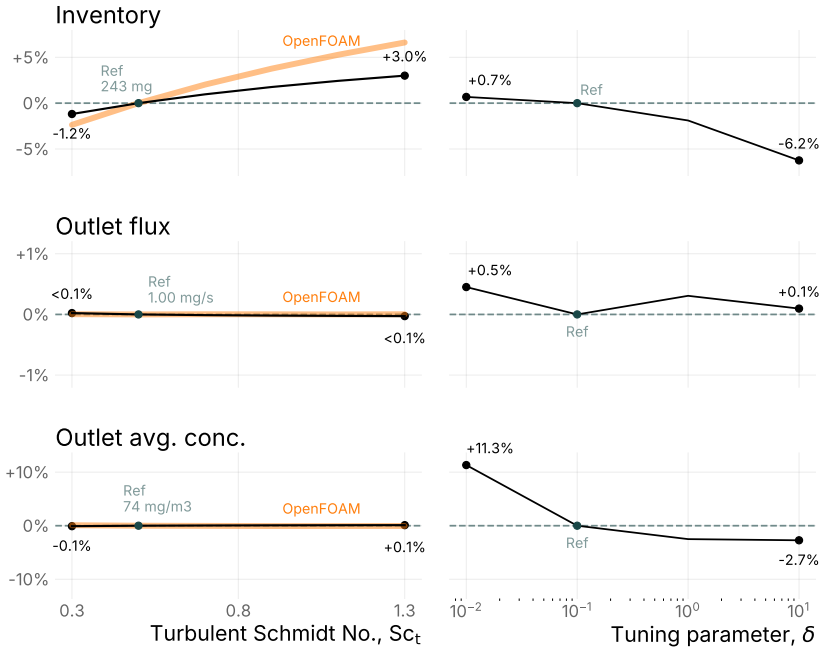
- The modest sensitivity to the turbulent Schmidt number across 0.3–1.3 means the bulk outlet behaviour is robust to this physical uncertainty, while the numerical stabilisation parameter has the larger effect and local mesh refinement is preferable to artificial diffusion.
- The close code-to-code agreement between the finite-element and finite-volume solutions suggests the reported inventory, outlet flux, and build-up time are not artefacts of one discretisation scheme.
Reading between the lines
- If the assumed 5-degree sector symmetry fails in a real blanket (different neutron flux, plenum geometries, or wall temperatures across sectors), the 72-fold scaling that produces 243 mg and 1.0 mg/s will not hold, and a multi-sector simulation would reveal the error.
- The artificial-diffusion stabilisation is not exactly conservative, with the finite-element outlet flux about 1.5% below the production rate at steady state, so replacing it with a discontinuous Galerkin scheme could shift the reported numbers slightly.
- Because the model omits tritium trapping and permeation in solid structures, and the paper cites ~20% inventory increases from trapping in comparable blankets plus potentially larger neutron-damage effects, the full system inventory including structures could be several times the 243 mg liquid-only value.
- A direct experimental check would be to measure the outlet tritium concentration of an ARC-like FLiBe loop under the modelled inlet conditions; agreement with the predicted roughly $0.90\ \mathrm{mg\,m^{-3}}$ would support the turbulence and stabilisation treatment, while strong disagreement would point to missing physics such as trapping, chemistry, or a nonzero inlet concentration.
Editorial analysis
A structured set of objections, weighed in public.
Referee Report
Summary. The paper presents a fully open-source multiphysics workflow coupling OpenMC (neutron transport), OpenFOAM (thermal hydraulics), and FESTIM (tritium transport) to model tritium behavior in a 5-degree toroidal sector of the ARC liquid immersion blanket. From this sector, system-level results are obtained by scaling to 72 identical sectors: a steady-state tritium inventory of approximately 243 mg, an outlet mass flux of approximately 1.0 mg/s, an outlet-averaged concentration of approximately 0.90 mg/m^3, and a build-up time of approximately 30 minutes. The inventory is explicitly labeled a lower bound because of the zero inlet concentration and the neglect of tritium in solid structures. A code-to-code comparison with an OpenFOAM passive scalar solver agrees to within about 1% on inventory and outlet flux, and a sensitivity study varies the turbulent Schmidt number and the numerical stabilization parameter. The paper is candid about the modeling limitations, including the absence of solid trapping, permeation, and chemical effects.
Significance. If the central results are reliable, the paper provides a useful component-scale demonstration of a transparent, extensible, and fully open-source toolchain for tritium transport modeling in ARC-class blankets. The main strengths are the release of the two converter packages (foam2dolfinx and openmc2dolfinx), the careful code-to-code verification, the explicit lower-bound caveat, and the identification of flow-stagnation regions as tritium accumulation hotspots. The prediction of a ~243 mg inventory and ~1.0 mg/s throughput is a concrete, falsifiable result that can inform early design iteration. However, the headline numbers rest on the assumption of perfect 72-fold toroidal symmetry, which is acknowledged but not quantified, and the sensitivity discussion somewhat overstates the role of the numerical stabilization parameter relative to the turbulent Schmidt number.
major comments (3)
- [Section 3 and Section 2.2] All system-level values (243 mg inventory, 1.0 mg/s outlet flux, 30 min build-up) are obtained by simulating one 5-degree sector and multiplying by 72, under the stated assumption of perfect geometric and flow symmetry. This assumption is load-bearing for every headline number, yet no test or error bound is provided. The symmetry boundary conditions on the toroidal faces of the sector and the toroidally uniform treatment of the OpenMC source enforce the assumption rather than verify it. A concrete test, such as a two-sector simulation with perturbed inlet conditions, a coarse full-torus run, or a sensitivity study in which the sector's inlet velocity or tritium source is varied within a plausible range, would bound the extrapolation error. Without such a test, the reported system-level values remain conditional on an unquantified geometric and hydraulic symmetry.
- [Abstract and Section 3.2 (Figure 9)] The abstract claims that predicted inventories are 'governed primarily by the numerical stabilisation scheme,' but the data in Figure 9 show that varying the stabilization parameter δ from 0.01 to 10 changes the inventory by -6.2% to +0.7%, while varying the turbulent Schmidt number Sct from 0.3 to 1.3 changes the inventory by -5% to +3%. These ranges overlap and are of comparable magnitude; the conclusion that the stabilization scheme is the dominant factor is therefore an overstatement. The text should be reworded to say that both parameters have modest effects, with δ having a somewhat larger influence in one direction, and the abstract should be aligned with this more balanced conclusion.
- [Sections 2.2, 2.3, and 3.2] No mesh convergence or grid sensitivity study is reported for either the OpenFOAM CFD run or the FESTIM transport solve. The 1% agreement between FESTIM and OpenFOAM demonstrates that two discretizations of the same equation on the same underlying mesh agree, but it does not establish that the mesh adequately resolves the velocity and concentration fields. A refinement study, or at least a report of the number of cells and element sizes in the computational meshes, is needed to support the claimed absolute accuracy of the 243 mg inventory and 1.0 mg/s flux.
minor comments (5)
- [Section 2.3, Eq. (3)] Equation (3) defines the artificial diffusion as Dart = δ h ||u||, which is an isotropic artificial diffusion term, but the text describes it as 'analogous to streamline upwind Petrov–Galerkin (SUPG) or artificial diffusion methods.' SUPG is a consistent streamline-upwind scheme, not isotropic diffusion, so the paper should clarify which stabilization is actually implemented, or use a more precise description.
- [Section 2.2, Table 3] The inlet turbulent kinetic energy and specific dissipation rate are specified as kin = 0.12 m^2/s^2 and ωin = 0.6 1/s, said to correspond to 20% turbulence intensity, but no turbulent length scale or hydraulic diameter is given; without this, the ωin value cannot be independently reproduced.
- [Section 3.2 and Figure 9] The color scale and label placement in Figure 9 make it difficult to associate the OpenFOAM comparison points with specific Sct values; a clearer legend or annotations would improve readability and help the reader verify the claimed agreement.
- [Section 3.2] The paper states that the reported inventory is a 'conservative minimum'; since 'conservative' is ambiguous in a safety context, consider using 'lower bound' consistently to avoid implying that a lower inventory is necessarily conservative from a regulatory perspective.
- [Section 3.2] The paper compares the FESTIM outlet flux with the neutronic production rate and reports a 1.5% imbalance, but the absolute value of the production rate is not stated; reporting it would put the imbalance in context.
Circularity Check
No load-bearing circularity: the 243 mg inventory and 1.0 mg/s outlet flux are forward solutions of the stated advection-diffusion problem; self-citations are tooling/context, with one minor definitional claim about turbulent-diffusion dominance.
-
self definitional
[Section 3.2 (FESTIM results), with Eq. (4) and Eq. (2) in Section 2.3]
"This behaviour is consistent with the dominant contribution of turbulence-induced diffusion to tritium transport: comparison of the Fickian and effective diffusivity fields (figure 5) shows the latter exceeding the former by several orders of magnitude throughout the breeder."
The dominance is fixed by construction rather than derived: Eq. (4) defines Deff = D + Dturb + Dart, Eq. (2) defines Dturb = nu_t/Sct, and Eq. (3) gives Dart >= 0. With nu_t supplied by the OpenFOAM CFD run and Sct chosen as 0.5, the inequality Deff >> D is an immediate restatement of the model's constitutive inputs, not an emergent solution property. This does not undermine the central quantitative claims, which require actually solving Eq. (1) for the concentration field and then integrating it to obtain 243 mg and the outlet flux of 1.0 mg/s.
full rationale
The paper's headline numbers are not fitted to the target outputs. The derivation chain is: OpenMC tallies supply the volumetric tritium source S; OpenFOAM supplies u and nu_t; FESTIM solves Eq. (1) with Deff from Eqs. (2)-(4), zero inlet concentration, and stated wall/outlet conditions. The 243 mg inventory, 1.0 mg/s outlet flux, and ~30 min build-up are integrals of that solution. No parameter is adjusted to reproduce these values: Sct and delta are chosen a priori and tested by sensitivity sweeps, and the code-to-code comparison against the OpenFOAM passive-scalar solver is a numerical cross-check of the same equation, not a source of fitted inputs. Many citations are to the authors' own tools (FESTIM, FERMI, foam2dolfinx, openmc2dolfinx, HTM) or prior system-level context [41], but these are used as infrastructure, geometry, or comparison, not as evidence for the 243 mg result. The only self-definitional element is the qualitative statement that turbulent diffusion dominates, which follows immediately from the definition of Deff; it is flagged but is not load-bearing for the quantitative predictions. The acknowledged limitations (72-sector symmetry extrapolation, neglect of solid trapping and permeation, idealised zero inlet) are assumptions or risk factors, not circular inputs. Overall circularity burden is low.
Assumptions & free parameters
free parameters (2)
- Numerical tuning parameter delta =
0.1
- Turbulent Schmidt number Sct =
0.5
assumptions (6)
- domain assumption The 5-degree sector with symmetry boundary conditions is representative of the full 72-sector blanket.
- domain assumption The inlet tritium concentration is zero, representing a perfectly efficient extraction system.
- domain assumption Tritium transport in the liquid is governed by the macroscopic advection-diffusion equation with effective diffusivity Deff = D + D_turb + D_art.
- domain assumption RANS k-omega SST with wall functions adequately captures the flow and turbulence fields.
- domain assumption The Fickian diffusion parameters D0 and ED from the HTM database are valid for tritium in FLiBe.
- domain assumption Tritium transport into and through solid structural materials is negligible for the reported liquid inventory.
Cite this review
Pith. "Pith review of Multiphysics tritium transport modelling of the ARC breeding blanket with FESTIM." pith.science (2026). https://pith.science/paper/TQQ3CI4W
@misc{pith2026260805398,
  author       = {Pith},
  title        = {Pith review of: Multiphysics tritium transport modelling of the ARC breeding blanket with FESTIM},
  year         = {2026},
  howpublished = {\url{https://pith.science/paper/TQQ3CI4W}},
  note         = {Machine review of arXiv:2608.05398}
}
read the original abstract
Accurate prediction of tritium behaviour in molten salt breeding blankets is essential for the design and safe operation of ARC-class fusion reactors. This work presents a fully open-source, component-scale multiphysics framework for modelling tritium transport in an ARC liquid immersion blanket. Neutron transport, thermal hydraulics, and hydrogen isotope transport are coupled using OpenMC, OpenFOAM, and FESTIM, leveraging dedicated tools enabling direct transfer of spatially resolved fields between solvers. Assuming a zero inlet concentration, steady-state simulations predict a total tritium inventory of approximately 243 mg, with the blanket reaching steady-state tritium throughput within approximately 30 min, which is of a similar order to previous system-level estimates. The results show that tritium transport is dominated by turbulence-enhanced diffusion, with strong localisation in flow stagnation regions and reduced accumulation in highly turbulent zones. Sensitivity analyses indicate that predicted inventories are governed primarily by the numerical stabilisation scheme, with only a modest dependence on the turbulent Schmidt number. The proposed workflow provides a transparent and extensible basis for high-fidelity analysis of tritium transport in ARC-class breeding blankets.
Figures


Figures from the paper (6 more)


Reference graph
Works this paper leans on
-
[1]
B. N. Sorbom, J. Ball, T. R. Palmer, F. J. Man- giarotti, J. M. Sierchio, P. Bonoli, C. Kasten, D. A. Sutherland, H. S. Barnard, C. B. Haakonsen, J. Goh, C. Sung, D. G. Whyte, ARC: A compact, high-field, fusion nuclear science facility and demon- stration power plant with demountable magnets, Fusion Engineering and Design 100 (2015) 378–405. doi:10.1016/j...
-
[2]
J. Dark, R. Delaporte-Mathurin, Y. Charles, E. A. Hodille, C. Grisolia, J. Mougenot, Influ- ence of hydrogen trapping on WCLL breeding blanket performances, Nuclear Fusion (2021). doi:10.1088/1741-4326/ac28b0. URLhttp://iopscience.iop.org/article/10. 1088/1741-4326/ac28b0
-
[4]
M. F. Simpson, G. R. Smolik, J. P. Sharpe, R. A. Anderl, D. A. Petti, Y. Hatano, M. Hara, Y. Oya, S. Fukada, S. Tanaka, T. Terai, D.-K. Sze, Quantitative measurement of beryllium-controlled redox of hydrogen fluoride in molten Flibe, Fusion Engineering and Design 81 (1) (2006) 541–547. doi:10.1016/j.fusengdes.2005.08.031. URLhttps://www.sciencedirect.com/...
-
[5]
M. Hara, Y. Hatano, M. F. Simpson, G. R. Smolik, J. P. Sharp, Y. Oya, K. Okuno, M. Nishikawa, T. Terai, S. Tanaka, R. A. Anderl, D. A. Petti, D. K. Sze, Interactions between molten Flibe and metallic Be, Fusion Engineering and Design 81 (1) (2006) 561–566.doi:10.1016/j.fusengdes.2005.06.372. URLhttps://www.sciencedirect.com/science/ article/pii/S0920379605005521
-
[6]
S. Fukada, M. F. Simpson, R. A. Anderl, J. P. Sharpe, K. Katayama, G. R. Smolik, Y. Oya, T. Terai, K. Okuno, M. Hara, D. A. Petti, S. Tanaka, D. K. Sze, A. Sagara, Reaction rate of beryllium with fluorine ion for Flibe redox control, Journal of Nuclear Materials 367-370 (2007) 1190–1196. doi:10.1016/j.jnucmat.2007.03.218. URLhttps://www.sciencedirect.com/...
-
[7]
J. R. Keiser, J. H. DeVan, E. J. Lawrence, Compati- bility of molten salts with type 316 stainless steel and lithium, Journal of Nuclear Materials 85-86 (1979) 295–298.doi:10.1016/0022-3115(79)90505-1. URLhttps://www.sciencedirect.com/science/ article/pii/0022311579905051
arXiv 1979
-
[8]
T. Terai, H. Nishimura, K. Yamaguchi, M. Ya- mawaki, A. Suzuki, T. Muroga, A. Sagara, O. Motojima, Compatibility of Structural Mate- rials with Li2BeF4 Molten Salt Breeder, Fusion Technology 39 (2P2) (2001) 784–788, _eprint: https://doi.org/10.13182/FST01-A11963334. doi:10.13182/FST01-A11963334. URLhttps://doi.org/10.13182/ FST01-A11963334
-
[9]
K. Dolan, G. Su, G. Zheng, M. Ames, D. Car- penter, L.-W. Hu, Experimental Measurement and Multiphysics Simulation of Tritium Trans- port in Neutron-Irradiated Flibe Salt, Nu- clear Technology 0 (0) (2023) 1–17, _eprint: https://doi.org/10.1080/00295450.2022.2135933. doi:10.1080/00295450.2022.2135933. URLhttps://doi.org/10.1080/00295450.2022. 2135933
Show all 47 references
-
[11]
Delaporte-Mathurin, N
R. Delaporte-Mathurin, N. Goles, J. Ball, C. Dunn, E. Edwards, S. Ferry, E. Lamere, A. Lanzrath, R. Leccacorvi, S. Meschini, E. Peterson, S. Segantin, R. Vieira, D. Whyte, W. Zhou, K. Woller, Advancing tritiumself-sufficiencyinfusionpowerplants: insights from the BABY experime...
2025 doi
-
[12]
Candido, M
L. Candido, M. Cantore, E. Galli, R. Testoni, M. Utili, M. Zucchetti, An integrated hydrogen 12 isotopes transport model for the TRIEX-II facility, Fusion Engineering and Design 155 (2020) 111585. doi:10.1016/j.fusengdes.2020.111585. URLhttp://www.sciencedirect.com/science/ ar...
2020
-
[13]
Candido, C
L. Candido, C. Alberghi, F. Moro, S. Noce, R. Testoni, M. Utili, M. Zucchetti, A novel approach to the study of magnetohydrodynamic effect on tritium transport in WCLL breeding blanket of DEMO, Fusion Engineering and Design 167 (2021) 112334.doi:10.1016/j.fusengdes.2021.112334...
2021
-
[14]
URLhttp://www.sciencedirect.com/science/ article/pii/S0920379620305445
C.Alberghi, L.Candido, R.Testoni, M.Utili, M.Zuc- chetti, Magneto-convective effect on tritium transport at breeder unit level for the WCLL breeding blanket of DEMO, Fusion Engineering and Design 160 (2020) 111996.doi:10.1016/j.fusengdes.2020.111996. URLhttp://www.sciencedirec...
2020
-
[15]
G. Zhou, F. Hernández, L. V. Boccaccini, H. Chen, M. Ye, Design study on the new EU DEMO HCPB breeding blanket: Thermal analysis, Progress in Nuclear Energy 98 (2017) 167–176. doi:10.1016/j.pnucene.2017.03.013. URLhttps://www.sciencedirect.com/science/ article/pii/S0149197017300586
2017 doi
-
[16]
Badalassi, A
V. Badalassi, A. Sircar, J. M. Solberg, J. W. Bae, K. Borowiec, P. Huang, S. Smolent- sev, E. Peterson, FERMI: Fusion Energy Re- actor Models Integrator, Fusion Science and Technology 79 (3) (2023) 345–379, _eprint: https://doi.org/10.1080/15361055.2022.2151818. doi:10.1080/15...
2023
-
[17]
Collins, et al., Progress in freda: A multi-fidelity plasma-engineering integrated modeling platform for fusion reactor design and assessment (2025)
C. Collins, et al., Progress in freda: A multi-fidelity plasma-engineering integrated modeling platform for fusion reactor design and assessment (2025). URLhttps://meetings-archive.aps.org/dpp/ 2025/no05/8/
2025
-
[18]
J. Dark, R. Delaporte-Mathurin, J. S. Dokken, H. Yang, C. Khurana, K. Dunnell, G. Fer- rero, V. Kulagin, S. Meschini, J. Dufour, E. A. Hodille, FESTIM v2.0: Upgraded framework for multi-species hydrogen transport and enhanced performance, International Journal of Hydro- gen En...
2026
-
[19]
P. K. Romano, N. E. Horelik, B. R. Herman, A. G. Nelson, B. Forget, K. Smith, OpenMC: A state-of-the-art Monte Carlo code for research and development, Annals of Nuclear Energy 82 (2015) 90–97.doi:10.1016/j.anucene.2014.07.048. URLhttps://linkinghub.elsevier.com/ retrieve/pii/...
2015 doi
-
[20]
URLwww.openfoam.org
OpenFOAM. URLwww.openfoam.org
-
[21]
Greenshields, H
C. Greenshields, H. Weller, Notes on Computational Fluid Dynamics: General Principles, section: Notes on CFD: General Principles (Apr. 2022). URLhttps://doc.cfd.direct/notes/ cfd-general-principles/index/
2022
-
[22]
J. Dark, R. Delaporte-Mathurin, festim- dev/foam2dolfinx: Release v1.0 (Oct. 2025). doi:10.5281/zenodo.17297277. URLhttps://zenodo.org/records/17297277
2025
-
[23]
I. A. Baratta, J. P. Dean, J. S. Dokken, M. Habera, J. S. Hale, C. N. Richardson, M. E. Rognes, M. W. Scroggs, N. Sime, G. N. Wells, DOLFINx: The next generation FEniCS problem solving environment (Dec. 2023). URLhttps://zenodo.org/records/10447666
2023
-
[24]
J. Dark, R. Delaporte-Mathurin, festim- dev/openmc2dolfinx: Release v1.0 (Oct. 2025). doi:10.5281/zenodo.17297566. URLhttps://zenodo.org/records/17297566
2025
-
[25]
P. P. H. Wilson, T. J. Tautges, J. A. Kraftcheck, B. M. Smith, D. L. Henderson, Acceleration techniques for the direct use of CAD-based ge- ometry in fusion neutronics analysis, Fusion En- gineering and Design 85 (10) (2010) 1759–1765. doi:10.1016/j.fusengdes.2010.05.030. URLh...
2010 doi
-
[26]
T. D. Blacker, S. J. Owen, M. L. Staten, W. R. Quadros, B. Hanks, B. W. Clark, R. J. Meyers, C. Ernst, K. Merkley, R. Morris, et al., CUBIT ge- ometry and mesh generation toolkit 15.1 user doc- umentation, Tech. rep., Sandia National Laboratory (2016)
2016
-
[27]
Fausser, A
C. Fausser, A. L. Puma, F. Gabriel, R. Villari, Tokamak D-T neutron source models for differ- ent plasma physics confinement modes, Fusion Engineering and Design 87 (5) (2012) 787–792. doi:10.1016/j.fusengdes.2012.02.025. URLhttps://www.sciencedirect.com/science/ article/pii/S...
2012 doi
-
[28]
M. B. Chadwick, M. Herman, P. Obložinský, M. E. Dunn, Y. Danon, A. C. Kahler, D. L. Smith, B. Pritychenko, G. Arbanas, R. Arcilla, R. Brewer, D. A. Brown, R. Capote, A. D. Carlson, Y. S. 13 Cho, H. Derrien, K. Guber, G. M. Hale, S. Hoblit, S. Holloway, T. D. Johnson, T. Kawano...
2011
-
[29]
Davis, A
A. Davis, A. Turner, Comparison of global variance reduction techniques for monte carlo radiation trans- port simulations of iter, Fusion Engineering and De- sign 86 (9-11) (2011) 2698–2700
2011
-
[30]
De Pietri, J
M. De Pietri, J. Alguacil, E. Rodríguez, R. Juárez, Development and validation in water of FLUNED, an open-source tool for fluid activation calculations, Computer Physics Communications 291 (2023) 108807.doi:10.1016/j.cpc.2023.108807. URLhttps://www.sciencedirect.com/science/ ...
2023
-
[31]
Mistrangelo, L
C. Mistrangelo, L. Bühler, Determination of multi- channel MHD velocity profiles from wall-potential measurements and numerical simulations, Fu- sion Engineering and Design 130 (2018) 137–141. doi:10.1016/j.fusengdes.2018.03.041. URLhttps://www.sciencedirect.com/science/ artic...
2018 doi
-
[32]
Caravello, A
M. Caravello, A. Aimetta, N. Abrate, S. Dulla, A. Froio, An OpenFOAM solver for multiphysics modeling of fusion reactor design: The nemoFoam code, Nuclear Materials and Energy 40 (2024) 101693.doi:10.1016/j.nme.2024.101693. URLhttps://www.sciencedirect.com/science/ article/pii...
2024
-
[33]
S. B. Seo, R. Hernandez, M. O’Neal, N. Meehan, F. S. Novais, M. Rizk, G. I. Maldonado, N. R. Brown, A review of thermal hydraulics systems analysis for breeding blanket design and future needs for fusion engineering demonstration facility design and licensing, Fusion Engineeri...
2021
-
[34]
J. W. Bae, A. Sircar, K. Borowiec, V. Badalassi, C. Collins, Impact of high-fidelity temperature feedback modeling on fusion blanket neutron- ics*, Nuclear Fusion 66 (3) (2026) 036001. doi:10.1088/1741-4326/ae3628. URLhttps://doi.org/10.1088/1741-4326/ ae3628
2026 doi
-
[35]
Delaporte-Mathurin, J
R. Delaporte-Mathurin, J. Dark, nateth- egreatINL, T. Fuerst, paulbrrn, C. Hill, RemDelaporteMathurin/h-transport-materials: Patch 0.16.1 (Jun. 2024).doi:10.5281/zenodo. 12189551. URLhttps://zenodo.org/records/12189551
2024
-
[36]
URLhttps://www.comsol.com/blogs/ understanding-stabilization-methods/
COMSOL, Understanding Stabilization Methods (2020). URLhttps://www.comsol.com/blogs/ understanding-stabilization-methods/
2020
-
[37]
E. A. Hodille, X. Bonnin, R. Bisson, T. Angot, C. S. Becquart, J. M. Layet, C. Grisolia, Macroscopic rate equation modeling of trapping/detrapping of hydrogen isotopes in tungsten materials, Jour- nal of Nuclear Materials 467 (2015) 424–431. doi:10.1016/j.jnucmat.2015.06.041. ...
2015 doi
-
[38]
Sircar, J
A. Sircar, J. W. Bae, K. Borowiec, V. Badalassi, C. Collins, Coupled neutronics and thermal hy- draulics simulation of tritium breeding and its transport in the arc-class fusion blanket (2024). URLhttps://www.ans.org/meetings/tofe2024/ session/view-2626/
2024
-
[39]
D., Matplotlib: A 2D graphics environ- ment, Computing in Science & Engineering 9 (3) (2007) 90–95.doi:10.1109/MCSE.2007.55
Hunter, J. D., Matplotlib: A 2D graphics environ- ment, Computing in Science & Engineering 9 (3) (2007) 90–95.doi:10.1109/MCSE.2007.55
2007 doi
-
[40]
Ayachit, The paraview guide: a parallel visualization application, Kitware, Inc., 2015
U. Ayachit, The paraview guide: a parallel visualization application, Kitware, Inc., 2015. doi:10.5555/2789330. URLhttps://dl.acm.org/doi/abs/10.5555/ 2789330
2015 doi
-
[41]
Meschini, S
S. Meschini, S. E. Ferry, R. Delaporte-Mathurin, D. G. Whyte, Modeling and analysis of the tritium fuel cycle for ARC- and STEP-class D-T fusion power plants, Nuclear Fusion 63 (12) (2023) 126005. doi:10.1088/1741-4326/acf3fc. URLhttps://dx.doi.org/10.1088/1741-4326/ acf3fc
2023 doi
-
[42]
Shimada, D
M. Shimada, D. Campbell, V. Mukhovatov, M. Fuji- wara, N. Kirneva, K. Lackner, M. Nagami, V. Pus- tovitov, N. Uckan, J. Wesley, N. Asakura, A. Cost- ley, A. Donné, E. Doyle, A. Fasoli, C. Gormezano, Y. Gribov, O. Gruber, T. Hender, W. Houlberg, S. Ide, Y. Kamada, A. Leonard, B...
2007 doi
-
[43]
T. F. Fuerst, M. D. Eklund, J. A. Leland, A. A. Riet, C. N. Taylor, Parametric study of the vacuum permeator for the tritium extrac- tion experiment, Fusion Science and Technol- ogy 79 (8) (2023) 1224–1234.arXiv:https: //doi.org/10.1080/15361055.2023.2196237, doi:10.1080/15361...
2023
-
[44]
A. J. Reynolds, The prediction of turbulent Prandtl and Schmidt numbers, International Journal of Heat and Mass Transfer 18 (9) (1975) 1055–1069. doi:10.1016/0017-9310(75)90223-9. URLhttps://www.sciencedirect.com/science/ article/pii/0017931075902239
1975
-
[45]
Tominaga, T
Y. Tominaga, T. Stathopoulos, Turbulent Schmidt numbers for CFD analysis with various types of flow- field, Atmospheric Environment 41 (37) (2007) 8091– 8099.doi:10.1016/j.atmosenv.2007.06.054. URLhttps://www.sciencedirect.com/science/ article/pii/S1352231007006036
2007 doi
-
[46]
Yamamoto, T
Y. Yamamoto, T. Kunugi, Direct numerical simula- tion of MHD heat transfer in high Reynolds number turbulent channel flows for Prandtl number of 25, Fusion Engineering and Design 90 (2015) 17–22. doi:10.1016/j.fusengdes.2014.10.005. URLhttps://www.sciencedirect.com/science/ ar...
2015 doi
-
[47]
E. A. Hodille, J. Dark, R. Delaporte-Mathurin, C. Grisolia, Y. Charles, J. Mougenot, Tritium reten- tion in the ITER/DEMO actively cooled tungsten monoblockinthepresenceofneutron-induceddefects, International Journal of Hydrogen Energy 205 (2026) 153245.doi:10.1016/j.ijhydene....
2026
-
[48]
J. Dark, R. Delaporte-Mathurin, T. Schwarz-Selinger, E. A. Hodille, J. Mougenot, Y. Charles, C. Griso- lia, Modelling neutron damage effects on tritium transport in tungsten, Nuclear Fusion 64 (8) (2024) 086026.doi:10.1088/1741-4326/ad56a0. URLhttps://dx.doi.org/10.1088/1741-4...
2024 doi
-
[49]
Bonifetto, M
R. Bonifetto, M. Utili, D. Valerio, R. Zanino, Concep- tual design of a PAV-based tritium extractor for the WCLL breeding blanket of the EU DEMO: Effects of surface-limited vs. diffusion-limited modeling, Fusion Engineering and Design 167 (2021) 112363. doi:10.1016/j.fusengdes...
2021
Reviewed August 8, 2026 · model on record in the stance chip above.
Discussion (0). Continue with ORCID to comment.