REVIEW 4 major objections 5 minor 35 references
Hierarchical Latent Prediction for Language Models
T0 review · 4 major / 5 minor · reviewed 2026-08-07 · deepseek-v4-flash
Pith's one-line read Adding a coarse, k-step-ahead latent prediction to language model pretraining improves coding and multi-step reasoning, and speeds speculative decoding with no inference overhead.
desk verdict A plausible incremental extension of NextLat whose central representation claim is under-supported by the reported evidence; worth refereeing if experimental rigor is enforced. read the letter →
The pith
A machine-rendered reading of the paper's core claim, the machinery that carries it, and where it could break.
The reading
What carries the argument
The load-bearing mechanism is the higher-level 'abstract latent' $u_t = \mathrm{SWA}(h_{t-k+1:t})$, a deterministic sliding-window attention summary of the last $k$ backbone hidden states, paired with the $k$-step-ahead predictor $p_\phi(u_{t+k}|u_t)$. The $k$-step lookahead in a coarser space is what distinguishes HiLP from single-step NextLat: the higher-level pathway supervises long-horizon structure directly instead of unrolling one step at a time and compounding error. The stop-gradient operators are equally load-bearing: targets such as $\mathrm{sg}[u_{t+k}]$ are detached so that the higher-level loss shapes the SWA module and $p_\phi$ without sending gradient pressure back into the backbone latents, leaving the token-level supervision to govern $h_t$.
What would settle it
Train the identical HiLP configuration but freeze the SWA module to a fixed random projection of the last $k$ hidden states (e.g., a random linear map that is not updated), keeping $p_\phi$, the combined head, and all loss weights unchanged. If the HumanEval and speculative-decoding gains over NextLat persist, the learned hierarchy is not the cause of the reported improvement.
Extended reading notes
Core claim
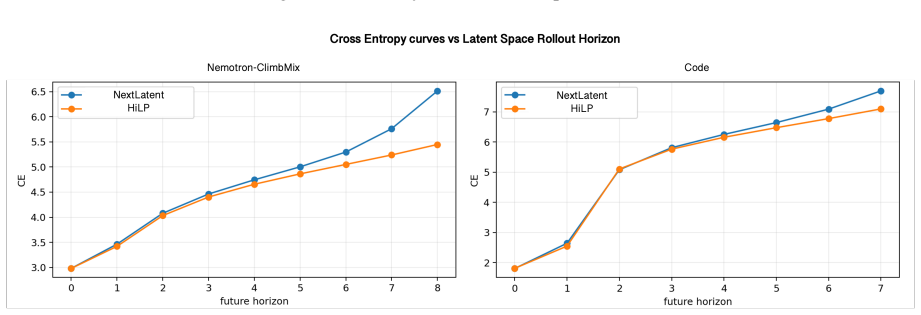
HiLP's central discovery is that a second, coarser temporal scale of self-prediction can be added to latent-space pretraining without changing the inference-time model. Concretely, the backbone produces lower-level latents $h_t = G_\theta(X_{1:t})$; a sliding-window attention module produces $u_t = \mathrm{SWA}(h_{t-k+1:t})$; and a higher-level dynamics model $p_\phi$ is trained to predict $\hat{u}_{t+k} = p_\phi(u_t)$, with the target $u_{t+k}$ stop-gradiented. The total training loss combines the standard NTP loss, the NextLat-style lower-level rollout losses and KL term, the higher-level consistency loss $L_u = \mathbb{E}_t[\mathrm{SmoothL1}(\mathrm{sg}[u_{t+k}], \hat{u}_{t+k})]$, and a combined-NTP loss that conditions next-token prediction on both latents. At optimality, the losses enforce the consistency conditions $p_\phi(u_{t+k}|u_t) = P(u_{t+k}|X_{1:t})$ alongside the usual next-token and lower-transition consistencies. The paper reports HumanEval pass@1 of 11.33 (versus 10.58 for NextLat and 8.77 for NTP) and an average accepted tokens of 3.41 versus 3.26 on code data, and presents latent cross-entropy curves showing lower long-horizon rollout error.
Load-bearing premise
The load-bearing premise is that the stop-gradiented target $\mathrm{sg}[u_{t+k}]$ is a stable and useful teaching signal even though $u_{t+k}$ is produced by the same backbone and SWA modules being trained; if this moving target collapses or drifts trivially, the claimed longer-horizon representation benefit fails.
Editorial extensions
If this is right
- If HiLP is right, latent-space auxiliary objectives for language pretraining should be designed at multiple temporal scales rather than as single-step transitions.
- The reported speculative-decoding gains (3.41 vs 3.26 average accepted tokens on code data, with no inference overhead) imply that self-predictive pretraining can make autoregressive decoding cheaper without enlarging the deployed model.
- The HumanEval and DCLM benchmark improvements support the view that pure teacher-forced next-token prediction under-trains long-horizon structure, and that explicit coarse-scale lookahead during training helps.
- Because the hierarchical apparatus is dropped at inference, HiLP is a pure pretraining intervention with zero added decoding latency, so it can be layered onto existing pretraining runs as a drop-in objective.
Reading between the lines
- The paper does not study whether the stop-gradiented moving target $u_{t+k}$ stays stable, so the natural next test is to measure the cosine drift or collapse of SWA latents over training; if the abstract latent becomes trivial, the hierarchy is not doing the claimed work.
- If the hierarchy is the cause of the gains, a similar multi-scale latent prediction should transfer to other modalities, e.g., image or audio pretraining, where long-horizon coherence matters.
- The fixed lookahead $k$ is a hyperparameter; a plausible extension is to make $k$ position-dependent, set by the confidence of $p_\phi$, which the paper lists as future work but does not test.
- The reported gains might partly come from adding a second auxiliary loss rather than from the hierarchical structure; a control with an equal-parameter single-scale auxiliary objective would separate these explanations.
Editorial analysis
A structured set of objections, weighed in public.
Referee Report
Summary. The paper proposes Hierarchical Latent Prediction (HiLP), an auxiliary training objective for causal language models that adds a higher-level abstract latent u_t = SWA(h_{t-k+1:t}) and a k-step-ahead predictor p_phi, along with a combined NTP head, on top of the standard NTP loss and a lower-level NextLat objective. At inference, only the trunk and the standard NTP head are retained, yielding zero additional latency. The authors pretrain 1B-parameter models on 100B tokens and report benchmark results on HumanEval and DCLM, plus speculative-decoding efficiency, claiming consistent gains over NTP, MTP, and NextLat baselines.
Significance. If the hierarchical mechanism performs as claimed, HiLP is a simple training-time intervention that could improve long-horizon latent prediction and speculative decoding without adding inference cost, and the paper includes a complete algorithmic description, hyperparameter table, and efficiency measurements. However, the central claim that HiLP 'leads to longer-horizon coherent belief state representation' is not yet established: the higher-level objective admits a trivial constant solution, the empirical comparisons lack statistical grounding, and the representation-quality evidence is partly circular. The paper's value depends on resolving these points.
major comments (4)
- [Section 2, Eq. (D), Algorithm 1 lines 9-13] The higher-level objective L_u = E SmoothL1(sg[u_{t+k}], p_phi(u_t)) admits a trivial constant solution: a constant u_t and a constant output of p_phi drive the loss to zero, and because the target is stop-gradiented there is no pressure to preserve information in u_t. The detached path in Eq. (E) (\tilde u_t = SWA(sg[h_{t-k+1:t}])) allows the combined head p_rho to learn to ignore \tilde u_t entirely, in which case the SWA module receives no gradient from L_cntp and condition (III) holds vacuously. The paper reports no diagnostic for u_t (e.g., effective rank, gradient norm, or probe accuracy), and Fig. 3 evaluates only lower-level latent rollout. To support the central claim of a longer-horizon coherent belief state, the authors should either add a collapse-prevention term or provide evidence that u_t is non-degenerate under the trained model.
- [Section 3, Tables 1-3 and Fig. 2] All reported benchmark numbers are single-run values without error bars, confidence intervals, or multiple seeds. The differences that support the main empirical claim are small (HumanEval pass@1 11.33 for HiLP vs 10.58 for NextLat; average accepted tokens 3.41 vs 3.26 on code data, and 2.59 vs 2.57 on Nemotron-ClimbMix), so without variance information the reader cannot determine whether the improvements are statistically meaningful. The DCLM symbolic/multi-step results appear only in a figure (Fig. 2) with no numerical values, preventing quantitative comparison and reproduction. Please provide seed-level numbers, confidence intervals, and tabulated DCLM values.
- [Section 3, Table 4 and Appendix D] The paper provides no ablations for the method's key hyperparameters: latent window size and lookahead k, rollout depth d, or loss weights (lambda_h, lambda_KL, lambda_u, lambda_cntp). More importantly, there is no ablation that removes the higher-level channel while keeping the lower-level NextLat objective, so the reported gains cannot be attributed specifically to the hierarchical component rather than to the added SWA module and combined head. The only ablation (Appendix D) concerns the input-combination implementation and does not address the hierarchical mechanism. I request an ablation of the hierarchy (e.g., setting lambda_u=0 and lambda_cntp=0, or replacing u_t with a fixed projection) to demonstrate that the higher-level latent is the source of the improvement.
- [Section 4, Fig. 3] The evidence for the 'longer-horizon coherent belief state' relies on latent prediction cross-entropy curves (Fig. 3), which are closely related to the training objective (Eq. D) itself. Reporting lower loss on essentially the same objective that is being optimized is partly circular and does not establish that the learned representation is more coherent. The authors should evaluate representation quality with an independent probe or a held-out task, or at minimum clarify the relation between the plotted curves and the training losses.
minor comments (5)
- [Section 3.1] The phrase 'show that HiLP is improve performance' should read 'shows that HiLP improves performance'.
- [Section 5.2 and References] The citations for CALM and Coconut both appear as 'Shao et al., 2025', but the reference list contains only one Shao et al. entry (Continuous autoregressive language models); the CALM paper is missing from the references.
- [Section 2, Eq. (D) and Table 4] The symbol k is used for both the SWA window size and the lookahead offset; the paper should state explicitly whether these are coupled or independently tunable.
- [Table 2] The per-K columns for MTP end at K=4 without a footnote; a note explaining MTP's shorter evaluated horizon would help the reader interpret the comparison.
- [Algorithm 1] The KL term uses a frozen copy p_sg_theta; please clarify whether this is implemented via stop-gradient on parameters or via a periodic parameter copy.
Circularity Check
Fig. 3’s “longer-horizon belief state” evidence replays the optimized latent losses; the benchmark results remain independent.
-
fitted input called prediction
[Section 4 (Discussion) and Fig. 3 caption]
"The latent prediction cross-entropy losses across rollout horizons up to 8 steps ahead are shown in 3. As the curves show, HiLP preserves the near-term cross-entropy of NextLat while producing lower future prediction error at longer horizons, suggesting that the hierarchical latent mitigates multi-step error accumulation. [Fig. 3 caption:] HiLP has comparable near-term latent prediction loss and lower long-horizon future and excess cross-entropy, indicating more stable multi-step latent rollout."
The “latent prediction cross-entropy losses” plotted in Fig. 3 are the same losses HiLP minimizes during training: Eq. (B) L_h = E_t[1/d Σ SL1(sg[h_{t+i}], ħ_{t+i})] and Eq. (D) L_u = E_t[SmoothL1(sg[u_{t+k}], û_{t+k})]. Reporting that HiLP has “lower future prediction error at longer horizons” is therefore reporting that the fitted objective is smaller on the web/code splits, not an independent measurement of whether the abstract latent u_t encodes longer-horizon structure. No external probe of u_t (e.g., effective rank, downstream probe, or controlled intervention) is provided. The HumanEval, DataComp, and speculative-decoding results are external benchmarks, so the circularity is localized to the “longer-horizon coherent belief state” claim.
full rationale
The paper’s headline empirical results are evaluated with external benchmarks: HumanEval pass@1 (11.33 vs 10.58 for NextLat), DCLM symbolic/multi-step reasoning, and speculative decoding accepted tokens (3.41 vs 3.26 on code). These comparisons are independent of the training objective and give the core practical claim genuine external grounding. The method itself is not derived from a self-citation chain; NextLat is used as an experimental baseline, and the overlapping-author citations are background rather than load-bearing. The one identifiable circular element is the evidence offered for “longer-horizon coherent belief state representation.” Fig. 3 plots latent prediction cross-entropy at rollout horizons up to 8, which is precisely the family of losses L_h (Eq. B) and L_u (Eq. D) that HiLP optimizes during pretraining. Showing that HiLP has lower future prediction error on those same curves is, to a first approximation, showing that the optimized objective is smaller; it does not by itself certify that the higher-level latent captures non-trivial multi-scale structure. That conclusion would require an independent diagnostic of the latent space. Because the benchmark tables provide independent support for the practical utility claims, the circularity is partial and localized, hence a score of 4 rather than 6 or higher.
Assumptions & free parameters
free parameters (4)
- Latent window size and lookahead offset k =
4
- Lower-level rollout depth d =
not stated in Table 4
- Auxiliary loss weights (lambda_h, lambda_KL, lambda_u, lambda_cntp) =
10.0, 0.1, 1.0, 0.5
- Latent learning rate =
1e-3
assumptions (5)
- domain assumption Language contains inherent hierarchical structure at multiple scales (characters, phrases, sentences, paragraphs) that can be exploited by hierarchical latent prediction.
- ad hoc to paper Latent-space self-prediction with a moving, stop-gradiented target provides a useful and stable training signal.
- ad hoc to paper Stop-gradient separation in the combined NTP head prevents competing optimization signals and lets the SWA module learn useful abstractions.
- domain assumption At optimality, the five loss terms can simultaneously satisfy the consistency conditions (I)-(IV).
- domain assumption The hidden-state latent space is sufficiently continuous and metric that SmoothL1 distance between predicted and actual latents is a meaningful training signal.
invented entities (1)
-
Higher-level abstract latent u_t
Cite this review
Pith. "Pith review of Hierarchical Latent Prediction for Language Models." pith.science (2026). https://pith.science/paper/VHLS6M2T
@misc{pith2026260805806,
  author       = {Pith},
  title        = {Pith review of: Hierarchical Latent Prediction for Language Models},
  year         = {2026},
  howpublished = {\url{https://pith.science/paper/VHLS6M2T}},
  note         = {Machine review of arXiv:2608.05806}
}
read the original abstract
While standard Next-Token Prediction (NTP) lays the foundation of language model pre- training, its teacher-forced training paradigm may not be optimal for long-horizon reasoning and planning. Recent works such as Multi-Token Prediction (MTP) and Next-Latent prediction (NextLat) try to mitigate the problem through predicting multiple future tokens and self-supervised prediction in the latent space. However, those auxiliary objectives either have a limited horizon or suffer from compounding error from multi-step rollout. We introduce Hierarchical Latent Prediction (HiLP), which introduces an auxiliary higher-level abstract latent to help reduce the error accumulation effect in latent-space rollouts. Experiments show that HiLP can lead to longer-horizon coherent belief state representation and demonstrate the effectiveness of our method across coding and multi-step reasoning benchmarks, and offers more speculative decoding efficiency.
Figures


Figures from the paper (1 more)

Reference graph
Works this paper leans on
-
[1]
arXiv preprint arXiv:2412.08821 , year=
Large concept models: Language modeling in a sentence representation space , author=. arXiv preprint arXiv:2412.08821 , year=
-
[2]
Advances in Neural Information Processing Systems , volume=
Nemotron-climb: Clustering-based iterative data mixture bootstrapping for language model pre-training , author=. Advances in Neural Information Processing Systems , volume=
-
[3]
arXiv preprint arXiv:2604.03208 , year=
Hierarchical planning with latent world models , author=. arXiv preprint arXiv:2604.03208 , year=
-
[4]
ACM Transactions on Intelligent Systems and Technology , year=
Hierarchical multimodal llms with semantic space alignment for enhanced time series classification , author=. ACM Transactions on Intelligent Systems and Technology , year=
-
[5]
arXiv preprint arXiv:2510.27688 , year=
Continuous Autoregressive Language Models , author=. arXiv preprint arXiv:2510.27688 , year=
-
[6]
Advances in Neural Information Processing Systems , volume=
Learning discrete concepts in latent hierarchical models , author=. Advances in Neural Information Processing Systems , volume=
-
[7]
Byte latent transformer: Patches scale better than tokens , author=. Proceedings of the 63rd Annual Meeting of the Association for Computational Linguistics (Volume 1: Long Papers) , pages=
-
[8]
arXiv preprint arXiv:2507.07955 , year=
Dynamic chunking for end-to-end hierarchical sequence modeling , author=. arXiv preprint arXiv:2507.07955 , year=
Show all 35 references
-
[9]
Advances in Neural Information Processing Systems , volume=
Megabyte: Predicting million-byte sequences with multiscale transformers , author=. Advances in Neural Information Processing Systems , volume=
-
[10]
arXiv preprint arXiv:2503.21801 , year=
Efficient joint prediction of multiple future tokens , author=. arXiv preprint arXiv:2503.21801 , year=
-
[11]
arXiv preprint arXiv:2403.06963 , year=
The pitfalls of next-token prediction , author=. arXiv preprint arXiv:2403.06963 , year=
-
[12]
Proceedings of the AAAI conference on artificial intelligence , volume=
The option-critic architecture , author=. Proceedings of the AAAI conference on artificial intelligence , volume=
-
[13]
arXiv preprint arXiv:2511.08544 , year=
Lejepa: Provable and scalable self-supervised learning without the heuristics , author=. arXiv preprint arXiv:2511.08544 , year=
-
[14]
arXiv preprint arXiv:2302.01318 , year=
Accelerating large language model decoding with speculative sampling , author=. arXiv preprint arXiv:2302.01318 , year=
-
[15]
Advances in neural information processing systems , volume=
The evolution of statistical induction heads: In-context learning markov chains , author=. Advances in neural information processing systems , volume=
-
[16]
Better & faster large language models via multi-token prediction, 2024 , author=
2024
-
[17]
International Conference on Learning Representations , volume=
Learning hierarchical world models with adaptive temporal abstractions from discrete latent dynamics , author=. International Conference on Learning Representations , volume=
-
[18]
Advances in Neural Information Processing Systems , volume=
Deep hierarchical planning from pixels , author=. Advances in Neural Information Processing Systems , volume=
-
[19]
International Conference on Learning Representations , volume=
Hierarchical world models as visual whole-body humanoid controllers , author=. International Conference on Learning Representations , volume=
-
[20]
International Conference on Learning Representations , volume=
The belief state transformer , author=. International Conference on Learning Representations , volume=
-
[21]
2, 2022-06-27 , author=
A path towards autonomous machine intelligence version 0.9. 2, 2022-06-27 , author=. Open Review , volume=
2022
-
[22]
International Conference on Machine Learning , pages=
Fast inference from transformers via speculative decoding , author=. International Conference on Machine Learning , pages=. 2023 , organization=
2023
-
[23]
arXiv preprint arXiv:2603.19312 , year=
Leworldmodel: Stable end-to-end joint-embedding predictive architecture from pixels , author=. arXiv preprint arXiv:2603.19312 , year=
-
[24]
arXiv preprint arXiv:2401.15077 , year=
Eagle: Speculative sampling requires rethinking feature uncertainty , author=. arXiv preprint arXiv:2401.15077 , year=
-
[25]
Proceedings of the 2024 conference on empirical methods in natural language processing , pages=
Eagle-2: Faster inference of language models with dynamic draft trees , author=. Proceedings of the 2024 conference on empirical methods in natural language processing , pages=
2024
-
[26]
Advances in Neural Information Processing Systems , volume=
Eagle-3: Scaling up inference acceleration of large language models via training-time test , author=. Advances in Neural Information Processing Systems , volume=
-
[27]
arXiv preprint arXiv:2510.14751 , year=
Beyond multi-token prediction: Pretraining llms with future summaries , author=. arXiv preprint arXiv:2510.14751 , year=
-
[28]
arXiv preprint arXiv:2401.08898 , year=
Bridging state and history representations: Understanding self-predictive rl , author=. arXiv preprint arXiv:2401.08898 , year=
-
[29]
Artificial intelligence , volume=
Between MDPs and semi-MDPs: A framework for temporal abstraction in reinforcement learning , author=. Artificial intelligence , volume=. 1999 , publisher=
1999
-
[30]
International Conference on Machine Learning , pages=
Understanding self-predictive learning for reinforcement learning , author=. International Conference on Machine Learning , pages=. 2023 , organization=
2023
-
[31]
arXiv preprint arXiv:2511.05963 , year=
Next-latent prediction transformers learn compact world models , author=. arXiv preprint arXiv:2511.05963 , year=
-
[32]
doi:10.5281/zenodo.12608602 , url =
Gao, Leo and Tow, Jonathan and Abbasi, Baber and Biderman, Stella and Black, Sid and DiPofi, Anthony and Foster, Charles and Golding, Laurence and Hsu, Jeffrey and Le Noac'h, Alain and Li, Haonan and McDonell, Kyle and Muennighoff, Niklas and Ociepa, Chris and Phang, Jason and...
-
[33]
2025 , eprint=
DataComp-LM: In search of the next generation of training sets for language models , author=. 2025 , eprint=
2025
-
[34]
2021 , eprint=
Evaluating Large Language Models Trained on Code , author=. 2021 , eprint=
2021
-
[35]
2025 , eprint=
Roll the dice & look before you leap: Going beyond the creative limits of next-token prediction , author=. 2025 , eprint=
2025
Reviewed August 7, 2026 · model on record in the stance chip above.
Discussion (0). Continue with ORCID to comment.