REVIEW 4 major objections 6 minor 14 references
Dynamic Graph Prompting via Topology-Routed Mixed-Curvature Experts
T0 review · 4 major / 6 minor · reviewed 2026-08-07 · deepseek-v4-flash
Pith's one-line read Geometry-aware prompting lifts few-shot link prediction by 13.9 AUC.
desk verdict Solid new combination of mixed-curvature experts and dynamic graph prompting, but the routing mechanism's contribution is under-ablated and the necessity of mixed curvature is not fully settled. read the letter →
The pith
A machine-rendered reading of the paper's core claim, the machinery that carries it, and where it could break.
The reading
What carries the argument
The central object is a topology-routed Riemannian mixture-of-experts where each expert lives in a constant-curvature space modeled by the $\kappa$-stereographic model, a unified formulation with exponential and logarithmic maps for hyperbolic ($\kappa<0$), Euclidean ($\kappa=0$), and spherical ($\kappa>0$) geometries. The machinery has four parts: a bank of curvature-diverse experts with expert-specific prompts; shared time and node condition nets that produce a node–time bias injected into both expert updates and the router; a topology-aware gate that encodes multi-resolution temporal neighborhoods (pooling the 2, 5, and 10 most recent neighbors) and performs soft Top-K routing in pre-training and hard Top-K routing with uniform weights downstream; and a mixed-curvature aggregation that sums selected experts in ambient coordinates and scores pairs with a routing-weighted curvature $\bar{\kappa}_{t,v}$ and geodesic distance. This lets both the embedding geometry and the scoring geometry adapt jointly to evolving local structure while keeping downstream adaptation parameter-efficient.
What would settle it
Test the frozen-router assumption by replacing the pre-trained router with a randomly initialized router (same Top-K sparsity, same experts) on the downstream few-shot splits of MOOC and Reddit; if link-prediction AUC does not fall substantially, the claimed geometry-adaptive routing is not the cause of the gains.
Extended reading notes
Core claim
The paper claims that temporal shifts in local clustering and degree heterogeneity actively reorganize the edge curvature spectrum, so the optimal representation geometry for a dynamic graph is not fixed but evolves with local topology. This geometry under-adaptation is the reason existing dynamic graph prompting methods, which operate in a single embedding space, lose accuracy on few-shot tasks. CurvPrompt addresses it by maintaining a bank of curvature-diverse Riemannian experts (hyperbolic, Euclidean, spherical) in the $\kappa$-stereographic model, each with a learnable prompt, and by routing every node–time instance to a sparse subset of these experts with a topology-aware gate fed by multi-resolution neighborhood pools and a node–time condition bias. Pre-training learns a soft topology–geometry mapping through link prediction; downstream, the router and experts are frozen and only prompts and a task head are tuned with hard Top-K uniform routing. The reported outcome is the best link-prediction AUC across all eight transductive and inductive settings on four benchmarks, for example +13.9 AUC over TGN-DyGPrompt on MOOC, plus strong node classification that validates the necessity of geometry-adaptive prompting.
Load-bearing premise
The downward transfer of the routing policy is assumed to work: the soft Top-K router learned during link-prediction pre-training is switched to hard Top-K with uniform weights and then frozen, with no check against a fine-tuned or randomly fixed router.
Editorial extensions
If this is right
- Few-shot link prediction on dynamic graphs can be improved without updating the backbone: learning geometry selection once during pre-training and freezing it downstream yields gains up to +13.9 AUC over the strongest fixed-geometry prompting baseline.
- Existing dynamic graph prompting loses accuracy because it operates in a single fixed embedding space; any prompting method should treat representation geometry as an adaptive per-node–time property.
- The soft-to-hard routing schedule is a workable way to transfer a topology–geometry mapping learned under dense supervision to label-scarce downstream tasks without additional routing parameters.
- On datasets with relatively stable local topology, such as Genre, geometry-adaptive encoding offers less headroom, and all methods cluster in a narrow accuracy band.
Reading between the lines
- A direct test the paper does not run is to compare frozen hard Top-K routing against a router fine-tuned on downstream labels; if fine-tuning does not help, the pre-trained routing is doing the work, but if it helps substantially, the freeze is leaving performance on the table.
- The motivating curvature-spectrum analysis suggests an interpretable control: replace the learned gate's input with explicit local Ollivier–Ricci curvature statistics and check whether the router's decisions co-vary with measured curvature drift, testing whether the gate is genuinely tracking geometry rather than some other topology signal.
- The same topology-routed mixed-curvature design could be lifted to static graph foundation models, where Euclidean prompt-expert mixtures already exist but curvature diversity is absent; a frozen per-task prompt bank over curved experts would be a natural extension.
- Because the auxiliary distortion and load-balancing weights show sensitivity on MOOC, an automatic tuning or annealing schedule for $\lambda_1$ and $\lambda_2$ could make the method more robust across datasets and downstream tasks.
Editorial analysis
A structured set of objections, weighed in public.
Referee Report
Summary. CurvPrompt proposes to fix a presumed 'geometry under-adaptation' in dynamic graph prompting: existing prompt methods operate in a single fixed embedding space, while the locally preferred representation geometry may shift over time as local clustering, degree heterogeneity, and edge curvature spectra evolve. The method maintains a bank of curvature-diverse Riemannian experts, each with a learnable prompt; a topology-aware gate routes each node--time instance to a sparse subset of experts based on multi-resolution neighborhood features. Pre-training uses soft Top-K routing and downstream adaptation switches to hard Top-K with uniform weights while freezing the router, topology encoder, curvatures, and backbone. Experiments on Wiki, Reddit, MOOC, and Genre report strong AUC-ROC for node classification and transductive/inductive link prediction, with the largest gains over the TGN-DyGPrompt baseline on MOOC. Ablations decompose the contributions of topology encoding, expert prompts, geometric regularization, load balancing, and the expert bank, and a geometry attribution study compares Euclidean MoE, single-curvature, and mixed-curvature variants. The paper's central claim is that these results validate the necessity of geometry-adaptive prompting for dynamic graphs.
Significance. If the central claim were fully established, CurvPrompt would be a meaningful advance: it is, to the best of my knowledge, the first Riemannian mixture-of-experts framework for dynamic graph prompt learning, and it adapts both the representation geometry and the scoring geometry at the node--time level while keeping downstream tuning parameter-efficient. The paper is also commendable for its extensive evaluation on four standard benchmarks, for the explicit soft-to-hard routing formulation, and for including Table 3, which partially disentangles expert capacity from curvature diversity. The work is not yet conclusive, however: the routing mechanism itself is never directly ablated, the switch from soft to hard Top-K with a frozen router is assumed rather than tested, and one of the paper's own sensitivity analyses (Figure 4b) shows an all-spherical configuration performing best on Reddit, which tempers the broad 'necessity of mixed curvature' claim. Because the central narrative depends on these points, the paper needs a major revision before the significance claim can be accepted.
major comments (4)
- [Methodology, Eqs. (8)--(9) and 'Downstream Prompt-Tuning Objective'] The paper asserts that the routing policy learned under soft Top-K during pre-training transfers to hard Top-K with uniform weights downstream, with the router, topology encoder, and expert curvatures frozen. This transfer is never ablated. Table 2's w/o Expert removes the experts and routing together, and Table 3 varies only the curvature configuration under a matched learned router. Neither comparison tests whether a randomly initialized router or a downstream fine-tuned router would produce similar AUC. If a random fixed router matches the reported performance, then the learned topology--geometry mapping is not the driver of the gains; if fine-tuning the router helps substantially, the reported frozen protocol is not a clean test of the proposed transfer strategy. Please add (i) a random-fixed-router baseline, (ii) a downstream fine-tuned-router variant, and (iii) an ablation that replaces the learned gate with a uniform fixed gate while keeping the expert bank intact.
- [Ablation Study, Table 2] The manuscript itself notes that w/o Expert simultaneously removes expert capacity, routing, and curvature specialization, so it cannot isolate whether the largest degradation comes from mixed-curvature geometry or simply from the extra capacity of the expert mixture. This caveat is appropriate, but the subsequent sentence in the same paragraph, 'indicating that the curvature-specialized expert mixture is the main contributor to interaction modeling,' is too strong given that admission. Table 3 is the right kind of control and provides partial support, but it is reported for only two datasets and always uses the learned router. Reporting the same Euclidean/single/mixed comparison with a fixed or uniform router would disentangle curvature diversity from router--expert interaction and would directly address the capacity-versus-geometry question.
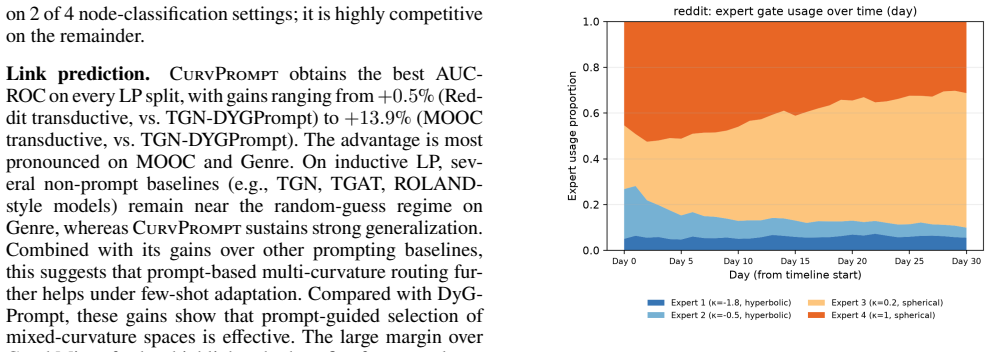
- [Expert Analysis and Hyperparameter Sensitivity, Figures 3 and 4(b)] Figure 3 shows that on Reddit the gate mass shifts from a high-curvature spherical expert toward a mild spherical expert while hyperbolic experts remain a minority, and Figure 4(b) reports that an all-spherical configuration achieves the best AUC on Reddit. This is in tension with the abstract's claim that the optimal representation geometry 'dynamically evolves' and with the caption's conclusion that diversity, rather than any single geometry, is the robust choice. The text acknowledges that the optimal expert is dataset-dependent, but the central 'necessity of geometry-adaptive prompting' claim needs to be qualified accordingly. Please provide geometry-attribution results on all four datasets, or explicitly restrict the necessity claim to datasets where mixed curvature is shown to beat every single-curvature configuration.
- [Experimental Setup, Baselines] The statement 'We report the best numbers from the original papers where available, or re-run them under our unified protocol' introduces a serious comparability risk for the headline comparisons. Several gains over the primary DyGPrompt baseline are small (e.g., Reddit LP-Trans 97.30 vs. 96.82; Wiki LP-Trans 95.70 vs. 94.33), and Table 1 reports standard deviations only for CurvPrompt, not for the baselines. If DyGPrompt's numbers were produced under a different downstream split, sample size, or hyperparameter selection, the reported gains may not be statistically reliable. Please rerun every baseline under the exact protocol used for CurvPrompt, report standard deviations for all methods, and state the number of seeds and task samples used for each baseline.
minor comments (6)
- [Eq. (3)] The notation E = {E_H1, E_H2, ..., E_Ei, ..., E_Si} is difficult to parse because the index i is used both for expert position and for geometry type; please use a single consistent indexing scheme, such as E_1, ..., E_M with an associated curvature value for each expert.
- [Figure 1 caption] The phrases 'back/inner' and 'front/outer' for the ridgeline plot are unclear; please add explicit day labels or a legend so the temporal direction of the curvature drift is immediately legible.
- [Table 3] The 'Single Curvature' row is under-specified: please state how the shared non-Euclidean curvature is chosen, whether it is learned or fixed, and what its initial value is, since the comparison depends on that choice.
- [Implementation Details] The text says expert curvatures are 'assigned diverse curvatures from positive, near-zero to negative' and are learnable during pre-training; please state the exact initial curvature values and whether they are constrained to remain in their sign regimes during optimization, since the routing analysis in Figure 3 depends on the curvature ranges.
- [Throughout] There are several small typos and inconsistent capitalizations, including 'TGN-DYGPrompt' versus 'TGN-DyGPrompt', and 'CurvPrompton' with a missing space; a careful copyedit would improve readability.
- [Introduction] The causal wording around 'geometry under-adaptation' is stronger than the direct evidence: Figure 1 shows correlational topology and curvature drift, but it does not by itself demonstrate that a fixed-geometry model fails because of the curvature mismatch. The empirical comparison provides indirect support, but the framing should acknowledge this distinction.
Circularity Check
No significant circularity: the reported gains are empirical outcomes against external baselines; the only self-citation is motivational and not load-bearing.
full rationale
CurvPrompt's central claim is that routing node-time instances to curvature-diverse Riemannian prompt experts improves few-shot dynamic graph prompting. This is supported by an empirical pipeline: pre-training with temporal link prediction (Eq. 11) plus auxiliary losses (Eqs. 12-15), then frozen-backbone prompt tuning with task losses (Eqs. 16-17), evaluated against external baselines in Table 1. No equation defines a predicted quantity in terms of a fitted constant of that same quantity; downstream LP/NC numbers are measured, not derived. The 'geometry under-adaptation' premise is motivated by the paper's own Figure 1 (curvature strata reorganize over time), so it does not reduce to a cited result. There is one self-citation (Wang et al. 2026, cited for curvature-stratified evaluation), but the central derivation and ablations do not depend on that citation being true; the method would stand or fall on Tables 1-3 regardless. The unablated soft-to-hard Top-K switch and the confound in the w/o Expert ablation are experimental-design concerns (correctness risk), not circularity, because the claimed gains could in principle fail and are not forced by construction.
Assumptions & free parameters
free parameters (4)
- Expert curvatures κ_ϵ =
learnable; final values not reported
- Loss weights λ1, λ2, λ3 =
λ1 ≈ 0.02, λ2 ∈ {0.01, 0.02, 0.05}, λ3 unspecified
- Neighborhood size set R =
{2, 5, 10}
- Expert count M and Top-K =
default configuration not clearly stated
assumptions (5)
- standard math The κ-stereographic model unifies spherical, Euclidean, and hyperbolic spaces with the given exponential/logarithmic maps.
- domain assumption The TGN memory and node features provide a sufficient state s_{t,v} for routing and expert updates.
- ad hoc to paper Edge Ollivier-Ricci curvature drift and clustering changes indicate the optimal representation geometry for downstream tasks.
- ad hoc to paper The router, topology encoder, and curvatures learned during pre-training transfer to downstream few-shot tasks without updating.
- domain assumption A small number of expert prompts and the node-time condition bias can steer the frozen backbone to downstream tasks.
Cite this review
Pith. "Pith review of Dynamic Graph Prompting via Topology-Routed Mixed-Curvature Experts." pith.science (2026). https://pith.science/paper/ZE7TNM77
@misc{pith2026260806031,
  author       = {Pith},
  title        = {Pith review of: Dynamic Graph Prompting via Topology-Routed Mixed-Curvature Experts},
  year         = {2026},
  howpublished = {\url{https://pith.science/paper/ZE7TNM77}},
  note         = {Machine review of arXiv:2608.06031}
}
read the original abstract
Dynamic graph prompting freezes a pre-trained temporal backbone and adapts it to label-scarce downstream tasks using lightweight prompts. However, existing methods operate within a single, fixed embedding space. In this work, we reveal that temporal shifts in local clustering and degree heterogeneity actively reorganize the edge curvature spectrum---indicating that the optimal representation geometry dynamically evolves with local topology over time. We formalize this unaddressed mismatch as geometry under-adaptation. To overcome this limitation, we propose CurvPrompt, a topology-routed geometry prompting framework for dynamic graphs. Instead of relying on a single space, CurvPrompt maintains a bank of curvature-diverse Riemannian experts, each paired with a learnable prompt. A topology-aware gate dynamically routes each node--time instance to a sparse subset of experts, constructing a personalized mixed-curvature representation. To ensure parameter efficiency and training stability under extreme label scarcity, CurvPrompt employs soft routing during pre-training to build a continuous topology--geometry mapping, and transitions to hard Top-K routing with uniform weights during downstream adaptation. Extensive experiments across four benchmark datasets show that CurvPrompt significantly advances few-shot link prediction while delivering strong, consistent performance on node classification tasks, validating the necessity of geometry-adaptive prompting.
Figures


Figures from the paper (2 more)


Reference graph
Works this paper leans on
-
[1]
Constant Curvature Graph Convolutional Networks
Bachmann,G.;Bécigneul,G.;andGanea,O.2020. Constant Curvature Graph Convolutional Networks. InICML, 486–
work page 2020
-
[8]
Predicting dynamic embedding trajectory in temporal interaction net- works. InSIGKDD, 1269–1278. Liu,Z.;Yu,X.;Fang,Y.;andZhang,X.2023. GraphPrompt: Unifyingpre-traininganddownstreamtasksforgraphneural networks. InWWW, 417–428. Nguyen,G.H.;Lee,J.B.;Rossi,R.A.;Ahmed,N.K.;Koh, E.; and Kim, S
work page 2023
-
[9]
Rossi, E.; Chamberlain, B.; Frasca, F.; Eynard, D.; Monti, F.; and Bronstein, M
Data- centric prompt tuning for dynamic graphs.arXiv preprint arXiv:2601.11954. Rossi, E.; Chamberlain, B.; Frasca, F.; Eynard, D.; Monti, F.; and Bronstein, M
-
[10]
Skarding, J.; Gabrys, B.; and Musial, K
Temporal graph networks for deep learning on dynamic graphs.arXiv preprint arXiv:2006.10637. Skarding, J.; Gabrys, B.; and Musial, K
arXiv 2006
-
[11]
DyRep: Learning representations over dynamic graphs. In ICLR. Wang, S.; Wang, X.; Wang, Q.; Wu, B.; Wang, B.; Huang, S.;Deng,B.;Liu,H.;Fang,R.;Xu,Z.;etal.2026. ThePost- GCN Decade Revisited: Curvature-Stratified Evaluation of Relational Learning.arXiv preprint arXiv:2606.06397. Wang,Y.;Chang,Y.-Y.;Liu,Y.;Leskovec,J.;andLi,P.2021. InductiveRepresentationLe...
work page Pith review arXiv 2026
-
[12]
GMoPE: A Prompt-Expert Mixture Framework for Graph Foundation Models.arXiv preprint arXiv:2511.03251. Wen, Z.; and Fang, Y
-
[14]
Yu, X.; Zhou, C.; Kuai, Z.; Zhang, X.; and Fang, Y
Text-Free Multi-domainGraphPre-training:TowardGraphFoundation Models.arXiv preprint arXiv:2405.13934. Yu, X.; Zhou, C.; Kuai, Z.; Zhang, X.; and Fang, Y. 2025d. GCoT:Chain-of-thoughtpromptlearningforgraphs. InPro- ceedings of the 31st ACM SIGKDD Conference on Knowl- edge Discovery and Data Mining V. 2, 3669–3679. Zhou, K.; Yang, J.; Loy, C. C.; and Liu, Z
-
[2019]
Hyper- bolic Graph Convolutional Neural Networks. InNeurIPS, 4869–4880. Chen,K.-J.;Zhang,J.;Jiang,L.;Wang,Y.;andDai,Y.2022. Pre-training on dynamic graph neural networks.Neurocom- puting, 500(C): 679–687. Chen, X.; Zhang, S.; Xiong, Y.; Wu, X.; Zhang, J.; Sun, X.; Zhang, Y.; Zhao, Y.; and Kang, Y
work page 2022
Show all 14 references
-
[2020]
In NeurIPS, 1877–1901
Language models are few-shot learners. In NeurIPS, 1877–1901. Cao, H.; Wang, Y.; Li, T.; Yao, X.; and Zhu, P
1901
-
[2022]
Fang,T.;Zhang,Y.;Yang,Y.;Wang,C.;andChen,L.2024
Do We Really Need Complicated Model Architectures For Temporal Networks? InICLR. Fang,T.;Zhang,Y.;Yang,Y.;Wang,C.;andChen,L.2024. Universal Prompt Tuning for Graph Neural Networks. In NeurIPS, 52464–52489. Gu,A.;Sala,F.;Gunel,B.;andRé,C.2019.LearningMixed- Curvature Representa...
2024
-
[2024]
Cong, W.; Zhang, S.; Kang, J.; Yuan, B.; Wu, H.; Zhou, X.; Tong, H.; and Mahdavi, M
Prompt Learning on Temporal Interaction Graphs.arXiv preprint arXiv:2402.06326. Cong, W.; Zhang, S.; Kang, J.; Yuan, B.; Wu, H.; Zhou, X.; Tong, H.; and Mahdavi, M
-
[2025]
InProceedings of the AAAI Conference on Artificial Intelligence, volume 39, 11754–11762
Graphmore: Mitigating topological heterogene- ity via mixture of riemannian experts. InProceedings of the AAAI Conference on Artificial Intelligence, volume 39, 11754–11762. Huang, S.; Poursafaei, F.; Danovitch, J.; Fey, M.; Hu, W.; Rossi,E.;Leskovec,J.;Bronstein,M.M.;Rabussea...
2023
-
[2026]
Chami, I.; Ying, Z.; Ré, C.; and Leskovec, J
Ge- ometric mixture-of-experts with curvature-guided adaptive routing for graph representation learning.arXiv preprint arXiv:2603.22317. Chami, I.; Ying, Z.; Ré, C.; and Leskovec, J
-
[6250]
Yu, X.; Liu, Z.; Fang, Y.; and Zhang, X. 2023c. HGPrompt: BridgingHomogeneousandHeterogeneousGraphsforFew- shot Prompt Learning. InAAAI, 16578–16586. Yu, X.; Liu, Z.; Zhang, X.; and Fang, Y. 2025b. Node-time conditional prompt learning in dynamic graphs. InInter- national Conf...
2025
Reviewed August 7, 2026 · model on record in the stance chip above.
Discussion (0). Sign in to comment.