REVIEW 4 major objections 4 minor 9 references
Balanced Routing for Symmetric Quantum Circuits
T0 review · 4 major / 4 minor · reviewed 2026-08-07 · deepseek-v4-flash
Pith's one-line read For cyclic circuits on heavy-hex, routing imbalance is an assignment choice wherever the patch shape allows a balanced assignment.
desk verdict Useful two-level picture of routing imbalance, with a genuinely new topological classification, but the 'proof' is pinned to one Qiskit version and no artifacts are shipped. read the letter →
The pith
A machine-rendered reading of the paper's core claim, the machinery that carries it, and where it could break.
The reading
What carries the argument
The load-bearing devices are the ring-distance profile and the duality lemma. The profile is the list of graph distances between consecutive logical roles on the physical patch, e.g. $(1,2,1,2)$ for a balanced four-part ring on a path; routing cost and its spread are read off this profile. The duality lemma equates measuring a rotated input on a fixed placement with measuring the unrotated input on a relabelled placement, turning symmetry-breaking into a property of the assignment. The exhaustive search enumerates every connected patch and every assignment up to rotation and reversal, using a graph-hash fingerprint only to count patch shapes, so each negative verdict is an impossibility proof. The closed-form balancing rule for the four-part ring assigns $\pi(0)=p_0$, $\pi(1)=p_1$, $\pi(2)=p_3$, $\pi(3)=p_2$ on a path and yields zero spread at the patch's cheapest depth.
What would settle it
Re-run the exhaustive assignment search with a different compiler's routing cost model over all 124 connected four-qubit patches: if any path-shaped patch shows a zero-spread assignment that costs more depth than its cheapest assignment, or any star-shaped patch admits a zero-spread assignment at any depth, the paper's central dichotomy is wrong. A live-device comparison with roughly uniform error rates would also settle it: the balanced assignment should reproduce the reported roughly 93 percent reduction in per-role spread; if it does not, the assignment-dependence claim fails.
Extended reading notes
Core claim
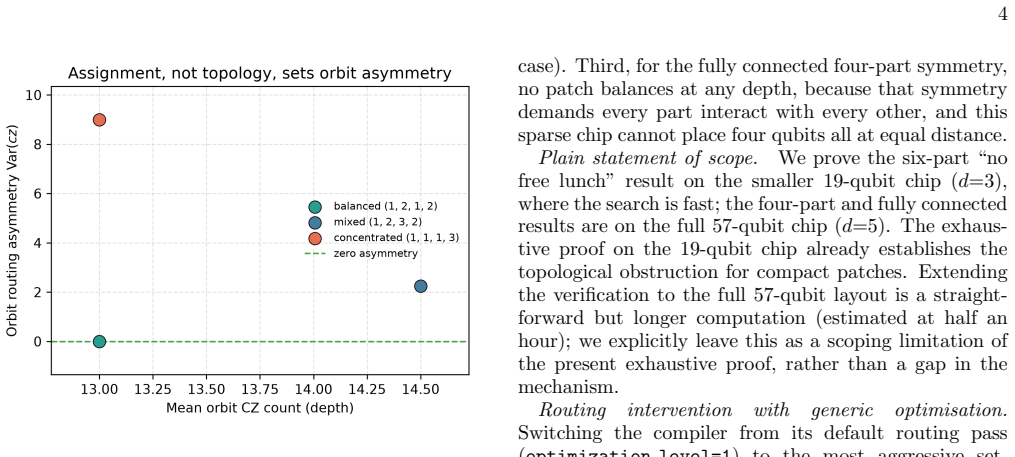
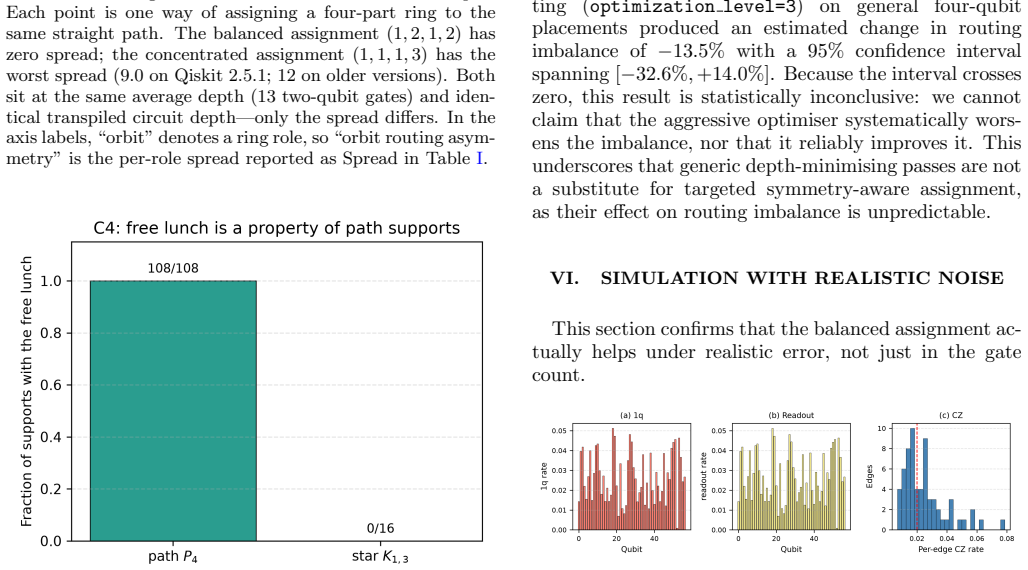
The central discovery is a two-level division of responsibility. For a cyclic symmetry, a ring of logical roles that should be interchangeable, the measured spread in per-role error is a statement about assignment: the paper's duality lemma shows that rotating the input is equivalent to relabelling which physical qubit plays which role, so the symmetry-breaking seen in experiments is literally the unevenness of routing across roles. The paper then proves, by exhaustive search over every connected patch of the 57-qubit heavy-hex lattice, that a patch's shape decides whether a balanced assignment exists and the assignment decides the actual imbalance when one exists. In concrete terms, on every path-shaped four-qubit patch the assignment that places the first two roles in order and swaps the last two yields ring-distance profile $(1,2,1,2)$, zero spread, and the patch's cheapest depth; star-shaped patches cannot host this profile; and fully connected four-part symmetry cannot be balanced on any compact patch at any depth because the sparse chip cannot place four qubits at equal distances.
Load-bearing premise
The load-bearing premise is that the routing cost model used by the compiler in the exhaustive search is the ground truth for what an assignment costs; a different compiler or routing algorithm that changed relative assignment costs could shift the free-lunch and no-free-lunch verdicts.
Editorial extensions
If this is right
- For any cyclic block on a patch that admits balance, a compiler can eliminate routing imbalance for free, so symmetry-aware assignment should be a first-class optimization target rather than an afterthought.
- Chip layouts can be compared by a new metric: how many balanced assignments the patch hosts; star-shaped four-qubit patches score zero for a four-part ring.
- Benchmarks of cyclic workloads should report the spread of per-role routing cost, because the average gate count is identical for the balanced and concentrated assignments and hides the breaking.
- On heavy-hex, a fully connected four-part symmetry cannot be balanced on any compact patch at any depth, so that symmetry class needs different hardware or a different circuit structure.
- A six-part ring can be balanced only by paying extra depth, and the paper leaves open the optimization of that depth-for-balance trade.
Reading between the lines
- If the patch-shape characterization carries over to other sparse topologies, such as square or triangular lattices, then balanced-assignment capacity becomes a design metric for chip geometry, not just for heavy-hex.
- Because the paper isolates the effect from error heterogeneity, one testable extension is to run the balanced-versus-concentrated comparison on chips with deliberately skewed error maps; the claim predicts the roughly 93 percent reduction persists as long as routing-cost spread is the dominant per-role difference.
- The six-part no-free-lunch result turns into an optimization problem a symmetry-aware compiler could solve: minimize additional depth subject to zero spread for a six-part ring, with the smaller-chip exhaustive search as a certified baseline.
- For multi-block circuits containing many cyclic blocks, assigning each ring independently could create cross-block depth tradeoffs, so a scheduler-level extension is needed.
Editorial analysis
A structured set of objections, weighed in public.
Referee Report
Summary. The paper studies how compiling cyclic-symmetric circuits onto heavy-hex hardware induces routing imbalance. It distinguishes two levels: whether a patch of qubits can host a balanced assignment (shape-dependent) and whether the actual assignment realizes it (compiler choice). The authors characterize four-qubit rings: on path-shaped patches the assignment (1,2,1,2) gives zero spread of per-role two-qubit gate counts at no extra depth, while star-shaped patches fail. For six-qubit rings, no compact patch gives a free balanced assignment; for fully connected four-part symmetry, balance is claimed to be impossible at any depth. Simulations with realistic noise claim a 92.7% reduction in raw symmetry-breaking and 87.0% in a decoherence-corrected metric relative to the worst-case concentrated assignment, with a 10.8% upper bound on the substrate-heterogeneity contribution. A closed-form balancing rule for the four-part ring is given. The paper explicitly scopes the six-part no-free-lunch result to a 19-qubit chip.
Significance. If the exhaustive verdicts are correct, the paper makes a useful conceptual point: routing imbalance for cyclic blocks is a compiler assignment choice whenever the patch geometry permits, and generic depth-minimizing passes do not reliably fix it. The exhaustive enumeration over all connected patches of the stated sizes is a strength, as is the explicit separation of 'exists at extra depth' versus 'free lunch' and the use of paired statistics with confidence intervals. The paper also honestly lists its limitations in the Discussion. However, the headline numbers are tied to a single compiler release, and the proof methodology for the 'at any depth' claims is not fully described, so the significance is conditional on those being clarified.
major comments (4)
- [Abstract and Section V] The abstract states that 'Through exhaustive search on a 57-qubit “heavy-hex” lattice, we prove these topological constraints exactly. For a six-part ring, cost-free balance is impossible on compact patches.' However, Section V, under 'Plain statement of scope,' says the six-part no-free-lunch result is proved on the smaller 19-qubit chip (d=3), with extension to the 57-qubit layout explicitly left as a scoping limitation. As written, the abstract overstates the support for the six-part claim. Please either prove the six-part result on the full 57-qubit lattice (the paper estimates this as a half-hour computation) or qualify the abstract to match the stated scope.
- [Section V, Table II] The 'Exists at any depth' verdicts are not backed by a described search over depth. The text explains that for each patch 'we generate every assignment up to the ring’s own rotations and reversals' and transpiles them; it does not describe how arbitrary extra SWAP insertions (that is, larger depths) are searched or bounded. The S4 conclusion that no patch balances at any depth is therefore stronger than the presented finite enumeration supports. The intuitive argument about four qubits not being at equal distance addresses direct interaction distances, not SWAP-sequence costs, which can in principle be modified by adding gates. Please specify the exact search space for the 'at any depth' verdicts, or provide a proof that suffices.
- [Section V, Tables I and II] The free-lunch classifications are defined by two-qubit-gate counts from a single, unspecified invocation of Qiskit 2.5.1's routing pass. Table I itself reports that an older compiler version changed the worst-case spread from 12.0 to 9.0, showing that the cost model is version-dependent. No code, seeds, or independent routing-cost model are provided. Since the central exhaustive counts (108/124, 0/62, and the 27 vs 13 gate estimates) are statements about these counts, their robustness is not established. The sentence 'the exact number depends on the routing algorithm, but the effect does not' is an assertion; please either ship the search code with fixed seeds, test with an independent cost model, or explicitly delimit all headline claims as 'with respect to Qiskit 2.5.1.'
- [Section VI] The claim that substrate error heterogeneity 'accounts for at most 10.8% of the matched-mean baseline effect' is not assessable because the channel-resolved ablation is not described: there is no specification of how error rates were varied, how the matched-mean baseline is defined, or how the 95% confidence bound was computed. This number is used to attribute the simulated effect to routing imbalance rather than qubit-quality variation, so the method needs to be reported in detail.
minor comments (4)
- [Section IV, Eq. (5)] The expectation operator E_x and the variable x are not defined; clarify that the expectation is over measurement shots.
- [Section IV] The resolution guard |\bar\mu| > 3\sigma_{\bar\mu} is never defined; provide the formula for \sigma_{\bar\mu}.
- [Table II] The C6 row entry 'yes (d=5) no' is ambiguous; the column structure should make clear what the parenthetical refers to (chip size versus depth).
- [Figure 1] The axis label 'orbit routing asymmetry' is unexplained; please define 'orbit' in the caption.
Circularity Check
No significant circularity: the central claims are established by exhaustive enumeration and a controlled noise simulation, not by definition or self-citation.
full rationale
The derivation chain is self-contained. Equation (2) is an exact duality identity showing that rotating the input equals relabelling roles on the chip; equation (3) then defines per-role error as a sum over compiled gate instances. The topological verdicts in Section V are produced by exhaustive enumeration of all connected patches and all assignments, with Qiskit 2.5.1 used to obtain two-qubit-gate counts; the balanced profile (1,2,1,2) is not defined as 'zero spread' but is found to have zero spread in the transpiled counts, while the concentrated profile (1,1,1,3) has spread 9.0. Section VI compares these two assignments on the same physical qubits with the same average gate count and error exposure, and the noise-inclusive spread is a separate measured quantity that could in principle have contradicted the gate-count spread; the reported 92.7% reduction, confidence intervals, Wilcoxon p-value, and 10.8% heterogeneity ablation make the comparison empirical rather than tautological. No parameter is fitted to the target result, and no load-bearing self-citation or imported uniqueness theorem is used. The disclosed limitations—dependence on Qiskit 2.5.1's routing cost model for the exact counts, and the six-part free-lunch verdict being proved only on the 19-qubit chip—are external-validity and scoping concerns, not circularity.
Assumptions & free parameters
free parameters (1)
- Resolution guard threshold |\bar mu| > 3 sigma_{\bar mu} =
3 sigma
assumptions (4)
- standard math For the studied symmetries, the symmetry operation is a permutation of qubits, making Eq. (2) an exact identity.
- domain assumption The compiler's routing cost for a given assignment is a deterministic function of the hardware graph and the compiler version.
- ad hoc to paper The exhaustive search enumerates every connected patch of the stated size exactly once.
- domain assumption Simulated error rates drawn to match IBM Heron and Eagle devices are representative for the comparison.
Cite this review
Pith. "Pith review of Balanced Routing for Symmetric Quantum Circuits." pith.science (2026). https://pith.science/paper/NPKC7IYC
@misc{pith2026260806072,
  author       = {Pith},
  title        = {Pith review of: Balanced Routing for Symmetric Quantum Circuits},
  year         = {2026},
  howpublished = {\url{https://pith.science/paper/NPKC7IYC}},
  note         = {Machine review of arXiv:2608.06072}
}
read the original abstract
Mapping quantum programs to restricted physical chips requires SWAP operations, incurring depth and error penalties. In symmetric programs, this routing overhead breaks theoretical symmetry because identical logical roles experience unequal shuffling. While often attributed to hardware topology alone, we show this is a two-level phenomenon. A qubit patch's shape dictates if it can host a balanced assignment. When balance is possible, the actual imbalance is set by the logical-to-physical assignment, meaning a balanced assignment can distribute routing costs perfectly evenly at no extra depth. Through exhaustive search on a 57-qubit "heavy-hex" lattice, we prove these topological constraints. For a four-part ring, 108 of 124 connected patches admit a cost-free balanced assignment, with the 16 exceptions being star-shaped. For a six-part ring, cost-free balance is impossible on compact patches. For a fully connected four-part symmetry, balance is structurally impossible at any depth. Simulations using realistic error rates show that, relative to the worst-case concentrated assignment, balanced assignments reduce symmetry-breaking by 92.7% (95% CI [+89.8%, +95.3%]) for the raw metric and 87.0% (95% CI [+79.6%, +94.1%]) for the decoherence-corrected measure (p = 2.45 x 10^-32). Substrate error heterogeneity accounts for at most 10.8% of this effect. Notably, switching to the compiler's highest generic optimization level did not yield a statistically significant change in routing imbalance, highlighting the need for targeted symmetry-aware passes. When patch geometry permits, routing imbalance is a compiler choice rather than a hardware limitation. Thus, symmetry-aware assignment should be a primary objective for compiler optimization and chip design.
Figures

Reference graph
Works this paper leans on
-
[1]
Theory for equivariant quantum neural networks,
Q. T. Nguyen, L. Schatzki, P. Braccia, M. Ragone, P. J. Coles, F. Sauvage, M. Larocca, and M. Cerezo, “Theory for equivariant quantum neural networks,” PRX Quantum5, 020328 (2024)
work page 2024
-
[2]
Theoretical guarantees for permutation- equivariant quantum neural networks,
L. Schatzki, M. Larocca, Q. T. Nguyen, F. Sauvage, and M. Cerezo, “Theoretical guarantees for permutation- equivariant quantum neural networks,” npj Quantum In- formation10, 12 (2024)
work page 2024
-
[3]
Prov- ably Trainable Rotationally Equivariant Quantum Ma- chine Learning,
M. T. West, J. Heredge, M. Sevior, and M. Usman, “Prov- ably Trainable Rotationally Equivariant Quantum Ma- chine Learning,” PRX Quantum5, 030320 (2024)
work page 2024
-
[4]
Symmetry Breaking in Geomet- ric Quantum Machine Learning in the Presence of Noise,
C. T¨ uys¨ uz, S. Y. Chang, M. Demidik, K. Jansen, S. Val- lecorsa, and M. Grossi, “Symmetry Breaking in Geomet- ric Quantum Machine Learning in the Presence of Noise,” PRX Quantum5, 030314 (2024)
work page 2024
-
[5]
TopGen: Topology-Aware Bottom-Up Generator for Variational Quantum Circuits
J. Cheng, H. Wang, Z. Liang, Y. Shi, S. Han, and X. Qian, “TopGen: Topology-Aware Bottom-Up Gener- ator for Variational Quantum Circuits,” arXiv:2210.08190 (2022)
work page Pith review arXiv 2022
-
[6]
Wide Quantum Circuit Optimization with Topology Aware Synthesis,
M. Weiden, J. Kalloor, J. Kubiatowicz, E. Younis, and C. Iancu, “Wide Quantum Circuit Optimization with Topology Aware Synthesis,” inProc. IEEE/ACM Third Intl. Workshop on Quantum Computing Software (QCS) (2022)
work page 2022
-
[7]
Suppressing quantum cir- cuit errors due to system variability,
P. D. Nation and M. Treinish, “Suppressing quantum cir- cuit errors due to system variability,” PRX Quantum4, 010327 (2023)
work page 2023
-
[8]
Noise-Adaptive Compiler Mappings for Noisy Intermediate-Scale Quantum Computers,
P. Murali, J. M. Baker, A. Javadi-Abhari, F. T. Chong, and M. Martonosi, “Noise-Adaptive Compiler Mappings for Noisy Intermediate-Scale Quantum Computers,” in Proc. ASPLOS(2019)
work page 2019
Show all 9 references
-
[9]
Not All Qubits Are Created Equal: A Case for Variability-Aware Policies for NISQ-Era Quantum Computers,
S. S. Tannu and M. K. Qureshi, “Not All Qubits Are Created Equal: A Case for Variability-Aware Policies for NISQ-Era Quantum Computers,” inProc. ASPLOS (2019)
2019
Reviewed August 7, 2026 · model on record in the stance chip above.
Discussion (0). Continue with ORCID to comment.