REVIEW 2 major objections 5 minor 17 references
Collective search-and-capture under competing assignment policies
T0 review · 2 major / 5 minor · reviewed 2026-08-07 · deepseek-v4-flash
Pith's one-line read Assignment policy, not walker persistence, is the main lever on collective capture time
desk verdict A credible, policy-speedup simulation result with a mechanism interpretation that is partly definitional; worth a serious referee. read the letter →
The pith
A machine-rendered reading of the paper's core claim, the machinery that carries it, and where it could break.
The reading
What carries the argument
The machinery is a discrete-time persistent random walk on a periodic square lattice with reorientation probability $\alpha$, combined with a three-way competition over assignments. The identity that carries the argument is the decomposition $T_c=\max_i T_i$ with $T_i=t_i^{\mathrm{start}}+\tau_i^{\mathrm{steer}}$, where $t_i^{\mathrm{start}}$ is the step at which the capturing walker begins its final uninterrupted run and $\tau_i^{\mathrm{steer}}$ is the length of that directed approach. The alternative assignment policies are single-round greedy selection (each target claims its nearest walker once per step), cascading reassignment (greedy acceptance of distance-sorted pairs), and maximum-cardinality matching computed by augmenting paths on the candidate graph. This decomposition lets the paper attribute changes in $T_c$ to the free-exploration tail rather than to steering, and the policy comparison isolates how matching quality affects that tail.
What would settle it
Re-run the same model with multi-step waypoint pursuit replacing the one-step greedy steering rule and check whether the latest assignment-start time still tracks $T_c$; if $T_c$ then ceases to be dominated by the free-exploration tail, or if the assignment-policy speedups shrink, the paper's central mechanism is refuted.
Extended reading notes
Core claim
On the paper's own terms, the discovery is that an assignment policy can control the collective completion time more strongly than the walkers' reorientation rate. Decomposing each capture time as $T_i = t_i^{\mathrm{start}} + \tau_i^{\mathrm{steer}}$, the measured steering duration stays below about one lattice step, while the population's latest assignment-start time tracks $T_c$ (ratio 1.00 at $R=1$, falling to 0.81 at $R=30$). Policies therefore do not primarily accelerate an already-directed final approach; they suppress the long intervals during which the last few unmatched walkers and targets fail to form a productive assignment. The numerical comparison is direct: cascading reassignment reduces $T_c$ by factors of several at large $R$, and maximum-cardinality matching on the candidate graph reduces it by more than an order of magnitude at moderate $R$ (at $R=5$, from about 467 steps to about 33 steps), with the speedup unchanged under tie-breaking in the matching algorithm.
Load-bearing premise
The load-bearing kinematic premise is that an assigned walker is steered only one greedy cardinal step before the assignment is recomputed, so the final directed run almost always begins when the walker is already adjacent to its target; if pursuit lasted many steps or failed assignments counted as directed time, the conclusion that policies act on free exploration would need revision.
Editorial extensions
If this is right
- Wherever a completion or cover time is set by the last target, improved global matching can yield order-of-ten speedups, a far larger lever than tuning individual search behaviour.
- At small search radius $R\le 5$, single-round and cascading greedy policies agree within uncertainty, while maximum-cardinality matching separates from both already at moderate $R$.
- The persistence optimum becomes shallow at large $R$, so reorientation tuning is a weak control once assignments can reach far across the lattice.
- Maximum-cardinality matching sustains far more dynamic reassignment throughout the run, not merely a larger initial assignment fraction; the instrumented campaign reports about 30 times more reassignment events per step than either greedy heuristic.
Reading between the lines
- Editorial extension: if the free-exploration tail is the bottleneck, a local anti-churn heuristic that prevents a walker from being assigned back to a target it just failed near might capture much of the matching speedup at far lower communication cost; the paper does not test this.
- Editorial extension: the decomposition applies to biological or robotic clearing tasks where the measurable quantity is the time until the last target is serviced; a quantitative prediction is that such systems will be optimized more for coordination than for persistence.
- Editorial extension: a continuous-time or off-lattice version with multi-step waypoint steering would test whether the tail attribution is an artifact of the one-step greedy kinematic rule.
Editorial analysis
A structured set of objections, weighed in public.
Referee Report
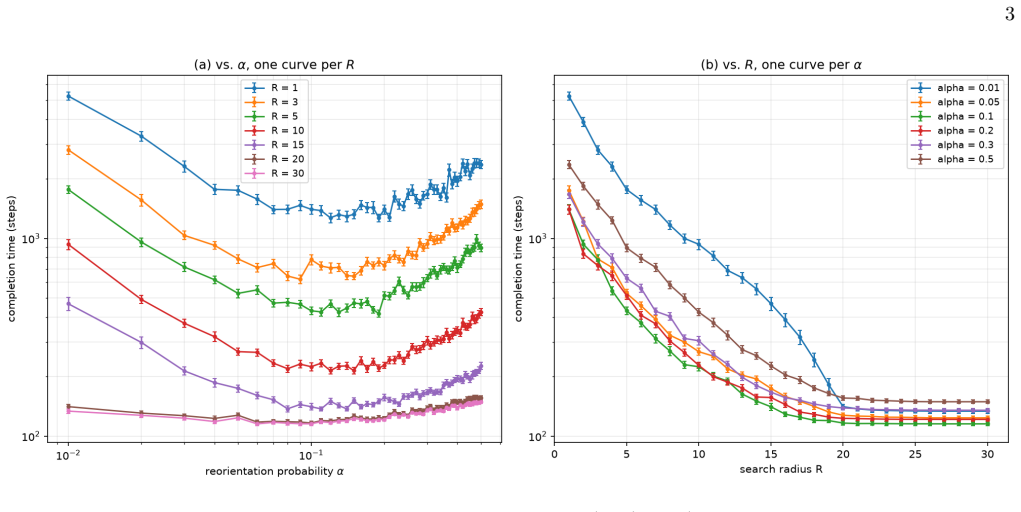
Summary. The paper studies a minimal lattice model of collective search-and-capture in which persistent random walkers capture immobile targets under a finite-range, mutually exclusive assignment rule. It reports that the collective completion time T_c depends non-monotonically on the walker reorientation probability alpha, with a minimum at intermediate persistence that flattens as the search radius R grows. It further argues that T_c is governed by an extreme late-time tail, not by typical capture events, and that this tail is controlled mainly by the free-exploration phase rather than by the final directed approach. Comparing single-round, cascading, and maximum-cardinality matching policies, the paper finds that maximum-cardinality matching strongly reduces T_c, by more than an order of magnitude at moderate R, and concludes that the assignment policy can control collective capture time more strongly than walker persistence.
Significance. If the empirical results hold, the paper identifies a new and practically relevant control parameter for collective search-and-capture problems: the quality of the matching policy rather than single-walker persistence. The reported speedups are large and supported by several good practices: 100 replicas per parameter set, reported standard deviations, bootstrap-based caveats for the flat parts of the alpha scan, and explicit controls for candidate-graph truncation and degeneracy of the maximum matching. The paper also makes a clean conceptual distinction between the typical capture time and the extreme completion time. The main weakness is that the mechanistic interpretation attached to the speedup—that policies act mainly by suppressing free exploration rather than by increasing directed motion—is not actually established by the reported decomposition, because the definition of t_start classifies all churned, non-final assigned motion as free exploration. The quantitative T_c values are credible, but the headline mechanism needs either revision or additional analysis.
major comments (2)
- [III.2, Eq. (3)] The decomposition T_i = t_start_i + tau_steer_i is defined so that t_start resets whenever the walker is unassigned for a step or is assigned to a different target; consequently all steps spent under a non-final assignment are counted as part of the free-exploration phase. The observations that the mean tau_steer is below 1.1 steps and that max(t_start)/T_c is close to 1 are therefore to a large extent guaranteed by this definition rather than being empirical discoveries about the dynamics. In particular, a walker that is assigned to target A for several steps, then to B, and only finally captures C contributes all of its A/B directed motion to the 'free exploration' part of the decomposition. The claim that policies 'do not primarily accelerate the already-directed final approach; instead, they suppress the long intervals...' is not supported unless one measures separately the total time spent assigned to any target, or implements a committed multi-step pursuit rule in which an assignment persists until capture. Please add such an analysis, or revise the mechanistic interpretation accordingly.
- [III.3 and Discussion] The causal statement that maximum-cardinality matching works by suppressing the long free-exploration tail rests on the same Eq. (3) classification. The paper reports an instrumented campaign showing that maximum-cardinality matching reassigns walkers much more often per step, and notes that this is 'associated with (though not, by this correlation alone, proven to cause) the suppression of the late free-exploration tail.' Given the definitional issue in Eq. (3), the association is even weaker than stated: the suppressed quantity labeled 'free exploration' includes a substantial amount of churned directed motion. To make the mechanism claim load-bearing, the paper should quantify the total assigned time per walker (regardless of whether the assignment ultimately leads to capture) under the three policies, or otherwise separate churned directed motion from true unassigned exploration.
minor comments (5)
- [Header and abstract] The author name appears with LaTeX accent artifacts ('N´ estor') and the arXiv date line is embedded in the main text; these should be cleaned up in the final version.
- [Figure 1 caption and Section III.1] The figure caption reports mean±SEM over 100 replicas, while the text in Section III.1 reports s.d. for specific values; please make the error-bar convention consistent and clearly state which quantity is plotted.
- [Table I] The fractional value T_50% = 0.4 is explained in the text, but the explanation should appear at the first mention of T_50% in the results section, not only after the table, to avoid confusion.
- [Section V, Conclusion] The statement that single-round assignment requires 'no communication beyond a target's immediate neighborhood' is imprecise for R>1, since each target must know the positions of all walkers within distance R; please rephrase to 'within its search radius R' or similar.
- [Introduction and Conclusion] The sentence 'policies do not primarily accelerate the already-directed final approach...' appears in both the Introduction and the Conclusion; if the mechanistic claim is revised in response to the major comments, both passages must be updated consistently.
Circularity Check
No significant circularity: the central results are direct simulation measurements with explicit controls, and the capture-time decomposition is descriptive with tau_steer measured rather than assumed.
full rationale
The paper contains no derivation that reduces to its own inputs. Tc, T_c(alpha), and T_c(R) are direct simulation outputs over scanned parameters alpha and R with 100 replicas, bootstrap caveats, and checks against truncation and tie-breaking degeneracy; no parameter is fitted to a subset of data and then used to predict the same or closely related quantity. The decomposition Ti = t_start_i + tau_steer_i (Eq. 3) is descriptive: tau_steer_i is the measured duration of the final uninterrupted assignment run, and the finding that tau_steer remains below 1.1 steps is an empirical property of the model's one-step greedy steering rule, not an assumption. Although the label 'free-exploration phase' absorbs time spent in non-final assigned motion, the paper explicitly states that any earlier assignment to a different target resets t_start_i, so the classification is transparent and not a hidden definitional transfer. The cited prior work by the same author (Refs. [6-8]) is used only as general context for lattice models and is not load-bearing for the capture-time claims. No uniqueness theorem, ansatz-by-citation, or renaming of a known result is used; the paper explicitly disclaims novelty for the non-monotonic persistence optimum and even flags the matching-reorganization correlation as not proven causal. Thus no circular step meets the evidence threshold.
Assumptions & free parameters
free parameters (3)
- reorientation probability alpha (control parameter)
- search radius R (control parameter)
- per-policy near-optimal alpha =
0.15 (R=1), 0.12 (R=5), 0.12 (R=10), 0.08 (R=20), 0.08 (R=30)
assumptions (5)
- domain assumption Periodic square lattice, rejection-sampled initial positions, independent orientation redraws with probability alpha after each step
- domain assumption N_w = N_t = 480 and each walker captures at most one target, making complete capture possible
- domain assumption Assignment is recomputed from scratch each step under a minimum-image Euclidean distance rule, with greedy cardinal steering
- ad hoc to paper The decomposition T_i = t_start_i + tau_steer_i, with t_start reset by any unassigned step or assignment to another target, cleanly separates free exploration from directed approach
- domain assumption Maximum-cardinality matching via augmenting paths on the candidate graph is exact for the untruncated candidate lists used at R=5
Cite this review
Pith. "Pith review of Collective search-and-capture under competing assignment policies." pith.science (2026). https://pith.science/paper/VLME5L42
@misc{pith2026260806084,
  author       = {Pith},
  title        = {Pith review of: Collective search-and-capture under competing assignment policies},
  year         = {2026},
  howpublished = {\url{https://pith.science/paper/VLME5L42}},
  note         = {Machine review of arXiv:2608.06084}
}
abstract
We study a minimal lattice model of active search-and-capture in which persistent random walkers locate and irreversibly capture immobile targets through a finite-range, mutually exclusive assignment rule. We measure the collective completion time $T_c$ as a function of the walkers' reorientation rate $\alpha$ and the search radius $R$. The dependence $T_c(\alpha)$ is non-monotonic, with a minimum at intermediate persistence whose depth decreases as $R$ grows. Capture kinetics show that $T_c$ is not a typical capture time but is governed by the extreme, late-time tail of the capture process, while the bulk of targets are captured much earlier; this tail is controlled mainly by the free-exploration phase rather than by the final directed approach. We then compare the baseline single-round assignment rule with cascading reassignment and with maximum-cardinality matching on a candidate graph. The two greedy policies (single-round and cascading) agree at very small $R$, whereas maximum-cardinality matching already produces a strong speedup at moderate $R$: improved matching reduces $T_c$ by factors of several at large $R$, and by more than an order of magnitude at moderate $R$. Thus, in this collective, depletion-coupled search problem, the assignment policy can control the capture time more strongly than the walkers' persistence.
Figures


Reference graph
Works this paper leans on
-
[1]
M. C. Marchetti, J. F. Joanny, S. Ramaswamy, T. B. Liverpool, J. Prost, M. Rao, and R. A. Simha, Reviews of Modern Physics85, 1143 (2013)
2013
-
[2]
Bechinger, R
C. Bechinger, R. Di Leonardo, H. L¨ owen, C. Reichhardt, G. Volpe, and G. Volpe, Reviews of Modern Physics88, 045006 (2016)
2016
-
[3]
M. E. Cates and J. Tailleur, Annual Review of Condensed Matter Physics6, 219 (2015)
2015
-
[4]
H. C. Berg and D. A. Brown, Nature239, 500 (1972)
work page 1972
-
[5]
Tailleur and M
J. Tailleur and M. E. Cates, Physical Review Letters100, 218103 (2008)
2008
- [6]
- [7]
-
[8]
B. P´ erez-Estay, M. L. Cordero, N. Sep´ ulveda, and R. Soto, Phys. Rev. E109, 054601 (2024)
work page 2024
Show all 17 references
-
[9]
Redner,A Guide to First-Passage Processes(Cam- bridge University Press, Cambridge, UK, 2001)
S. Redner,A Guide to First-Passage Processes(Cam- bridge University Press, Cambridge, UK, 2001)
2001
-
[10]
B´ enichou, C
O. B´ enichou, C. Loverdo, M. Moreau, and R. Voituriez, Reviews of Modern Physics83, 81 (2011)
2011
-
[11]
G. M. Viswanathan, S. V. Buldyrev, S. Havlin, M. G. E. da Luz, E. P. Raposo, and H. E. Stanley, Nature401, 911 (1999)
1999
-
[12]
Tejedor, R
V. Tejedor, R. Voituriez, and O. B´ enichou, Physical Re- view Letters108, 088103 (2012)
2012
-
[13]
Volpe and G
G. Volpe and G. Volpe, Proceedings of the National Academy of Sciences USA114, 11350 (2017)
2017
-
[14]
Kim and S
H. Kim and S. D. Lawley, Physical Review E109, 014121 (2024)
2024
-
[15]
Chupeau, O
M. Chupeau, O. B´ enichou, and R. Voituriez, Nature Physics11, 844 (2015)
2015
-
[16]
S. D. Lawley, Physical Review E102, 062118 (2020)
2020
-
[17]
H. W. Kuhn, Naval Research Logistics Quarterly2, 83 (1955)
1955
Reviewed August 7, 2026 · model on record in the stance chip above.
Discussion (0). Continue with ORCID to comment.