REVIEW 4 major objections 5 minor 42 references
The Structure of Spreading on Temporal Networks
T0 review · 4 major / 5 minor · reviewed 2026-08-07 · deepseek-v4-flash
Pith's one-line read For a class of SIS processes, temporal spreading is exactly reachability in one event graph.
desk verdict A useful mapping of temporal SIS variants to event-graph reachability, with a clean R0 for directed random networks, but the abstract overclaims generality that Appendix C itself undermines. read the letter →
The pith
A machine-rendered reading of the paper's core claim, the machinery that carries it, and where it could break.
The reading
What carries the argument
The load-bearing object is the temporal event graph (EG): a static directed acyclic graph whose nodes are the events of the temporal network and whose directed edges connect temporally adjacent events, weighted by waiting time. The recovery time $δt$ thresholds these edges (bond percolation) and the infection probability $β$ removes events (site percolation), so a spreading process with waiting-time limit $δt$ traverses exactly the paths kept in the pruned EG. For random temporal networks the argument runs through the excess out-degree generating function $G_1(y)$, whose derivative at 1 gives $R_0 = F_R(δt) \langle k_{in} k_{out}\rangle / \langle k_{in}\rangle$, separating temporal statistics (the residual CDF $F_R$) from static structure. The global consistency condition specifies which processes can be coded by a single EG; lrSIS and frSIS satisfy it, standard fixed-recovery SIS does not, and lrSIS nevertheless upper-bounds standard SIS.
What would settle it
Run the lrSIS process on a directed configuration-model temporal network with a specified joint in/out degree distribution and a known inter-event time distribution, and compare the measured onset to $δt_c$ satisfying $F_R(δt_c) = 1/R_{stat}^0$; a significant mismatch would falsify the branching-process derivation. Conversely, on an undirected $k$-regular network with Lomax inter-event times, the measured onset should sit above the analytical $R_0 = 1$ line because ABAB motifs make branches converge, as seen in the paper's Fig. 5.
Extended reading notes
Core claim
The paper's discovery is that spreading on temporal networks is isomorphic to reachability in a temporal event graph whenever the process is globally consistent: all possible realisations from any initial condition live in a single static directed acyclic graph. The lrSIS process, in which an infected node's fixed recovery clock resets after every incoming infectious event, satisfies this condition, and a proof in Appendix A shows that the infected events in lrSIS are exactly the nodes in the event-graph out-component of the seed. As a direct corollary, the basic reproduction number for random temporal networks is $R_0 = F_R(δt) R_{stat}^0$, so the epidemic threshold is determined by the residual waiting-time distribution and the static degree structure alone; for Poisson link activation this reproduces the known fixed-recovery-time SIS threshold. Because event-graph out-components are ordered in time, they carry infection times and transmission routes, not only final outbreak size, making the correspondence stronger than the static percolation mapping. On empirical Twitter, flight, and public-transport networks, the numerical $R_0 = 1$ condition from the event graph predicts the observed epidemic onset well, with a noted overestimate on the public transport data.
Load-bearing premise
The analytical $R_0$ and threshold equations assume that the event graph is locally tree-like so that spreading branches from an event are independent; the paper's own Appendix C shows that in undirected networks alternating paths between two links make branches converge, shifting the measured onset away from the predicted threshold.
Editorial extensions
If this is right
- On random temporal networks, the epidemic threshold can be calculated in closed form from the inter-event time distribution and static degree distribution, with no epidemic simulation.
- For Poisson link activation the threshold reduces to $δt_c = -(1/λ)\log(1 - 1/R_{stat}^0)$, the same condition as fixed-recovery-time SIS on a static network, so temporal and static analyses coincide in this limit.
- Because the event graph encodes the whole time-respecting path structure, its out-components give not only final outbreak size but also infection times and transmission routes for any seed.
- The lrSIS process is an upper bound for standard fixed-recovery SIS and shows the same epidemic onset, so event-graph analysis locates conventional SIS thresholds even where the processes are not exactly isomorphic.
- Each globally consistent process can be computed for all initial conditions from one event-graph component sweep, giving a large computational saving as the number of realisations grows.
Reading between the lines
- The global-consistency criterion is likely the right organising principle for a general theory: any dynamics (random walks, complex contagions, opinion or behaviour spread) that admits a globally consistent variant automatically becomes a structural reachability problem on the same kind of event graph.
- The ABAB-motif failure suggests a testable correction for undirected networks: if one prunes alternating two-link returns in the event graph, the analytical threshold may be recovered, but the graph would then depend on process history, so the exactness is lost; an effective branching-factor correction might retain simplicity.
- The factorisation $R_0 = F_R(δt) R_{stat}^0$ implies a design principle: temporal heterogeneity and static topology act multiplicatively, so a network designer could compensate for burstiness (small $α$) by increasing static connectivity, and the threshold line from the paper's Eq. (5) gives the trade-off.
- In empirical networks with locally dense regions, a globally subcritical network can still have supercritical subpopulations, so onset may occur before $R_0 = 1$; a local out-component spectrum of the event graph could quantify this.
Editorial analysis
A structured set of objections, weighed in public.
Referee Report
Summary. The paper proposes a structural framework for spreading on temporal networks: it maps a class of SIS-type processes to reachability in temporal event graphs (EGs). Two 'globally consistent' processes are introduced, lrSIS and frSIS, whose recovery clocks reset upon infection, and Appendix A proves exact isomorphisms between these processes and EG reachability together with an upper bound relating lrSIS to standard fixed-recovery-time SIS. Using branching-process generating functions under a locally tree-like EG assumption, the paper derives the basic reproduction number R0 = F_R(dt) R_stat^0 (Eq. 2) and threshold conditions (Eqs. 3-5) for directed configuration-model temporal networks with independent renewal link dynamics, and validates them on Poisson and Lomax inter-event-time models and on three empirical temporal networks, claiming significant computational advantages from single-sweep EG component analysis. Appendix C reports that the undirected generalization fails: ABAB motifs make EG branches converge, so the analytical threshold underestimates the observed onset.
Significance. The framework is a genuine contribution if the directed-network results are confirmed. The equivalence and upper-bound proofs in Appendix A are clean and correct, and the upper-bound theorem gives the constructed lrSIS/frSIS processes a substantive connection to the standard SIS model rather than leaving them as purely definitional objects. The R0 factorization is elegant and falsifiable: it reduces to the known static threshold as dt grows, and Eqs. (4)-(5) give explicit, testable predictions for Poisson and bursty dynamics that the simulations in Fig. 3 reportedly match. The computational reduction, building the EG once and obtaining outcomes for all initial conditions from a single component sweep, is real and is benchmarked on empirical data. The paper is also honest: it reports the Helsinki overestimate and, in Appendix C, its own failure case. The principal limitations are the scope of the analytical claim (directed networks only; the abstract overstates this), the unverified tree-likeness assumption, and the definitional nature of lrSIS/frSIS as processes constructed for EG compatibility; these are fixable with qualification and additional verification.
major comments (4)
- [Abstract; Appendix C] The abstract states that epidemic thresholds are derived 'for temporal networks with arbitrary degree and inter-event time distributions' without any directedness caveat. The actual derivation (Eqs. (1)-(5) and Appendix B) is restricted to directed configuration-model static networks with independent link event processes, and Appendix C shows that the natural undirected analogue, Eq. (C3), 'significantly underestimates the onset of the frSIS process' on k-regular undirected networks because ABAB motifs make branches converge (Fig. 5). Undirected contact networks are a standard case, so the headline claim in the abstract, the introduction, and the discussion is not established; the threshold result should be stated as valid for directed temporal networks, with the undirected breakdown reported in the main text.
- [Section 'If the EG is locally tree-like...'; Appendix B] The branching-process derivation of Eq. (2) assumes the EG is locally tree-like and branches are independent, but the paper provides no argument that this holds for the directed configuration model, and Appendix C identifies a concrete violation mechanism: a static node with multiple in-events and a shared out-event creates convergent EG branches, a local configuration not suppressed by network sparsity. The close agreement claimed in Fig. 3 is numerical evidence for particular parameter settings, not verification of an asymptotic limit. The authors should add a convergence argument or an explicit structural check (e.g., merge statistics or a comparison of Eq. (2) against a non-tree computation) for the directed case, and phrase the 'striking' agreement (Fig. 3 caption) as a validated approximation with stated scope.
- [Section 'A temporal event graph...'] The main text invites the reader to 'see Appendix C' for generalization to undirected events, but Appendix C shows that only the process definition and the local branching factor generalize: the analytical threshold 'significantly underestimates the onset' (Fig. 5b). This internal mismatch between the main-text claim and the appendix result should be resolved by rewording the main text to state that the process mapping and numerical component analysis generalize, while the closed-form threshold does not.
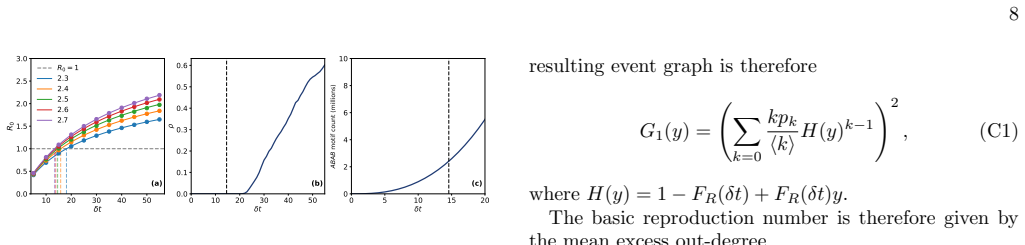
- [Eq. (1); Appendix B; Fig. 2] The generating function H(y) = 1 - F_R(dt) + F_R(dt)y in Eq. (1)/(B1) models each static link as contributing at most one EG branch. This corresponds to the frSIS constrained event graph D_C (at most one admissible event per link), not to the unconstrained EG to which lrSIS maps exactly, where multiple dt-adjacent events on one static link create multiple EG edges; at the parameters of Fig. 2 the expected count lambda*dt reaches order 1. Since the same dashed line from Eq. (4) is overlaid on both the lrSIS and frSIS phase diagrams (Fig. 2b,c), the text should state explicitly which event-graph variant and which process the analytic R0 describes, and justify the at-most-one-branch reduction for lrSIS.
minor comments (5)
- [Figs. 3 and 4] Simulation results are reported without error bars or confidence intervals; in Fig. 4, where outcomes are averaged over randomly sampled observation windows, the spread across windows should be reported to support the 'remarkable' agreement claim.
- [Author affiliations] The affiliation contains a typo: 'Aalto Univerisity' should read 'Aalto University'.
- [Eq. (5)] The Lomax model requires alpha > 2 for a finite mean (t0 = mu(alpha-2) > 0); the parameter range should be stated explicitly at Eq. (5).
- [Eq. (3)] The parenthetical remark after Eq. (3) that the threshold takes a different functional form if p depends on kin or kout is correct but unexplained; a one-line example would help the reader gauge the scope of the result.
- [Fig. 3 caption] The statement that the insets compare SIS and frSIS densities is informative, but the caption could also state the number of independent realizations and network sizes used in the numerical R0 measurements.
Circularity Check
The lrSIS-to-event-graph mapping is definitional by construction, but the R0 derivation and thresholds are independent; Appendix C limits scope without adding circularity.
-
self definitional
[Main text, 'Globally consistent processes' section; Appendix A equivalence proof]
"if the infectious period of an infected node is reset after every incoming event from an infected neighbour, the process becomes globally consistent. We call this the last-contact reinforcing SIS (lrSIS) process, as the fixed recovery time is always computed from the last infecting event in a δt adjacent interaction sequence of an infected node. The lrSIS maps exactly to reachability on the event graph for fixed recovery time δt (see Fig. 1(d) for an example and Appendix A for proof)."
The event-graph edge is defined by δt-adjacency (second event within δt and target of first equals source of second, or shared node for undirected events). The lrSIS recovery rule is defined by resetting the clock at exactly such δt-adjacent infecting events. Appendix A's two steps unpack these two definitions in opposite directions: Step 1 infers infection from event-graph adjacency because the lrSIS clock was reset at the preceding event; Step 2 infers event-graph adjacency from lrSIS transmission because both require t_j - t_i < δt and the same causal node-sharing condition. Thus the 'exact mapping' is an identity by construction rather than an independent first-principles result.
full rationale
Aside from the deliberately defined lrSIS/frSIS mapping, the analytical chain is self-contained. R0 in Eq. (2) comes from a generating-function calculation (Appendix B) with no fitted parameters; the residual CDF F_R(δt) is a standard renewal-theory input, and the result is checked against external simulations and empirical thresholds, so it is not a fit renamed as prediction. The paper relies on prior event-graph work by overlapping authors [23–29], but the definitions are restated and the new derivation is carried out in the paper, so self-citation is not load-bearing. Appendix C is an honest limitation: for undirected networks the tree-like branching assumption fails because ABAB motifs make branches converge, shifting the predicted threshold below the observed onset; this narrows the scope of the abstract's unrestricted claim but is a correctness/assumption issue, not circularity. The only definitional step is that lrSIS is constructed so that its recovery rule coincides with δt-adjacency, and the paper is transparent about that modelling choice.
Assumptions & free parameters
assumptions (5)
- standard math Generating functions and branching process theory are valid for the event graph.
- domain assumption The event graph is locally tree-like and branches are independent.
- domain assumption Events on different links are independent and the underlying static network is a directed configuration model.
- domain assumption Infection arrivals occur at random points in a link's timeline, so the residual waiting time CDF F_R(δt) is the relevant activation probability.
- ad hoc to paper lrSIS/frSIS recovery-reset rules define globally consistent processes.
invented entities (2)
-
lrSIS (last-contact reinforcing SIS) process
-
frSIS (first-contact reinforcing SIS) process
independent evidence
Cite this review
Pith. "Pith review of The Structure of Spreading on Temporal Networks." pith.science (2026). https://pith.science/paper/VNEU445U
@misc{pith2026260806175,
  author       = {Pith},
  title        = {Pith review of: The Structure of Spreading on Temporal Networks},
  year         = {2026},
  howpublished = {\url{https://pith.science/paper/VNEU445U}},
  note         = {Machine review of arXiv:2608.06175}
}
read the original abstract
The physics of spreading in static networks is well understood through mappings to percolation. We show that spreading dynamics on temporal networks can analogously be mapped to reachability in temporal event graphs. This provides a theoretical and computational framework for a class of processes, such as variants of the susceptible-infected-susceptible model. Without explicit simulations, through the component analysis of event graphs, we obtain epidemic prevalence and derive epidemic thresholds for temporal networks with arbitrary degree and inter-event time distributions, with significant computational advantages as compared to explicit simulations.
Figures


Figures from the paper (2 more)

Reference graph
Works this paper leans on
-
[1]
W. O. Kermack and A. G. McKendrick, Proceedings of the Royal Society of London. Series A, Containing Pa- pers of a Mathematical and Physical Character115, 700 (1927)
work page 1927
-
[2]
R. Pastor-Satorras, C. Castellano, P. Van Mieghem, and A. Vespignani, Reviews of Modern Physics87, 925 (2015)
work page 2015
-
[3]
M. E. Newman, Physical review E66, 016128 (2002)
work page 2002
- [4]
-
[5]
M. Bogu˜ n´ a, C. Castellano, and R. Pastor-Satorras, Phys- ical Review Letters111, 068701 (2013)
work page 2013
-
[6]
Holme and J
P. Holme and J. Saram¨ aki, Physics Reports519, 97 (2012)
2012
-
[7]
R. Lambiotte and N. Masuda,A Guide to Temporal Net- works(World Scientific, Singapore, 2016)
work page 2016
- [8]
Show all 42 references
-
[9]
Holme and F
P. Holme and F. Liljeros, Scientific Reports4, 4999 (2014)
2014
-
[10]
Masuda and P
N. Masuda and P. Holme, F1000Prime Reports5, 6 (2013)
2013
-
[11]
S. Lee, L. E. C. Rocha, F. Liljeros, and P. Holme, PLOS ONE7, e36439 (2012)
2012
-
[12]
Kivel¨ a, R
M. Kivel¨ a, R. K. Pan, K. Kaski, J. Kert´ esz, J. Saram¨ aki, and M. Karsai, Journal of Statistical Mechanics: Theory and Experiment2012, P03005 (2012)
2012
-
[13]
Stehl´ e, N
J. Stehl´ e, N. Voirin, A. Barrat, C. Cattuto, V. Colizza, L. Isella, C. R´ egis, J.-F. Pinton, N. Khanafer, W. Van den Broeck, and P. Vanhems, BMC Medicine9(2011)
2011
-
[14]
D. X. Horv´ ath and J. Kert´ esz, New Journal of Physics 16, 073037 (2014)
2014
-
[15]
Holme and N
P. Holme and N. Masuda, PLOS ONE10, 1 (2015)
2015
-
[16]
Onaga, J
T. Onaga, J. P. Gleeson, and N. Masuda, Physical Re- view Letters119, 108301 (2017)
2017
-
[17]
L. E. C. Rocha, F. Liljeros, and P. Holme, PLOS Com- putational Biology7, e1001109 (2011)
2011
-
[18]
Valdano, L
E. Valdano, L. Ferreri, C. Poletto, and V. Colizza, Phys- ical Review X5, 021005 (2015)
2015
-
[19]
Valdano, M
E. Valdano, M. Re Fiorentin, C. Poletto, and V. Colizza, Physical Review Letters120, 068302 (2018)
2018
-
[20]
Perra, B
N. Perra, B. Gon¸ calves, R. Pastor-Satorras, and A. Vespignani, Scientific Reports2, 469 (2012)
2012
-
[21]
Karsai, N
M. Karsai, N. Perra, and A. Vespignani, SCIENTIFIC REPORTS4(2014), 10.1038/srep04001
2014 doi
-
[22]
Mancastroppa, A
M. Mancastroppa, A. Vezzani, M. A. Mu˜ noz, and R. Bu- rioni, Journal of Statistical Mechanics: Theory and Ex- periment2019, 053502 (2019)
2019
-
[23]
Mellor, Journal of complex networks6, 639 (2018)
A. Mellor, Journal of complex networks6, 639 (2018)
2018
-
[24]
Weighted temporal event graphs,
J. Saram´ aki, A. Badie Modiri, A. Rizi, M. Kivel¨ a, and M. Karsai, “Weighted temporal event graphs,” inTem- poral Network Theory(Springer, 2019)
2019
-
[25]
Badie-Modiri, A
A. Badie-Modiri, A. K. Rizi, M. Karsai, and M. Kivel¨ a, Physical Review Research4, L022047 (2022)
2022
-
[26]
Badie-Modiri, A
A. Badie-Modiri, A. K. Rizi, M. Karsai, and M. Kivel¨ a, Physical Review E105, 054313 (2022)
2022
-
[27]
Hinrichsen, Advances in physics49, 815 (2000)
H. Hinrichsen, Advances in physics49, 815 (2000)
2000
-
[28]
Badie-Modiri, M
A. Badie-Modiri, M. Karsai, and M. Kivel¨ a, Physical Review E101, 052303 (2020)
2020
-
[29]
Kivel¨ a, J
M. Kivel¨ a, J. Cambe, J. Saram¨ aki, and M. Karsai, Sci- entific reports8, 12357 (2018)
2018
-
[30]
Grassberger, Mathematical Biosciences63, 157 (1983)
P. Grassberger, Mathematical Biosciences63, 157 (1983)
1983
-
[31]
J. L. Cardy and R. L. Sugar, Journal of Physics A: Math- ematical and General13, L423 (1980)
1980
-
[32]
A. S. Mata, Chaos: An Interdisciplinary Journal of Non- linear Science31, 012101 (2021)
2021
-
[33]
Kivel¨ a and M
M. Kivel¨ a and M. A. Porter, Physical Review E92, 052813 (2015)
2015
-
[34]
I. Z. Kiss, G. R¨ ost, and Z. Vizi, Physical Review Letters 115, 078701 (2015)
2015
-
[35]
N. L. Johnson, S. Kotz, and N. Balakrishnan,Continu- ous univariate distributions, volume 1, Vol. 1 (John wiley & sons, 1994)
1994
-
[36]
Yang and J
J. Yang and J. Leskovec, inProceedings of the fourth ACM international conference on Web search and data mining(2011) pp. 177–186
2011
-
[37]
Crowdsourced air traffic data from the opensky network 2020,
X. Olive, M. Strohmeier, and J. L¨ ubbe, “Crowdsourced air traffic data from the opensky network 2020,” (2023)
2023
-
[38]
Kujala, C
R. Kujala, C. Weckstr¨ om, R. K. Darst, M. N. Mladen- ovi´ c, and J. Saram¨ aki, Scientific Data5, 180089 (2018)
2018
-
[39]
Bogun´ a, R
M. Bogun´ a, R. Pastor-Satorras, and A. Vespignani, Physical review letters90, 028701 (2003)
2003
-
[40]
J. C. Miller, Physical Review E—Statistical, Nonlinear, and Soft Matter Physics80, 020901 (2009)
2009
-
[41]
A. K. Rizi, R. Michielan, C. Stegehuis, and M. Kivel¨ a, Nature communications16, 11351 (2025)
2025
-
[42]
Hiraoka, Z
T. Hiraoka, Z. Ghadiri, A. K. Rizi, M. Kivel¨ a, and J. Saram¨ aki, Proceedings of the National Academy of Sciences122, e2421460122 (2025). 7 End Matter Appendix A: Event graphs vs. spreading processes Equivalence between lrSIS process and event graph reachability Statement:Th...
2025
Reviewed August 7, 2026 · model on record in the stance chip above.
Discussion (0). Continue with ORCID to comment.