REVIEW 2 major objections 4 minor
Unconventional Scaling of Electric Hall Effect in Magnetic Weyl Semimetals
T0 review · 2 major / 4 minor · reviewed 2026-08-07 · deepseek-v4-flash
Pith's one-line read In 2D magnetic Weyl semimetals one integer, the topological charge of the Weyl point, fixes the electric Hall response: a universal $C/|E_F|$ scaling at zero temperature and a universal $E_z \ln(1/|E_z|)$ scaling at finite temperature.
desk verdict Solid, mostly new scaling results for the electric Hall effect near 2D Weyl points, with the 'universal' prefactor claim overstating what the math actually shows. read the letter →
The pith
A machine-rendered reading of the paper's core claim, the machinery that carries it, and where it could break.
The reading
What carries the argument
The workhorse is the mapping from momentum space to the three-dimensional space of Pauli-matrix coefficients, $d(k) = (d_1, d_2, d_3)$, together with the scaling transformation $k \to \lambda^{1/\nu} k$, $E_F \to \lambda E_F$ under which the Hamiltonian rescales homogeneously. For a Weyl point the first two components wind $C$ times around the origin; the out-of-plane field enters as a mass $m = \alpha E_z$ along $\tau_3$, so $E_z = 0$ is a topological critical point at which the crossing is exactly gapless. The EHE coefficient is a momentum integral of three geometric quantities — the occupied-band Berry curvature $\Omega_n$, the layer polarization $P_{nn}$, and the Berry-curvature polarizability $\Lambda_n$ — and the paper evaluates it by changing to $d$-space: the local stretching factor (Jacobian) of the band map cancels between the Berry curvature and the area element, leaving the sign of the map and the integer multiplicity $C$. This cancellation is what forces the result to depend on $C$ alone, reducing the integral to $\int_{|E_F|}^\infty \rho\,d\rho/\rho^3 \propto 1/|E_F|$. The finite-temperature result follows from convolving the piecewise-defined $\sigma_{xy}^{(0)}$ with the thermal kernel $B(\varepsilon - E_F, T)$: the field-induced gap cuts off the $1/\varepsilon$ pole at $\varepsilon = |\alpha E_z|$, and pulling the slowly varying kernel out of the remaining integral leaves $\ln(1/|E_z|)$.
What would settle it
Compute $\chi_{xy}(E_F)$ on a tight-binding lattice whose low-energy limit is a Weyl point, adding a small particle-hole-asymmetric scalar term to the Hamiltonian: if the prefactor of the $1/|E_F|$ divergence shifts away from $\alpha C/2$ by an amount of order the scalar term divided by $E_F$, exact universality is falsified for symmetry-unprotected points. Experimentally, a candidate material from Table I whose electric Hall susceptibility fails to grow as the Fermi level is swept through the Weyl point would count equally as a falsification.
Extended reading notes
Core claim
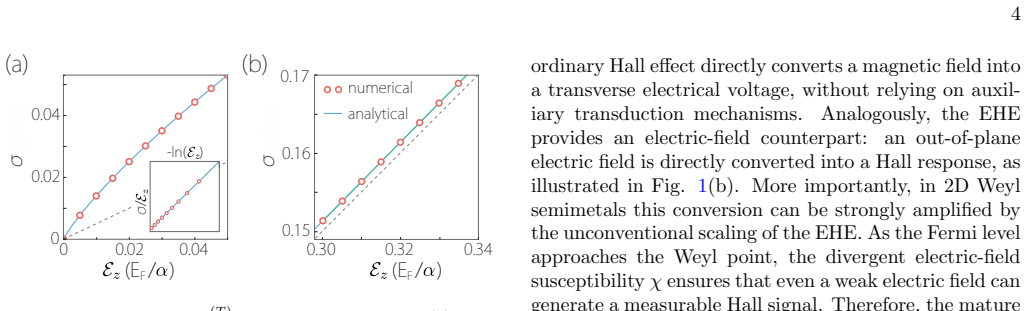
On the paper's own terms, the discovery is a pair of closed-form scaling identities. For a generic Weyl point described by $H_0(k) = (c_1 k_-^\nu + c_2 k_+^\nu)\tau_+ + \mathrm{h.c.}$ with winding number $C = \nu\, \mathrm{sgn}(|c_1|^2 - |c_2|^2)$, the zero-temperature electric Hall coefficient is exactly $\chi_{xy}^{(0)}(E_F) = (\alpha/2) C/|E_F|$: the dispersion parameters $c_1$ and $c_2$ cancel completely, and the order $\nu$ of the crossing enters only through $C$. The proof routes the momentum integral through the image of the band structure in the space of Pauli-matrix coefficients, where the Jacobian of the map cancels the Berry-curvature normalization and the $|C|$-to-one multiplicity of the map supplies the topological factor. The same flux counting gives the zero-temperature Hall conductivity $\sigma_{xy}^{(0)} = (C/2)\,\mathrm{sgn}(\alpha E_z)$ inside the field-induced gap and $(C/2)\,\alpha E_z/|E_F|$ outside it; convolving this piecewise result with the thermal kernel yields the finite-temperature law $\sigma_{xy}^{(T)} = (\alpha C/2)\,W(0,E_F,T)\,E_z \ln(1/|E_z|) + O(E_z)$. Both laws make the electric-field susceptibility diverge — as $E_F \to 0$ at zero temperature and as $E_z \to 0$ at finite temperature.
Load-bearing premise
The universal scalings presume the Weyl-point Hamiltonian has no scalar energy-shift term that moves the two bands together (particle-hole asymmetry); the paper proves such a term is symmetry-forbidden in the 30 layer groups it lists, so for those materials the exact $|E_F|^{-1}$ and $E_z \ln(1/|E_z|)$ laws with their pure-$C$ prefactors hold, while for a generic Weyl point they hold only as leading-order approximations.
Editorial extensions
If this is right
- The zero-temperature electric Hall susceptibility $\chi_{xy}$ diverges as $1/|E_F|$, so tuning the Fermi level close to a Weyl point converts a weak out-of-plane field into a measurable Hall current; the paper's estimate is that $E_z \approx 0.15$ V/cm suffices for a detectable signal ($\sigma_{xy} = 10^{-5}\,e^2/h$) with $\alpha = 5$ Å, $C = 1$, $E_F = 2$ meV, and $T = 10$ K.
- At finite temperature, thermal broadening does not suppress the divergence: $\sigma_{xy}^{(T)} \propto E_z \ln(1/|E_z|)$ for weak fields, so a divergent field susceptibility survives for any Fermi energy, not only at the tuned critical point.
- The prefactors of both scaling laws are set by the winding number $C$ alone: at fixed $|E_F|$ the response is proportional to $|C|$, so linear, quadratic, and cubic Weyl points differ only through their charges $|C| = 1, 2, 3$, and the local parameters $c_1, c_2$ never enter.
- The predicted $E_z \ln(1/|E_z|)$ field dependence is a transport fingerprint for identifying Weyl points in the 30 magnetic layer groups listed in Table I, and scanning the EHE signal against Fermi energy locates the crossing in energy.
- For $k_B T \ll |E_F|$ the response crosses over to the conventional linear law $\sigma_{xy}^{(T)} \simeq (\alpha C/2)(E_z/|E_F|)\,[1 + (\pi^2/3)(k_B T/E_F)^2]$, so the finite-temperature enhancement is a crossover effect of the thermal kernel, not a violation of the zero-temperature result.
Reading between the lines
- A corollary the paper leaves implicit: fitting the measured $\chi_{xy}(E_F)$ curve to $\alpha C/(2|E_F|)$ at known $\alpha$ would measure the integer winding number $C$ directly — a transport-based topological metrology for 2D nodal points that needs no knowledge of the microscopic band parameters.
- Equation (14) carries a caveat the paper does not stress: its coefficient $W(0,E_F,T)$ is the thermal kernel at the Weyl point, which is exponentially small when $|E_F| \gg k_B T$; the temperature-robust logarithmic divergence is therefore most pronounced when the Fermi level sits within a few $k_B T$ of the crossing.
- The $d$-space flux-counting argument is generic enough that analogous universal scalings should appear in other geometric response functions of 2D nodal points — for example, frequency-dependent or magnetoelectric variants of the electric Hall effect — a testable extension of the paper's approach.
- The sensitivity estimate assumes an ideal coupling $\alpha = 5$ Å and an isolated Weyl point; since the paper notes that $\alpha$ is set by the height of the 2D system, engineering thicker or more polarizable layers is the natural material knob for pushing the detectable field below 0.1 V/cm.
Editorial analysis
A structured set of objections, weighed in public.
Referee Report
Summary. The paper studies the electric Hall effect (EHE) in two-dimensional magnetic Weyl semimetals whose Weyl points are stabilized by crystalline symmetry and whose gap can be controlled by an out-of-plane electric field E_z. For a two-band model H(q)=d(q)·τ with a mass term m=αE_z, it derives two central results: at zero temperature the EHE coefficient satisfies χ_xy^(0)(E_F)=(α/2) C/|E_F|, with C the topological winding number and no dependence on the dispersion parameters c1,c2; at finite temperature the Hall conductivity obeys σ_xy^(T)=(αC/2) W(0,E_F,T) ln(1/|E_z|) E_z + O(E_z) in the weak-field limit, giving a divergent electric-field susceptibility. The paper also screens the 528 magnetic layer groups and lists those that can host both the relevant Weyl points and the intrinsic EHE. The derivations are clean for the stated d0=0 model, and the finite-temperature convolution is standard, but the claimed universality for real symmetry-stabilized Weyl points is not fully established because a scalar d0(k)τ0 term is omitted from the starting Hamiltonian.
Significance. If the ideal d0=0 model is taken as the intended scope, this is a valuable and elegant contribution: the k-to-d mapping derivation is transparent, the ν=1 case correctly reduces to the known massive-Dirac result, and the finite-temperature logarithmically corrected scaling is a nontrivial and potentially useful prediction. The MLG screening table is a concrete asset for material selection, and the proposed all-electric sensing route is imaginative. However, the central claim of a parameter-free, topology-determined prefactor is sensitive to a symmetry-allowed scalar term in the Hamiltonian, and the practical claim that the logarithmic enhancement holds for any Fermi energy is overstated. These issues are fixable within the manuscript's scope, but they need to be addressed before the universality claims can be accepted.
major comments (2)
- [SM Section I; main text Eq. (9)] The omission of the scalar term d0(k)τ0 is not innocuous for the EHE coefficient. The justification given in SM Section I, that d0 only shifts the eigenvalues and affects neither the eigenstates nor the Berry curvature, is correct for those quantities, but Eq. (5) of the main text contains the occupation factor f(ε_n−E_F), and Eq. (S22) is obtained only when the occupied regions are precisely the disks ρ=E_F. A nonzero d0(k) changes the Fermi-surface occupation and the thermal kernel W(0). Moreover, the symmetry generators listed for the MLG 58.4.408 example in SM Eq. (S42) leave q^2 τ0 invariant, so d0=γ q^2 is allowed in a material that realizes this WP. The scaling argument in Eqs. (7)-(8) also relies on H0(λ^{1/ν}k)=λ H0(k), which fails when d0 has a different homogeneity. Therefore Eq. (9) is a property of the fine-tuned model H=d·τ, not a parameter-free universal law for the WPs of Table I. Please either prove that d0 is forbidden for all listed WPs by the relevant symmetries, or reformulate the results as asymptotic leading-order statements and estimate the magnitude of the corrections.
- [Eq. (14) and the following paragraph] The statement that the logarithmically corrected scaling 'emerges for any E_F' should be qualified. In Eq. (14) the prefactor is W(0,E_F,T)=2B(E_F,T), and for |E_F|≫k_B T this quantity decays exponentially, W(0)∼2β e^{−β|E_F|}. Hence for a Fermi energy far from the Weyl point the logarithmic term is exponentially small, and at any finite E_z the regular O(E_z) terms may dominate. The limit E_z→0 is mathematically logarithmic for every E_F, but the practical remarks that the response is 'strengthened' by temperature and that no tuning of E_F is needed are not valid in that regime. The regime of practical relevance is |E_F|≲ few k_B T, which should be stated explicitly.
minor comments (4)
- [Abstract and Fig. 1(b)] The abstract and Fig. 1(b) read as if the out-of-plane field E_z alone generates the Hall current, but Eq. (4) shows that the response is bilinear in E_z and the in-plane driving field E_b. Please clarify the measurement geometry in the text and in the figure caption.
- [Fig. 2 caption] In the caption of Fig. 2, 'χ_xy^(0) E_F' should read 'χ_xy^(0) versus E_F'.
- [Table I and SM Section IV] Table I lists many magnetic layer groups, but the screening protocol used to identify 'EHE-compatible' WPs is not described beyond citing Refs. [40] and [27]. A short paragraph in the SM explaining how the intersection of the two criteria was performed would aid reproducibility.
- [Main text after Eq. (9)] The sentence that the EHE is 'more significant for the WPs with quadratic and cubic dispersion' should be qualified: for fixed |E_F|, the enhancement is proportional to the winding number C=±ν, so the statement follows from the larger topological charge rather than from the order of the dispersion as such.
Circularity Check
No significant circularity: the zero- and finite-temperature scaling laws are derived by direct integration and convolution, not assumed or fitted.
full rationale
The central derivation is self-contained. Equation (9), chi_xy^(0) = (alpha/2) C/|E_F|, is obtained in SM Sec. II by an explicit k-to-d mapping: Lambda_s = -s alpha J/(2 rho^3), and the integral over rho > E_F of J/rho^3 gives 2 pi C/E_F, so the result follows by direct calculation from the model Hamiltonian, not from an assumed answer. The finite-temperature result, Eq. (14), is obtained by convolving the zero-temperature sigma_xy^(0) with a thermal kernel; the logarithmic divergence comes from the 1/epsilon singularity in the convolution integral and is a mathematical consequence of the zero-temperature form, not a fitted or assumed input. The self-citations to [40] for the general EHE formula and to [27] for the WP classification are present but do not reduce the paper's claim to a self-citation chain: [40] does not contain the scaling laws and is used only as the general response expression, while [27] is an independent classification of allowed low-energy Hamiltonians. No fitted parameter is renamed as a prediction: alpha and C are model inputs, and W(0,E_F,T) is the thermal broadening kernel, not a fitting parameter. The omission of the scalar term d0(k) tau0 in the two-band Hamiltonian is a modeling assumption that can affect quantitative accuracy beyond leading order, and the paper's justification for that omission is incomplete for transport quantities involving Fermi-surface occupation; however, that is a correctness or scope concern, not a circularity, because the derived equations are not equivalent to their inputs by construction.
Assumptions & free parameters
free parameters (1)
- alpha (layer-coordinate coupling) =
not fitted; set to 1 Angstrom or 5 Angstrom in figures and estimates
assumptions (5)
- domain assumption The leading-order WP Hamiltonian H0(k) = (c1 k_-^nu + c2 k_+^nu) tau_+ + h.c. fully describes the low-energy physics; the scalar d0 term is dropped.
- domain assumption The E_z coupling is exactly H_E = alpha E_z tau_3, with no symmetry-allowed tau_0, tau_1, or tau_2 terms for all EHE-compatible WPs.
- domain assumption The EHE coefficient formula (Eq. (5)) from Ref. [40] (Cui et al., PRL 135, 116301 (2025)) is correct.
- domain assumption Finite-temperature response is obtained by spectral convolution of the zero-temperature Hall conductivity with the thermal kernel (Eqs. (10)-(11)).
- standard math The k-to-d mapping from Eq. (S2) is a regular |C|-to-one covering map on the region rho > E_F, so the Jacobian cancellation in the Berry-curvature integral holds.
Cite this review
Pith. "Pith review of Unconventional Scaling of Electric Hall Effect in Magnetic Weyl Semimetals." pith.science (2026). https://pith.science/paper/LQMLUHWG
@misc{pith2026260806217,
  author       = {Pith},
  title        = {Pith review of: Unconventional Scaling of Electric Hall Effect in Magnetic Weyl Semimetals},
  year         = {2026},
  howpublished = {\url{https://pith.science/paper/LQMLUHWG}},
  note         = {Machine review of arXiv:2608.06217}
}
abstract
Electric Hall Effect (EHE), a unique phenomenon in two-dimensional (2D) magnetic systems, refers to the generation of Hall current by an out-of-plane electric field $\Ez$. Here, we demonstrate that for 2D magnetic Weyl semimetals that host doubly degenerate nodal points, the EHE features multiple unconventional scaling laws. At zero temperature, the EHE exhibits a topological $E_F^{-1}$ Fermi-energy scaling. Remarkably, the prefactor of the scaling is determined by the global topological charge of the point without any dependence on the local parameters of the system, leading to a universal and significant enhancement of Hall response in any species of Weyl points as the Fermi energy approaches the Weyl point. This significant response enables a weak electric field to be directly converted into a measurable Hall signal. Surprisingly, this enhanced Hall response is not diminished by temperature, but evolves into an unconventional logarithmically corrected scaling at finite temperature $\sigma_{xy}\propto\Ez\ln(1/|\Ez|)$ for weak $\Ez$, still yielding a divergent electric-field susceptibility. Thus, our work not only unveils intriguing scaling laws resulting from the interaction between magnetism and topology, but also suggests a novel scaling-enhanced and temperature-robust mechanism that may enable weak electric-field sensing through a practical and all-electric route.
Figures


Reviewed August 7, 2026 · model on record in the stance chip above.
Discussion (0). Continue with ORCID to comment.