REVIEW 3 major objections 4 minor 56 references
A Neutron Star Hidden Inside a Black Hole
T0 review · 3 major / 4 minor · reviewed 2026-08-07 · deepseek-v4-flash
Pith's one-line read A dark matter halo can enclose a neutron star in an event horizon while the star remains a regular, non-singular configuration inside.
desk verdict The TOV numerics are solid but the black-hole interpretation collapses: with their metric ansatz, the negative g_rr^{-1} shell is a signature change, not an event horizon. read the letter →
The pith
A machine-rendered reading of the paper's core claim, the machinery that carries it, and where it could break.
The reading
What carries the argument
The argument runs on the modified TOV system (17)–(18), built from two-fluid stress-energy conservation and the metric function identification $e^{-2\beta}=g_{rr}^{-1}=1-2G m_{\rm all}/(c^2 r)$, where $m_{\rm all}$ sums the baryonic and dark-matter enclosed masses. The dark matter is the Einasto profile $\rho_d(r)=\rho_0 e^{-(r/h)^{1/n}}$ with the anisotropic equation of state $p_r^{(d)}=-\rho_d c^2$, which is smooth at the center and supplies negative radial pressure; the transverse pressure is fixed by conservation. The sign of $g_{rr}^{-1}$ is the horizon criterion: positive through the star, negative in a shell outside it, then positive again, defining the inner and outer horizons. This machinery converts the question of whether a neutron star can be hidden inside a black hole into a numerical scan over three halo parameters.
What would settle it
At the radius $r_h$ where $1-2G m_{\rm all}/(c^2 r_h)=0$, compute the metric component $g_{tt}(r_h)$ and the combination $m_{\rm all}(r_h)+4\pi r_h^3 p_{\rm all}(r_h)/c^2$. If $g_{tt}$ does not vanish there, or that combination is nonzero, the Einstein equations are singular at $r_h$, so the sign change of $g_{rr}^{-1}$ is not a smooth event horizon and the neutron-star-in-a-black-hole interpretation fails.
Extended reading notes
Core claim
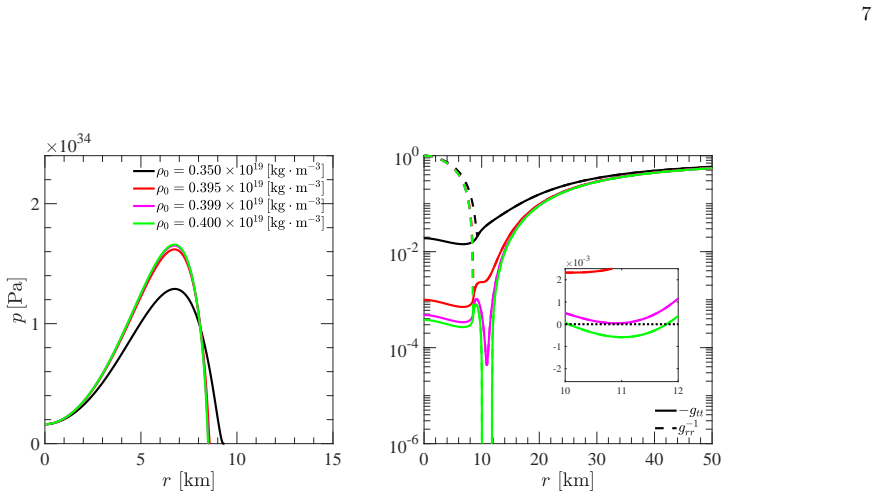
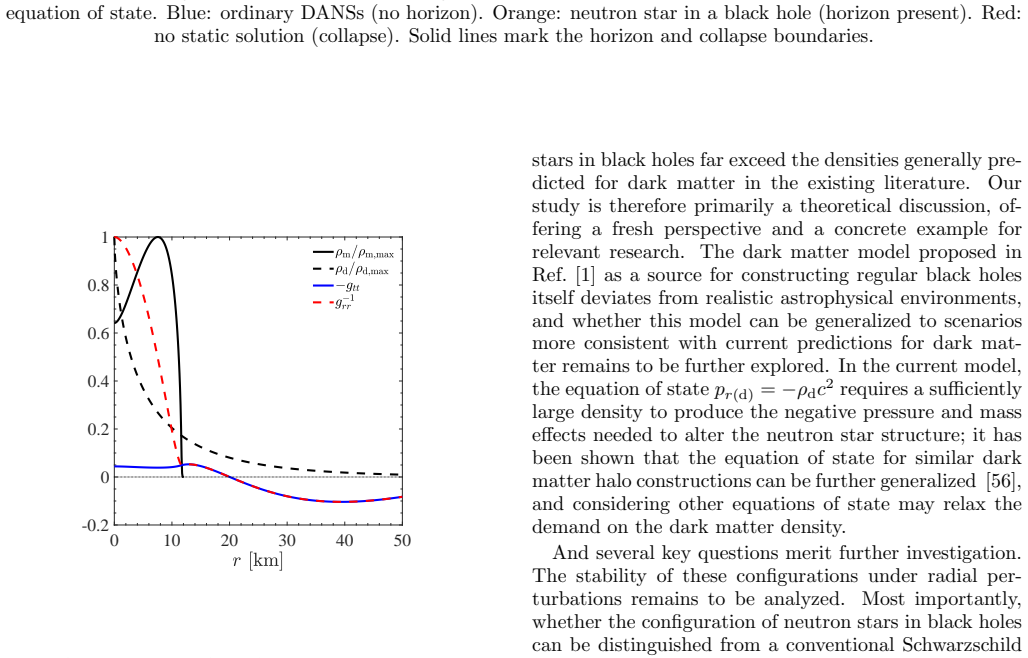
On the paper's own terms, the discovery is that the coexistence of a neutron star with an Einasto dark-matter halo whose radial pressure satisfies $p_r^{(d)}=-\rho_d c^2$ produces, for a range of halo parameters, a static, spherically symmetric spacetime in which $g_{rr}^{-1}=1-2G m_{\rm all}/(c^2 r)$ changes sign outside the stellar surface while the neutron star solution continues to exist as a regular interior configuration. The region of negative $g_{rr}^{-1}$ is bounded by an inner and outer horizon, and the star is fully contained within it; the paper calls this a 'neutron star in a black hole.' It occurs for two different equations of state and is not tied to a specific EOS. The paper also maps the three solution regimes—ordinary dark-matter admixed neutron star, neutron star in a black hole, and no static solution—in slices of the Einasto parameter space and reports that at horizon-forming densities the dark matter mass is comparable to the neutron star mass.
Load-bearing premise
The whole result rests on the assumption that where the metric component $g_{rr}^{-1}$ crosses zero the spacetime remains smooth, so the crossing is a real horizon rather than a coordinate or signature failure; that smoothness is asserted, not verified in the paper.
Editorial extensions
If this is right
- For a window of Einasto halo parameters, the neutron star solution persists while $g_{rr}^{-1}$ dips below zero in a shell outside the star, so the star can sit wholly inside a horizon.
- The configuration appears with both the BSk19 and SLy4 equations of state, so within this model it does not hinge on a specific nuclear equation of state.
- At the horizon-forming densities, dark-matter mass and neutron-star mass are comparable, so the horizon is a joint effect of both components.
- The parameter space has three regimes—ordinary dark-matter admixed neutron star, neutron star in a black hole, and no static solution—and increasing the halo mass on a static branch favors horizon formation.
- The results are stable under changes in ODE solver tolerance, step size, and solver type, so the negative $g_{rr}^{-1}$ region is not a numerical artifact according to the paper's checks.
Reading between the lines
- If the horizon interpretation survives a check of $g_{tt}$ and the regularity condition, the configuration gives a concrete two-horizon geometry whose interior contains baryonic matter; one could search for differences in quasinormal-mode spectra or tidal deformability relative to a vacuum Schwarzschild black hole.
- The required halo densities far exceed current dark-matter predictions, so the paper's phenomenon is a proof-of-principle; a natural extension is to find dark-matter equations of state that produce the same negative-pressure effect at lower densities.
- Stability under radial perturbations is unexamined; if these configurations are unstable, they would quickly collapse or migrate to another branch, which is a testable dynamical prediction.
Editorial analysis
A structured set of objections, weighed in public.
Referee Report
Summary. The paper studies static, spherically symmetric configurations of a neutron star described by the BSk19 and SLy4 equations of state, embedded in an Einasto dark matter halo with anisotropic pressures and the radial equation of state p_r^(d) = -ρ_d c^2. Solving the modified two-fluid TOV equations, the authors find parameter regions in which the formal metric function g_rr^{-1} = 1 - 2G m_all/(c^2 r) becomes negative in a shell outside the stellar surface. They interpret this sign change as the formation of an event horizon containing a regular neutron star, and they map the corresponding phase diagrams and mass-radius relations for both equations of state.
Significance. If the central interpretation were correct, the paper would present a striking and computable model of a regular black hole with baryonic matter inside the horizon, going beyond the usual vacuum or matter-free regular black hole constructions. The numerical work has clear strengths: the TOV integrations are standard, the mass function formula is correctly derived, the two-EOS comparison supports the structural part of the study, and the numerical robustness checks (ODE tolerance, step size, solver) are well documented. However, the central claim is not established: the paper never verifies that g_tt vanishes at the would-be horizon, never checks the horizon regularity condition, and the region where the formal expression 1 - 2G m_all/(c^2 r) is negative has a negative-definite (t,r) block, which is a signature change rather than a Lorentzian black-hole interior. The authors also honestly acknowledge that the required dark matter densities exceed astrophysical expectations by orders of magnitude, which further limits the physical significance of the configuration as presented.
major comments (3)
- [§III.B, Eq. (15)] The criterion that a sign change of g_rr^{-1} marks an event horizon is not justified. With the metric ansatz (9), g_tt = -e^{2α} c^2 < 0 for real α and g_rr = e^{2β} > 0 for real β, so the quantity e^{-2β} = 1 - 2G m_all/(c^2 r) cannot be negative without making β imaginary. A region where 1 - 2G m_all/(c^2 r) < 0 therefore has a negative-definite (t,r) block and is a Euclidean-signature region, not the interior of a black hole. The paper never shows that g_tt = 0 at the same radii, and Figs. 5-6 plot -g_tt as positive across the shell, which contradicts the horizon interpretation.
- [§II.B, Eq. (18)] Even if one attempted to interpret the zeros of 1 - 2G m_all/(c^2 r) as Killing horizons, the regularity condition is missing. At a genuine horizon the numerator c^2 m_all + 4π r^3 p_all must also vanish at the same radius, otherwise α' diverges there. Outside the neutron star, where p_all = -ρ_d c^2, this requires ρ_d(r_±) = c^2/(8π G r_±^2). The paper does not check this condition, and for the representative parameters of §III.B and Fig. 6 the required value is an order of magnitude larger than the actual Einasto density at the would-be crossing. Thus the solution does not satisfy the necessary condition for a regular Killing horizon.
- [§III.B, Figs. 5-8] The paper's central claim requires a global causal analysis that is absent. No null geodesics are computed, no trapped surfaces are identified, no extension across the would-be horizons is constructed, and the asymptotic structure of the spacetime outside r_+ is not analyzed. The term 'event horizon' is therefore used without the supporting global definition, and the plotted shell where the formal expression changes sign cannot, on the evidence provided, be identified as a black-hole horizon.
minor comments (4)
- [§II.B, Eq. (13)-(15)] The quantity m(r) = 4π∫ρ x^2 dx is called a mass function, but it is a coordinate-density integral rather than the Misner-Sharp or ADM mass. In particular, M_all = m_all(R) in §III.C excludes the dark matter outside the neutron star radius, while the total gravitational mass relevant at infinity would be m_all(∞). This distinction should be stated when presenting the mass-radius relations.
- [§III.B, Figs. 5-6] The text repeatedly says 'g_rr^{-1} changes sign', but with the ansatz (9) the actual metric component satisfies g_rr^{-1} = e^{-2β} > 0 for real β. The authors should consistently write that the formal expression 1 - 2G m_all/(c^2 r) changes sign, and should state explicitly that this implies a breakdown of the real-β ansatz rather than a horizon.
- [§III.B, Fig. 1] The schematic in Fig. 1 labels r_- and r_+ as 'horizons', but the text never defines these surfaces as apparent horizons, trapping horizons, or event horizons. A brief definition in the text would help avoid ambiguity.
- [§IV, Conclusion] The concluding caveat that the required dark matter densities are far above current predictions is appreciated, but the abstract's statement that the configuration 'appears in both equations of state' may overstate the physical relevance; the two-EOS comparison shows model-independence only within the same highly idealized dark matter model.
Circularity Check
No significant circularity: the modified TOV integration is self-contained and no fitted quantity is relabeled as a prediction; the horizon interpretation is a correctness concern, not a circularity.
full rationale
The paper's derivation chain is not circular. The metric functions are obtained by integrating the modified TOV equations (17)-(18) with the baryonic BSk19/SLy4 equations of state and the external Einasto dark-matter source (Eqs. 6-8 from Ref. [1]); the plotted quantity e^{-2β}=1-2Gm_all/(c^2r) (Eq. 15) is then evaluated from the resulting mass functions. No parameter is fitted to a target horizon, no data subset is used to force the sign change, and no uniqueness theorem is imported. The self-citations [55] and [56] are used only as stylistic or programmatic analogies ('filled hard candy'-like structure; possible generalization of the EOS) and are not load-bearing for the central claim. The assertion that min(g_rr^{-1})<0 'signals the formation of an event horizon' is physically questionable because with ansatz (9) g_tt=-e^{2α}c^2 cannot change sign for real α and the paper does not check the regularity condition or a global extension, but that is an incorrect or unsupported physical interpretation, not a case of the output reducing to the input by definition.
Assumptions & free parameters
free parameters (4)
- Einasto central dark matter density rho0 =
0.1 to 0.4 times 10^19 kg/m^3 (scanned)
- Einasto scale radius h =
1 to 8 km (scanned)
- Einasto index n =
1/3 to 1.5 (scanned)
- Central baryonic density rho_c =
2.5 times 10^17 to rho_max (scanned)
assumptions (5)
- domain assumption Dark matter is described by the Einasto profile with radial equation of state p_r^(d) = -rho_d c^2 (Eq. 7) and transverse pressure from conservation (Eq. 8).
- domain assumption Baryonic and dark matter interact only gravitationally and are separately conserved.
- ad hoc to paper The static, spherically symmetric metric ansatz (9) remains valid across the would-be horizon.
- ad hoc to paper A zero or sign change of g_rr^{-1} indicates an event horizon.
- domain assumption The baryonic equations of state BSk19 [52] and SLy4 [53,54] are valid up to the causal limit rho_max.
Cite this review
Pith. "Pith review of A Neutron Star Hidden Inside a Black Hole." pith.science (2026). https://pith.science/paper/3Y7S7FZJ
@misc{pith2026260806224,
  author       = {Pith},
  title        = {Pith review of: A Neutron Star Hidden Inside a Black Hole},
  year         = {2026},
  howpublished = {\url{https://pith.science/paper/3Y7S7FZJ}},
  note         = {Machine review of arXiv:2608.06224}
}
abstract
We investigate dark matter admixed neutron stars in which the neutron star coexists with an anisotropic dark matter halo described by the Einasto density profile, a model recently shown to produce regular, singularity-free black hole solutions~[Phys. Rev. D \textbf{113}, 043011 (2026)]. Solving the modified Tolman--Oppenheimer--Volkoff equations with two different equations of state (BSk19 and SLy4), we find that the dark matter halo significantly alters the neutron star structure. Furthermore, for a specific range of halo parameters, $g_{rr}^{-1}$ changes sign outside the stellar surface, forming an event horizon with the neutron star persisting as a regular configuration inside it--- ``neutron stars in black holes''. This configuration appears in both equations of state and does not depend on a specific choice of the equation of state. The discovery of this configuration provides a new perspective and a concrete computable instance for the study of what lies inside a black hole.
Figures


Figures from the paper (9 more)






Reference graph
Works this paper leans on
-
[1]
Dark matter halo as a source of regular black-hole geometries,
R. A. Konoplya and A. Zhidenko, “Dark matter halo as a source of regular black-hole geometries,” Phys. Rev. D 113, no.4, 043011 (2026) [arXiv:2511.03066 [gr-qc]]
arXiv 2026
-
[2]
Rotation of the An- dromeda Nebula from a Spectroscopic Survey of Emission Regions,
V. C. Rubin and W. K. Ford, Jr., “Rotation of the An- dromeda Nebula from a Spectroscopic Survey of Emission Regions,” Astrophys. J.159, 379-403 (1970). 11 1018-5 0 5 10 15 2010-3 FIG. 11: Global minimum ofg −1 rr as a function of the central baryonic matter densityρ c, for ρ0 = 0.40×10 19 [kg/m3],h= 5 [km],n= 1
work page 1970
-
[3]
V. C. Rubin, W. K. Ford, Jr. and N. Thonnard, “Ex- tended rotation curves of high-luminosity spiral galax- ies. IV. Systematic dynamical properties, Sa through Sc,” Astrophys. J. Lett.225, L107-L111 (1978)
work page 1978
-
[4]
Rotation curves of spiral galax- ies,
Y. Sofue and V. Rubin, “Rotation curves of spiral galax- ies,” Ann. Rev. Astron. Astrophys.39, 137-174 (2001) [arXiv:astro-ph/0010594 [astro-ph]]
arXiv 2001
-
[5]
A direct em- pirical proof of the existence of dark matter,
D. Clowe, M. Bradac, A. H. Gonzalez, M. Markevitch, S. W. Randall, C. Jones and D. Zaritsky, “A direct em- pirical proof of the existence of dark matter,” Astrophys. J. Lett.648, L109-L113 (2006) [arXiv:astro-ph/0608407 [astro-ph]]
arXiv 2006
-
[6]
Planck 2018 results. VI. Cosmological parameters,
N. Aghanimet al.[Planck], “Planck 2018 results. VI. Cosmological parameters,” Astron. Astrophys.641, A6 (2020) [erratum: Astron. Astrophys.652, C4 (2021)] [arXiv:1807.06209 [astro-ph.CO]]
arXiv 2020
-
[7]
Particle dark matter: Evidence, candidates and constraints,
G. Bertone, D. Hooper and J. Silk, “Particle dark matter: Evidence, candidates and constraints,” Phys. Rept.405, 279-390 (2005) [arXiv:hep-ph/0404175 [hep-ph]]
arXiv 2005
-
[8]
G. Bertone and D. Hooper, “History of dark mat- ter,” Rev. Mod. Phys.90, no.4, 045002 (2018) [arXiv:1605.04909 [astro-ph.CO]]
arXiv 2018
Show all 56 references
-
[9]
Dark Matter Search Results from a One Ton-Year Exposure of XENON1T,
E. Aprileet al.[XENON], “Dark Matter Search Results from a One Ton-Year Exposure of XENON1T,” Phys. Rev. Lett.121, no.11, 111302 (2018) [arXiv:1805.12562 [astro-ph.CO]]
2018 arXiv
-
[10]
Dark Matter Search Re- sults from the PandaX-4T Commissioning Run,
Y. Menget al.[PandaX-4T], “Dark Matter Search Re- sults from the PandaX-4T Commissioning Run,” Phys. Rev. Lett.127, no.26, 261802 (2021) [arXiv:2107.13438 [hep-ex]]
2021 arXiv
-
[11]
Search for new phenomena in events with an energetic jet and missing transverse mo- mentum inppcollisions at √s=13 TeV with the AT- LAS detector,
G. Aadet al.[ATLAS], “Search for new phenomena in events with an energetic jet and missing transverse mo- mentum inppcollisions at √s=13 TeV with the AT- LAS detector,” Phys. Rev. D103, no.11, 112006 (2021) 1018-0.12 -0.1 -0.08 -0.06 -0.04 -0.02 0 FIG. 12: Global minimum ofg −...
2021 arXiv
-
[12]
Searching for Dark Matter Annihilation from Milky Way Dwarf Spheroidal Galaxies with Six Years of Fermi Large Area Telescope Data,
M. Ackermannet al.[Fermi-LAT], “Searching for Dark Matter Annihilation from Milky Way Dwarf Spheroidal Galaxies with Six Years of Fermi Large Area Telescope Data,” Phys. Rev. Lett.115, no.23, 231301 (2015) [arXiv:1503.02641 [astro-ph.HE]]
2015 arXiv
-
[13]
Direct Detection of WIMP Dark Mat- ter: Concepts and Status,
M. Schumann, “Direct Detection of WIMP Dark Mat- ter: Concepts and Status,” J. Phys. G46, no.10, 103003 (2019) [arXiv:1903.03026 [astro-ph.CO]]
2019 arXiv
-
[14]
Neutron stars as extreme labora- tories for gravity tests,
L. Shao and K. Yagi, “Neutron stars as extreme labora- tories for gravity tests,” Sci. Bull.67, 1946-1949 (2022) [arXiv:2209.03351 [gr-qc]]
2022 arXiv
-
[15]
The physics of neu- tron stars,
J. M. Lattimer and M. Prakash, “The physics of neu- tron stars,” Science304, 536-542 (2004) [arXiv:astro- ph/0405262 [astro-ph]]
2004
-
[16]
Neutron Star Ob- servations: Prognosis for Equation of State Con- straints,
J. M. Lattimer and M. Prakash, “Neutron Star Ob- servations: Prognosis for Equation of State Con- straints,” Phys. Rept.442, 109-165 (2007) [arXiv:astro- ph/0612440 [astro-ph]]
2007
-
[17]
A Massive Pulsar in a Compact Relativistic Binary,
J. Antoniadis, P. C. C. Freire, N. Wex, T. M. Tauris, R. S. Lynch, M. H. van Kerkwijk, M. Kramer, C. Bassa, V. S. Dhillon and T. Driebe,et al.“A Massive Pulsar in a Compact Relativistic Binary,” Science340, 6131 (2013) [arXiv:1304.6875 [astro-ph.HE]]
2013 arXiv
-
[18]
Equa- tions of state for supernovae and compact stars,
M. Oertel, M. Hempel, T. Kl¨ ahn and S. Typel, “Equa- tions of state for supernovae and compact stars,” Rev. Mod. Phys.89, no.1, 015007 (2017) [arXiv:1610.03361 [astro-ph.HE]]
2017 arXiv
-
[19]
The Equation of State of Hot, Dense Matter and Neutron Stars,
J. M. Lattimer and M. Prakash, “The Equation of State of Hot, Dense Matter and Neutron Stars,” Phys. Rept. 621, 127-164 (2016) [arXiv:1512.07820 [astro-ph.SR]]
2016 arXiv
-
[20]
Compact Stars as Dark Matter Probes,
G. Bertone and M. Fairbairn, “Compact Stars as Dark Matter Probes,” Phys. Rev. D77, 043515 (2008) [arXiv:0709.1485 [astro-ph]]. 12
2008 arXiv
-
[21]
Can Neutron stars con- strain Dark Matter?,
C. Kouvaris and P. Tinyakov, “Can Neutron stars con- strain Dark Matter?,” Phys. Rev. D82, 063531 (2010) [arXiv:1004.0586 [astro-ph.GA]]
2010 arXiv
-
[22]
Dark Matter Effects On Neutron Star Properties,
J. Ellis, G. H¨ utsi, K. Kannike, L. Marzola, M. Raidal and V. Vaskonen, “Dark Matter Effects On Neutron Star Properties,” Phys. Rev. D97, no.12, 123007 (2018) [arXiv:1804.01418 [astro-ph.CO]]
2018 arXiv
-
[23]
Gravitational Waves and Gamma- rays from a Binary Neutron Star Merger: GW170817 and GRB 170817A,
B. P. Abbottet al.[LIGO Scientific, Virgo, Fermi-GBM and INTEGRAL], “Gravitational Waves and Gamma- rays from a Binary Neutron Star Merger: GW170817 and GRB 170817A,” Astrophys. J. Lett.848, no.2, L13 (2017) [arXiv:1710.05834 [astro-ph.HE]]
2017 arXiv
-
[24]
The Radius of PSR J0437–4715 from NICER Data,
M. C. Miller, A. J. Dittmann, I. M. Holt, F. K. Lamb, C. Chirenti, Z. Arzoumanian, J. Berteaud, S. Bogdanov, K. C. Gendreau and W. C. G. Ho,et al.“The Radius of PSR J0437–4715 from NICER Data,” Astrophys. J. Lett. 1000, no.2, L48 (2026) [arXiv:2512.08790 [astro-ph.HE]]
2026 arXiv
-
[25]
AN ICER View of PSR J0030+0451: Millisecond Pulsar Parameter Estimation,
T. E. Riley, A. L. Watts, S. Bogdanov, P. S. Ray, R. M. Ludlam, S. Guillot, Z. Arzoumanian, C. L. Baker, A. V. Bilous and D. Chakrabarty,et al.“AN ICER View of PSR J0030+0451: Millisecond Pulsar Parameter Estimation,” Astrophys. J. Lett.887, no.1, L21 (2019) [arXiv:1912.05702 ...
2019 arXiv
-
[26]
Grippa, G
F. Grippa, G. Lambiase and T. K. Poddar, Uni- verse11, no.3, 74 (2025) doi:10.3390/universe11030074 [arXiv:2412.09381 [astro-ph.HE]]
2025
-
[27]
Static solutions of Einstein’s field equa- tions for spheres of fluid,
R. C. Tolman, “Static solutions of Einstein’s field equa- tions for spheres of fluid,” Phys. Rev.55, 364-373 (1939)
1939
-
[28]
On massive neu- tron cores,
J. R. Oppenheimer and G. M. Volkoff, “On massive neu- tron cores,” Phys. Rev.55, 374-381 (1939)
1939
-
[29]
The Effects of Self-interacting Bosonic Dark Matter on Neutron Star Properties,
E. Giangrandi, V. Sagun, O. Ivanytskyi, C. Providˆ encia and T. Dietrich, “The Effects of Self-interacting Bosonic Dark Matter on Neutron Star Properties,” Astrophys. J. 953, no.1, 115 (2023) [arXiv:2209.10905 [astro-ph.HE]]
2023 arXiv
-
[30]
Bosonic dark matter in neutron stars and its effect on gravitational wave signal,
D. R. Karkevandi, S. Shakeri, V. Sagun and O. Ivanyt- skyi, “Bosonic dark matter in neutron stars and its effect on gravitational wave signal,” Phys. Rev. D105, no.2, 023001 (2022) [arXiv:2109.03801 [astro-ph.HE]]
2022 arXiv
-
[31]
Exploring the Distribution and Impact of Bosonic Dark Matter in Neutron Stars,
D. R. Karkevandi, M. Shahrbaf, S. Shakeri and S. Typel, “Exploring the Distribution and Impact of Bosonic Dark Matter in Neutron Stars,” Particles7, no.1, 201-213 (2024) [arXiv:2402.18696 [astro-ph.HE]]
2024 arXiv
-
[32]
Tidal deforma- bility of dark matter admixed neutron stars,
K. L. Leung, M. C. Chu and L. M. Lin, “Tidal deforma- bility of dark matter admixed neutron stars,” Phys. Rev. D105, no.12, 123010 (2022) [arXiv:2207.02433 [astro- ph.HE]]
2022 arXiv
-
[33]
Jockel and L
C. Jockel and L. Sagunski, Particles7, no.1, 52-79 (2024) doi:10.3390/particles7010004 [arXiv:2310.17291 [gr-qc]]
2024 arXiv
-
[34]
Effects of fermionic dark matter on properties of neu- tron stars,
Q. F. Xiang, W. Z. Jiang, D. R. Zhang and R. Y. Yang, “Effects of fermionic dark matter on properties of neu- tron stars,” Phys. Rev. C89, no.2, 025803 (2014) [arXiv:1305.7354 [astro-ph.SR]]
2014 arXiv
-
[35]
Dark matter ad- mixed neutron star properties in light of gravitational wave observations: A two fluid approach,
A. Das, T. Malik and A. C. Nayak, “Dark matter ad- mixed neutron star properties in light of gravitational wave observations: A two fluid approach,” Phys. Rev. D 105, no.12, 123034 (2022) [arXiv:2011.01318 [nucl-th]]
2022 arXiv
-
[36]
Scalar and vector dark matter admixed neutron stars with linear and quadratic couplings,
F. Grippa, G. Lambiase and T. K. Poddar, “Scalar and vector dark matter admixed neutron stars with linear and quadratic couplings,” Phys. Rev. D113, no.6, 063014 (2026) [arXiv:2407.16386 [hep-ph]]
2026
-
[37]
Fermionic versus Bosonic Dark Matter in Neutron Stars: A bayesian study with multi-density constraints,
P. Arvikar, S. Gautam, A. Venneti and S. Banik, “Fermionic versus Bosonic Dark Matter in Neutron Stars: A bayesian study with multi-density constraints,” JCAP 03, 012 (2026) [arXiv:2512.13574 [astro-ph.CO]]
2026
-
[38]
Analyzing Fermionic Dark Matter scenarios with anomalous compact objects,
Y. Cano and J. M. Alarc´ on, “Analyzing Fermionic Dark Matter scenarios with anomalous compact objects,” [arXiv:2603.22490 [hep-ph]]
-
[39]
Effects of mirror dark matter on neutron stars,
F. Sandin and P. Ciarcelluti, “Effects of mirror dark matter on neutron stars,” Astropart. Phys.32, 278-284 (2009) [arXiv:0809.2942 [astro-ph]]
2009 arXiv
-
[40]
Generating ul- tracompact neutron stars with bosonic dark matter,
S. L. Pitz and J. Schaffner-Bielich, “Generating ul- tracompact neutron stars with bosonic dark matter,” Phys. Rev. D111, no.4, 043050 (2025) [arXiv:2408.13157 [astro-ph.HE]]
2025 arXiv
-
[41]
Ax- ial Quasi-normal Modes of Admixed Neutron Stars,
H. Boumaza and B. Betancourt Kamenetskaia, “Ax- ial Quasi-normal Modes of Admixed Neutron Stars,” [arXiv:2605.10467 [hep-ph]]
-
[42]
Bose-Einstein Condensate Dark Matter in the Core of Neutron Stars: Implications for Gravitational-wave Ob- servations,
S. Mukherjee, P. S. Aswathi, C. Singha and A. Ganguly, “Bose-Einstein Condensate Dark Matter in the Core of Neutron Stars: Implications for Gravitational-wave Ob- servations,” [arXiv:2506.22353 [gr-qc]]
-
[43]
Universal relation involving fundamental modes in two-fluid dark matter admixed neutron stars,
H. Sotani and A. Kumar, “Universal relation involving fundamental modes in two-fluid dark matter admixed neutron stars,” Eur. Phys. J. C85, no.12, 1438 (2025) [arXiv:2512.07105 [astro-ph.HE]]
2025
-
[44]
Sta- bility Boundary of Neutron-Dark Matter Mixed Stars,
X. D. Zhou, T. S. Chen, S. M. Wu and K. Zhang, “Sta- bility Boundary of Neutron-Dark Matter Mixed Stars,” [arXiv:2512.01641 [astro-ph.HE]]
-
[45]
Gravita- tional synchronization in bosonic dark matter admixed neutron stars,
C. Lazarte, N. Sanchis-Gual and J. A. Font, “Gravita- tional synchronization in bosonic dark matter admixed neutron stars,” [arXiv:2512.11044 [gr-qc]]
-
[46]
New criterion for the existence of dark matter in neutron stars,
H. Sun and D. Wen, “New criterion for the existence of dark matter in neutron stars,” Phys. Rev. D109, no.12, 123037 (2024) [arXiv:2312.17288 [astro-ph.HE]]
2024 arXiv
-
[47]
Constraints on dark mat- ter in neutron stars from recent observations and mass correlation analysis,
J. F. Hu, H. Lu and B. Y. Sun, “Constraints on dark mat- ter in neutron stars from recent observations and mass correlation analysis,” Astrophys. Space Sci.371, no.5, 57 (2026) [arXiv:2512.23577 [astro-ph.HE]]
2026
-
[48]
Cooling of dark neutron stars,
B. X. Zhou, H. C. Das, J. B. Wei, G. F. Burgio, Z. H. Li and H. J. Schulze, “Cooling of dark neutron stars,” Phys. Rev. D112, no.12, 123035 (2025) [arXiv:2508.09704 [astro-ph.HE]]
2025
-
[49]
On the Construction of a Composite Model for the Galaxy and on the Determination of the System of Galactic Parameters,
J. Einasto, “On the Construction of a Composite Model for the Galaxy and on the Determination of the System of Galactic Parameters,” Trudy Astrofizicheskogo Instituta Alma-Ata5, 87-100 (1965)
1965
-
[50]
A Family of Potential–Density Pairs for Spherical Galaxies and Bulges,
W. Dehnen, “A Family of Potential–Density Pairs for Spherical Galaxies and Bulges,” Mon. Not. Roy. Astron. Soc.265, 250-256 (1993)
1993
-
[51]
Constraints on the Self-Interaction Cross-Section of Dark Matter from Numerical Simula- tions of the Merging Galaxy Cluster 1E 0657-56,
S. W. Randall, M. Markevitch, D. Clowe, A. H. Gonza- lez and M. Bradac, “Constraints on the Self-Interaction Cross-Section of Dark Matter from Numerical Simula- tions of the Merging Galaxy Cluster 1E 0657-56,” Astro- phys. J.679, 1173-1180 (2008) [arXiv:0704.0261 [astro- ph]]
2008 arXiv
-
[52]
Analytical representations of uni- fied equations of state for neutron-star matter,
A. Y. Potekhin, A. F. Fantina, N. Chamel, J. M. Pear- son and S. Goriely, “Analytical representations of uni- fied equations of state for neutron-star matter,” Astron. Astrophys.560, A48 (2013) [arXiv:1310.0049 [astro- ph.SR]]
2013 arXiv
-
[53]
A unified equation of state of dense matter and neutron star structure,
F. Douchin and P. Haensel, “A unified equation of state of dense matter and neutron star structure,” Astron. As- trophys.380, 151 (2001) [arXiv:astro-ph/0111092 [astro- ph]]
2001 arXiv
-
[54]
Analytical repre- sentations of unified equations of state of neutron- star matter,
P. Haensel and A. Y. Potekhin, “Analytical repre- sentations of unified equations of state of neutron- star matter,” Astron. Astrophys.428, 191-197 (2004) [arXiv:astro-ph/0408324 [astro-ph]]. 13
2004 arXiv
-
[55]
Frozen Neutron Stars,
C. Tan and Y. Q. Wang, “Frozen Neutron Stars,” [arXiv:2509.09338 [gr-qc]]
-
[56]
Compact Stars Sourced by Dark Matter Halos and Their Frozen States,
Y. Yue and Y. Q. Wang, “Compact Stars Sourced by Dark Matter Halos and Their Frozen States,” [arXiv:2601.15415 [gr-qc]]
Reviewed August 7, 2026 · model on record in the stance chip above.
Discussion (0). Sign in to comment.