REVIEW 2 major objections 5 minor 77 references
Impact of Nonlinearities on Local Kinetic and Thermokinetic Uncertainty Relations in Bosonic Transport
T0 review · 2 major / 5 minor · reviewed 2026-08-07 · deepseek-v4-flash
Pith's one-line read Nonlinearity breaks local precision bounds in bosonic heat transport
desk verdict The harmonic-network activity comparison is solid and worth citing; the NESB breakdown of local KURs is real but only proven in the hard-core infinite-Kerr limit, and the finite-Kerr gap needs filling. read the letter →
The pith
A machine-rendered reading of the paper's core claim, the machinery that carries it, and where it could break.
The reading
What carries the argument
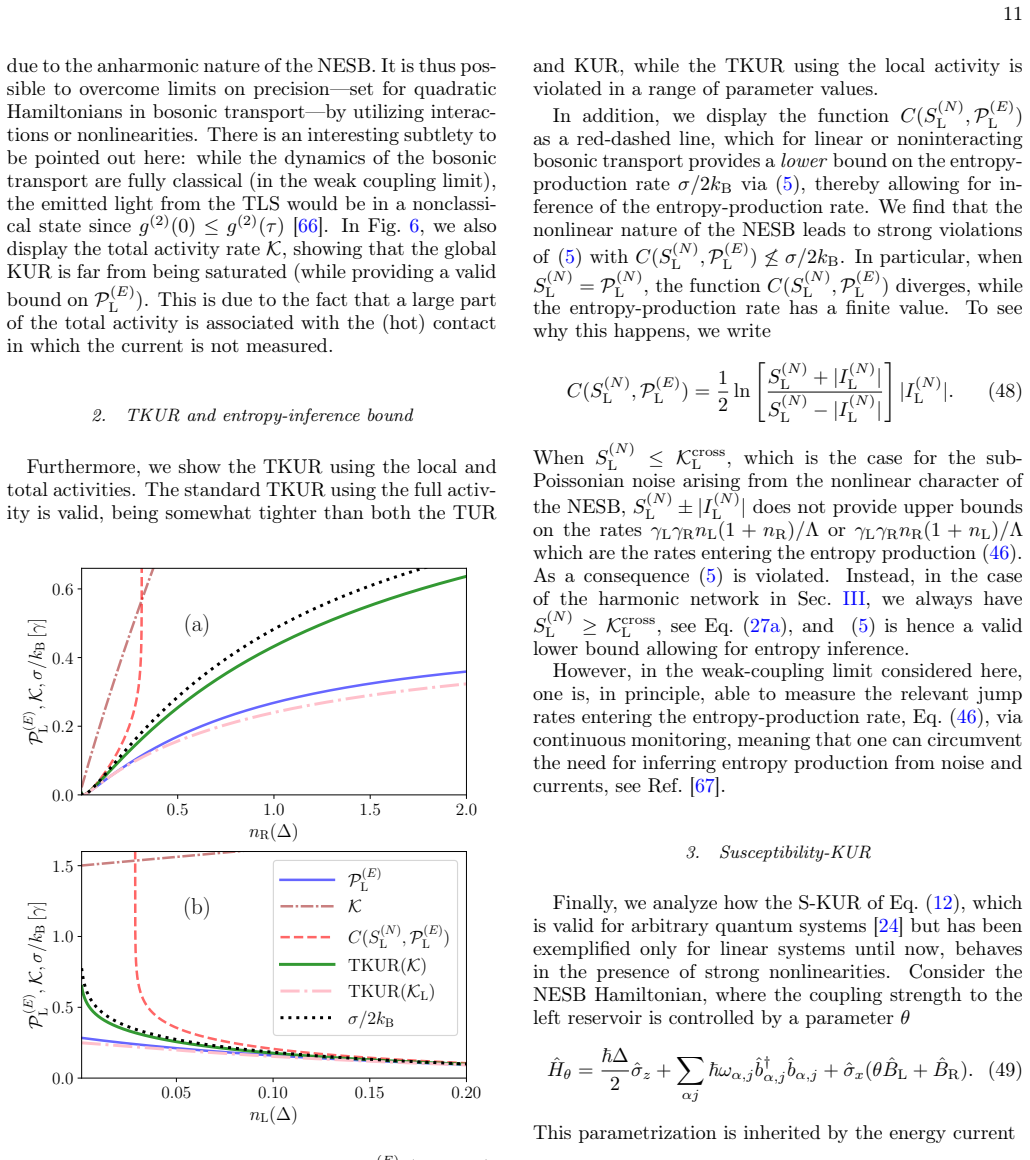
The central object is the nonequilibrium spin-boson model, viewed as the hard-core limit of a bosonic mode: a two-level system with level splitting $\Delta$ coupled to two thermal bosonic baths, described by a GKSL master equation with jump operators $\hat L_\alpha^+=\sqrt{\gamma_\alpha n_\alpha}\,\hat\sigma_+$ and $\hat L_\alpha^-=\sqrt{\gamma_\alpha(1+n_\alpha)}\,\hat\sigma_-$. The nonlinearity is entirely the single-excitation constraint. Two activity notions carry the argument: the correlator-based local activity $K_\alpha^{VV}$, defined as the symmetrized autocorrelation of the system-bath coupling, and the particle-current noise $S_\alpha^{(N)}$, which in linear systems counts single-excitation transfers. The decisive identity is the relation between current noise, activity, and current, $S_L^{(N)}=K^{\mathrm{cross}}-2(I_L^{(N)})^2/\Lambda$, together with the second-order correlation function $g^{(2)}(\tau)=1-e^{-\Lambda\tau}$, whose vanishing at zero delay signals antibunching and hence sub-Poissonian statistics that violate the linear-system bounds. The susceptibility-KUR of Eq. (12) provides the alternative bound: it replaces the current by the susceptibility $\partial_\theta I_L^{(E)}(\theta)|_{\theta=1}$ with respect to a scaled coupling strength, which remains valid under nonlinearities.
What would settle it
Run the same steady-state GKSL calculation, or a continuous-monitoring jump simulation, for a two-level system coupled symmetrically to two bosonic baths with left occupation $n_L(\Delta)=0.01$ and right occupation $n_R(\Delta)=1$, and compute the ratios $K_L^{VV}/P_L^{(E)}$ and $S_L^{(N)}/P_L^{(E)}$. The paper predicts both ratios below 1 in this window; if either ratio stays at or above 1, the claimed breakdown of the local bounds fails. An experimental test would use a circuit-QED heat-transport setup with independently temperature-biased baths and time-resolved current measurement.
Extended reading notes
Core claim
For a harmonic-oscillator network coupled to two bosonic reservoirs at different temperatures, the paper shows that local kinetic and thermokinetic uncertainty relations hold: the precision $P_L^{(E)}$ of the left-reservoir energy current is bounded by the correlator-based local activity $K_L^{VV}$ and by the particle-current noise $S_L^{(N)}$, with the tightness depending on temperatures and coupling asymmetry. The central new claim is that in the nonequilibrium spin-boson model, a two-level system absorbing and emitting excitations into two bosonic baths with the hard-core constraint that at most one excitation is hosted, these same local bounds are violated: for small cold-contact occupation $n_L(\Delta)\approx 0.01$ and large temperature bias with $n_R(\Delta)\approx 1$, the precision exceeds both $K_L^{VV}$ and $S_L^{(N)}$, and the local thermokinetic bound is also violated. The mechanism is not quantum coherence; the steady state is diagonal and effectively classical, and the enhanced precision is due purely to anharmonicity: emissions from the two-level system are anti-bunched, $g^{(2)}(0)\le g^{(2)}(\tau)$, giving sub-Poissonian fluctuations that linear bosonic transport cannot produce. In contrast, the susceptibility-KUR of Eq. (12), which bounds precision by the response of the current to a scaled coupling, remains valid and saturates to 0.988 over broad sampled parameters, while the global KUR remains valid but loose (maximum saturation 0.247) and the entropy-inference bound of Eq. (5) breaks.
Load-bearing premise
The central result rests on modeling the nonlinearity as nothing more than the rule that the system can hold at most one excitation, in the weak-coupling Markovian limit with no coherent inter-state tunneling; if a finite Kerr term, a transverse field, or strong coupling changes the dynamics, the predicted breakdown is not established.
Editorial extensions
If this is right
- If the paper is right, nonlinear bosonic junctions can be more precise than linear bosonic junctions with comparable activity: the hard-core constraint itself suppresses current fluctuations below the local activity and particle-noise bounds.
- The breakdown is parametric: local bounds survive except when the cold reservoir occupation is small and the temperature bias is large, so experimental searches for violations should target that regime.
- The susceptibility-KUR, measured by tuning the coupling to one reservoir and reading the current response, is the reliable precision certificate in the nonlinear regime, with near-saturation up to 0.988.
- The entropy-inference method based on particle-current noise and precision fails exactly when transfer statistics become sub-Poissonian; the paper notes that in the weak-coupling limit the relevant jump rates can instead be obtained by continuous monitoring.
- Circuit-QED realizations of the spin-boson model, such as superconducting qubits coupled to waveguides or cavities, are natural places to look for the predicted violation experimentally.
Reading between the lines
- A natural next test is interpolating between the harmonic oscillator and the hard-core two-level system by adding a finite Kerr nonlinearity; the hard-core limit suggests precision improvement should onset continuously as the nonlinearity grows, but the paper does not demonstrate this.
- Because the breakdown is statistical rather than coherence-based, similar precision enhancement might appear in any system with a hard-core exclusion rule, such as Coulomb-blockaded quantum dots, although the fermionic reference bounds differ and the paper does not treat that case.
- The antibunching mechanism implies a measurable nonclassical photon statistics, $g^{(2)}(0)<g^{(2)}(\tau)$, accompanying the improved precision, so photon-correlation measurements could serve as a witness of the regime where local bounds break.
- The near-saturation of the susceptibility-KUR suggests it may be the practical bound to quote for nonlinear bosonic devices, since it requires only a tunable coupling and current readout rather than full counting statistics.
Editorial analysis
A structured set of objections, weighed in public.
Referee Report
Summary. The paper analyzes how nonlinearities affect kinetic (KUR) and thermokinetic (TKUR) precision bounds in bosonic transport. For a harmonic-oscillator network it gives full-counting-statistics expressions for energy and excitation currents, noise, entropy production, and several local activity measures, and it numerically demonstrates the expected hierarchy for linear systems, P_L^(E) ≤ K_cross ≤ S_N^(N), with the TUR, TKUR, and susceptibility-KUR saturations. For the nonequilibrium spin-boson model (NESB), interpreted as the hard-core limit of a bosonic mode, it uses a weak-coupling GKSL master equation to obtain closed-form results and shows that, in a regime with large temperature bias and a very cold contact, the local activity K_L and the particle-current noise S_L^(N) are violated by the precision, while the global KUR/TKUR and the susceptibility-KUR of Eq. (12) remain valid. The enhanced precision is attributed to antibunching, with g^(2)(0)=0 in Eq. (47).
Significance. If the claims hold in the generality stated, the paper would provide an interesting and useful message: strong bosonic nonlinearities can improve transport precision beyond linear-system bounds, local kinetic/thermokinetic bounds are not universal, and the susceptibility-KUR is a robust replacement. The NESB calculation is simple, analytic, and free of fitted parameters, giving explicit and falsifiable predictions for the parameter regions where local bounds are violated. The harmonic-oscillator FCS material is standard and consistently presented, and the comparison of activity definitions is useful as a benchmark. The main weakness, discussed below, is that the central 'nonlinearities break local bounds' claim is demonstrated only in the singular hard-core/infinite-Kerr limit, with no finite-nonlinearity calculation or continuity argument; this limits the generality of the abstract, title, and experimental-testability statements.
major comments (2)
- [Sec. IV B 1, Fig. 5] The violation of the local KUR and of the KUR-like bound P ≤ S_N is computed only in the TLS/hard-core limit of a bosonic mode. The paper's abstract and conclusion state that nonlinearities can break local precision bounds and that this should be testable in circuit QED, but no finite-Kerr calculation or threshold estimate is provided. At the Fig. 5 violation parameters (n_L=0.01, n_R=1), one has k_B T_R ≈ 1.44ħ∆; the second-excitation occupation of a finite-Kerr mode with frequency ∆ and Kerr strength U is n_2 ≈ 0.33 at U=0 and ≈0.21 at U/ħ∆=0.5, becoming negligible only for U/ħ∆ substantially larger than 5. A finite population in the two-excitation manifold weakens the blockade, raises g^(2)(0), and tends to restore the linear-bosonic ordering. Without a finite-U analysis or at least a continuity/threshold argument, the general nonlinearity claim is not established beyond the infinite-U limit.
- [Sec. III B, Eq. (28)] As printed, the entropy-production expression contains the factor (F_αβ − F_βα)^2. The standard and dimensionally correct expression for the harmonic network is (F_αβ − F_βα) ln(F_αβ/F_βα), without a square. Since σ enters all TUR and TKUR comparisons in Figs. 2, 3, and 6, either the formula is a typographical error that must be corrected, or the numerical results are based on a different quantity than stated. Please clarify and fix this.
minor comments (5)
- [Sec. II B 2] The notation P_α^(X) is introduced through J_α^(X), but the remainder of the paper mostly uses P^(X) from Eq. (3). Please clarify the relation between these two precision definitions explicitly.
- [Sec. IV B 1] The computed expression g^(2)(τ)=1−e^{−Λτ} holds for τ≥0; the statement g^(2)(0)≤g^(2)(τ) should be written with this domain noted explicitly.
- [Sec. IV B 1] The violation ratios in the insets are visually small; please state the maximum values of K_L/P and S_N/P attained in the displayed ranges, or plot the ratios on a scale that makes the violation quantitatively clear.
- [References] The validity of the susceptibility-KUR is imported from Ref. [24], which is an unpublished preprint. If a refereed or published version is available, it should be cited; otherwise, a short self-contained derivation or a precise statement of the assumptions in the appendix would make the paper more self-contained.
- [Sec. III B] The chain P ≤ K_cross ≤ S_N is stated for linear systems; it may help to note explicitly that K_cross ≤ S_N follows directly from Eq. (27a) because the quantum-noise term is nonnegative, while P ≤ K_cross is the nontrivial bound taken from Refs. [16,18].
Circularity Check
No significant circularity: the NESB violation is computed from the model, not fitted, and the authors' prior results are used as external benchmarks rather than as inputs that force the predicted breakdown.
full rationale
The central claims are derived from explicit steady-state expressions, not from fitting or from a definition that presupposes the result. In Sec. IV A, the NESB current, noise, activity, and entropy production are given by closed formulas: I_L^(N) = gamma_L gamma_R (n_L - n_R)/Lambda, S_L^(N) = K_cross - 2(I_L^(N))^2/Lambda, K_VV_L = K_cross + K_auto_L, and sigma = k_B ln[n_L(1+n_R)/(n_R(1+n_L))] I_L^(N). The violation of the local KUR and the KUR-like bound in Fig. 5 is the inequality P_L^(E) > K_L and P_L^(E) > S_L^(N), evaluated with these formulas; no parameter is adjusted to force the inequality. The antibunching mechanism is derived rather than imposed: Eq. (47) gives g^(2)(tau) = 1 - exp(-Lambda tau), and the paper explicitly connects this to the sub-Poissonian statistics via Eq. (45). The bounds used as benchmarks, Eqs. (5), (30)-(32), and (37), come from the authors' prior work (Refs. [16,18,24]), but they are imported as fixed inequality statements whose validity for linear systems is independent of the present NESB calculation; the present paper does not redefine them in terms of the NESB observables in a way that would make the comparison tautological. The S-KUR (12) is cited to the authors' own preprint [24]; however, it is used as a general theorem and then independently computed for the NESB in Sec. IV B 3, reaching saturation 0.988 without any fitted parameter. This is self-citation but not circular reasoning: the cited theorem has general content and the numerical evaluation could in principle have shown a violation. The manuscript's limitation to the hard-core TLS limit of a bosonic mode, with no finite-Kerr calculation, is a scope/generality concern rather than a circularity. The finite-Kerr generalization and strong-coupling validity are not established by the paper, but those are correctness risks, not reductions of the derivation to its inputs.
Assumptions & free parameters
assumptions (6)
- domain assumption The steady-state cumulant generating function for energy and excitation transport in harmonic junctions, Eq. (25), is taken from Ref. [52] and used to compute currents and noises.
- domain assumption The local kinetic bound P^(E)_α ≤ K^cross_α ≤ S^(N)_α for linear bosonic transport, Eq. (30), is taken from Refs. [16,18] by the same group.
- domain assumption The susceptibility-kinetic uncertainty relation, Eq. (12), is taken from Ref. [24], an arXiv preprint by the same group.
- domain assumption The weak-coupling GKSL master equation with jump operators (40) and steady state (41) for the NESB is adopted from Refs. [60,61].
- domain assumption The relation S^(N)_L = K^cross - 2(I^(N)_L)^2/Λ for the TLS noise, Eq. (45), is taken from Ref. [43].
- domain assumption Bosonic reservoirs have zero chemical potential, so heat and energy currents coincide and the entropy production rate is the Clausius expression, Eq. (2).
Cite this review
Pith. "Pith review of Impact of Nonlinearities on Local Kinetic and Thermokinetic Uncertainty Relations in Bosonic Transport." pith.science (2026). https://pith.science/paper/SKYJ5O33
@misc{pith2026260806303,
  author       = {Pith},
  title        = {Pith review of: Impact of Nonlinearities on Local Kinetic and Thermokinetic Uncertainty Relations in Bosonic Transport},
  year         = {2026},
  howpublished = {\url{https://pith.science/paper/SKYJ5O33}},
  note         = {Machine review of arXiv:2608.06303}
}
read the original abstract
The precision of transport observables can be bounded by the entropy production and the activity of the transport process via kinetic and thermokinetic uncertainty relations. In linear bosonic systems, such uncertainty relations can provide tight bounds when the activity is replaced by a local activity of the measurement contact of interest---even in the strong-coupling regime. How much nonlinearities (or interactions) impact the validity and predictiveness of these local bounds and how much this impact depends on the concrete definition of activity are open questions that we address for two experimentally relevant model systems, a harmonic oscillator network and the intrinsically nonlinear spin-boson model. We thereby provide experimentally testable predictions on how nonlinearities impact or even break local kinetic and thermokinetic precision bounds.
Figures


Figures from the paper (4 more)



Reference graph
Works this paper leans on
-
[24]
Thermodynamic bounds on coher- ent transport in periodically driven conductors,
Elina Potanina, Christian Flindt, Michael Moskalets, and Kay Brandner, “Thermodynamic bounds on coher- ent transport in periodically driven conductors,” Physical Review X11, 021013 (2021)
2021
-
[1]
Dynamical activity from a (quantum) jump approach We start by introducing activity for an open quantum system interacting weakly with Markovian baths, where stochastic jumps are well defined. Such a system is de- scribed by a GKSL master equation for the reduced den- sity operator ˙ˆρS(t) =LˆρS(t) =− i ℏ [ ˆHS(t),ˆρS(t)] + X α,j D[ ˆLα,j(t)]ˆρS(t). (6) He...
-
[2]
Re- cently, a definition for a quantum-transport setting has been introduced in Ref
Correlator-based dynamical activity in quantum transport Defining a dynamical activity for quantum systems be- yond weak coupling is an ongoing research topic. Re- cently, a definition for a quantum-transport setting has been introduced in Ref. [19], based on the symmetrized correlator of the system-bath couplings. Concretely, for an open quantum system d...
-
[3]
Dynamical-activity substitutes motivated by quantum-transport observables A complementary approach to establishing precision bounds is by identifying how measurable (transport) quantities constrain the precision of arbitrary currents. In Refs. [16, 18], it was shown that the particle-current noise, or more specifically the particle-current auto- correlati...
-
[4]
TUR and local KURs In Fig. 2, we show the results for energy-current preci- sion together with thefullentropy production and with different definitions of thelocalactivity and their con- stituents as functions of temperature bias∆T. Indeed, 7 for noninteracting systems, as the local network consid- ered here, local versions of the bounds introduced in Sec...
-
[5]
TKUR and entropy-inference bound In Fig. 3, we analyze bounds on the energy-current precision given by the thermokinetic uncertainty relation (TKUR), see Eq. (4), again using the different activities introduced above. In general, we see that the TKUR bounds are close to the TUR for small biases and pro- vide better bounds than the TUR far away from equili...
-
[6]
cross” term as the one that is symmetric under exchange of reservoir indices L↔R, and the “auto
Susceptibility-KUR To consider the S-KUR for the harmonic oscillator, we rescale the coupling strength to the left reservoir byθ, whichisinheritedbytheenergycurrentasaparametriza- tion of the transmission function I (E) L (θ) = Z ∞ 0 dω 2π TLR(ω;θ)ℏω(n L(ω)−n R(ω))(35) TLR(ω;θ) = θ2ΓL(ω)ΓR(ω) (ω2 −ω 2 0)2 + 1 4 [θ2ΓL(ω) + ΓR(ω)]2 ,(36) and the response cu...
-
[7]
(5) estimating transfer rates using excitation-current noise, as well as of the TKUR in Fig
TUR and local KURs We start by showing violations of the local KUR, of the KUR-like bound of Eq. (5) estimating transfer rates using excitation-current noise, as well as of the TKUR in Fig. 5 for the energy-current precision. In panel (a), the results are shown as a function of the average occupation of the right reservoir at the energy splittingℏ∆,nR(∆),...
Show all 77 references
-
[8]
TKUR and entropy-inference bound Furthermore, we show the TKUR using the local and total activities. The standard TKUR using the full activ- ity is valid, being somewhat tighter than both the TUR 0.5 1.0 1.5 2.0 nR(∆) 0.0 0.2 0.4 0.6 P (E) L , K, σ/kB [γ] (a) 0.05 0.10 0.15 0....
-
[9]
(12), which is valid for arbitrary quantum systems [24] but has been exemplified only for linear systems until now, behaves in the presence of strong nonlinearities
Susceptibility-KUR Finally, we analyze how the S-KUR of Eq. (12), which is valid for arbitrary quantum systems [24] but has been exemplified only for linear systems until now, behaves in the presence of strong nonlinearities. Consider the NESB Hamiltonian, where the coupling s...
-
[10]
Shot noise in meso- scopic conductors,
Ya. M. Blanter and M. Büttiker, “Shot noise in meso- scopic conductors,” Phys. Rep.336, 1–166 (2000)
2000
-
[11]
Nonequilibrium fluctuations, fluctuation the- orems, and counting statistics in quantum systems,
Massimiliano Esposito, Upendra Harbola, and Shaul Mukamel, “Nonequilibrium fluctuations, fluctuation the- orems, and counting statistics in quantum systems,” Rev. Mod. Phys.81, 1665–1702 (2009)
2009
-
[12]
Thermodynamic Un- certainty Relation for Biomolecular Processes,
Andre C. Barato and Udo Seifert, “Thermodynamic Un- certainty Relation for Biomolecular Processes,” Phys. Rev. Lett.114, 158101 (2015)
2015
-
[13]
Dissipation Bounds All Steady-State Current Fluctuations,
Todd R. Gingrich, Jordan M. Horowitz, Nikolay Pe- runov, and Jeremy L. England, “Dissipation Bounds All Steady-State Current Fluctuations,” Phys. Rev. Lett. 116, 120601 (2016)
2016
-
[14]
Thermo- dynamic uncertainty relations constrain non-equilibrium fluctuations,
Jordan M. Horowitz and Todd R. Gingrich, “Thermo- dynamic uncertainty relations constrain non-equilibrium fluctuations,” Nat. Phys.16, 15–20 (2020)
2020
-
[15]
Thermodynamic Uncer- tainty Relation for Time-Dependent Driving,
Timur Koyuk and Udo Seifert, “Thermodynamic Uncer- tainty Relation for Time-Dependent Driving,” Phys. Rev. Lett.125, 260604 (2020)
2020
-
[16]
Kinetic uncertainty relation,
Ivan Di Terlizzi and Marco Baiesi, “Kinetic uncertainty relation,” J. Phys. A: Math. Theor.52, 02LT03 (2018)
2018
-
[17]
Simple bounds on fluctuations and uncertainty relations for first-passage times of counting observables,
Juan P. Garrahan, “Simple bounds on fluctuations and uncertainty relations for first-passage times of counting observables,” Phys. Rev. E95, 032134 (2017)
2017
-
[18]
Unified thermodynamic–kinetic uncertainty relation,
Van Tuan Vo, Tan Van Vu, and Yoshihiko Hasegawa, “Unified thermodynamic–kinetic uncertainty relation,” J. 16 Phys. A: Math. Theor.55, 405004 (2022)
2022
-
[19]
Quantum Thermodynamic Un- certainty Relation for Continuous Measurement,
Yoshihiko Hasegawa, “Quantum Thermodynamic Un- certainty Relation for Continuous Measurement,” Phys. Rev. Lett.125, 050601 (2020)
2020
-
[20]
Unifying speed limit, thermody- namic uncertainty relation and Heisenberg principle via bulk-boundary correspondence,
Yoshihiko Hasegawa, “Unifying speed limit, thermody- namic uncertainty relation and Heisenberg principle via bulk-boundary correspondence,” Nat. Commun.14, 2828 (2023)
2023
-
[21]
Role of Quantum Coherence in Kinetic Uncertainty Re- lations,
Kacper Prech, Patrick P. Potts, and Gabriel T. Landi, “Role of Quantum Coherence in Kinetic Uncertainty Re- lations,” Phys. Rev. Lett.134, 020401 (2025)
2025
-
[22]
Fundamental Bounds on Precision and Response for Quantum Trajectory Observables,
Tan Van Vu, “Fundamental Bounds on Precision and Response for Quantum Trajectory Observables,” PRX Quantum6, 010343 (2025)
2025
-
[23]
Ther- modynamic Bounds on Precision in Ballistic Multiter- minal Transport,
Kay Brandner, Taro Hanazato, and Keiji Saito, “Ther- modynamic Bounds on Precision in Ballistic Multiter- minal Transport,” Physical Review Letters120, 090601 (2018)
2018
-
[25]
Kinetic Uncertainty Relations for Quan- tum Transport,
Didrik Palmqvist, Ludovico Tesser, and Janine Splettstoesser, “Kinetic Uncertainty Relations for Quan- tum Transport,” Phys. Rev. Lett.135, 166302 (2025)
2025
- [26]
-
[27]
Combining kinetic and thermodynamic uncertainty relations in quantum transport,
Didrik Palmqvist, Ludovico Tesser, and Janine Splettstoesser, “Combining kinetic and thermodynamic uncertainty relations in quantum transport,” Quantum Sci. Technol.10, 035059 (2025)
2025
-
[28]
Quantum Kinetic Uncertainty Relations in Mesoscopic Conduc- tors at Strong Coupling,
Gianmichele Blasi, Ricard Ravell Rodríguez, Mykhailo Moskalets, RosaLópez, andGéraldineHaack,“Quantum Kinetic Uncertainty Relations in Mesoscopic Conduc- tors at Strong Coupling,” Phys. Rev. Lett.137, 056302 (2026)
2026
- [29]
-
[30]
Fundamental Precision Limits in Finite-Dimensional Quantum Thermal Machines,
Yoshihiko Hasegawa, “Fundamental Precision Limits in Finite-Dimensional Quantum Thermal Machines,” Phys. Rev. Lett.135, 200404 (2025)
2025
- [31]
-
[32]
Exact solution to quantum dynamical activity,
Tomohiro Nishiyama and Yoshihiko Hasegawa, “Exact solution to quantum dynamical activity,” Phys. Rev. E 109, 044114 (2024)
2024
- [33]
-
[34]
thesis, Chalmers University of Technology (2026), 551724
Didrik Palmqvist,Thermokinetic Uncertainty Rela- tions and Dynamical Activities in Quantum Systems, Ph.D. thesis, Chalmers University of Technology (2026), 551724
2026
-
[35]
Thermodynamic uncertainty relation in thermal transport,
Sushant Saryal, Hava Meira Friedman, Dvira Segal, and Bijay Kumar Agarwalla, “Thermodynamic uncertainty relation in thermal transport,” Phys. Rev. E100, 042101 (2019)
2019
- [36]
-
[37]
Quantum technologies with hybrid sys- tems,
Gershon Kurizki, Patrice Bertet, Yuimaru Kubo, Klaus Mølmer, David Petrosyan, Peter Rabl, and Jörg Schmiedmayer, “Quantum technologies with hybrid sys- tems,” Proc. Natl. Acad. Sci. U.S.A.112, 3866–3873 (2015)
2015
-
[38]
Superconducting Circuits for Quantum Information: An Outlook,
M. H. Devoret and R. J. Schoelkopf, “Superconducting Circuits for Quantum Information: An Outlook,” Science 339, 1169–1174 (2013)
2013
-
[39]
Quantum-information processing with circuit quantum electrodynamics,
Alexandre Blais, Jay Gambetta, A. Wallraff, D. I. Schus- ter, S. M. Girvin, M. H. Devoret, and R. J. Schoelkopf, “Quantum-information processing with circuit quantum electrodynamics,” Phys. Rev. A75, 032329 (2007)
2007
-
[40]
A quantum-dot heat engine operating close to the thermodynamic efficiency limits,
Martin Josefsson, Artis Svilans, Adam M. Burke, Eric A. Hoffmann, Sofia Fahlvik, Claes Thelander, Martin Lei- jnse, and Heiner Linke, “A quantum-dot heat engine operating close to the thermodynamic efficiency limits,” Nat. Nanotechnol.13, 920–924 (2018)
2018
-
[41]
Tunable photonic heat transport in a quantum heat valve,
A. Ronzani, B. Karimi, J. Senior, Y.-C. Chang, J. T. Pel- tonen, C.D. Chen, and J. P. Pekola, “Tunable photonic heat transport in a quantum heat valve,” Nat. Phys.14, 991–995 (2018)
2018
-
[42]
Heat rectification via a superconducting artificial atom,
J. Senior, A. Gubaydullin, B. Karimi, J. T. Peltonen, J. Ankerhold, and J. P. Pekola, “Heat rectification via a superconducting artificial atom,” Commun. Phys.3, 40 (2020)
2020
-
[43]
Colloquium: Quantum heat transport in condensed matter systems,
J. P. Pekola and B. Karimi, “Colloquium: Quantum heat transport in condensed matter systems,” Rev. Mod. Phys.93, 041001 (2021)
2021
-
[44]
Thermodynamic bound on current fluctuations in coherent conductors,
Kay Brandner and Keiji Saito, “Thermodynamic bound on current fluctuations in coherent conductors,” J. Phys. A: Math. Theor.58, 435002 (2025)
2025
-
[45]
Entropy production as correlation be- tween system and reservoir,
Massimiliano Esposito, Katja Lindenberg, and Christian Van den Broeck, “Entropy production as correlation be- tween system and reservoir,” New J. Phys.12, 013013 (2010)
2010
- [46]
-
[47]
Dynamical First- Order Phase Transition in Kinetically Constrained Mod- els of Glasses,
J. P. Garrahan, R. L. Jack, V. Lecomte, E. Pitard, K. van Duijvendijk, and F. van Wijland, “Dynamical First- Order Phase Transition in Kinetically Constrained Mod- els of Glasses,” Phys. Rev. Lett.98, 195702 (2007)
2007
-
[48]
Thermodynamic Formalism for Systems with Markov Dynamics,
V. Lecomte, C. Appert-Rolland, and F. van Wijland, “Thermodynamic Formalism for Systems with Markov Dynamics,” J. Stat. Phys.127, 51–106 (2007)
2007
-
[49]
Frenesy: Time-symmetric dynamical activity in nonequilibria,
Christian Maes, “Frenesy: Time-symmetric dynamical activity in nonequilibria,” Phys. Rep.850, 1–33 (2020)
2020
-
[50]
Thermodynamic Uncertainty Re- lation for General Open Quantum Systems,
Yoshihiko Hasegawa, “Thermodynamic Uncertainty Re- lation for General Open Quantum Systems,” Phys. Rev. Lett.126, 010602 (2021)
2021
-
[51]
thesis, Chalmers University of Technology, Sweden (2025), 544208
Ludovico Tesser,Thermodynamic constraints on noise, Ph.D. thesis, Chalmers University of Technology, Sweden (2025), 544208
2025
-
[52]
CurrentFluctuationsinOpen Quantum Systems: Bridging the Gap Between Quantum Continuous Measurements and Full Counting Statistics,
Gabriel T. Landi, Michael J. Kewming, Mark T. Mitchi- son, andPatrickP.Potts,“CurrentFluctuationsinOpen Quantum Systems: Bridging the Gap Between Quantum Continuous Measurements and Full Counting Statistics,” PRX Quantum5, 020201 (2024)
2024
-
[53]
Unraveling the Large Deviation Statistics of Markovian Open Quantum Systems,
Federico Carollo, Robert L. Jack, and Juan P. Garrahan, “Unraveling the Large Deviation Statistics of Markovian Open Quantum Systems,” Phys. Rev. Lett.122, 130605 (2019). 17
2019
-
[54]
Thermodynamics of Pre- cision in Markovian Open Quantum Dynamics,
Tan Van Vu and Keiji Saito, “Thermodynamics of Pre- cision in Markovian Open Quantum Dynamics,” Phys. Rev. Lett.128, 140602 (2022)
2022
-
[55]
Nonequilibrium Green’s function method for quantum thermal transport,
Jian-Sheng Wang, Bijay Kumar Agarwalla, Huanan Li, and Juzar Thingna, “Nonequilibrium Green’s function method for quantum thermal transport,” Front. Phys.9, 673–697 (2014)
2014
-
[56]
Direct calculation of the tunneling current,
C. Caroli, R. Combescot, P. Nozieres, and D. Saint- James, “Direct calculation of the tunneling current,” J. Phys. C: Solid State Phys.4, 916 (1971)
1971
-
[57]
Charge distribution in quantum shot noise,
L. S. Levitov and G. B. Lesovik, “Charge distribution in quantum shot noise,” JETP Letters58, 225 (1993)
1993
-
[58]
Electron counting statistics and coherent states of electric current,
Leonid S. Levitov, Hyunwoo Lee, and Gordey B. Leso- vik, “Electron counting statistics and coherent states of electric current,” Journal of Mathematical Physics37, 4845–4866 (1996)
1996
-
[59]
Full counting statisticsofageneralquantummechanicalvariable,
Yu V. Nazarov and M. Kindermann, “Full counting statisticsofageneralquantummechanicalvariable,” Eur. Phys. J. B35, 413–420 (2003)
2003
-
[60]
Scat- tering matrix approach to the description of quantum electron transport,
G. B. Lesovik and Ivan Aleksandrovich Sadovskyy, “Scat- tering matrix approach to the description of quantum electron transport,” Phys.-Usp.54, 1007–1059 (2011)
2011
-
[61]
Full-counting statistics of heat transport in har- monicjunctions:Transient,steadystates,andfluctuation theorems,
Bijay Kumar Agarwalla, Baowen Li, and Jian-Sheng Wang, “Full-counting statistics of heat transport in har- monicjunctions:Transient,steadystates,andfluctuation theorems,” Phys. Rev. E85, 051142 (2012)
2012
-
[62]
Full-counting statistics of charge and spin transport in the transient regime: A nonequilibrium Green’s function approach,
Gao-Min Tang and Jian Wang, “Full-counting statistics of charge and spin transport in the transient regime: A nonequilibrium Green’s function approach,” Phys. Rev. B90, 195422 (2014)
2014
-
[63]
Fluctuation Theorem in Quantum Heat Conduction,
Keiji Saito and Abhishek Dhar, “Fluctuation Theorem in Quantum Heat Conduction,” Phys. Rev. Lett.99, 180601 (2007)
2007
-
[64]
Mesoscopic photon heat transistor,
T. Ojanen and A.-P. Jauho, “Mesoscopic photon heat transistor,” Phys. Rev. Lett.100, 155902 (2008)
2008
-
[65]
Vibrational Heat Transport in Molecular Junctions,
Dvira Segal and Bijay Kumar Agarwalla, “Vibrational Heat Transport in Molecular Junctions,” Annu. Rev. Phys. Chem. , 185–209 (2016)
2016
-
[66]
Energy cur- rent and its statistics in the nonequilibrium spin-boson model: Majorana fermion representation,
Bijay Kumar Agarwalla and Dvira Segal, “Energy cur- rent and its statistics in the nonequilibrium spin-boson model: Majorana fermion representation,” New J. Phys. 19, 043030 (2017)
2017
-
[67]
Weiss,Quantum Dissipative Systems(World Scien- tific, Singapore, 2012, 4th ed.)
U. Weiss,Quantum Dissipative Systems(World Scien- tific, Singapore, 2012, 4th ed.)
2012
-
[68]
Dynamics of the dissipative two-state system,
A. J. Leggett, S. Chakravarty, A. T. Dorsey, Matthew P.A.Fisher, AnupamGarg, andW.Zwerger,“Dynamics of the dissipative two-state system,” Rev. Mod. Phys.59, 1–85 (1987)
1987
-
[69]
Spin-Boson thermal rectifier,
D. Segal and A. Nitzan, “Spin-Boson thermal rectifier,” Phys. Rev. Lett.94, 034301 (2005)
2005
-
[70]
Heat flow in nonlinear molecular junctions: Master equation analysis,
Dvira Segal, “Heat flow in nonlinear molecular junctions: Master equation analysis,” Phys. Rev. B73, 205415 (2006)
2006
-
[71]
Kondo Signature in heat trans- fer via a local two-state system,
K. Saito and T. Kato, “Kondo Signature in heat trans- fer via a local two-state system,” Phys. Rev. Lett.111, 214301 (2013)
2013
-
[72]
Unifying quan- tum heat transfer in a nonequilibrium spin-boson model with full counting statistics,
Chen Wang, Jie Ren, and Jianshu Cao, “Unifying quan- tum heat transfer in a nonequilibrium spin-boson model with full counting statistics,” Phys. Rev. A95, 023610 (2017)
2017
-
[73]
Photon-antibunchingandsub- Poissonian photon statistics,
X.T.ZouandL.Mandel,“Photon-antibunchingandsub- Poissonian photon statistics,” Phys. Rev. A41, 475–476 (1990)
1990
-
[74]
Bunching and antibunching in electronic transport,
Clive Emary, Christina Pöltl, Alexander Carmele, Julia Kabuss, Andreas Knorr, and Tobias Brandes, “Bunching and antibunching in electronic transport,” Phys. Rev. B 85, 165417 (2012)
2012
-
[75]
Photon An- tibunching in Resonance Fluorescence,
H. J. Kimble, M. Dagenais, and L. Mandel, “Photon An- tibunching in Resonance Fluorescence,” Phys. Rev. Lett. 39, 691–695 (1977)
1977
-
[76]
Quantum jump approach to microscopic heat engines,
Paul Menczel, Christian Flindt, and Kay Brandner, “Quantum jump approach to microscopic heat engines,” Phys. Rev. Res.2, 033449 (2020)
2020
-
[77]
Heinz-Peter Breuer and Francesco Petruccione,The The- ory of Open Quantum Systems(Oxford University Press, Oxford, 2007)
2007
Reviewed August 7, 2026 · model on record in the stance chip above.
Discussion (0). Continue with ORCID to comment.