REVIEW 5 major objections 4 minor 105 references
Learning to Predict Middle-Layer Attention in MLLMs for Visual Token Prunin
T0 review · 5 major / 4 minor · reviewed 2026-08-10 · deepseek-v4-flash
Pith's one-line read MAP predicts each sample's most question-responsive middle-layer attention and uses it to prune visual tokens before the first LLM layer, keeping 97.5% of unpruned performance with 5.56% of tokens on LLaVA-NeXT-7B.
desk verdict Genuinely new QCTS plus predictor for MLLM token pruning, but missing training-data disclosure and held-out attention fidelity checks make the headline 97.5% number provisional. read the letter →
The pith
A machine-rendered reading of the paper's core claim, the machinery that carries it, and where it could break.
The reading
What carries the argument
The central mechanism is Question Contrastive Teacher Selection (QCTS): for each training sample it computes text-to-vision attention across all LLM layers under both the real question and the fixed reference question "What is shown in this image?", normalizes each layer's scores, and takes the layer with the largest Jensen-Shannon divergence as the teacher. The second piece is the cross-modal attention distillation: a lightweight predictor maps text and visual embeddings through two MLPs, applies RoPE, and produces a query-key attention distribution that is trained with KL divergence against the teacher's distribution. The third piece is the inference-time selection rule, which scores tokens by predicted importance multiplied by the norm of the feature residual orthogonal to an orthonormal basis of already-selected tokens, greedily adding the best candidate until the token budget is met.
What would settle it
Take an unseen image-question pair from a domain far from the training data, compute the teacher layer by QCTS, and compare the predictor's attention distribution to the true teacher attention: if the correlation between predicted and actual attention drops sharply while pruning performance drops accordingly, the claim that prediction replaces computation fails. Concretely, evaluate MAP on a medical or document benchmark and measure both attention agreement (e.g., JS divergence between predicted and teacher distribution) and relative accuracy against the unpruned model.
Extended reading notes
Core claim
MAP establishes that text-to-vision attention from a middle LLM layer, chosen per sample by contrasting attention under the actual question against a generic reference question, can be distilled into a lightweight predictor that runs before the first language model layer. The selected teacher layer is the one where the Jensen-Shannon divergence between the two attention distributions is largest, capturing the layer most responsive to the question. A predictor with two modality MLPs, RoPE, and a query-key attention form is trained to match that distribution, and at inference its scores are combined with a greedy diversity selection over residual features. The paper reports 97.5% relative performance with 5.56% of visual tokens on LLaVA-NeXT-7B, a 7.44x prefill speedup and 3.09x end-to-end speedup, with consistent gains over attention-based, diversity-based, and sensitivity-based baselines.
Load-bearing premise
The predictor, trained on the model's own pre-LLM features, must estimate the selected teacher layer's text-to-vision attention accurately enough on unseen images and questions that the resulting pruning decisions are nearly as good as using the real attention; the paper offers no analysis of how this generalization holds under distribution shift.
Editorial extensions
If this is right
- If MAP is right, pruning decisions can be moved entirely before the LLM, meaning optimized attention kernels like FlashAttention remain usable and prefill cost scales with retained tokens.
- Sample-specific teacher selection means pruning quality no longer depends on picking one middle layer, and the method should transfer across backbones with different layer counts (LLaVA-1.5, LLaVA-NeXT, Qwen2.5-VL).
- The QCTS procedure provides a training signal without any human annotation: only the reference question text is needed to identify per-sample supervision.
- At high compression ratios (5.6% tokens), MAP outperforms fixed-layer and ViT-attention baselines by larger margins, suggesting question-aware prediction matters most when the budget is tight.
Reading between the lines
- The reference question itself is a hyperparameter; the method's sensitivity to the wording of the generic reference question is not analyzed, so a natural extension is to test whether other generic prompts such as "Describe the image" change the selected teacher layers and downstream pruning quality.
- Because the predictor is trained on the frozen model's embeddings, MAP could be composed with other acceleration methods such as KV-cache quantization or speculative decoding; the paper claims compatibility but does not demonstrate the combination.
- A testable hypothesis is that distribution shift between training benchmarks (GQA-style images) and specialist domains (medical or document images) will widen the gap between predicted and actual attention; one could measure predictor attention error per domain and predict where MAP's gains shrink.
Editorial analysis
A structured set of objections, weighed in public.
Referee Report
Summary. The paper proposes Middle-layer Attention Prediction (MAP), a visual token pruning method for multimodal large language models. MAP first uses Question Contrastive Teacher Selection (QCTS) to choose, for each training sample, the LLM layer whose text-to-vision attention differs most between the original question and a fixed reference question; it then distills that layer's attention into a lightweight predictor operating on pre-LLM multimodal embeddings. At inference, the predictor estimates token importance, which is combined with a diversity-based greedy selection to prune visual tokens before the first LLM layer, avoiding the need to materialize attention maps. The authors report strong results on LLaVA-1.5-7B, LLaVA-NeXT-7B, and Qwen2.5-VL-7B, including 97.5% average relative performance at 5.56% token retention on LLaVA-NeXT-7B with a 3.09x end-to-end speedup.
Significance. If the claims are supported, the work is a solid contribution to MLLM efficiency: it moves token-importance estimation ahead of the LLM, removes the inference-time cost of extracting middle-layer attention, and is compatible with optimized attention kernels. The QCTS idea of per-sample teacher selection is interesting and the paper includes meaningful ablations, including comparisons against fixed-layer teachers. The main limitations are reproducibility and validation gaps: the predictor's training data and hyperparameters are not disclosed, no held-out attention-fidelity metric is reported, and the most relevant baseline is missing from one of the three backbone evaluations. These gaps directly affect the strength of the central generalization claim, so the paper requires revision before the empirical conclusions can be fully accepted.
major comments (5)
- [Experiments, 'Datasets and Models'] The manuscript never states which data are used to train the predictor, nor whether any of the ten evaluation benchmarks contribute training or validation images/questions. Because standard MLLM instruction-tuning corpora often contain images from GQA, TextVQA, VQAv2, and similar sources, the reported 97.5% relative retention could partly reflect overlap between training and evaluation distributions. This is load-bearing for the paper's main claim, which is that the predictor generalizes to unseen samples. Please disclose the training corpus and any overlap filtering, and ideally retrain on a held-out set that excludes all benchmark images and questions.
- [Method, Eq. (3); Experiments, 'Ablation of Teacher Selection for Predictor Training'] No direct measure of prediction fidelity on held-out data is reported: there is no KL divergence, correlation, or rank correlation between the predicted attention distribution and the QCTS-selected teacher attention. Without such a metric, the causal link from the distillation objective to the pruning gains is unverified, and the diversity term alone (whose contribution is shown in Table 6) could explain part of the benefit. Please add held-out fidelity metrics and, if possible, an upper-bound comparison that uses the true teacher attention at inference instead of the predicted attention.
- [Experiments, Table 3] LearnPruner, which is the most closely related baseline and is described in the introduction and related work, is omitted from the Qwen2.5-VL-7B experiments. In Table 2, LearnPruner also has missing entries for several benchmarks. As a result, the claim that MAP 'consistently outperforms existing methods' across all three backbones is not fully supported. Please include LearnPruner in the Qwen2.5-VL evaluation or explicitly justify its absence, and clarify how the relative score is computed when some entries are missing.
- [Inference-Time Token Pruning, Eq. (4)] The initial retained-set size K0 is defined in the algorithm but its value is never specified anywhere in the paper, nor is a sensitivity analysis provided. Since K0 controls the balance between importance-based initialization and diversity-based expansion, this is a missing implementation detail that affects reproducibility. Please report the value of K0 used in all experiments and include an ablation over it.
- [Experiments, Tables 1 and 2] No error bars, multiple seeds, or significance tests are reported. Several benchmark-level differences between MAP and the strongest baseline are small (for example, differences of 0.1-0.3 points in some GQA and SQA-I cells in Table 1), and the headline relative scores could be affected by run-to-run variance. Please report at least three seeds with standard deviations for the main tables, or otherwise demonstrate that the reported improvements are stable.
minor comments (4)
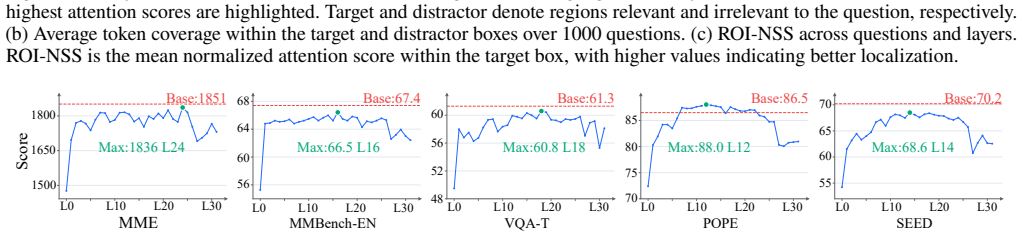
- [Motivation, Fig. 2] The analysis of 500 paired questions from GQA is based on a specific dataset and a specific model; please state explicitly that the conclusions about layer variability are drawn from this single source, since the later layer-wise pruning evaluation (Fig. 3) covers only five benchmarks.
- [Abstract] The abstract reports '5.56% of the visual tokens' while Tables 1 and 2 use '5.6%' in their row labels; please make the rounding consistent.
- [Experiments, Table 2] For the LearnPruner rows, the 'Rel.' column appears to be computed over only the non-missing benchmarks; this should be stated in the table caption or in the text to avoid an unfair comparison with full-row methods.
- [Method, QCTS] The fixed reference question 'What is shown in this image?' is presented as a neutral baseline, but it may itself direct attention to salient objects; a brief discussion of this assumption and its potential failure modes would strengthen the motivation.
Circularity Check
No significant circularity: MAP's predictor is a trained surrogate with independent benchmark evaluation.
full rationale
The derivation chain is sequential and each stage is independently specified. The Motivation section first establishes, through its own GQA analysis (Fig. 2) and layer-wise pruning probes (Fig. 3), that middle-layer text-to-vision attention localizes question-relevant evidence and that the best layer varies. QCTS then selects a teacher layer by maximizing JS divergence between attention for the original and a reference question (Eq. 2), and this selection is validated against ground-truth ROI-Max in Table 4, an external criterion not used in the method. The predictor is trained to imitate the selected teacher's attention from pre-LLM embeddings via KL divergence (Eq. 3), and is evaluated by downstream benchmark retention rather than by any quantity that appears as a training input. The final inference rule (Eq. 4) combines predicted importance with a diversity residual, and Table 6 ablates the diversity term, showing the importance term alone already drives most of the gain. The headline 97.5% relative score and 3.09x speedup are measured on ten held-out benchmarks and are not quantities used to define or fit the method. There is no load-bearing self-citation with author overlap: LearnPruner is external prior work, and the paper re-derives the middle-layer-attention effect with its own analysis. The undisclosed training data for the predictor is a legitimate generalization-risk concern, but it is not a circularity because the paper does not state that evaluation benchmarks were used to train the predictor, and no equation or construction forces the benchmark result from the training objective. The predictor is a learned surrogate, not a self-referential derivation, so the central claim retains independent empirical content.
Assumptions & free parameters
free parameters (1)
- K0
assumptions (4)
- domain assumption Middle-layer text-to-vision attention reliably indicates which visual tokens are relevant to the question.
- ad hoc to paper The layer with the largest Jensen-Shannon divergence between question-conditioned and reference-conditioned attention distributions is the best teacher layer for pruning.
- domain assumption A lightweight predictor operating on pre-LLM multimodal features can generalize to estimate the selected layer's attention distribution on unseen images.
- ad hoc to paper The fixed reference question 'What is shown in this image?' provides a neutral baseline for question-contrastive selection.
Cite this review
Pith. "Pith review of Learning to Predict Middle-Layer Attention in MLLMs for Visual Token Prunin." pith.science (2026). https://pith.science/paper/STES65VE
@misc{pith2026260806411,
  author       = {Pith},
  title        = {Pith review of: Learning to Predict Middle-Layer Attention in MLLMs for Visual Token Prunin},
  year         = {2026},
  howpublished = {\url{https://pith.science/paper/STES65VE}},
  note         = {Machine review of arXiv:2608.06411}
}
read the original abstract
Multimodal large language models (MLLMs) achieve strong performance across diverse vision-language tasks, but their efficiency is limited by the cost of processing numerous visual tokens. Visual token pruning can reduce this cost, but requires accurate token importance estimates. Recent studies have demonstrated that text-to-vision attention from middle language model layers can effectively guide visual token pruning, typically using attention from a predefined middle layer to select the visual tokens to retain. Two problems therefore remain. First, our analysis shows that the layer whose attention is most responsive to the question varies substantially across samples, making a fixed layer suboptimal. Second, obtaining attention from the appropriate middle layer requires processing numerous visual tokens through several language model layers, by which point considerable computation has already been spent. To address both problems, we propose Middle-layer Attention Prediction (MAP), which uses Question Contrastive Teacher Selection to identify a sample-specific teacher layer by contrasting attention under the original and reference questions, and distills attention from the selected layer into a lightweight predictor that estimates visual token importance from multi-modal input features. During inference, MAP combines the predicted importance scores with a diversity criterion to prune visual tokens before the first language model layer. Thus, MAP requires no attention maps for pruning and remains compatible with existing inference acceleration techniques. Across ten benchmarks on LLaVA-NeXT-7B, MAP retains 97.5% of the unpruned model performance with only 5.56% of the visual tokens, yielding a 3.09x end-to-end speedup.
Figures


Figures from the paper (2 more)


Reference graph
Works this paper leans on
-
[1]
arXiv preprint arXiv:2502.13923 , year=
Qwen2.5-VL Technical Report , author=. arXiv preprint arXiv:2502.13923 , year=
-
[2]
arXiv preprint arXiv:2504.10479 , year=
Internvl3: Exploring advanced training and test-time recipes for open-source multimodal models , author=. arXiv preprint arXiv:2504.10479 , year=
-
[3]
CVPR , year=
Internvl: Scaling up vision foundation models and aligning for generic visual-linguistic tasks , author=. CVPR , year=
-
[4]
ICML , year=
Learning transferable visual models from natural language supervision , author=. ICML , year=
-
[5]
ICML , year=
Blip-2: Bootstrapping language-image pre-training with frozen image encoders and large language models , author=. ICML , year=
-
[6]
NeurIPS , year=
Instructblip: Towards general-purpose vision-language models with instruction tuning , author=. NeurIPS , year=
-
[7]
NeurIPS , year=
Flamingo: a visual language model for few-shot learning , author=. NeurIPS , year=
-
[8]
NeurIPS , year=
Visual instruction tuning , author=. NeurIPS , year=
Show all 105 references
-
[9]
CVPR , year=
Improved baselines with visual instruction tuning , author=. CVPR , year=
-
[10]
Llava-next: Improved reasoning, ocr, and world knowledge , author=
-
[11]
arXiv preprint arXiv:2308.12966 , year=
Qwen-vl: A frontier large vision-language model with versatile abilities , author=. arXiv preprint arXiv:2308.12966 , year=
-
[12]
arXiv preprint arXiv:2404.16821 , year=
How far are we to gpt-4v? closing the gap to commercial multimodal models with open-source suites , author=. arXiv preprint arXiv:2404.16821 , year=
-
[13]
arXiv preprint arXiv:2312.11805 , year=
Gemini: a family of highly capable multimodal models , author=. arXiv preprint arXiv:2312.11805 , year=
-
[14]
arXiv preprint arXiv:2403.05530 , year=
Gemini 1.5: Unlocking multimodal understanding across millions of tokens of context , author=. arXiv preprint arXiv:2403.05530 , year=
-
[15]
Gpt-4v(ision) system card , author=
-
[16]
arXiv preprint arXiv:2210.09461 , year=
Token merging: Your vit but faster , author=. arXiv preprint arXiv:2210.09461 , year=
-
[17]
arXiv preprint arXiv:2202.07800 , year=
Not all patches are what you need: Expediting vision transformers via token reorganizations , author=. arXiv preprint arXiv:2202.07800 , year=
-
[18]
arXiv preprint arXiv:2403.15388 , year=
Llava-prumerge: Adaptive token reduction for efficient large multimodal models , author=. arXiv preprint arXiv:2403.15388 , year=
-
[19]
CVPR , year=
Honeybee: Locality-enhanced projector for multimodal llm , author=. CVPR , year=
-
[20]
arXiv preprint arXiv:2312.16886 , year=
Mobilevlm: A fast, strong and open vision language assistant for mobile devices , author=. arXiv preprint arXiv:2312.16886 , year=
-
[21]
arXiv preprint arXiv:2407.02392 , year=
Tokenpacker: Efficient visual projector for multimodal llm , author=. arXiv preprint arXiv:2407.02392 , year=
-
[22]
arXiv preprint arXiv:2411.17686 , year=
Rethinking Token Reduction in MLLMs: Towards a Unified Paradigm for Training-Free Acceleration , author=. arXiv preprint arXiv:2411.17686 , year=
-
[23]
arXiv preprint arXiv:2307.09288 , year=
Llama 2: Open foundation and fine-tuned chat models , author=. arXiv preprint arXiv:2307.09288 , year=
-
[24]
arXiv preprint arXiv:2309.16609 , year=
Qwen technical report , author=. arXiv preprint arXiv:2309.16609 , year=
-
[25]
arXiv preprint arXiv:2403.18814 , year=
Mini-gemini: Mining the potential of multi-modality vision language models , author=. arXiv preprint arXiv:2403.18814 , year=
-
[26]
arXiv preprint arXiv:2501.03895 , year=
LLaVA-Mini: Efficient Image and Video Large Multimodal Models with One Vision Token , author=. arXiv preprint arXiv:2501.03895 , year=
-
[27]
CVPR , year=
Feature pyramid networks for object detection , author=. CVPR , year=
-
[28]
CVPR , year=
Deep residual learning for image recognition , author=. CVPR , year=
-
[29]
arXiv preprint arXiv:2412.01818 , year=
[CLS] Attention is All You Need for Training-Free Visual Token Pruning: Make VLM Inference Faster , author=. arXiv preprint arXiv:2412.01818 , year=
-
[30]
arXiv preprint arXiv:2410.04417 , year=
Sparsevlm: Visual token sparsification for efficient vision-language model inference , author=. arXiv preprint arXiv:2410.04417 , year=
-
[31]
arXiv preprint arXiv:2411.10803 , year=
Multi-Stage Vision Token Dropping: Towards Efficient Multimodal Large Language Model , author=. arXiv preprint arXiv:2411.10803 , year=
-
[32]
arXiv preprint arXiv:2412.00447 , year=
ATP-LLaVA: Adaptive Token Pruning for Large Vision Language Models , author=. arXiv preprint arXiv:2412.00447 , year=
-
[33]
arXiv preprint arXiv:2410.14072 , year=
Efficient vision-language models by summarizing visual tokens into compact registers , author=. arXiv preprint arXiv:2410.14072 , year=
-
[34]
arXiv preprint arXiv:2403.17297 , year=
Internlm2 technical report , author=. arXiv preprint arXiv:2403.17297 , year=
-
[35]
CVPR , year=
Towards vqa models that can read , author=. CVPR , year=
-
[36]
WACV , year=
Docvqa: A dataset for vqa on document images , author=. WACV , year=
-
[37]
WACV , year=
Infographicvqa , author=. WACV , year=
-
[38]
arXiv preprint arXiv:2203.10244 , year=
Chartqa: A benchmark for question answering about charts with visual and logical reasoning , author=. arXiv preprint arXiv:2203.10244 , year=
-
[39]
CVPR , year=
Gqa: A new dataset for real-world visual reasoning and compositional question answering , author=. CVPR , year=
-
[40]
CVPR , year=
Vizwiz grand challenge: Answering visual questions from blind people , author=. CVPR , year=
-
[41]
EMNLP , year=
Evaluating object hallucination in large vision-language models , author=. EMNLP , year=
-
[42]
CVPR , year=
Mmmu: A massive multi-discipline multimodal understanding and reasoning benchmark for expert agi , author=. CVPR , year=
-
[43]
arXiv preprint arXiv:2402.03766 , year=
Mobilevlm v2: Faster and stronger baseline for vision language model , author=. arXiv preprint arXiv:2402.03766 , year=
-
[44]
ECCV , year=
Llava-uhd: an lmm perceiving any aspect ratio and high-resolution images , author=. ECCV , year=
-
[45]
arXiv e-prints , year=
Mini-monkey: Alleviate the sawtooth effect by multi-scale adaptive cropping , author=. arXiv e-prints , year=
-
[46]
CVPR , year=
Monkey: Image resolution and text label are important things for large multi-modal models , author=. CVPR , year=
-
[47]
arXiv preprint arXiv:2307.02499 , year=
mplug-docowl: Modularized multimodal large language model for document understanding , author=. arXiv preprint arXiv:2307.02499 , year=
-
[48]
arXiv preprint arXiv:2406.08487 , year=
Beyond llava-hd: Diving into high-resolution large multimodal models , author=. arXiv preprint arXiv:2406.08487 , year=
-
[49]
NeurIPS , year=
Internlm-xcomposer2-4khd: A pioneering large vision-language model handling resolutions from 336 pixels to 4k hd , author=. NeurIPS , year=
-
[50]
ECCV , pages=
Sharegpt4v: Improving large multi-modal models with better captions , author=. ECCV , pages=
-
[51]
arXiv preprint arXiv:2304.10592 , year=
Minigpt-4: Enhancing vision-language understanding with advanced large language models , author=. arXiv preprint arXiv:2304.10592 , year=
-
[52]
NeurIPS , year=
Dense connector for mllms , author=. NeurIPS , year=
-
[53]
arXiv preprint arXiv:2409.10994 , year=
Less is more: A simple yet effective token reduction method for efficient multi-modal llms , author=. arXiv preprint arXiv:2409.10994 , year=
-
[54]
arXiv preprint arXiv:2409.09564 , year=
TG-LLaVA: Text Guided LLaVA via Learnable Latent Embeddings , author=. arXiv preprint arXiv:2409.09564 , year=
-
[55]
arXiv preprint arXiv:2411.14228 , year=
FocusLLaVA: A Coarse-to-Fine Approach for Efficient and Effective Visual Token Compression , author=. arXiv preprint arXiv:2411.14228 , year=
-
[56]
arXiv preprint arXiv:2403.05525 , year=
Deepseek-vl: towards real-world vision-language understanding , author=. arXiv preprint arXiv:2403.05525 , year=
-
[57]
NeurIPS , year=
Cogvlm: Visual expert for pretrained language models , author=. NeurIPS , year=
-
[58]
arXiv preprint arXiv:2010.11929 , year=
An image is worth 16x16 words: Transformers for image recognition at scale , author=. arXiv preprint arXiv:2010.11929 , year=
2010 arXiv
-
[59]
NeurIPS , year=
Flashattention: Fast and memory-efficient exact attention with io-awareness , author=. NeurIPS , year=
-
[60]
arXiv preprint arXiv:2409.12191 , year=
Qwen2-vl: Enhancing vision-language model's perception of the world at any resolution , author=. arXiv preprint arXiv:2409.12191 , year=
-
[61]
ICML , pages=
Blip: Bootstrapping language-image pre-training for unified vision-language understanding and generation , author=. ICML , pages=
-
[62]
arXiv preprint arXiv:2412.10302 , year=
Deepseek-vl2: Mixture-of-experts vision-language models for advanced multimodal understanding , author=. arXiv preprint arXiv:2412.10302 , year=
-
[63]
ACM Transactions on Database Systems (TODS) , pages=
DBSCAN revisited, revisited: why and how you should (still) use DBSCAN , author=. ACM Transactions on Database Systems (TODS) , pages=
-
[64]
arXiv preprint arXiv:2410.21276 , year=
Gpt-4o system card , author=. arXiv preprint arXiv:2410.21276 , year=
-
[65]
arXiv preprint arXiv:2507.06261 , year=
Gemini 2.5: Pushing the frontier with advanced reasoning, multimodality, long context, and next generation agentic capabilities , author=. arXiv preprint arXiv:2507.06261 , year=
-
[66]
Proceedings of the 32nd ACM International Conference on Multimedia , pages=
Vlmevalkit: An open-source toolkit for evaluating large multi-modality models , author=. Proceedings of the 32nd ACM International Conference on Multimedia , pages=
-
[67]
arXiv preprint arXiv:2407.07895 , year=
Llava-next-interleave: Tackling multi-image, video, and 3d in large multimodal models , author=. arXiv preprint arXiv:2407.07895 , year=
-
[68]
CVPR , year=
Making the v in vqa matter: Elevating the role of image understanding in visual question answering , author=. CVPR , year=
-
[69]
ECCV , year=
Mmbench: Is your multi-modal model an all-around player? , author=. ECCV , year=
-
[70]
NeurIPS , year=
Are we on the right way for evaluating large vision-language models? , author=. NeurIPS , year=
-
[71]
arXiv preprint arXiv:2307.16125 , year=
Seed-bench: Benchmarking multimodal llms with generative comprehension , author=. arXiv preprint arXiv:2307.16125 , year=
-
[72]
arXiv preprint arXiv:2306.13394 , year=
Mme: A comprehensive evaluation benchmark for multimodal large language models , author=. arXiv preprint arXiv:2306.13394 , year=
-
[73]
ICCV , year=
Shortv: Efficient multimodal large language models by freezing visual tokens in ineffective layers , author=. ICCV , year=
-
[74]
arXiv preprint arXiv:2411.19628 , year=
Accelerating multimodal large language models via dynamic visual-token exit and the empirical findings , author=. arXiv preprint arXiv:2411.19628 , year=
-
[75]
arXiv preprint arXiv:2511.21631 , year=
Qwen3-vl technical report , author=. arXiv preprint arXiv:2511.21631 , year=
-
[76]
arXiv preprint arXiv:2408.03326 , year=
Llava-onevision: Easy visual task transfer , author=. arXiv preprint arXiv:2408.03326 , year=
-
[77]
CVPR , year=
Visionzip: Longer is better but not necessary in vision language models , author=. CVPR , year=
-
[78]
AAAI , year=
Fit and prune: Fast and training-free visual token pruning for multi-modal large language models , author=. AAAI , year=
-
[79]
ECCV , year=
An image is worth 1/2 tokens after layer 2: Plug-and-play inference acceleration for large vision-language models , author=. ECCV , year=
-
[80]
NeurIPS , year=
Beyond attention or similarity: Maximizing conditional diversity for token pruning in mllms , author=. NeurIPS , year=
-
[81]
CVPR , year=
Fastvlm: Efficient vision encoding for vision language models , author=. CVPR , year=
-
[82]
5-vl technical report , author=
Seed1. 5-vl technical report , author=. arXiv preprint arXiv:2505.07062 , year=
-
[83]
arXiv preprint arXiv:2503.21307 , year=
Internvl-x: Advancing and accelerating internvl series with efficient visual token compression , author=. arXiv preprint arXiv:2503.21307 , year=
-
[84]
NeurIPS , year=
Language models are few-shot learners , author=. NeurIPS , year=
-
[85]
arXiv preprint arXiv:2302.13971 , year=
Llama: Open and efficient foundation language models , author=. arXiv preprint arXiv:2302.13971 , year=
-
[86]
arXiv preprint arXiv:2412.19437 , year=
Deepseek-v3 technical report , author=. arXiv preprint arXiv:2412.19437 , year=
-
[87]
arXiv preprint arXiv:2505.09388 , year=
Qwen3 technical report , author=. arXiv preprint arXiv:2505.09388 , year=
-
[88]
AAAI , year=
Boosting multimodal large language models with visual tokens withdrawal for rapid inference , author=. AAAI , year=
-
[89]
ECCV , year=
A diagram is worth a dozen images , author=. ECCV , year=
-
[90]
CVPR , year=
Hallusionbench: an advanced diagnostic suite for entangled language hallucination and visual illusion in large vision-language models , author=. CVPR , year=
-
[91]
arXiv preprint arXiv:2307.02628 , year=
Skipdecode: Autoregressive skip decoding with batching and caching for efficient llm inference , author=. arXiv preprint arXiv:2307.02628 , year=
-
[92]
arXiv preprint arXiv:2506.04179 , year=
Skipgpt: Dynamic layer pruning reinvented with token awareness and module decoupling , author=. arXiv preprint arXiv:2506.04179 , year=
-
[93]
arXiv preprint arXiv:2404.02258 , year=
Mixture-of-depths: Dynamically allocating compute in transformer-based language models , author=. arXiv preprint arXiv:2404.02258 , year=
-
[94]
Proceedings of the 2025 Conference on Empirical Methods in Natural Language Processing , pages=
VisiPruner: Decoding Discontinuous Cross-Modal Dynamics for Efficient Multimodal LLMs , author=. Proceedings of the 2025 Conference on Empirical Methods in Natural Language Processing , pages=
2025
-
[95]
arXiv preprint arXiv:2512.03043 , year=
Onethinker: All-in-one reasoning model for image and video , author=. arXiv preprint arXiv:2512.03043 , year=
-
[96]
arXiv preprint arXiv:2604.23950 , year=
LearnPruner: Rethinking Attention-based Token Pruning in Vision Language Models , author=. arXiv preprint arXiv:2604.23950 , year=
-
[97]
arXiv preprint arXiv:2601.22674 , year=
VisionTrim: Unified Vision Token Compression for Training-Free MLLM Acceleration , author=. arXiv preprint arXiv:2601.22674 , year=
-
[98]
AAAI , pages=
D ^2 Pruner: Debiased Importance and Structural Diversity for MLLM Token Pruning , author=. AAAI , pages=
-
[99]
Findings of the Association for Computational Linguistics: NAACL 2025 , year=
Lmms-eval: Reality check on the evaluation of large multimodal models , author=. Findings of the Association for Computational Linguistics: NAACL 2025 , year=
2025
-
[100]
arXiv preprint arXiv:2602.23699 , year=
Hidrop: Hierarchical vision token reduction in mllms via late injection, concave pyramid pruning, and early exit , author=. arXiv preprint arXiv:2602.23699 , year=
-
[101]
NeurIPS , year=
Learn to explain: Multimodal reasoning via thought chains for science question answering , author=. NeurIPS , year=
-
[102]
arXiv preprint arXiv:2508.18264 , year=
Mmtok: Multimodal coverage maximization for efficient inference of vlms , author=. arXiv preprint arXiv:2508.18264 , year=
-
[103]
CVPR , year=
ZOO-Prune: Training-Free Token Pruning via Zeroth-Order Gradient Estimation in Vision-Language Models , author=. CVPR , year=
-
[104]
ICCV , year=
Beyond text-visual attention: Exploiting visual cues for effective token pruning in vlms , author=. ICCV , year=
-
[105]
Important Tokens
Stop Looking for “Important Tokens” in Multimodal Language Models: Duplication Matters More , author=. EMNLP , year=
Reviewed August 10, 2026 · model on record in the stance chip above.
Discussion (0). Continue with ORCID to comment.