REVIEW 3 major objections 4 minor 35 references
Fixed and Adaptive Topological DeepONets: Functional Measurements on Hausdorff Locally Convex Spaces
T0 review · 3 major / 4 minor · reviewed 2026-08-10 · deepseek-v4-flash
Pith's one-line read The paper replaces point-sensor DeepONet inputs with continuous linear functionals from the dual of a Hausdorff locally convex space, yielding compact, interpretable coordinates that transfer across discretizations, including for…
desk verdict A solid functional-measurement idea with two overclaimed results: the non-normable benchmark is mislabeled and the discretization-portability claim lacks quadrature analysis. read the letter →
The pith
A machine-rendered reading of the paper's core claim, the machinery that carries it, and where it could break.
The reading
What carries the argument
The load-bearing object is the functional measurement map $\Lambda_m(v)=(\lambda_1(v),\dots,\lambda_m(v))^\top$ with $\lambda_j\in V'$, the continuous dual of a Hausdorff locally convex space whose topology is generated by a point-separating family of seminorms $\{p_\alpha\}$. In the adaptive variant the coordinates are further compressed by a trainable linear map $M\in\mathbb{R}^{m\times q}$ initialized from a structured dictionary, so each learned coordinate $\ell_k^M(v)=\sum_j M_{jk}\lambda_j(v)$ is still a continuous linear functional. This map is combined with a Two-Step construction: a weighted SVD of output snapshots produces a rank-stable, weighted-orthonormal output basis, and the branch network predicts reduced coefficients in that basis, with a training-only decoder and soft orthogonality and drift losses stabilizing the adaptive measurements. The discrete error bound separates the total error into $L_h\varepsilon_{\mathrm{rec}}(q)+\varepsilon_{\mathrm{out}}(r,q)+\varepsilon_{NN}$, and the Barron refinement gives a network-width rate $N^{-1/2}$ for the neural term.
What would settle it
Recompute the 32 Darcy functional coordinates $\ell_j(a)=\int_\Omega a(x)\phi_j(x)\,dx$ by the paper's grid-dependent quadrature on a coarse and strongly nonuniform unseen mesh, and compare them with the same functionals evaluated on the fine reference field; if the quadrature-induced error is comparable to the model's $5.5\%$ prediction error, the claim of discretization portability is not settled. A simpler check is to report the quadrature error itself for the $57\times57$ grid before training.
Extended reading notes
Core claim
On the paper's own terms, the central discovery is that replacing the point-evaluation encoding $\mathcal{S}_m(v)=(v(x_1),\dots,v(x_m))$ of a DeepONet branch with a functional measurement map $\mathcal{L}_m(v)=(\ell_1(v),\dots,\ell_q(v))$, where each $\ell_j$ belongs to the continuous dual $V'$ of the input space $(V,\{p_\alpha\})$, preserves the branch-trunk architecture while freeing the coordinates from any prescribed mesh and extending the framework to non-normable locally convex spaces. The fixed model uses prescribed global functionals; the adaptive model learns a linear map $M\in\mathbb{R}^{m\times q}$ inside the span of an admissible dual dictionary, so each learned coordinate remains a continuous linear functional. Combined with a weighted-SVD output basis from the Two-Step procedure, the framework yields a total error controlled by measurement reconstruction, output-basis truncation, and neural approximation. The paper argues that the empirical evidence, including best DeepONet accuracy on fixed-time Navier-Stokes, resolution-independent Darcy errors on unseen grids, and a benchmark on a non-normable locally convex input space, supports the conclusion that the continuous dual coordinates themselves, rather than universal superiority over grid-adapted architectures such as FNO, are the contribution.
Load-bearing premise
The load-bearing practical premise is that evaluating the same continuous linear functionals by grid-dependent quadrature on arbitrary unseen meshes accurately approximates the true continuum dual pairings, and the paper provides no quadrature-error analysis, no minimum-resolution condition, and no sensitivity study for that transfer step.
Editorial extensions
If this is right
- The same $q$ functionals can be evaluated on any native grid, so a model trained on mixed resolutions can be applied to unseen meshes without interpolating inputs to a common grid.
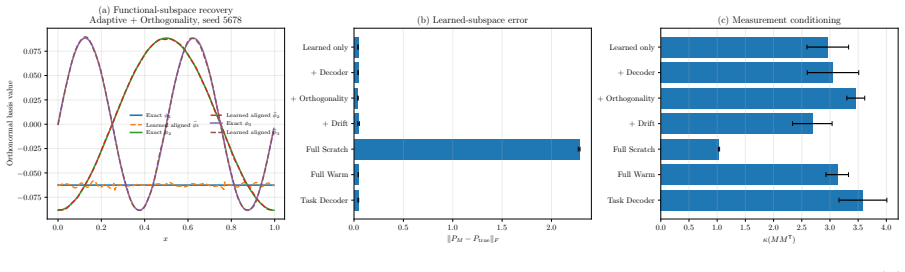
- At equal representation budgets, global functional coordinates outperform point sensors: on Darcy, the Fixed Topological model reduces global relative $L^2$ error from $10.39\%$ to $5.88\%$ at $q=32$.
- Learning the measurement functionals yields gains at nearly unchanged inference cost, with the Adaptive model reaching $1.685\%$ mean relative error on fixed-time Navier-Stokes and $76.0\%$ of test samples below the $2\%$ threshold.
- The framework extends to non-normable locally convex input spaces and to distribution-valued inputs where measurements are evaluated directly from source lists without rasterization.
- A matched Fourier neural operator still achieves $0.832\%$ on the same benchmark, so the contribution is compact, portable, interpretable coordinates rather than universal accuracy superiority.
Reading between the lines
- The paper's portability claim is only as strong as its quadrature: a testable extension is to derive quadrature-error bounds for the dual pairings on coarse or irregular grids and to adapt the weights to each native mesh.
- Because the learned coordinates are confined to the span of a prescribed dictionary, the dual-continuity guarantee is structural; extending the dictionary during training, or using unrestricted learned test functions, would break the guarantee and would need separate justification.
- The error decomposition suggests that measurement compression and output-basis truncation can be tuned independently; tracking the three error terms during training could guide adaptive dictionary selection in future operator-learning pipelines.
- The same functional-coordinate idea could be combined with physics-informed losses or used as interpretable features for inverse problems and uncertainty quantification on experimental data that arrive on irregular grids.
Editorial analysis
A structured set of objections, weighed in public.
Referee Report
Summary. The paper proposes Fixed and Adaptive Topological DeepONets, which replace the point-sample branch input of a standard DeepONet with continuous linear functionals drawn from the dual V' of a Hausdorff locally convex input space (V,{p_α}). The adaptive measurements are learned as linear combinations of a fixed admissible dual dictionary, and both variants are combined with a Two-Step coefficient-space output projection. The theoretical section derives a finite-dimensional error decomposition (Theorem 4.1) separating measurement-reconstruction, output-basis truncation, and neural-approximation errors, together with a Barron-rate refinement (Corollary 4.1). Experiments span the antiderivative operator with per-sample verification of the bound, heterogeneous Darcy flow including transfer to unseen grids, a controlled operator with a known task-relevant input subspace, fixed-time and time-evolving Navier-Stokes vorticity prediction, and a screened-Poisson operator with source-list (measure-valued) inputs. The Adaptive Topological DeepONet is reported as the most accurate DeepONet-based model on the fixed-time Navier-Stokes problem (mean relative L2 error 1.685% ± 0.017% with 128 functional coordinates), while a parameter-matched FNO achieves lower error (0.832% ± 0.172%) at higher training time, peak GPU memory, and seed variance.
Significance. The computational study is substantial and largely carefully controlled: matched parameter budgets across models, an explicitly framed FNO comparison that concedes lower accuracy on the uniform periodic grid, per-sample coverage metrics, a controlled operator that isolates the task-relevant functional subspace, and detailed appendices documenting dictionaries, quadrature, SVD construction, and training schedules. Theorem 4.1 is correct but elementary (a triangle-inequality decomposition in finite dimensions), and its numerical verification in Section 5.1 is a strength, although the reported verification numbers are internally inconsistent (Major Comment 3). The paper's genuine strengths are the honest and mostly controlled experiments rather than the theory. If the load-bearing issues below are resolved — the misidentified 'non-normable' benchmark, the unsupported discretization-portability verification, and the contradictory sharpness ratios — the manuscript would be a solid computational contribution to operator learning. In its current form, the headline claims about non-normable input spaces and discretization portability exceed the evidence provided.
major comments (3)
- [Section 5.9; Abstract; Section 6] The abstract's final claim — that the formulation works 'including for input spaces that are not normable' — is supported in the manuscript only by the screened-Poisson benchmark, which is described as posed on 'a genuinely non-normable locally convex input space.' As written this is incorrect: the space M(Ω) of finite signed measures on a bounded domain is a Banach space under the total variation norm. Section 5.9 specifies no topology on M(Ω), and the algorithm only evaluates the finite sums ℓ_j(μ) = Σ_i a_i φ_j(x_i) directly from the source list; it never computes the seminorms p_α or otherwise engages a non-normable topology. If the intended input topology is the weak-* topology σ(M(Ω), C(Ω)), which is indeed non-normable, the paper must say so explicitly, since the continuity of the functionals and of G depends on the chosen topology. The benchmark therefore demonstrates learning from measure-valued source lists, but it does not demonstrate the claimed extension to non-normable input spaces, and Section 6's statement that the input topology 'cannot be represented by a single norm' is unsupported.
- [Section 5.5; Eq. (83); Appendices B.3, B.5, B.6] The discretization-portability claim, which is the central advertised advantage over fixed-grid DeepONets, is not established. The discrete evaluation ℓ_j(a) ≈ Σ_m w_m a(x_m) φ_j(x_m) in Eq. (83) is used with no quadrature-error analysis, no minimum-resolution condition, and no direct comparison against the continuum pairing ∫_Ω a φ_j. The 'unseen' test grids in Section 5.5 (57×57, 73×73, 97×97) are, as the paper itself discloses, generated by subsampling a common stored fine (421×421) field, so the quadrature error is correlated with the training-resolution family and the test does not probe arbitrary native meshes. Moreover, the dictionary orthonormalization in Appendix B.5 is computed with the training-grid weighted Gram matrix G = Φ^T W_q Φ, and the active-atom selection in Appendix B.6 uses training-set variance; if these preprocessing steps are rerun on a new grid, the coordinates are not evaluations of the same continuum functionals, whereas if they are frozen, the quadrature error on a new grid is uncontrolled. Finally, Theorem 4.1 is entirely finite-dimensional and never bounds the gap between the discrete ℓ_{j,h} and a continuum ℓ_j, so the theory also provides no support for the cross-grid claim. A direct measurement of the quadrature error, or a test on genuinely independent meshes, is needed before the portability claim can be accepted.
- [Section 5.1 and Section 6] The reported numerical verification of Theorem 4.1 is internally inconsistent. Section 5.1 and Figure 4(d) state that at q = 32 the maximum samplewise ratio is max_i E_tot/E_thm = 0.1249, whereas Section 6 states that 'all 400 test samples satisfied the samplewise bound, with maximum sharpness ratios of 0.94 and 0.97 for the adaptive and fixed models, respectively.' These numbers cannot both describe the verification of the same bound. Please report a single consistent set of values, define E_emp and E_thm precisely, and specify over which q the sharpness ratio is maximized.
minor comments (4)
- [Section 3.2.5; Algorithm 1] The text says the adaptive coordinates 'remain continuous linear functionals,' but the coordinates actually fed to the branch network are standardized: z̃(v) = diag(σ_z)^{-1}(M^T Λ_m(v) − μ_z), which is an affine map of v, not a linear one. Please either absorb the standardization into the network or state explicitly that the linearity claim refers to the pre-standardization measurement map.
- [Code and Reproducibility] The paper states that code and data 'will be made publicly available upon publication,' but no artifact is available in the submitted version. Given the number of benchmarks, dictionaries, and hyperparameters, providing the code at revision time would materially aid verification of the central claims.
- [Notation] The symbol m denotes the number of sensors/functionals in Section 3.1, the number of base observations in Section 3.2, and the grid-point index in Eq. (83); harmonizing this notation would improve readability.
- [Figure 4 and Appendix A.5] The quantities E_emp, E_thm, and the 'operator-level measurement error' E_op,meas plotted in Figure 4 are not consistently defined in the text: Section 5.1 defines E_thm = E_Lip + E_out + E_NN, while Appendix A.5 defines E_bound = E_meas + E_out + E_NN and never defines E_emp; please align the notation between the figure, the text, and the appendix.
Circularity Check
No circularity: the central error bound is an elementary decomposition, the adaptive coordinates are supervised fits, and self-citations are contextual.
full rationale
The derivation chain is self-contained. Theorem 4.1 states a finite-dimensional triangle-inequality decomposition with a standard universal-approximation term; the proof exhibits the decomposition directly (Eq. 24) and does not import the empirical results. The adaptive measurement matrix M is trained from data and evaluated on held-out test inputs, so the accuracy claims are fits tested out-of-sample, not fitted parameters renamed as predictions. The claim that learned coordinates remain in V' follows by construction from Eq. 7 and Appendix B.7 (linear combinations of dual elements are dual elements), which is a closure property rather than a circular derivation. Self-citations [1,5-10,20,30] are contextual background or baselines; the load-bearing approximation theorem is attributed to Ismailov [2], an external author. The numerical 'verification' of the bound in Section 5.1/A.5 is a tautological application of the triangle inequality with the neural term defined as the remainder, but it is presented as an illustration of the decomposition, not as evidence for a predictive claim, so it does not constitute circularity. The discretization-portability claim rests on an untested quadrature assumption and on subsampled rather than truly native unseen grids; that is an experimental/correctness risk, not a circularity.
Assumptions & free parameters
free parameters (6)
- q: number of functional coordinates =
40 (antiderivative cosine), 4 (antiderivative Legendre), 32 (Darcy), 128 (Navier-Stokes)
- r: output basis rank =
64 (antiderivative), up to 128 (Navier-Stokes)
- Adaptive regularization weights λrec, λorth, λdrift =
λdrift = 1e-4 reported for antiderivative; other weights not reported
- Coefficient-loss weights λrel, λworst, temperature τc =
not reported
- Multiscale dictionary hyperparameters K, scales =
K = 512 = 4*128; scales {1.5, 3, 6, 12}
- Quadrature rule for functionals =
grid-dependent weights (e.g., trapezoidal or discrete inner products)
assumptions (6)
- standard math Feed-forward networks with continuous nonpolynomial activations can uniformly approximate continuous functions on compact subsets of R^q
- standard math Barron's theorem: functions with finite Barron norm are approximated by two-layer sigmoidal networks at rate N^{-1/2}
- domain assumption Ismailov's Topological DeepONet universality theorem for continuous operators on compact subsets of Hausdorff locally convex spaces
- domain assumption K_h is compact and G_h is Lipschitz continuous on K_h ∪ R_q(M_q K_h) with constant L_h
- domain assumption Grid-dependent quadrature accurately realizes continuum functionals on unseen discretizations
- ad hoc to paper The screened-Poisson input space M(Ω) is non-normable
Cite this review
Pith. "Pith review of Fixed and Adaptive Topological DeepONets: Functional Measurements on Hausdorff Locally Convex Spaces." pith.science (2026). https://pith.science/paper/J3R3MQ5M
@misc{pith2026260806428,
  author       = {Pith},
  title        = {Pith review of: Fixed and Adaptive Topological DeepONets: Functional Measurements on Hausdorff Locally Convex Spaces},
  year         = {2026},
  howpublished = {\url{https://pith.science/paper/J3R3MQ5M}},
  note         = {Machine review of arXiv:2608.06428}
}
abstract
Deep Operator Networks (DeepONets; arXiv:1910.03193) typically encode an input function through point values on a fixed discretization. Building on the Topological DeepONet framework of Ismailov (arXiv:2603.11972), we replace point samples by continuous linear functionals drawn from the continuous dual of a Hausdorff locally convex space $({V},\{p_\alpha\}_{\alpha\in A})$, whose topology is generated by a point-separating family of seminorms rather than a single norm, and develop fixed and adaptive functional measurement systems. Measurements are combined with the coefficient-space Two-Step procedure of Lee and Shin (arXiv:2309.01020), while a training-only decoder and regularization stabilize the adaptive coordinates. We derive a discrete error decomposition separating measurement, output-basis, and neural-approximation errors, together with a Barron-rate refinement. The framework is evaluated on the antiderivative operator, a non-normable locally convex input space, heterogeneous Darcy flow, a controlled operator, and fixed-time and time-evolving Navier-Stokes vorticity operators. In the heterogeneous Darcy problem, the functional models retain nearly resolution-independent errors of 5.5-5.6% on unseen grids, while in the controlled problem adaptive measurements reduce the mean error below 1.2%. For the fixed-time Navier-Stokes problem, the Adaptive Topological DeepONet is the most accurate DeepONet-based model, attaining a mean relative $L^2$ error of 1.685% +/- 0.017% using 128 functional coordinates. A comparably sized Fourier neural operator (FNO; arXiv:2010.08895) achieves the lower error 0.832% +/- 0.172%, but requires the full 64x64 input field, twice the training time, and 10.7x greater peak GPU memory. The formulation provides compact, interpretable, and discretization-portable coordinates in the continuous dual $V'$, including for non-normable input spaces.
Figures


Figures from the paper (14 more)




Reference graph
Works this paper leans on
-
[1]
Lu Lu, Pengzhan Jin, Guofei Pang, Zhongqiang Zhang, and George Em Karniadakis. Learn- ing nonlinear operators via DeepONet based on the universal approximation theorem of op- erators.Nature Machine Intelligence, 3(3):218–229, 2021. doi: 10.1038/s42256-021-00302-5
-
[2]
Vugar Ismailov. Topological deeponets and a generalization of the chen-chen operator approximation theorem.arXiv preprint arXiv:2603.11972, 2026
-
[3]
Sanghyun Lee and Yeonjong Shin. On the training and generalization of deep operator networks.SIAM Journal on Scientific Computing, 46(4):C273–C296, 2024
work page 2024
-
[4]
Fourier neural operator for parametric partial differential equations
Zongyi Li, Nikola Kovachki, Kamyar Azizzadenesheli, Burigede Liu, Kaushik Bhattacharya, Andrew Stuart, and Anima Anandkumar. Fourier neural operator for parametric partial differential equations. InInternational Conference on Learning Representations, 2021. URL https://openreview.net/forum?id=c8P9NQVtmnO
work page 2021
-
[5]
Deep neural operators as accurate surrogates for shape optimization.Engineering Applications of Artificial Intelligence, 129:107615, 2024
Khemraj Shukla, Vivek Oommen, Ahmad Peyvan, Michael Penwarden, Nicholas Plewacki, Luis Bravo, Anindya Ghoshal, Robert M Kirby, and George Em Karniadakis. Deep neural operators as accurate surrogates for shape optimization.Engineering Applications of Artificial Intelligence, 129:107615, 2024
2024
-
[6]
Learning two-phase microstructure evolution using neural operators and autoencoder architectures.npj Computational Materials, 8(1):190, 2022
Vivek Oommen, Khemraj Shukla, Somdatta Goswami, R´ emi Dingreville, and George Em Karniadakis. Learning two-phase microstructure evolution using neural operators and autoencoder architectures.npj Computational Materials, 8(1):190, 2022
2022
-
[7]
Vivek Oommen, Khemraj Shukla, Saaketh Desai, R´ emi Dingreville, and George Em Kar- niadakis. Rethinking materials simulations: Blending direct numerical simulations with neural operators.npj Computational Materials, 10(1):145, 2024
work page 2024
-
[8]
Deep operator neural network model predictive control.IEEE Open Journal of Control Systems, 2025
Thomas Oliver de Jong, Khemraj Shukla, and Mircea Lazar. Deep operator neural network model predictive control.IEEE Open Journal of Control Systems, 2025
work page 2025
Show all 35 references
-
[9]
Neural operator modeling of platelet geometry and stress in shear flow.arXiv preprint arXiv:2503.12074, 2025
Marco Laudato, Luca Manzari, and Khemraj Shukla. Neural operator modeling of platelet geometry and stress in shear flow.arXiv preprint arXiv:2503.12074, 2025
2025 arXiv
-
[10]
Deep operator learning-based surrogate models for aerothermodynamic analysis of aedc hypersonic waverider.arXiv preprint arXiv:2405.13234, 2024
Khemraj Shukla, Jasmine Ratchford, Luis Bravo, Vivek Oommen, Nicholas Plewacki, Anindya Ghoshal, and George Karniadakis. Deep operator learning-based surrogate models for aerothermodynamic analysis of aedc hypersonic waverider.arXiv preprint arXiv:2405.13234, 2024
2024 arXiv
-
[11]
Maziar Raissi, Paris Perdikaris, and George Em Karniadakis. Physics-informed neural networks: A deep learning framework for solving forward and inverse problems involving nonlinear partial differential equations.Journal of Computational Physics, 378:686–707,
-
[12]
Kevrekidis, Lu Lu, Paris Perdikaris, Sifan Wang, and Liu Yang
George Em Karniadakis, Ioannis G. Kevrekidis, Lu Lu, Paris Perdikaris, Sifan Wang, and Liu Yang. Physics-informed machine learning.Nature Reviews Physics, 3:422–440, 2021. doi: 10.1038/s42254-021-00314-5
2021 doi
-
[13]
Universal differential equations for scientific machine learning.arXiv preprint arXiv:2001.04385, 2020
Christopher Rackauckas, Yingbo Ma, Julius Martensen, Collin Warner, Kirill Zubov, Rohit Supekar, Dominic Skinner, Ali Ramadhan, and Alan Edelman. Universal differential equations for scientific machine learning.arXiv preprint arXiv:2001.04385, 2020
2001 arXiv
-
[14]
Scientific machine learning through physics-informed neural 37 networks: Where we are and what’s next.Journal of Scientific Computing, 92(3):88, 2022
Salvatore Cuomo, Vincenzo Schiano Di Cola, Fabio Giampaolo, Gianluigi Rozza, Maziar Raissi, and Francesco Piccialli. Scientific machine learning through physics-informed neural 37 networks: Where we are and what’s next.Journal of Scientific Computing, 92(3):88, 2022. doi: 10.1...
2022 doi
-
[15]
Kovachki, Zongyi Li, Burigede Liu, Kamyar Azizzadenesheli, Kaushik Bhat- tacharya, Andrew M
Nikola B. Kovachki, Zongyi Li, Burigede Liu, Kamyar Azizzadenesheli, Kaushik Bhat- tacharya, Andrew M. Stuart, and Anima Anandkumar. Neural operator: Learning maps between function spaces with applications to PDEs.Journal of Machine Learning Research, 24(89):1–97, 2023
2023
-
[16]
Multiwavelet-based operator learning for differential equations
Gaurav Gupta, Xiongye Xiao, and Paul Bogdan. Multiwavelet-based operator learning for differential equations. InAdvances in Neural Information Processing Systems, volume 34, pages 24048–24062, 2021
2021
-
[17]
GNOT: A general neural operator transformer for operator learning
Zhongkai Hao, Zhengyi Wang, Hang Su, Chengyang Ying, Yinpeng Dong, Songming Liu, Ze Cheng, Jun Song, and Jun Zhu. GNOT: A general neural operator transformer for operator learning. InProceedings of the 40th International Conference on Machine Learning, volume 202 ofProceedings...
2023
-
[18]
Battaglia
Tobias Pfaff, Meire Fortunato, Alvaro Sanchez-Gonzalez, and Peter W. Battaglia. Learning mesh-based simulation with graph networks. InInternational Conference on Learning Representations, 2021
2021
-
[19]
Wang, Yuan Yin, Jean- No¨ el Vittaut, and Patrick Gallinari
Louis Serrano, Lise Le Boudec, Armand Kassa ¨ ı Koupa ¨ ı, Thomas X. Wang, Yuan Yin, Jean- No¨ el Vittaut, and Patrick Gallinari. Operator learning with neural fields: Tackling PDEs on general geometries. InAdvances in Neural Information Processing Systems, volume 36, 2023
2023
-
[20]
Uncertainty quantification in pinns for turbulent flows: Bayesian inference and repulsive ensembles.arXiv preprint arXiv:2604.17156, 2026
Khemraj Shukla, Zongren Zou, Theo Kaeufer, Michael Triantafyllou, and George Em Karniadakis. Uncertainty quantification in pinns for turbulent flows: Bayesian inference and repulsive ensembles.arXiv preprint arXiv:2604.17156, 2026
2026 arXiv
-
[21]
Seidman, Georgios Kissas, Paris Perdikaris, and George J
Jacob H. Seidman, Georgios Kissas, Paris Perdikaris, and George J. Pappas. NOMAD: Nonlinear manifold decoders for operator learning. InAdvances in Neural Information Processing Systems, volume 35, 2022
2022
-
[22]
Learning the solution operator of para- metric partial differential equations with physics-informed DeepONets.Science Advances, 7 (40):eabi8605, 2021
Sifan Wang, Hanwen Wang, and Paris Perdikaris. Learning the solution operator of para- metric partial differential equations with physics-informed DeepONets.Science Advances, 7 (40):eabi8605, 2021. doi: 10.1126/sciadv.abi8605
2021 doi
-
[23]
Universal approximation to nonlinear operators by neural networks with arbitrary activation functions and its application to dynamical systems
Tianping Chen and Hong Chen. Universal approximation to nonlinear operators by neural networks with arbitrary activation functions and its application to dynamical systems. IEEE Transactions on Neural Networks, 6(4):911–917, 1995. doi: 10.1109/72.392253
1995 doi
-
[24]
MIONet: Learning multiple-input operators via tensor product.SIAM Journal on Scientific Computing, 44(6):A3490–A3514, 2022
Pengzhan Jin, Shuai Meng, and Lu Lu. MIONet: Learning multiple-input operators via tensor product.SIAM Journal on Scientific Computing, 44(6):A3490–A3514, 2022. doi: 10.1137/22M1477751
2022 doi
-
[25]
SVD perspectives for augmenting DeepONet flexibility and interpretability.Computer Methods in Applied Mechanics and Engineering, 403:115718,
Simone Venturi and Tiernan Casey. SVD perspectives for augmenting DeepONet flexibility and interpretability.Computer Methods in Applied Mechanics and Engineering, 403:115718,
-
[26]
Multiscale DeepONet for nonlinear operators in oscillatory function spaces for building seismic wave responses.Engineering Structures, 276:115221, 2023
Lizuo Liu and Wei Cai. Multiscale DeepONet for nonlinear operators in oscillatory function spaces for building seismic wave responses.Engineering Structures, 276:115221, 2023
2023
- [27]
- [28]
-
[29]
A discretization-invariant extension and analysis of some deep operator networks.arXiv preprint arXiv:2307.09738, 2023
Zecheng Zhang, Wing Tat Leung, and Hayden Schaeffer. A discretization-invariant extension and analysis of some deep operator networks.arXiv preprint arXiv:2307.09738, 2023. doi: 10.48550/arXiv.2307.09738
-
[30]
Error estimates for Deep- ONets: A deep learning framework in infinite dimensions.arXiv preprint arXiv:2102.09618,
Samuel Lanthaler, Siddhartha Mishra, and George Em Karniadakis. Error estimates for Deep- ONets: A deep learning framework in infinite dimensions.arXiv preprint arXiv:2102.09618,
-
[31]
Manzil Zaheer, Satwik Kottur, Siamak Ravanbakhsh, Barnabas Poczos, Ruslan Salakhutdi- nov, and Alexander J. Smola. Deep sets. InAdvances in Neural Information Processing Systems, volume 30, pages 3391–3401, 2017
2017
-
[32]
Physics-informed neural operator for learning partial differential equations.arXiv preprint arXiv:2111.03794, 2021
Zongyi Li, Hongkai Zheng, Nikola Kovachki, David Jin, Haoxuan Chen, Burigede Liu, Kamyar Azizzadenesheli, and Anima Anandkumar. Physics-informed neural operator for learning partial differential equations.arXiv preprint arXiv:2111.03794, 2021. A Details of the antiderivative c...
2021 arXiv
-
[2019]
doi: 10.1016/j.jcp.2018.10.045
2018 doi
- [2021]
-
[2023]
doi: 10.1016/j.cma.2022.115718
2022
Reviewed August 10, 2026 · model on record in the stance chip above.
Discussion (0). Continue with ORCID to comment.