REVIEW 3 major objections 4 minor 94 references
bioMoR: Biology-Guided Mixture-of-Recursions for Effective Genomic Learning
T0 review · 3 major / 4 minor · reviewed 2026-08-11 · deepseek-v4-flash
Pith's one-line read A fixed gene-knowledge graph injected into a shared recursive transformer lifts omics classification by 8.2 macro-F1 points over biology-agnostic adaptive computation.
desk verdict Biology-guided recursion depth for genomics is a genuinely new idea with a clean controlled comparison, but the paper leaves a load-bearing ambiguity about whether the biological graph avoids test-cell information. read the letter →
The pith
A machine-rendered reading of the paper's core claim, the machinery that carries it, and where it could break.
The reading
What carries the argument
The load-bearing object is the fixed, row-normalized biological-knowledge matrix $A = D^{-1}B$, where $B$ holds partial correlations among marker genes (from inverse covariance of expression) or undirected relations among curated pathways, and $D$ is the row-sum diagonal matrix. BioMoR applies the same $A$ at three sites: Site 1 smooths tokens as $(1-\lambda)T + \lambda A T$ before recursion; Site 2 adds $\lambda_{\text{attn}}\mathbf{1}[A > 0]$ to attention logits; Site 3 augments MoR's routing score with a learned correction computed from $[A H^{(t)},\, H^{(t)} - A H^{(t)}]$. The machinery is a shared recursive Transformer block $f_\theta$ reused across depths, with token-specific recursion depth $d_m$ decided by expert-choice or token-choice routing, so depth can vary without adding parameters.
What would settle it
Take any single-cell benchmark, recompute the gene co-expression partial-correlation matrix using only each training fold, re-run the bioMoR expert-choice configuration with all other settings fixed, and compare macro-F1 with the reported numbers. If the margin over biology-agnostic MoR collapses, the headline gain came from test-set information in the biological-knowledge matrix rather than from biology-guided routing.
Extended reading notes
Core claim
The paper proposes bioMoR, a Mixture-of-Recursions model in which one Transformer block is reused up to K times and a router decides, at each step, which gene-marker or Reactome pathway tokens continue to the next recursion. Its central discovery is that biology can guide all three places where adaptive computation is decided: a learned mixture smooths token embeddings toward biological neighbors, a binary mask biases self-attention toward biologically related tokens, and a graph-aware router adds a neighborhood-consistency correction to the token's routing score. The knowledge enters as a fixed row-normalized matrix $A = D^{-1}B$ built from gene co-expression partial correlations for single-cell data or curated pathway relations for multi-omics data. The authors report that this biology-guided recursion beats both vanilla Transformers and biology-agnostic MoR across eight classification benchmarks, improves survival-risk concordance on four TCGA cohorts, and allocates deeper recursion to pathways such as Wnt signaling, epithelial-to-mesenchymal transition, and PI3K-Akt in a metastatic-cancer case study. The paper's claim is that biological structure should control which tokens are refined further, not merely which features are selected.
Load-bearing premise
The paper never states whether the matrix of gene or pathway relationships that guides all three biology-aware components is computed from training data only or from the entire dataset including held-out test cells; if it is computed from the entire dataset, the reported accuracy gains would be inflated by information leaking from the test set.
Editorial extensions
If this is right
- If the reported gains hold, biology-agnostic adaptive computation is leaving a substantial accuracy margin unused in genomics: the same shared recursive block, routed by biology, reaches 74.6 average macro-F1 versus 66.4 for the strongest non-bioMoR baseline.
- Token-specific recursion depth gives interpretability for free: because each token names a marker gene or curated pathway, routing decisions produce a per-task list of which biological programs received deeper computation, and the paper shows metastatic-cancer pathways such as Wnt signaling, EMT, and PI3K-Akt among the deepest.
- The efficiency claim is load-bearing: expert-choice bioMoR at K=2 uses 0.42 times the normalized FLOPs of the vanilla Transformer, so the accuracy gains are not bought simply by spending more compute.
- The mechanism transfers to time-to-event endpoints: bioMoR variants are competitive on C-index across four TCGA survival cohorts, suggesting biology-guided recursion is not classification-specific.
Reading between the lines
- Beyond the paper: the single-cell knowledge matrix $B$ is built from the inverse covariance of expression, and the paper does not state whether $B$ is fit on training folds only. Re-fitting $B$ within each cross-validation fold is the decisive check on whether the headline gain is a genuine routing effect or transduction from test-set information.
- Beyond the paper: because the router correction starts at zero and is gated by a learned sigmoid, bioMoR defines a smooth interpolation from biology-agnostic to biology-guided routing; the same neighborhood-augmented score could be wrapped around other adaptive-computation mechanisms, not only Mixture-of-Recursions.
- Beyond the paper: the binary attention mask for pathways could be replaced by a soft bias proportional to partial correlation or pathway overlap, which might help datasets where the curated graph is dense and a hard mask is overly restrictive.
- Beyond the paper: the recursion-depth lists could be used as a marker-discovery tool for new cohorts, treating tokens that consistently reach the deepest levels as candidate disease drivers before downstream validation.
Signed reviews
Editorial analysis
A structured set of objections, weighed in public.
Referee Report
Summary. The paper proposes bioMoR, a Mixture-of-Recursions (MoR) framework for genomic classification in which a fixed biological-knowledge graph (gene co-expression for single-cell data, Reactome pathway relations for multi-omics data) is injected at three sites: embedding smoothing, attention bias, and router-score computation. A shared recursive Transformer block is reused for up to K steps, and a biology-aware router decides each token's recursion depth under expert-choice or token-choice policies. The paper reports that, across eight benchmarks under five-fold cross-validation, bioMoR improves average macro-F1 by 8.2 points and balanced accuracy by 7.1 points over the strongest biology-agnostic MoR baseline, while using 75% fewer parameters and up to 58% fewer FLOPs than a non-recursive Transformer. The supplement adds four further datasets, a paired Wilcoxon significance test, survival endpoints, ablations, and a pathway-prioritization case study.
Significance. If the central claim holds, this is a solid contribution: it demonstrates that structured biological priors can serve as a control signal for adaptive per-token computation rather than only as static feature enrichments. The controlled architecture ladder (Vanilla, Recursive, MoR, bioMoR), the unified five-fold protocol, fixed hyperparameters by modality, and the supplementary 12-dataset paired Wilcoxon test are methodological strengths. The paper also honestly reports the negative Xin delta in the supplement. The main obstacle is the construction protocol for the single-cell biological-knowledge matrix B: the manuscript never states whether B is estimated on the training folds only or on all cells, and all three injection sites depend on A = D^{-1}B. This must be resolved before the headline claims can be accepted as valid estimates of biology-guided routing.
major comments (3)
- [Section 3, 'Biological-knowledge construction', Eq. (5)] The manuscript never states whether the single-cell biological-knowledge matrix B is estimated on the training folds only or on the full dataset including held-out test cells. Appendix C explicitly says that per-gene z-scoring is fit on the train fold only, but it is silent on B. Because A = D^{-1}B enters all three injection sites (embedding smoothing in Eq. 6, attention bias in Eq. 7, and the router in Eq. 8), a B computed from all cells would make the five-fold evaluation transductive: the router and the attention/embedding injections could exploit test-cell co-expression structure during training. In that case, the reported 8.2/7.1 percentage-point gains over biology-agnostic MoR would not be an unbiased estimate of the benefit of biology-guided routing. Please state the fold-local construction of B, or recompute B per fold from training data only and report whether the conclusions change.
- [Abstract and Section 5, RQ1 (Table 1)] The headline 8.2/7.1 percentage-point improvements are averages over the eight datasets shown in Table 1, which exclude Oesophagus, Baron, Xin, and STAD. The supplement's per-dataset deltas (Table 5) show these four excluded datasets have mixed results, with Xin at -1.3 for macro-F1. The supplement's own 'Avg' column in Tables 3 and 4 appears to reproduce the 8-dataset average rather than the mean of the 12 displayed columns, so the full-suite average is not directly readable from the tables. Please report the complete 12-dataset average explicitly (or state the selection rule for the eight benchmarks), and correct the supplement's Avg column so it matches the displayed columns.
- [Section 3, 'Genomic Tokenization', Eq. (2)] The marker-token queries are trained as soft weighted mixtures of genes, but the text says that at test time each query collapses to its top-1 gene. This is a train/test mismatch that applies to all models in the ladder, so it is not the source of the bioMoR-vs-MoR difference, but it could affect the absolute numbers and the interpretability claims. Please report whether all evaluations use the hard top-1 collapse, and ideally include an ablation comparing soft-mixture and hard-collapse tokenization at test time.
minor comments (4)
- [Figure 7 and Appendix L] Figure 7 states that the router sends the top 75% of active pathways to the next depth at each recursion, but Appendix L reports a capacity schedule of (1.00, 0.75, 0.5625, 0.5625). Please reconcile these descriptions.
- [Supplementary Table 3] The table header says 'all 11 classification datasets' but the table contains 12 dataset columns; the count should be corrected.
- [Section 5, RQ1 and Figure 2] The survival-prediction comparison is presented only as boxplots without numerical C-index values in the main text; please report the mean C-index and standard deviation for each model and cohort, at least in the supplement.
- [Section 3, Eq. (10)] The FLOPs formula uses a_t as the mean number of active tokens, but the text also refers to 'the mean number of active tokens at recursion step t'; please clarify whether the reported FLOPs are per-sample averages or per-batch totals, since the formula as written scales with a_t^2.
Circularity Check
No circularity: the biological graph is an unsupervised input feature, not a fitted output; the only real concern is a possible transductive estimate of B, which is a leakage risk rather than a circular derivation.
full rationale
bioMoR's derivation chain is self-contained. The model is defined by Eqs. (1)-(10): tokens T are built from the input x, the biological matrix B is an unsupervised partial-correlation (or curated Reactome) matrix, A = D^{-1}B is a fixed row-normalized graph, and Sites 1-3 are graph-based feature transformations of the token states. No equation defines the predicted label y-hat in terms of the input by construction; the router correction is learned from the task loss, and the comparison to biology-agnostic MoR uses the same recursive backbone and folds. The self-citations to Genomap and PATH provide an independently published graph-construction recipe and fixed hyperparameters, respectively; neither is a uniqueness theorem nor an ansatz smuggled in to forbid alternatives. The one legitimate concern is that Section 'Biological-knowledge construction' never states whether the single-cell B is estimated on training folds only; Appendix C restricts per-gene z-scoring to the train fold but is silent on B. If B is computed on the full dataset including held-out test cells, the evaluation would be transductive and the reported gains over MoR would be inflated. That is a correctness/leakage risk in the experimental protocol, not a circularity of the derivation: B is not fitted to the labels, and the predictions are not statistically forced by B alone. Under the stated hard rules, no circular step can be exhibited via an equation-level reduction, so the circularity score is 0.
Assumptions & free parameters
free parameters (8)
- lambda (embedding smoothing) =
learned, not reported
- lambda_attn (attention bias strength) =
learned, not reported
- gamma_t (router gate) =
learned, not reported
- auxiliary loss coefficients alpha, beta, gamma, eta =
not reported
- expert-choice capacity schedule =
e.g., 0.75 per step in the main case study; 0.5625 floor for PAN-3M
- max recursion depth K =
4 default
- token budget M =
128 single-cell, 256 multi-omics
- router temperature tau_r =
not reported
assumptions (6)
- domain assumption The single-cell gene co-expression matrix, with entries given by partial correlations from an inverse covariance matrix, is a valid and useful biological knowledge for the tasks.
- domain assumption Reactome pathway relations, treated as an undirected binary graph, are a valid prior for multi-omics classification.
- ad hoc to paper Marker-token queries trained as soft gene mixtures remain meaningful when collapsed to hard top-1 genes at test time.
- domain assumption The shared recursive Transformer block can be trained stably for up to K steps under the total loss in Eq. (9).
- domain assumption The effective-FLOPs formula Phi_eff captures the meaningful computational cost of the model.
- ad hoc to paper Auxiliary losses L_suf, L_div, L_cmp, and L_router are well-defined and behave as described.
Cite this review
Pith. "Pith review of bioMoR: Biology-Guided Mixture-of-Recursions for Effective Genomic Learning." pith.science (2026). https://pith.science/paper/EQ33JCVJ
@misc{pith2026260806727,
  author       = {Pith},
  title        = {Pith review of: bioMoR: Biology-Guided Mixture-of-Recursions for Effective Genomic Learning},
  year         = {2026},
  howpublished = {\url{https://pith.science/paper/EQ33JCVJ}},
  note         = {Machine review of arXiv:2608.06727}
}
read the original abstract
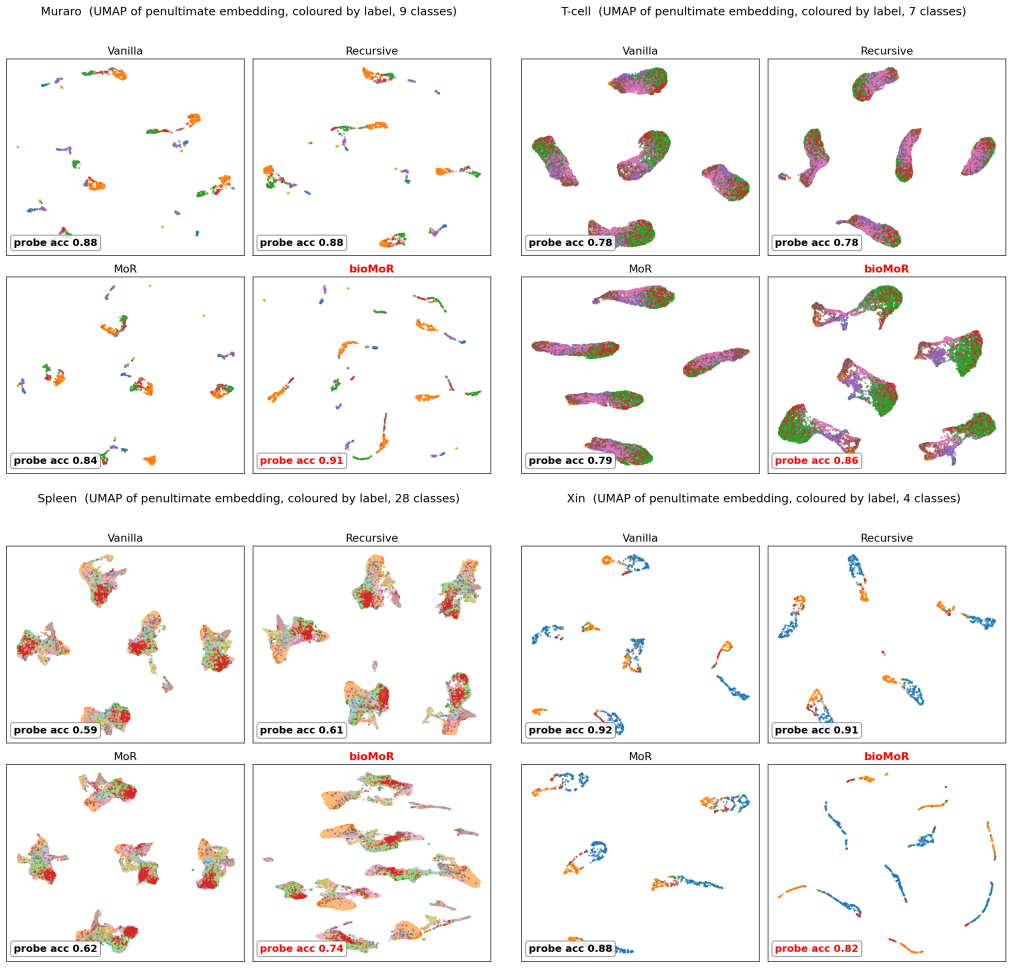
Transformer models for high-dimensional omics analysis process thousands of genes or pathways, although only a subset requires deep computation. Mixture-of-Recursions (MoR) improves efficiency through adaptive token-choice or expert-choice routing. We propose bioMoR, which, to the best of our knowledge, is the first framework to apply MoR to gene-level and pathway-level learning. Our contributions include identifying three locations for integrating structured biological knowledge within an MoR backbone: graph-based information sharing refines token embeddings, a structural bias guides self-attention toward biologically related tokens, and a graph-aware router uses neighborhood information to determine each token's recursion depth. These techniques are centered on our insight that additional knowledge of token interaction can effectively help models construct embeddings and select which tokens should be learned more deeply. Across eight benchmarks spanning diverse omics data types and evaluated under a unified five-fold cross-validation protocol, bioMoR improves average macro-F1 by 8.2 percentage points and balanced accuracy by 7.1 percentage points over the strongest biology-agnostic MoR baseline while using 75 percent fewer parameters and up to 58 percent fewer FLOPs than a non-recursive Transformer. The selected marker genes or pathways provide biological interpretability, while their token-specific recursion depths reveal how computation is allocated.
Figures


Figures from the paper (12 more)




Reference graph
Works this paper leans on
-
[1]
Advances in Neural Information Processing Systems (NeurIPS) , year=
Attention Is All You Need , author=. Advances in Neural Information Processing Systems (NeurIPS) , year=
-
[2]
Machine Learning , volume=
Random Forests , author=. Machine Learning , volume=
-
[3]
Communications Biology , volume=
A Gene Prioritization Method Based on a Swine Multi-omics Knowledgebase and a Deep Learning Model , author=. Communications Biology , volume=
-
[4]
Proceedings of the National Academy of Sciences , volume=
Diagnosis of Multiple Cancer Types by Shrunken Centroids of Gene Expression , author=. Proceedings of the National Academy of Sciences , volume=
-
[5]
International Conference on Learning Representations (ICLR) , year=
Universal Transformers , author=. International Conference on Learning Representations (ICLR) , year=
-
[6]
Lan, Zhenzhong and Chen, Mingda and Goodman, Sebastian and Gimpel, Kevin and Sharma, Piyush and Soricut, Radu , booktitle=
-
[7]
Advances in Neural Information Processing Systems (NeurIPS) , year=
Mixture-of-Recursions: Learning Dynamic Recursive Depths for Adaptive Token-Level Computation , author=. Advances in Neural Information Processing Systems (NeurIPS) , year=
-
[8]
Advances in Neural Information Processing Systems , volume=
Mixture-of-Experts with Expert Choice Routing , author=. Advances in Neural Information Processing Systems , volume=. 2022 , doi=
2022
Show all 94 references
-
[9]
arXiv preprint arXiv:2404.02258 , year=
Mixture-of-Depths: Dynamically Allocating Compute in Transformer-based Language Models , author=. arXiv preprint arXiv:2404.02258 , year=
-
[10]
International Conference on Learning Representations (ICLR) , year=
Outrageously Large Neural Networks: The Sparsely-Gated Mixture-of-Experts Layer , author=. International Conference on Learning Representations (ICLR) , year=
-
[11]
International Conference on Machine Learning (ICML) , year=
On Calibration of Modern Neural Networks , author=. International Conference on Machine Learning (ICML) , year=
-
[12]
arXiv preprint arXiv:1603.08983 , year=
Adaptive Computation Time for Recurrent Neural Networks , author=. arXiv preprint arXiv:1603.08983 , year=
-
[13]
arXiv preprint arXiv:2006.04768 , year=
Linformer: Self-Attention with Linear Complexity , author=. arXiv preprint arXiv:2006.04768 , year=
2006 arXiv
-
[14]
International Conference on Learning Representations (ICLR) , year=
Rethinking Attention with Performers , author=. International Conference on Learning Representations (ICLR) , year=
-
[15]
omformer: A Nystr\
Nystr\"omformer: A Nystr\"om-based Algorithm for Approximating Self-Attention , author=. AAAI Conference on Artificial Intelligence , year=
-
[16]
International Conference on Learning Representations (ICLR) , year=
Categorical Reparameterization with Gumbel-Softmax , author=. International Conference on Learning Representations (ICLR) , year=
-
[17]
International Conference on Machine Learning (ICML) , year=
Concrete Autoencoders: Differentiable Feature Selection and Reconstruction , author=. International Conference on Machine Learning (ICML) , year=
-
[18]
scGPT: Toward Building a Foundation Model for Single-Cell Multi-omics Using Generative
Cui, Haotian and Wang, Chloe and Maan, Hassaan and Pang, Kuan and Luo, Fengning and Duan, Nan and Wang, Bo , journal=. scGPT: Toward Building a Foundation Model for Single-Cell Multi-omics Using Generative
-
[19]
Nature Methods , volume=
Large-scale Foundation Model on Single-cell Transcriptomics , author=. Nature Methods , volume=
-
[20]
Nature , volume=
Transfer Learning Enables Predictions in Network Biology , author=. Nature , volume=
-
[21]
International Conference on Machine Learning (ICML) , year=
Cell2Sentence: Teaching Large Language Models the Language of Biology , author=. International Conference on Machine Learning (ICML) , year=
-
[22]
Nature Communications , volume=
Fully-automated and Ultra-fast Cell-type Identification Using Specific Marker Combinations from Single-cell Transcriptomic Data , author=. Nature Communications , volume=
-
[23]
Nature Communications , volume=
Cartography of Genomic Interactions Enables Deep Analysis of Single-cell Expression Data , author=. Nature Communications , volume=
-
[24]
Nature Biotechnology , volume=
Gene Signature Extraction and Cell Identity Recognition at the Single-cell Level with Cell-ID , author=. Nature Biotechnology , volume=
-
[25]
CellMarker 2.0: An Updated Database of Manually Curated Cell Markers in Human/Mouse and Web Tools Based on
Hu, Congxue and Li, Tengyue and Xu, Yingqi and Zhang, Xinxin and Li, Feng and Bai, Jing and Chen, Jing and Jiang, Wenqi and Yang, Kaiyue and Ou, Qi and Li, Xia and Wang, Peng and Zhang, Yunpeng , journal=. CellMarker 2.0: An Updated Database of Manually Curated Cell Markers in...
-
[26]
PanglaoDB: A Web Server for Exploration of Mouse and Human Single-cell
Franz. PanglaoDB: A Web Server for Exploration of Mouse and Human Single-cell. Database , volume=
-
[27]
Nucleic Acids Research , volume=
The Reactome Pathway Knowledgebase 2022 , author=. Nucleic Acids Research , volume=
2022
-
[28]
Nature Genetics , volume=
The Cancer Genome Atlas Pan-Cancer Analysis Project , author=. Nature Genetics , volume=
-
[29]
and Craft, Brian and Hastie, Mim and Repe
Goldman, Mary J. and Craft, Brian and Hastie, Mim and Repe. Visualizing and Interpreting Cancer Genomics Data via the. Nature Biotechnology , volume=
-
[30]
Science , volume=
The Tabula Sapiens: A Multiple-organ, Single-cell Transcriptomic Atlas of Humans , author=. Science , volume=
-
[31]
Wolf, F Alexander and Angerer, Philipp and Theis, Fabian J , journal=
-
[32]
eLife , volume=
The Human Cell Atlas , author=. eLife , volume=
-
[33]
Current Best Practices in Single-cell
Luecken, Malte D and Theis, Fabian J , journal=. Current Best Practices in Single-cell
-
[35]
Nature , volume=
Biologically Informed Deep Neural Network for Prostate Cancer Discovery , author=. Nature , volume=
-
[36]
Integrating Gene Regulatory Priors into Transformer Attention with
Milia, Mikele and Tshimanga, Louis Fabrice and Mueller, Henning and Atzori, Manfredo and Di Camillo, Barbara , journal=. Integrating Gene Regulatory Priors into Transformer Attention with
-
[37]
Zhang, Ru and Li, Xunkai and Deng, Yaxin and Liu, Sicheng and Su, Daohan and Dai, Qiangqiang and Qin, Hongchao and Li, Rong-Hua and Wang, Guoren and Li, Jia , journal=
-
[38]
arXiv preprint arXiv:2504.16956 , year=
GeneMamba: An Efficient and Effective Foundation Model on Single Cell Data , author=. arXiv preprint arXiv:2504.16956 , year=
-
[39]
Danziger, Michael M. and Dandala, Bharath and Gurev, Viatcheslav and Madgwick, Matthew and Ravid, Sivan and Rumbell, Tim and Koseki, Akira and Kozlovski, Tal and Tsou, Ching-Huei and Barkan, Ella and Biswas, Tanwi and Xu, Jielin and Shimoni, Yishai and Hu, Jianying and Rosen-Z...
-
[40]
arXiv preprint arXiv:2602.16696 , year=
Parameter-free representations outperform single-cell foundation models on downstream benchmarks , author=. arXiv preprint arXiv:2602.16696 , year=
-
[41]
Nature Methods , volume=
Deep Generative Modeling for Single-cell Transcriptomics , author=. Nature Methods , volume=
-
[42]
European Conference on Computer Vision (ECCV) , year=
Sliced Recursive Transformer , author=. European Conference on Computer Vision (ECCV) , year=
-
[43]
2024 , doi=
Zhou, Xiaoqiang and Huang, Huaibo and Wang, Zilei and He, Ran , journal=. 2024 , doi=
2024
-
[44]
Improving Recursive Transformers with Mixture of
Nouriborji, Mohammadmahdi and Rohanian, Morteza and Rohanian, Omid , journal=. Improving Recursive Transformers with Mixture of. 2025 , doi=
2025
-
[45]
Ouroboros: Dynamic Weight Generation for Recursive Transformers via Input-Conditioned
Jaber, Jaber and Jaber, Obeida , journal=. Ouroboros: Dynamic Weight Generation for Recursive Transformers via Input-Conditioned
-
[46]
Proceedings of the AAAI Conference on Artificial Intelligence , volume=
Refinement Contrastive Learning of Cell--Gene Associations for Unsupervised Cell Type Identification , author=. Proceedings of the AAAI Conference on Artificial Intelligence , volume=
-
[47]
Proceedings of the AAAI Conference on Artificial Intelligence , volume=
Gene Incremental Learning for Single-Cell Transcriptomics , author=. Proceedings of the AAAI Conference on Artificial Intelligence , volume=
-
[48]
Mizera, Andrzej and Zarzycki, Jakub , booktitle=. The
-
[49]
Nature Machine Intelligence , volume=
scBERT as a large-scale pretrained deep language model for cell type annotation of single-cell RNA-seq data , author=. Nature Machine Intelligence , volume=
-
[50]
Nature , year=
Universal cell embedding provides a foundation model for cell biology , author=. Nature , year=
-
[51]
Wen, Hongzhi and Tang, Wenzhuo and Dai, Xinnan and Ding, Jiayuan and Jin, Wei and Xie, Yuying and Tang, Jiliang , booktitle=
-
[52]
Gong, Jing and Hao, Minsheng and Cheng, Xingyi and Zeng, Xin and Liu, Chiming and Ma, Jianzhu and Zhang, Xuegong and Wang, Taifeng and Song, Le , booktitle=
-
[53]
iScience , volume=
Generative pretraining from large-scale transcriptomes for single-cell deciphering , author=. iScience , volume=
-
[54]
Bian, Haiyang and Chen, Yixin and Dong, Xiaomin and Li, Chen and Hao, Minsheng and Chen, Sijie and Hu, Jinyi and Sun, Maosong and Wei, Lei and Zhang, Xuegong , booktitle=
-
[55]
Yang, Xiaodong and Liu, Guangyu and Feng, Guibo and Bu, Dechao and Wang, Pengfei and Jiang, Jie and Chen, Shubai and Yang, Qinmeng and Miao, Hefan and Zhang, Yisheng and Man, Zhenpeng and others , journal=
-
[56]
bioRxiv , year=
Nicheformer: a foundation model for single-cell and spatial omics , author=. bioRxiv , year=
-
[57]
Zhao, Suyuan and Zhang, Jiahuan and Wu, Yushuai and Luo, Yizhen and Nie, Zaiqing , booktitle=
-
[58]
Proceedings of the 32nd ACM International Conference on Information and Knowledge Management (CIKM) , year=
Single-Cell Multimodal Prediction via Transformers , author=. Proceedings of the 32nd ACM International Conference on Information and Knowledge Management (CIKM) , year=
-
[59]
Zeng, Yuansong and Xie, Jiancong and Wei, Zhuoyi and Su, Yun and Shangguan, Ningyuan and Yang, Shuangyu and Zhang, Chengyang and Li, Wenbing and Zhang, Jinbo and Fang, Nan and Zhang, Hongyu and Zhao, Huiying and Lu, Yutong and Fan, Jue and Yu, Weijiang and Yang, Yuedong , journal=
-
[60]
Cheng, Jiabei and Li, Jiachen and Yang, Kaiyuan and Shen, Hongbin and Yuan, Ye , booktitle=
-
[61]
Genome Biology , volume=
Multi-omics approaches to disease , author=. Genome Biology , volume=
-
[62]
Cell , volume=
Comprehensive Integration of Single-Cell Data , author=. Cell , volume=
-
[63]
Yang, Rui and Dai, Wenrui and Li, Chenglin and Zou, Junni and Wu, Dapeng and Xiong, Hongkai , journal=
-
[64]
Wang, Tongxin and Shao, Wei and Huang, Zhi and Tang, Haixu and Zhang, Jie and Ding, Zhengming and Huang, Kun , journal=
-
[65]
Wang, Yuechen and Jia, Lina and Wang, Qinglong and Tian, Feng , journal=
-
[66]
arXiv preprint arXiv:2505.04300 , year=
Sparsity is All You Need: Rethinking Biological Pathway-Informed Approaches in Deep Learning , author=. arXiv preprint arXiv:2505.04300 , year=
-
[67]
Bioinformatics , volume=
Pathformer: A Biological Pathway Informed Transformer for Disease Diagnosis and Prognosis Using Multi-omics Data , author=. Bioinformatics , volume=
-
[68]
Oncogene , volume=
Autophagy in Cancer Metastasis , author=. Oncogene , volume=
-
[69]
Zanconato, Francesca and Cordenonsi, Michelangelo and Piccolo, Stefano , journal=
-
[70]
Experimental & Molecular Medicine , volume=
Mitotic Protein Kinase-driven Crosstalk of Machineries for Mitosis and Metastasis , author=. Experimental & Molecular Medicine , volume=
-
[71]
Nature Reviews Cancer , volume=
Insulin and Insulin-like Growth Factor Signalling in Neoplasia , author=. Nature Reviews Cancer , volume=
-
[72]
Oncogene , volume=
Inhibition of Cancer Cell Proliferation and Metastasis by Insulin Receptor Downregulation , author=. Oncogene , volume=
-
[73]
Tiffany and Palmieri, Diane and Qian, Yongzhen and Badve, Sunil and Sledge, George and Gril, Brunilde and Aladjem, Mirit I
Woditschka, Stephan and Evans, Lynda and Duchnowska, Renata and Reed, L. Tiffany and Palmieri, Diane and Qian, Yongzhen and Badve, Sunil and Sledge, George and Gril, Brunilde and Aladjem, Mirit I. and others , journal=
-
[74]
and Hicks, David J
Morrison Joly, Mathilde and Williams, Melissa M. and Hicks, David J. and Jones, Benjamin and Sanchez, Victoria and Young, Christian D. and others , journal=. Two Distinct
-
[75]
Oncotarget , volume=
Glycolysis Is the Primary Bioenergetic Pathway for Cell Motility and Cytoskeletal Remodeling in Human Prostate and Breast Cancer Cells , author=. Oncotarget , volume=
-
[76]
and Chiang, Anne C
Nguyen, Don X. and Chiang, Anne C. and Zhang, Xiang H.-F. and Kim, Juliet Y. and Kris, Mark G. and Ladanyi, Marc and Gerald, William L. and Massagu. Cell , volume=
-
[77]
Science Translational Medicine , volume=
Triple-Negative Breast Cancer Metastasis Involves Complex Epithelial-Mesenchymal Transition Dynamics and Requires Vimentin , author=. Science Translational Medicine , volume=
-
[78]
and others , journal=
Thibault, Benoit and Ramos-Delgado, Fernanda and Pons-Tostivint, Elvire and Therville, Nicole and Cintas, Celia and Arcucci, Silvia and Cassant-Sourdy, Stephanie and Reyes-Castellanos, Gabriela and Tosolini, Marie and Villard, Amelie V. and others , journal=. Pancreatic Cancer...
-
[79]
Nature Reviews Cancer , volume=
Glycosylation in Cancer: Mechanisms and Clinical Implications , author=. Nature Reviews Cancer , volume=
-
[80]
Nature Reviews Cancer , volume=
The Sweet and Sour of Cancer: Glycans as Novel Therapeutic Targets , author=. Nature Reviews Cancer , volume=
-
[81]
and others , journal=
Li, Chien-Wei and Lim, Szu-Ou and Xia, Wei and Lee, Hsu-Han and Chan, Li-Chuan and Kuo, Cheng-Wen and Khoo, Kai-Hsien and Chang, Shih-Shin and Cha, Ji-Hye and Kim, Taewan and Hsu, Jeffrey L. and others , journal=. Glycosylation and Stabilization of Programmed Death Ligand-1 Suppresses
-
[82]
Hsu, Jeffrey M. and Xia, Wei and Hsu, Yun-Han and Chan, Li-Chuan and Yu, Wen-Hsuan and Cha, Ji-Hye and Chen, Chia-Tung and Liao, Hung-Wei and Kuo, Cheng-Wen and Khoo, Kai-Hsien and others , journal=
-
[83]
Zhan, Tianzuo and Rindtorff, Niklas and Boutros, Michael , journal=
-
[84]
van der Maten, Miriam and Reijnen, Casper and Pijnenborg, Johanna M. A. and Zegers, Mirjam M. , journal=
-
[85]
and Pfister, Tomas , booktitle=
Arik, Sercan O. and Pfister, Tomas , booktitle=
-
[86]
Nature Communications , volume=
Transformer for One Stop Interpretable Cell Type Annotation , author=. Nature Communications , volume=
-
[87]
Journal of Open Source Software , volume=
McInnes, Leland and Healy, John and Saul, Nathaniel and Gro. Journal of Open Source Software , volume=
-
[88]
International Conference on Learning Representations (ICLR) , year=
Decoupled Weight Decay Regularization , author=. International Conference on Learning Representations (ICLR) , year=
-
[89]
Statistics in Medicine , volume=
Regression Modelling Strategies for Improved Prognostic Prediction , author=. Statistics in Medicine , volume=
-
[90]
Wang, Zhong and Gerstein, Mark and Snyder, Michael , journal=
-
[91]
Science , volume=
Cancer Genome Landscapes , author=. Science , volume=
-
[92]
Nature Reviews Genetics , volume=
Structural Variation in the Human Genome , author=. Nature Reviews Genetics , volume=
-
[93]
and Etzioni, Oren , journal=
Schwartz, Roy and Dodge, Jesse and Smith, Noah A. and Etzioni, Oren , journal=. Green
-
[94]
arXiv preprint arXiv:2604.16685 , year=
Graph Transformer-Based Pathway Embedding for Cancer Prognosis , author=. arXiv preprint arXiv:2604.16685 , year=
-
[95]
arXiv preprint arXiv:1610.01644 , year=
Understanding Intermediate Layers Using Linear Classifier Probes , author=. arXiv preprint arXiv:1610.01644 , year=
Reviewed August 11, 2026 · model on record in the stance chip above.
Discussion (0). Continue with ORCID to comment.