REVIEW 2 major objections 6 minor 23 references
IB-RL: Isolated Bilateral Reinforcement Learning for Strategic Dialogue Agents
T0 review · 2 major / 6 minor · reviewed 2026-08-10 · deepseek-v4-flash
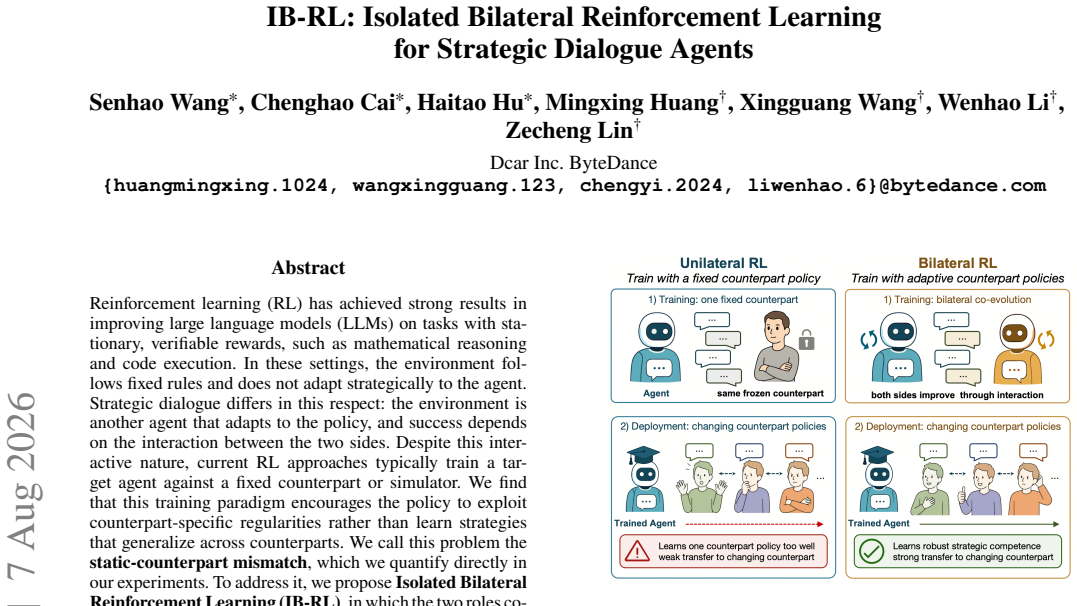
Pith's one-line read Training both sides of a strategic dialogue with fully separated rewards, advantages, masks, and optimizer states produces policies that generalize to seen and unseen counterparts better than training one side against a fixed opponent.
desk verdict Solid empirical paper on isolated bilateral RL for strategic dialogue; the DoND results are clean, but the TeleSales held-out simulator shares rubric structure with training, so that generalization claim needs scrutiny. read the letter →
The pith
A machine-rendered reading of the paper's core claim, the machinery that carries it, and where it could break.
The reading
What carries the argument
The central object is Isolated Bilateral RL (IB-RL), a co-evolutionary training loop in which two asymmetric dialogue roles share trajectories but nothing else: per-role reward functions, per-role group-normalized advantages (Equation 4), turn-level token masks in the GRPO surrogate objective (Equation 5), and separate optimizer states. Stability comes from opponent-pool sampling, which mixes each role's current and historical checkpoints, and from staggered update scheduling that updates the two roles at different frequencies and learning rates. The load-bearing design choice is that the counterpart influences learning only through the trajectories it induces, never through a shared value function, advantage baseline, or gradient.
What would settle it
Run the frozen IB-RL sales policies against a customer simulator built independently by a different team with a different behavior rubric, or against human role-players, and check whether the 89.6% Success@1 still beats the best unilateral baseline by roughly five points; if the lead shrinks or reverses under a genuinely independent judge, the reported gain reflects simulator compatibility rather than general persuasion skill.
Extended reading notes
Core claim
The paper's central claim is that the static-counterpart mismatch is a real and measurable failure mode of unilateral RL, and that IB-RL mitigates it by co-evolving both roles while keeping every learning signal per-agent. Concretely, the two roles share dialogue trajectories, but each role's reward is normalized within its own group, the GRPO surrogate loss is masked to the role's own tokens, and the two optimizers never share state; opponent-pool sampling and staggered update schedules stabilize the co-evolution. Under held-out evaluation with counterparts that share no parameters, prompts, or reward logic with any training system, a 9B IB-RL agent reaches 89.6% Success@1 on TeleSales (best unilateral: 84.6%) and 98.4% agreement against DeepSeek V4 Pro on Deal-or-No-Deal (best unilateral: 86.4%). Ablations removing isolation collapse Success@1 to 38.0% with a shared reward and 78.8% with joint normalization, which the authors take as evidence that per-agent isolation, not bilateral training alone, drives the gain.
Load-bearing premise
The evaluation's central comparison assumes that the held-out customer simulators measure genuine persuasion or negotiation skill rather than rewarding the particular dialogue style the co-trained policies happen to produce, since the primary telesales metric is the simulator's own recorded add-WeChat action.
Editorial extensions
If this is right
- Unilaterally trained dialogue policies systematically overfit their training counterpart, and the gap can be quantified as a covariance between trajectory reward and deployment unlikeliness.
- IB-RL policies retain much of their competence against held-out counterparts and in self-play, where unilateral baselines collapse by roughly 30 to 40 percentage points.
- Per-agent isolation of rewards, advantages, masks, and optimizer states is necessary for bilateral training to work; removing any part of the isolation degrades performance.
- A pool of static frontier counterparts does not substitute for a co-evolving opponent curriculum; the pool-of-3 baseline underperforms even the weakest single-counterpart unilateral baseline.
- Bilateral co-evolution without stability measures, such as opponent-pool sampling and staggered updates, collapses after an initial stable phase, so the full stabilization package is needed for the method to succeed.
Reading between the lines
- If the result holds, dialogue-agent training pipelines should treat the counterpart as part of the training signal rather than a fixed test fixture, and evaluation should always include partners outside the training loop.
- The isolation principle may extend beyond two roles: in any multi-role LLM system with misaligned objectives, sharing a critic, advantage baseline, or optimizer state could inject cross-role bias, so per-role decoupling is a plausible general design rule.
- A direct testable extension would vary the held-out counterpart pool, for example by using human role-players or independently built simulators, to see whether the IB-RL advantage grows with counterpart diversity.
- Because the telesales reward is judged by an LLM, an open question the paper does not resolve is whether the isolation benefit persists when the reward signal itself is noisy or biased.
Editorial analysis
A structured set of objections, weighed in public.
Referee Report
Summary. The paper identifies a "static-counterpart mismatch" in RL for strategic dialogue: a policy trained against a fixed counterpart exploits counterpart-specific regularities and degrades under counterpart shift. It proposes Isolated Bilateral Reinforcement Learning (IB-RL), in which two role policies coevolve through joint rollouts while keeping rewards, advantages, action masks, and optimizer states per-role, instantiated on GRPO with opponent-pool sampling and staggered updates. The method is evaluated on Vehicle TeleSales (persuasion to accept a WeChat contact) and Deal-or-No-Deal (negotiation), with frozen policies tested against held-out counterparts. The main reported results are 89.6% vs. 84.6% Success@1 on TeleSales and 98.4% vs. 86.4% agreement on DoND against DeepSeek V4 Pro, with ablations attributing the gain to isolation.
Significance. The paper addresses a real and underappreciated problem and contains several genuinely careful elements: the DoND evaluation uses fully external LLM counterparts, comparisons are analyzed with logistic GEEs with Holm correction, the TeleSales outcome is human-validated (92% agreement, kappa=0.84), and the ablations in Table 3 isolate the contribution of per-agent isolation. The formal covariance characterization of the static-counterpart mismatch in Appendix A is a useful contribution. If the held-out evaluations are accepted, the method is a meaningful advance for training strategic dialogue agents. The principal weakness is that the TeleSales held-out simulator is not as independent as claimed: it is a team-authored rubric-based simulator that shares state semantics and action structure with the training counterpart. The skeptic's concern on this point is valid and is the basis of Major Comment 1; it does not affect the DoND evidence, which is the cleanest part of the paper.
major comments (2)
- [Section 5.2, Tables 11 and 16] Section 5.2, Tables 11 and 16: the designation of the TeleSales held-out customer simulator as sharing "no parameters, prompts, or reward logic" with training is not accurate. The GPT-5.5 evaluation simulator is driven by a story-compilation prompt and a per-turn behavior rubric that are authored by the same team, and the rubric uses the same willingness/trust/patience state variables, the same action spaces (dialogue_action, intent_action), and the same structured-output conventions as the training customer policy in Table 16. The add_wechat outcome recorded by the simulator is exactly the terminal event that the training reward targets. The 5-point Success@1 margin over the best unilateral baseline (Table 1) could therefore stem from the IB-RL policy having learned to trigger rubric-positive behaviors (B01-B06) rather than from general persuasion competence. Please provide a genuinely external evaluation counterpart for TeleSales, or at least vary the rubric parameters and show the advantage is robust, and qualify the "fully independent" claim.
- [Section 5.4, Table 13] Section 5.4, Table 13: the human validation demonstrates that the recorded add_wechat label agrees with human reading of consent (92%, kappa=0.84), but it does not validate the customer simulator's acceptance behavior. Annotators were asked whether the visible dialogue supports the recorded outcome, not whether the simulator's willingness/patience updates and accept/refuse decisions are natural or externally calibrated. This leaves open the possibility that the sales policy is optimized to exploit the rubric's scoring rules rather than to persuade a realistic customer. Please state this scope explicitly and, if feasible, add a human-in-the-loop or black-box evaluation for the primary domain.
minor comments (6)
- [Table 1] Table 1, 4B IB-RL row: the numeric entries are run together ("1.628.60.338 0.260"), making the row unreadable; please reformat the table.
- [Section 5.3, Table 2] Section 5.3, Table 2: for the unilateral baseline trained against DeepSeek V4 Pro, the "vs DS V4 Pro" column is identical to the "In-System" column by construction; please add a footnote so readers do not mistake it for a held-out comparison.
- [Figure 3] Figure 3 caption and Section 5.4: the stabilization experiment removes opponent-pool sampling and staggered updates simultaneously; state this in the caption to avoid readers attributing the collapse to either component alone.
- [Appendix B] Appendix B, Algorithm 1: please restate the opponent-configuration sampling probabilities (p_both, p_agent1, p_agent2) and the update-frequency schedule near the algorithm, since they are defined only in Section 5.1.
- [Abstract and Section 6] Abstract and Section 6: the limitation about a small set of held-out counterparts is appropriate, but it should be reflected in the abstract, which currently states general "unseen counterpart" claims without noting that the TeleSales result rests on a single held-out simulator.
- [Appendix and code release] Throughout: the paper claims code is released in the appendix, but no code listing or repository link appears in the manuscript text; please add the actual artifact or remove the claim.
Circularity Check
No significant circularity: the method is a standard GRPO instantiation with per-agent isolation, and the reported held-out evaluations use external counterpart models with no fitted parameters renamed as predictions.
full rationale
The derivation chain is self-contained. IB-RL is instantiated on the standard GRPO surrogate (Eq. 5) with per-role advantage normalization (Eq. 4); no parameter is fitted to the reported Success@1 or agreement outcomes, and the held-out counterparts (GPT-5.5, GLM-5.2, DeepSeek V4 Pro) are separate systems with no shared model weights. The static-counterpart mismatch is defined as a measurable gap (Eqs. 1-3), and Appendix A proves a covariance identity (Eq. 9) via a short importance-sampling argument; this is a mathematical characterization, not a result equivalent to its own inputs. The ablation results (Table 3) are empirical observations under the same evaluation protocol, not definitional consequences. The one adjacent concern is that the TeleSales evaluation simulator and the training customer policy are both team-authored and share state and action semantics, so the 5-point Success@1 lead could partly reflect rubric compatibility; the paper itself limits this claim in Section 6 by noting that the audit validates the WeChat-add outcome but does not assess judge bias. That is an external-validity threat rather than a circular reduction, because the evaluation outcome is not computed from the training reward and no fitted parameter is relabeled as a prediction. With no self-citation chain and no definitional equivalence, the appropriate circularity score is 0.
Assumptions & free parameters
free parameters (4)
- Opponent-pool sampling probabilities =
p_both = 0.7, p_agent1 = 0.2, p_agent2 = 0.1
- Learning rates and update frequency asymmetry =
1e-6 (sales) / 1e-7 (user), user updates at half frequency
- TeleSales reward weights =
lambda_turn = 0.2, lambda_episode = 0.8, gamma = 0.9
- GRPO hyperparameters =
KL coefficient 0.02, entropy coefficient 0.1, 4 rollouts per prompt, batch size 64
assumptions (4)
- domain assumption The reward judge (DeepSeek V4 Pro) used during TeleSales RL training provides a valid and unbiased learning signal.
- domain assumption The GPT-5.5-based customer simulator used for TeleSales evaluation is a valid proxy for real customer behavior.
- domain assumption Performance against GLM-5.2 and DeepSeek V4 Pro in DoND represents performance against unseen counterparts generally.
- standard math GRPO with group normalization within each role's own rollouts yields unbiased advantages when the two roles interact.
Cite this review
Pith. "Pith review of IB-RL: Isolated Bilateral Reinforcement Learning for Strategic Dialogue Agents." pith.science (2026). https://pith.science/paper/GU5S4R6H
@misc{pith2026260806735,
  author       = {Pith},
  title        = {Pith review of: IB-RL: Isolated Bilateral Reinforcement Learning for Strategic Dialogue Agents},
  year         = {2026},
  howpublished = {\url{https://pith.science/paper/GU5S4R6H}},
  note         = {Machine review of arXiv:2608.06735}
}
read the original abstract
Reinforcement learning (RL) has achieved strong results in improving large language models (LLMs) on tasks with stationary, verifiable rewards, such as mathematical reasoning and code execution. In these settings, the environment follows fixed rules and does not adapt strategically to the agent. Strategic dialogue differs in this respect: the environment is another agent that adapts to the policy, and success depends on the interaction between the two sides. Despite this interactive nature, current RL approaches typically train a target agent against a fixed counterpart or simulator. We find that this training paradigm encourages the policy to exploit counterpart-specific regularities rather than learn strategies that generalize across counterparts. We call this problem the static-counterpart mismatch, which we quantify directly in our experiments. To address it, we propose Isolated Bilateral Reinforcement Learning (IB-RL), in which the two roles coevolve through joint rollouts while each role optimizes its own reward through fully independent advantages, action masks, and update paths. We evaluate frozen policies against fully independent held-out counterparts in both domains. On Vehicle TeleSales, IB-RL achieves 89.6% Success@1, compared to 84.6% for the best unilateral RL baseline. On Deal-or-NoDeal, it reaches 98.4% agreement against DeepSeek V4 Pro, compared to 86.4% for the best unilateral baseline. These results indicate that jointly training both roles with strict peragent isolation produces policies that generalize more effectively to unseen counterparts.
Figures


Figures from the paper (3 more)


Reference graph
Works this paper leans on
-
[1]
Understand and respond to the customer’s vehicle-related needs
-
[2]
Answer the customer’s question before attempting to advance the sales process
-
[3]
Introduce relevant platform benefits, such as vehicle inspection, warranty, financing, online viewing, and after-sales protection
-
[4]
Naturally explain the value of continuing the conversation on WeChat, such as sending an inspection report, vehicle video, price details, or alternative vehicle recommendations
-
[5]
Conversation policy.Use natural, concise, spoken language suitable for a phone call
Avoid unsupported claims or fabricated information. Conversation policy.Use natural, concise, spoken language suitable for a phone call. Do not repeat or restate the customer’s question unnecessarily,andansweronlytheinformationrequested.Donotpressureacustomerwhohasclearlyrefused.Ifthecustomeragreesto add WeChat, confirm whether the current phone number is...
-
[6]
Do not introduce facts absent from the customer profile or reveal that the role is a simulator or AI model. Conversation state.Stage{stage}; willingness before the turn{willingness_before}; patience before the turn {patience_before}; WeChat status{wechat_status}; guidance method{guidance_type}; guidance quality {guidance_quality}. Outputformat.Returnexact...
-
[7]
The numbers again denote the units received by your side
Output<selection> item0=N item1=N item2=N <selection>only after the allocation is explicit, both sides have agreed, and all three values are valid non-negative integers. The numbers again denote the units received by your side
-
[8]
If both participants explicitly agree that no deal is possible, repeated attempts fail, or the proposed final allocation is impossible, output exactly<disagree>
Show all 23 references
-
[9]
Respond in one to three short, natural spoken sentences
-
[10]
Remain consistent with the intent level, personality, concerns, willingness, patience, and conversation history
-
[11]
Low-intent customers must not become highly cooperative without sufficient conversational evidence
-
[12]
5.ConfirmAdded,IgnoreRequest, andRejectRequestare available only after the customer has verbally agreed to add WeChat
Select exactly one behavior from:Greeting,AskQuestion,ExpressConcern,Hesitate,RequestValue, PartialAgree,AgreeWeChat,DeclineSoft,DeclineHard,HangUp,Interruption,ConfirmAdded, IgnoreRequest, orRejectRequest. 5.ConfirmAdded,IgnoreRequest, andRejectRequestare available only after...
-
[14]
The other participant’s private values are never visible
Use only your own private input and prior chat messages. The other participant’s private values are never visible
-
[15]
Infertheotherparticipant’spreferencesonlyfromwhatitsays.Generateonlyyourownnextturnandnevergeneratethecounterpart’s response
-
[16]
You may ask a question, make an offer, accept, or compromise
Keep the utterance natural, concise, and negotiation-like. You may ask a question, make an offer, accept, or compromise. Avoid ending the negotiation while a counteroffer remains possible
-
[17]
Useitem0,item1, anditem2exactly as the item names; do not call values or counts item types
-
[18]
The numbers specify the units received by your side; the counterpart receives the remaining units
A non-final proposal must include a concrete allocation in exactly the form<try> item0=N item1=N item2=N <try>. The numbers specify the units received by your side; the counterpart receives the remaining units
-
[19]
A complete valid dialogue contains at least one<try>allocation and two matching<selection>confirmations, one from each participant
A final agreement is valid only when every item has a concrete allocation and both participants confirm the same deal. A complete valid dialogue contains at least one<try>allocation and two matching<selection>confirmations, one from each participant
-
[22]
If the counterpart’s proposal is merely unfavorable, do not immediately output no-deal; make a counteroffer
-
[23]
If it proposes a concrete allocation, include the required<try>allocation
Otherwise, output one concise negotiation sentence. If it proposes a concrete allocation, include the required<try>allocation. Generate only your own next turn. Table 17: The Deal-or-No-Deal role prompt used during bilateral RL training. Each role receives the same instruction...
-
[2019]
Wan, Z.; Li, Y.; Wen, X.; Song, Y.; Wang, H.; Yang, L.; Schmidt,M.;Wang,J.;Zhang,W.;Hu,S.;andWen,Y.2025
Grandmaster Level in StarCraft II Using Multi-Agent Reinforcement Learning.Nature, 575: 350–354. Wan, Z.; Li, Y.; Wen, X.; Song, Y.; Wang, H.; Yang, L.; Schmidt,M.;Wang,J.;Zhang,W.;Hu,S.;andWen,Y.2025. REMA:LearningtoMeta-thinkforLLMswithMulti-Agent Reinforcement Learning. InN...
2025
-
[2024]
get to the point
SOTOPIA: Interactive Evaluation for Social Intelli- gence in Language Agents. InICLR. Zhu, J.; Dou, H.; Li, J.; Guo, L.; Chen, F.; Zhang, C.; and Kong, F. 2026. Evaluating, Synthesizing, and Enhancing for Customer Support Conversation. InAAAI, volume 40, 35185–35194. A Formal ...
2026
-
[5001]
OpenAI.2024
Association for Computational Linguistics. OpenAI.2024. OpenAIo1SystemCard. arXiv:2412.16720. Park,J.;Cho,S.;andLee,J.-Y.2026. DivideandCooperate: Role-Decomposed Multi-Agent LLM Training with Cross- Agent Learning Signals. arXiv:2606.10684. Rashid,T.;Samvelyan,M.;SchroederdeW...
2024 arXiv
Reviewed August 10, 2026 · model on record in the stance chip above.
Discussion (0). Continue with ORCID to comment.