REVIEW 3 major objections 4 minor 34 references
FutureBridge: Token Selection Beyond Local Preference in Collaborative Decoding
T0 review · 3 major / 4 minor · reviewed 2026-08-10 · deepseek-v4-flash
Pith's one-line read FutureBridge reranks joint SLM-LLM token candidates by the frozen SLM's likelihood of a verified shared future, improving Qwen3-1.7B math accuracy by 35.1% relative to greedy decoding.
desk verdict Genuinely new receiver-conditioned token reranking with strong controlled ablations, but the single-verified-future supervision leaves a testable gap around multi-path correctness that a revision should close. read the letter →
The pith
A machine-rendered reading of the paper's core claim, the machinery that carries it, and where it could break.
The reading
What carries the argument
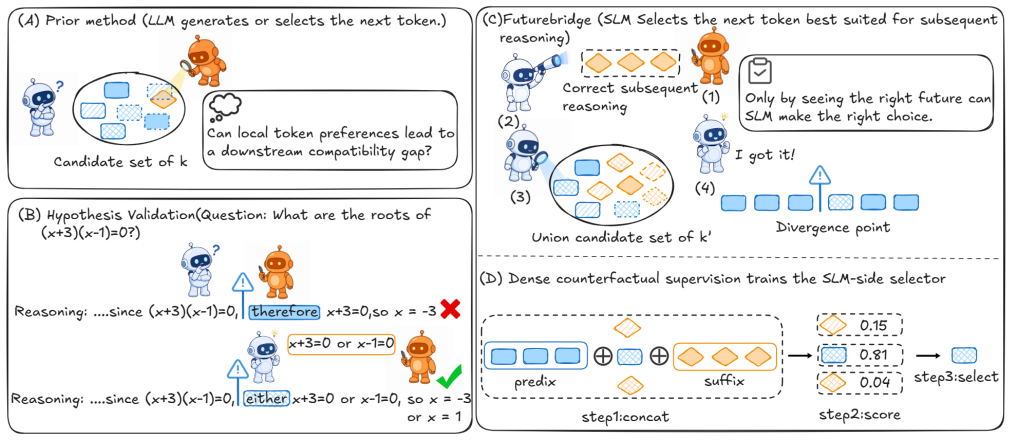
The machinery is the student-conditioned future compatibility score B_H(c_k | s_t, f_t^(H)): the length-normalized average of the frozen SLM's conditional log-probs for each token of a shared, answer-verified LLM future, computed under teacher forcing after inserting candidate c_k. This score converts a fixed downstream context into per-candidate labels, and the group-level soft targets in Eq. (9) distill these labels into a LoRA-based reranker r_theta that observes only (s_t, c_k). The joint candidate pool C_t = C^S_t ∪ C^T_t separates candidate coverage from selection: the LLM expands the action space, while the compatibility score picks the token.
What would settle it
Take a held-out set of admitted states, compute B_H for each candidate, and also run complete free-running SLM rollouts from each candidate. If there exists a statistically significant group of states where the B_H-selected token yields a lower final-answer accuracy than the LLM-local-preference token, or where the B_H ranking has worse pairwise agreement with rollout success than the LLM local score, the surrogate would be falsified for those candidates.
Extended reading notes
Core claim
The central discovery is that the LLM's local next-token probability is a poor selector for collaborative decoding, because an LLM-preferred token can be hard for the smaller model to continue from. FutureBridge instead defines the value of a candidate token c_k at state s_t as the average teacher-forced log-likelihood B_H(c_k) that the frozen SLM assigns to a fixed, answer-verified shared future f_t after inserting c_k. Splitting the candidate pool into a joint SLM-LLM set and scoring all candidates against the same future gives directly comparable, receiver-conditioned supervision, which is then distilled into a token-only reranker. The results show this future-compatibility signal agrees substantially better with complete candidate rollouts than the LLM's local score, and that the end-to-end gains hold at two SLM scales.
Load-bearing premise
The load-bearing premise is that the average teacher-forced likelihood B_H that the frozen small model assigns to a fixed answer-verified future is a reliable proxy for the outcome the small model would actually produce if allowed to generate freely from the candidate; the paper states this is a tractable surrogate, not a causal outcome.
Editorial extensions
If this is right
- If the compatibility signal is right, token-level collaboration can be improved without changing the request policy or the candidate budget; the gains come purely from selection.
- The reranker needs no LLM suffix at inference, so deployment cost stays token-level and the SLM context is never polluted by unverified LLM continuations.
- The method generalizes to a weaker SLM (Qwen3-0.6B), gaining more over baselines than with the 1.7B receiver, suggesting that receiver-conditioned selection matters more when the receiver is less capable.
- The ablation on future quality (unverified, incorrect, cross-state, token-shuffled) shows that the shared future must be state-specific and answer-correct; the supervision signal degrades monotonically as the future is corrupted.
- The horizon sweep shows most of the benefit is captured by H=64, and extending to 128 adds little, meaning a modest amount of downstream context suffices.
Reading between the lines
- We infer that the same counterfactual-compatibility recipe could transfer to non-math domains (e.g., code or multi-step instruction following) whenever a verifier can certify one correct continuation; the paper only tests math.
- The paper's own Sec. 4.3 caveat suggests a stress test: if a candidate yields high teacher-forced likelihood for the shared future but derails free-running generation (e.g., by triggering repetition or a different reasoning style), the reranker would misrank it; future work could augment the surrogate with a short free-running rollout for a small subset of candidates.
- Because the shared future comes from greedy LLM decoding, the method inherits any bias in that decoding; using a diverse set of verified futures as supervision could provide a denoised target, which the paper does not explore.
Editorial analysis
A structured set of objections, weighed in public.
Referee Report
Summary. FutureBridge proposes a token-level collaboration method in which, at admitted decoding states, a joint pool of SLM and LLM next-token candidates is reranked by a lightweight scorer trained to predict how well each candidate supports the receiving SLM's subsequent reasoning. During training, an answer-verified greedy LLM trajectory supplies a fixed shared future; for every candidate, the frozen SLM's average teacher-forced log-likelihood of that future, after inserting the candidate, becomes the supervision target. This target is distilled into a LoRA-based reranker that sees only the current state and candidate token. At inference, the LLM contributes only next-token candidates, the reranker selects one token, and generation returns to the SLM. On five mathematical reasoning benchmarks, FutureBridge improves Qwen3-1.7B Math Avg. from 37.30 (greedy SLM) to 50.38, and from 49.14 for the S2T baseline, under the same request schedule and intervention budget; similar gains are reported for Qwen3-0.6B. The paper includes controlled ablations on candidate-pool composition, supervision target, future horizon, and training-future quality, plus candidate-level rollout diagnostics.
Significance. If the central claim holds, the paper makes a useful conceptual contribution: it replaces LLM-local preference with an SLM-conditioned compatibility signal for token selection, and it shows through matched ablations that this signal, rather than merely the enlarged candidate pool, drives the end-to-end gains. The manuscript is also commendably concrete: it fixes the request policy, intervention budget, candidate pools, architecture, and optimization budget across comparisons; it reports deployment cost (4.8 LLM calls, one appended token per intervention); and it explicitly acknowledges that the compatibility score is a teacher-forced surrogate, not a causal outcome, providing rollout diagnostics to probe the connection. The quality ablations (unverified, incorrect, cross-state, and token-shuffled futures) are a good falsifiable check that the supervision signal is not vacuous. The main unresolved risk is that the score is defined against a single answer-verified LLM future per state, so the measured "future compatibility" may partly reflect fidelity to one particular correct path rather than general ability of the receiver to continue reasoning.
major comments (3)
- [§4.2, Eqs. (4)-(7), and Fig. 2(a)/Table 9] The compatibility score B_H is defined against one answer-verified greedy LLM future f_t fixed per state. If a state admits several correct solution paths, B_H rewards candidates that make the SLM imitate that particular LLM continuation and penalizes candidates that support an equally valid alternative path. The diagnostics in Fig. 2(a) and Table 9 evaluate only one reference future per state, and the horizon sweep in Fig. 2(b) varies only prefixes of the same future, so neither can detect this bias. As a result, the central claim that the reranker models "whether the receiving SLM can continue reasoning" is not yet fully established: the current supervision cannot distinguish future-compatibility from single-trajectory imitation. Please add a multi-future analysis, e.g., sampling several verified correct futures per state and reporting top-1 agreement or Kendall tau of the B_H rankings across futures, or training with a multi-future aggregated target; this would demonstrate that the score is stable across correct solution paths.
- [§4.3 and Table 9] The teacher-forced surrogate B_H is acknowledged in the text, and the rollout agreement in Table 9 is a useful check, but the agreement is only 69.7% pairwise and top-1 success on OlympiadBench is 40.1% for Direct-B_H. Because the shared future is the LLM's own greedy continuation, the score may mechanically favor the LLM token a_T^t and candidates that imitate the LLM, rather than candidates that genuinely support free-running SLM success. Table 9 does not report agreement separately for the singleton a_T^t, for SLM-only versus LLM-only candidates, or by rollout success. Please add these subgroup diagnostics; without them, the improvement over "LLM local score" in Table 3 cannot be attributed unambiguously to receiver-conditioning rather than to a proxy for LLM-path fidelity.
- [§4.2 and Supplement A] The logged training states are collected by running the frozen SLM without any intervention tokens, whereas at deployment the reranker is applied to states that may contain tokens selected by the reranker at earlier admitted events. The paper does not quantify the distribution shift between these logged states and the states actually encountered at inference. If earlier intervention tokens change the SLM's subsequent state distribution, the distillation targets may be unrepresentative of deployment. Please measure this drift (for example, report a state-overlap or KL metric between logged and deployment states, or retrain on rollouts generated with the deployed reranker) and report whether end-to-end accuracy changes.
minor comments (4)
- [Figure 2(b)] The label "Δ accuracy" in the figure is not defined in the main text; please state explicitly in the caption or text that values are accuracy-point differences relative to the H=16 configuration.
- [§5.2 and Table 9] The term "Direct-B_H" is used in Figure 2 and Table 9 without a definition in the main text; please define it at first use as the privileged offline compatibility score computed from the shared future.
- [§5.1 and Table 1] The supplement reports that Table 1 gives the seed mean without per-cell standard deviations; please include standard deviations for the main head-to-head comparisons, at least for FutureBridge and S2T, since the reported differences are only 1-2 accuracy points in some rows.
- [Section 5.1, collaboration protocol] The text says MATH validation is used to select the request threshold, reranker checkpoint, and H; please clarify whether the threshold and H are selected jointly or independently, and confirm that no held-out benchmark is used in any selection step.
Circularity Check
No significant circularity: the future-compatibility score is an explicitly validated surrogate, not an assumed consequence; related self-citations are not load-bearing.
full rationale
The paper's derivation chain is not circular by construction. The ideal selection criterion in Eq. (1) is the free-running SLM rollout outcome R(x, y<t ⊕ c ⊕ G_S(s_t,c)). The training target B_H in Eqs. (6)-(7) is instead the teacher-forced average log-likelihood of a fixed answer-verified LLM future under the frozen SLM. The paper explicitly states in Sec. 4.3 that 'B_H measures compatibility under teacher forcing rather than final-answer correctness under free-running generation. It is a tractable surrogate for the complete SLM rollout value in Equation (1), not a causal outcome.' This is an acknowledged approximation, not a definitional equivalence. The surrogate is then tested against independent evidence: Table 9 and Figure 2(a) compare Direct-B_H and the distilled reranker with complete token-only SLM rollouts on held-out states, and Table 3 shows a 3-4 point gap over LLM local scoring under matched pools and budgets. The deployed reranker observes only (s_t,c) and never the future, so its predictions are not forced by the training target at inference. The paper contains a few related-work citations (e.g., Shi et al. 2025, Liao et al. 2025, Huang et al. 2026) that may overlap with the authors, but none is load-bearing: the method does not rely on any prior 'uniqueness theorem' or ansatz from those papers. The single-future supervision bias raised by a skeptical reader is a real empirical limitation of the surrogate, not a circularity: the paper does not define the target as the surrogate, and it provides rollout-based validation. Overall circularity is minimal.
Assumptions & free parameters
free parameters (6)
- Future horizon H =
64 (selected from {16,32,64,128} on MATH validation)
- Request-policy entropy threshold =
0.99 quantile of SLM entropy on MATH validation
- Per-trajectory intervention budget =
8 admitted events
- Candidate budgets K_S and K_T =
8 and 8
- Target temperature tau =
0.5
- LoRA training configuration =
rank 16, scale 32, dropout 0.05, lr 2e-4, 3 epochs, batch 32 groups
assumptions (6)
- domain assumption SLM and LLM share the same tokenizer, so candidate tokens from both models can be inserted into the same prefix.
- domain assumption The task-specific verifier V correctly identifies answer-correct trajectories.
- domain assumption Average teacher-forced SLM log-likelihood over a fixed verified future is a reliable proxy for free-running rollout success.
- domain assumption The fixed external request policy is adequate for all compared methods.
- domain assumption Validation-based selection of H and request threshold generalizes to held-out benchmarks.
- domain assumption A complete answer-correct LLM continuation of at least 128 tokens exists for retained training states.
Cite this review
Pith. "Pith review of FutureBridge: Token Selection Beyond Local Preference in Collaborative Decoding." pith.science (2026). https://pith.science/paper/YOVYOF5F
@misc{pith2026260806819,
  author       = {Pith},
  title        = {Pith review of: FutureBridge: Token Selection Beyond Local Preference in Collaborative Decoding},
  year         = {2026},
  howpublished = {\url{https://pith.science/paper/YOVYOF5F}},
  note         = {Machine review of arXiv:2608.06819}
}
read the original abstract
Token-level collaboration allows a large language model (LLM) to assist a small language model (SLM) when their predictions diverge. Existing methods either use LLM-generated intervention tokens or rank candidates with the LLM's next-token probabilities. Both rely on the LLM's local preference, even though an LLM-selected token may be difficult for the SLM to build on. We present FutureBridge, which ranks joint LLM-SLM token candidates according to how well they support the SLM's subsequent reasoning. During training, an answer-verified LLM trajectory supplies a fixed shared future, and a frozen SLM evaluates every candidate under this common context. The resulting counterfactual scores supervise a lightweight token reranker that observes only the current state and candidate token. At inference, FutureBridge uses the LLM only to expand the candidate pool, selects one token, and returns generation to the SLM without generating or appending a future suffix. Across five mathematical reasoning benchmarks, FutureBridge improves the Qwen3-1.7B SLM's Math Avg. by 35.1% relative to greedy SLM decoding. These results indicate that token selection benefits from modeling whether the receiving SLM can use each candidate to continue reasoning, rather than relying on the LLM's local preference alone.
Figures

Reference graph
Works this paper leans on
-
[1]
Ong, Isaac and Almahairi, Amjad and Wu, Vincent and Chiang, Wei-Lin and Wu, Tianhao and Gonzalez, Joseph E. and Kadous, M. Waleed and Stoica, Ion , title =. International Conference on Learning Representations , year =
-
[2]
and Wang, Hongyi and Yao, Huaxiu , title =
Zheng, Wenhao and Chen, Yixiao and Zhang, Weitong and Kundu, Souvik and Li, Yun and Liu, Zhengzhong and Xing, Eric P. and Wang, Hongyi and Yao, Huaxiu , title =. Conference on Language Modeling , year =
-
[3]
Advances in Neural Information Processing Systems , year =
Fu, Tianyu and Ge, Yi and You, Yichen and Liu, Enshu and Yuan, Zhihang and Dai, Guohao and Yan, Shengen and Yang, Huazhong and Wang, Yu , title =. Advances in Neural Information Processing Systems , year =
-
[4]
International Conference on Machine Learning , year =
Liao, Siteng and Liang, Yuzhu and Rao, Hengzhong and Luo, Xizhao and Wang, Tian , title =. International Conference on Machine Learning , year =
-
[5]
Proceedings of the AAAI Conference on Artificial Intelligence , volume =
Lee, Sangmook and Kim, Dohyung and Koh, Hyukhun and Yang, Nakyeong and Jung, Kyomin , title =. Proceedings of the AAAI Conference on Artificial Intelligence , volume =. 2026 , doi =
work page 2026
-
[6]
Findings of the Association for Computational Linguistics: ACL 2026 , year =
Zeng, Wenhao and Zhang, Xuteng and Shi, Yuling and Hu, Chao and Chen, Yuting and Shen, Beijun and Gu, Xiaodong , title =. Findings of the Association for Computational Linguistics: ACL 2026 , year =
work page 2026
-
[7]
Findings of the Association for Computational Linguistics: ACL 2026 , year =
Zhao, Yi and Peng, Yajuan and Nguyen, Cam-Tu and Li, Zuchao and Wang, Xiaoliang and Fu, Xiaoming and Zhao, Hai , title =. Findings of the Association for Computational Linguistics: ACL 2026 , year =
work page 2026
-
[8]
International Conference on Machine Learning , year =
Liao, Baohao and Xu, Yuhui and Dong, Hanze and Li, Junnan and Monz, Christof and Savarese, Silvio and Sahoo, Doyen and Xiong, Caiming , title =. International Conference on Machine Learning , year =
Show all 34 references
-
[9]
Advances in Neural Information Processing Systems , year =
Pan, Rui and Dai, Yinwei and Zhang, Zhihao and Oliaro, Gabriele and Jia, Zhihao and Netravali, Ravi , title =. Advances in Neural Information Processing Systems , year =
-
[10]
arXiv preprint arXiv:2601.05167 , year =
Huang, Chengsong and Zheng, Tong and Huang, Langlin and Li, Jinyuan and Liu, Haolin and Huang, Jiaxin , title =. arXiv preprint arXiv:2601.05167 , year =
-
[11]
and Li, Yueying and Abdelfattah, Mohamed S
Akhauri, Yash and Fei, Anthony and Chang, Chi-Chih and AbouElhamayed, Ahmed F. and Li, Yueying and Abdelfattah, Mohamed S. , title =. arXiv preprint arXiv:2504.16379 , year =
-
[12]
arXiv preprint arXiv:2601.22132 , year =
Dong, Ziming and Sharma, Hardik and O'Toole, Evan and Champati, Jaya Prakash and Wu, Kui , title =. arXiv preprint arXiv:2601.22132 , year =
-
[13]
International Conference on Machine Learning , year =
Ye, Wenxuan and Zhang, Yangyang and An, Xueli and Carle, Georg and Ma, Yunpu , title =. International Conference on Machine Learning , year =
-
[14]
Findings of the Association for Computational Linguistics: EMNLP 2025 , year =
Shi, Junhan and Zhu, Yijia and Shi, Zhenning and Zhao, Dan and Li, Qing and Jiang, Yong , title =. Findings of the Association for Computational Linguistics: EMNLP 2025 , year =
2025
-
[15]
International Conference on Learning Representations , year =
Li, Aochong Oliver and Goyal, Tanya , title =. International Conference on Learning Representations , year =
-
[16]
Proceedings of the 43rd International Conference on Machine Learning , series =
Liang, Weida and Sun, Yiyou and Nan, Shuyuan and Li, Chuang and Song, Dawn and Kawaguchi, Kenji , title =. Proceedings of the 43rd International Conference on Machine Learning , series =
-
[17]
arXiv preprint arXiv:2604.12627 , year =
Yu, Linhao and Yang, Tianmeng and Ding, Siyu and Jin, Renren and Gu, Naibin and Hao, Xiangzhao and Nie, Shuaiyi and Xiong, Deyi and Yin, Weichong and Sun, Yu and Wu, Hua , title =. arXiv preprint arXiv:2604.12627 , year =
-
[18]
Proceedings of the 19th Conference of the European Chapter of the Association for Computational Linguistics , year =
Zhang, Chuang and Zhu, Zizhen and Wei, Yihao and Tian, Bing and Liu, Junyi and Wang, Henan and Xavier, Wang and Liu, Yaxiao , title =. Proceedings of the 19th Conference of the European Chapter of the Association for Computational Linguistics , year =
-
[19]
Proceedings of the 40th International Conference on Machine Learning , pages =
Leviathan, Yaniv and Kalman, Matan and Matias, Yossi , title =. Proceedings of the 40th International Conference on Machine Learning , pages =
-
[20]
Proceedings of the 61st Annual Meeting of the Association for Computational Linguistics , pages =
Li, Xiang Lisa and Holtzman, Ari and Fried, Daniel and Liang, Percy and Eisner, Jason and Hashimoto, Tatsunori and Zettlemoyer, Luke and Lewis, Mike , title =. Proceedings of the 61st Annual Meeting of the Association for Computational Linguistics , pages =. 2023 , doi =
2023
-
[21]
Proceedings of the 43rd International Conference on Machine Learning , series =
Xiong, Nuoya and Zhou, Yuhang and Zeng, Hanqing and Chen, Zhaorun and Huang, Furong and Bi, Shuchao and Zhang, Lizhu and Zhao, Zhuokai , title =. Proceedings of the 43rd International Conference on Machine Learning , series =
-
[22]
arXiv preprint arXiv:2606.25354 , year =
Yin, Yutong and Jin, Mingyu and Pan, Jin and Yang, Changyi and Xia, Zijie and Pai, Dhruv and Hu, Shuming and Zhang, Zhen and Zhao, Chenyang and Zhao, Jinman and Xu, Wujiang and Li, Raymond and Wang, Xin Eric and McAuley, Julian and Wang, Zhaoran , title =. arXiv preprint arXiv...
-
[23]
, title =
Kim, Yoon and Rush, Alexander M. , title =. Proceedings of the 2016 Conference on Empirical Methods in Natural Language Processing , pages =. 2016 , doi =
2016
-
[24]
Unifying Distillation and Privileged Information , booktitle =
Lopez-Paz, David and Bottou, L. Unifying Distillation and Privileged Information , booktitle =. 2016 , eprint =
2016
-
[25]
arXiv preprint arXiv:2505.09388 , year =
Yang, An and Li, Anfeng and Yang, Baosong and Zhang, Beichen and Hui, Binyuan and Zheng, Bo and Yu, Bowen and Gao, Chang and Huang, Chengen and Lv, Chenxu and others , title =. arXiv preprint arXiv:2505.09388 , year =
-
[26]
International Conference on Learning Representations , year =
Baek, Seung Jun and Kim, Minsang , title =. International Conference on Learning Representations , year =
-
[27]
and Chi, Ed H
Wang, Xuezhi and Wei, Jason and Schuurmans, Dale and Le, Quoc V. and Chi, Ed H. and Narang, Sharan and Chowdhery, Aakanksha and Zhou, Denny , title =. International Conference on Learning Representations , year =
-
[28]
arXiv preprint arXiv:2601.08808 , year =
Tang, Yao and Dong, Li and Hao, Yaru and Dong, Qingxiu and Wei, Furu and Gu, Jiatao , title =. arXiv preprint arXiv:2601.08808 , year =
-
[29]
Proceedings of the 43rd International Conference on Machine Learning , series =
Fu, Tianyu and You, Yichen and Chen, Zekai and Dai, Guohao and Yang, Huazhong and Wang, Yu , title =. Proceedings of the 43rd International Conference on Machine Learning , series =
-
[30]
arXiv preprint arXiv:2110.14168 , year =
Cobbe, Karl and Kosaraju, Vineet and Bavarian, Mohammad and Chen, Mark and Jun, Heewoo and Kaiser, Lukasz and Plappert, Matthias and Tworek, Jerry and Hilton, Jacob and Nakano, Rei and others , title =. arXiv preprint arXiv:2110.14168 , year =
-
[31]
Advances in Neural Information Processing Systems Datasets and Benchmarks Track , year =
Hendrycks, Dan and Burns, Collin and Kadavath, Saurav and Arora, Akul and Basart, Steven and Tang, Eric and Song, Dawn and Steinhardt, Jacob , title =. Advances in Neural Information Processing Systems Datasets and Benchmarks Track , year =
-
[32]
Proceedings of the 62nd Annual Meeting of the Association for Computational Linguistics (Volume 1: Long Papers) , pages =
He, Chaoqun and Luo, Renjie and Bai, Yuzhuo and Hu, Shengding and Thai, Zhen and Shen, Junhao and Hu, Jinyi and Han, Xu and Huang, Yujie and Zhang, Yuxiang and Liu, Jie and Qi, Lei and Liu, Zhiyuan and Sun, Maosong , title =. Proceedings of the 62nd Annual Meeting of the Assoc...
2024
-
[33]
2024 , howpublished =
Jia, Maxwell , title =. 2024 , howpublished =
2024
-
[34]
2025 , howpublished =
2025
Reviewed August 10, 2026 · model on record in the stance chip above.
Discussion (0). Continue with ORCID to comment.