REVIEW 2 major objections 5 minor 77 references
Decoupling Intention from Trajectory: A Representational Deduction Framework for World Action Models
T0 review · 2 major / 5 minor · reviewed 2026-08-10 · deepseek-v4-flash
Pith's one-line read Training learnable motion tokens to predict future VJEPA2-AC representations separates intention from trajectory and pushes robot success to 97.9%, 62.6%, and 83.1% on LIBERO, RoboCasa-GR1, and real hardware.
desk verdict A well-engineered WAM with real gains, but the RD mechanism's semantic interpretation is under-supported; still deserves a serious referee. read the letter →
The pith
A machine-rendered reading of the paper's core claim, the machinery that carries it, and where it could break.
The reading
What carries the argument
The mechanism is the Representational Deduction branch: a frozen VJEPA2-AC encoder (a self-supervised video model whose patch-level representations emphasize predictable, action-relevant structure) provides the current representation $r_t$ and the future target $r_{t+\Delta}$; a trainable Causal Dynamics Engine, initialized from the VJEPA2-AC predictor, consumes $r_t$ together with projected motion-semantic tokens $\tilde{m}$ and robot state $\tilde{s}$, and must output the future representation (Eqs. 8–11). The SmoothL1 loss makes the motion tokens carry the state transition $o_t \to o_{t+\Delta}$ instead of appearance. A complementary causally-decoupled attention (Eqs. 3–4) restricts the non-action latents to attending to the vision-language context while action tokens may also attend to the latents, so diffusion noise cannot contaminate the tokens. Together these pieces convert the tokens into a motion chain-of-thought: a training-time information bottleneck that summarizes intention, and a conditioning signal for the flow-matching action decoder at inference.
What would settle it
Run the identical PILOT training but replace the learned motion-semantic tokens with a single constant token inside the Causal Dynamics Engine, keeping $L_{RD}$ active. If the engine's future-representation error and the downstream success rates stay close to the full model's, the motion tokens are not carrying the transition information and the decoupling claim is not supported.
Extended reading notes
Core claim
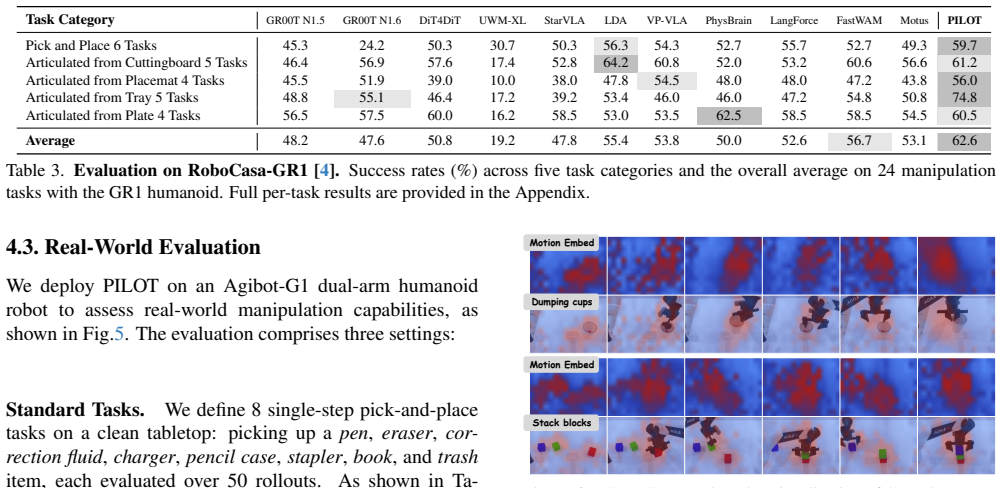
The central claim is that the limiting factor in World Action Models is whether the action branch can separate 'what physical transition is happening' from 'how to move to realize it,' and that this separation can be trained explicitly rather than left implicit. PILOT introduces a latent motion-semantic variable $m$ produced by learnable query tokens, and a Representational Deduction loss $L_{RD} = \mathrm{SmoothL1}(\hat{r}_{t+\Delta}, r_{t+\Delta})$ that forces a Causal Dynamics Engine, conditioned on $m$ and the robot state, to predict the frozen VJEPA2-AC representation of the future frame from the current frame's representation. Because JEPA-style representations are organized around predictable, action-relevant structure rather than texture, the gradient funnels transition information into the tokens. A causally-decoupled attention then lets those tokens condition action decoding while blocking diffusion noise from leaking back into them. Measured on its own terms, the paper claims this delivers 97.9% on LIBERO, 62.6% on RoboCasa-GR1, and 83.1% on a real Agibot-G1 humanoid, with zero-shot robustness on LIBERO-Plus and successful few-shot fine-tuning from 10% of the data.
Load-bearing premise
The load-bearing premise is that the VJEPA2-AC future representations are dominated by predictable, action-relevant structure, so the representational-deduction loss cannot be minimized by copying static background patches and genuinely forces the motion tokens to encode the state transition; if background copying suffices, the tokens could be empty of transition information while the loss still looks healthy.
Editorial extensions
If this is right
- The gains of future prediction can be captured at training time without paying for video generation at test time: on RoboCasa the decoupled pipeline runs at 111.6 ms per step versus 1330 ms for predict-then-act, with slightly higher success (62.6% versus 58.4%).
- Motion tokens cluster by action type with no clustering supervision, and the engine's predicted future representations show color changes only in manipulated foreground regions, supporting the claim that the tokens encode transition dynamics rather than background appearance.
- Few-shot fine-tuning on 10% of real-world data keeps PILOT at 62.4% (a 20.7% relative drop from 83.1%), while Fast-WAM falls to 40.8% (a 44.3% relative drop).
- Zero-shot robustness on LIBERO-Plus reaches 81.0%, with the largest gains on camera-displacement (70.0%) and layout-change (82.0%) suites, consistent with a representation focused on transitions rather than static scene features.
- The cumulative ablation shows pixel-level grounding and representational-deduction supervision are complementary: together they give the best results (97.9% / 62.6%), each alone giving less.
Reading between the lines
- The paper does not mask static patches in the representational-deduction loss even though it does apply a change-weighted mask to its future-frame loss; a direct test would restrict $L_{RD}$ to patches that actually change, and success under that restriction would confirm the tokens encode true transitions rather than copiable background.
- No ablation removes the motion tokens from the engine: a control with a constant token in place of $m$ would settle whether the tokens are causally responsible for the future-representation prediction or merely correlated with it.
- Because the supervision target is a frozen JEPA-style representation space rather than anything specific to VJEPA2-AC, the same Representational Deduction recipe should transfer to other self-supervised video encoders; a cheap check is to swap encoders and see whether the success gains and action-type clustering persist.
- The same decoupling could be layered hierarchically: one stage of motion tokens per sub-task, each trained by its own future-representation deduction, would give long-horizon planners an explicit intention ladder, which is a concrete form of the paper's stated plan for hierarchical Motion-CoT.
Signed reviews
Editorial analysis
A structured set of objections, weighed in public.
Referee Report
Summary. The paper proposes PILOT, a World Action Model that augments a flow-matching action head with a Representational Deduction (RD) branch. Learnt motion-semantic query tokens m are supervised by a Causal Dynamics Engine (CDE) that predicts future patch-level VJEPA2-AC representations from the current representation and from m, with the goal of making m encode action-conditioned state transitions. At inference the generation pipeline is bypassed and only the understanding-action pathway is used, yielding a claimed 90% latency reduction relative to predict-then-act. The paper reports strong results on LIBERO (97.9%), LIBERO-Plus (81.0%), RoboCasa-GR1 (62.6%), and real-world desk manipulation (83.1% standard, 68.3% generalization, 62.4% few-shot), supported by cumulative ablations and qualitative t-SNE/PCA analyses.
Significance. If the mechanism is substantiated, the paper offers a practically valuable way to inject transition-level supervision into World Action Models without paying the inference cost of pixel-level future-frame generation. The empirical scope is broad: two simulation benchmarks, a real-robot suite with generalization and few-shot settings, a latency analysis, and detailed hyper-parameters and algorithms that make reproduction feasible. The cumulative ablation design is a genuine strength, and the use of a frozen external VJEPA2-AC target avoids the main form of circularity one might fear in representation-supervision methods. However, the central interpretative claim — that the RD loss forces m to encode action-conditioned state transitions rather than exploiting static-copy shortcuts — is not directly established by the current experiments, and one reporting choice (test-set checkpoint selection) weakens the headline comparisons.
major comments (2)
- [Sec. 3.4, Eq. (10)-(11); contrast with Sec. 7.7, Eq. (27)-(29)] The RD loss L_RD is a SmoothL1 loss over all P=256 patch tokens between the CDE prediction and the frozen future representation. In typical tabletop scenes, the large majority of patches are static background or table surface whose future VJEPA2-AC representation is nearly identical to the current one. A CDE can therefore drive L_RD down mostly by copying unchanged patch tokens from r_t, while receiving little or no gradient signal that actually depends on m. The paper's own future-frame loss explicitly uses a change-weighted mask (Eq. 27-29) to avoid exactly this static-copy failure mode, yet L_RD has no analogous mask or static-patch downweighting. The paper also does not ablate removing m from the CDE input (or replacing m with a constant/random token), so the reader cannot tell whether the observed gains require m to encode transition semantics. The qualitative PCA in Sec. 4.5 is not a quantitative substitute for such an ablation. This concern is load-bearing because the paper's central claim is that RD decouples high-level motion intention from low-level trajectory generation; the benchmark gains could in principle survive even if the CDE mostly copied static features and m acted only as a weak regularizer. I recommend adding a change-masked or background-masked variant of L_RD, and an ablation with m removed from or frozen in the CDE, before the decoupling interpretation is accepted.
- [Sec. 7.12 (Checkpointing and evaluation)] The paper states that 'the final reported results correspond to the checkpoint with the highest average success rate across all tasks within each benchmark.' This is selection on the test set, not on a held-out validation set. Such test-set checkpoint selection can inflate reported numbers and makes comparisons with baselines unfair unless the same protocol is used for all methods. The headline comparisons in Tables 1-4 therefore need to be re-reported with a validation-selected checkpoint, or with a protocol that is explicitly applied identically to every baseline (ideally with variance across seeds or checkpoints). This is a reporting issue that affects the quantitative claims of the paper and should be fixed before publication.
minor comments (5)
- [Sec. 3.1, Eq. (1)] The factorization p(at | ot, ℓ, st) = ∫ p(at | m, st) p(m | ot, ℓ, st) dm is a tautology for any latent variable m; as written it contributes no modeling content. It should either be replaced by a concrete parameterization of the two factors or moved to a motivational paragraph.
- [Appendix / Algorithms 1-4] The model is named PILOT in the main text, but Algorithms 1-4 and several appendix sections refer to 'WAM-VJEPA'. Please unify the naming throughout to avoid confusion.
- [Sec. 7.6 vs. Sec. 7.14] The CDE is described as a 24-layer causal transformer in Sec. 7.6 (L_p = 24) and as a lightweight transformer with only 4 layers in Sec. 7.14. This inconsistency affects reproducibility and the efficiency discussion, and should be corrected.
- [Sec. 4.5] The t-SNE and PCA analyses are qualitative. Reporting quantitative cluster metrics (e.g., silhouette score) and showing results over multiple random seeds or checkpoint selections would strengthen the claim that motion-semantic tokens cluster by action type rather than by low-level appearance.
- [Table 5] The row label 'MotionCoT' is ambiguous: does it include the learnable query tokens alone, or also the causally-decoupled attention? Please clarify what each cumulative row contains.
Circularity Check
No significant circularity: the RD target is an external frozen VJEPA2-AC representation, and future information enters only as a supervision target, not as an input to motion-token generation.
full rationale
The central derivation is self-contained and not circular. The motion-semantic variable m is generated by learnable queries from the current observation and language context (Eqs. 2-6); it is not taken from the future frame. The Causal Dynamics Engine receives the current frozen representation r_t and the projected motion tokens, and predicts the future representation (Eq. 10). The Representational Deduction loss L_RD then compares that prediction against the externally computed frozen VJEPA2-AC representation r_{t+delta} (Eq. 11). Because the supervision target is a fixed external encoder output rather than a quantity defined by the model's own predictions, the prediction is not equivalent to its input by construction. The factorization in Eq. 1 is a conditional-independence modeling assumption, not a definitional identity, and it does not by itself force the claimed decoupling. The paper's decoupling claim is an empirical interpretation supported by ablations and representational analyses. The only self-citation is to the authors' prior CVPR work [41] in a survey-style related-work list; it is not load-bearing for any equation or benchmark claim. The lack of static-patch masking in L_RD is a legitimate empirical risk that the auxiliary loss could be partly minimized by copying near-static patches, but that is a possible failure mode, not a circular reduction of the target to the input. Overall, the derivation chain is not circular.
Assumptions & free parameters
free parameters (3)
- Future-frame gap Delta =
16 timesteps
- Number of motion-semantic query tokens K =
64
- Loss weights lambda_wm and lambda_RD =
1.0 each
assumptions (4)
- domain assumption VJEPA2-AC representations are organized around predictable, action-relevant structure rather than pixel-level appearance.
- standard math The factorization p(at|ot,ell,st) = integral p(at|m,st) p(m|ot,ell,st) dm is a valid model family.
- domain assumption Pretrained VJEPA2-AC predictor weights provide a good starting point for the CDE.
- domain assumption The Wan2.2 world model co-trained on future-frame prediction retains beneficial instruction-grounded priors without the action head degrading the encoder.
invented entities (1)
-
Motion-semantic latent variable m (Motion-CoT tokens)
Cite this review
Pith. "Pith review of Decoupling Intention from Trajectory: A Representational Deduction Framework for World Action Models." pith.science (2026). https://pith.science/paper/W2UOWU73
@misc{pith2026260806994,
  author       = {Pith},
  title        = {Pith review of: Decoupling Intention from Trajectory: A Representational Deduction Framework for World Action Models},
  year         = {2026},
  howpublished = {\url{https://pith.science/paper/W2UOWU73}},
  note         = {Machine review of arXiv:2608.06994}
}
read the original abstract
World Action Models (WAMs) aim to construct a unified architecture capable of understanding world state evolution and guiding to generative motion planning. However, existing visual branches focus on predicting static visual observation, rather than reflecting potential transition information that captures the evolution of world states under motion interactions. This leads to representational entanglement between high-level physical condition evolution and low-level action trajectory generation within the Action Model, creating a structural bottleneck while weakening the predictive capability of world evolution modeling for action generation. We propose PILOT (Physical Inference for Latent Optimized Trajectories), whose core Representational Deduction (RD) bridges this gap by integrating motion thought-of-chain (CoT) guidance as a native model capability. Specifically, RD aims to encourage the action branch to explicitly model potential state transition tokens, which are retained as CoT in the reasoning space to guide fine-grained motion trajectory. Experiments demonstrate that RD not only significantly improves the success rate and generalization ability of WAMs in complex robotic manipulation tasks but also enhances the model's physical interpretability by decoupling high-level motion semantics from low-level trajectory details. Furthermore, the abundant state transition supervision signals introduced by RD effectively alleviate the sparse supervision in action generation, enabling it to serve as an efficient few-shot real-robot fine-tuning strategy and demonstrating superior scalability for migration to mainstream WAM architectures.
Figures


Figures from the paper (9 more)




Reference graph
Works this paper leans on
-
[1]
Geoaware-vla: Implicit geometry aware vision-language-action model.arXiv:2509.14117, 2025
Ali Abouzeid, Malak Mansour, Qinbo Sun, Zezhou Sun, and Dezhen Song. Geoaware-vla: Implicit geometry aware vision-language-action model.arXiv:2509.14117, 2025. 12
arXiv 2025
-
[2]
Mido Assran, Adrien Bardes, David Fan, Quentin Garrido, Russell Howes, Matthew Muckley, Ammar Rizvi, Claire Roberts, Koustuv Sinha, Artem Zholus, et al. V-jepa 2: Self- supervised video models enable understanding, prediction and planning.arXiv:2506.09985, 2025. 2, 3, 12
arXiv 2025
-
[3]
Motus: A unified latent ac- tion world model
Hongzhe Bi, Hengkai Tan, Shenghao Xie, Zeyuan Wang, Shuhe Huang, Haitian Liu, Ruowen Zhao, Yao Feng, Chen- dong Xiang, Yinze Rong, et al. Motus: A unified latent ac- tion world model. InCVPR, pages 35101–35113, 2026. 1, 2, 6, 12, 20
work page 2026
-
[4]
Gr00t n1: An open foundation model for generalist humanoid robots.arXiv:2503.14734, 2025
Johan Bjorck, Fernando Casta ˜neda, Nikita Cherniadev, Xingye Da, et al. Gr00t n1: An open foundation model for generalist humanoid robots.arXiv:2503.14734, 2025. 7, 8, 12, 20, 24
arXiv 2025
-
[5]
pi 0: A vision-language-action flow model for general robot control
Kevin Black, Noah Brown, Danny Driess, Adnan Es- mail, Michael Equi, Chelsea Finn, Niccolo Fusai, Lachy Groom, Karol Hausman, Brian Ichter, et al. pi 0: A vision-language-action flow model for general robot control. arXiv:2410.24164, 2024. 1, 8, 12, 13, 20
-
[6]
Rt-1: Robotics transformer for real-world control at scale
Anthony Brohan, Noah Brown, Justice Carbajal, Yevgen Chebotar, Joseph Dabis, Chelsea Finn, Keerthana Gopalakr- ishnan, Karol Hausman, Alex Herzog, Jasmine Hsu, et al. Rt-1: Robotics transformer for real-world control at scale. arXiv:2212.06817, 2022. 1, 12
arXiv 2022
-
[7]
Ge- nie: Generative interactive environments
Jake Bruce, Michael D Dennis, Ashley Edwards, Jack Parker-Holder, Yuge Shi, Edward Hughes, Matthew Lai, Aditi Mavalankar, Richie Steigerwald, Chris Apps, et al. Ge- nie: Generative interactive environments. InICML, 2024. 1, 3, 12
work page 2024
-
[8]
Univla: Learning to act anywhere with task-centric latent ac- tions.arXiv:2505.06111, 2025
Qingwen Bu, Yanting Yang, Jisong Cai, Shenyuan Gao, Guanghui Ren, Maoqing Yao, Ping Luo, and Hongyang Li. Univla: Learning to act anywhere with task-centric latent ac- tions.arXiv:2505.06111, 2025. 2, 3, 6, 12, 13, 20
arXiv 2025
Show all 77 references
-
[9]
Rynnvla-002: A unified vision-language-action and world model.arXiv:2511.17502, 2025
Jun Cen, Siteng Huang, Yuqian Yuan, Kehan Li, Hangjie Yuan, Chaohui Yu, Yuming Jiang, Jiayan Guo, Xin Li, Hao Luo, et al. Rynnvla-002: A unified vision-language-action and world model.arXiv:2511.17502, 2025. 1, 2
2025 arXiv
-
[10]
Worldvla: Towards autoregressive action world model.arXiv:2506.21539, 2025
Jun Cen, Chaohui Yu, Hangjie Yuan, Yuming Jiang, Siteng Huang, Jiayan Guo, Xin Li, Yibing Song, Hao Luo, Fan Wang, et al. Worldvla: Towards autoregressive action world model.arXiv:2506.21539, 2025. 2, 6, 12, 20
2025 arXiv
-
[11]
Lawam: Latent world action models for efficient dynamics-aware robot policies.arXiv:2606.15768,
Jialei Chen, Kai Wang, Kang Chen, Shuaihang Chen, Feng Gao, Wenhao Tang, Zhiyuan Li, Weilin Liu, Zhuyu Yao, Boxun Li, et al. Lawam: Latent world action models for efficient dynamics-aware robot policies.arXiv:2606.15768,
-
[12]
Mi- rage: Cross-embodiment zero-shot policy transfer with cross-painting.arXiv:2402.19249, 2024
Lawrence Yunliang Chen, Kush Hari, Karthik Dharmara- jan, Chenfeng Xu, Quan Vuong, and Ken Goldberg. Mi- rage: Cross-embodiment zero-shot policy transfer with cross-painting.arXiv:2402.19249, 2024. 2
2024 arXiv
-
[13]
Lapo: Latent-variable advantage- weighted policy optimization for offline reinforcement learn- ing.NeurIPS, 35:36902–36913, 2022
Xi Chen, Ali Ghadirzadeh, Tianhe Yu, Jianhao Wang, Alex Yuan Gao, Wenzhe Li, Liang Bin, Chelsea Finn, and Chongjie Zhang. Lapo: Latent-variable advantage- weighted policy optimization for offline reinforcement learn- ing.NeurIPS, 35:36902–36913, 2022. 2, 12
2022
-
[14]
Villa-x: enhancing la- tent action modeling in vision-language-action models
Xiaoyu Chen, Hangxing Wei, Pushi Zhang, Chuheng Zhang, Kaixin Wang, Yanjiang Guo, Rushuai Yang, Yucen Wang, Xinquan Xiao, Li Zhao, et al. Villa-x: enhancing la- tent action modeling in vision-language-action models. arXiv:2507.23682, 2025. 13
2025 arXiv
-
[15]
Moto: Latent mo- tion token as the bridging language for learning robot ma- nipulation from videos
Yi Chen, Yuying Ge, Weiliang Tang, Yizhuo Li, Yixiao Ge, Mingyu Ding, Ying Shan, and Xihui Liu. Moto: Latent mo- tion token as the bridging language for learning robot ma- nipulation from videos. InProceedings of the IEEE/CVF International Conference on Computer Vision, pages ...
2025
-
[16]
Xr-1: Towards versatile vision-language-action models via learning unified vision-motion representations
Shichao Fan, Kun Wu, Zhengping Che, Xinhua Wang, Di Wu, Fei Liao, Ning Liu, Yixue Zhang, Zhen Zhao, Zhiyuan Xu, et al. Xr-1: Towards versatile vision-language-action models via learning unified vision-motion representations. arXiv:2511.02776, 2025. 13
2025 arXiv
-
[17]
Libero-plus: In-depth robustness analysis of vision- language-action models.arXiv:2510.13626, 2025
Senyu Fei, Siyin Wang, Junhao Shi, Zihao Dai, Jikun Cai, Pengfang Qian, Li Ji, Xinzhe He, Shiduo Zhang, Zhaoye Fei, et al. Libero-plus: In-depth robustness analysis of vision- language-action models.arXiv:2510.13626, 2025. 6
2025 arXiv
-
[18]
Vi- dar: Embodied video diffusion model for generalist manipu- lation.arXiv:2507.12898, 2025
Yao Feng, Hengkai Tan, Xinyi Mao, Chendong Xiang, Guodong Liu, Shuhe Huang, Hang Su, and Jun Zhu. Vi- dar: Embodied video diffusion model for generalist manipu- lation.arXiv:2507.12898, 2025. 2
2025 arXiv
-
[19]
Dreamdojo: A generalist robot world model from large-scale human videos
Shenyuan Gao, William Liang, Kaiyuan Zheng, Ayaan Ma- lik, Seonghyeon Ye, Sihyun Yu, Wei-Cheng Tseng, Yuzhu Dong, Kaichun Mo, Chen-Hsuan Lin, et al. Dreamdojo: A generalist robot world model from large-scale human videos. arXiv:2602.06949, 2026. 2
2026 arXiv
-
[20]
Mastering diverse domains through world models
Danijar Hafner, Jurgis Pasukonis, Jimmy Ba, and Timothy Lillicrap. Mastering diverse domains through world models. arXiv:2301.04104, 2023. 1
2023 arXiv
-
[21]
pi 0.5: a vision-language-action model with open-world generaliza- tion.arXiv:2504.16054, 2025
Physical Intelligence, Kevin Black, Noah Brown, James Darpinian, Karan Dhabalia, Danny Driess, Adnan Esmail, Michael Equi, Chelsea Finn, Niccolo Fusai, et al. pi 0.5: a vision-language-action model with open-world generaliza- tion.arXiv:2504.16054, 2025. 1, 6, 8, 12, 13, 20
2025 arXiv
-
[22]
Perceiver: General perception with iterative attention
Andrew Jaegle, Felix Gimeno, Andy Brock, Oriol Vinyals, Andrew Zisserman, and Joao Carreira. Perceiver: General perception with iterative attention. InICML, pages 4651– 4664, 2021. 3
2021
-
[23]
Recon- struction or semantics? what makes a latent space useful for robotic world models.arXiv:2605.06388, 2026
Saurav Jha, Artem Zholus, Sarath Chandar, et al. Recon- struction or semantics? what makes a latent space useful for robotic world models.arXiv:2605.06388, 2026. 2, 12
2026 arXiv
-
[24]
Openvla: An open- source vision-language-action model.arXiv:2406.09246,
Moo Jin Kim, Karl Pertsch, Siddharth Karamcheti, Ted Xiao, Ashwin Balakrishna, Suraj Nair, Rafael Rafailov, Ethan Fos- ter, Grace Lam, Pannag Sanketi, et al. Openvla: An open- source vision-language-action model.arXiv:2406.09246,
-
[25]
Fine-tuning vision-language-action models: Optimizing speed and suc- cess.arXiv:2502.19645, 2025
Moo Jin Kim, Chelsea Finn, and Percy Liang. Fine-tuning vision-language-action models: Optimizing speed and suc- cess.arXiv:2502.19645, 2025. 6, 12, 13, 20
2025 arXiv
-
[26]
Cosmos policy: Fine- tuning video models for visuomotor control and planning
Moo Jin Kim, Yihuai Gao, Tsung-Yi Lin, Yen-Chen Lin, Yunhao Ge, Grace Lam, Percy Liang, Shuran Song, Ming- Yu Liu, Chelsea Finn, et al. Cosmos policy: Fine- tuning video models for visuomotor control and planning. arXiv:2601.16163, 2026. 2, 8, 12, 20
2026 arXiv
-
[27]
Spatial forc- ing: Implicit spatial representation alignment for vision- language-action model.arXiv:2510.12276, 2025
Fuhao Li, Wenxuan Song, Han Zhao, et al. Spatial forc- ing: Implicit spatial representation alignment for vision- language-action model.arXiv:2510.12276, 2025. 6, 20
2025
-
[28]
Blip-2: Bootstrapping language-image pre-training with frozen image encoders and large language models
Junnan Li, Dongxu Li, Silvio Savarese, and Steven Hoi. Blip-2: Bootstrapping language-image pre-training with frozen image encoders and large language models. InIn- ternational conference on machine learning, pages 19730– 19742. PMLR, 2023. 3, 13
2023
-
[29]
Causal world modeling for robot control
Lin Li, Qihang Zhang, Yiming Luo, Shuai Yang, Ruilin Wang, Fei Han, Mingrui Yu, Zelin Gao, Nan Xue, Xing Zhu, et al. Causal world modeling for robot control. arXiv:2601.21998, 2026. 1, 2, 12
2026 arXiv
-
[30]
Wall-wm: Carving world action model- ing at the event joints.arXiv:2606.01955, 2026
Shalfun Li, Victor Yao, Charles Yang, Truth Qu, Regis Cheng, Ryan Yu, Howard Lu, Newton V on, Vincent Chen, Yohann Tang, et al. Wall-wm: Carving world action model- ing at the event joints.arXiv:2606.01955, 2026. 1, 2
2026 arXiv
-
[31]
Cogvla: Cognition-aligned vision-language-action models via instruction-driven routing & sparsification.Advances in neural information processing systems, 38:137646–137675,
Wei Li, Renshan Zhang, Rui Shao, Jie He, and Liqiang Nie. Cogvla: Cognition-aligned vision-language-action models via instruction-driven routing & sparsification.Advances in neural information processing systems, 38:137646–137675,
-
[32]
Langforce: Bayesian decomposition of vision language ac- tion models via latent action queries
Shijie Lian, Bin Yu, Laurence Tianruo Yang, Zhaolong Shen, Changti Wu, YuZhuo Miao, Cong Huang, Kai Chen, et al. Langforce: Bayesian decomposition of vision language ac- tion models via latent action queries. InICML, 2026. 20
2026
-
[33]
Physbrain: Human egocentric data as a bridge from vision language models to physical intelligence
Xiaopeng Lin, Shijie Lian, Bin Yu, Ruoqi Yang, Zhaolong Shen, Changti Wu, Yuzhuo Miao, Yurun Jin, Yukun Shi, Jiyan He, et al. Physbrain: Human egocentric data as a bridge from vision language models to physical intelligence. arXiv:2512.16793, 2025. 20
2025
-
[34]
Libero: Benchmarking knowledge transfer for lifelong robot learning.NeurIPS, 36: 44776–44791, 2023
Bo Liu, Yifeng Zhu, Chongkai Gao, Yihao Feng, Qiang Liu, Yuke Zhu, and Peter Stone. Libero: Benchmarking knowledge transfer for lifelong robot learning.NeurIPS, 36: 44776–44791, 2023. 6, 20
2023
-
[35]
Lara: Latent action representation align- ment for vision-language-action models.arXiv:2606.07100,
Mengya Liu, Baoxiong Jia, Jiangyong Huang, Jingze Zhang, and Siyuan Huang. Lara: Latent action representation align- ment for vision-language-action models.arXiv:2606.07100,
-
[36]
Rdt-1b: a diffusion foundation model for bimanual manipulation
Songming Liu, Lingxuan Wu, Bangguo Li, et al. Rdt-1b: a diffusion foundation model for bimanual manipulation. In ICLR, pages 29982–30009, 2025. 12
2025
-
[37]
Being-h0
Hao Luo, Wanpeng Zhang, Yicheng Feng, Sipeng Zheng, Haiweng Xu, Chaoyi Xu, Ziheng Xi, Yuhui Fu, and Zongqing Lu. Being-h0. 7: A latent world-action model from egocentric videos.arXiv:2605.00078, 2026. 3, 13
2026 arXiv
-
[38]
F1: A vision-language- action model bridging understanding and generation to ac- tions.arXiv:2509.06951, 2025
Qi Lv, Weijie Kong, Hao Li, et al. F1: A vision-language- action model bridging understanding and generation to ac- tions.arXiv:2509.06951, 2025. 6, 20
2025 arXiv
-
[39]
Lda-1b: Scaling latent dynam- ics action model via universal embodied data ingestion
Jiangran Lyu, Kai Liu, Xuheng Zhang, Haoran Liao, Yusen Feng, Wenxuan Zhu, Tingrui Shen, Jiayi Chen, Jiazhao Zhang, Yifei Dong, et al. Lda-1b: Scaling latent dynam- ics action model via universal embodied data ingestion. arXiv:2602.12215, 2026. 1, 2, 12, 20
2026 arXiv
-
[40]
Dit4dit: Jointly modeling video dynamics and actions for generalizable robot control.arXiv:2603.10448, 2026
Teli Ma, Jia Zheng, Zifan Wang, et al. Dit4dit: Jointly modeling video dynamics and actions for generalizable robot control.arXiv:2603.10448, 2026. 20
2026
-
[41]
Unifying perception and action: A hybrid- modality pipeline with implicit visual chain-of-thought for robotic action generation
Xiangkai Ma, Lekai Xing, Han Zhang, Wenzhong Li, and Sanglu Lu. Unifying perception and action: A hybrid- modality pipeline with implicit visual chain-of-thought for robotic action generation. InCVPR, pages 22380–22390,
-
[42]
Leworldmodel: Stable end- to-end joint-embedding predictive architecture from pixels
Lucas Maes, Quentin Le Lidec, Damien Scieur, Yann Le- Cun, and Randall Balestriero. Leworldmodel: Stable end- to-end joint-embedding predictive architecture from pixels. arXiv:2603.19312, 2026. 2, 12
2026 arXiv
-
[43]
V-jepa 2.1: Unlocking dense fea- tures in video self-supervised learning.arXiv:2603.14482,
Lorenzo Mur-Labadia, Matthew Muckley, Amir Bar, Mido Assran, Koustuv Sinha, Mike Rabbat, Yann LeCun, Nicolas Ballas, and Adrien Bardes. V-jepa 2.1: Unlocking dense fea- tures in video self-supervised learning.arXiv:2603.14482,
-
[44]
Gr00t n1: An open foundation model for gener- alist humanoid robots, 2025
NVIDIA, Johan Bjorck, Fernando Casta ˜neda, Nikita Cherni- adev, et al. Gr00t n1: An open foundation model for gener- alist humanoid robots, 2025. 6, 20
2025
-
[45]
mimic-video: Video-action models for generalizable robot control beyond vlas.arXiv:2512.15692, 2025
Jonas Pai, Liam Achenbach, Victoriano Montesinos, Benedek Forrai, Oier Mees, and Elvis Nava. mimic-video: Video-action models for generalizable robot control beyond vlas.arXiv:2512.15692, 2025. 1, 2, 12
2025 arXiv
-
[46]
Fast: Effi- cient action tokenization for vision-language-action models
Karl Pertsch, Kyle Stachowicz, Brian Ichter, et al. Fast: Effi- cient action tokenization for vision-language-action models. arXiv:2501.09747, 2025. 6, 20
2025 arXiv
-
[47]
Spatialvla: Exploring spatial representations for visual-language-action model.arXiv:2501.15830, 2025
Delin Qu, Haoming Song, Qizhi Chen, Yuanqi Yao, Xinyi Ye, Yan Ding, Zhigang Wang, JiaYuan Gu, Bin Zhao, Dong Wang, et al. Spatialvla: Exploring spatial representations for visual-language-action model.arXiv:2501.15830, 2025. 12
2025 arXiv
-
[48]
Vipra: Video prediction for robot ac- tions.arXiv:2511.07732, 2025
Sandeep Routray, Hengkai Pan, Unnat Jain, Shikhar Bahl, and Deepak Pathak. Vipra: Video prediction for robot ac- tions.arXiv:2511.07732, 2025. 2, 3, 12
2025
-
[49]
World guidance: World modeling in condition space for action generation.arXiv:2602.22010,
Yue Su, Sijin Chen, Haixin Shi, Mingyu Liu, Zhengshen Zhang, Ningyuan Huang, Weiheng Zhong, Zhengbang Zhu, Yuxiao Liu, and Xihui Liu. World guidance: World modeling in condition space for action generation.arXiv:2602.22010,
-
[50]
Rocket: Residual-oriented multi-layer align- ment for spatially-aware vision-language-action models
Guoheng Sun, Tingting Du, Kaixi Feng, Chenxiang Luo, Xingguo Ding, Zheyu Shen, Ziyao Wang, Yexiao He, and Ang Li. Rocket: Residual-oriented multi-layer align- ment for spatially-aware vision-language-action models. arXiv:2602.17951, 2026. 12
2026
-
[51]
Vla-jepa: Enhancing vision-language-action model with latent world model.arXiv:2602.10098, 2026
Jingwen Sun, Wenyao Zhang, Zekun Qi, Shaojie Ren, Zezhi Liu, Hanxin Zhu, Guangzhong Sun, Xin Jin, and Zhibo Chen. Vla-jepa: Enhancing vision-language-action model with latent world model.arXiv:2602.10098, 2026. 1, 3, 6, 12, 13, 20
2026
-
[52]
Motubrain: An advanced world ac- tion model for robot control.arXiv:2604.27792, 2026
MotuBrain Team, Chendong Xiang, Fan Bao, Haitian Liu, Hengkai Tan, Hongzhe Bi, James Li, Jiabao Liu, Jingrui Pang, Kiro Jing, et al. Motubrain: An advanced world ac- tion model for robot control.arXiv:2604.27792, 2026. 1
2026 arXiv
-
[53]
Improving and generalizing flow- based generative models with minibatch optimal transport
Alexander Tong, Kilian Fatras, Nikolay Malkin, Guillaume Huguet, Yanlei Zhang, Jarrid Rector-Brooks, Guy Wolf, and Yoshua Bengio. Improving and generalizing flow- based generative models with minibatch optimal transport. arXiv:2302.00482, 2023. 13, 18
2023 arXiv
-
[54]
Visualizing data using t-sne.Journal of machine learning research, 9 (11), 2008
Laurens Van der Maaten and Geoffrey Hinton. Visualizing data using t-sne.Journal of machine learning research, 9 (11), 2008. 8
2008
-
[55]
Wan: Open and advanced large-scale video generative models.arXiv:2503.20314, 2025
Team Wan, Ang Wang, Baole Ai, Bin Wen, Chaojie Mao, Chen-Wei Xie, Di Chen, Feiwu Yu, Haiming Zhao, Jianx- iao Yang, et al. Wan: Open and advanced large-scale video generative models.arXiv:2503.20314, 2025. 2, 3
2025 arXiv
-
[56]
Learn- ing diffusion models with flexible representation guidance
Chenyu Wang, Cai Zhou, Sharut Gupta, Johnson Lin, Ste- fanie Jegelka, Stephen Bates, and Tommi Jaakkola. Learn- ing diffusion models with flexible representation guidance. NeurIPS, 38:131176–131222, 2026. 2, 3, 12
2026
-
[57]
Scaling proprioceptive-visual learning with heterogeneous pre-trained transformers.Advances in neural information processing systems, 37:124420–124450, 2024
Lirui Wang, Xinlei Chen, Jialiang Zhao, and Kaiming He. Scaling proprioceptive-visual learning with heterogeneous pre-trained transformers.Advances in neural information processing systems, 37:124420–124450, 2024. 2, 12
2024
-
[58]
Vp-vla: Visual prompting as an interface for vision-language-action models
Zixuan Wang, Yuxin Chen, Yuqi Liu, et al. Vp-vla: Visual prompting as an interface for vision-language-action models. arXiv:2603.22003, 2026. 20
2026 arXiv
-
[59]
From reaction to anticipation: Proactive failure re- covery through agentic task graph for robotic manipulation
Sheng Xu, Ruixing Jin, Huayi Zhou, Bo Yue, Guanren Qiao, Yunxin Tai, Yueci Deng, Kui Jia, and Guiliang Liu. From reaction to anticipation: Proactive failure re- covery through agentic task graph for robotic manipulation. arXiv:2605.11951, 2026. 1
2026 arXiv
-
[60]
Thinking in space: How mul- timodal large language models see, remember, and recall spaces
Jihan Yang, Shusheng Yang, Anjali W Gupta, Rilyn Han, Li Fei-Fei, and Saining Xie. Thinking in space: How mul- timodal large language models see, remember, and recall spaces. InCVPR, pages 10632–10643, 2025. 1
2025
-
[61]
Como: Learning continuous latent motion from in- ternet videos for scalable robot learning
Jiange Yang, Yansong Shi, Haoyi Zhu, Mingyu Liu, Kai- jing Ma, Yating Wang, Gangshan Wu, Tong He, and Limin Wang. Como: Learning continuous latent motion from in- ternet videos for scalable robot learning. InCVPR, pages 42352–42363, 2026. 3, 13
2026
-
[62]
Mantis: A versatile vision-language-action model with disentangled visual foresight
Yi Yang, Xueqi Li, Yiyang Chen, Jin Song, Yihan Wang, Zipeng Xiao, Jiadi Su, You Qiaoben, Pengfei Liu, and Zhi- jie Deng. Mantis: A versatile vision-language-action model with disentangled visual foresight. InCVPR, pages 42505– 42515, 2026. 1, 6, 20
2026
-
[63]
Starvla: Reducing complexity in vision- language-action systems.arXiv preprint arXiv:2604.11757,
Jinhui Ye, Ning Gao, Senqiao Yang, Jinliang Zheng, Zix- uan Wang, Yuxin Chen, Pengguang Chen, Yilun Chen, Shu Liu, and Jiaya Jia. Starvla: Reducing complexity in vision- language-action systems.arXiv preprint arXiv:2604.11757,
-
[64]
Latent action pretrain- ing from videos
Seonghyeon Ye, Joel Jang, Byeongguk Jeon, Se June Joo, Jianwei Yang, Baolin Peng, Ajay Mandlekar, Reuben Tan, Yu-Wei Chao, Bill Yuchen Lin, et al. Latent action pretrain- ing from videos. InICLR, pages 28213–28239, 2025. 2, 3, 6, 13, 20
2025
-
[65]
World ac- tion models are zero-shot policies.arXiv:2602.15922, 2026
Seonghyeon Ye, Yunhao Ge, Kaiyuan Zheng, Shenyuan Gao, Sihyun Yu, George Kurian, Suneel Indupuru, You Liang Tan, Chuning Zhu, Jiannan Xiang, et al. World ac- tion models are zero-shot policies.arXiv:2602.15922, 2026. 2, 12
2026 arXiv
-
[66]
Fast-wam: Do world action models need test-time future imagination?arXiv:2603.16666, 2026
Tianyuan Yuan, Zibin Dong, Yicheng Liu, and Hang Zhao. Fast-wam: Do world action models need test-time future imagination?arXiv:2603.16666, 2026. 1, 2, 6, 8, 12, 20
2026 arXiv
-
[67]
Robotic control via embodied chain-of-thought reasoning
Michał Zawalski, William Chen, Karl Pertsch, et al. Robotic control via embodied chain-of-thought reasoning. arXiv:2407.08693, 2024. 6, 20
2024 arXiv
-
[68]
Clap: Contrastive latent action pretraining for learn- ing vision-language-action models from human videos
Chubin Zhang, Jianan Wang, Zifeng Gao, Yue Su, Tianru Dai, Cai Zhou, Jiwen Lu, and Yansong Tang. Clap: Contrastive latent action pretraining for learn- ing vision-language-action models from human videos. arXiv:2601.04061, 2026. 3, 13
2026
-
[69]
Dreamvla: a vision-language- action model dreamed with comprehensive world knowl- edge.NeurIPS, 38:24195–24228, 2026
Wenyao Zhang, Hongsi Liu, Zekun Qi, Yunnan Wang, Xin- qiang Yu, Jiazhao Zhang, Runpei Dong, Jiawei He, He Wang, Zhizheng Zhang, et al. Dreamvla: a vision-language- action model dreamed with comprehensive world knowl- edge.NeurIPS, 38:24195–24228, 2026. 1, 2
2026
-
[70]
Disentangled robot learning via separate forward and inverse dynamics pretraining.arXiv preprint arXiv:2604.16391, 2026
Wenyao Zhang, Bozhou Zhang, Zekun Qi, Wenjun Zeng, Xin Jin, and Li Zhang. Disentangled robot learning via separate forward and inverse dynamics pretraining.arXiv preprint arXiv:2604.16391, 2026. 1, 3, 13
2026 arXiv
-
[71]
Imagewam: Do world action models really need video generation, or just image editing?arXiv:2606.19531, 2026
Yuyang Zhang, Wenyao Zhang, Zekun Qi, et al. Imagewam: Do world action models really need video generation, or just image editing?arXiv:2606.19531, 2026. 2, 19
2026 arXiv
-
[72]
Pokevla: Empowering pocket-sized vision- language-action model with comprehensive world knowl- edge guidance.arXiv:2604.20834, 2026
Yupeng Zheng, Xiang Li, Songen Gu, Yuhang Zheng, Shuai Tian, Weize Li, Linbo Wang, Senyu Fei, Pengfei Li, Yin- feng Gao, et al. Pokevla: Empowering pocket-sized vision- language-action model with comprehensive world knowl- edge guidance.arXiv:2604.20834, 2026. 6, 20
2026 arXiv
-
[73]
Robodreamer: Learn- ing compositional world models for robot imagination
Siyuan Zhou, Yilun Du, Jiaben Chen, Yandong Li, Dit- Yan Yeung, and Chuang Gan. Robodreamer: Learn- ing compositional world models for robot imagination. arXiv:2404.12377, 2024. 2
2024 arXiv
-
[74]
Unified world models: Coupling video and action diffusion for pre- training on large robotic datasets.arXiv:2504.02792, 2025
Chuning Zhu, Raymond Yu, Siyuan Feng, et al. Unified world models: Coupling video and action diffusion for pre- training on large robotic datasets.arXiv:2504.02792, 2025. 20
2025 arXiv
-
[75]
Rt-2: Vision-language-action models transfer web knowledge to robotic control
Brianna Zitkovich, Tianhe Yu, Sichun Xu, Peng Xu, Ted Xiao, Fei Xia, Jialin Wu, Paul Wohlhart, Stefan Welker, Ayzaan Wahid, et al. Rt-2: Vision-language-action models transfer web knowledge to robotic control. InConference on Robot Learning, pages 2165–2183. PMLR, 2023. 1, 12
2023
-
[76]
imagining
Extended Related Work We provide a more comprehensive discussion of the re- search landscape surrounding PILOT, extending the brief treatment in manuscripts. 6.1. Vision-Language-Action Models Vision-Language-Action (VLA) models [4–6, 21, 24] rep- resent a paradigm that adapts...
-
[77]
Training Algorithm Algorithm 1 details the full training procedure of W AM- VJEPA
Implementation Details 7.1. Training Algorithm Algorithm 1 details the full training procedure of W AM- VJEPA. The three branches are jointly optimized in a sin- gle forward–backward pass. Our codebase is built upon the StarVLA project [63]. We highlight several implementation...
Reviewed August 10, 2026 · model on record in the stance chip above.
Discussion (0). Continue with ORCID to comment.