REVIEW 3 major objections 7 minor 45 references
Full analytic expressions of overlap reduction functions for anisotropies of the stochastic gravitational-wave background with pulsar timing arrays
T0 review · 3 major / 7 minor · reviewed 2026-08-10 · deepseek-v4-flash
Pith's one-line read This paper derives exact closed-form overlap reduction functions for all six gravitational-wave polarization modes and arbitrary spherical-harmonic order, with no short-wavelength approximation, and shows their monopole component…
desk verdict Useful if the GitHub formulas hold up, but the paper as written delegates its main result to an unreviewed repository and shows no direct numerical check. read the letter →
The pith
A machine-rendered reading of the paper's core claim, the machinery that carries it, and where it could break.
The reading
What carries the argument
The central object is the anisotropic overlap reduction function $\Gamma^{A,\ell m}_{ij}(a_u,a_v,\gamma)$, the projection in Eq. (18) of the product of two single-pulsar Doppler response functions onto the sky harmonic $\tilde{Y}_{\ell m}$. Three moves working together carry the argument: a change of integration variables from the sky angles to the projected cosines $\tilde{x}=\hat{n}\cdot\hat{u}$ and $\tilde{y}=\hat{n}\cdot\hat{v}$, which maps the unit sphere to an elliptical domain and turns the response product into exponentials times low-order polynomials in $\tilde{x}$ and $\tilde{y}$; a set of symmetry theorems (Wigner-$D$ rotation behaviour, exact vanishing when $\ell+m$ is odd, exchange symmetry in the two distance parameters $a_u$ and $a_v$, and the $\ell,-m$ reflection identity) that cut the number of independent integrals by roughly three quarters; and evaluation of the surviving integrals in terms of elementary functions plus the exponential integral $\mathrm{E}_1$ and the sine and cosine integrals $\mathrm{Si}$ and $\mathrm{Ci}$.
What would settle it
Evaluate the paper's closed form for a specific low-order ORF, say $\Gamma^{T,0,0}(a_u,a_v,\gamma)$ with $a_u=a_v=10$ at $\gamma=1$ rad, and compare it with direct numerical quadrature of Eq. (18) using the response function of Eq. (13) to machine precision; agreement at the level of $10^{-12}$ confirms the reduction, while any systematic discrepancy—or any nonzero recovered value for an $\ell+m$ odd multipole—shows the analytic mapping of the integral is incorrect.
Extended reading notes
Core claim
On the paper's own terms, the core discovery is that the anisotropic overlap-reduction-function integral—$\Gamma^{A,\ell m}_{ij}(a_u,a_v,\gamma)$, the spherical-harmonic projection of the two-pulsar response product—can be evaluated in closed form for every polarization $A$ and every harmonic $(\ell,m)$, with no short-wavelength approximation. By changing variables from the sky angles to the two dot products $\tilde{x}=\hat{n}\cdot\hat{u}$ and $\tilde{y}=\hat{n}\cdot\hat{v}$, the authors convert the spherical integral into one over an elliptical domain in which the response functions reduce to exponentials times low-order polynomials in $\tilde{x}$ and $\tilde{y}$. Using four symmetry theorems—the Wigner-$D$ rotation rule, the vanishing of all $\ell+m$ odd terms, the exchange symmetry between the two pulsar-distance parameters, and the reflection relation for $m\leftrightarrow -m$—they reduce the surviving integrals to expressions in elementary functions and the special functions $\mathrm{E}_1$, $\mathrm{Si}$, $\mathrm{Ci}$. The framework's $(0,0)$ component reproduces the Hellings-Downs curve for tensor modes and the known isotropic results for vector, breathing, and longitudinal modes; unlike previous treatments, the vector and scalar-longitudinal ORFs are finite everywhere, including the coincident-pulsar limit. Explicit formulas are given through $\ell\leq 5$, with the algorithm extendable to arbitrary order.
Load-bearing premise
The load-bearing premise is the standard Doppler-frequency response model of Eq. (13)—with its pulsar-term phase and the choice $r_2=0$—so if real timing residuals respond differently, every ORF expression inherits the error.
Editorial extensions
If this is right
- Any pulsar pair's ORF at any multipole and any polarization becomes a single closed-form evaluation, so anisotropic sky mapping and polarization-separation pipelines no longer need per-pair numerical quadrature over oscillatory integrands.
- Existing isotropic analyses are exactly recovered: the $(0,0)$ tensor component gives the Hellings-Downs curve, and the $(0,0)$ components for the other modes reduce to the published isotropic ORFs.
- Because $\ell+m$ odd coefficients vanish identically and $m<0$ coefficients are fixed by symmetry, roughly three quarters of the naive harmonic grid is forced to zero or related, shrinking the parameter space of anisotropy searches.
- The formerly divergent vector and scalar-longitudinal ORFs become finite and frequency-dependent; the model predicts the longitudinal autocorrelation grows linearly with frequency and the vector autocorrelation logarithmically, which is testable once pulsar-distance information is included.
Reading between the lines
- Beyond the paper: the same change-of-variables and symmetry machinery should transfer to other correlated detectors—space-based interferometers or astrometric surveys—whose ORF integrals share the same spherical-harmonic skeleton, though the paper demonstrates it only for pulsar pairs.
- Beyond the paper: the exact imaginary parts of the ORFs for unequal pulsar distances carry information that real-valued Hellings-Downs analyses ignore; a frequency-dependent statistic built on the full complex ORF may detect anisotropies at lower signal-to-noise ratio, a gain the paper does not quantify.
- Beyond the paper: the parity rule that $\ell+m$ odd gives zero offers a cheap null test—a real PTA pipeline that recovers a statistically significant $\ell+m$ odd coefficient would be flagging a systematics or model error rather than a gravitational-wave signal.
Editorial analysis
A structured set of objections, weighed in public.
Referee Report
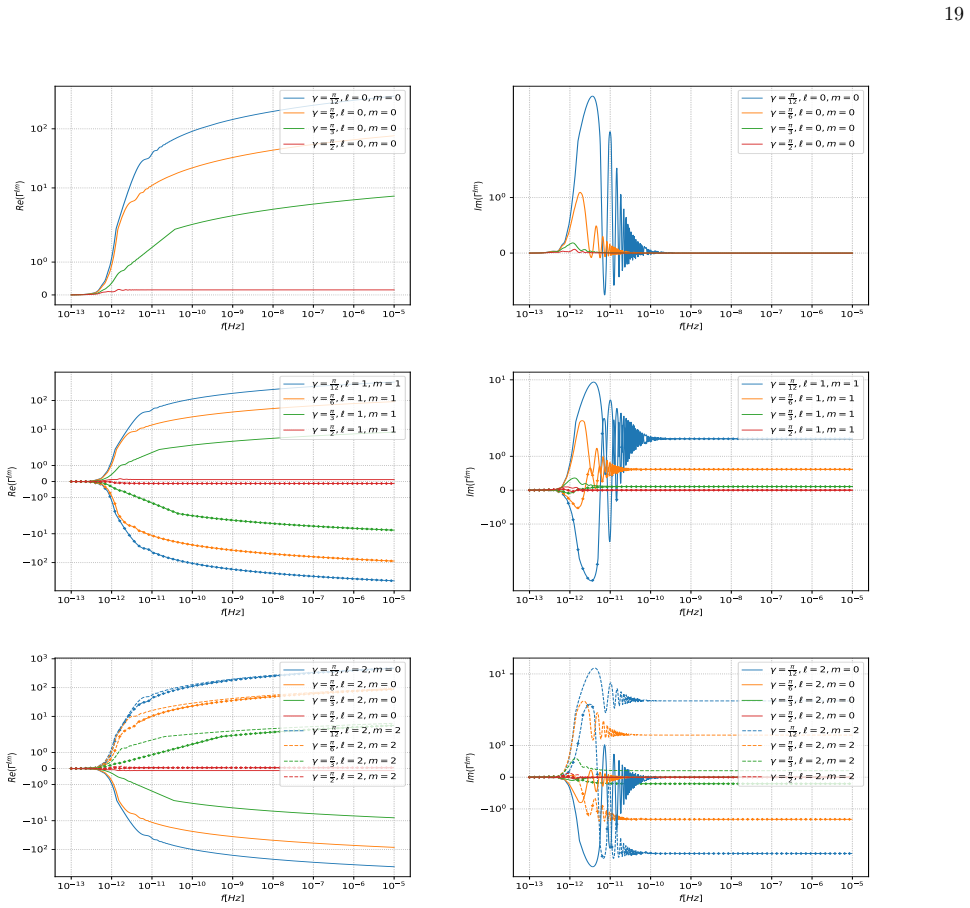
Summary. The paper proposes a universal analytical framework for the overlap reduction functions (ORFs) of a stochastic gravitational-wave background with pulsar timing arrays, covering all six polarization modes and arbitrary spherical-harmonic order. The authors choose a coordinate system with the two pulsars symmetric about the z-axis, introduce the variables x̃ and ỹ as projections of the sky direction onto the two pulsar directions, and state that the ORF integral on the sphere transforms into an integral over an elliptical domain with a Jacobian 1/(sin γ cos θ). They further state that this integral can be evaluated analytically. The paper presents four symmetry theorems for the anisotropic ORFs, short-wavelength limits for ℓ ≤ 2, autocorrelation limits, and plots of the claimed analytical results for tensor, vector, scalar-breathing, and scalar-longitudinal modes. The complete analytical expressions up to ℓ ≤ 5, however, are not printed in the manuscript; the reader is referred to a GitHub repository [36]. The paper repeatedly asserts agreement with numerical integration, but no numerical quadrature comparison is shown; the figures compare the analytical curves only with the short-wavelength approximation.
Significance. If the claimed formulas are correct, the paper would supply exact, closed-form angular correlation kernels for anisotropic PTA searches, removing the need for numerical integration over the sky in each pair evaluation. The symmetry results, especially the vanishing of ORFs for ℓ + m odd and the exchange symmetry under pulsar exchange, are plausible, non-trivial, and could be useful in reducing computational cost and in code validation. The paper also correctly emphasizes the failure of the short-wavelength approximation for the scalar longitudinal mode at small angular separations. However, the central deliverable — the complete ℓ ≤ 5 analytical expressions — is absent from the manuscript, and the claimed agreement with numerical integration is not demonstrated. As written, the headline result is therefore unverified, and the paper cannot be accepted in its current form.
major comments (3)
- [Sec. III, before Sec. III A] The paper states: "Here we present the analytical forms of all ORFs for ℓ≤5. For the detailed expressions of these formulas, please see Ref. [36]," where Ref. [36] is a GitHub repository. This means the central claim of the paper — complete analytic expressions up to ℓ ≤ 5 for all six modes — is not actually contained in the manuscript. A journal publication must be self-contained for its main result; the full formulas need to be included in the paper or in a published appendix/supplement, with the repository serving only as auxiliary code. As it stands, the claimed result cannot be checked from the paper itself.
- [Sec. III, Eq. (34)] The crucial step "This integral can be evaluated analytically" is asserted without derivation. Equation (34) involves a change of variables from the sphere to the elliptical domain E, with Jacobian 1/(sin γ cos θ). The transformation from (θ, φ) to (x̃, ỹ) is two-to-one, since the sphere is covered twice when cos θ changes sign, and the branch of cos θ in the Jacobian is not specified. The text does not explain how the integration domain is resolved, how the two-to-one map is handled, or how the singular behavior at cos θ = 0 is treated. This missing derivation is load-bearing because all closed-form formulas in the paper and repository rest on the analytic evaluation of Eq. (34). The authors should provide a step-by-step derivation of the reduction, including the domain decomposition and branch handling.
- [Secs. III A–D, Figs. 2–13] The manuscript repeatedly claims that the analytical expressions are "in excellent agreement with numerical integration," but no comparison with numerical quadrature of the defining integral Eq. (16) is shown. All plotted comparisons are between the claimed analytical curves and the short-wavelength approximation, which is a different object. This is a particular concern because the formulas are delegated to a repository and the analytic integration step is not demonstrated. The authors should add explicit residual plots or tables comparing their closed-form expressions with direct numerical integration of Eq. (16) over the same (a_u, a_v, γ) values, for each polarization and for a representative set of (ℓ, m) up to ℓ = 5. Without such a check, the central claim of exact analytical expressions is not supported by the evidence in the paper.
minor comments (7)
- [Sec. III, Eq. (34)] The notation R_ij(a_u, a_v, x̃, ỹ) ⊙ Ỹ_ℓm(x̃, ỹ) is introduced without definition. Please define the "⊙" operation explicitly, including its normalization and how it relates to the integral in Eq. (16).
- [Sec. II B, Eq. (13)] The response function in Eq. (13) is taken from Ref. [31] with the choice r2 = 0, but the text later refers to ⃗r2 = L2 r̂2 and L2. Please clarify the notation and the sense in which Earth's position can be set to zero, since the phase factor e^{i 2π f n̂·r2/c} is retained.
- [Sec. III] The subscript "sw" is used for short-wavelength expressions without a definition at first use. Please define the short-wavelength approximation and state clearly where it is being applied.
- [Sec. II A, Eqs. (4) and (5)] Equation (4) writes δ^2(k̂, k̂′) while Eq. (5) writes δ^(2)(k̂ − k̂′); these notations are inconsistent. Please use a single convention for the two-dimensional delta function on the sphere.
- [Bibliography] Reference [36] is incomplete and appears as "(????)". If the GitHub repository is to be cited, please provide a full citation with a version, a DOI, or an archival link (for example, Zenodo) so that the exact version of the formulas can be identified.
- [Figure captions] Several figure captions contain malformed text such as "au = av = 10, = 0,m = 0" and "sw,m = 1", with missing symbols and inconsistent spacing. These should be corrected throughout Figs. 2–13.
- [Sec. III B] In the discussion of vector modes, the paper states that for the full expression "larger a_v is needed for better agreement with the short-wavelength approximation." This is qualitative; please provide a quantitative convergence criterion, for example the value of a_v at which the difference falls below a stated tolerance.
Circularity Check
No circular derivation found; the derivation chain is self-contained and benchmarked externally, with only a minor self-citation that is not logically load-bearing.
full rationale
The paper's derivation proceeds from the standard ORF definition in Eq. (16)/(18), the externally cited Doppler response function in Eq. (13) from Romano and Cornish [31], and the change of variables leading to Eq. (34). No fitted parameter is introduced, and no target result is used as an input. The (0,0) component is checked against the Hellings-Downs curve and against isotropic results from externally authored papers [22, 23, 37-39], which provides independent benchmarks. The symmetry theorems in Sec. II C are proved in the appendix from rotation invariance and spherical-harmonic properties rather than assumed. The only self-references are [35], which is contextual, and [36], a same-author GitHub repository containing the detailed analytical expressions for ell <= 5. The manuscript's statement 'Here we present the analytical forms of all ORFs for ell <= 5. For the detailed expressions of these formulas, please see Ref. [36]' means the central deliverable is not printed in the paper; however, this is a support, verifiability, and completeness gap, not a circular step. No equation or claim reduces by construction to its own input, and there is no fitted quantity renamed as a prediction. The appropriate finding is therefore no significant circularity, with a low score reflecting the minor same-author repository delegation rather than any circular reasoning.
Assumptions & free parameters
assumptions (4)
- domain assumption Response function (13) from Romano & Cornish [31] is the exact mapping from metric perturbations to PTA timing correlations.
- domain assumption The SGWB is stationary, unpolarized, and the six polarization modes are statistically independent (Eq. 4).
- standard math The rigid-rotation invariance property in Eq. (81), cited from Bartolo et al. [45], holds for the PTA response.
- ad hoc to paper The integral over the elliptical domain (Eq. 34) can be evaluated analytically in closed form to arbitrary multipole order.
Cite this review
Pith. "Pith review of Full analytic expressions of overlap reduction functions for anisotropies of the stochastic gravitational-wave background with pulsar timing arrays." pith.science (2026). https://pith.science/paper/5ZR2UASO
@misc{pith2026260807095,
  author       = {Pith},
  title        = {Pith review of: Full analytic expressions of overlap reduction functions for anisotropies of the stochastic gravitational-wave background with pulsar timing arrays},
  year         = {2026},
  howpublished = {\url{https://pith.science/paper/5ZR2UASO}},
  note         = {Machine review of arXiv:2608.07095}
}
read the original abstract
Pulsar timing arrays (PTAs) have detected a stochastic gravitational-wave background (SGWB) in the nanohertz band, enabling tests of gravity and cosmology, as well as studies of supermassive black holes and early Universe physics. PTA data analysis relies on cross-correlating timing residuals, where overlap reduction functions (ORFs) critically determine sensitivity. Conventional ORF calculations using the short-wavelength approximation break down for the scalar longitudinal mode and cannot handle frequency dependence or anisotropies. This work rigorously derives the full response functions within an analytical cross-correlation framework. We reveal, for the first time, intrinsic symmetries and relations among anisotropic ORF integrals for all polarizations. By variable substitutions and coordinate rotations, we transform complex integrals into tractable forms, resolving divergences in vector and scalar longitudinal modes. Building on this, we establish a universal framework yielding fully analytical expressions for anisotropic ORFs to arbitrary order for all six modes. As a direct application, we give complete expressions up to l <= 5. This framework is free of approximations; its (0,0) component recovers the isotropic Hellings--Downs curve. Compared with numerical integration, our results offer broader applicability, faster computation, and higher precision, providing a valuable foundation for anisotropic sky mapping, polarization-mode separation, and new-physics searches with PTA data.
Figures


Figures from the paper (10 more)


Reference graph
Works this paper leans on
- [36]
-
[1]
B. P. Abbott, R. Abbott, T. D. Abbott, et al., Phys. Rev. Lett.116, 061102 (2016), URLhttps://doi.org/ 10.1103/PhysRevLett.116.061102
- [2]
- [3]
-
[4]
M. Rajagopal and R. W. Romani, Astrophys. J.446, 543 (1995), URLhttps://doi.org/10.1086/175813
doi:10.1086/175813 1995
- [5]
-
[6]
C. Caprini, R. Durrer, and X. Siemens, Phys. Rev. D 82, 063511 (2010), URLhttps://link.aps.org/doi/ 10.1103/PhysRevD.82.063511
-
[7]
R. W. Hellings and G. S. Downs, Astrophys. J. Lett.265, L39 (1983), URLhttps://doi.org/10.1086/183954
doi:10.1086/183954 1983
Show all 45 references
-
[8]
Burke-Spolaor, S
S. Burke-Spolaor, S. R. Taylor, M. Charisi, et al., Astron. Astrophys. Rev.27, 5 (2019), URLhttps://doi.org/ 10.1007/s00159-019-0115-7
2019 doi
-
[9]
Agazie et al
G. Agazie et al. (NANOGrav), Astrophys. J. Lett.951, L8 (2023), 2306.16213, URLhttps://iopscience.iop. 20 org/article/10.3847/2041-8213/acdac6
2023 arXiv
-
[10]
Antoniadis et al
J. Antoniadis et al. (EPTA), Astron. Astrophys. 678, A50 (2023), URLhttps://doi.org/10.1051/ 0004-6361/202346844
2023
-
[11]
D. J. Reardon et al. (PPTA), Astrophys. J. Lett.951, L6 (2023), URLhttps://doi.org/10.3847/2041-8213/ acdd02
2023 doi
-
[12]
Xu et al
H. Xu et al. (CPTA), Res. Astron. Astrophys.23, 075024 (2023), URLhttps://doi.org/10.1088/1674-4527/ acdfa5
2023 doi
-
[13]
Caprini, Nature Rev
C. Caprini, Nature Rev. Phys.6, 291 (2024)
2024
-
[14]
N. Laal, S. R. Taylor, R. van Haasteren, W. G. Lamb, and X. Siemens, Phys. Rev. D111, 063067 (2025), 2410.11944, URLhttps://doi.org/10.1103/PhysRevD. 111.063067
2025 arXiv
-
[15]
J. J. Somalwar and V. Ravi, The Astrophysical Jour- nal982, 195 (2025), URLhttps://doi.org/10.3847/ 1538-4357/adbc62
2025
-
[16]
M. T. Miles, R. M. Shannon, D. J. Reardon, et al. (MeerKAT PTA), Mon. Not. R. Astron. Soc.536, 1489 (2024), URLhttps://doi.org/10.1093/mnras/ stae2571
2024 doi
-
[17]
Gouttenoire and E
Y. Gouttenoire and E. Vitagliano, Phys. Rev. D110, L061306 (2024), 2306.17841, URLhttps://link.aps. org/doi/10.1103/PhysRevD.110.L061306
2024 arXiv
-
[18]
Ellis, M
J. Ellis, M. Fairbairn, G. Franciolini, G. H¨ utsi, A. Iovino, M. Lewicki, M. Raidal, J. Urrutia, V. Vaskonen, and H. Veerm¨ ae, Phys. Rev. D109, 023522 (2024), URLhttps://link.aps.org/doi/10. 1103/PhysRevD.109.023522
2024
-
[19]
C. M. F. Mingarelli, T. Sidery, I. Mandel, and A. Vecchio, Phys. Rev. D88, 062005 (2013), URLhttps://doi.org/ 10.1103/PhysRevD.88.062005
2013 doi
-
[20]
S. R. Taylor and J. R. Gair, Phys. Rev. D88, 084001 (2013), URLhttps://link.aps.org/doi/10. 1103/PhysRevD.88.084001
2013
-
[21]
R. C. Bernardo and K.-W. Ng, Phys. Rev. D107, 044007 (2023), URLhttps://link.aps.org/doi/10. 1103/PhysRevD.107.044007
2023
-
[22]
K. J. Lee, F. A. Jenet, and R. H. Price, Astrophys. J.685, 1304 (2008), URLhttps://doi.org/10.1086/ 591080
2008
-
[23]
S. J. Chamberlin and X. Siemens, Phys. Rev. D85, 082001 (2012), URLhttps://link.aps.org/doi/10. 1103/PhysRevD.85.082001
2012
-
[24]
Anholm, S
M. Anholm, S. Ballmer, J. D. E. Creighton, L. R. Price, and X. Siemens, Phys. Rev. D79, 084030 (2009), URL https://doi.org/10.1103/PhysRevD.79.084030
2009 doi
-
[25]
J. R. Gair, J. D. Romano, S. R. Taylor, and C. M. F. Mingarelli, Phys. Rev. D90, 082001 (2014), URLhttps: //doi.org/10.1103/PhysRevD.90.082001
2014 doi
-
[26]
Hu, P.-P
Y. Hu, P.-P. Wang, Y.-J. Tan, and C.-G. Shao, Phys. Rev. D106, 024005 (2022), 2205.09272, URLhttps: //arxiv.org/abs/2205.09272
2022 arXiv
-
[27]
Anil Kumar and M
N. Anil Kumar and M. Kamionkowski, Phys. Rev. Lett. 133, 151401 (2024), 2311.14159, URLhttps://link. aps.org/doi/10.1103/PhysRevLett.133.151401
2024 arXiv
-
[28]
Inomata, M
K. Inomata, M. Kamionkowski, C. M. Toral, and S. R. Taylor, Phys. Rev. D110, 063547 (2024), 2406.00096, URLhttps://link.aps.org/doi/10.1103/ PhysRevD.110.063547
2024 arXiv
-
[29]
Cordes and K
N. Cordes and K. Schmitz, arXiv e-prints (2024), 2407.04464, URLhttps://arxiv.org/abs/2407.04464
2024 arXiv
-
[30]
W. G. Lamb, S. R. Taylor, and R. van Haasteren, Phys. Rev. D108, 103019 (2023), URLhttps://doi.org/10. 1103/PhysRevD.108.103019
2023
-
[31]
J. D. Romano and N. J. Cornish, Living Rev. Rel- ativ.20, 2 (2017), URLhttps://doi.org/10.1007/ s41114-017-0004-1
2017
-
[32]
Janssen et al., Proc
G. Janssen et al., Proc. Sci.AASKA14, 037 (2015), URLhttps://doi.org/10.22323/1.215.0037
2015 doi
-
[33]
Allen and J
B. Allen and J. D. Romano, Phys. Rev. D59, 102001 (1999), gr-qc/9710117, URLhttps://link.aps.org/ doi/10.1103/PhysRevD.59.102001
1999 arXiv
-
[34]
Bartolo, D
N. Bartolo, D. Bertacca, R. Caldwell, C. R. Con- taldi, G. Cusin, V. De Luca, E. Dimastrogiovanni, M. Fasiello, D. G. Figueroa, G. Franciolini, et al. (LISA Cosmology Working Group), JCAP11, 009 (2022), 2201.08782, URLhttps://doi.org/10.1088/ 1475-7516/2022/11/009
2022 arXiv
-
[35]
K. Zhou, J. Cheng, and L. Ren, arXiv e-prints arXiv:2306.14439 (2023), 2306.14439, URLhttps:// arxiv.org/abs/2306.14439
2023 arXiv
-
[37]
Lu, Y.-J
X.-Y. Lu, Y.-J. Tan, and C.-G. Shao, Phys. Rev. D 100, 044042 (2019), URLhttps://link.aps.org/doi/ 10.1103/PhysRevD.100.044042
2019 doi
-
[38]
Wang, Y.-J
P.-P. Wang, Y.-J. Tan, W.-L. Qian, and C.-G. Shao, Phys. Rev. D103, 063021 (2021), URLhttps://link. aps.org/doi/10.1103/PhysRevD.103.063021
2021 doi
-
[39]
Wang, Y.-J
P.-P. Wang, Y.-J. Tan, W.-L. Qian, and C.-G. Shao, Phys. Rev. D104, 023002 (2021), URLhttps://link. aps.org/doi/10.1103/PhysRevD.104.023002
2021 doi
-
[40]
J. L. Han et al., Res. Astron. Astrophys.25, 014001 (2025), 2411.15961, URLhttps://doi.org/10.1088/ 1674-4527/ada3b7
2025 arXiv
-
[41]
D. J. Reardon et al., Mon. Not. Roy. Astron. Soc. 507, 2137 (2021), 2107.04609, URLhttps://doi.org/ 10.1093/mnras/stab1990
2021 arXiv
-
[42]
D. J. D’Orazio and A. Loeb, Phys. Rev. D104, 063015 (2021), 2009.06084, URLhttps://link.aps.org/doi/ 10.1103/PhysRevD.104.063015
2021 arXiv
-
[43]
Smits, S
R. Smits, S. J. Tingay, N. Wex, M. Kramer, and B. Stappers, Astron. Astrophys.528, A108 (2011), 1101.5971, URLhttp://dx.doi.org/10.1051/ 0004-6361/201016141
2011 arXiv
-
[44]
P. F. Wang, J. L. Han, Z. L. Yang, T. Wang, C. Wang, W. Q. Su, J. Xu, D. J. Zhou, Y. Yan, W. C. Jing, et al., Research in Astronomy and Astrophysics 25, 014003 (2025), URLhttps://doi.org/10.1088/ 1674-4527/ada3b8
2025
-
[45]
Bartolo, V
N. Bartolo, V. Domcke, D. G. Figueroa, J. Garcia- Bellido, M. Peloso, M. Pieroni, A. Ricciardone, M. Sakel- lariadou, L. Sorbo, and G. Tasinato, J. Cosmology As- tropart. Phys.2018, 034 (2018), 1806.02819, URLhttp: //dx.doi.org/10.1088/1475-7516/2018/11/034
2018 arXiv
Reviewed August 10, 2026 · model on record in the stance chip above.
Discussion (0). Continue with ORCID to comment.