REVIEW 4 major objections 5 minor 71 references
Overaging with stress in polymer glasses? Faster segmental dynamics despite larger yield stress!
T0 review · 4 major / 5 minor · reviewed 2026-08-10 · deepseek-v4-flash
Pith's one-line read Aging a PMMA glass under a 9 MPa stress raises its yield stress while making its segmental dynamics faster, directly contradicting the overaging interpretation of stress-accelerated aging.
desk verdict Direct probe-reorientation measurements show stress-aged PMMA has a higher yield stress yet faster segmental dynamics, undercutting the overaging interpretation, though missing error bars and relying on a probe proxy. read the letter →
The pith
A machine-rendered reading of the paper's core claim, the machinery that carries it, and where it could break.
The reading
What carries the argument
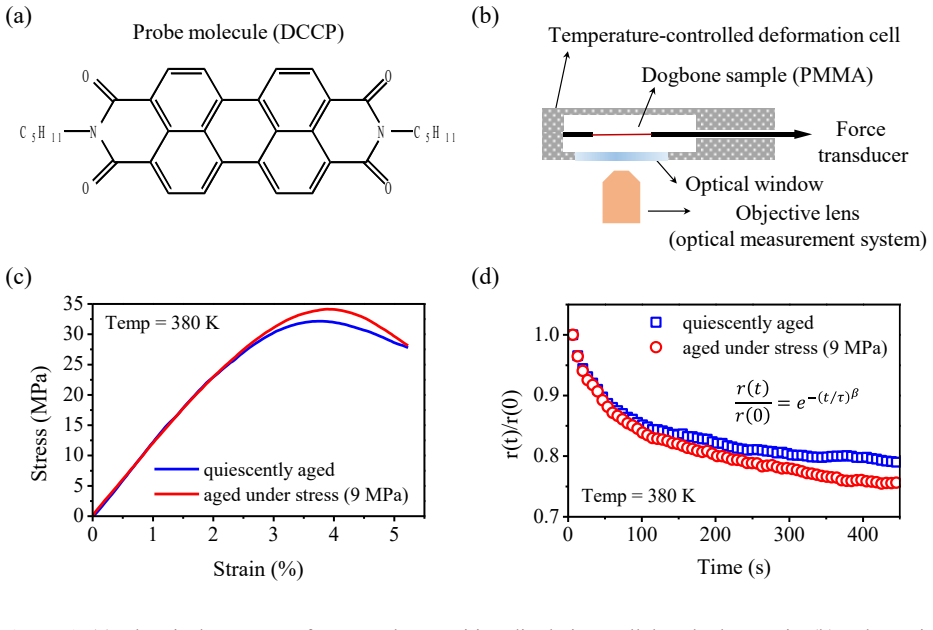
The load-bearing measurement is photobleaching probe reorientation of DCCP molecules dispersed at tracer concentration in the PMMA glass. A polarized laser selectively bleaches probes; the decay of fluorescence anisotropy $r(t)$ is fit to a Kohlrausch-Williams-Watts function $r(t)=r(0)\exp[-(t/\tau)^\beta]$, and the relaxation time $\tau_{KWW}$ is taken as the segmental relaxation time. This optical measurement can be run while the sample sits in the mechanical test cell, so the same thermal-mechanical history yields both yield stress and segmental dynamics. The argument's logical machinery is a two-arm comparison: identical thermal/time protocols with and without a constant stress, with the yield stress measured in a constant strain-rate ramp and the dynamics measured by the probe. The central contradiction is that stress-aged samples have larger yield stress and smaller $\tau_{KWW}$ simultaneously.
What would settle it
Perform a probe-free measurement of segmental relaxation, such as dielectric relaxation spectroscopy, on the same stress-aged PMMA protocol at 380 K; if the measured relaxation time after stress release is longer than or equal to that of the quiescently aged sample, the central observation fails.
Extended reading notes
Core claim
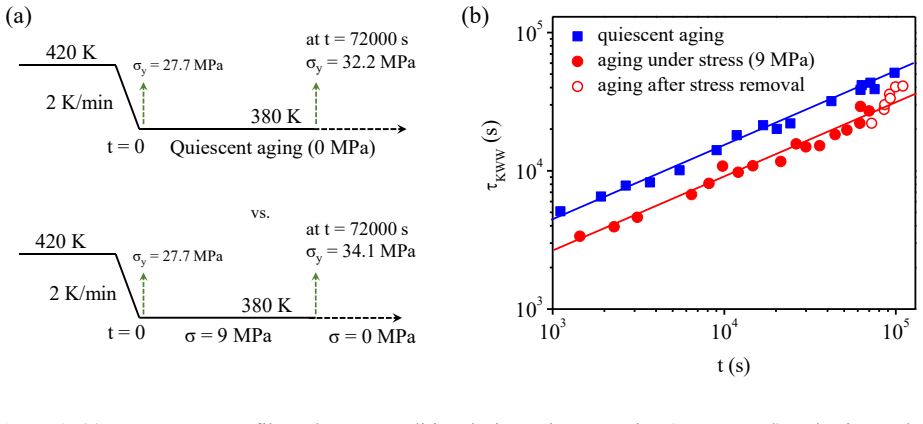
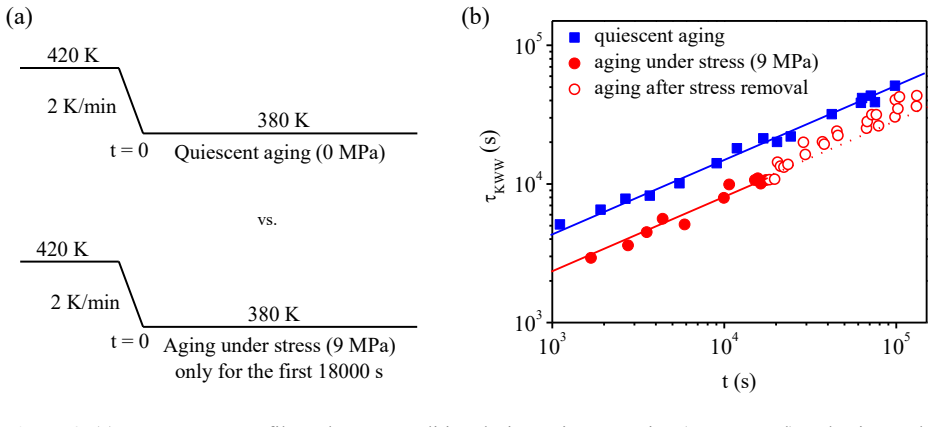
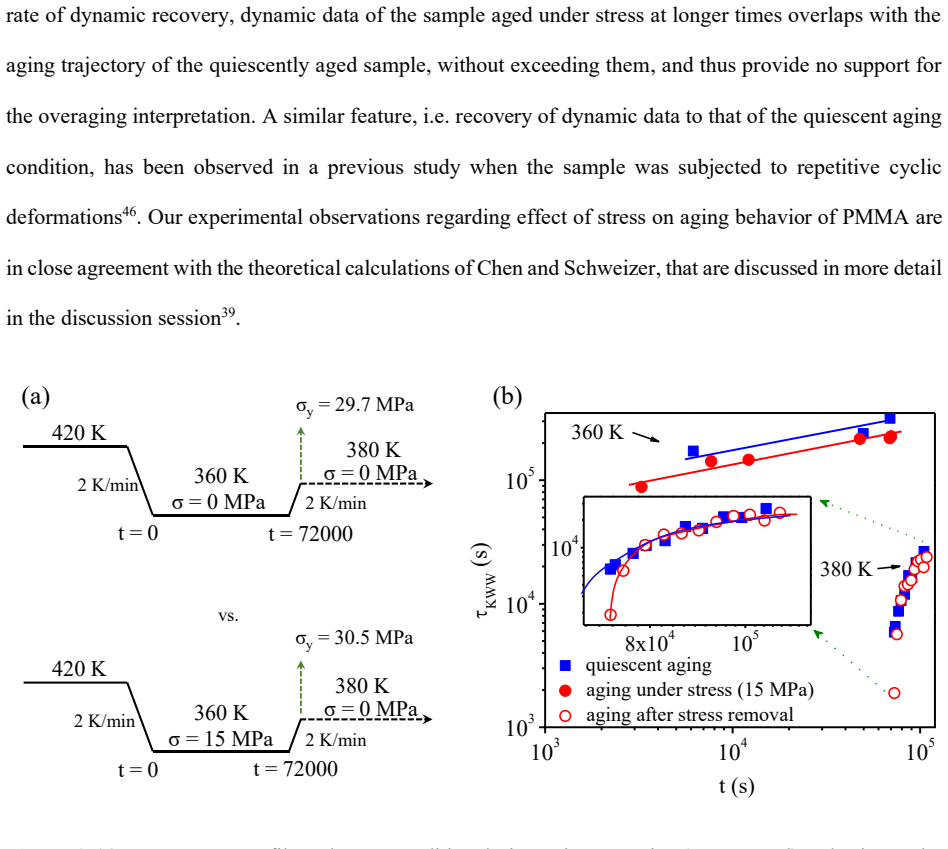
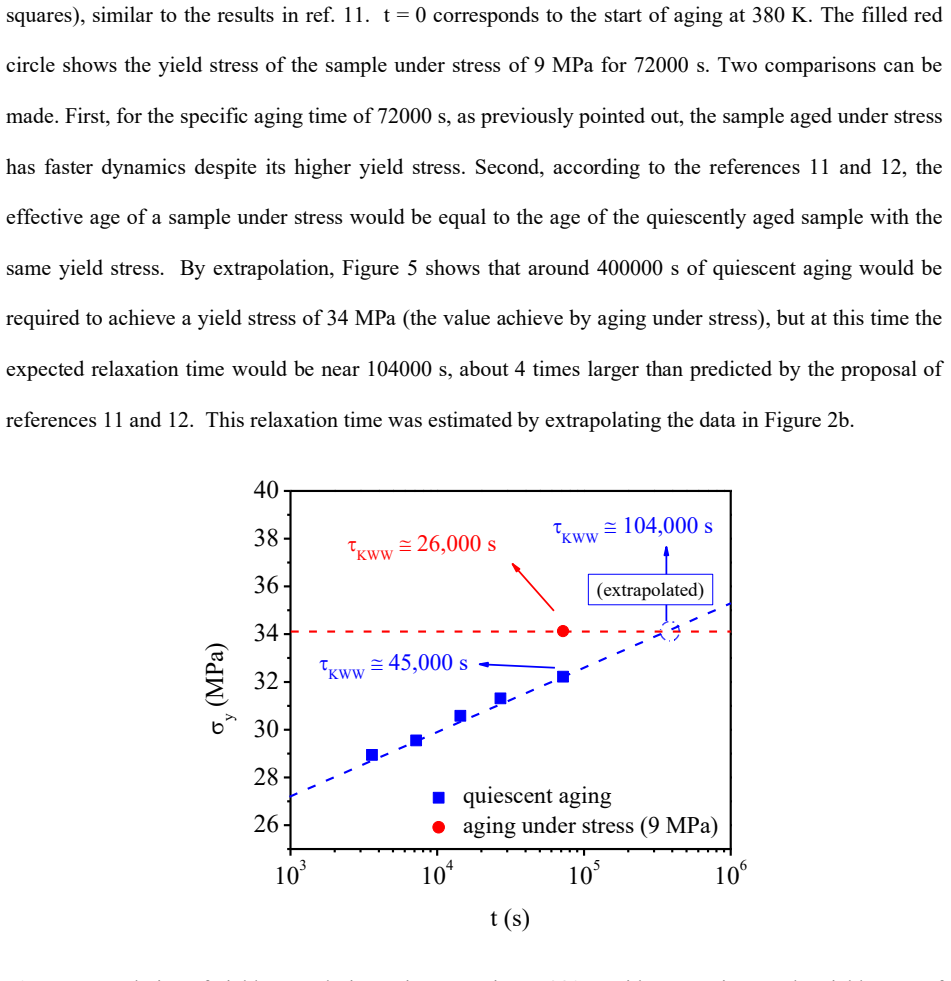
The central discovery is a decoupling of mechanical and dynamical age under stress. For lightly crosslinked PMMA aged at 380 K, holding the sample under a constant 9 MPa stress for 72,000 s increased the subsequent yield stress from 32.2 MPa (quiescent) to 34.1 MPa, a 6% rise, while the segmental relaxation time measured by probe reorientation fell from roughly 45,000 s to 26,000 s, about a factor of two faster. The faster dynamics persisted for at least 30,000 s after the stress was released, and the same qualitative pattern held in a second protocol with stress removed after 18,000 s and in a lower-temperature (360 K) comparison. The authors therefore conclude that the higher yield stress of stress-aged samples is not evidence of accelerated physical aging; the glass is dynamically younger and yet mechanically stronger. They also show that matching the yield stress achieved under stress by quiescent aging would require roughly 400,000 s and would correspond to a relaxation time near 104,000 s, four times the observed value under stress aging.
Load-bearing premise
The probe reorientation time $\tau_{KWW}$ is assumed to faithfully track the polymer's true segmental relaxation time while the glass is under stress and after stress release; if the probe molecule's motion decouples from segmental dynamics in the deformed glass, the 'faster dynamics after stress release' observation would not prove the glass is younger.
Editorial extensions
If this is right
- If the conclusion holds, time-stress superposition methods that convert stress aging into an equivalent longer quiescent aging time will overestimate the relaxation time increase after stress release.
- Yield stress alone cannot serve as a proxy for the structural age of a polymer glass; mechanical aging and dynamical aging must be tracked separately.
- Constitutive models that let segmental relaxation time control the full nonlinear mechanical response ('material time' models) are missing at least one additional state variable.
- The higher yield stress under stress aging may be carried by structural orientation or a mechanical state variable rather than by a denser, more aged glass.
- Rapidly quenched simulation glasses may show overaging, but slowly cooled laboratory glasses may not, so simulation-derived overaging results should not be transferred to typical polymer processing without careful attention to the annealing state.
Reading between the lines
- A natural extension is to vary the aging stress continuously from small to large values and measure both yield stress and segmental relaxation time at fixed aging time; the paper's picture predicts a non-monotonic relation, with yield stress peaking before the relaxation time turns over.
- The same decoupling may appear in enthalpy measurements: the Nanzai DSC data cited in the paper indicate almost no enthalpy change under strain despite higher yield stress, suggesting that mechanical strength and thermodynamic age can follow independent trajectories in other glass families.
- If the probe is decoupled from segmental dynamics in the deformed state, the conclusions would be wrong; a direct test with an independent probe-free technique is a suitable way to settle that concern.
- For applications, the results imply that load-bearing polymer parts could be strengthened by pre-stressing without the embrittlement normally associated with physical aging, since the segmental dynamics remain faster.
Editorial analysis
A structured set of objections, weighed in public.
Referee Report
Summary. The paper reports an experimental study of lightly crosslinked PMMA glasses aged under constant tensile stress, comparing their yield stress and segmental dynamics with quiescently aged glasses. The authors measure segmental dynamics via DCCP probe reorientation (KWW fits) and yield stress via constant strain-rate tensile tests. Their central observation is that aging under 9 MPa at 380 K for 72,000 s produces a yield stress about 6% higher than quiescent aging, while the segmental relaxation time after stress release is about a factor of two faster, with the difference persisting for at least 30,000 s. Additional protocols at 18,000 s at 380 K and at 72,000 s at 360 K show qualitatively similar behavior and eventual recovery toward the quiescent aging trajectory. The authors interpret these results as contradicting the 'overaging' interpretation of stress-accelerated aging and conclude that yield stress is not a simple function of structural relaxation time, so theoretical models based on that assumption need revision.
Significance. If correct, the main finding is significant for the physics of polymer glasses and for constitutive modeling: it directly challenges the widely used interpretation that a stress-induced increase in yield stress implies accelerated physical aging ('overaging'), and it gives experimental support to recent arguments against the material-time assumption. The paper's strengths include the direct measurement of segmental dynamics rather than only mechanical proxies, the use of multiple aging protocols and stress-release recovery checks, the explicit comparison with Chen-Schweizer NLE theory, and the clearly stated falsifiable claim. The main limitation is that the central conclusion rests on the assumption that probe reorientation faithfully reports polymer segmental dynamics in the permanently oriented post-creep state, an assumption validated in earlier work mostly for melts and linear deformations.
major comments (4)
- [Discussion, first paragraph] The central claim depends on the assumption that DCCP reorientation time reports the polymer's segmental relaxation time in the specific post-creep state studied here, where the sample has accumulated 5.8% total creep and 5.1% permanent strain and is permanently oriented. The cited validation (refs 42-43, 47-49) is for polymer melts and for linear deformations; the present protocol is nonlinear and produces a recovered but oriented glass. Because the authors explicitly concede that 'our statements about the segmental dynamics of the polymer are inferences,' an independent check is needed in this state. I recommend a comparison of probe reorientation with a probe-free segmental dynamics measurement (e.g., stress relaxation modulus or dielectric spectroscopy) on identically aged and stress-released samples, or at minimum a quantitative discussion of why the probe cannot be decoupled from segmental dynamics under these conditions. Without this, the faster post-stress tau_KWW could be a probe artifact rather than evidence against overaging.
- [Results, Figure 2 and Table 1] The key quantitative claims are the 6% difference in yield stress (34.1 vs 32.2 MPa) and the factor-of-two difference in tau_KWW, yet no error bars or replicate statistics are provided. The main-text measurements are stated to come from one sample, and the statement that repeatability was confirmed on different samples is not accompanied by data. Sample-to-sample variation in yield stress of a few percent is common in polymer glasses and could change the sign of the 6% effect. I request at least three independent repeats of the central protocol (quiescent aging vs 9 MPa stress aging at 380 K) with reported mean and standard deviation for both yield stress and tau_KWW, and a statement of how many measurements contribute to each reported value.
- [Results, Figure 5 and related text] The quantitative comparison against the effective-age prediction of refs. 11-12 relies on an extrapolated tau_KWW of about 104,000 s, obtained by extrapolating the quiescent-aging power law from Figure 2b with exponent about 0.53. No uncertainty is given for this extrapolation, and the power-law exponent is fit to data from a single sample without reported fitting errors. Since the factor-of-four discrepancy is a central part of the argument against the quantitative overaging model, the authors should provide confidence intervals for the extrapolated value, perhaps by fitting the quiescent data over different time ranges and by propagating the scatter in tau_KWW.
- [Discussion, paragraph on chain orientation] The authors argue that chain orientation is 'likely a contributing factor but not the primary factor' based on a simple strain-hardening estimate and on the nearly constant g factor. However, the g factor measures probe alignment, not directly polymer chain orientation, and the strain-hardening calculation is not derived in detail. Because the 5.1% permanent strain could in principle orient chain segments that are not captured by the probe alignment, this part of the discussion would benefit from either direct orientation measurements (birefringence, FTIR, or simulation data) or a clearly stated uncertainty. This point is not fatal to the main conclusion, since the claim of faster dynamics after stress release does not require orientation to be absent, but it affects the interpretation of why yield stress is elevated.
minor comments (5)
- [Experimental, probe reorientation measurement] There is a typo: 'DPPC probe molecules' should read 'DCCP probe molecules', matching the molecule name used elsewhere.
- [Figure 2b and Figure 3b] The axis labels and legend entries are small and somewhat crowded; adding error bars to the plotted points and increasing font size would improve readability.
- [Results, paragraph after Figure 2] The phrase 'always smaller than (or the same as)' is stronger than what the data show, since the 360 K protocol shows eventual overlap with the quiescent trajectory; consider rewording to 'smaller than or equal to' with the explicit time window stated.
- [References] Reference 64 is a preprint ('ArXiv 2019'); please update to the published version or provide the journal citation if it has appeared.
- [Figure 4] The inset of Figure 4 is difficult to read, particularly the linear-time expanded portion; enlarging the inset and labeling the axes more clearly would help the reader follow the recovery argument.
Circularity Check
No significant circularity: the key quantities are independent measurements, not derived from each other.
full rationale
The central claim is an empirical comparison: samples aged under stress have higher yield stress but faster probe reorientation times after stress release. Yield stress is measured independently by constant-strain-rate tensile deformation, while segmental dynamics are measured independently by photobleaching anisotropy decay. Neither quantity is fit to the other, and no model equation is used to convert one into the other. The KWW relaxation time is a descriptive fit parameter, not an input that forces the yield stress result. The paper explicitly acknowledges that the probe reorientation measurement is an inference about segmental dynamics, and it supports this inference with prior comparisons to probe-free mechanical and dielectric measurements; this is an empirical validation assumption, not a circular derivation, and the paper candidly flags its limitation. Agreement with the Chen-Schweizer NLE theory is external comparison, not an input to the measurement. The extrapolation in Figure 5 is used only to illustrate the contrast with the effective-age proposal of refs. 11-12, and it does not enter the central conclusion. No step in the paper reduces a prediction to its own inputs, either by definition, fitted parameter renaming, or a load-bearing self-citation chain. The result is therefore self-contained as an experimental finding and no circularity is present.
Assumptions & free parameters
free parameters (2)
- KWW stretching exponent beta =
0.31 (fixed for quiescent) or 0.28-0.31 (free under stress)
- Quiescent aging power-law exponent =
~0.53
assumptions (4)
- domain assumption Probe reorientation time reports the polymer segmental relaxation time.
- domain assumption Annealing above Tg erases prior mechanical and thermal history.
- standard math KWW functional form describes the anisotropy decay.
- domain assumption Yield stress measured at 380 K two minutes after stress release represents the aged-under-stress state.
Cite this review
Pith. "Pith review of Overaging with stress in polymer glasses? Faster segmental dynamics despite larger yield stress!." pith.science (2026). https://pith.science/paper/J4YYBVLN
@misc{pith2026260807310,
  author       = {Pith},
  title        = {Pith review of: Overaging with stress in polymer glasses? Faster segmental dynamics despite larger yield stress!},
  year         = {2026},
  howpublished = {\url{https://pith.science/paper/J4YYBVLN}},
  note         = {Machine review of arXiv:2608.07310}
}
read the original abstract
It is well known that physical aging of polymer glasses increases their yield stress and affects their failure behavior. Studies indicate that application of moderate levels of stress during aging results in higher yield stress compared to aging in the absence of stress (quiescent aging). This has been interpreted to indicate that stress accelerates physical aging, and has been described as overaging. In this study, we age PMMA glasses under stress, and carry out direct measurement of segmental dynamics during and after aging by using a probe reorientation technique. We observe that samples aged under stress, despite having higher yield stress, have faster segmental dynamics after stress release than quiescently aged samples. This contradicts the overaging interpretation, for the range of conditions explored here. Our results indicate that yield stress is not a simple function of structural relaxation time and theoretical models based on this understanding need to be revised.
Figures
Figures from the paper (2 more)
Reference graph
Works this paper leans on
-
[1]
Ediger, M. D.; Angell, C. A.; Nagel, S. R., Supercooled liquids and glasses. The journal of physical chemistry 1996, 100 (31), 13200-13212
work page 1996
-
[2]
Struik, L. C. E., Physical aging in plastics and other glassy materials. Polymer Engineering & Science 1977, 17 (3), 165-173
work page 1977
-
[3]
The Journal of chemical physics 2010, 133 (1), 014901
Lee, H.-N.; Ediger, M., Interaction between physical aging, deformation, and segmental mobility in poly (methyl methacrylate) glasses. The Journal of chemical physics 2010, 133 (1), 014901
work page 2010
-
[4]
B., Shear stress relaxation and physical aging study on simple glass- forming materials
Shi, X.; Mandanici, A.; McKenna, G. B., Shear stress relaxation and physical aging study on simple glass- forming materials. The Journal of chemical physics 2005, 123 (17), 174507
work page 2005
-
[5]
Angell, C. A.; Ngai, K. L.; McKenna, G. B.; McMillan, P. F.; Martin, S. W., Relaxation in glassforming liquids and amorphous solids. Journal of applied physics 2000, 88 (6), 3113-3157
work page 2000
-
[6]
L., Signatures of structural recovery in polystyrene by nanocalorimetry
Lopez, E.; Simon, S. L., Signatures of structural recovery in polystyrene by nanocalorimetry. Macromolecules 2016, 49 (6), 2365-2374
work page 2016
-
[7]
Visser, H. A.; Bor, T. C.; Wolters, M.; Wismans, J. G.; Govaert, L. E., Lifetime Assessment of Load‐Bearing Polymer Glasses: The Influence of Physical Ageing. Macromolecular materials and engineering 2010, 295 (12), 1066-1081
work page 2010
-
[8]
Modelling and Simulation in Materials Science and Engineering 2013, 21 (8), 085015
Poluektov, M.; Van Dommelen, J.; Govaert, L.; Yakimets, I.; Geers, M., Micromechanical modelling of short-term and long-term large-strain behaviour of polyethylene terephthalate. Modelling and Simulation in Materials Science and Engineering 2013, 21 (8), 085015
work page 2013
Show all 71 references
-
[9]
V., The effect of cryogenic thermal cycling on aging, rejuvenation, and mechanical properties of metallic glasses
Priezjev, N. V., The effect of cryogenic thermal cycling on aging, rejuvenation, and mechanical properties of metallic glasses. Journal of Non-Crystalline Solids 2019, 503, 131-138
2019
-
[10]
Physical Review E 2007, 76 (3), 031802
Warren, M.; Rottler, J., Simulations of aging and plastic deformation in polymer glasses. Physical Review E 2007, 76 (3), 031802. 21
2007
-
[11]
Macromolecules 2005, 38 (16), 6997-7008
Klompen, E.; Engels, T.; Govaert, L.; Meijer, H., Modeling of the postyield response of glassy polymers: influence of thermomechanical history. Macromolecules 2005, 38 (16), 6997-7008
2005
-
[12]
C.; Kanters, M
Clarijs, C. C.; Kanters, M. J.; van Erp, M. J.; Engels, T. A.; Govaert, L. E., Predicting plasticity‐controlled failure of glassy polymers: Influence of stress‐accelerated progressive physical aging. Journal of Polymer Science Part B: Polymer Physics 2019, 57 (19), 1300-1314
2019
-
[13]
-J.; Ogata, S., Prediction of pressure -promoted thermal rejuvenation in metallic glasses
Miyazaki, N.; Wakeda, M.; Wang, Y. -J.; Ogata, S., Prediction of pressure -promoted thermal rejuvenation in metallic glasses. npj Computational Materials 2016, 2 (1), 1-9
2016
-
[14]
Journal of Polymer Science: Polymer Physics Edition 1976, 14 (4), 703-721
Matsushige, K.; Radcliffe, S.; Baer, E., The mechanical behavior of poly (methyl methacrylate) under pressure. Journal of Polymer Science: Polymer Physics Edition 1976, 14 (4), 703-721
1976
-
[15]
The Journal of Chemical Physics 1969, 51 (9), 3728-3739
Goldstein, M., Viscous liquids and the glass transition: a potential energy barrier picture. The Journal of Chemical Physics 1969, 51 (9), 3728-3739
1969
-
[16]
B., Mechanical rejuvenation in polymer glasses: fact or fallacy? Journal of Physics: Condensed Matter 2003, 15 (11), S737
McKenna, G. B., Mechanical rejuvenation in polymer glasses: fact or fallacy? Journal of Physics: Condensed Matter 2003, 15 (11), S737
2003
-
[17]
A., Role of Local Structure in the Enhanced Dynamics of Deformed Glasses
Yang, E.; Riggleman, R. A., Role of Local Structure in the Enhanced Dynamics of Deformed Glasses. Physical Review Letters 2022, 128 (9), 097801
2022
-
[18]
A.; Schweizer, K
Riggleman, R. A.; Schweizer, K. S.; Pablo, J. J. d., Nonlinear creep in a polymer glass. Macromolecules 2008, 41 (13), 4969-4977
2008
-
[19]
Y.-H.; Rottler, J., Aging under stress in polymer glasses
Liu, A. Y.-H.; Rottler, J., Aging under stress in polymer glasses. Soft Matter 2010, 6 (19), 4858-4862
2010
-
[20]
Mota, R. M. O.; Lund, E. T.; Sohn, S.; Browne, D. J.; Hofmann, D. C.; Curtarolo, S.; van de Walle, A.; Schroers, J., Enhancing ductility in bulk metallic glasses by straining during cooling. Communications Materials 2021, 2 (1), 1-8
2021
-
[21]
Acta Materialia 2014, 74, 165-182
Magagnosc, D.; Kumar, G.; Schroers, J.; Felfer, P.; Cairney, J.; Gianola, D., Effect of ion irradiation on tensile ductility, strength and fictive temperature in metallic glass nanowires. Acta Materialia 2014, 74, 165-182
2014
-
[22]
A., Photoinduced structural relaxation in chalcogenide glasses
Lucas, P.; Doraiswamy, A.; King, E. A., Photoinduced structural relaxation in chalcogenide glasses. Journal of non-crystalline solids 2003, 332 (1-3), 35-42
2003
-
[23]
A., Densification and strain hardening of a metallic glass under tension at room temperature
Wang, Z.; Pan, J.; Li, Y.; Schuh, C. A., Densification and strain hardening of a metallic glass under tension at room temperature. Physical Review Letters 2013, 111 (13), 135504
2013
-
[24]
-Y.; Peng, H
Zhou, Z. -Y.; Peng, H. -L.; Yu, H. -B., Structural origin for vibration -induced accelerated aging and rejuvenation in metallic glasses. The Journal of Chemical Physics 2019, 150 (20), 204507
2019
-
[25]
J.; Osborne, M
Lacks, D. J.; Osborne, M. J., Energy landscape picture of overaging and rejuvenation in a sheared glass. Physical review letters 2004, 93 (25), 255501
2004
-
[26]
V.; Michels, M., Time scales and mechanisms of relaxation in the energy landscape of polymer glass under deformation: direct atomistic modeling
Lyulin, A. V.; Michels, M., Time scales and mechanisms of relaxation in the energy landscape of polymer glass under deformation: direct atomistic modeling. Physical review letters 2007, 99 (8), 085504
2007
-
[27]
Viasnoff, V.; Jurine, S.; Lequeux, F., How are colloidal suspensions that age rejuvenated by strain application? Faraday Discussions 2003, 123, 253-266
2003
-
[28]
Nature 2001, 413 (6854), 407-409
D'Anna, G.; Grémaud, G., The jamming route to the glass state in weakly perturbed granular media. Nature 2001, 413 (6854), 407-409
2001
-
[29]
Nature materials 2005, 4 (2), 121-128
Richard, P.; Nicodemi, M.; Delannay, R.; Ribiere, P.; Bideau, D., Slow relaxation and compaction of granular systems. Nature materials 2005, 4 (2), 121-128
2005
-
[30]
-N.; Riggleman, R
Lee, H. -N.; Riggleman, R. A.; de Pablo, J. J.; Ediger, M., Deformation -induced mobility in polymer glasses during multistep creep experiments and simulations. Macromolecules 2009, 42 (12), 4328-4336
2009
-
[31]
Journal of Applied Physics 1972, 43 (11), 4370-4383
Sternstein, S.; Ho, T., Biaxial stress relaxation in glassy polymers: polymethylmethacrylate. Journal of Applied Physics 1972, 43 (11), 4370-4383
1972
-
[32]
Polymer 1980, 21 (8), 962-967
Struik, L., The mechanical enhancement of physical aging. Polymer 1980, 21 (8), 962-967
1980
-
[33]
B.; Zapas, L
Mckenna, G. B.; Zapas, L. J., Superposition of small strains on large deformations as a probe of nonlinear response in polymers. Polymer Engineering & Science 1986, 26 (11), 725-729. 22
1986
-
[34]
Z., Aging in fully annealed and subsequently strained poly (methyl methacrylate)
Nanzai, Y.; Miwa, A.; Cui, S. Z., Aging in fully annealed and subsequently strained poly (methyl methacrylate). Polymer journal 2000, 32 (1), 51-56
2000
-
[35]
R., Acceleration and homogenization of the dynamics during plastic deformation
Conca, L.; Dequidt, A.; Sotta, P.; Long, D. R., Acceleration and homogenization of the dynamics during plastic deformation. Macromolecules 2017, 50 (23), 9456-9472
2017
-
[36]
Physical Review Letters 2012, 108 (4), 048301
Fielding, S.; Larson, R.; Cates, M., Simple model for the deformation -induced relaxation of glassy polymers. Physical Review Letters 2012, 108 (4), 048301
2012
-
[37]
S., Theory of yielding, strain softening, and steady plastic flow in polymer glasses under constant strain rate deformation
Chen, K.; Schweizer, K. S., Theory of yielding, strain softening, and steady plastic flow in polymer glasses under constant strain rate deformation. Macromolecules 2011, 44 (10), 3988-4000
2011
-
[38]
S.; Stamm, R.; Lee, E.; Caruthers, J
Chen, K.; Schweizer, K. S.; Stamm, R.; Lee, E.; Caruthers, J. M., Theory of nonlinear creep in polymer glasses. The Journal of chemical physics 2008, 129 (18), 184904
2008
-
[39]
S., Theory of aging, rejuvenation, and the nonequilibrium steady state in deformed polymer glasses
Chen, K.; Schweizer, K. S., Theory of aging, rejuvenation, and the nonequilibrium steady state in deformed polymer glasses. Physical Review E 2010, 82 (4), 041804
2010
-
[40]
Macromolecules 2019, 52 (21), 8177-8186
Ricci, J.; Bennin, T.; Xing, E.; Ediger, M., Linear Stress Relaxation and Probe Reorientation: Comparison of the Segmental Dynamics of Two Glassy Polymers during Physical Aging. Macromolecules 2019, 52 (21), 8177-8186
2019
-
[41]
M.; Bonn, D., On different ways of measuring “the” yield stress
Dinkgreve, M.; Paredes, J.; Denn, M. M.; Bonn, D., On different ways of measuring “the” yield stress. Journal of non-Newtonian fluid mechanics 2016, 238, 233-241
2016
-
[42]
F.; Ediger, M., Dye reorientation as a probe of stress-induced mobility in polymer glasses
Lee, H.-N.; Paeng, K.; Swallen, S. F.; Ediger, M., Dye reorientation as a probe of stress-induced mobility in polymer glasses. The Journal of chemical physics 2008, 128 (13), 134902
2008
-
[43]
Macromolecules 2018, 51 (19), 7785-7793
Ricci, J.; Bennin, T.; Ediger, M., Direct Comparison of Probe Reorientation and Linear Mechanical Measurements of Segmental Dynamics in Glassy Poly (methyl methacrylate). Macromolecules 2018, 51 (19), 7785-7793
2018
-
[44]
-N.; Ediger, M., Mechanical rejuvenation in poly (methyl methacrylate) glasses? Molecular mobility after deformation
Lee, H. -N.; Ediger, M., Mechanical rejuvenation in poly (methyl methacrylate) glasses? Molecular mobility after deformation. Macromolecules 2010, 43 (13), 5863-5873
2010
-
[45]
F.; Ediger, M., Direct measurement of molecular mobility in actively deformed polymer glasses
Lee, H.-N.; Paeng, K.; Swallen, S. F.; Ediger, M., Direct measurement of molecular mobility in actively deformed polymer glasses. Science 2009, 323 (5911), 231-234
2009
-
[46]
Macromolecules 2017, 50 (3), 1016-1026
Hebert, K.; Ediger, M., Reversing strain deformation probes mechanisms for enhanced segmental mobility of polymer glasses. Macromolecules 2017, 50 (3), 1016-1026
2017
-
[47]
Journal of Polymer Science Part B: Polymer Physics 1996, 34 (17), 2853-2861
Hwang, Y.; Ediger, M., Enhanced translational diffusion of rubrene and tetracene in polysulfone. Journal of Polymer Science Part B: Polymer Physics 1996, 34 (17), 2853-2861
1996
-
[48]
-Y.; Ediger, M., Enhanced translational diffusion of 9, 10 -bis (phenylethynyl) anthracene (BPEA) in polystyrene
Wang, C. -Y.; Ediger, M., Enhanced translational diffusion of 9, 10 -bis (phenylethynyl) anthracene (BPEA) in polystyrene. Macromolecules 1997, 30 (16), 4770-4771
1997
-
[49]
T.; Ediger, M., Molecular motions and viscoelasticity of amorphous polymers near Tg
Inoue, T.; Cicerone, M. T.; Ediger, M., Molecular motions and viscoelasticity of amorphous polymers near Tg. Macromolecules 1995, 28 (9), 3425-3433
1995
-
[50]
J., Probing segmental dynamics of polymer glasses during tensile deformation with dielectric spectroscopy
Kalfus, J.; Detwiler, A.; Lesser, A. J., Probing segmental dynamics of polymer glasses during tensile deformation with dielectric spectroscopy. Macromolecules 2012, 45 (11), 4839-4847
2012
-
[51]
-Y.; Long, D
Perez-Aparicio, R.; Cottinet, D.; Crauste -Thibierge, C.; Vanel, L.; Sotta, P.; Delannoy, J. -Y.; Long, D. R.; Ciliberto, S., Dielectric spectroscopy of a stretched polymer glass: heterogeneous dynamics and plasticity. Macromolecules 2016, 49 (10), 3889-3898
2016
-
[52]
S., Derivation of a microscopic theory of barriers and activated hopping transport in glassy liquids and suspensions
Schweizer, K. S., Derivation of a microscopic theory of barriers and activated hopping transport in glassy liquids and suspensions. The Journal of chemical physics 2005, 123 (24), 244501
2005
-
[53]
S.; Saltzman, E
Schweizer, K. S.; Saltzman, E. J., Theory of dynamic barriers, activated hopping, and the glass transition in polymer melts. The Journal of chemical physics 2004, 121 (4), 1984-2000
2004
-
[54]
The Journal of Chemical Physics 2016, 145 (6), 064505
Rottler, J., Relaxation times in deformed polymer glasses: A comparison between molecular simulations and two theories. The Journal of Chemical Physics 2016, 145 (6), 064505
2016
-
[55]
D., Segmental Dynamics in the Strain-Hardening Regime for Poly(methyl methacrylate) Glasses with and without Melt Stretching
Xing, E.; Bennin, T.; Razavi, M.; Ediger, M. D., Segmental Dynamics in the Strain-Hardening Regime for Poly(methyl methacrylate) Glasses with and without Melt Stretching. Macromolecules 2022. 23
2022
-
[56]
A.; Xing, E.; Ediger, M
Medvedev, G. A.; Xing, E.; Ediger, M. D.; Caruthers, J. M., Multistep Deformation Experiment and Development of a Model for the Mechanical Behavior of Polymeric Glasses. Macromolecules 2022
2022
-
[57]
The Journal of chemical physics 1936, 4 (4), 283-291
Eyring, H., Viscosity, plasticity, and diffusion as examples of absolute reaction rates. The Journal of chemical physics 1936, 4 (4), 283-291
1936
-
[58]
A.; Caruthers, J
Medvedev, G. A.; Caruthers, J. M., Development of a stochastic constitutive model for prediction of postyield softening in glassy polymers. Journal of Rheology 2013, 57 (3), 949-1002
2013
-
[59]
S., Microscopic constitutive equation theory for the nonlinear mechanical response of polymer glasses
Chen, K.; Schweizer, K. S., Microscopic constitutive equation theory for the nonlinear mechanical response of polymer glasses. Macromolecules 2008, 41 (15), 5908-5918
2008
-
[60]
A.; Schweizer, K
Riggleman, R. A.; Schweizer, K. S.; de Pablo, J. J., Nonlinear creep in a polymer glass. Macromolecules 2008, 41 (13), 4969-4977
2008
-
[61]
V., Slow relaxation dynamics in binary glasses during stress -controlled, tension - compression cyclic loading
Priezjev, N. V., Slow relaxation dynamics in binary glasses during stress -controlled, tension - compression cyclic loading. Computational Materials Science 2018, 153, 235-240
2018
-
[62]
Phys Rev E 2020, 101 (1-1), 012603
Schinasi-Lemberg, E.; Regev, I., Annealing and rejuvenation in a two -dimensional model amorphous solid under oscillatory shear. Phys Rev E 2020, 101 (1-1), 012603
2020
-
[63]
Physical Review Letters 2020, 124 (22)
Yeh, W.-T.; Ozawa, M.; Miyazaki, K.; Kawasaki, T.; Berthier, L., Glass Stability Changes the Nature of Yielding under Oscillatory Shear. Physical Review Letters 2020, 124 (22)
2020
-
[64]
ArXiv 2019, (arXiv:1911.12957 [cond-mat.dis-nn])
Bhaumik, H.; Foffie, G.; Sastry, S., The role of annealing in determining the yield behavior of glasses during cyclic shear deformation. ArXiv 2019, (arXiv:1911.12957 [cond-mat.dis-nn])
2019 arXiv
-
[65]
J., Stress aging in anhydrous nylon 6 –10
Kramer, E. J., Stress aging in anhydrous nylon 6 –10. Journal of Applied Physics 1970, 41 (11), 4327- 4341
1970
-
[66]
M., Heat treatment of precipitation hardening alloys
Liu, J.; Kersker, M. M., Heat treatment of precipitation hardening alloys. Google Patents: 1992
1992
-
[67]
Google Patents: 1914
Wilm, A., Process of improving alloys. Google Patents: 1914
1914
-
[68]
Defense, D
R H, H., Stress -aging: A new treatment for alloys, part one: Effect on standard tensile properties of stainless steels. Defense, D. o., Ed. Department of Defence: Defense Technical Infromation Center 1963
1963
-
[69]
Defense, D
R H, H., Stress -aging: A new treatment for alloys, part two: Effect on standard tensile properties of 4330 type steel. Defense, D. o., Ed. Defense Technical Infromation Center: 1964
1964
-
[70]
Effect on standard tensile properties of four ultra-high-strength steels
R H, H., Stress -aging: A new treatment for alloys, part three. Effect on standard tensile properties of four ultra-high-strength steels. Defense, D. o., Ed. Defense Technical Infromation Center: 1965
1965
-
[71]
Q., Double yielding in deformation of semicrystalline polymers
Razavi, M.; Wang, S. Q., Double yielding in deformation of semicrystalline polymers. Macromolecular chemistry and physics 2020, 221 (19), 2000151
2020
Reviewed August 10, 2026 · model on record in the stance chip above.
Discussion (0). Continue with ORCID to comment.