REVIEW 4 major objections 5 minor 66 references
COMEX: A Composition-Grounded Benchmark and Learning Framework for Explainable Aesthetic Image Cropping
T0 review · 4 major / 5 minor · reviewed 2026-08-11 · deepseek-v4-flash
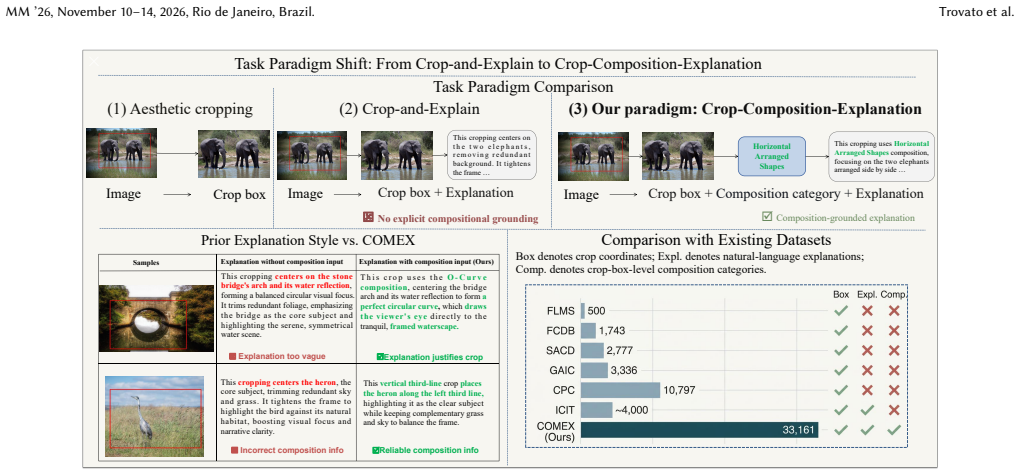
Pith's one-line read By inserting an explicit composition category between the crop box and the explanation, this paper claims that models both crop better and explain their crops more faithfully, with a 2B-parameter model surpassing far larger rivals.
desk verdict A solid empirical paper with a genuinely new benchmark and a clean two-stage training recipe, but the synthetic IO-reversal ground truth raises a real construct-validity question that the paper only partially answers. read the letter →
The pith
A machine-rendered reading of the paper's core claim, the machinery that carries it, and where it could break.
The reading
What carries the argument
The load-bearing object is the structured triplet $y=(b,c,e)$ - crop box, composition category, explanation - generated as one text sequence, with the composition category acting as the bridge that ties geometry to language. Under it sits the IO-reversal construction pipeline: the original photograph is preserved pixel-for-pixel inside an outpainted canvas and treated as the ideal crop, so composition labels transfer from image to crop box without manual re-annotation. Training runs in two stages: supervised fine-tuning teaches the output format, and Group Relative Policy Optimization (GRPO), a value-model-free reinforcement learning update that normalizes rewards within a sampled group, optimizes the total reward $R_{all} = 0.5 R_{box} + 0.175 R_{sem} + 0.325 R_{fmt}$, where $R_{box}$ combines IoU with boundary displacement error, $R_{sem}$ mixes explanation similarity with composition-category agreement, and $R_{fmt}$ enforces valid syntax. The ablation that carries the argument shows that with composition information, IoU rises from 0.7484 to 0.7529 and explanation win rates jump from roughly a third to two-thirds or more across all evaluator groups.
What would settle it
Ask expert photographers to independently choose the best crop of a sample of COMEX's expanded images without being told where the original photo lies; if their chosen crops frequently disagree with the stored ground-truth box, the IO-reversal supervision is not capturing what humans consider the ideal crop. A second direct check: re-annotate a random subset of COMEX crops with fresh composition labels by independent experts and measure agreement with the inherited PICD labels - low agreement would mean the composition supervision itself is unreliable and the explanation-grounding claims rest on noisy labels.
Extended reading notes
Core claim
The central claim is that composition is the missing intermediate layer in explainable aesthetic cropping: instead of generating an explanation after the fact from a predicted box, the model should first decide where to crop, name the composition category that justifies the placement (rule of thirds, centered single shape, horizontal arranged shapes, and so on), and then produce an explanation grounded in that category. To make this trainable, the authors construct COMEX by taking 49,123 expert-labeled composition images from PICD, filtering them, outpainting each one into a larger canvas with FLUX so the original photograph becomes the ground-truth crop, and using Seed-1.8 to write explanations conditioned on the crop box and composition category. They then train a vision-language model in two stages: structured supervised fine-tuning to establish the output protocol, followed by GRPO with rewards for box IoU and boundary accuracy, explanation-composition consistency, and output format. Their Qwen3-VL-2B model reaches 0.7765 mIoU, 0.7448 composition accuracy, and 0.5194 METEOR on COMEX and 0.7225 IoU on FCDB, and the ablations show that removing composition supervision cuts explanation preference sharply while composition-aware explanations win 66-76% of pairwise comparisons.
Load-bearing premise
The pipeline assumes that the original photograph, inside its artificially outpainted canvas, is the ideal crop for that expanded image, and that the composition label inherited from the source dataset remains correct at the crop-box level - if outpainting changes what a good crop is, or the label does not transfer to the crop, every downstream metric inherits the error.
Editorial extensions
If this is right
- Composition supervision transfers across domains: a model trained only on the synthetic COMEX reaches 0.6251 IoU on real FCDB photos zero-shot, and fine-tuning on FCDB pushes IoU to 0.7225, ahead of prior methods.
- GRPO is a genuine second stage: five epochs of reinforcement learning improve IoU from 0.7532 to 0.7765 and METEOR from 0.5129 to 0.5194, whereas five more epochs of SFT barely move any metric.
- The semantic reward is what keeps explanations honest: removing $R_{sem}$ costs 2.25 points of composition accuracy and 1.34 points of METEOR while gaining only 0.13% IoU.
- Small backbones suffice: with composition supervision, even a 0.8B-parameter model reaches 0.6927 mIoU after SFT, and the 2B model matches or beats prior dedicated cropping models while additionally producing composition labels and explanations.
Reading between the lines
- A risk the paper leaves implicit: because the ground-truth crop is always the original photo embedded in the outpainted canvas, the model may partly learn to find the real-photo region rather than a general aesthetic skill; the FCDB transfer results argue against this but do not fully rule it out, and a test on real photos with human-composed, crop-grounded explanations would settle it.
- The 24-category composition taxonomy constrains what explanations can say; a finer-grained or hierarchical composition vocabulary could yield more specific explanations, and the same SFT+GRPO pipeline should transfer to it directly.
- The win-rate gains suggest a cheap testable extension: prompt generic vision-language models with the composition category as an extra input at inference time and measure how much explanation quality improves without any retraining.
- If the claims hold, the recipe - structured intermediate labels plus RL rewards aligned to those labels - should generalize to other perception tasks with human-interpretable intermediate concepts, such as design layout assessment or document formatting.
Editorial analysis
A structured set of objections, weighed in public.
Referee Report
Summary. The paper reformulates explainable aesthetic image cropping as a structured crop-composition-explanation problem, introduces the COMEX benchmark constructed by outpainting PICD images and treating the original photographs as ground-truth crops, and proposes a two-stage SFT+GRPO training framework with rewards for box accuracy, composition consistency, and explanation quality. Experiments on COMEX and FCDB report that the proposed framework outperforms prior cropping methods and general-purpose MLLMs, with composition supervision improving explanation preference and GRPO improving all metrics.
Significance. If the COMEX ground truth is valid, the paper would make a useful contribution: it is the first large-scale benchmark to jointly provide crop boxes, composition categories, and composition-grounded explanations, and the two-stage SFT+GRPO recipe is practical and shows consistent gains over multiple backbones. The FCDB transfer results and the human preference study are positive evidence. However, the benchmark construction rests on an unvalidated IO-reversal assumption, and the explanation evaluation is entangled with the Seed model family, so the central claims about composition being a faithful intermediate layer are not yet established at the level of confidence the paper claims.
major comments (4)
- [§3.1, Figure 2] The IO-reversal premise is unvalidated. The paper asserts that the original PICD image, preserved pixel-for-pixel, is the ideal crop of the outpainted canvas, but no experiment checks whether humans or established aesthetic criteria prefer that region over alternative crops of the expanded image. Because only the surrounding context is synthesized, the model can learn to solve the task by detecting real-vs-FLUX boundary artifacts, and the statement in §3.1 that the domain gap is confined to the context does not rule out such low-level shortcut cues. Since Tables 1, 3, and 4 all use this ground truth, the in-domain IoU gains and the composition-intermediate ablation inherit this concern. Please add a human preference validation on a sample of COMEX images and a diagnostic that removes or blurs boundary cues (for example, applying a common JPEG or color transform to the full canvas) to test whether box prediction collapses.
- [§3.2(4), Table 3] Explanation references and explanation judges come from the same model family: references were generated with Seed-1.8, and the judges in Table 3 are Seed2.0Pro, Seed1.8, and Seed1.6. In addition, the with-composition condition explicitly receives the composition category that the reference explanations were instructed to mention. METEOR and the MLLM win rates may therefore reward stylistic mimicry of Seed-generated text and the presence of the category token rather than faithfulness to the cropping rationale. The human study, with 100 images and 81 participants, is too small to resolve this concern, and no inter-annotator agreement or confidence intervals are reported. Please evaluate with judge models from outside the Seed family and with a human protocol that defines faithfulness criteria and blinds the composition condition.
- [Tables 1–5] All quantitative comparisons are point estimates without variance, significance tests, or confidence intervals. Several load-bearing differences are small, such as IoU 0.7484 vs. 0.7529 in Table 3, IoU 0.7778 vs. 0.7765 in Table 5, and Comp-ACC 0.7448 vs. 0.7411 in Table 4. With single-seed evaluation and no error bars, the claims of consistent improvements are not substantiated. Please report bootstrap confidence intervals or multiple-seed standard deviations for the main metrics, especially for the ablation comparisons that drive the central claims.
- [§5.2.2, Table 2] The zero-shot transfer to FCDB is important evidence for generalization, but the paper does not check for image overlap or near-duplicates between the FCDB test set and the PICD-derived training data. PICD sources include Flickr-derived aesthetic datasets, and FCDB is also Flickr-derived, so near-duplicate leakage could inflate the transfer IoU reported in Table 2 (0.6251 for Stage I+II zero-shot). Please quantify source overlap and remove near-duplicate images before reporting transfer results.
minor comments (5)
- [§4.3, Eqs. (6)–(8)] The reward weights (w_bde, lambda_s, alpha_g, alpha_s, alpha_f) are fixed on validation performance, but no sensitivity analysis is reported; a small table varying these weights would strengthen the claim that the method is robust to hyperparameter choice.
- [§3.2] The paper reports that source filtering retains 44,201 images and that quality control removes approximately 25% of samples, but exact counts after each pipeline stage would improve reproducibility and clarify how the final 33,161 samples are reached.
- [§5.3.1, Table 3] The pairwise preference protocol is underspecified: please state whether ties were allowed, how the 100 test images were sampled, how the 71 general users and 10 experts were recruited, whether evaluators were blind to condition, and report inter-annotator agreement.
- [References [22] and §3.2] The text refers to FLUX.1 [dev], while reference [22] cites FLUX.1 Kontext; please clarify which model version was used and include the exact outpainting prompt and sampling settings.
- [§4.2, §4.3] Several details essential for reproducibility, such as the full prompt template and the definitions of R_bde, R_exp, R_comp, and R_fmt, are deferred to the supplementary material; please ensure these are fully available at publication time.
Circularity Check
COMEX's IO-reversal defines the crop/composition ground truth, and explanation metrics are anchored to Seed-family references and judges; FCDB and human studies give only partial independent support.
-
self definitional
[Section 3.1 (Data Source and IO-Reversal), used in Tables 1, 3, and 4]
"Rather than manually collecting crop boxes or relying on model-predicted crops, we adopt an IO-reversal strategy: each original PICD image is treated as the ideal crop target, and a larger context image is constructed through outpainting. The crop box thus naturally inherits the composition label from the original annotation, providing crop-level composition supervision without additional relabeling."
The COMEX ground-truth crop box is not an independently judged aesthetic choice for the expanded image; it is, by construction, the bounding box of the original PICD photograph, and its composition category is inherited from the whole-image PICD label. Consequently, mIoU and Comp-ACC measure the model's ability to recover the original photograph and reproduce its inherited label rather than to choose an aesthetically superior crop. Since only the surrounding context is synthetic, a model can exploit real-versus-generated boundary cues instead of compositional reasoning. The claimed IoU benefit of composition supervision (0.7484 vs.
-
other
[Section 3.2 (Construction Pipeline, stage 4) and Section 5.3.1 (Is Composition Information Useful?)]
"we generate a composition-grounded cropping explanation using Seed-1.8 [7], a multimodal large language model. ... explanation quality is assessed by pairwise preference judgments from three MLLM evaluators (Seed2.0Pro, Seed1.8, and Seed1.6)."
Stage I trains the model to imitate Seed-1.8-generated reference explanations, METEOR is computed against those same Seed-family references, and the MLLM judges used to claim that composition supervision yields 'more faithful' explanations are Seed2.0Pro, Seed1.8, and Seed1.6. The reported explanation-quality gains therefore largely measure lexical and stylistic alignment with the annotation generator rather than an independent standard of aesthetic faithfulness. The 100-image human study with 71 general users and 10 experts is genuinely external evidence, but it is small and the headline METEOR values and Table 3 win rates mainly certify agreement with Seed-style outputs.
full rationale
The paper's central claim is that introducing composition as an explicit intermediate layer improves both crop quality and explanation faithfulness. The COMEX portion of this claim is partially self-definitional: Section 3.1 defines the ideal crop as the original PICD image placed inside an outpainted canvas, so the crop box and its composition label are fixed by the IO-reversal construction rather than by independent aesthetic judgment of the expanded image. All COMEX crop and composition metrics, including the headline 0.7765 mIoU and the Table 3 IoU ablation, measure recovery of this constructed target. The explanation portion is similarly anchored to the annotation generator: explanations are produced by Seed-1.8, METEOR compares against those references, and the MLLM judges in Table 3 are from the same Seed family, so the claimed explanation-faithfulness improvements partly reflect imitation of Seed-style text. FCDB transfer (Table 2) is a genuine external check on real human-annotated photographs and shows that the SFT+GRPO framework improves IoU to 0.7225, and the 100-image human preference study is also external evidence in favor of composition supervision. However, FCDB has no composition labels, so it cannot validate the specific claim that the composition-intermediate layer causes the gain, and the human study is limited to 100 samples. The appended Limitations section openly acknowledges that 'COMEX relies on synthetic outpainting and proprietary MLLM-generated annotations, which may introduce domain bias and annotation noise,' which is transparent, but it does not remove the load-bearing circularity: the benchmark's crop/composition ground truth is defined by the pipeline, and the explanation evaluation is anchored to the same model family that generated the training references. Overall, this is partial circularity: one core prediction (COMEX crop box) reduces by construction to the original image region, and the explanation-faithfulness metric is partly self-referential, while FCDB and the human study provide independent but incomplete support. Score: 6.
Assumptions & free parameters
free parameters (5)
- w_bde =
0.25
- lambda_s =
0.7
- alpha_g =
0.5
- alpha_s =
0.175
- alpha_f =
0.325
assumptions (6)
- domain assumption PICD composition annotations are expert-annotated and reliable enough to serve as ground truth for crop-level composition.
- ad hoc to paper The original PICD image is an ideal crop target of its outpainted expansion.
- domain assumption FLUX outpainting with the designed prompt produces natural surrounding context without introducing extraneous subjects.
- domain assumption Seed-1.8 generated explanations, after manual filtering, are valid reference explanations for training and evaluation.
- ad hoc to paper Composition categories are a sufficient intermediate representation for explaining crop decisions.
- domain assumption METEOR and MLLM-judge preference are valid proxies for explanation faithfulness.
Cite this review
Pith. "Pith review of COMEX: A Composition-Grounded Benchmark and Learning Framework for Explainable Aesthetic Image Cropping." pith.science (2026). https://pith.science/paper/UBHTBFKH
@misc{pith2026260807570,
  author       = {Pith},
  title        = {Pith review of: COMEX: A Composition-Grounded Benchmark and Learning Framework for Explainable Aesthetic Image Cropping},
  year         = {2026},
  howpublished = {\url{https://pith.science/paper/UBHTBFKH}},
  note         = {Machine review of arXiv:2608.07570}
}
read the original abstract
Explainable aesthetic image cropping requires not only localizing a visually pleasing crop but also explaining why it is preferred. Existing crop-and-explain methods largely treat explanation as post-hoc text generation and overlook composition, a key aesthetic factor that links crop decisions with interpretable reasoning. In this paper, we reformulate explainable aesthetic image cropping as a structured crop-composition-explanation problem. To support this setting, we introduce COMEX, a new benchmark built through image expansion and an IO-reversal pipeline. COMEX contains 33,161 quadruples, each consisting of an expanded image, a crop box, a composition category, and a composition-grounded explanation, enabling joint learning of crop localization, composition understanding, and explanation generation. We further propose a two-stage SFT+GRPO framework, where supervised fine-tuning establishes the structured output protocol and basic cropping ability, and GRPO further improves crop quality, composition prediction, and explanation faithfulness. We benchmark 15 large vision-language models and existing cropping methods on COMEX, establishing a comprehensive testbed for composition-grounded explainable aesthetic cropping. Experiments on both COMEX and prior benchmarks demonstrate the effectiveness and transferability of our framework, with strong performance across evaluation metrics.
Figures


Figures from the paper (1 more)

Reference graph
Works this paper leans on
-
[1]
[n. d.]. Flickr: Image and Video Hosting Service. https://www.flickr.com. Ac- cessed: 2025
work page 2025
-
[2]
[n. d.]. Pexels: Free Stock Photos & Videos. https://www.pexels.com. Accessed: 2025
work page 2025
-
[3]
[n. d.]. Unsplash: Free High-Resolution Photos. https://unsplash.com. Accessed: 2025
work page 2025
-
[4]
Shuai Bai, Yuxuan Cai, Ruizhe Chen, Keqin Chen, Xionghui Chen, Zesen Cheng, Lianghao Deng, Wei Ding, Chang Gao, Chunjiang Ge, et al . 2025. Qwen3-vl technical report.arXiv preprint arXiv:2511.21631(2025)
arXiv 2025
-
[5]
Shuai Bai, Keqin Chen, Xuejing Liu, Jialin Wang, Wenbin Ge, Sibo Song, Kai Dang, Peng Wang, Shijie Wang, Jun Tang, Humen Zhong, Yuanzhi Zhu, Mingkun Yang, Zhaohai Li, Jianqiang Wan, Pengfei Wang, Wei Ding, Zheren Fu, Yiheng Xu, Jiabo Ye, Xi Zhang, Tianbao Xie, Zesen Cheng, Hang Zhang, Zhibo Yang, Haiyang Xu, and Junyang Lin. 2025. Qwen2.5-VL Technical Rep...
arXiv 2025
-
[6]
Satanjeev Banerjee and Alon Lavie. 2005. METEOR: An automatic metric for MT evaluation with improved correlation with human judgments. InProceedings of the acl workshop on intrinsic and extrinsic evaluation measures for machine translation and/or summarization. 65–72
2005
-
[7]
ByteDance Seed. 2026. Seed2.0. https://seed.bytedance.com/en/seed2. Official model page, accessed March 24, 2026
work page 2026
-
[8]
Luigi Celona, Gianluigi Ciocca, Paolo Napoletano, and Raimondo Schettini. 2019. Autocropping: A closer look at benchmark datasets. InInternational conference on image analysis and processing. Springer, 315–325
work page 2019
Show all 66 references
-
[9]
Yi-Ling Chen, Tzu-Wei Huang, Kai-Han Chang, Yu-Chen Tsai, Hwann-Tzong Chen, and Bing-Yu Chen. 2017. Quantitative analysis of automatic image cropping algorithms: A dataset and comparative study. In2017 IEEE winter conference on applications of computer vision (W ACV). IEEE, 226–234
2017
-
[10]
Yi-Ling Chen, Jan Klopp, Min Sun, Shao-Yi Chien, and Kwan-Liu Ma. 2017. Learn- ing to compose with professional photographs on the web. InProceedings of the 25th ACM international conference on Multimedia. 37–45
2017
-
[11]
Gheorghe Comanici, Eric Bieber, Mike Schaekermann, Ice Pasupat, Noveen Sachdeva, Inderjit Dhillon, Marcel Blistein, Ori Ram, Dan Zhang, Evan Rosen, et al. 2025. Gemini 2.5: Pushing the frontier with advanced reasoning, multi- modality, long context, and next generation agentic...
2025 arXiv
-
[12]
Tianxiang Du, Hulingxiao He, and Yuxin Peng. 2026. Venus: Benchmarking and Empowering Multimodal Large Language Models for Aesthetic Guidance and Cropping.arXiv preprint arXiv:2602.23980(2026)
2026
-
[13]
Daya Guo, Dejian Yang, Haowei Zhang, Junxiao Song, Peiyi Wang, Qihao Zhu, Runxin Xu, Ruoyu Zhang, Shirong Ma, Xiao Bi, et al . 2025. DeepSeek-R1 in- centivizes reasoning in LLMs through reinforcement learning.Nature645, 8081 (2025), 633–638
2025
-
[14]
Guanjun Guo, Hanzi Wang, Chunhua Shen, Yan Yan, and Hong-Yuan Mark Liao
-
[15]
Chaoyi Hong, Shuaiyuan Du, Ke Xian, Hao Lu, Zhiguo Cao, and Weicai Zhong
-
[16]
James Hong, Lu Yuan, Micha"el Gharbi, Matthew Fisher, and Kayvon Fatahalian
-
[17]
Edward J Hu, Phillip Wallis, Zeyuan Allen-Zhu, Yuanzhi Li, Shean Wang, Lu Wang, Weizhu Chen, et al. [n. d.]. LoRA: Low-Rank Adaptation of Large Language Models. InInternational Conference on Learning Representations
-
[18]
Yipo Huang, Xiangfei Sheng, Zhichao Yang, Quan Yuan, Zhichao Duan, Pengfei Chen, Leida Li, Weisi Lin, and Guangming Shi. 2024. Aesexpert: Towards multi- modality foundation model for image aesthetics perception. InProceedings of the 32nd ACM International Conference on Multime...
2024
-
[19]
Aaron Hurst, Adam Lerer, Adam P Goucher, Adam Perelman, Aditya Ramesh, Aidan Clark, AJ Ostrow, Akila Welihinda, Alan Hayes, Alec Radford, et al. 2024. Gpt-4o system card.arXiv preprint arXiv:2410.21276(2024)
2024 arXiv
-
[20]
Gengyun Jia, Huaibo Huang, Chaoyou Fu, and Ran He. 2022. Rethinking image cropping: Exploring diverse compositions from global views. In 2022 IEEE. In CVF Conference on Computer Vision and Pattern Recognition (CVPR). 2436–2445
2022
-
[21]
Alina Kuznetsova, Hassan Rom, Neil Alldrin, Jasper Uijlings, Ivan Krasin, Jordi Pont-Tuset, Shahab Kamali, Stefan Popov, Matteo Malloci, Alexander Kolesnikov, et al. 2020. The open images dataset v4: Unified image classification, object detection, and visual relationship detec...
2020
-
[22]
Black Forest Labs, Stephen Batifol, Andreas Blattmann, Frederic Boesel, Saksham Consul, Cyril Diagne, Tim Dockhorn, Jack English, Zion English, Patrick Esser, Sumith Kulal, Kyle Lacey, Yam Levi, Cheng Li, Dominik Lorenz, Jonas Müller, Dustin Podell, Robin Rombach, Harry Saini,...
2025 arXiv
-
[23]
Seung Hyun Lee, Jijun Jiang, Yiran Xu, Zhuofang Li, Junjie Ke, Yinxiao Li, Junfeng He, Steven Hickson, Katie Datsenko, Sangpil Kim, et al. 2025. Cropper: Vision- language model for image cropping through in-context learning. InProceedings of the Computer Vision and Pattern Rec...
2025
-
[24]
Debang Li, Huikai Wu, Junge Zhang, and Kaiqi Huang. 2018. A2-RL: Aesthetics aware reinforcement learning for image cropping. InProceedings of the IEEE conference on computer vision and pattern recognition. 8193–8201
2018
-
[25]
Debang Li, Huikai Wu, Junge Zhang, and Kaiqi Huang. 2019. Fast a3rl: Aesthetics- aware adversarial reinforcement learning for image cropping.IEEE Transactions on Image Processing28, 10 (2019), 5105–5120
2019
-
[26]
Debang Li, Junge Zhang, and Kaiqi Huang. 2020. Learning to learn cropping models for different aspect ratio requirements. InProceedings of the IEEE/CVF Conference on Computer Vision and Pattern Recognition. 12685–12694
2020
-
[27]
Debang Li, Junge Zhang, Kaiqi Huang, and Ming-Hsuan Yang. 2020. Compos- ing good shots by exploiting mutual relations. InProceedings of the IEEE/CVF Conference on Computer Vision and Pattern Recognition. 4213–4222
2020
-
[28]
Weiqi Li, Xuanyu Zhang, Shijie Zhao, Yabin Zhang, Junlin Li, Li Zhang, and Jian Zhang. 2025. Q-insight: Understanding image quality via visual reinforcement learning.arXiv preprint arXiv:2503.22679(2025)
2025 arXiv
-
[29]
Haotian Liu, Chunyuan Li, Qingyang Wu, and Yong Jae Lee. 2023. Visual in- struction tuning.Advances in neural information processing systems36 (2023), 34892–34916
2023
-
[30]
Xiaoyu Liu, Ming Liu, Junyi Li, Shuai Liu, Xiaotao Wang, Lei Lei, and Wangmeng Zuo. 2023. Beyond image borders: Learning feature extrapolation for unbounded image composition. InProceedings of the IEEE/CVF International Conference on Computer Vision. 13023–13032
2023
-
[31]
Ziyu Liu, Zeyi Sun, Yuhang Zang, Xiaoyi Dong, Yuhang Cao, Haodong Duan, Dahua Lin, and Jiaqi Wang. 2025. Visual-rft: Visual reinforcement fine-tuning. In Proceedings of the IEEE/CVF International Conference on Computer Vision. 2034– 2044
2025
-
[32]
MiniMaxAI. 2026. MiniMax-M2.5·Hugging Face. https://huggingface.co/ MiniMaxAI/MiniMax-M2.5 Model card, accessed March 24, 2026
2026
-
[33]
Naila Murray, Luca Marchesotti, and Florent Perronnin. 2012. AVA: A large-scale database for aesthetic visual analysis. In2012 IEEE conference on computer vision and pattern recognition. IEEE, 2408–2415
2012
-
[34]
Bingbing Ni, Mengdi Xu, Bin Cheng, Meng Wang, Shuicheng Yan, and Qi Tian
-
[35]
OpenBMB. 2026. MiniCPM-V-4·Hugging Face. https://huggingface.co/openbmb/ MiniCPM-V-4 Model card, accessed March 24, 2026
2026
-
[36]
Jiazhen Pan, Che Liu, Junde Wu, Fenglin Liu, Jiayuan Zhu, Hongwei Bran Li, Chen Chen, Cheng Ouyang, and Daniel Rueckert. 2025. Medvlm-r1: Incentivizing medical reasoning capability of vision-language models (vlms) via reinforcement learning. InInternational Conference on Medic...
2025
-
[37]
Zhiyu Pan, Ke Xian, Hao Lu, and Zhiguo Cao. 2021. Robust image cropping by filtering composition irrelevant factors. InInternational Conference on Image and Graphics. Springer, 277–289
2021
-
[38]
2022.Deep reinforcement learning
Aske Plaat. 2022.Deep reinforcement learning. Vol. 10. Springer
2022
-
[39]
Qwen Team. 2026. Qwen3.5 - a Qwen Collection. https://huggingface.co/ collections/Qwen/qwen35. Hugging Face collection page, accessed March 26, 2026
2026
-
[40]
Joseph Redmon, Santosh Divvala, Ross Girshick, and Ali Farhadi. 2016. You only look once: Unified, real-time object detection. InProceedings of the IEEE conference on computer vision and pattern recognition. 779–788
2016
-
[41]
Xiangfei Sheng, Pangu Xie, Weidong Zou, Pengfei Chen, Tong Zhu, and Leida Li. 2025. InstructCrop: Teaching Multimodal Large Language Models to Crop Aesthetic Images. InProceedings of the 33rd ACM International Conference on Multimedia. 6830–6839
2025
-
[42]
StepFun AI. 2026. Step3-VL-10B. https://huggingface.co/spaces/stepfun-ai/Step3- VL-10B Hugging Face Space, accessed March 24, 2026
2026
-
[43]
Kimi Team, Angang Du, Bohong Yin, Bowei Xing, Bowen Qu, Bowen Wang, Cheng Chen, Chenlin Zhang, Chenzhuang Du, Chu Wei, et al . 2025. Kimi-vl technical report.arXiv preprint arXiv:2504.07491(2025)
2025 arXiv
-
[44]
Yi Tu, Li Niu, Weijie Zhao, Dawei Cheng, and Liqing Zhang. 2020. Image cropping with composition and saliency aware aesthetic score map. InProceedings of the AAAI conference on artificial intelligence, Vol. 34. 12104–12111. MM ’26, November 10–14, 2026, Rio de Janeiro, Brazil....
2020
-
[45]
Chao Wang, Li Niu, Bo Zhang, and Liqing Zhang. 2023. Image cropping with spatial-aware feature and rank consistency. InProceedings of the IEEE/CVF Con- ference on Computer Vision and Pattern Recognition. 10052–10061
2023
-
[46]
Tiantian Wang, Lihe Zhang, Shuo Wang, Huchuan Lu, Gang Yang, Xiang Ruan, and Ali Borji. 2018. Detect globally, refine locally: A novel approach to saliency detection. InProceedings of the IEEE conference on computer vision and pattern recognition. 3127–3135
2018
-
[47]
Weiyun Wang, Zhangwei Gao, Lixin Gu, Hengjun Pu, Long Cui, Xingguang Wei, Zhaoyang Liu, Linglin Jing, Shenglong Ye, Jie Shao, et al. 2025. Internvl3. 5: Ad- vancing open-source multimodal models in versatility, reasoning, and efficiency. arXiv preprint arXiv:2508.18265(2025)
2025 arXiv
-
[48]
Wenguan Wang and Jianbing Shen. 2017. Deep cropping via attention box prediction and aesthetics assessment. InProceedings of the IEEE international conference on computer vision. 2186–2194
2017
-
[49]
Wenguan Wang, Jianbing Shen, and Haibin Ling. 2018. A deep network solution for attention and aesthetics aware photo cropping.IEEE transactions on pattern analysis and machine intelligence41, 7 (2018), 1531–1544
2018
-
[50]
Xu Wang, Sen Wang, Xingxing Liang, Dawei Zhao, Jincai Huang, Xin Xu, Bin Dai, and Qiguang Miao. 2022. Deep reinforcement learning: A survey.IEEE Transactions on Neural Networks and Learning Systems35, 4 (2022), 5064–5078
2022
-
[51]
Zijun Wei, Jianming Zhang, Xiaohui Shen, Zhe Lin, Radomir Mech, Minh Hoai, and Dimitris Samaras. 2018. Good view hunting: Learning photo composition from dense view pairs. InProceedings of the IEEE conference on computer vision and pattern recognition. 5437–5446
2018
-
[52]
Zijun Wei, Jianming Zhang, Xiaohui Shen, Zhe Lin, Radom’ir Mech, Minh Hoai, and Dimitris Samaras. 2018. Good View Hunting: Learning Photo Composition From Dense View Pairs. InProceedings of the IEEE/CVF Conference on Computer Vision and Pattern Recognition (CVPR)
2018
-
[53]
An Yang, Anfeng Li, Baosong Yang, Beichen Zhang, Binyuan Hui, Bo Zheng, Bowen Yu, Chang Gao, Chengen Huang, Chenxu Lv, et al. 2025. Qwen3 technical report.arXiv preprint arXiv:2505.09388(2025)
2025 arXiv
-
[54]
Guo-Ye Yang, Wen-Yang Zhou, Yun Cai, Song-Hai Zhang, and Fang-Lue Zhang
-
[55]
Yuzhe Yang, Liwu Xu, Leida Li, Nan Qie, Yaqian Li, Peng Zhang, and Yandong Guo. 2022. Personalized image aesthetics assessment with rich attributes. In Proceedings of the IEEE/CVF Conference on Computer Vision and Pattern Recognition. 19861–19869
2022
-
[56]
Z.ai. 2026. GLM-4.6·Hugging Face. https://huggingface.co/zai-org/GLM-4.6 Model card, accessed March 24, 2026
2026
-
[57]
Hui Zeng, Lida Li, Zisheng Cao, and Lei Zhang. 2019. Reliable and efficient image cropping: A grid anchor based approach. InProceedings of the IEEE/CVF conference on computer vision and pattern recognition. 5949–5957
2019
-
[58]
Hui Zeng, Lida Li, Zisheng Cao, and Lei Zhang. 2020. Grid anchor based image cropping: A new benchmark and an efficient model.IEEE Transactions on Pattern Analysis and Machine Intelligence44, 3 (2020), 1304–1319
2020
-
[59]
Bo Zhang, Li Niu, Xing Zhao, and Liqing Zhang. 2022. Human-centric image cropping with partition-aware and content-preserving features. InEuropean Conference on Computer Vision. Springer, 181–197
2022
-
[60]
Zhaoran Zhao, Peng Lu, Anran Zhang, Peipei Li, Xia Li, Xuannan Liu, Yang Hu, Shiyi Chen, Liwei Wang, and Wenhao Guo. 2025. Can machines understand composition? Dataset and benchmark for photographic image composition em- bedding and understanding. InProceedings of the Computer...
2025
-
[61]
Zhihang Zhong, Mingxi Cheng, Zhirong Wu, Yuhui Yuan, Yinqiang Zheng, Ji Li, Han Hu, Stephen Lin, Yoichi Sato, and Imari Sato. 2023. ClipCrop: condi- tioned cropping driven by vision-language model. InProceedings of the IEEE/CVF International Conference on Computer Vision. 294–304
2023
-
[2013]
Learning to photograph: A compositional perspective.IEEE Transactions on Multimedia15, 5 (2013), 1138–1151
2013
-
[2018]
Automatic image cropping for visual aesthetic enhancement using deep neural networks and cascaded regression.IEEE Transactions on Multimedia20, 8 (2018), 2073–2085
2018
-
[2021]
InProceedings of the IEEE/CVF Conference on Computer Vision and Pattern Recognition
Composing photos like a photographer. InProceedings of the IEEE/CVF Conference on Computer Vision and Pattern Recognition. 7057–7066
-
[2023]
Focusing on your subject: Deep subject-aware image composition recom- mendation networks.Computational Visual Media9, 1 (2023), 87–107
2023
-
[2024]
In Proceedings of the AAAI Conference on Artificial Intelligence, Vol
Learning subject-aware cropping by outpainting professional photos. In Proceedings of the AAAI Conference on Artificial Intelligence, Vol. 38. 2175–2183
Reviewed August 11, 2026 · model on record in the stance chip above.
Discussion (0). Continue with ORCID to comment.