REVIEW 4 major objections 4 minor 31 references
Agent-MD: Selective LLM Intervention with Event-Driven Escalation for Stateful GCMC--MD Campaigns
T0 review · 4 major / 4 minor · reviewed 2026-08-11 · deepseek-v4-flash
Pith's one-line read Long-running simulation campaigns can run with LLM reasoning confined to planning and rare reviews.
desk verdict A useful architectural pattern—removing the LLM from routine production—with an honest but thin evaluation of the event-triggered LLM path. read the letter →
The pith
A machine-rendered reading of the paper's core claim, the machinery that carries it, and where it could break.
The reading
What carries the argument
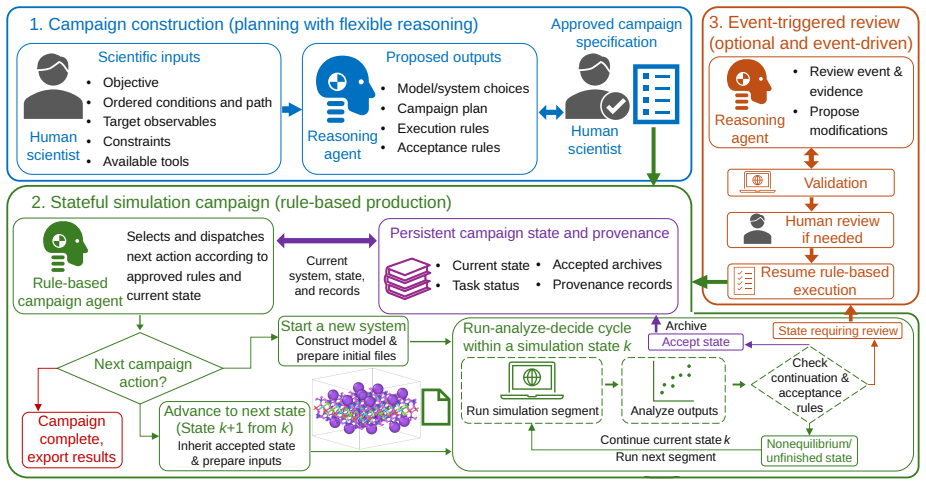
The central mechanism is the separation of roles enforced by a machine-readable campaign specification: a reasoning agent proposes the plan and reviews unresolved events, while a persistent rule-based campaign agent reads approved policies and explicit state records to select the next action. The load-bearing object is the 'campaign state'—a record that for each system-RH state tracks current configuration, sampling progress, acceptance status, archived restarts, and provenance lineage—together with a small set of review-event identifiers such as CONVERGENCE_ANOMALY and PROVENANCE_CONFLICT, plus an evidence bundle stored in agent_event.json and evidence_bundle.json. Any reasoning-agent recommendation is schema- and policy-validated before it can affect production, and state-local (RH-local) step accounting is what prevents the inherited-absolute-timestep misinterpretation from corrupting the campaign. This machinery carries the argument by showing that routine decisions are rule-decidable and only ambiguous states need flexible interpretation.
What would settle it
Rerun any of the 15 accepted states with substantially longer sampling, say five to ten times the RH-local steps, and compare the resulting basal spacing and water populations to the reported accepted-state means and error bars; if the new means lie outside the reported temporal standard deviations, the acceptance criteria were too permissive. A cleaner test is to run two independent replicas from the same restart with different random seeds and check whether the inter-replica spread exceeds the intra-trajectory error bars the paper reports.
Extended reading notes
Core claim
On its own terms, the paper's central claim is that selective placement of LLM reasoning—at campaign construction and at event-triggered review—is sufficient to run a long, state-dependent simulation campaign, provided the routine layer is a rule-based campaign agent operating from an approved machine-readable specification, explicit persistent state, and provenance-aware restart inheritance. The supporting demonstration is a GCMC-MD water-vapor desorption campaign over five montmorillonite systems across RH = 0.9, 0.3, and 0.1, with state-specific sampling lengths determined by repeated reassessment. The workflow accepted all 15 system-RH states and completed 10 RH transitions without a single non-interactive reasoning-agent invocation during production. One state (K-LC0.4 at RH=0.3) hit a review boundary because a production limit was evaluated with the inherited absolute timestep rather than the state-local step count; the workflow was corrected, resumed, and accepted. Two frozen incidents—that timestep misaccounting and a stale smoke-test archive—were replayed through the reasoning agent in blind mode, and its recommendations matched the recorded resolutions. The campaign also produced physical results: Ca-LC0.4 retained more interlayer water and a roughly 14.4 Angstrom basal spacing at low RH, while Na-LC0.5 retained the most residual water, a finding the paper attributes to the combined variation of layer charge and compensating Na+ population.
Load-bearing premise
The acceptance criteria—coefficients of variation of 0.03, 0.05, and 0.08 for total, interlayer, and external-surface water, plus trend and health checks—are treated as sufficient signs that a state is converged; the paper itself calls these operational indicators rather than proof of thermodynamic equilibrium.
Editorial extensions
If this is right
- If selective reasoning is sufficient, long-running simulation campaigns can be automated around a deterministic core, cutting token costs and eliminating model variability in routine actions.
- A reusable pattern emerges: define explicit state, acceptance criteria, restart provenance, and permitted next actions in machine-readable form, and use an LLM only at planning and at review boundaries.
- Scientific software should expose structured agent-oriented interfaces (current state, valid restart, completed analyses) rather than forcing an LLM to interpret human-oriented directories and logs.
- Workflow incidents can be safely contained: a state that fails rule-based resolution pauses before propagating to downstream states, and reasoning-agent proposals are validated before execution.
- The physical findings on cation- and charge-dependent dehydration of montmorillonite are direct corollaries of the accepted-state records, contingent on those records being true converged states.
Reading between the lines
- The zero-invocation production result suggests that the LLM cost of a campaign can be nearly independent of campaign length, provided acceptance criteria are conservative enough—a cost ladder the paper does not directly measure.
- The event-triggered design could transfer to other restartable scientific pipelines, such as adaptive free-energy calculations or materials screening, wherever successor states inherit only from authoritative archives; the paper proposes but does not test such transfers.
- A natural next experiment is to inject a set of seeded production anomalies (wrong restart, timestep misaccounting, stale archive) and measure the reasoning agent's diagnostic accuracy against known ground truth, since the current two-case replay cannot establish general failure-diagnosis performance.
Editorial analysis
A structured set of objections, weighed in public.
Referee Report
Summary. The paper presents Agent-MD, a workflow architecture for long-running molecular simulation campaigns in which an LLM-based reasoning agent is used only for campaign construction and event-triggered review, while a persistent rule-based campaign agent handles routine simulation, analysis, continuation, archiving, and state progression. The approach is demonstrated on a GCMC-MD water-vapor desorption campaign for five montmorillonite systems across three relative-humidity states (RH = 0.9, 0.3, 0.1). The campaign completed 120 segmented simulation cycles, accepted 15 system-RH states, and recorded zero non-interactive LLM calls during formal production. One production state (K-LC0.4 at RH=0.3) reached a review boundary due to a timestep-accounting bug, which was corrected without invoking the reasoning agent. Two preserved incidents were later replayed through the reasoning agent offline. The paper also reports composition-dependent differences in residual water content and basal spacing. The central claim is that selective reasoning, combined with deterministic execution and structured evidence, can provide reproducible and auditable agent-assisted simulation without placing every operation inside an LLM loop.
Significance. If the architecture is accepted as demonstrated, Agent-MD would be a useful contribution to the emerging area of LLM-assisted scientific workflows, and the public release of code, campaign specifications, provenance records, and frozen replay cases is a clear strength. The physical results on montmorillonite desorption are plausible and consistent with prior literature, but they are not the main contribution; the main significance lies in the workflow-design claim that event-triggered LLM intervention can be kept selective without sacrificing campaign completion. However, the current evidence for that claim is substantially weaker than the title and abstract imply: the only production-time anomaly was resolved by a code correction with zero LLM involvement, and the two reasoning-agent evaluations are retrospective replays whose recommendations were never executed or validated live. The paper is honest about these limitations in Sections 4 and 5, but the framing of the central contribution needs to be either softened or backed by a live escalation case.
major comments (4)
- [§3.2, §3.3, Abstract, §5] The paper's central architectural claim is that event-triggered LLM review can resolve states that the rule-based agent cannot safely handle, but this mechanism is never exercised in production. The only production-time review event (K-LC0.4 at RH=0.3) was stopped by an absolute-versus-RH-local timestep bug and was resolved by a workflow code correction with zero non-interactive Codex CLI invocations (§3.2, Table 2). The two reasoning-agent evaluations in §3.3 are retrospective, frozen replay cases: the recommendations were produced after the fact, were never applied to a running campaign, and were checked only against the authors' own recorded interpretations. The abstract's phrasing that "one state reached a review boundary" and that replay cases "identified the underlying workflow problems" is literally accurate, but the title and the overall framing present event-driven escalation as a demonstrated capability. This is load-bearing: without a live case in which a reasoning-agent recommendation is validated, executed, and the campaign completes, the paper demonstrates a rule-based workflow plus an offline case study, not the full Agent-MD loop. I recommend either adding a live escalation run or clearly redefining the contribution as an architecture with retrospective illustration.
- [§2.3.2, Figures 5-7, §3.4] The acceptance criteria are configured CV thresholds (0.03, 0.05, 0.08 for total, interlayer, and external-surface water) plus trend and health checks, and the manuscript explicitly states these are "operational indicators for state assessment rather than as proof of strict thermodynamic equilibrium." The physical conclusions, including Ca-LC0.4 maintaining a 14.4 Å basal spacing and Na-LC0.5 retaining more residual water, rest entirely on states accepted under these unvalidated heuristics. No block-averaging convergence check, comparison with substantially longer sampling, or independent-replica verification is provided for any state. Because the "15 accepted states" record is used both as evidence of workflow success and as the basis for the scientific comparisons, the adequacy of the convergence criteria is load-bearing. The paper should either validate the criteria on at least a subset of states or explicitly downgrade the physical claims to preliminary observations.
- [§3.3, §4] The reasoning-agent evaluation consists of two self-selected incidents, both authored by the same group, with the expected diagnosis withheld but the evidence bundle constructed by the authors; there are no negative controls, no blinded third-party assessment, and no comparison with a deterministic baseline or with human-only review. The authors acknowledge in §4 that the replays "do not establish general failure-diagnosis capability," but the Results section still presents the agreements as evidence that the agent "could interpret the preserved evidence for these specific examples." This is a legitimate but anecdotal demonstration; the paper should make the anecdotal status prominent in the abstract and conclusions rather than allowing the replay results to appear as a validation of the escalation mechanism.
- [§2.4, Abstract] The abstract claims that selective reasoning is combined with "validated control handoffs," but the validation described in §2.4 is only a schema- and policy-scope check: consistency with the event identifier, allowed decision types, confidence value, and permitted parameter scope. It does not check whether a recommendation is scientifically correct. A recommendation that passes these checks could still be wrong and lead to a bad decision. The term "validated control handoffs" therefore overstates the safety property the system actually provides. I suggest using a more precise term such as "policy-validated control handoffs" or adding a correctness/verification layer before making this claim.
minor comments (4)
- [§1, last paragraph] In the final sentence of the Introduction, the phrase "Agent-MDbothasapracticalworkflowarchitectureforreliableandauditablelong-runningsimulation and as a tool..." contains missing spaces around "Agent-MD" and should be corrected to read "Agent-MD both as a practical workflow architecture...".
- [Table 1 and §2.3.1] The final absolute timestep for each system is slightly larger than the sum of RH-local steps (by 0.1 to 0.2 million steps), presumably reflecting the initial NVT equilibration; this offset should be stated explicitly in the text or table caption so readers do not infer an inconsistency.
- [§3.4 and Figure captions] The error bars in Figures 5-7 are temporal sample standard deviations over the final 1.0 million steps and do not represent uncertainty across independent replicas; the text states this in §2.3.2 and §3.4, but the figure captions should repeat it for clarity.
- [References [7] and [8]] References [7] and [8] are listed as preprints without DOIs or arXiv identifiers; adding stable identifiers would improve the reproducibility and verifiability of the related-work discussion.
Circularity Check
No significant circularity: the campaign record, physical comparisons, and replay evaluation are not derived from the framework's own definitions or fitted parameters.
full rationale
Agent-MD is presented as an empirical demonstration rather than a derivation, so the usual circular patterns (fitted input renamed as prediction, self-citation importing uniqueness, ansatz smuggled via citation) do not occur. The acceptance thresholds in Section 2.3.2 are explicitly described as operational indicators rather than proof of equilibrium, and the physical trends (e.g., Ca-LC0.4 retaining more interlayer water and maintaining a larger basal spacing) emerge from the simulations rather than being encoded in the stopping rules; the criteria do not target the reported ordering. The retrospective replay evaluation in Section 3.3 is a self-constructed check: the two cases come from the authors' own campaign and success means agreement with the recorded interpretation, but the paper explicitly blinds the reasoning agent to that interpretation and explicitly limits the conclusion ('Because the evaluation contained only two cases, however, it does not establish general diagnostic accuracy across other simulation failures or workflow states'). The one production review boundary was resolved by a code correction rather than by a reasoning-agent call, and the paper reports this accurately rather than claiming a production escalation success. The citation to the authors' prior validated GCMC-MD protocol [17] is background support for the scientific setup, not a load-bearing derivation of the framework claim. I therefore find no step in which a prediction or result is equivalent to its inputs by construction.
Assumptions & free parameters
free parameters (2)
- Acceptance CV thresholds for total, interlayer, and external-surface water =
0.03, 0.05, 0.08
- Analysis and summary window length =
1.0e6 MD steps
assumptions (3)
- domain assumption ClayFF and SPC/E force fields, together with the GCMC-MD protocol from Ref 17, are valid for montmorillonite water-vapor desorption.
- ad hoc to paper The configured acceptance criteria are adequate to treat a state as converged for scientific reporting.
- domain assumption Restart files and recorded provenance faithfully reflect the simulation trajectory and its lineage.
Cite this review
Pith. "Pith review of Agent-MD: Selective LLM Intervention with Event-Driven Escalation for Stateful GCMC--MD Campaigns." pith.science (2026). https://pith.science/paper/R25HI3TX
@misc{pith2026260807637,
  author       = {Pith},
  title        = {Pith review of: Agent-MD: Selective LLM Intervention with Event-Driven Escalation for Stateful GCMC--MD Campaigns},
  year         = {2026},
  howpublished = {\url{https://pith.science/paper/R25HI3TX}},
  note         = {Machine review of arXiv:2608.07637}
}
read the original abstract
Long-running molecular simulation campaigns require repeated continuation from saved states, provenance-aware progression, adaptive assessment, and occasional interpretation of workflow conditions that cannot be resolved safely by fixed rules. Here, we present Agent-MD, a framework that places large language model (LLM) reasoning selectively at campaign construction and event-triggered review, while routine simulation, analysis, continuation, archiving, and state progression are handled by a persistent rule-based campaign agent using approved policies and explicit state records. Agent-MD was demonstrated in a grand canonical Monte Carlo-molecular dynamics (GCMC-MD) water-vapor desorption campaign comprising five montmorillonite systems and three sequential relative-humidity states (RH = 0.9-0.3-0.1). Across 15 system-RH states, the workflow completed 120 segmented simulation cycles with state-specific sampling lengths and provenance-aware restart inheritance. Routine production required no live reasoning-agent invocation, while one state reached a review boundary; two preserved incidents were subsequently evaluated through blinded reasoning-agent replay, which identified the underlying workflow problems and recommended appropriate follow-up actions. The simulations also revealed distinct composition-dependent low-RH responses, with Ca-bearing montmorillonite retaining more interlayer water and maintaining a larger basal spacing than the Na- and K-bearing systems, while the highest-charge Na system retained more residual water under dry conditions. These results demonstrate that long-running scientific workflows need not place every operation inside an LLM reasoning loop: selective reasoning can instead be combined with deterministic execution, structured evidence, and validated control handoffs to provide reproducible and auditable agent-assisted molecular simulation.
Figures


Figures from the paper (4 more)


Reference graph
Works this paper leans on
-
[1]
Hollingsworth, S. A.; Dror, R. O. Molecular Dynamics Simulation for All.Neuron2018,99, 1129–1143, DOI:10.1016/j.neuron.2018.08.011
-
[2]
Craven, N. C. et al. Achieving Reproducibility and Replicability of Molecular Dynamics and Monte Carlo Simulations Using the Molecular Simulation Design Framework (MoSDeF).Journal of Chemical & Engineering Data2025,70, 2178–2199, DOI:10.1021/acs.jced.5c00010
-
[3]
Adorf, C. S.; Dodd, P. M.; Ramasubramani, V.; Glotzer, S. C. Simple data and workflow management with the signac framework.Computational Materials Science2018,146, 220–229, DOI:10.1016/j.commatsci.2018.01.035
-
[4]
Bereau, T.; Walter, L. J.; Rudzinski, J. F. Martignac: Computational Workflows for Repro- ducible, Traceable, and Composable Coarse-Grained Martini Simulations.Journal of Chemical Information and Modeling2024,64, 9413–9423, DOI:10.1021/acs.jcim.4c01754
-
[5]
Campbell, Q.; Cox, S.; Medina, J.; Watterson, B.; White, A. D. MDCrow: automating molecular dynamics workflows with large language models.Machine Learning: Science and Technology 2026,7, 025037, DOI:10.1088/2632-2153/ae4b07
-
[6]
Ding, M.; Huang, C.; Hu, Y.; Li, Y.; Lu, Z.; Yu, X.; Zhang, D.; Zhai, W.; Zhu, T.; Gu, Q.; Zeng, J. Automating Computational Chemistry Workflows via OpenClaw and Domain-Specific Skills.Journal of Chemical Theory and Computation2026,22, 5919–5929, DOI: 10.1021/acs. jctc.6c00622
-
[7]
SimMOF: AI agent for Automated MOF Simulations
Lee, J.; Bae, T.; Kim, J. SimMOF: AI agent for Automated MOF Simulations. 2026; Preprint
work page 2026
-
[8]
D.; Tummalapalli, H.; Bhuiyan, F
Pham, T. D.; Tummalapalli, H.; Bhuiyan, F. H.; Vázquez Mayagoitia, Á.; Simpson, C.; Balin, R.; Vishwanath, V.; Keçeli, M. Multi-Agent Orchestration for High-Throughput Materials Screening on a Leadership-Class System. 2026; Preprint
work page 2026
Show all 31 references
-
[9]
E.; Maragakis, P.; Lindorff-Larsen, K.; Piana, S.; Dror, R
Shaw, D. E.; Maragakis, P.; Lindorff-Larsen, K.; Piana, S.; Dror, R. O.; Eastwood, M. P.; Bank, J. A.; Jumper, J. M.; Salmon, J. K.; Shan, Y.; Wriggers, W. Atomic-Level Char- acterization of the Structural Dynamics of Proteins.Science2010,330, 341–346, DOI: 10.1126/science.1187409
-
[10]
E.; Nadeem, H.; Shukla, D
Kleiman, D. E.; Nadeem, H.; Shukla, D. Adaptive Sampling Methods for Molecular Dynamics in the Era of Machine Learning.The Journal of Physical Chemistry B2023,127, 10669–10681, DOI:10.1021/acs.jpcb.3c04843
-
[11]
Extensible and Scalable Adaptive Sampling on Supercomputers.Journal of Chemical Theory and Computation2020, 16, 7915–7925, DOI:10.1021/acs.jctc.0c00991
Hruska, E.; Balasubramanian, V.; Lee, H.; Jha, S.; Clementi, C. Extensible and Scalable Adaptive Sampling on Supercomputers.Journal of Chemical Theory and Computation2020, 16, 7915–7925, DOI:10.1021/acs.jctc.0c00991. 18
-
[12]
P.; Chen, W.; Medasani, B.; Qu, X.; Kocher, M.; Brafman, M.; Petretto, G.; Rignanese, G.-M.; Hautier, G.; Gunter, D.; Persson, K
Jain, A.; Ong, S. P.; Chen, W.; Medasani, B.; Qu, X.; Kocher, M.; Brafman, M.; Petretto, G.; Rignanese, G.-M.; Hautier, G.; Gunter, D.; Persson, K. A. FireWorks: a dynamic workflow system designed for high-throughput applications.Concurrency and Computation: Practice and Exper...
-
[13]
AiiDA: Automated Interactive Infrastructure and Database for Computational Science.Computational Materials Science 2016,111, 218–230, DOI:10.1016/j.commatsci.2015.09.013
Pizzi, G.; Cepellotti, A.; Sabatini, R.; Marzari, N.; Kozinsky, B. AiiDA: Automated Interactive Infrastructure and Database for Computational Science.Computational Materials Science 2016,111, 218–230, DOI:10.1016/j.commatsci.2015.09.013
2016 doi
-
[14]
Huber, S. P. et al. AiiDA 1.0, a scalable computational infrastructure for automated reproducible workflows and data provenance.Scientific Data2020,7, 300, DOI: 10.1038/s41597-020-006 38-4
-
[15]
E.; Snurr, R
Dubbeldam, D.; Calero, S.; Ellis, D. E.; Snurr, R. Q. RASPA: molecular simulation software for adsorption and diffusion in flexible nanoporous materials.Molecular Simulation2016,42, 81–101, DOI:10.1080/08927022.2015.1010082
2015
-
[16]
Wang, Y.; Hu, L. Evaluation of the BET and GAB models for interpretation of soil water isotherms: A molecular simulation study.Computers and Geotechnics2023,159, 105454, DOI: 10.1016/j.compgeo.2023.105454
2023
-
[17]
Wang, Y.; Yin, Z.-Y.; Hicher, P.-Y.; Hu, L. Hysteresis at low humidity on vapor sorption isotherm of Ca-montmorillonite: The key role of interlayer cations.Applied Clay Science2025, 263, 107628, DOI:10.1016/j.clay.2024.107628
2024
-
[18]
M.; Katti, K
Amarasinghe, P. M.; Katti, K. S.; Katti, D. R. Insight into Role of Clay–Fluid Molecular Interactions on Permeability and Consolidation Behavior of Na-Montmorillonite Swelling Clay.Journal of Geotechnical and Geoenvironmental Engineering2012,138, 138–146, DOI: 10.1061/(ASCE)GT...
-
[19]
L.; Greathouse, J
Teich-McGoldrick, S. L.; Greathouse, J. A.; Jove-Colon, C. F.; Cygan, R. T. Swelling Properties of Montmorillonite and Beidellite Clay Minerals from Molecular Simulation: Comparison of Temperature, Interlayer Cation, and Charge Location Effects.The Journal of Physical Chemistr...
-
[20]
Yotsuji, K.; Tachi, Y.; Sakuma, H.; Kawamura, K. Effect of interlayer cations on montmorillonite swelling: Comparison between molecular dynamic simulations and experiments.Applied Clay Science2021,204, 106034, DOI:10.1016/j.clay.2021.106034
-
[21]
Hydration and Mobility of Interlayer Ions of (Nax, Cay)-Montmorillonite: A Molecular Dynamics Study.The Journal of Physical Chemistry C2014,118, 29811–29821, DOI:10.1021/jp508427c
Zhang, L.; Lu, X.; Liu, X.; Zhou, J.; Zhou, H. Hydration and Mobility of Interlayer Ions of (Nax, Cay)-Montmorillonite: A Molecular Dynamics Study.The Journal of Physical Chemistry C2014,118, 29811–29821, DOI:10.1021/jp508427c
-
[22]
K.; Sun, S
Yang, Y.; Narayanan Nair, A. K.; Sun, S. Layer Charge Effects on Adsorption and Diffusion of Water and Ions in Interlayers and on External Surfaces of Montmorillonite.ACS Earth and Space Chemistry2019,3, 2635–2645, DOI:10.1021/acsearthspacechem.9b00236
-
[23]
J.; Hensen, E
Tambach, T. J.; Hensen, E. J. M.; Smit, B. Molecular Simulations of Swelling Clay Minerals. The Journal of Physical Chemistry B2004,108, 7586–7596, DOI:10.1021/jp049799h
-
[24]
Manipulating Layer Charge to Regulate the Hydration and Swelling of Montmorillonite.Géotechnique2025,75, 1401–1415, DOI: 10.168 0/jgeot.24.00997
Ma, T.; Hao, F.; Yu, H.; Wei, C.; Zhang, G. Manipulating Layer Charge to Regulate the Hydration and Swelling of Montmorillonite.Géotechnique2025,75, 1401–1415, DOI: 10.168 0/jgeot.24.00997. 19
-
[25]
A.; Geoffroy, N.; Jacquot, E.; Drits, V
Ferrage, E.; Lanson, B.; Sakharov, B. A.; Geoffroy, N.; Jacquot, E.; Drits, V. A. Investigation of dioctahedral smectite hydration properties by modeling of X-ray diffraction profiles: Influence of layer charge and charge location.American Mineralogist2007,92, 1731–1743, DOI:1...
-
[26]
T.; Erastova, V
Pollak, H.; Degiacomi, M. T.; Erastova, V. Modeling Realistic Clay Systems with ClayCode. Journal of Chemical Theory and Computation2024,20, 9606–9617, DOI:10.1021/acs.jctc .4c00987
-
[27]
T.; Liang, J.-J.; Kalinichev, A
Cygan, R. T.; Liang, J.-J.; Kalinichev, A. G. Molecular Models of Hydroxide, Oxyhydroxide, and Clay Phases and the Development of a General Force Field.The Journal of Physical Chemistry B2004,108, 1255–1266, DOI:10.1021/jp0363287
-
[28]
Berendsen, H. J. C.; Grigera, J. R.; Straatsma, T. P. The Missing Term in Effective Pair Potentials.The Journal of Physical Chemistry1987,91, 6269–6271, DOI: 10.1021/j100308a 038
-
[29]
Fast Parallel Algorithms for Short-Range Molecular Dynamics.Journal of Com- putational Physics1995,117, 1–19, DOI:10.1006/jcph.1995.1039
Plimpton, S. Fast Parallel Algorithms for Short-Range Molecular Dynamics.Journal of Com- putational Physics1995,117, 1–19, DOI:10.1006/jcph.1995.1039
1995
-
[30]
P.; Aktulga, H
Thompson, A. P.; Aktulga, H. M.; Berger, R.; Bolintineanu, D. S.; Brown, W. M.; Crozier, P. S.; in ’t Veld, P. J.; Kohlmeyer, A.; Moore, S. G.; Nguyen, T. D.; Shan, R.; Stevens, M. J.; Tranchida, J.; Trott, C.; Plimpton, S. J. LAMMPS - a flexible simulation tool for particle- ...
-
[31]
Brochard, L. Swelling of Montmorillonite from Molecular Simulations: Hydration Diagram and Confined Water Properties.The Journal of Physical Chemistry C2021,125, 15527–15543, DOI:10.1021/acs.jpcc.1c02659. 20
Reviewed August 11, 2026 · model on record in the stance chip above.
Discussion (0). Continue with ORCID to comment.