REVIEW 1 major objections 5 minor 89 references
The G347.3-0.5 outlier from O3: a follow-up case study for continuous gravitational-wave candidates
T0 review · 1 major / 5 minor · reviewed 2026-08-11 · deepseek-v4-flash
Pith's one-line read Three independent pipelines confirm a gravitational-wave outlier in O3 data and find no trace of it in O4, disfavouring a long-lived signal.
desk verdict A solid, well-scoped multi-pipeline follow-up that confirms the O3 outlier and finds no O4 signal; the negative claim is strong within the standard CW model, and the paper is honest about its limits. read the letter →
The pith
A machine-rendered reading of the paper's core claim, the machinery that carries it, and where it could break.
The reading
What carries the argument
The load-bearing object is the standard continuous-wave signal model: a slow frequency evolution f(t)=f0+fdot0(t-tref)+... truncated at second order, combined with the detector-response model that folds in Doppler and relativistic phase shifts. Against this model, the paper deploys three matched-filtering engines that share the same signal hypothesis but differ in inference: a time-domain Bayesian heterodyne with nested sampling, a grid-based fully coherent F-statistic search using a metric-template lattice, and a stochastic-sampling F-statistic search. The F-statistic analytically maximises over the four amplitude parameters, leaving a search over frequency-evolution parameters, and the semi-coherent averaged statistic 2Fhat is used for combined-run searches. The consistent absence of any high-statistic excess in O4, compared with injection-controlled expectations, is what carries the negative conclusion.
What would settle it
Whether the negative conclusion is right can be settled by the next data release: if a standard phase-coherent signal with the O3 parameters exists, the fully coherent F-statistic in O4 should grow to the predicted values of about 91 for O4a and about 222 for O4ab and appear as a clear excess over the Gaussian-noise template distribution. Repeating the grid or stochastic searches on O4c data, expected in December 2026, and finding either no excess or an excess at the wrong parameters would confirm the paper's verdict; finding the predicted excess would refute it.
Extended reading notes
Core claim
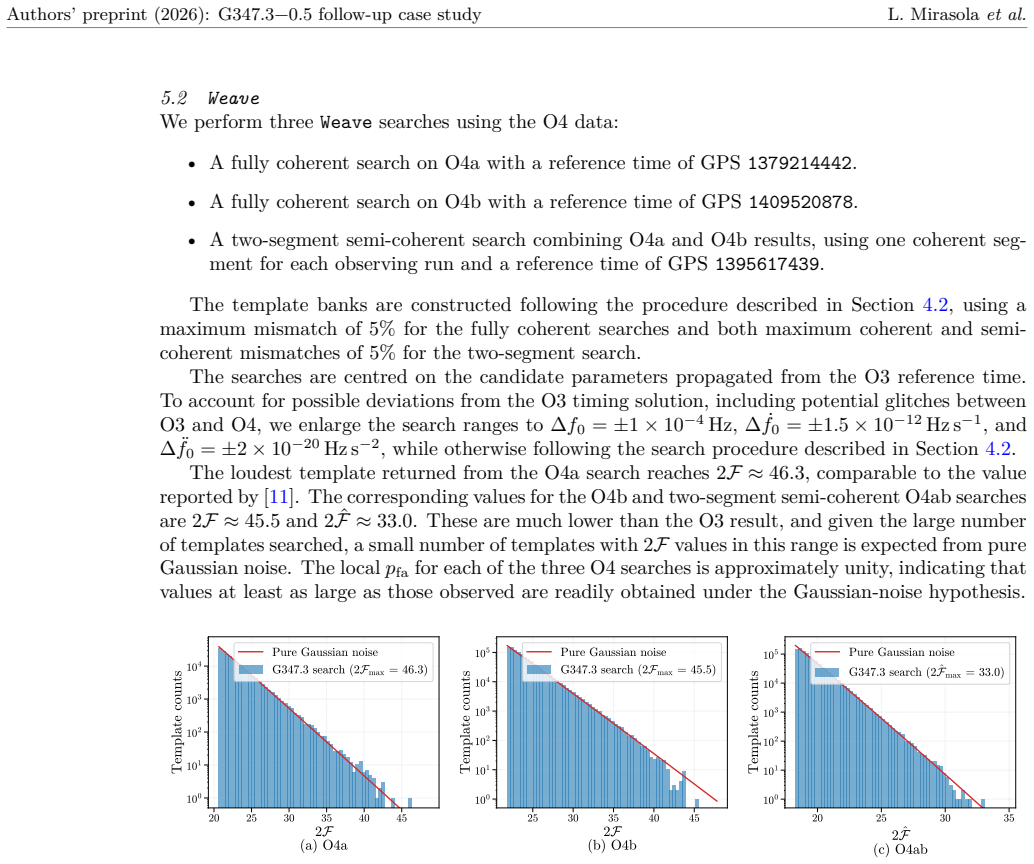
Grounded in the standard CW signal model, a Taylor expansion of the signal frequency with up to second-order spin-down and Doppler/relativistic phase corrections, the paper finds that the G347.3-0.5 outlier is a consistent feature of O3 data but does not persist into O4a or O4b. In O3, the time-domain Bayesian analysis returns a log10 Bayes factor of 3.9 in favour of a coherent signal over noise, the grid-based F-statistic search recovers 2Fmax=74.6 with local pfa approximately 1e-8, and the stochastic F-statistic analysis recovers 2F approximately 78 with local pfa approximately 6e-6; all agree with the original candidate parameters, including a small sky offset reproduced by injection. In O4a and O4b, the same pipelines find loudest statistics (2F in the range of roughly 31-50, and 2Fhat approximately 33 for the semi-coherent search) that track the Gaussian-noise expectation instead of the predicted values of 2F approximately 91 for O4a and approximately 222 for O4ab, and Bayesian evidence shifts to disfavour the signal, with log10 Bayes factors around -0.2 to -0.5. The conclusion is that the candidate is not consistent with a standard CW signal persisting across the full available data, though no known instrumental artifact or correlated noise can be blamed either.
Load-bearing premise
The conclusion rests on the assumption that a real signal from the same source would follow the standard CW model and lie within the enlarged parameter ranges searched in O4; a sufficiently large glitch or prolonged post-glitch recovery could make a genuine astrophysical signal undetectable in these follow-ups.
Editorial extensions
If this is right
- If the paper is right, the G347.3-0.5 outlier should not be treated as a candidate CW source: no long-lived phase-coherent signal exists at those parameters in the available data.
- CW candidates should require consistent recovery in later observing runs, not only in the discovery run, before being considered astrophysical.
- Multi-pipeline cross-checks, combining Bayesian time-domain inference, grid-based F-statistics, and stochastic F-statistics, can produce a convergent verdict on a single candidate.
- No known instrumental line or correlated detector noise explains the O3 outlier, so its origin remains unidentified.
- For a genuine persistent signal, adding data should raise the detection statistic and evidence; the observed decrease is itself a discriminating test.
Reading between the lines
- The pattern of a strong O3 recovery and an O4 absence is exactly what a transient noise event, or a signal whose phase changed between runs, would look like; the paper's glitch tests are not conclusive but point in that direction.
- If the candidate is eventually classed as noise, search pipelines can still produce false-alarm survivors at the roughly ten-percent level, and only multi-run disfavouring can retire them; this argues for building follow-up protocols around later observing runs.
- A testable extension is to hunt specifically for a glitched version of this signal in O4c data, using glitch-epoch priors informed by the paper's O3+O4a posteriors rather than only a standard signal model.
- The candidate's implied braking index of about 19 is far outside standard expectations of n=3 or n=5, which independently weakens the astrophysical interpretation of the O3 outlier.
Editorial analysis
A structured set of objections, weighed in public.
Referee Report
Summary. This paper reports a multi-pipeline follow-up of the continuous-gravitational-wave outlier identified by the Einstein@Home directed search toward the supernova remnant G347.3-0.5. The authors analyze O3, O4a, and the newly released O4b data from the LIGO H1 and L1 detectors, after extensive data-quality investigations that include spectral artifact identification, auxiliary-channel coherence checks with Fscan and STAMP-PEM, and inter-detector coherence studies with Stochmon. Three independent analysis pipelines are used: CWInPy (time-domain Bayesian), Weave (grid-based F-statistic), and PyFstat (stochastic F-statistic). In O3 data, all three pipelines recover the outlier with parameters consistent with the original report and with local false-alarm probabilities of order 10^-8 to 10^-6. In O4a and O4b, the maximum recovered 2F lies in the range 31-50, far below the value of about 222 predicted from the O3 parameters, and the observed template statistics are consistent with Gaussian noise; injection tests confirm that the pipelines would have recovered a signal of the O3 amplitude. The paper concludes that the outlier is not consistent with a long-lived, phase-coherent continuous wave under the standard signal model, while explicitly leaving open non-standard scenarios such as large glitches or post-glitch recovery.
Significance. This is a useful and well-executed case study for the continuous-wave follow-up workflow. Its strengths are the three independent pipelines with consistent conclusions, the injection tests that calibrate the O4 null result, the off-source noise distributions used for false-alarm estimation, and the explicit falsifiable prediction of the expected O4 detection statistic. The O4 null result is meaningful because the expected statistic is much larger than what is observed. The paper is appropriately cautious about restricting its conclusion to the standard continuous-wave model, but the boundary of the claim (no coverage for large glitches or post-glitch exponential recovery) is stated only in Section 5.2 and should be carried into the abstract. If the results hold, the paper provides a useful template for adjudicating future continuous-wave candidates.
major comments (1)
- [Abstract and Section 6 (with Section 5.2)] The central negative claim is explicitly conditional on the standard continuous-wave signal model and on the searched parameter ranges, but the abstract and title do not carry that qualifier. The O4 searches cover finite ranges: Weave uses Delta f0 = ±1e-4 Hz, Delta fdot = ±1.5e-12 Hz/s, and Delta fddot = ±2e-20 Hz/s^2 (Section 5.2); PyFstat's third-derivative prior has sigma = 4e-29 Hz/s^3 (Section 5.3); and the CWInPy glitch analysis is limited to O3+O4a and models phase jumps rather than a post-glitch exponential recovery (Section 5.1 and Appendix A). As the authors themselves state in Section 5.2, a sufficiently large glitch or a prolonged post-glitch recovery could keep an astrophysical signal undetected. Because the published version will be read through its abstract, I request that the abstract and the first paragraph of Section 6 state explicitly that the null result applies to the standard, phase-coherent continuous-wave model and does not exclude large-glitch or post-glitch-recovery scenarios.
minor comments (5)
- [Section 4.4] The local false-alarm probabilities quoted for O3 (Weave ~1e-8, PyFstat ~6e-6) are not corrected for the multiple pipelines, prior configurations, or earlier search stages; the paper states this, but the abstract phrase "robustly recover the outlier" could be read as implying a global significance, so I suggest using wording such as "recover the outlier with parameters consistent with those of the original search" instead.
- [Section 5.2] The statement that the local pfa for each O4 search is "approximately unity" is correct only after accounting for the very large number of templates searched; I recommend adding the template count or a one-sentence explanation so that the reader does not infer that a 2F value near 46 is itself a small statistic.
- [Figure 2] The y-axis labels in the text version contain placeholder boxes for the power-of-ten exponents; please check the final rendering of the superscripts.
- [Sections 5.3 and 5.4] The predicted O4ab 2F value of about 222 is mentioned only in Section 5.4; reporting it alongside the observed maxima in Section 5.3 would make the falsification more immediate for the reader.
- [Section 4.1] The reported Bayes factor of 3.9 depends on the reweighting lower bound of 10^-33; since the flat-prior value is 0.11, a brief statement on the sensitivity of the Bayes factors to this bound would help the reader judge the strength of the evidence.
Circularity Check
No significant circularity: the O4 null result is an independent falsifiable test of O3-derived predictions against new data, with scope limitations explicitly acknowledged.
full rationale
This paper is an observational follow-up rather than a derivation chain. The central negative claim—that the G347.3−0.5 outlier does not persist as a standard continuous-wave (CW) signal in O4—is tested by extrapolating O3 maximum-likelihood parameters to predict the expected detection statistic in O4a and O4ab (2F≈91 and ≈222, respectively; Section 5.4), then comparing those predictions with observed maxima (≈31–50) and with noise and injection distributions. The prediction is not fitted to O4 data: the O4 searches use enlarged parameter ranges relative to O3 posteriors (e.g., Weave ranges Δf0=±1e−4 Hz, Δfdot=±1.5e−12 Hz/s, Δfddot=±2e−20 Hz/s^2 in Section 5.2) and their sensitivity is demonstrated by injections, so the null result is not forced by construction. The paper explicitly restricts its conclusion to 'the assumptions adopted in this analysis' (Section 6) and acknowledges in Section 5.2 that a sufficiently large glitch or post-glitch exponential recovery could hide an astrophysical signal; this is a scope limitation, not circularity. Self-citations appear for software, recommended sampler settings, and collaboration data-quality tools, but none is load-bearing: the multi-pipeline consistency and injection-based sensitivity checks provide independent support. No step reduces, by definition or by self-citation, to its own input.
Assumptions & free parameters
free parameters (3)
- O4 search prior widening factors =
CWInPy: 10x O3 priors; Weave: f0 +/-1e-4, fdot +/-1.5e-12, fddot +/-2e-20; PyFstat: 2x sigma
- Bayes factor reweighting bounds =
log-uniform [1e-33, 1e-20] over h0
- Gumbel fit parameters for off-source 2F =
not quoted in text
assumptions (4)
- standard math Under stationary Gaussian noise, 2\hat{F} times Nseg follows a chi-squared distribution with 4 Nseg degrees of freedom; with a signal, a non-central chi-squared with non-centrality rho^2.
- domain assumption A CW from an isolated NS is described by Eq. 1 (Taylor expansion in frequency) and Eq. 2 (rotating-star amplitude model), with fixed sky position.
- domain assumption The LIGO H1/L1 data in the candidate band are Gaussian after removing known artifacts; no unmodeled correlated noise is present in the band.
- ad hoc to paper O4 prior and template ranges are wide enough to recover a standard CW signal from the same source if present.
Cite this review
Pith. "Pith review of The G347.3-0.5 outlier from O3: a follow-up case study for continuous gravitational-wave candidates." pith.science (2026). https://pith.science/paper/B4ZMZDWE
@misc{pith2026260807662,
  author       = {Pith},
  title        = {Pith review of: The G347.3-0.5 outlier from O3: a follow-up case study for continuous gravitational-wave candidates},
  year         = {2026},
  howpublished = {\url{https://pith.science/paper/B4ZMZDWE}},
  note         = {Machine review of arXiv:2608.07662}
}
read the original abstract
We report a multi-pipeline follow-up study of the continuous gravitational-wave (CW) outlier identified by the Ming et al. Einstein@Home directed search for the young supernova remnant G347.3-0.5 (containing the central compact object RXJ1713.7-3946). The outlier was initially identified in LIGO data from the O3a observing run and followed up with the addition of O3b and O4a data by the Einstein@Home pipeline, with O4a producing weaker evidence. Here, we show extended data quality checks and results from three pipelines that have independently investigated this outlier, including the newly released O4b data set. We can robustly recover the outlier in O3, while we find no evidence for a related standard CW signal in O4a (consistent with Ming et al.) and O4b data. This work serves as a useful test case for future multi-pipeline follow-ups of CW candidates that aim to investigate their astrophysical or noise nature, and it is therefore an important step in preparation for the first CW detection.
Figures


Figures from the paper (10 more)




Reference graph
Works this paper leans on
- [1]
-
[2]
Jones D I and Riles K 2025Class. Quant. Grav.42033001 (Preprint2403.02066)
- [3]
-
[4]
J.1291993 (Preprint astro-ph/0412641)
Manchester R N, Hobbs G B, Teoh A and Hobbs M 2005Astron. J.1291993 (Preprint astro-ph/0412641)
-
[5]
Modeling the Galactic Neutron Star Population for Use in Continuous Gravitational Wave Searches
Reed B T, Deibel A and Horowitz C J 2021Astrophys. J.92189 (Preprint2104.00771) 19 Authors’ preprint (2026): G347.3−0.5 follow-up case study L. Mirasolaet al
work page Pith review arXiv 2026
-
[6]
Wette Ket al.(LIGO Scientific Collaboration) 2008Class. Quant. Grav.25235011 (Preprint 0802.3332)
-
[7]
Space Res.491313–1319 (Preprint1202.0245)
Ferrand G and Safi-Harb S 2012Adv. Space Res.491313–1319 (Preprint1202.0245)
-
[8]
Phys.153102880 [Erratum: Astropart.Phys
Wette K 2023Astropart. Phys.153102880 [Erratum: Astropart.Phys. 179, 103229 (2026)] (Preprint2305.07106)
arXiv 2026
Show all 89 references
-
[9]
Tenorio R, Keitel D and Sintes A M 2021Universe7474 (Preprint2111.12575)
-
[10]
Aasi Jet al.(LIGO Scientific Collaboration) 2015Class. Quant. Grav.32074001 (Preprint 1411.4547)
-
[11]
J.100465 (Preprint2512.15672)
Ming J, Papa M A, Eggenstein H B, Machenschalk B, Martins J, Steltner B, McGloughlin B, Dergachev V, Prix R and Bensch M 2026Astrophys. J.100465 (Preprint2512.15672)
-
[12]
J.92180 (Preprint2105.11641)
Abbott Ret al.(LIGO Scientific, Virgo, KAGRA Collaborations) 2021Astrophys. J.92180 (Preprint2105.11641)
-
[13]
J.1004204 (Preprint2603.25808)
Abac A Get al.(LIGO Scientific, Virgo, KAGRA Collaborations) 2026Astrophys. J.1004204 (Preprint2603.25808)
-
[14]
Acernese Fet al.(Virgo Collaboration) 2015Class. Quant. Grav.32024001 (Preprint1408. 3978)
-
[15]
Akutsu Tet al.(KAGRA Collaboration) 2021PTEP202105A101 (Preprint2005.05574)
-
[16]
Abbott Ret al.(LIGO Scientific, Virgo, KAGRA Collaborations) 2023Astrophys. J. Suppl. 26729 (Preprint2302.03676)
-
[17]
J.1004232 (Preprint2508.18079)
Abac A Get al.(LIGO Scientific, Virgo, KAGRA Collaborations) 2026Astrophys. J.1004232 (Preprint2508.18079)
-
[18]
Abac A Get al.(LIGO Scientific, Virgo, KAGRA Collaborations) 2026arXiv e-prints(Preprint 2605.27090)
-
[19]
Pitkin M 2022Journal of Open Source Software74568 URLhttps://doi.org/10.21105/ joss.04568
-
[20]
Wette K, Walsh S, Prix R and Papa M A 2018Phys. Rev. D97123016 (Preprint1804.03392)
-
[21]
Ashton G and Prix R 2018Phys. Rev. D97103020 (Preprint1802.05450)
-
[22]
Open Source Softw.63000 (Preprint2101
Keitel D, Tenorio R, Ashton G and Prix R 2021J. Open Source Softw.63000 (Preprint2101. 10915)
-
[23]
Ashton G, Keitel D, Prix R, Tenorio R and Ferrer M A 2025 PyFstat URLhttps://doi.org/ 10.5281/zenodo.3967045
2025 doi
-
[24]
Antonopoulou D, Haskell B and Espinoza C M 2022Rept. Prog. Phys.85126901
-
[25]
Ashton G, Prix R and Jones D I 2017Phys. Rev. D96063004 (Preprint1704.00742)
-
[26]
JaranowskiP,KrolakAandSchutzBF1998Phys. Rev. D58063001(Preprintgr-qc/9804014)
-
[27]
Brady P R, Creighton T, Cutler C and Schutz B F 1998Phys. Rev. D572101–2116 (Preprint gr-qc/9702050)
-
[28]
Brady P R and Creighton T 2000Phys. Rev. D61082001 (Preprintgr-qc/9812014)
-
[29]
Pletsch H J 2008Phys. Rev. D78102005 (Preprint0807.1324)
-
[30]
Pletsch H J and Allen B 2009Phys. Rev. Lett.103181102 (Preprint0906.0023)
-
[31]
Pletsch H J 2010Phys. Rev. D82042002 (Preprint1005.0395)
-
[32]
Keitel D, Prix R, Papa M A, Leaci P and Siddiqi M 2014Phys. Rev. D89064023 (Preprint 1311.5738)
-
[33]
Keitel D 2016Phys. Rev. D93084024 (Preprint1509.02398) 20 Authors’ preprint (2026): G347.3−0.5 follow-up case study L. Mirasolaet al
2026 arXiv
-
[34]
Cutler C and Schutz B F 2005Phys. Rev. D72063006 (Preprintgr-qc/0504011)
-
[35]
Wette K, Dunn L, Clearwater P and Melatos A 2021Phys. Rev. D103083020 (Preprint 2103.12976)
-
[36]
Astrophys.651A40 (Preprint2106.00700)
Mayer M G F and Becker W 2021Astron. Astrophys.651A40 (Preprint2106.00700)
-
[37]
physics.umanitoba.ca/
SNRcat - high energy observations of galactic supernova remnants URLhttp://snrcat. physics.umanitoba.ca/
-
[38]
Wang Z R, Qu Q Y and Chen Y 1997Astronomy and Astrophysics318L59–L61
-
[39]
Astrophys
Mignani R P, Zaggia S, De Luca A, Perna R, Bassan N and Caraveo P A 2008Astron. Astrophys. 484457 (Preprint0803.3722)
-
[40]
Ashok A, Covas P B, Prix R and Papa M A 2024Phys. Rev. D109104002 (Preprint2401. 17025)
-
[41]
Salvadore C, La Rosa I, Leaci P, Amicucci F, Astone P, D’Antonio S, D’Onofrio L, Palomba C, Pierini L and Safai Tehrani F 2025Phys. Rev. D112083051 (Preprint2507.15027)
-
[42]
J.998205 (Preprint2508.20073)
McGloughlin B, Steltner B, Martins J, Papa M A, Eggenstein H B, Ming J, Machenschalk B, Prix R and Bensch M 2026Astrophys. J.998205 (Preprint2508.20073)
-
[43]
J.977154 (Preprint2408.14573)
Ming J, Papa M A, Eggenstein H B, Beheshtipour B, Machenschalk B, Prix R, Allen B and Bensch M 2024Astrophys. J.977154 (Preprint2408.14573)
-
[44]
Abbott Ret al.(LIGO Scientific, Virgo, KAGRA Collaborations) 2022Phys. Rev. D106102008 (Preprint2201.00697)
-
[45]
Abac A Get al.(LIGO Scientific, Virgo, KAGRA Collaborations) 2026arXiv e-prints(Preprint 2603.14168)
-
[46]
Martins J, Papa M A, Steltner B, Prix R and Covas P B 2026Phys. Rev. D113023041 (Preprint 2508.18204)
-
[47]
Dergachev V and Papa M A 2026Phys. Rev. D113042001 (Preprint2507.12161)
-
[48]
Leaci P and Prix R 2015Phys. Rev. D91102003 (Preprint1502.00914)
-
[49]
Covas P B 2020Mon. Not. Roy. Astron. Soc.5005167–5176 (Preprint2008.00983)
-
[50]
Parthasarathy Aet al.2019Mon. Not. Roy. Astron. Soc.4893810–3826 (Preprint1908.11709)
-
[51]
J.76558 (Preprint1301.2717)
Gotthelf E V, Halpern J P and Alford J 2013Astrophys. J.76558 (Preprint1301.2717)
-
[52]
Buikema Aet al.(aLIGO Collaboration) 2020Phys. Rev. D102062003 (Preprint2008.01301)
-
[53]
Acernese Fet al.(Virgo Collaboration) 2019Phys. Rev. Lett.123231108
-
[54]
Sun Let al.2020Class. Quant. Grav.37225008 (Preprint2005.02531)
-
[55]
Sun Let al.2021arXiv e-prints(Preprint2107.00129)
-
[56]
Acernese Fet al.(Virgo Collaboration) 2022Class. Quant. Grav.39045006 (Preprint2107. 03294)
-
[57]
Ganapathy Det al.(LIGO O4 Detector Collaboration) 2023Phys. Rev. X13041021
-
[58]
Jia Wet al.(LIGO Scientific Collaboration) 2024Science3851318 (Preprint2404.14569)
-
[59]
Capote Eet al.2025Phys. Rev. D111062002 (Preprint2411.14607)
-
[60]
Soni Set al.(LIGO Collaboration) 2025Class. Quant. Grav.42085016 (Preprint2409.02831)
-
[61]
Goetz Eet al.(O4 LIGO Detector Team) 2026arXiv e-prints(Preprint2606.05959)
-
[62]
LIGO Scientific Collaboration, Virgo Collaboration and KAGRA Collaboration 2025 LIGO data management plan URLhttps://dcc.ligo.org/M1000066-v31/public
2025
-
[63]
Mirasolaet al
Acernese Fet al.(Virgo Collaboration) 2026 (Preprint2607.19273) 21 Authors’ preprint (2026): G347.3−0.5 follow-up case study L. Mirasolaet al
2026 arXiv
-
[64]
Allen B, Goetz E, Keitel D, Landry M, Mendell G, Prix R, Riles K and Wette K 2025 SFT Data Format Version 2–3 Specification Tech. Rep. LIGO-T0900149-v3 LIGO Laboratory URL https://dcc.ligo.org/T0900149-v3/public
2025
-
[65]
LIGO Scientific Collaboration, Virgo Collaboration and KAGRA Collaboration 2026 LVK Al- gorithm Library - LALSuite Free software (GPL) URLhttps://doi.org/10.7935/GT1W-FZ16
2026 doi
-
[66]
Wade Met al.2025Class. Quant. Grav.42215016 (Preprint2508.08423)
-
[67]
Meyers P 2018Cross-correlation searches for persistent gravitational waves with Advanced LIGO and noise studies for current and future ground-based gravitational-wave detectorsPhd thesis University of Minnesota
-
[68]
Hernandez G and Thrane E 2023Stochmon: A LIGO Data Analysis ToolTech. Rep. T1400205 LSC URLhttps://dcc.ligo.org/LIGO-T1400205/public
-
[69]
Piccinni O J, Astone P, D’Antonio S, Frasca S, Intini G, Leaci P, Mastrogiovanni S, Miller A, Palomba C and Singhal A 2019Classical Quantum Gravity36015008 (Preprint1811.04730)
-
[70]
D’Onofrio Let al.2025Class. Quant. Grav.42015005 (Preprint2406.09236)
-
[71]
Prix R 2015 The F-statistic and its implementation in ComputeFStatistic_v2 Tech. Rep. LIGO- T0900149 LIGO Laboratory URLhttps://dcc.ligo.org/T0900149/public
2015
-
[72]
Dupuis R J and Woan G 2005Phys. Rev. D72102002 (Preprintgr-qc/0508096)
-
[73]
J.87910 [Erratum: Astrophys.J
Abbott B Pet al.(LIGO Scientific, Virgo Collaborations) 2019Astrophys. J.87910 [Erratum: Astrophys.J. 899, 170 (2020)] (Preprint1902.08507)
2020 arXiv
-
[74]
Pitkin M, Isi M, Veitch J and Woan G 2017arXiv e-prints(Preprint1705.08978)
-
[75]
Proc.735395
Skilling J 2004AIP Conf. Proc.735395
-
[76]
Skilling J 2006Bayesian Analysis1833–859
-
[77]
Speagle J S 2020Mon. Not. Roy. Astron. Soc.4933132–3158 (Preprint1904.02180)
-
[78]
Ashton Get al.2019Astrophys. J. Suppl.24127 (Preprint1811.02042)
-
[79]
J.83912 [Erratum: Astrophys.J
Abbott B Pet al.(LIGO Scientific, Virgo Collaborations) 2017Astrophys. J.83912 [Erratum: Astrophys.J. 851, 71 (2017)] (Preprint1701.07709)
2017 arXiv
-
[80]
Isi M, Pitkin M and Weinstein A J 2017Phys. Rev. D96042001 (Preprint1703.07530)
-
[81]
Wette K and Prix R 2013Phys. Rev. D88123005 (Preprint1310.5587)
-
[82]
Wette K 2015Phys. Rev. D92082003 (Preprint1508.02372)
-
[83]
Wette K 2014Phys. Rev. D90122010 (Preprint1410.6882)
-
[84]
Tenorio R, Keitel D and Sintes A M 2021Phys. Rev. D104084012 (Preprint2105.13860)
-
[85]
Vousden W D, Farr W M and Mandel I 2016Mon. Not. Roy. Astron. Soc.4551919–1937 (Preprint1501.05823)
1937 arXiv
-
[86]
Mirasola L and Tenorio R 2024Phys. Rev. D110124049 (Preprint2405.18934)
-
[87]
org/LIGO-P2600436
Ferrer-Martinez M A and Keitel D 2026 Enabling new sampling strategies for continuous- wave analyses by integrating bilby into PyFstat (In preparation) URLhttps://dcc.ligo. org/LIGO-P2600436
2026
-
[88]
J.98399 (Preprint2501.01495)
Abac A Get al.(LIGO Scientific, Virgo, KAGRA Collaborations) 2025Astrophys. J.98399 (Preprint2501.01495)
-
[89]
Owen B J and Rajbhandari B 2025arXiv e-prints(Preprint2512.22938) 22
Reviewed August 11, 2026 · model on record in the stance chip above.
Discussion (0). Continue with ORCID to comment.