REVIEW 3 major objections 5 minor 15 references
SpikeWorld: Fast-State Adaptation for Frozen Spiking World Models
T0 review · 3 major / 5 minor · reviewed 2026-08-11 · deepseek-v4-flash
Pith's one-line read A frozen spiking world model adapts to changed actuator dynamics through a 24,384-byte external state, raising frozen-policy reward by 7.90 on 450 live trajectories.
desk verdict A narrow but honest systems paper: frozen spiking world model adapted via a 24KB external state for two in-bank faults; deserves review, but the broad 'fast-state adaptation' framing outruns the coverage evidence. read the letter →
The pith
A machine-rendered reading of the paper's core claim, the machinery that carries it, and where it could break.
The reading
What carries the argument
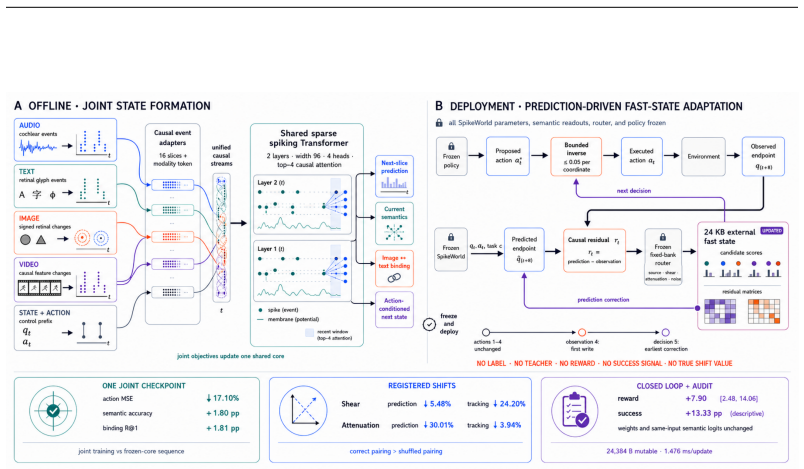
The key machinery is the separation of state formation from state adaptation. The frozen part is a two-layer sparse spiking Transformer of width 96 whose joint objective $L_{\text{joint}} = L_{\text{next}} + L_{\text{sem}} + 0.25L_{\text{bind}} + 4L_{\text{act}}$ forms the shared predictive-semantic state. The mutable part is a 24,384-byte external module containing two $96\times 30$ route-specific residual matrices, 32 cumulative candidate scores, a transition count, and padding. A frozen router sends the residual to one family of a fixed bank (source, shear $k\in[0.05,0.75]$, attenuation $g\in[0.20,0.95]$); cumulative losses $S_j \leftarrow S_j + \tfrac{1}{39}\|\hat d_t^{(j)} - d_t\|_2^2$ select the candidate, the active matrix takes one normalized gradient step projected to Frobenius radius 0.20, and the bounded inverse clips each coordinate correction to $\pm 0.05$. The first write happens at observation four, so decision five is the earliest corrected action.
What would settle it
Run the frozen checkpoint on a shear coefficient outside the bank (say $k=0.9$) or on a compound attenuation-plus-noise fault and measure whether the fixed-bank losses and bounded inverse improve closed-loop reward over the frozen policy; if the router misroutes and the correction abstains or hurts, the claimed bank coverage fails.
Extended reading notes
Core claim
The paper's central claim is that a single 1.45M-parameter sparse spiking checkpoint can be jointly formed to predict sensory next slices, classify semantics, bind images to text, and forecast action-conditioned endpoints, and that after deployment this checkpoint can be left completely frozen while a 24,384-byte external state adapts to registered actuator shifts. The external state is updated only from the standardized residual $r_t = g_{\theta_0}(q_t, a_t, c) - (q_{t+8} - q_t - \mu_\Delta)/\sigma_\Delta$; cumulative fixed-bank losses select the best source, shear, or attenuation candidate, and route-specific residual matrices refine future predictions. On held-out shear and attenuation streams this improves aggregate prediction by 5.48% and 30.01% and action tracking by 24.20% and 3.94%. In closed-loop Meta-World evaluation under attenuation $g=0.4$, the correction raises frozen-policy mean reward from 414.68 to 422.58, a paired gain of 7.90 (95% CI [2.48, 14.06]), with a descriptive success-rate increase of 13.33 percentage points (CI [0, 40]). For identical sensory inputs, all trained parameters and inherited semantic outputs remain bitwise unchanged.
Load-bearing premise
The deployed fault must belong to the fixed menu of mechanisms, source, shear within the tested range, or attenuation within the tested range, and the offline-trained router must pick the right one; otherwise the bounded inverse is not guaranteed to act.
Editorial extensions
If this is right
- If correct, any jointly trained predictive-semantic checkpoint can be recalibrated to changed actuator dynamics using only observed next-state residuals, without labels, rewards, teacher outputs, or the true shift value.
- The first four macro-transitions are always observation-only and the earliest corrected action is decision five, so any deployment must tolerate a fixed warm-up latency of four transitions.
- The fast-state module uses 24,384 bytes (0.420% of the 5.81 MB checkpoint) and no optimizer state, so adaptation can run under tight memory budgets without persistent optimizer moments.
- A 16-byte recursive least squares estimator still achieves the highest non-oracle reward on constant linear attenuation, so the contribution is integration with a frozen multimodal spiking checkpoint rather than superior linear identification.
- Full prediction-path tuning matches SpikeWorld's aggregate success on the evaluated tasks but changes semantic-output hashes, whereas SpikeWorld leaves identical-input semantic logits bitwise unchanged.
Reading between the lines
- Editorial inference: the same separation could extend to compound or previously unseen faults if the router were paired with a novelty detector; the paper's own negative results suggest detecting out-of-bank inputs, not enlarging the bank, is the bottleneck.
- Editorial inference: because RLS beats SpikeWorld on constant linear attenuation, the neural fast state is only justified when the checkpoint also carries semantics and must distinguish multiple dynamics families; a head-to-head on nonlinear or time-varying faults would be the natural next test.
- Editorial inference: bitwise identical semantic outputs under identical inputs is a strong non-interference guarantee that could be attractive for safety-critical deployments, provided the routing and residual-matrix updates are themselves certified.
Editorial analysis
A structured set of objections, weighed in public.
Referee Report
Summary. The paper proposes SpikeWorld, a 1.45M-parameter spiking world model jointly trained for multimodal prediction, semantics, image-text binding, and action-conditioned dynamics. At deployment all trained parameters are frozen, and a 24,384-byte external module uses delayed next-state residuals to select a bounded action correction from a fixed bank of source, shear, and attenuation mechanisms, while route-specific residual matrices refine next-state prediction. The experiments report that joint training improves action next-state MSE by 17.10%; that on held-out shear and attenuation streams the external state improves prediction and action tracking; and that in a six-arm closed-loop study on 450 Meta-World trajectories the frozen policy reward rises by 7.90 (95% CI [2.48, 14.06]) while model parameters and identical-input semantic outputs remain bitwise unchanged. The paper also reports that a 16-byte RLS estimator outperforms SpikeWorld on constant linear attenuation, and it explicitly limits the claims to a finite, pre-specified mechanism bank.
Significance. If the result holds, the paper makes a useful and well-scoped contribution: it demonstrates that a jointly trained predictive and semantic spiking checkpoint can be adapted to changed actuator dynamics without rewriting any trained parameter, using only prediction residuals and a compact external state. The paper is unusually careful on several fronts: bootstrap confidence intervals are computed at the episode unit, action-shuffled controls are included, the closed-loop study has six arms including full tuning, RLS, replay, and an oracle, and the deployment audit enumerates online fields, parameter hashes, and semantic-output hashes. The authors also honestly report negative results and boundary failures in Section A.8. The main weakness is an external-validity gap: the closed-loop reward result is obtained for a single in-bank attenuation fault, while the abstract and contributions frame the contribution as general 'fast-state adaptation'.
major comments (3)
- [Section 4.2, Table 2] The fixed-bank router is the gate for the entire correction path: Eq. (15) restricts candidate selection to the routed family, and Eqs. (16)-(17) apply the inverse of that family. The paper reports only aggregate router accuracy (76.5% for shear, 94.0% for attenuation in Table 2), with no architecture, training data, or confusion matrix. A misrouted shear stream classified as attenuation would receive the wrong inverse, and a misroute to source or noise would suppress correction entirely. Because the closed-loop result in Section 6.3 uses only attenuation g=0.4, where router accuracy is higher, the claimed adaptation has not been tested under the router's failure mode. Please add router training details, a confusion matrix, and an out-of-bank or deliberately misrouted closed-loop arm, or restrict the abstract and contribution claims to correctly routed in-bank shifts.
- [Section 6.3 and Abstract] The headline closed-loop gain of +7.90 (95% CI [2.48, 14.06]) in Section 6.3 is obtained exclusively under attenuation g=0.4, which lies inside the hand-built bank of Section 4.2 and A.3. The shear results in Table 2 come from the registered-shift offline/counterfactual protocol, not from a live closed-loop policy. The abstract's 'fast-state adaptation' phrasing and contribution 2 therefore extrapolate from one in-bank actuator fault to a general capability. Either add a closed-loop shear arm and preferably an out-of-bank value, or explicitly state in the abstract that closed-loop validation covers a single in-bank attenuation fault.
- [Sections 4.3 and A.8] Equations (16)-(17) apply the inverse of the routed family, and the attenuation inverse is floored at a gain of 0.2. The bank's attenuation range begins at 0.20, so a true gain below the floor or a shift outside the bank would make the correction structurally wrong rather than merely suboptimal. Section A.8 already documents nearby boundary failures (the uncapped inverse fails the shear action gate and source-return suppression is only 9-51% in earlier streams). The paper should report a sweep over out-of-bank gains and shear values, or explicitly state that the method is intended only for in-range, correctly routed shifts.
minor comments (5)
- [Section A.3 and Abstract] The 24,384-byte fast-state module includes 303 inert padding entries; the active mutable state is 5,793 values. The distinction between the module budget and runtime memory is clear in the body, but the abstract's '24,384-byte external state' phrasing could mislead readers; consider reporting active bytes in the abstract.
- [Section 3.2, Eq. (7)] The standardization statistics mu_Delta and sigma_Delta are described as Meta-World statistics, but their exact source is not specified; please state whether they are computed only on the offline training episodes and held fixed at deployment.
- [Table 3 and Section 6.3] The paired reward difference between SpikeWorld and full tuning is reported with a confidence interval, but the pairing structure (over model seeds, tasks, or task-seed cells) is not stated; please specify the unit of pairing.
- [Section 5] The term 'registered-shift' is used for the offline counterfactual adaptation protocol, which could be confused with time-stamped preregistration; consider renaming it 'held-out shift' or 'offline counterfactual' to avoid ambiguity.
- [Section A.8] The negative result 'source-return suppression between 9% and 51%' is reported without protocol details; please add the number of streams, the definition of suppression, and the metric used to measure it.
Circularity Check
No load-bearing circularity: the central adaptation result is driven by held-out residual updates, with only a minor non-load-bearing self-citation.
full rationale
Walked the derivation chain from joint training (Eq. 8) through the frozen deployment graph (Eqs. 9-11), fixed bank (Eqs. 12-14), candidate scoring (Eq. 15), bounded inverse (Eqs. 16-18), and the prequential/closed-loop protocols (Section 5). No step assumes its conclusion. The external state is updated only from observed endpoint residuals after the endpoint is available, and the first corrected action occurs only after four observations, so the reward gain at decisions 5-13 is out-of-sample with respect to the update. The bitwise semantic invariance is structural (external state is not fed to semantic readouts) and verified by hashes; it is a stated invariant, not a derived prediction. The only by-construction relation is that Eqs. 16-17 are the exact algebraic inverse of the bank operators Eqs. 13-14. That is a designed control law, not a fitted parameter renamed as a prediction; its success depends on the empirically reported router accuracy (76.5% shear, 94.0% attenuation) and estimator convergence, and the paper explicitly limits the claim to the finite bank and reports that a 16-byte RLS estimator outperforms SpikeWorld on constant linear attenuation. There is one minor self-citation (Yu et al., 2026, in Related Work for surrogate-gradient timing capabilities) that is not load-bearing. The stated limitations (finite router bank, unreliable source-return write suppression, shared multimodal foundation checkpoint, hand-designed eventizers) are external-validity gaps, not circularities. Therefore no significant circularity is present; score 2 reflects only the minor non-load-bearing self-citation.
Assumptions & free parameters
free parameters (5)
- Meta-World standardization statistics mu_Delta, sigma_Delta =
not reported numerically
- Objective weights in L_joint =
4 Lact, 1 Lnext, 1 Lsem, 0.25 Lbind
- Fixed candidate bank values =
15 shear k values in 0.05 to 0.75; 16 attenuation g values in 0.20 to 0.95
- Action correction bound and inverse floor =
0.05 per coordinate; inverse floor max(g, 0.2)
- Residual-matrix update hyperparameters =
learning rate 0.02, Frobenius radius 0.20
assumptions (4)
- domain assumption Endpoint prediction residual after eight environment steps is an informative, self-supervised signal for actuator changes.
- ad hoc to paper The deployed fault is exactly representable by the finite bank T_source, T_shear, T_atten with candidate values in the specified ranges.
- domain assumption The offline-trained router generalizes from its training signatures to the held-out streams.
- domain assumption Meta-World reward and success are reliable evaluation metrics, and the 0.05 bounded correction does not destabilize the frozen policy.
invented entities (2)
-
Route-specific residual matrices C_shear and C_atten
-
Fixed-bank router
Cite this review
Pith. "Pith review of SpikeWorld: Fast-State Adaptation for Frozen Spiking World Models." pith.science (2026). https://pith.science/paper/3DQ6CKJC
@misc{pith2026260807712,
  author       = {Pith},
  title        = {Pith review of: SpikeWorld: Fast-State Adaptation for Frozen Spiking World Models},
  year         = {2026},
  howpublished = {\url{https://pith.science/paper/3DQ6CKJC}},
  note         = {Machine review of arXiv:2608.07712}
}
read the original abstract
A predictive model receives a self-supervised signal whenever the consequence of an action is observed. Using that signal after deployment is difficult when dynamics and semantics share parameters: freezing prevents adaptation, whereas weight updates require optimizer state and may alter the learned representation. Here we introduce SpikeWorld, a 1.45M-parameter sparse spiking model jointly trained for heterogeneous sensory prediction, semantics, image-text binding and action-conditioned dynamics. At deployment, all trained parameters are frozen. Delayed next-state residuals update two external paths: cumulative fixed-bank losses select the bounded action correction, while route-specific residual matrices refine next-state prediction. Neither path uses labels, teacher outputs, rewards, success signals or the true shift value. Joint optimization improves action next-state MSE by 17.10\% while also improving multimodal prediction, semantic accuracy and image-text retrieval. On held-out shear and attenuation streams, the combined external state improves aggregate prediction by 5.48\% and 30.01\%; its fixed-bank action path improves tracking by 24.20\% and 3.94\%, respectively. In a six-arm study comprising 450 new Meta-World trajectories (75 per arm), SpikeWorld raises frozen-policy reward by 7.90 (95\% CI [2.48, 14.06]); the 13.33-point success difference is descriptive (CI [0, 40]). For identical sensory inputs, model parameters and inherited semantic outputs remain bitwise unchanged. A 16-byte RLS estimator obtains the highest non-oracle reward on linear attenuation, showing that the contribution is not superior linear identification, but its integration with a frozen multimodal spiking checkpoint. Reference code is publicly available at https://github.com/Oooorca/SpikeWorld.
Figures

Reference graph
Works this paper leans on
-
[1]
Mido Assran et al. V-JEPA 2: Self-supervised video models enable understanding, prediction and planning.arXiv preprint arXiv:2506.09985,
-
[4]
doi: 10.1109/TPAMI.2020.3008413. URL https://doi.org/10. 1109/TPAMI.2020.3008413. David Ha and Jürgen Schmidhuber. World models.arXiv preprint arXiv:1803.10122,
arXiv 2020
-
[6]
Ashish Kumar, Zipeng Fu, Deepak Pathak, and Jitendra Malik
URLhttps://arxiv.org/abs/2212.10368. Ashish Kumar, Zipeng Fu, Deepak Pathak, and Jitendra Malik. RMA: Rapid motor adaptation for legged robots. InRobotics: Science and Systems XVII,
-
[11]
EventCLIP: Adapting CLIP for event-based object recognition.arXiv preprint arXiv:2306.06354,
10 Ziyi Wu, Xudong Liu, and Igor Gilitschenski. EventCLIP: Adapting CLIP for event-based object recognition.arXiv preprint arXiv:2306.06354,
-
[13]
Ziqiao Yu, Pengfei Sun, and Dan F
URLhttps://arxiv.org/abs/1910.10897. Ziqiao Yu, Pengfei Sun, and Dan F. M. Goodman. Beyond rate coding: Surrogate gradients enable spike timing learning in spiking neural networks.Neuromorphic Computing and Engineering, 6:014016,
arXiv 1910
-
[14]
URL https://doi.org/10.1088/ 2634-4386/ae46d5
doi: 10.1088/2634-4386/ae46d5. URL https://doi.org/10.1088/ 2634-4386/ae46d5. Friedemann Zenke and Surya Ganguli. SuperSpike: Supervised learning in multilayer spiking neural networks.Neural Computation, 30(6),
-
[15]
URL https://doi.org/10.1162/NECO_A_01086
doi: 10.1162/NECO_A_01086. URL https://doi.org/10.1162/NECO_A_01086. Jiazhou Zhou, Xu Zheng, Yuanhuiyi Lyu, and Lin Wang. EventBind: Learning a unified representation to bind them all for event-based open-world understanding.arXiv preprint arXiv:2308.03135, 2023a. URLhttps://arxiv.org/abs/2308.03135. Zhaokun Zhou, Yuesheng Zhu, Chao He, Yaowei Wang, Shuic...
-
[16]
URL https://arxiv.org/abs/2302.13939. 11 A IMPLEMENTATION ANDEXTENDEDEVIDENCE A.1 REALIZED ARCHITECTURE AND OFFLINE DATA The complete checkpoint has 1,451,388 parameters: 1,442,527 inherited multimodal parameters and 8,861 action-path parameters. The sparse core uses two layers, width 96, four heads, FFN width 192, membrane decay 0.85, sensory sequence le...
Show all 15 references
-
[2008]
URL https://doi.org/10.1109/JSSC
doi: 10.1109/JSSC.2007.914337. URL https://doi.org/10.1109/JSSC. 2007.914337. Michael L. Littman, Richard S. Sutton, and Satinder Singh. Predictive representations of state. In Advances in Neural Information Processing Systems, volume 14, pp. 1555–1561,
2007
-
[2016]
Adrien Bardes, Quentin Garrido, Jean Ponce, Xinlei Chen, Michael Rabbat, Yann LeCun, Mahmoud Assran, and Nicolas Ballas
URL https://proceedings.neurips.cc/paper/2016/hash/ 9f44e956e3a2b7b5598c625fcc802c36-Abstract.html. Adrien Bardes, Quentin Garrido, Jean Ponce, Xinlei Chen, Michael Rabbat, Yann LeCun, Mahmoud Assran, and Nicolas Ballas. Revisiting feature prediction for learning visual repres...
2016 arXiv
-
[2018]
Simon Klenk, David Bonello, Lukas Koestler, Nikita Araslanov, and Daniel Cremers
URL https://arxiv.org/abs/1803.10122. Simon Klenk, David Bonello, Lukas Koestler, Nikita Araslanov, and Daniel Cremers. Masked event modeling: Self-supervised pretraining for event cameras.arXiv preprint arXiv:2212.10368,
-
[2019]
URL https://doi.org/10.1109/MSP.2019.2931595
doi: 10.1109/MSP.2019.2931595. URL https://doi.org/10.1109/MSP.2019.2931595. Shuaicheng Niu, Jiaxiang Wu, Yifan Zhang, Yaofo Chen, Shijian Zheng, Peilin Zhao, and Mingkui Tan. Efficient test-time model adaptation without forgetting. InProceedings of the 39th Inter- national Co...
2019
-
[2021]
URLhttps://roboticsproceedings.org/rss17/p011.html
doi: 10.15607/RSS.2021.XVII.011. URLhttps://roboticsproceedings.org/rss17/p011.html. Patrick Lichtsteiner, Christoph Posch, and Tobi Delbruck. A 128 ×128 120 db 15 µs latency asynchronous temporal contrast vision sensor.IEEE Journal of Solid-State Circuits, 43(2):566– 576,
2021 doi
-
[2022]
doi: 10.1109/TNNLS.2020. 3044364. Guillermo Gallego, Tobi Delbruck, Garrick Orchard, Chiara Bartolozzi, Brian Taba, Andrea Censi, Stefan Leutenegger, Andrew J. Davison, Jorg Conradt, Kostas Daniilidis, and Davide Scaramuzza. Event-based vision: A survey.IEEE Transactions on Pa...
2020 doi
-
[2026]
URL https: //doi.org/10.1038/s42256-026-01255-3
doi: 10.1038/s42256-026-01255-3. URL https: //doi.org/10.1038/s42256-026-01255-3. Dequan Wang, Evan Shelhamer, Shaoteng Liu, Bruno Olshausen, and Trevor Darrell. Tent: Fully test- time adaptation by entropy minimization. InInternational Conference on Learning Representations,
Reviewed August 11, 2026 · model on record in the stance chip above.
Discussion (0). Continue with ORCID to comment.