REVIEW 3 major objections 5 minor 102 references
Gravitational radiation from binary systems with time varying masses
T0 review · 3 major / 5 minor · reviewed 2026-08-12 · deepseek-v4-flash
Pith's one-line read This paper claims that slowly varying binary masses add new mass-derivative terms to gravitational-wave energy and angular-momentum loss, so mass-losing binaries inspiral differently from constant-mass systems.
desk verdict Substantial variable-mass quadrupole formalism, but the orbital-decay equations rest on an unstated mass-loss prescription that contradicts the text; needs a major revision before results can be trusted. read the letter →
The pith
A machine-rendered reading of the paper's core claim, the machinery that carries it, and where it could break.
The reading
What carries the argument
The load-bearing object is the linear map $A$ of Eq. (38), which connects the constant-mass quadrupole derivative stack $(D_{ij}, \dot D_{ij}, \ddot D_{ij}, \dddot D_{ij})_c$ to the variable-mass one using the total-mass scale factor $f_M$ and reduced-mass scale factor $f_\mu$. From this map come the coefficients $F_1,\dots,F_4$ and $F'_1,\dots,F'_3$; $F_4=f_M^{3/2}f_\mu$ multiplies the standard constant-mass quadrupole rate, while the other $F_i$ generate the new terms. Orbit-averaging the expanded fourth derivative produces the $A_i$ and $B_i$ integrals that turn into the compact formulas (50) and (54).
What would settle it
For two equal point masses with prescribed isotropic mass loss $M(t)=M_0(1+kt)$, numerically integrate the Newtonian two-body equations and measure the scaling of orbital separation with $M$; a $1/M^3$ scaling would support the specific-angular-momentum conservation used in Section III A, while a $1/M$ scaling would support the total-angular-momentum conservation of Section VI, thereby selecting the correct $\langle da/dt\rangle$ and coalescence time.
Extended reading notes
Core claim
The central claim is that for a slowly mass-varying binary with $M_i(t)=M_{ci}f_i(t)$, the orbit-averaged gravitational energy loss is $\langle dE/dt\rangle = -F_4^2 \langle dE/dt\rangle_c + \frac{G\mu_c^2}{10c^5}[\cdots]$ (Eq. 50), with an analogous expression for $-\langle dL/dt\rangle$ (Eq. 54). Here $F_4=f_M^{3/2}f_\mu$ rescales the constant-mass result, while the bracket terms involve $F_1,F_2,F_3$, combinations of first, second, and third time derivatives of the mass scale factors. Feeding these into the energy and angular-momentum balance equations gives modified $\langle da/dt\rangle$, $\langle de/dt\rangle$, and $\langle dP_b/dt\rangle$, plus closed-form coalescence times for linear and exponential mass decay that reduce to $a_0^4/(4\beta)$ when the mass is constant. The paper thereby claims that mass variation is not a small perturbation to the waveform but a source of observable corrections to the inspiral.
Load-bearing premise
The central premise is that one conservation law governs orbital angular momentum under isotropic mass loss, but Section III A conserves specific angular momentum $h=r^2\dot\theta$ while Section VI conserves total angular momentum $L$, and these give different orbital responses.
Editorial extensions
If this is right
- For equal-mass circular binaries with $f(t)=1+kt$ or $f(t)=e^{\omega t}$, the coalescence time is longer than the constant-mass value, with explicit formulas $T_c=\frac1k[(\beta/(\beta-4a_0^4k))^{1/4}-1]$ and $T_c=\frac1{5\omega}\ln(4\beta/(4\beta-5\omega a_0^4))$ that reduce to $a_0^4/(4\beta)$ as $k,\omega\to0$.
- The period derivative gains a direct Keplerian mass-loss term $-\dot f_M/(2f_M)$ alongside the gravitational-radiation term, so pulsar timing of binaries with known mass loss can separate the two.
- Early in the inspiral, the mass-loss term $a(\dot f_1/f_1+\dot f_2/f_2)$ can dominate over gravitational-wave decay, meaning the orbit can widen while the masses shrink before radiation takes over.
- In the Newtonian adiabatic limit without radiation, eccentricity is constant; the circularization seen in the paper's numerical runs is attributed entirely to gravitational-wave emission.
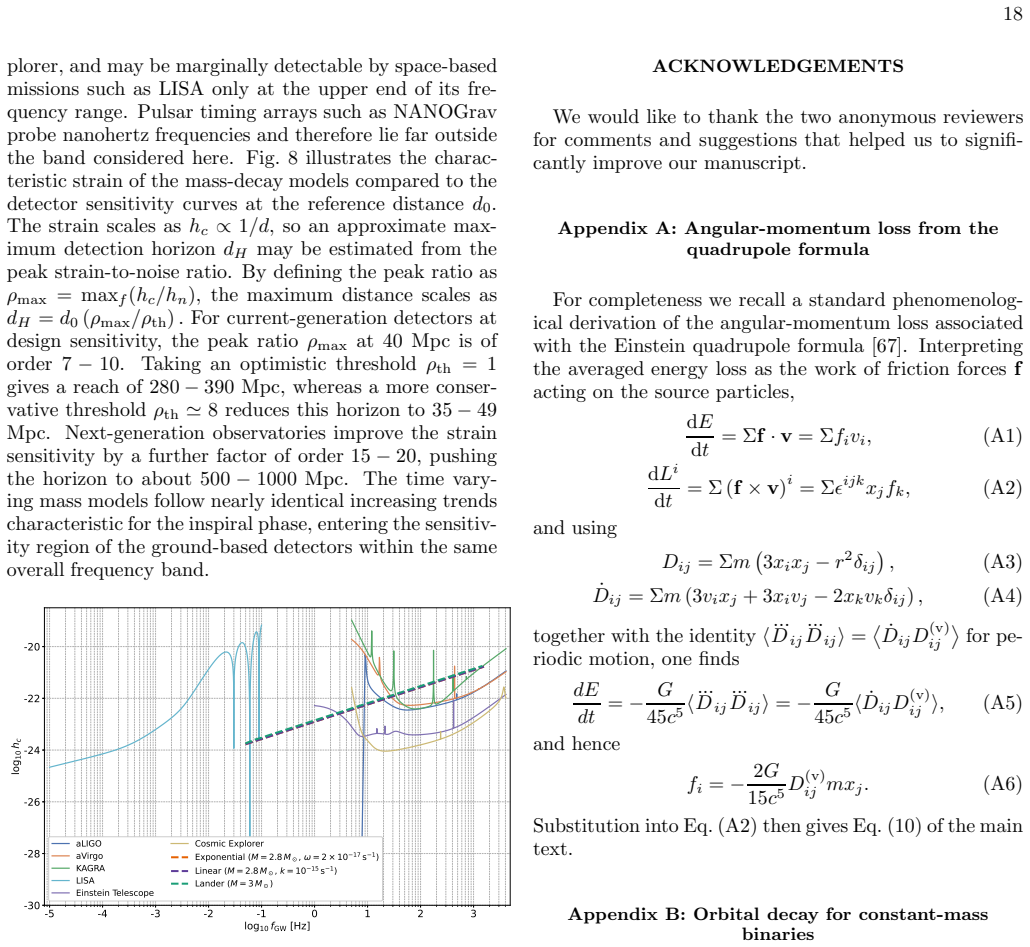
- For magnetar binaries with neutrino-heated winds, mass loss is concentrated in the first ~60 s and heavier systems inspiral and merge faster, with strain amplitudes near $10^{-21}$ at 40 Mpc for ground-based detectors.
Reading between the lines
- Editorial inference: if these corrections are real, constant-mass template banks for gravitational-wave searches will systematically bias the recovered masses and merger times of binaries with strong pre-merger winds; the dephasing could be a target for next-generation ground-based detectors.
- Editorial inference: the paper's two conservation statements for angular momentum under isotropic mass loss predict different separation scalings; deriving the formalism from a single variable-mass action would resolve which evolution equations are physically correct.
- Editorial inference: the correction structure suggests one could absorb mass variation into an effective time-dependent chirp mass; comparing an observed chirp-mass drift with the predicted $F_i$ terms would test the formalism directly.
- Editorial inference: the same formulas with positive $\dot f$ (accretion) flip the sign of the mass-transfer terms, so accreting binaries like X-ray binaries might show delayed or accelerated inspiral; this is a testable extension the paper does not perform.
Editorial analysis
A structured set of objections, weighed in public.
Referee Report
Summary. The paper generalizes the Peters-Mathews quadrupole treatment of gravitational radiation from binaries to systems whose component masses vary in time. The main formal results are the orbit-averaged energy-loss rate, Eq. (50), and angular-momentum-loss rate, Eq. (54), expressed as the constant-mass fluxes plus corrections built from the mass-scaling functions f1(t), f2(t) and their time derivatives up to third order. From these the authors derive evolution equations for the semimajor axis, eccentricity and orbital period (Eqs. (56), (H2), (59)-(60)), coalescence times for linear and exponential mass-loss models (Eqs. (81), (86)), and a public numerical code, GRAV-T, validated against LEGWORK in the constant-mass limit. The formalism is applied to binary magnetars with neutrino-heated winds (Section V). The constant-mass limit correctly reduces to the Peters-Mathews results.
Significance. If the predictions were unambiguous, the paper would extend a classical formalism to astrophysically relevant settings with real mass loss (stellar winds, supernova ejecta, magnetar winds) and yield falsifiable signatures: modified inspiral laws, period derivatives, and coalescence times, with GRAV-T providing documented, reproducible numerics (relative residuals versus LEGWORK at the 10^-4 level). The algebra in Sections III and the appendices is extensive and internally plausible, and Eqs. (50) and (54) are well-defined adiabatic quadrupole fluxes that correctly reduce to Peters-Mathews when the masses are constant. However, the paper's headline predictions are not delivered uniquely, because the conversion of these fluxes into da/dt and de/dt depends on an ambiguous and self-contradictory prescription of the variable-mass orbital dynamics, as detailed in the major comments.
major comments (3)
- [III (preamble), III.A, VI; Eqs. (56), (H2)] The concern that the angular-momentum behavior under mass loss is ambiguous is confirmed by the text. The preamble to Section III states that the masses vary 'while conserving the total orbital energy and angular momentum.' For time-varying masses these two conservation laws are incompatible: for equal masses, E = -Gm^2/(2a) = const implies a proportional to m^2, and substituting into Eq. (20) gives L proportional to m^(5/2), not constant. Section III.A then states that the specific angular momentum h = r^2 d(theta)/dt is conserved for isotropic mass loss, which for a circular orbit (h^2 = GMa) implies da/dt = -a df/fdt, while two paragraphs later the same subsection asserts conservation of J = mu sqrt(GMr), which implies da/dt = -3a df/fdt; both statements are presented without noting the discrepancy. Section VI asserts that the total orbital angular momentum L is an adiabatic invariant, again giving a proportional to f^(-3). Finally, the mass-loss term a(df1/f1dt + df2/f2dt) in Eq. (56) corresponds, in the no-gravitational-wave limit, to da/dt = 2a df/fdt, i.e., a proportional to f^2 and constant orbital energy, a third, unstated prescription. The three prescriptions disagree even in the sign of the mass-loss contribution to da/dt. Because the paper's astrophysical conclusions, including the modified inspiral, the eccentricity evolution, the coalescence times of Section IV, and the magnetar simulations of Section V, are all obtained from Eqs. (56) and (H2) rather than from Eqs. (50) and (54) alone, the central claim that variable-mass binaries inspiral differently from constant-mass templates is not well defined until this ambiguity is resolved.
- [VI versus (H2), (88), (90)] Section VI concludes from the adiabatic invariants Jr and Jtheta that 'if the mass variation of the system is slow, then the eccentricity of the orbit does not change in time' and that the only source of time variation of L and e is gravitational radiation. This contradicts the explicit mass-loss term -(1-e^2)/(2e)(dfM/fMdt - 3df1/f1dt - 3df2/f2dt) in Eq. (H2), which for equal mass functions f1 = f2 = fM = f reduces to +5(1-e^2)df/(2efdt) in Eq. (90): with df/dt < 0 this term drives the eccentricity to zero even when the gravitational-wave term is switched off. The caveat inserted after Eq. (100), that adiabatic invariance holds only 'in the Newtonian adiabatic limit with negligible gravitational-wave emission,' does not resolve the contradiction, because the offending term in Eq. (H2) is present precisely in that limit. Since the numerical code GRAV-T integrates Eqs. (56) and (H2), the circularization reported in Section V is likewise affected by this ambiguity.
- [Eq. (81)] The coalescence-time formula for the linear mass-variation model is inconsistent with Eq. (80), from which it is derived. Setting a^4(Tc) = 0 in Eq. (80) gives (1 + kTc)^4 = beta/(beta - k a0^4), hence Tc = (1/k)[(beta/(beta - k a0^4))^(1/4) - 1]. The factor 4 in the printed Eq. (81), beta/(beta - 4a0^4k), is spurious. As printed, Eq. (81) has the limit Tc -> a0^4/beta as k -> 0, contradicting the stated limit a0^4/(4beta); only the corrected expression reduces to a0^4/(4beta). The exponential analog, Eq. (86), is consistent and does reduce correctly, so the error is localized to the linear case, but Eq. (81) is a headline result and must be corrected.
minor comments (5)
- [Eq. (76)] Substituting f1 = f2 = fM = f and e = 0 into Eq. (56) using the coefficients of Eqs. (73)-(75) yields bracket terms 441 G a^3 f (d2f/dt2)^2 + 315 G a^3 (df/dt)^2 (d2f/dt2) + (225/4) G a^3 (df/dt)^4 / f - 108 G a^3 f (d3f/dt3)(df/dt) and (4/3) a^6 (d3f/dt3)^2 / Mc, whereas Eq. (76) displays 36 G a^3 (49(d2f/dt2)^2/(4f) + 25(df/dt)^4/(16f^3) + 35(df/dt)^2(d2f/dt2)/(4f^2) - 3(d3f/dt3)(df/dt)/f) and 4 a^6 (d3f/dt3)^2/(3 Mc f^2). Each of the displayed sub-terms differs by a factor 1/f^2 from the value implied by Eq. (56). The mismatch propagates into Eqs. (78) and (83); it is higher order under the stated slow-variation assumptions and does not change the reduced equations (79) and (84) or the coalescence-time formulas, but the displayed equations should be made internally consistent.
- [IV.C.1 versus V] The sign convention for the linear mass-loss parameter is inconsistent between sections: Section IV.C.1 writes f(t) about 1 + kt with the coalescence-time formula Eq. (81) requiring k < 0 to describe mass loss, while Section V defines linear decay as f(t) = 1 - kt with k > 0 (Table II). The text never states that the two k's have opposite roles.
- [Abstract and Introduction] The abstract and the introduction promise 'the expressions describing the time variation of the ... periastron shift' as one of the paper's results, but no periastron-shift formula appears anywhere in the paper or its appendices.
- [Acknowledgments] The acknowledgment 'We would like to thank the two anonymous reviewers for comments and suggestions...' appears to be leftover text from a previous version of the manuscript and should be removed.
- [Section VI] The comparison of dP/dt about 10^-11 (exponential model, Fig. 5) and dP/dt about 10^-10 (Lander-Jones model, Fig. 7) with dP/dt about 2.4 x 10^-12 for PSR B1913+16 concerns binaries at very different masses, separations and evolutionary stages; the observability claim would be better supported by a normalized quantity such as (dP/dt)/P or by models matched to the same orbital parameters.
Circularity Check
No significant circularity: the variable-mass quadrupole derivation is self-contained and reduces to Peters-Mathews in the constant-mass limit.
full rationale
The central results, Eqs. (50) and (54), are obtained by inserting the time-dependent mass decomposition M_i(t) = M_{ic} f_i(t) into the standard quadrupole moments D_ij = D^c_ij f_mu, expanding the time derivatives through the matrix A in Eq. (38), and orbit-averaging the resulting instantaneous fluxes. The coefficients F_i and F'_i are explicit algebraic functions of f_M, f_mu and their derivatives, not fitted parameters; the mass-scale functions f_1, f_2 are chosen from independent astrophysical scalings (linear and exponential wind models, Lander-Jones neutrino wind), not from the gravitational-wave output. The final expressions reduce identically to Peters-Mathews when f_1 = f_2 = 1, and the numerical code is validated against the external LEGWORK package in the constant-mass limit, with mean residuals of order 1e-4. The self-citations to Refs. [47,48] (coauthored by T. Harko) are contextual and not load-bearing: the paper does not rely on an unverified uniqueness claim from those works. The noted tension between specific-angular-momentum conservation (h = r^2 dot_theta, Sec. III A), J = mu sqrt(G M r) conservation (Eq. 30), and total-angular-momentum adiabatic invariance (Sec. VI) is a physical-consistency and correctness concern about which variable-mass dynamics is used, not a circularity in which a prediction is equivalent to an input by construction. No fitted quantity is renamed as a prediction, and no ansatz is smuggled in solely via citation.
Assumptions & free parameters
free parameters (2)
- linear mass-loss rate k =
range 1e-15 to 3e-13 s^-1 in simulations
- exponential mass-loss rate omega =
range 2e-17 to 6e-15 s^-1
assumptions (4)
- domain assumption The Einstein quadrupole formula applies to sources with slowly time-varying masses.
- domain assumption Orbits remain Keplerian with slowly varying orbital elements (osculating orbits).
- domain assumption Adiabatic mass variation: Pb dot_Mi << Mi, so f_i and its derivatives are constant over one orbital period.
- ad hoc to paper Total orbital angular momentum L is conserved during mass variation (adiabatic invariant).
Cite this review
Pith. "Pith review of Gravitational radiation from binary systems with time varying masses." pith.science (2026). https://pith.science/paper/OF3XQLH7
@misc{pith2026260807951,
  author       = {Pith},
  title        = {Pith review of: Gravitational radiation from binary systems with time varying masses},
  year         = {2026},
  howpublished = {\url{https://pith.science/paper/OF3XQLH7}},
  note         = {Machine review of arXiv:2608.07951}
}
read the original abstract
We consider the properties of the gravitational radiation emitted by massive stars in binary systems with time varying mass, orbiting around each other in Keplerian orbits under the influence of the gravitational force. When this effect is combined to the quadrupole expression of the gravitational radiation, some supplementary terms in the standard formulae describing radiative effects do appear. By using the generalized quadrupole formalism, with time dependent masses, we obtain the expressions describing the time variation of the angular momentum, semimajor axis, eccentricity and periastron shift of the binary system. As a simple application of the developed formalism we consider in detail two cases of the mass variation, by assuming a linear and an exponential time dependence, respectively. The gravitational radiation characteristics corresponding to these models are fully investigated numerically with the help of a dedicated software package \href{https://github.com/croi900/GRAV-T}{GRAV-T}, specifically developed for the study of the gravitational radiation of the mass varying systems. The impact of the gravitational wave emission on the merger of two magnetars losing mass due to neutrino heated winds is also investigated in detail. The obtained results could be important for the understanding of general relativistic effects in the case of the variation of the gravitational mass with time, which sensitively influences the properties of the gravitational radiation emission.
Figures


Figures from the paper (5 more)


Reference graph
Works this paper leans on
-
[1]
From the definition of f =M/Mc, we know that f (0) = 1
The linear time variation of the mass Iff (t) can be approximate by a linear function, then ˙f is equal to a constant. From the definition of f =M/Mc, we know that f (0) = 1. Using the linear approximation, we assume that the mass function is given by f (t) ≈ 1 +kt, (77) wherek is a small constant. Then Eq. (76) giving (d a/dt) in the presence of time vary...
-
[2]
Hence we will assume that f (t) ≈ eωt, (82) where ω is a constant
The exponentially varying mass case If the mass variation rate is approximately directly pro- portional to the mass of the binary system, ˙M ∝M , then f (t) is given by an exponential function. Hence we will assume that f (t) ≈ eωt, (82) where ω is a constant. Then Eq. (76) for (d a/dt) takes the form da dt = − 64G3McM1cM2c 5c5 e3ωt a3 + 2aω − ( 492G2µcMc...
-
[3]
(56) for (da/dt) and Eq
The general linear time dependent mass function case From the analysis of these two special cases, we can find a more general conclusion: if the mass variation func- tion can be expanded in the form that f = 1 +kt +O(k), Eq. (56) for (da/dt) and Eq. (H2) for (d e/dt) are approx- imately given by ⟨ da dt ⟩ ≈ F 2 4 f1f2 ⟨ da dt ⟩ c +a ( ˙f1 f1 + ˙f2 f2 ) , (...
-
[4]
As a first test we adopt the linear an- alytical function f (t) = 1 − kt, where k is a positive coefficient describing the mass loss rate
Linear mass decay Within the aforementioned simulation setup, we con- sidered a typical neutron star binary system of equal masses M1c = M2c = 1.4M⊙, with time varying func- tions associated to their mass decay given by f1(t) = f2(t) = f (t). As a first test we adopt the linear an- alytical function f (t) = 1 − kt, where k is a positive coefficient describin...
-
[5]
k [s−1] Tc [s] Tc [years] 1.00 × 10⁻¹⁵ 3.23 × 10¹¹ 1.02 × 10⁴ 1.00 × 10⁻¹³ 3.72 × 10¹¹ 1.18 × 10⁴ 2.00 × 10⁻¹³ 4.45 × 10¹¹ 1.41 × 10⁴ 3.00 × 10⁻¹³ 5.92 × 10¹¹ 1.88 × 10⁴ Table II
For direct comparison, the curves are clipped to the time domain of the fastest coalescence, and the corre- sponding coalescence times are summarized in Table II. k [s−1] Tc [s] Tc [years] 1.00 × 10⁻¹⁵ 3.23 × 10¹¹ 1.02 × 10⁴ 1.00 × 10⁻¹³ 3.72 × 10¹¹ 1.18 × 10⁴ 2.00 × 10⁻¹³ 4.45 × 10¹¹ 1.41 × 10⁴ 3.00 × 10⁻¹³ 5.92 × 10¹¹ 1.88 × 10⁴ Table II. Coalescence ti...
-
[6]
This second problem is initialized with a semi- major axis a0 = 10 −3 AU ≈ 1.5×10⁵ km and eccentricity e0 = 0.1
Exponential mass decay The other simulation constructed for the program val- idation contains the exponentially varying mass function f (t) = e−ωt, with ω > 0, again considering a system of two neutron stars with equal masses M1c = M2c = 1.4M⊙. This second problem is initialized with a semi- major axis a0 = 10 −3 AU ≈ 1.5×10⁵ km and eccentricity e0 = 0.1....
-
[7]
J. L. Cervantes-Cota, S. Galindo-Uribarri, and G. F. Smooth, ”A Brief History of Gravi- tational Waves”, Universe 2016 (2016): 22. https://doi.org/10.3390/universe2030022
-
[8]
D yy = [ ( ¨Dxy)cF ′ 3 + 2( ˙Dxy)cF ′ 2 + (Dxy)cF ′ 1 ] [ (
(C7) For evaluating the terms containing the products of the time derivatives of the quadrupole moments we obtain ¨Dxy ... D yy = [ ( ¨Dxy)cF ′ 3 + 2( ˙Dxy)cF ′ 2 + (Dxy)cF ′ 1 ] [ ( ... D yy )cF4 + 3( ¨Dyy)cF3 + 3( ˙Dyy)cF2 + (Dyy )cF1 ] , ¨Dyy ... D xy = [ ( ¨Dyy)cF ′ 3 + 2( ˙Dyy)cF ′ 2 + (Dyy )cF ′ 1 ] [ ( ... D xy)cF4 + 3( ¨Dxy)cF3 + 3( ˙Dxy)cF2 + (Dx...
Show all 102 references
-
[9]
B. P. Abbott et al., ”Observation of Gravita- tional Waves from a Binary Black Hole Merger”, Phys. Rev. Lett. 116, no. 6 (2016): 061102. https://doi.org/10.1103/PhysRevLett.116.061102
2016 doi
-
[10]
B. P. Abbott et al., ”GW151226: Observation of Gravita- tional Waves from a 22-Solar-Mass Binary Black Hole Co- alescence”, Phys. Rev. Lett. 116, no. 24 (2016): 241103. https://doi.org/doi/10.1103/PhysRevLett.116.241103
2016 doi
-
[11]
Poincar´ e, ”Sur la dynamique de l’´ electron”, Report s of the Academy of Sciences of the session of June 5, 140 (1905): 1504
H. Poincar´ e, ”Sur la dynamique de l’´ electron”, Report s of the Academy of Sciences of the session of June 5, 140 (1905): 1504
1905
-
[12]
Einstein, ”N¨ aherungsweise Integration der Feld- gleichungen der Gravitation”, Sitzungsberichte der K¨ oniglich Preussischen Akademie der Wissenschaften Berlin, part 1 (1916): 688
A. Einstein, ”N¨ aherungsweise Integration der Feld- gleichungen der Gravitation”, Sitzungsberichte der K¨ oniglich Preussischen Akademie der Wissenschaften Berlin, part 1 (1916): 688
1916
-
[13]
G. F. R. Ellis, ”100 Years of General Relativity”, arXiv:1509.01772v1 (2015)
2015 arXiv
-
[14]
F. A. E. Pirani, ”Invariant formulation of gravita- tional radiation theory”, Phys. Rev. 105, (1957): 1089. https://doi.org/10.1103/PhysRev.105.1089
1957 doi
-
[15]
L. Shao, N. Sennett, A. Buonanno, et al., ”Constraining nonperturbative strong-field effects in tensor-scalar grav - ity with pulsar timing”, Phys. Rev. X 7, no. 4 (2017): 041025. https://doi.org/10.1103/PhysRevX.7.041025
2017 doi
-
[16]
R. A. Hulse and J. R. Taylor, ”Discovery of a pulsar in a binary system”, The Astrophysical Journal 195 (1975): L51. https://doi.org/10.1086/181708
1975 doi
-
[17]
J. M. Weisberg, D. J. Nice, and J. H. Taylor, ”Tim- ing Measurements of the Relativistic Binary Pulsar PSR B1913+16”, The Astrophysical Journal 722, no. 2 (2010):
2010
-
[18]
B. C. Seymour and K. Yagi, ”Probing mas- sive scalar and vector fields with binary pul- sars” Phys. Rev. D 102, no. 10 (2020): 104003. https://doi.org/10.1103/PhysRevD.102.104003
2020 doi
-
[20]
Wex, ”Testing Relativistic Gravity with Radio Pul- sars”, edited by S
N. Wex, ”Testing Relativistic Gravity with Radio Pul- sars”, edited by S. M. Kopeikin, published by Gruyter GmbH, Berlin, (2014): arXiv:1402.5594 [gr-qc]
2014 arXiv
-
[21]
Kramer, ”Pulsars as probes of grav- ity and fundamental physics”, The Four- teenth Marcel Grossmann Meeting, (2017): 82
M. Kramer, ”Pulsars as probes of grav- ity and fundamental physics”, The Four- teenth Marcel Grossmann Meeting, (2017): 82. https://doi.org/10.1142/9789813226609 0006
2017 doi
-
[22]
P. C. C. Freire, N. Wex, G. Esposito-Farese, et al., ”The relativistic pulsar-white dwarf binary PSR J1738+0333 – II. The most stringent test of scalar-tensor gravity”, Mon. Not. Roy. Astron. Soc. 423, no. 4 (2012): 3328. https://doi.org/10.1111/j.1365-2966.2012.21253.x
2012
-
[23]
K. Yagi, L. C. Stein, and N. Yunes, ”Challenging the Presence of Scalar Charge and Dipolar Radiation in Bi- nary Pulsars”, Phys. Rev. D 93, no. 2 (2016): 024010. https://doi.org/10.1103/PhysRevD.93.024010
2016 doi
-
[24]
Venkatraman Krishnan et al., ”Testing Gravity with Binary Pulsars in the SKA Era”, The Open Jour- nal of Astrophysics 8, Supplement, Issue 1 (2025)
V. Venkatraman Krishnan et al., ”Testing Gravity with Binary Pulsars in the SKA Era”, The Open Jour- nal of Astrophysics 8, Supplement, Issue 1 (2025). https://doi.org/10.33232/001c.154246
2025 doi
-
[25]
J. Zhao, L. Shao, Z. Cao, and B.-Q. Ma, ”Reduced- order surrogate models for scalar-tensor gravity in the strong field regime and applications to binary pulsars and GW170817”, Phys. Rev. D 100, no. 6 (2019): 064034. https://doi.org/10.1103/PhysRevD.100.064034
2019 doi
-
[26]
L. Shao, N. Wex, and S.-Y. Zhou, ”New graviton mass bound from binary pulsars”, Phys. Rev. D 102, no. 2 (2020): 024069. https://doi.org/10.1103/PhysRevD.102.024069
2020 doi
-
[27]
B. P. Abbott et al., ”GWTC-1: A Gravitational-Wave Transient Catalog of Compact Binary Mergers Observed by LIGO and Virgo during the First and Second Ob- serving Runs”, Phys Rev X 9, no. 3 (2019): 031040. https://doi.org/10.1103/PhysRevX.9.031040
2019 doi
-
[28]
Zhang, ”Tests of gravitational scalar polar- ization and constraints of chameleon f (R) grav- ity from comprehensive analysis of binary pul- sars”, Phys
X. Zhang, ”Tests of gravitational scalar polar- ization and constraints of chameleon f (R) grav- ity from comprehensive analysis of binary pul- sars”, Phys. Rev. D 106, no. 2 (2022): 024010. https://doi.org/10.1103/PhysRevD.106.024010
2022 doi
-
[29]
Santoni, J
A. Santoni, J. Alfaro, and A. Soto, ”Graviton mass bounds in very special relativity from binary pulsar’s gravitational waves”, Phys. Rev. D 108, no. 4 (2023): 044072. https://doi.org/10.1103/PhysRevD.108.044072
2023 doi
-
[30]
Carleo, ”Constraints on non-local gravity from bina ry pulsars gravitational emission”, Phys
A. Carleo, ”Constraints on non-local gravity from bina ry pulsars gravitational emission”, Phys. Lett. B 848 (2024): 138410. https://doi.org/10.1016/j.physletb.2023.138410
2024
-
[31]
P. Y. Yordanov, K. V. Staykov, S. S. Yazadjiev, and D. D. Doneva, ”The power of binary pulsars in testing Gauss- Bonnet gravity”, Astron. Astrophys. 687 (2024): A17. https://doi.org/10.1051/0004-6361/202449679
2024 doi
-
[32]
Errehymy et al., ”Testing linear non-minimal coupling in f(Q,T) gravity using X-ray bi- nary pulsars constrained by NICER observa- tions”, Physics Dark Universe 50 (2025): 102055
A. Errehymy et al., ”Testing linear non-minimal coupling in f(Q,T) gravity using X-ray bi- nary pulsars constrained by NICER observa- tions”, Physics Dark Universe 50 (2025): 102055. https://doi.org/10.1016/j.dark.2025.102055
2025
-
[33]
P. C. Peters, ”Gravitational Radiation and the Motion of Two Point Masses”, Phys. Rev. 136, no. 4B (1964):
1964
-
[34]
Bussieres, M
S. Bussieres, M. Caldarola, and S. Nesseris, ”Updated constraints on modified gravity from binary pulsars”, arXiv:2507.18188 [gr-qc] (2025)
2025 arXiv
-
[35]
Sieniawska and M
M. Sieniawska and M. Bejger, ”Continuous Gravi- tational Waves from Neutron Stars: Current Sta- tus and Prospects”, Universe 5, no. 11 (2019): 217. https://doi.org/10.3390/universe5110217 23
2019 doi
-
[37]
B. P. Abbott et al., ”GW190425: Observation of a Compact Binary Coalescence with Total Mass ∼ 3.4M⊙”, Astrophys. J. Letters 892, no. 1 (2020): L3. https://doi.org/10.3847/2041-8213/ab75f5
2020 doi
-
[38]
Abbot et al., ”GW190814: Gravitational Waves from the Coalescence of a 23 Solar Mass Black Hole with a 2.6 Solar Mass Compact Object”, Astrophys
R. Abbot et al., ”GW190814: Gravitational Waves from the Coalescence of a 23 Solar Mass Black Hole with a 2.6 Solar Mass Compact Object”, Astrophys. J. 896, no. 2 (2020): L44. https://doi.org/10.3847/2041-8213/ab960f
2020 doi
-
[39]
Tsokaros, M
A. Tsokaros, M. Ruiz, and S. L. Shapiro, ”GW190814: Spin and Equation of State of a Neutron Star Compan- ion”, The Astrophysical Journal 905, no. 1 (2020): 48. https://doi.org/10.3847/1538-4357/abc421
2020 doi
-
[41]
P. C. Peters and J. Mathews, ”Gravitational Radiation from Point Masses in a Keplerian Orbit”, Phys. Rev. 131, (1963): 435. https://doi.org/10.1103/PhysRev.131.435
1963 doi
-
[42]
L. A. Gergely, ”Second post-Newtonian radia- tive evolution of the relative orientations of angular momenta in spinning compact bina- ries”, Phys. Rev. D 62, no. 2 (2000): 024007. https://doi.org/10.1103/PhysRevD.62.024007
2000 doi
-
[43]
Rezzolla, K
L. Rezzolla, K. Uryu, and S. Yoshida, ”Gravitational wave emission by cataclysmic variables: numerical mod- els of semi-detached binaries”, Monthly Notices of the Royal Astronomical Society 327, no 3 (2001): 888. https://doi.org/10.1046/j.1365-8711.2001.04796.x
2001
-
[44]
R. O. Hansen, ”Post-Newtonian Gravitational Ra- diation from Point Masses in a Hyperbolic Ke- pler Orbit”, Phys. Rev. D 5, no. 4 (1972): 1021. https://doi.org/10.1103/PhysRevD.5.1021
1972 doi
-
[45]
Turner, ”Gravitational radiation from point masses in unbound orbits: Newtonian results”, Astrophys
M. Turner, ”Gravitational radiation from point masses in unbound orbits: Newtonian results”, Astrophys. J. 216 (1977): 610. https://doi.org/10.1086/155501
1977 doi
-
[46]
Seto, ”Coupling of dual mass-transferring white dwarf binaries as a variable gravitational- wave emitter”, Monthly Notices of the Royal Astronomical Society 496, no 4 (2020): 5575
N. Seto, ”Coupling of dual mass-transferring white dwarf binaries as a variable gravitational- wave emitter”, Monthly Notices of the Royal Astronomical Society 496, no 4 (2020): 5575. https://doi.org/10.1093/mnras/staa1938
2020 doi
-
[47]
Ehlers, A
J. Ehlers, A. Rosenblum, J. N. Goldberg, and P. Havas, ”Comments on gravitational radiation damping and en- ergy loss in binary systems”, Astrophys. J. 208 (1976): L77. https://doi.org/10.1086/182236
1976 doi
-
[48]
Damour, ”Gravitational Radiation”, N
T. Damour, ”Gravitational Radiation”, N. Deruelle and T. Piran, (Eds). Amsterdam, North Holland (1983): 59
1983
-
[49]
Kidder, C
L. Kidder, C. Will, and A. Wiseman, ”Spin ef- fects in the inspiral of coalescing compact bina- ries”, Phys. Rev. D 47, no. 10 (1993): 4183. https://doi.org/10.1103/PhysRevD.47.R4183
1993 doi
-
[50]
Kidder, ”Coalescing binary systems of compact objects to post-Newtonian 5/2 order
L. Kidder, ”Coalescing binary systems of compact objects to post-Newtonian 5/2 order. V. Spin ef- fects”, Phys. Rev. D 52, no. 2 (1995): 821. https://doi.org/10.1103/PhysRevD.52.821
1995 doi
-
[51]
L. A. Gergely, Z. Perjes, and M. Vasuth, ”Spin effects in gravitational radiation back reaction. I. The Lense- Thirring approximation”, Phys. Rev. D 57 (1998): 876. https://doi.org/10.1103/PhysRevD.57.876
1998 doi
- [52]
-
[53]
Blanchet, ”Gravitational Radiation from Post- Newtonian Sources and Inspiralling Compact Bina- ries”, Living Reviews in Relativity 5, (2002): 3 https://doi.org/10.12942/lrr-2002-3
L. Blanchet, ”Gravitational Radiation from Post- Newtonian Sources and Inspiralling Compact Bina- ries”, Living Reviews in Relativity 5, (2002): 3 https://doi.org/10.12942/lrr-2002-3
2002 doi
-
[54]
Paczynski, ”Gravitational waves and the evolution o f close binaries”, Acta Astron
B. Paczynski, ”Gravitational waves and the evolution o f close binaries”, Acta Astron. 17 (1967): 287
1967
-
[55]
Paczynski and R
B. Paczynski and R. Sienkiewicz, ”Evolution of Close Binaries. VIII. Mass Exchange on the Dynamical Time Scale”, Acta Astron. 22 (1972): 73
1972
-
[56]
Kyutoku, M
K. Kyutoku, M. Shibata, and K. Taniguchi, ”Co- alescence of black hole-neutron star binaries”, Liv- ing Reviews in Relativity 24, no. 1 (2021): 5. https://doi.org/10.1007/s41114-021-00033-4
2021 doi
-
[57]
K. S. Cheng, T. Harko, Y. F. Huang, et al., ”Rela- tivistic mass ejecta from phase-transition-induced col- lapse of neutron stars”, JCAP 09 (2009): 007. https://doi.org/10.1088/1475-7516/2009/09/007
2009 doi
-
[58]
Cheng, T
K.S. Cheng, T. Harko, Y.F. Yuan, and P.S. Tang, ”Or- bital Decay of a Binary System Consisting of Spin-Down Neutron Stars”, Astrophysics and Space Science 294, no 3-4 (2004): 151
2004
-
[59]
A. M. Holgado and P. M. Ricker, ”Gravitational Radi- ation from Close Binaries with Time-varying Masses”, The Astrophysical Journal 882, no 1 (2019): 39. https://doi.org/10.3847/1538-4357/ab3293
2019 doi
-
[60]
(94) We now apply this mass-loss rate to analyse the orbital evolution described in Section III. For a binary system consisting of two identical magnetars, we assume initial massesM1c =M2c = 1.4M⊙, giving a total system mass Mc = 2.8M⊙ and reduced mass µc = 0.7M⊙, so that ˙f =...
1913
-
[61]
A. M. Holgado and P. M. Ricker, ”Gravita- tional waves from supernova mass loss and na- tal kicks in close binaries”, Monthly Notices of the Royal Astronomical Society 490 (2019): 5560. https://doi.org/10.1093/mnras/stz2925
2019 doi
- [62]
-
[63]
Khadkikar and D
S. Khadkikar and D. Singh, ”Case study of GW190425 for classifying binary neutron star versus binary black hole mergers and constraining asymmetric dark matter with gravitational wave detectors”, Phys. Rev. D 113, no. 2 (2026): 023029. https://doi.org/10.1103/tzz8-wvrf
2026 doi
-
[64]
A. G. Aksenov and V. M. Chechetkin, ”Grav- itational radiation during coalescence of neu- tron stars”, Astronomy Reports 57 (2013): 498. https://doi.org/10.1134/S1063772913060012
2013 doi
-
[65]
Nyadzani and S
L. Nyadzani and S. Razzaque, ”Coalescence Time of Compact Binary Systems”, arXiv:1905.06086 (2019)
2019 arXiv
-
[66]
Cheng, G
C.-H. Cheng, G. Ficarra, and H. Witek, ”Dephasing in binary black hole mergers surrounded by scalar wave dark matter clouds”, Phys. Rev. D 113, no. 2 (2026): 024063. https://doi.org/10.1103/715r-4p7g
2026 doi
-
[67]
W. M. Campbell, L. Mariani, M. E. Tobar, and M. Gory- achev, ”Experimental Limits on Planetary Mass Primor- dial Black Hole Mergers”, Phys. Rev. Lett. 135, no. 25 (2025): 251402. https://doi.org/10.1103/c1kj-rj3c
2025 doi
-
[68]
Z. J. Hoelscher, T. W. Kephart, and K. Holley- Bockelmann, ”Cosmological impacts of black hole merg- ers: No relief in sight for the Hubble tension”, Phys. Rev. D 112 (2025): 123509. https://doi.org/10.1103/n9xb- qm3y 24
2025 doi
-
[69]
Bartos and Z
I. Bartos and Z. Haiman, ”Accretion is All You Need: Black Hole Spin Alignment in Merger GW231123 Indicates Accretion Pathway”, The As- trophysical Journal Letters 996, no. 2 (2026): L44. https://doi.org/10.3847/2041-8213/ae2bff
2026 doi
-
[70]
Bers and S
N. Bers and S. Biscoveanu, ”Probing the Peak of Star Formation with the Stochastic Background of Binary Black Hole Mergers”, The Astrophysical Journal 997 (2026): 108. https://doi.org/10.3847/1538-4357/ae2319
2026 doi
-
[71]
Cuceu, M
I. Cuceu, M. A. Bizouard, N. Christensen, and M. Sakel- lariadou, ”GW231123: Binary black hole merger or cos- mic string?”, Phys. Rev. D 113, no. 2 (2026): L021302. https://doi.org/10.1103/zd8m-tzxd
2026 doi
-
[72]
Harry and C
I. Harry and C. Hoy, ”Constraining the neutron star- black hole merger rate”, Phys. Rev. D 113, no. 2 (2026): L021305. https://doi.org/10.1103/cqqn-gl4y
2026 doi
-
[73]
Blachier, A
B. Blachier, A. Barrau, K. Martineau, and C. Ren- evey, ”Competitive effects between gravitational radia- tion and mass variation for two-body systems in circular orbits”, General Relativity and Gravitation 56 (2024):
2024
-
[74]
Steppohn, S
O. Steppohn, S. H. V¨ olkel, and T. Dietrich, ”Black hole spectroscopy of collapsing and merging neutron stars”, Phys. Rev. D 113, no 2 (2026): 024011. https://doi.org/10.1103/hnhc-m4lw
2026 doi
-
[75]
Roy and J
S. Roy and J. Janquart, ”Testing modified grav- ity with the eccentric neutron star-black hole merger GW200105”, Phys. Rev. D 113, no 2 (2026): 024056. https://doi.org/10.1103/6scp-xqhb
2026 doi
-
[76]
Nieuwenhuijzen and C
H. Nieuwenhuijzen and C. de Jager, ”Parametrization of stellar rates of mass loss as functions of the fundamental stellar parameters M, L, and R.”, Astronomy and Astro- physics 231 (1990): 134
1990
-
[77]
L. D. Landau and E. M. Lifshitz, ”The Classical Theory of Fields”, Pergamon Press, Oxford (1975)
1975
-
[78]
Straumann, ”General Relativity and Relativistic As - trophysics”, Springer, Berlin (1984)
N. Straumann, ”General Relativity and Relativistic As - trophysics”, Springer, Berlin (1984)
1984
-
[79]
Maggiore, ”Gravitational Waves”, Oxford Universit y Press, Oxford (2008)
M. Maggiore, ”Gravitational Waves”, Oxford Universit y Press, Oxford (2008)
2008
-
[80]
J. H. Hadjidemetriou, ”Two-body problem with vari- able mass: A new approach”, Icarus 2 (1963): 440. https://doi.org/10.1016/0019-1035(63)90072-1
1963 doi
-
[81]
J. H. Hadjidemetriou, ”Analytic solutions of the two- body problem with variable mass”, Icarus 5 (1966): 34. https://doi.org/10.1016/0019-1035(66)90006-6
1966 doi
-
[82]
Verhulst, ”Celestial Mechanics” 11 (1975): 95
F. Verhulst, ”Celestial Mechanics” 11 (1975): 95
1975
-
[83]
Misra, M
D. Misra, M. Linares, and C. S. Ye, ”Investi- gating cannibalistic millisecond pulsar binaries using MESA: New constraints from pulsar spin and mass evolution”, Astron. Astrophys. 693 (2025): A314. https://doi.org/10.1051/0004-6361/202452035
2025 doi
-
[84]
https://doi.org/10.1007/s10714-024-03201-3
-
[85]
Jian-Hui and Z
F. Jian-Hui and Z. Song-Qing, ” Noether’s theo- rem of a rotational relativistic variable mass sys- tem”, Chinese Physics 11, no 5 (2002): 445. https://doi.org/10.1088/1009-1963/11/5/307
2002 doi
-
[86]
L. D. Landau and E. M. Lifshitz, ”Mechanics”, Butterworth-Heinenann, Oxford (2000)
2000
-
[87]
S. K. Lander and D. I. Jones, ”Magnetar birth: rota- tion rates and gravitational-wave emission”, Monthly No- tices of the Royal Astronomical Society 494 (2020): 4838. https://doi.org/10.1093/mnras/staa966
2020 doi
-
[88]
J. S. Vink, ”Theory and Diagnostics of Hot Star Mass Loss”, Annual Review of Astronomy and Astrophysics 60 (2022): 203. https://doi.org/10.1146/annurev-astro- 052920-094949
2022 doi
-
[89]
Haensel, ”Urca processes in dense matter and neu- tron star cooling”, Space Science Reviews 74 (1995): 427
P. Haensel, ”Urca processes in dense matter and neu- tron star cooling”, Space Science Reviews 74 (1995): 427. https://doi.org/10.1007/BF00751429
1995 doi
-
[90]
Smith, ”Mass Loss: Its Effect on the Evo- lution and Fate of High-Mass Stars”, Annual Re- view of Astronomy and Astrophysics 52 (2014): 487
N. Smith, ”Mass Loss: Its Effect on the Evo- lution and Fate of High-Mass Stars”, Annual Re- view of Astronomy and Astrophysics 52 (2014): 487. https://doi.org/10.1146/annurev-astro-081913-040025
2014 doi
-
[91]
G. E. Sarty, T. Szalai, L. L. Kiss, et al., Mon. Not. R. Astron. Soc. 411, (2011): 1293. https://doi.org/10.1111/j.1365-2966.2010.17757.x
2011
-
[92]
Molina and V
E. Molina and V. Bosch-Ramon, ”A dynamical and radi- ation semi-analytical model of pulsar-star colliding wind s along the orbit: Application to LS 5039”, Astron. As- trophys. 641 (2020): A84. https://doi.org/10.1051/0004- 6361/202038417
2020 doi
-
[93]
D’Antona and M
F. D’Antona and M. Tailo, ”Millisecond Pulsars”, edite d by S. Bhattacharyya, A. Papitto, and D. Bhattacharya, Springer International Publishing (2022)
2022
-
[95]
Blanchet, ”Post-Newtonian theory for gravitationa l waves”, Living Reviews in Relativity 27, no
L. Blanchet, ”Post-Newtonian theory for gravitationa l waves”, Living Reviews in Relativity 27, no. 1 (2024):
2024
-
[96]
https://doi.org/10.1007/s41114-024-00050-z
-
[97]
Blanchet, ”Gravitational Radiation from Post- Newtonian Sources and Inspiralling Compact Bina- ries”, Living Rev
L. Blanchet, ”Gravitational Radiation from Post- Newtonian Sources and Inspiralling Compact Bina- ries”, Living Rev. Relativ. 17, no. 1 (2014): 2. https://doi.org/10.12942/lrr-2014-2
2014 doi
-
[98]
Bini and G
D. Bini and G. Di Russo, ”Radial fall: the gravitational waveform up to the second-and-half Post-Newtonian or- der” arXiv:2604.01699 [gr-qc] (2026)
2026
-
[100]
J. H. Taylor and J. M. Weisberg, ”Further experimen- tal tests of relativistic gravity using the binary pul- sar PSR 1913+16”, Astrophys. J. 345 (1989): 434. https://doi.org/10.1086/167917
1989 doi
-
[101]
J. M. Weisberg and Y. Huang, ”Relativistic Mea- surements from Timing the Binary Pulsar PSR B1913+16”, Astrophys. J. 829, no 1 (2016): 55. https://doi.org/10.3847/0004-637X/829/1/55
2016 doi
-
[102]
Fonseca, I
E. Fonseca, I. H. Stairs, and S. E. Thorsett, ”A Comprehensive Study of the Relativistic Binary Pulsar PSR B1534+12”, Astrophys. J. 787, no. 1 (2014): 82. https://doi.org/10.1088/0004-637X/787/1/82
2014 doi
-
[103]
T. Wagg, K. Breivik, and S. de Mink, ”LEGWORK: A python package for computing the evolution and detectability of stellar-origin gravitational- wave sources with space-based detectors”, The Journal of Open Source Software 7 (2022): 7. https://doi.org/10.21105/joss.03998
2022 doi
-
[104]
Cantiello et al., ”A Precise Distance to the Host Galaxy of the Binary Neutron Star Merger GW170817 Using Surface Brightness Fluctuations”, Astroph
M. Cantiello et al., ”A Precise Distance to the Host Galaxy of the Binary Neutron Star Merger GW170817 Using Surface Brightness Fluctuations”, Astroph. J. Letters 854 (2018): L31. https://doi.org/10.3847/2041- 8213/aaad64
2018 doi
-
[105]
A. Chen, N. K. Johnson-McDaniel, T. Diet- rich and R. Dudi, ”Distinguishing high-mass bi- nary neutron stars from binary black holes with 25 second- and third-generation gravitational wave ob- serva tories”, Phys. Rev. D 101 (2020): 103008. https://doi.org/10.1103/PhysRevD.101.103008
2020 doi
-
[1030]
https://doi.org/10.1088/0004-637X/722/2/1030
-
[1224]
https://doi.org/10.1103/PhysRev.136.B1224
Reviewed August 12, 2026 · model on record in the stance chip above.
Discussion (0). Continue with ORCID to comment.