REVIEW 3 major objections 6 minor 57 references
A continually expandable foundation model for brain MRI
T0 review · 3 major / 6 minor · reviewed 2026-08-12 · deepseek-v4-flash
Pith's one-line read A 3D brain MRI foundation model pretrained on 425,000 volumes can be sequentially expanded from healthy ageing to tumour imaging while retaining earlier skills, provided newly important network modules are frozen and the rest kept…
desk verdict Large-scale, honestly hedged empirical study of continual learning for 3D brain MRI; the GBP method looks promising, but the EWC baseline appears undertuned, weakening part of the headline claim. read the letter →
The pith
A machine-rendered reading of the paper's core claim, the machinery that carries it, and where it could break.
The reading
What carries the argument
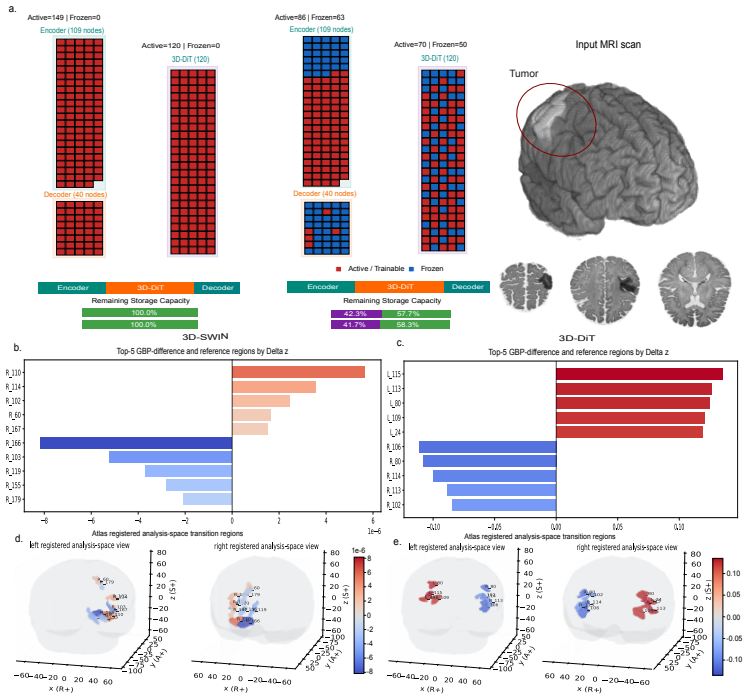
The load-bearing mechanism is Graph-Blueprint Pruning (GBP), a structural-memory operator that partitions the network into computational modules (attention, feed-forward, normalisation and adaptive-modulation components) and ranks their domain-associated contributions by an activation–gradient salience score such as $s_n(x) = \mathbb{E}_j^*\bigl|a^*_{n,j}(x)\,\partial_{a_{n,j}} L\bigr|$. Salience vectors are aggregated over probe samples, compressed by principal component analysis into a task blueprint, and an upper-quantile rule selects the salient modules among the currently trainable complement; those modules are frozen exactly by masking their optimizer updates, and the frozen sets accumulate monotonically across domains. Separate blueprint streams are maintained for the 3D-SWIN encoder–decoder and the 3D-DiT latent diffusion generator, and after four domains roughly 58% of the predefined modules in each stream remain trainable. This is what distinguishes GBP from elastic weight consolidation: instead of softly penalising parameter changes, it imposes a hard, inspectable structural constraint while keeping most of the model's capacity available for future learning.
What would settle it
Run the D1–D4 expansion again with EWC's regularisation strength swept over at least an order of magnitude, recomputing the Fisher information on each domain's training set, and compare retention on D1–D3 after D4; if a well-tuned EWC reaches the 19–26 dB retention levels that GBP reports, the claimed advantage is an artifact of the baseline's tuning.
Extended reading notes
Core claim
The paper's central claim is that structural module freezing, rather than soft parameter anchoring, is what lets a volumetric MRI model expand across clinically distinct domains with limited forgetting. GBP computes activation–gradient salience for each predefined computational module, compresses the salience vectors with principal component analysis, and freezes the high-salience modules by masking their optimizer updates, so each new domain is learned in the residual trainable subspace. After adaptation to adult brain tumours, the most disruptive domain, GBP retained 25.6, 18.5 and 19.3 dB PSNR on the three earlier domains in the single-channel setting, while EWC collapsed to 10.1, 8.3 and 13.2 dB, and GBP still reached 21.4 dB on the new tumour domain. The same ordering held in two-channel and hybrid input configurations, with GBP peak forgetting between 0.03 and 0.87 dB compared with roughly 10–12 dB for EWC, although SSIM told a different story and showed GBP paying a structural-similarity cost under two-channel learning and channel collapse. The paper also shows that no single representation level is best for every clinical objective: encoder features supported cross-modal synthesis, intermediate features supported Alzheimer's classification, combined representations supported glioma risk ranking, and GBP's clearest downstream advantage came in few-shot postoperative outcome prediction.
Load-bearing premise
The comparison assumes elastic weight consolidation was implemented and tuned fairly; the reported single-channel EWC collapse to 10.1, 8.3 and 13.2 dB PSNR on D1–D3 after D4 is atypical for reasonable EWC settings, so the headline advantage over EWC could be inflated if EWC was undertuned.
Editorial extensions
If this is right
- If GBP works as reported, brain MRI foundation models can be updated incrementally with new diseases, cohorts and protocols instead of being re-pretrained or replaced by one model per domain.
- Hard structural freezing of selected modules is a viable alternative to soft regularisation when the new domain differs strongly in pathology and anatomy, with the largest measured gap on tumour imaging.
- The cumulative blueprint gives an inspectable map of protected versus available capacity, which could support auditing and targeted release of modules in regulated clinical settings.
- Because no single representation wins every task, practical deployments should select feature depth and component per endpoint: encoder features for synthesis, intermediate features for classification, combined representations for survival ranking.
- Background-inclusive SSIM saturates and masks forgetting, so retention benchmarks should report signal-region voxel metrics alongside structural ones to avoid mistaking limited plasticity for successful retention.
Reading between the lines
- The success of GBP suggests the salience ranking itself is doing causal work; a natural control experiment the paper does not run is freezing a randomly chosen set of modules of the same size, which should forget more if the blueprint selection matters.
- Because blueprints accumulate monotonically, longer sequences than the four domains tested here will eventually exhaust trainable modules, so compressing, sharing, or safely releasing protected capacity is the next design problem rather than a proven solution.
- The strong postoperative few-shot result with microstructural maps hints that protected modules retain low-level diffusion and NODDI features; this could be tested by ablating blueprint-protected modules during postoperative inference and measuring the drop in F1.
- Domain order is likely to change the relative ranking of methods; the paper places tumour imaging last, and a milder final domain would presumably shrink GBP's advantage over sequential fine-tuning and EWC.
Signed reviews
Editorial analysis
A structured set of objections, weighed in public.
Referee Report
Summary. This paper introduces Alcmaeon, a three-dimensional brain MRI foundation model pretrained on over 425,000 volumes, and proposes Graph-Blueprint Pruning (GBP) as a continual-learning mechanism that freezes network modules selected by activation–gradient salience while leaving other modules trainable. The model is sequentially expanded across four clinical domains (healthy ageing, neurodegeneration, developmental/psychiatric imaging, and brain tumours), and the authors report that GBP exhibits less forgetting than sequential fine-tuning (SEQ) and elastic weight consolidation (EWC) on voxel-level reconstruction metrics (PSNR, MSE, RMSE, MAE), with the largest advantage after adaptation to tumour imaging. The paper also evaluates representations from the continually adapted models on cross-modal synthesis, Alzheimer's disease classification, glioma survival modelling, and postoperative outcome prediction, finding task-dependent utility rather than a single universally optimal representation. The manuscript is accompanied by extensive extended-data figures and a supplementary information document.
Significance. If the central claim is upheld, GBP would offer a practical and inspectable structural-memory mechanism for expanding large volumetric foundation models across clinical domains, which is a relevant problem for medical imaging. The work is unusually broad in scope: it combines a large-scale pretraining pipeline, a new continual-learning method, multiple input-channel configurations, a background-retained robustness check, and several clinical downstream tasks. The authors are transparent about many limitations, including the single domain order, the small postoperative cohort, and the exploratory nature of the anatomical attribution maps. However, the headline comparison against EWC currently rests on an EWC implementation whose key hyperparameters are undisclosed and whose reported behaviour is consistent with severe over-regularization, so the quantitative claim of 'less forgetting than EWC' is not yet established on the evidence presented.
major comments (3)
- [Methods: Continual-learning strategies; Results: Graph-Blueprint Pruning limits forgetting] The EWC baseline is not specified sufficiently to be considered a fair comparator. Methods states only that EWC 'used a diagonal Fisher approximation' and gives no regularization strength (lambda), Fisher sample count, or the loss used for the Fisher. In the single-channel evaluation, EWC retains only 10.1, 8.3 and 13.2 dB PSNR on D1–D3 after D4 adaptation, and in the background-inclusive evaluation its D4 learning accuracy is 19.26 dB versus 24.45 dB for SEQ and 22.75 dB for GBP (Fig. 2 and Extended Data Fig. 3). These values are consistent with a heavily over-regularized or misimplemented EWC. Because the abstract's headline claim directly contrasts GBP with EWC, a properly tuned EWC, with lambda reported and a sensitivity analysis over lambda, is required before 'less forgetting than ... EWC' can be considered established.
- [Methods: Continual-learning strategies; Results: Graph-Blueprint mapping] The GBP method depends on hyperparameters that are not reported: the upper-quantile threshold for selecting salient units, the PCA variance or number of components used to compress salience vectors, and the number of probe samples aggregated per domain. These choices control how much capacity is frozen at each stage and directly affect the forgetting–adaptation trade-off. The manuscript gives no sensitivity analysis around the quantile threshold, so it is unclear how robust the reported advantage over SEQ/EWC is to the main methodological knob. Please report these values and evaluate at least a small range of thresholds.
- [Evaluation metrics; Supplementary Information S6] The continual-learning comparisons in Fig. 2 and Extended Data Figs. 3–4 report standard deviations per cell but no multiple-seed information or statistical comparison of the forgetting differences. The central claim is comparative ('GBP showed less forgetting'), and the reader cannot tell whether the reported F, BWT, and ACC values come from a single run or from repeated runs, or whether the differences are statistically significant. Please state the number of independent runs/seeds, clarify whether the SDs are across subjects, folds, or seeds, and provide paired tests or confidence intervals for the key forgetting/backward-transfer/accuracy differences.
minor comments (6)
- [Fig. 5 and Extended Data Fig. 5 captions] 'Overal survival' should be 'Overall survival'.
- [Methods: Continual-learning strategies] The salience formula is typeset as [s_n(x) = E∗j |a∗n,j(x) ∂an,j L|]; the expectation index and the meaning of the starred quantities are unclear. Please define a_n,j and clarify the aggregation.
- [Acknowledgements] The sentence 'We acknowledge the use of the facilities of the Research Computing Services (RCS) of University of Cambridge, UK.' appears twice; delete the duplicate.
- [Throughout the manuscript] Use consistent capitalization for 'Swin'/'SWIN' (e.g., '3D-SWIN' vs '3D-Swin') and for 'single-channel' vs '1-channel' across text and figures.
- [Methods: Clinical fine-tuning] The methods for cross-modal synthesis state that competing generative models were trained with 'recommended repository settings' but do not list the actual hyperparameters for VQVAE, AEKL, MAISI, LDM, MOTFM, and Rectified Flow; specify them for reproducibility.
- [Extended Data Fig. 6 caption] The caption contains the fragment 'mEWC one-channel modelOne-channel model'; this appears to be a copy-paste artifact and should be fixed.
Circularity Check
No significant circularity: the central continual-learning claim is an empirical benchmark against external baselines, not a derivation from its own inputs.
full rationale
The paper's load-bearing claim is empirical: across sequential expansion from healthy ageing to tumour imaging, GBP showed less forgetting than SEQ and EWC on voxel-level reconstruction measures. This is a benchmark result, not a derivation, so there is no equation-level reduction of a prediction to an input. The GBP module-selection rule uses activation-gradient salience aggregated over probe samples, and the evaluation is performed on held-out validation partitions (70/30 splits), separate from the data used to select and protect modules. The headline advantage is reported on PSNR, MSE, RMSE and MAE, which are not defined in terms of GBP's protection rule; the comparison against SEQ and EWC is an external, falsifiable benchmark. The only metric-alignment issue is that SSIM is part of the reconstruction training loss and is also reported as an evaluation metric, but the paper explicitly acknowledges this ('Because SSIM directly defined the autoencoder reconstruction loss, the higher values achieved by SEQ and EWC may reflect their greater freedom to optimize this loss-aligned structural criterion, whereas blueprint protection imposed an adaptation cost on GBP') and does not base its central claim on SSIM; in fact GBP is worse on SSIM in several configurations, which indicates the evaluation is not constructed to favour the proposed method. No load-bearing self-citations appear in the paper: architectural components cite external works (SwinUNETR, DiT, EWC, winning subnetworks), and no uniqueness theorem or prior result by the same authors is invoked to force the method choice. The undertuned EWC baseline visible in the reported numbers (e.g., 10.1, 8.3 and 13.2 dB PSNR on D1-D3 after D4) is a potential correctness and fairness concern about the comparator, not circularity: it bears on whether the comparison is informative, not on whether the claimed result is equivalent to its inputs. The derivation chain is therefore self-contained, and no circular step is exhibited.
Assumptions & free parameters
free parameters (5)
- EWC regularization strength lambda =
not reported
- GBP upper-quantile selection threshold =
not reported
- Postoperative survival threshold =
10 months
- Operating spatial resolution =
64^3
- Global batch size =
512
assumptions (5)
- domain assumption Activation-gradient products measure module importance for previous domains.
- domain assumption Freezing high-salience modules preserves old capabilities without preventing new learning.
- domain assumption Voxel-level reconstruction fidelity reflects retained clinical knowledge.
- domain assumption SSIM in the training loss can be used as an independent evaluation metric.
- domain assumption Downstream test participants are independent of pretraining data.
Cite this review
Pith. "Pith review of A continually expandable foundation model for brain MRI." pith.science (2026). https://pith.science/paper/WEAZZXZJ
@misc{pith2026260808319,
  author       = {Pith},
  title        = {Pith review of: A continually expandable foundation model for brain MRI},
  year         = {2026},
  howpublished = {\url{https://pith.science/paper/WEAZZXZJ}},
  note         = {Machine review of arXiv:2608.08319}
}
read the original abstract
Brain magnetic resonance imaging (MRI) is central to neuroscience and clinical assessment, but models are commonly developed for individual diseases, populations or imaging protocols. Foundation models promise more general representations, yet they are usually pretrained once and can lose earlier capabilities when updated with new data. Here we show that Alcmaeon, a three-dimensional brain MRI foundation model pretrained without manual labels on more than 425,000 volumes and derived imaging maps, can be expanded sequentially across clinical domains. Alcmaeon combines volumetric encoding and latent diffusion generation with Graph-Blueprint Pruning (GBP), which protects network modules important to earlier domains while leaving the remaining capacity trainable. Across expansion from healthy ageing and neurodegeneration to developmental, psychiatric and tumour imaging, GBP showed less forgetting than sequential adaptation and elastic weight consolidation across voxel-level reconstruction measures, with its largest advantage after adaptation to tumour imaging. The blueprints provided an inspectable record of how model capacity was protected and reused. Representations from different model levels supported image synthesis, disease classification, survival modelling and postoperative prediction, although no single representation was optimal for every task. These findings provide a route towards brain MRI foundation models that can grow with emerging data while retaining earlier capabilities.
Figures


Figures from the paper (2 more)

Reference graph
Works this paper leans on
-
[1]
An openmind for 3d medical vision self-supervised learning, 23839– 23879 (2025)
Wald, T.et al. An openmind for 3d medical vision self-supervised learning, 23839– 23879 (2025)
work page 2025
-
[2]
Kaczmarek, E., Szeto, J., Nichyporuk, B. & Arbel, T. Building a general simclr self-supervised foundation model across neurological diseases to advance 3d brain mri diagnoses (2025). URL https://arxiv.org/abs/2509.10620. 2509.10620
work page Pith review arXiv 2025
-
[3]
URL https://doi.org/10.1093/gigascience/giaf116
Barba, T.et al.DUNE: a versatile neuroimaging encoder captures brain complex- ity across 3 major diseases: cancer, dementia, and schizophrenia.GigaScience14, giaf116 (2025). URL https://doi.org/10.1093/gigascience/giaf116
-
[4]
Nature Neuroscience29, 945–956 (2026)
Tak, D.et al.A generalizable foundation model for analysis of human brain MRI. Nature Neuroscience29, 945–956 (2026)
work page 2026
-
[5]
URL https://arxiv.org/abs/2604.27277
Wu, Y.et al.Braindino: A brain mri foundation model for generalizable clinical representation learning (2026). URL https://arxiv.org/abs/2604.27277. 2604. 27277
arXiv 2026
-
[6]
van de Ven, G. M., Soures, N. & Kudithipudi, D. in1.09 - continual learn- ing and catastrophic forgettingThird edition edn, (ed.Wixted, J.)Learning and Memory: A Comprehensive Reference (Third Edition)153–168 (Academic Press, Oxford, 2025). URL https://www.sciencedirect.com/science/article/pii/ B9780443157547000730
work page 2025
-
[7]
Mirzadeh, S., Farajtabar, M., G¨ or¨ ur, D., Pascanu, R. & Ghasemzadeh, H. Linear mode connectivity in multitask and continual learning.CoRRabs/2010.04495 (2020). URL https://arxiv.org/abs/2010.04495
arXiv 2020
-
[8]
Kirkpatrick, J.et al.Overcoming catastrophic forgetting in neural networks. Proceedings of the National Academy of Sciences of the United States of America 114, 3521–3526 (2017)
work page 2017
Show all 57 references
-
[9]
Forget-free continual learning with winning subnetworks, Vol
Kang, H.et al. Forget-free continual learning with winning subnetworks, Vol. 162 ofProceedings of Machine Learning Research, 10734–10750 (PMLR, 2022). URL https://proceedings.mlr.press/v162/kang22b.html
2022
-
[10]
& Karatzoglou, A.Overcoming catastrophic forget- ting with hard attention to the task, Vol
Serr` a, J., Sur ´ ıs, D., Miron, M. & Karatzoglou, A.Overcoming catastrophic forget- ting with hard attention to the task, Vol. 80 ofProceedings of Machine Learning Research, 4548–4557 (PMLR, 2018). URL https://proceedings.mlr.press/v80/ serra18a.html
2018
-
[11]
Learning without isolation: Pathway protection for continual learn- ing, Vol
Chen, Z.et al. Learning without isolation: Pathway protection for continual learn- ing, Vol. 267 ofProceedings of Machine Learning Research, 9377–9399 (PMLR, 2025). 40
2025
-
[12]
URL https://arxiv.org/abs/2103.14030
Liu, Z.et al.Swin transformer: Hierarchical vision transformer using shifted windows.Proceedings of the IEEE/CVF International Conference on Computer Vision (ICCV)(2021). URL https://arxiv.org/abs/2103.14030
2021 arXiv
-
[13]
Tang, Y.et al.Self-supervised pretraining of swin transformers for 3d medical image analysis.Proceedings of the IEEE/CVF Conference on Computer Vision and Pattern Recognition20730–20740 (2022)
2022
-
[14]
S., Brox, T
C ¸ i¸ cek,¨O., Abdulkadir, A., Lienkamp, S. S., Brox, T. & Ronneberger, O.3d u- net: Learning dense volumetric segmentation from sparse annotation, Vol. 9901 ofLecture Notes in Computer Science, 424–432 (Springer, 2016)
2016
-
[15]
& Xie, S.Scalable diffusion models with transformers, 4195–4205 (2023)
Peebles, W. & Xie, S.Scalable diffusion models with transformers, 4195–4205 (2023)
2023
-
[16]
An image is worth 16x16 words: Transformers for image recognition at scale(2021)
Dosovitskiy, A.et al. An image is worth 16x16 words: Transformers for image recognition at scale(2021). URL https://openreview.net/forum?id= YicbFdNTTy
2021
-
[17]
& Abbeel, P.Denoising diffusion probabilistic models, Vol
Ho, J., Jain, A. & Abbeel, P.Denoising diffusion probabilistic models, Vol. 33, 6840–6851 (2020). URL https://proceedings.neurips.cc/paper/2020/ hash/4c5bcfec8584af0d967f1ab10179ca4b-Abstract.html
2020
-
[18]
& Brox, T.U-net: Convolutional networks for biomedical image segmentation, Vol
Ronneberger, O., Fischer, P. & Brox, T.U-net: Convolutional networks for biomedical image segmentation, Vol. 9351 ofLecture Notes in Computer Science, 234–241 (Springer, 2015)
2015
-
[19]
Kingma, D. P. & Welling, M.Auto-encoding variational bayes(2014). 1312.6114
2014 arXiv
-
[20]
Neural discrete representation learning, Vol
Van Den Oord, A., Vinyals, O.et al. Neural discrete representation learning, Vol. 30 (2017)
2017
-
[21]
& Ommer, B.High-resolution image synthesis with latent diffusion models, 10684–10695 (2022)
Rombach, R., Blattmann, A., Lorenz, D., Esser, P. & Ommer, B.High-resolution image synthesis with latent diffusion models, 10684–10695 (2022)
2022
-
[22]
Maisi: Medical ai for synthetic imaging, 4430–4441 (2025)
Guo, P.et al. Maisi: Medical ai for synthetic imaging, 4430–4441 (2025)
2025
-
[23]
& Shahriari, D
Yazdani, M., Medghalchi, Y., Ashrafian, P., Hacihaliloglu, I. & Shahriari, D. Flow Matching for Medical Image Synthesis: Bridging the Gap Between Speed and Quality, Vol. LNCS 15975 (Springer Nature Switzerland, 2025)
2025
-
[24]
& Liu, Q
Liu, X., Gong, C. & Liu, Q. Flow straight and fast: Learning to generate and transfer data with rectified flow.arXiv preprint arXiv:2209.03003(2022)
2022 arXiv
-
[25]
& Zheng, Y
Chen, S., Ma, K. & Zheng, Y. Med3d: Transfer learning for 3d medical image analysis.arXiv preprint arXiv:1904.00625(2019). URL https://arxiv.org/abs/ 1904.00625. 41
2019 arXiv
-
[26]
URL https://arxiv.org/abs/ 2505.21862
Zhao, C.et al.Towards scalable language-image pre-training for 3d medical imaging.arXiv preprint arXiv:2505.21862(2025). URL https://arxiv.org/abs/ 2505.21862
2025
-
[27]
Sanchez, P., Kascenas, A., Liu, X., O’Neil, A. Q. & Tsaftaris, S. A.What is healthy? generative counterfactual diffusion for lesion localization, Vol. 13609 of Lecture Notes in Computer Science, 34–44 (Springer, 2022)
2022
-
[28]
Counterfactual image synthesis for discovery of personalized predictive image markers, Vol
Kumar, A.et al. Counterfactual image synthesis for discovery of personalized predictive image markers, Vol. 13602 ofLecture Notes in Computer Science, 113– 124 (Springer, 2022)
2022
-
[29]
P´ alsson, S.et al.Predicting survival of glioblastoma from automatic whole-brain and tumor segmentation of MR images.Scientific Reports12, 19744 (2022)
2022
-
[30]
G.et al.Multi-parametric deep learning model for prediction of over- all survival after postoperative concurrent chemoradiotherapy in glioblastoma patients.Cancers12, 2284 (2020)
Yoon, H. G.et al.Multi-parametric deep learning model for prediction of over- all survival after postoperative concurrent chemoradiotherapy in glioblastoma patients.Cancers12, 2284 (2020)
2020
-
[31]
Rutherford, S.et al.The normative modeling framework for computational psychiatry.Nature Protocols17, 1711–1734 (2022)
2022
-
[32]
L., Marinescu, R
Young, A. L., Marinescu, R. V., Oxtoby, N. P.et al.Uncovering the heterogeneity and temporal complexity of neurodegenerative diseases with subtype and stage inference.Nature Communications9, 4273 (2018)
2018
-
[33]
https://www.ukbiobank.ac.uk/
Uk biobank. https://www.ukbiobank.ac.uk/
-
[34]
Sudlow, C., Gallacher, J., Allen, N.et al.Uk biobank: an open access resource for identifying the causes of a wide range of complex diseases of middle and old age.PLoS Medicine12, e1001779 (2015)
2015
-
[35]
URL https://onlinelibrary.wiley.com/doi/abs/10.1002/acn3
Marek, K.et al.The parkinson’s progression markers initiative (ppmi) – estab- lishing a pd biomarker cohort.Annals of Clinical and Translational Neurology 5, 1460–1477 (2018). URL https://onlinelibrary.wiley.com/doi/abs/10.1002/acn3. 644
2018 doi
-
[36]
W.et al.The alzheimer’s disease neuroimaging initiative 3: Continued innovation for clinical trial improvement.Alzheimer’s & Dementia13, 561–571 (2017)
Weiner, M. W.et al.The alzheimer’s disease neuroimaging initiative 3: Continued innovation for clinical trial improvement.Alzheimer’s & Dementia13, 561–571 (2017). URL https://alz-journals.onlinelibrary.wiley.com/doi/abs/10.1016/j.jalz. 2016.10.006
2017 doi
-
[37]
URL https://alz-journals.onlinelibrary.wiley.com/doi/abs/10
Villeneuve, S.et al.The prevent-ad cohort: Accelerating alzheimer’s dis- ease research and treatment in canada and beyond.Alzheimer’s & Dementia 21, e70653 (2025). URL https://alz-journals.onlinelibrary.wiley.com/doi/abs/10. 1002/alz.70653. 42
2025
-
[38]
URL https://www.sciencedirect.com/science/article/pii/ S1878929317301214
Casey, B.et al.The adolescent brain cognitive development (abcd) study: Imaging acquisition across 21 sites.Developmental Cognitive Neuroscience 32, 43–54 (2018). URL https://www.sciencedirect.com/science/article/pii/ S1878929317301214
2018
-
[39]
Shafiei, G.et al.Reproducible brain charts: An open data resource for mapping brain development and its associations with mental health.Neuron113, 3758– 3779.e6 (2025)
2025
-
[40]
Petersen, M. E.et al.Health and aging brain study–health disparities (habs- hd) methods and partner characteristics.Alzheimer’s & Dementia: Translational Research & Clinical Interventions11, e70140 (2025). URL https://alz-journals. onlinelibrary.wiley.com/doi/abs/10.1002/trc2.70140
2025 doi
-
[41]
The university of pennsylvania glioblastoma cohort (upenn-gbm) (2021)
The Cancer Imaging Archive. The university of pennsylvania glioblastoma cohort (upenn-gbm) (2021). URL https://doi.org/10.7937/TCIA.709X-DN49. Data set
2021 doi
-
[42]
The university of california san francisco preop- erative diffuse glioma mri dataset (ucsf-pdgm) (2022)
The Cancer Imaging Archive. The university of california san francisco preop- erative diffuse glioma mri dataset (ucsf-pdgm) (2022). URL https://doi.org/10. 7937/TCIA.BDGF-8V37. Data set
2022
-
[43]
The erasmus glioma database (egd) (2021)
Erasmus MC & Health-RI. The erasmus glioma database (egd) (2021). URL https://xnat.bmia.nl/data/archive/projects/egd. Controlled-access data set
2021
-
[44]
Isensee, F.et al.Automated brain extraction of multisequence mri using artificial neural networks.Human brain mapping40, 4952–4964 (2019)
2019
-
[45]
URL https://doi.org/10.1038/ s41597-023-02806-8
Prado, P., Medel, V., Gonzalez-Gomez, R.et al.The brainlat project, a multimodal neuroimaging dataset of neurodegeneration from underrepresented backgrounds.Scientific Data10, 889 (2023). URL https://doi.org/10.1038/ s41597-023-02806-8
2023
-
[46]
Adewole, M.et al.The brain tumor segmentation (brats) challenge 2023: Glioma segmentation in sub-saharan africa patient population (brats-africa).arXiv preprint arXiv:2305.19369(2023)
2023 arXiv
-
[47]
W.et al.The brain tumor segmentation-metastases (brats-mets) challenge 2023: Brain metastasis segmentation on pre-treatment mri.arXiv preprint arXiv:2306.00838(2023)
Moawad, A. W.et al.The brain tumor segmentation-metastases (brats-mets) challenge 2023: Brain metastasis segmentation on pre-treatment mri.arXiv preprint arXiv:2306.00838(2023)
2023 arXiv
-
[48]
F.et al.The brain tumor segmentation (brats) challenge 2023: Focus on pediatrics (cbtn-connect-dipgr-asnr-miccai brats-peds).arXiv preprint arXiv:2305.17033(2023)
Kazerooni, A. F.et al.The brain tumor segmentation (brats) challenge 2023: Focus on pediatrics (cbtn-connect-dipgr-asnr-miccai brats-peds).arXiv preprint arXiv:2305.17033(2023)
2023 arXiv
-
[49]
URL https://doi.org/10.7937/K9/TCIA.2016.L4LTD3TK
Pedano, N.et al.The cancer genome atlas low grade glioma collection (tcga-lgg) (2016). URL https://doi.org/10.7937/K9/TCIA.2016.L4LTD3TK. Data set. 43
2016 doi
-
[50]
Ixi dataset: Infor- mation extraction from images (2002)
Biomedical Image Analysis Group, Imperial College London. Ixi dataset: Infor- mation extraction from images (2002). URL https://brain-development.org/ ixi-dataset/. EPSRC GR/S21533/02
2002
-
[51]
URL https://doi.org/10.7937/4545-c905
Cepeda, S.et al.The r ´ ıo hortega university hospital glioblastoma dataset: A comprehensive collection of preoperative, early postoperative and recurrence mri scans (rhuh-gbm) (2023). URL https://doi.org/10.7937/4545-c905. Data set
2023 doi
-
[52]
The cancer genome atlas glioblastoma multi- forme collection (tcga-gbm) (2016)
The Cancer Imaging Archive. The cancer genome atlas glioblastoma multi- forme collection (tcga-gbm) (2016). URL https://doi.org/10.7937/K9/TCIA. 2016.RNYFUYE9. Data set
2016 doi
-
[53]
URL https://doi.org/10.6084/m9.figshare.c.5904905.v1
Suter, Y.et al.The lumiere dataset: Longitudinal glioblastoma mri with expert rano evaluation (2022). URL https://doi.org/10.6084/m9.figshare.c.5904905.v1. Data set
2022 doi
-
[54]
E., Jain, R., Mikkelsen, T
Scarpace, L., Flanders, A. E., Jain, R., Mikkelsen, T. & Andrews, D. W. Data from REMBRANDT (2019). URL https://doi.org/10.7937/K9/TCIA.2015. 588OZUZB. Data set
2019 doi
-
[55]
Ivy glioblastoma atlas project collection (ivygap- gbm) (2016)
The Cancer Imaging Archive. Ivy glioblastoma atlas project collection (ivygap- gbm) (2016). URL https://doi.org/10.7937/K9/TCIA.2016.XL W AN6NL. Data set
2016 doi
-
[56]
The clinical proteomic tumor analysis consortium glioblastoma multiforme collection (cptac-gbm) (2018)
National Cancer Institute Clinical Proteomic Tumor Analysis Consortium. The clinical proteomic tumor analysis consortium glioblastoma multiforme collection (cptac-gbm) (2018). URL https://doi.org/10.7937/K9/TCIA.2018.3RJE41Q1. Data set
2018 doi
-
[57]
URL https://transformer-circuits.pub/2025/attribution-graphs/ biology.html
Lindsey, J.et al.On the biology of a large language model.Transformer Circuits Thread(2025). URL https://transformer-circuits.pub/2025/attribution-graphs/ biology.html. 44
2025
Reviewed August 12, 2026 · model on record in the stance chip above.
Discussion (0). Continue with ORCID to comment.