REVIEW 3 major objections 4 minor 70 references
ERF-GS: Reconstructing Fast Motion from Disjoint Event-RGB Viewpoints
T0 review · 3 major / 4 minor · reviewed 2026-08-14 · deepseek-v4-flash
Pith's one-line read Fusing event-camera data into Gaussian splatting lifts dynamic view synthesis by about 1 dB on moving pixels.
desk verdict Solid incremental work on event-RGB dynamic Gaussian splatting with a useful new benchmark protocol, but the headline gain rests on simulated events derived from the same RGB supervision. read the letter →
The pith
A machine-rendered reading of the paper's core claim, the machinery that carries it, and where it could break.
The reading
What carries the argument
The load-bearing machinery is two attached components rather than a new representation. EARL (event-assisted regularized loss) treats an event frame as the difference in log-luma between two rendered images, weights each pixel by the inverse of its event count so that noisy spikes are downweighted, and adds linear-trajectory and color-stability regularizers to stop Gaussians from zigzagging or shifting hue while fitting sparse events. EDS (event-guided densification) unprojects nonzero event pixels into depth-sampled 3D candidates, re-projects them into several other event viewpoints for cross-validation, and filters the survivors by depth uniqueness, spatial coherence with existing Gaussians, and deformation consistency before adding them. Together these components give the Gaussian cloud the high-temporal-resolution motion evidence that RGB-only training lacks.
What would settle it
Run the same Neu3D- and Nvidia-style scenes with physical event cameras in a disjoint-view capture rig; if the dynamic-PSNR gain over the RGB-only baseline drops to within noise, or color-shift artifacts grow as they do on simulated reflective and dark regions, the central transfer claim fails.
Extended reading notes
Core claim
ERF-GS establishes that event information can be injected into both optimization and densification of a dynamic 3D Gaussian representation without requiring ground-truth RGB frames, color-channel alignment, or shared viewpoints between event and RGB cameras. Using the v2e simulator to turn natural multiview videos into event streams, then degrading RGB by temporal subsampling and motion blur and holding out event-only viewpoints, the method reports that the 4DGS backbone gains 0.91 dB in dynamic PSNR on Neu3D-dv and 1.44 dB on Nvidia-dv, with average PSNR gains of 0.17 dB and 0.57 dB. The central discovery is that sparse monochrome events, interpreted as relative log-intensity changes between two rendered predictions, can both supervise Gaussian motion and guide where new Gaussians are placed, recovering fast-moving content that blurred RGB frames alone do not resolve.
Load-bearing premise
The load-bearing premise is that event streams synthesized by the v2e simulator from RGB video are a faithful stand-in for real event-camera recordings, so the measured gains would transfer to actual hardware.
Editorial extensions
If this is right
- If the result holds, an existing dynamic Gaussian splatting method can be upgraded with event fusion without redesigning its Gaussian representation or deformation network.
- The method removes the usual requirement that event and RGB cameras share a viewpoint, so a capture rig can combine a sparse RGB camera set with event-only cameras at different positions.
- The reported improvements concentrate on moving pixels, rising by 0.91–1.44 dB in dynamic PSNR while overall PSNR rises by 0.17–0.57 dB, indicating the event stream's value is specific to fast scene dynamics.
- Training-set metrics at RGB-supervised timesteps also improve slightly, implying the event-driven losses regularize the representation even where ordinary RGB supervision exists.
Reading between the lines
- A natural next experiment is to run the same pipeline on real event streams from a multiview rig; if the 1 dB margin persists, the simulation-to-real gap the paper acknowledges would be largely bridged.
- The robustness of EDS to the number of disjoint event viewpoints, tested with two to four, suggests a practical capture design with only two or three event cameras supplementing a larger RGB rig.
- The failure cases around reflective surfaces and dark regions indicate that future event-assisted methods will need to distinguish motion-triggered events from lighting- and specularity-triggered events before deployment in uncontrolled scenes.
- A testable extension would combine EARL and EDS with simultaneous camera-pose optimization for moving event cameras, since the paper's static-camera assumption is an acknowledged simplification.
Editorial analysis
A structured set of objections, weighed in public.
Referee Report
Summary. The paper proposes ERF-GS, a dynamic 3D Gaussian splatting framework that fuses event streams into both the optimization and densification stages of a 4DGS backbone. The two proposed components are EARL, an event-assisted regularized loss that supervises rendered images against simulated event frames from possibly disjoint viewpoints, and EDS, an event-guided densification strategy that lifts event pixels to 3D candidates and cross-validates them across views. Experiments are conducted on temporally subsampled and motion-blurred variants of the Neu3D and Nvidia datasets, with v2e-generated events, and the paper reports average DPSNR improvements of 0.91 dB over 4DGS on Neu3D-dv and 1.44 dB on Nvidia-dv, plus a comparison with the E-D3DGS baseline. The paper also releases code and processed datasets.
Significance. If the reported gains transfer to real event-camera captures, the paper would be a useful contribution to event-assisted dynamic scene reconstruction: it addresses realistic constraints such as disjoint event-RGB viewpoints, does not require ground-truth RGB at intermediate times, and is designed as a plug-in for existing dynamic Gaussian splatting methods. The ablations in Table 5 support the usefulness of both EARL and EDS, and the release of code and processed datasets is a concrete strength. However, the significance is conditional on external validity: every experiment uses simulated events generated from the same RGB videos that supply both training supervision and evaluation ground truth, and the paper itself concedes the simulated-to-real domain gap. The central claim of a >0.9 dB improvement is therefore not yet validated for real hardware, which is the main risk in assessing this work.
major comments (3)
- [Sec. 4.1, Sec. 5.3, Eq. (6)] The evaluation's only event modality is v2e events generated from the same high-frame-rate RGB videos that define the evaluation ground truth and the blurred training inputs. An event frame is essentially a log-intensity difference between original frames, so at intermediate timesteps it encodes exactly the motion that subsampled RGB hides. Because EARL in Eq. (6) and EDS in Sec. 3.3 are optimized against these same-data-derived events, the reported 0.91 dB and 1.44 dB DPSNR gains are internally consistent but do not establish that the method improves reconstruction from real event sensors. The paper's own statement in Sec. 5.3 that 'the domain gap between simulated and real-captured events is unavoidable' makes this a load-bearing validity gap, not a cosmetic caveat. The authors should either validate on real multiview event-RGB data or provide a simulation protocol in which events are not derived from the exact frames used for supervision and evaluation.
- [Sec. 4.5, Table 8] The comparison with E-D3DGS is not on equal footing. The paper states that E-D3DGS had to be run with 2x2 downsampled inputs 'essentially reducing the reconstruction difficulty,' while ERF-GS runs at full resolution. The 10.30 dB DPSNR gap on Neu3D-dv (16.35 vs. 26.65) could be largely attributable to resolution rather than method quality. Please retrain E-D3DGS at full resolution under comparable memory settings, or clearly label it as a lower-resolution baseline and do not use the margin to support the claim of superiority.
- [Sec. 4.1, Tables 2 and 3] The headline average improvements are not supported by error bars or multiple runs. Per-scene results include meaningful regressions, for example 'cut roasted beef' drops from 27.17 to 26.09 DPSNR in Table 1 and 'Dynamicface' is worse in all metrics in Table 2, while 'Balloon2' is excluded post hoc in Sec. 4.1. Since the central claim is an average gain of more than 0.9 dB, the authors should report standard deviations over several seeds, state the per-scene success rate, and either include Balloon2 or justify its exclusion with a pre-specified criterion rather than a post hoc observation of poor quality.
minor comments (4)
- [Sec. 3.2.1] The section title says 'confidence-weighed event loss' but 'weighed' should be 'weighted'.
- [Abstract and Sec. 3.2] The abstract's phrase 'event-based learning detached from RGB inputs' is overstated: Eq. (5) still uses rendered RGB-to-luma images, and Eqs. (7) and (8) anchor intermediate states to RGB-supervised Gaussian positions and colors. Suggest rewording to 'detached from ground-truth RGB frames at intermediate timesteps.'
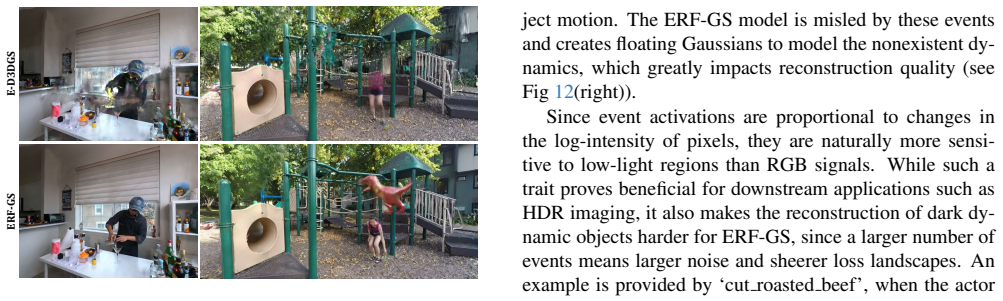
- [Fig. 9 and Fig. 12] The event-frame visualizations are small and hard to read; please annotate the timestamps, viewpoints, and failure regions explicitly so the qualitative claims can be verified.
- [Sec. 4.3, Table 3] The '-mb' variants are created by averaging each subsampled frame with its two original neighbors, and the paper itself notes this can leak information from adjacent frames; this makes the -mb results difficult to interpret as a test of robustness to genuine motion blur.
Circularity Check
No circular derivation: ERF-GS's reported gains are empirical comparisons against an external baseline, with event losses forming an additional constraint rather than a renamed fit.
full rationale
The paper's central claim is an empirical improvement over the external 4DGS baseline on Neu3D and Nvidia variants, and the reported DPSNR/PSNR numbers are produced by training and evaluating both methods under the same protocol. No fitted parameter is relabeled as a prediction: the method adds event-based losses (EARL) and event-guided densification (EDS) on top of an unmodified 4DGS backbone, and the ablation study independently attributes gains to each component. Equation (6), the confidence-weighted event loss, supervises the log-luma difference between two rendered images against a v2e-simulated event frame; this is not identical to the RGB photometric loss seen by the baseline, because the baseline only observes subsampled and motion-blurred RGB frames while the event data encodes temporal differences at intermediate timesteps. The event signal is therefore an additional source of information, even though it is ultimately derived from the same original RGB videos. The use of v2e-simulated events rather than real sensor data is a real limitation on external validity, and the paper explicitly concedes that 'the domain gap between simulated and real-captured events is unavoidable'; however, this is a benchmark-fidelity and generalization concern, not a circularity in the sense of a derivation reducing to its own inputs. The claimed improvements are not forced by construction: the model must still reconstruct full appearance, color, and geometry, and the event data alone does not determine the rendered RGB frames. Self-citations to the authors' prior work appear only in peripheral contexts such as related work and a remark about reflective surfaces, and they are not load-bearing. The derivation chain is therefore self-contained as an empirical study, and no circular step can be exhibited from the paper's equations or experimental protocol.
Assumptions & free parameters
free parameters (6)
- Event loss weight =
0.1
- Trajectory regularization weight lambda_p =
0.01
- Color regularization weight lambda_c =
0.01
- Contrast threshold c and variance sigma_c =
not reported
- EDS hyperparameters M, epsilon, kappa, N =
100, 10, 3, 500
- Temporal subsampling factor f =
16 for Neu3D; 4, 6, or 8 per Nvidia scene
assumptions (4)
- domain assumption v2e event simulation from RGB video is a realistic proxy for real event sensor outputs.
- domain assumption Static camera poses throughout each scene, so event activations correspond to object motion.
- domain assumption SAM 2-generated dynamic masks correctly identify moving pixels for DPSNR evaluation.
- domain assumption A relatively large number of static cameras (more than 10) is available.
Cite this review
Pith. "Pith review of ERF-GS: Reconstructing Fast Motion from Disjoint Event-RGB Viewpoints." pith.science (2026). https://pith.science/paper/UOCDJZCV
@misc{pith2026260808531,
  author       = {Pith},
  title        = {Pith review of: ERF-GS: Reconstructing Fast Motion from Disjoint Event-RGB Viewpoints},
  year         = {2026},
  howpublished = {\url{https://pith.science/paper/UOCDJZCV}},
  note         = {Machine review of arXiv:2608.08531}
}
read the original abstract
Deep learning-driven representations such as neural radiance fields (NeRFs) and 3D Gaussian splatting (3DGS) have revolutionized the field of dynamic 3D scene reconstruction with improved visual precision and scalability. However, the reconstruction of fast-moving objects remains a challenge; existing methods based on conventional frame-based videos often struggle in scenarios such as sports events and animal videography. We propose an event-RGB fusion Gaussian splatting (ERF-GS) framework that integrates event information into both optimization and densification stages of the Gaussian splatting pipeline, taking advantage of novel event sensors with high frame-rate. Unlike many other event-assisted scene reconstruction methods, ERF-GS was developed using realistic simulation settings and realizes event-based learning detached from RGB inputs. This design enables its application beyond straightforward synthetic data into the realm of natural video with complex layout, low frame rates and severe motion blur. Our experiments show that ERF-GS outperforms both the 4DGS baseline and the concurrent E-D3DGS on different variants of the Neu3D and Nvidia datasets which include blurry RGB frames and disjoint RGB-event viewpoints. Our code is available at https://github.com/andrewbxy/ERF-GS.
Figures


Figures from the paper (9 more)



Reference graph
Works this paper leans on
-
[1]
Ev-segnet: Semantic segmentation for event-based cameras
Inigo Alonso and Ana C Murillo. Ev-segnet: Semantic segmentation for event-based cameras. InProceedings of the IEEE/CVF Conference on Computer Vision and Pattern Recognition Workshops, pages 0–0, 2019
work page 2019
-
[2]
Anastasios N Angelopoulos, Julien NP Martel, Amit P Kohli, J ¨org Conradt, and Gordon Wetzstein. Event-based near-eye gaze tracking beyond 10,000 hz.IEEE Transactions on Visualization and Computer Graphics, 27(5):2577–2586, 2021
work page 2021
-
[3]
Deepdeform: Learning non-rigid rgb-d reconstruction with semi-supervised data
Aljaz Bozic, Michael Zollhofer, Christian Theobalt, and Matthias Nießner. Deepdeform: Learning non-rigid rgb-d reconstruction with semi-supervised data. InProceedings of the IEEE/CVF Conference on Computer Vision and Pattern Recognition, pages 7002–7012, 2020
work page 2020
-
[4]
Hexplane: A fast representa- tion for dynamic scenes
Ang Cao and Justin Johnson. Hexplane: A fast representa- tion for dynamic scenes. InProceedings of the IEEE/CVF Conference on Computer Vision and Pattern Recognition, pages 130–141, 2023
2023
-
[5]
E2GS: Event enhanced gaussian splatting
Hiroyuki Deguchi, Mana Masuda, Takuya Nakabayashi, and Hideo Saito. E2GS: Event enhanced gaussian splatting. In IEEE International Conference on Image Processing (ICIP), pages 1676–1682, 2024
work page 2024
-
[6]
Activity-driven, event-based vision sensors
Tobi Delbr ¨uck, Bernabe Linares-Barranco, Eugenio Culur- ciello, and Christoph Posch. Activity-driven, event-based vision sensors. InProceedings of IEEE international sym- posium on circuits and systems, pages 2426–2429, 2010
work page 2010
-
[7]
A voxel graph cnn for object classification with event cameras
Yongjian Deng, Hao Chen, Hai Liu, and Youfu Li. A voxel graph cnn for object classification with event cameras. In Proceedings of the IEEE/CVF Conference on Computer Vi- sion and Pattern Recognition, pages 1172–1181, 2022
work page 2022
-
[8]
Neural radiance flow for 4d view 15 synthesis and video processing
Yilun Du, Yinan Zhang, Hong-Xing Yu, Joshua B Tenen- baum, and Jiajun Wu. Neural radiance flow for 4d view 15 synthesis and video processing. InIEEE/CVF International Conference on Computer Vision (ICCV), pages 14304– 14314, 2021
work page 2021
Show all 70 references
-
[9]
Eventaid: Bench- marking event-aided image/video enhancement algorithms with real-captured hybrid dataset.IEEE Transactions on Pat- tern Analysis and Machine Intelligence, 2025
Peiqi Duan, Boyu Li, Yixin Yang, Hanyue Lou, Minggui Teng, Xinyu Zhou, Yi Ma, and Boxin Shi. Eventaid: Bench- marking event-aided image/video enhancement algorithms with real-captured hybrid dataset.IEEE Transactions on Pat- tern Analysis and Machine Intelligence, 2025
2025
-
[10]
Hypere2vid: Improving event-based video reconstruction via hypernetworks.IEEE Transactions on Im- age Processing, 2024
Burak Ercan, Onur Eker, Canberk Saglam, Aykut Erdem, and Erkut Erdem. Hypere2vid: Improving event-based video reconstruction via hypernetworks.IEEE Transactions on Im- age Processing, 2024
2024
-
[11]
Event-based vision: A survey.IEEE transactions on pattern analysis and machine intelligence, 44(1):154–180, 2020
Guillermo Gallego, Tobi Delbr ¨uck, Garrick Orchard, Chiara Bartolozzi, Brian Taba, Andrea Censi, Stefan Leutenegger, Andrew J Davison, J ¨org Conradt, Kostas Daniilidis, et al. Event-based vision: A survey.IEEE transactions on pattern analysis and machine intelligence, 44(1):...
2020
-
[12]
Dynamic view synthesis from dynamic monocular video
Chen Gao, Ayush Saraf, Johannes Kopf, and Jia-Bin Huang. Dynamic view synthesis from dynamic monocular video. In Proceedings of the IEEE/CVF International Conference on Computer Vision, pages 5712–5721, 2021
2021
-
[13]
Gaussianflow: Splatting gaussian dynamics for 4d content creation.arXiv preprint arXiv:2403.12365, 2024
Quankai Gao, Qiangeng Xu, Zhe Cao, Ben Mildenhall, Wen- chao Ma, Le Chen, Danhang Tang, and Ulrich Neumann. Gaussianflow: Splatting gaussian dynamics for 4d content creation.arXiv preprint arXiv:2403.12365, 2024
2024 arXiv
-
[14]
Recurrent vision transformers for object detection with event cameras
Mathias Gehrig and Davide Scaramuzza. Recurrent vision transformers for object detection with event cameras. InPro- ceedings of the IEEE/CVF conference on computer vision and pattern recognition, pages 13884–13893, 2023
2023
-
[15]
E-raft: Dense optical flow from event cam- eras
Mathias Gehrig, Mario Millh ¨ausler, Daniel Gehrig, and Da- vide Scaramuzza. E-raft: Dense optical flow from event cam- eras. InIEEE International Conference on 3D Vision (3DV), pages 197–206, 2021
2021
-
[16]
Event-3dgs: Event-based 3d reconstruction using 3d gaus- sian splatting.Advances in Neural Information Processing Systems, 37, 2024
Haiqian Han, Jianing Li, Henglu Wei, and Xiangyang Ji. Event-3dgs: Event-based 3d reconstruction using 3d gaus- sian splatting.Advances in Neural Information Processing Systems, 37, 2024
2024
-
[17]
A causal convolutional neural network for multi-subject mo- tion modeling and generation.Computational Visual Media, 10(1):45–59, 2024
Shuaiying Hou, Congyi Wang, Wenlin Zhuang, Yu Chen, Yangang Wang, Hujun Bao, Jinxiang Chai, and Weiwei Xu. A causal convolutional neural network for multi-subject mo- tion modeling and generation.Computational Visual Media, 10(1):45–59, 2024
2024
-
[18]
v2e: From video frames to realistic dvs events
Yuhuang Hu, Shih-Chii Liu, and Tobi Delbruck. v2e: From video frames to realistic dvs events. InProceedings of the IEEE/CVF conference on computer vision and pattern recognition, pages 1312–1321, 2021
2021
-
[19]
Ev3DGS: Event enhanced 3D gaussian splatting from blurry images
Junwu Huang, Zhexiong Wan, Zhicheng Lu, Juanjuan Zhu, Mingyi He, and Yuchao Dai. Ev3DGS: Event enhanced 3D gaussian splatting from blurry images. InIEEE Asia Pacific Signal and Information Processing Association Annual Sum- mit and Conference (APSIPA ASC), pages 1–6, 2024
2024
-
[20]
Sc-gs: Sparse-controlled gaussian splatting for editable dynamic scenes
Yi-Hua Huang, Yang-Tian Sun, Ziyi Yang, Xiaoyang Lyu, Yan-Pei Cao, and Xiaojuan Qi. Sc-gs: Sparse-controlled gaussian splatting for editable dynamic scenes. InProceed- ings of the IEEE/CVF Conference on Computer Vision and Pattern Recognition, pages 4220–4230, 2024
2024
-
[21]
Event- based 3d motion flow estimation using 4d spatio temporal subspaces properties.Frontiers in Neuroscience, 10:596, 2017
Sio-Hoi Ieng, Jo ˜ao Carneiro, and Ryad B Benosman. Event- based 3d motion flow estimation using 4d spatio temporal subspaces properties.Frontiers in Neuroscience, 10:596, 2017
2017
-
[22]
Real-time 3d reconstruction tech- niques applied in dynamic scenes: A systematic literature review.Computer Science Review, 39:100338, 2021
Anupama K Ingale et al. Real-time 3d reconstruction tech- niques applied in dynamic scenes: A systematic literature review.Computer Science Review, 39:100338, 2021
2021
-
[23]
3D gaussian splatting for real-time radiance field rendering.ACM Trans
Bernhard Kerbl, Georgios Kopanas, Thomas Leimk ¨uhler, and George Drettakis. 3D gaussian splatting for real-time radiance field rendering.ACM Trans. Graph., 42(4):139–1, 2023
2023
-
[24]
Neural 3d video synthesis from multi-view video
Tianye Li, Mira Slavcheva, Michael Zollhoefer, Simon Green, Christoph Lassner, Changil Kim, Tanner Schmidt, Steven Lovegrove, Michael Goesele, Richard Newcombe, et al. Neural 3d video synthesis from multi-view video. In Proceedings of the IEEE/CVF Conference on Computer Vi- si...
2022
-
[25]
Dynibar: Neural dynamic image-based rendering
Zhengqi Li, Qianqian Wang, Forrester Cole, Richard Tucker, and Noah Snavely. Dynibar: Neural dynamic image-based rendering. InProceedings of the IEEE/CVF Conference on Computer Vision and Pattern Recognition, pages 4273– 4284, 2023
2023
-
[26]
Spacetime gaus- sian feature splatting for real-time dynamic view synthesis
Zhan Li, Zhang Chen, Zhong Li, and Yi Xu. Spacetime gaus- sian feature splatting for real-time dynamic view synthesis. InProceedings of the IEEE/CVF Conference on Computer Vision and Pattern Recognition, pages 8508–8520, 2024
2024
-
[27]
EF- 3DGS: Event-aided free-trajectory 3d gaussian splatting
Bohao Liao, Wei Zhai, Zengyu Wan, Zhixin Cheng, Wenfei Yang, Yang Cao, Tianzhu Zhang, and Zheng-Jun Zha. EF- 3DGS: Event-aided free-trajectory 3d gaussian splatting. In The Thirty-ninth Annual Conference on Neural Information Processing Systems, 2025
2025
-
[28]
A 128 times 128 120 db 15 us latency asynchronous temporal contrast vision sensor.IEEE journal of solid-state circuits, 43(2):566–576, 2008
Patrick Lichtsteiner, Christoph Posch, and Tobi Delbruck. A 128 times 128 120 db 15 us latency asynchronous temporal contrast vision sensor.IEEE journal of solid-state circuits, 43(2):566–576, 2008
2008
-
[29]
Embodied neuromorphic synergy for lighting-robust machine vision to see in extreme bright.Nature Communications, 15(1):10781, 2024
Shijie Lin, Guangze Zheng, Ziwei Wang, Ruihua Han, Wanli Xing, Zeqing Zhang, Yifan Peng, and Jia Pan. Embodied neuromorphic synergy for lighting-robust machine vision to see in extreme bright.Nature Communications, 15(1):10781, 2024
2024
-
[30]
All- in-Focus Imaging from Event Focal Stack
Hanyue Lou, Minggui Teng, Yixin Yang, and Boxin Shi. All- in-Focus Imaging from Event Focal Stack. InIEEE/CVF Conference on Computer Vision and Pattern Recognition (CVPR), pages 17366–17375, 2023
2023
-
[31]
Dynamic 3d gaussians: Tracking by persistent dynamic view synthesis.arXiv preprint arXiv:2308.09713, 2023
Jonathon Luiten, Georgios Kopanas, Bastian Leibe, and Deva Ramanan. Dynamic 3d gaussians: Tracking by persistent dynamic view synthesis.arXiv preprint arXiv:2308.09713, 2023
2023 arXiv
-
[32]
Deformable neural radiance fields using rgb and event cameras
Qi Ma, Danda Pani Paudel, Ajad Chhatkuli, and Luc Van Gool. Deformable neural radiance fields using rgb and event cameras. InProceedings of the IEEE/CVF Interna- tional Conference on Computer Vision, pages 3590–3600, 2023
2023
-
[33]
Multi-bracket high dynamic range imaging with event cameras
Nico Messikommer, Stamatios Georgoulis, Daniel Gehrig, Stepan Tulyakov, Julius Erbach, Alfredo Bochicchio, Yuanyou Li, and Davide Scaramuzza. Multi-bracket high dynamic range imaging with event cameras. InProceedings of the IEEE/CVF conference on computer vision and pattern re...
2022
-
[34]
Data-driven feature tracking for event cameras
Nico Messikommer, Carter Fang, Mathias Gehrig, and Da- vide Scaramuzza. Data-driven feature tracking for event cameras. InProceedings of the IEEE/CVF Conference on Computer Vision and Pattern Recognition, pages 5642– 5651, 2023
2023
-
[35]
NeRF: Representing scenes as neural radiance fields for view syn- thesis.Communications of the ACM, 65(1):99–106, 2021
Ben Mildenhall, Pratul P Srinivasan, Matthew Tancik, Jonathan T Barron, Ravi Ramamoorthi, and Ren Ng. NeRF: Representing scenes as neural radiance fields for view syn- thesis.Communications of the ACM, 65(1):99–106, 2021
2021
-
[36]
Exploiting event cameras for spatio- temporal prediction of fast-changing trajectories
Marco Monforte, Ander Arriandiaga, Arren Glover, and Chiara Bartolozzi. Exploiting event cameras for spatio- temporal prediction of fast-changing trajectories. In2nd IEEE International Conference on Artificial Intelligence Cir- cuits and Systems (AICAS), pages 108–112, 2020
2020
-
[37]
Visual event-based egocentric human action recognition
Francisco J Moreno-Rodr ´ıguez, V Javier Traver, Francisco Barranco, Mariella Dimiccoli, and Filiberto Pla. Visual event-based egocentric human action recognition. InIberian Conference on Pattern Recognition and Image Analysis, pages 402–414, 2022
2022
-
[38]
The event-camera dataset and simulator: Event-based data for pose estimation, visual odometry, and slam.The International Journal of Robotics Research, 36(2):142–149, 2017
Elias Mueggler, Henri Rebecq, Guillermo Gallego, Tobi Del- bruck, and Davide Scaramuzza. The event-camera dataset and simulator: Event-based data for pose estimation, visual odometry, and slam.The International Journal of Robotics Research, 36(2):142–149, 2017
2017
-
[39]
Dynamicfusion: Reconstruction and tracking of non-rigid scenes in real-time
Richard A Newcombe, Dieter Fox, and Steven M Seitz. Dynamicfusion: Reconstruction and tracking of non-rigid scenes in real-time. InProceedings of the IEEE conference on computer vision and pattern recognition, pages 343–352, 2015
2015
-
[40]
Nerfies: Deformable neural radiance fields
Keunhong Park, Utkarsh Sinha, Jonathan T Barron, Sofien Bouaziz, Dan B Goldman, Steven M Seitz, and Ricardo Martin-Brualla. Nerfies: Deformable neural radiance fields. InProceedings of the IEEE/CVF International Conference on Computer Vision, pages 5865–5874, 2021
2021
-
[41]
Hypernerf: A higher- dimensional representation for topologically varying neural radiance fields.arXiv preprint arXiv:2106.13228, 2021
Keunhong Park, Utkarsh Sinha, Peter Hedman, Jonathan T Barron, Sofien Bouaziz, Dan B Goldman, Ricardo Martin- Brualla, and Steven M Seitz. Hypernerf: A higher- dimensional representation for topologically varying neural radiance fields.arXiv preprint arXiv:2106.13228, 2021
2021 arXiv
-
[42]
Gaussian-plus-sdf slam: High-fidelity 3d reconstruction at 150+ fps.Computa- tional Visual Media, 2025
Zhexi Peng, Kun Zhou, and Tianjia Shao. Gaussian-plus-sdf slam: High-fidelity 3d reconstruction at 150+ fps.Computa- tional Visual Media, 2025
2025
-
[43]
D-nerf: Neural radiance fields for dynamic scenes
Albert Pumarola, Enric Corona, Gerard Pons-Moll, and Francesc Moreno-Noguer. D-nerf: Neural radiance fields for dynamic scenes. InProceedings of the IEEE/CVF Con- ference on Computer Vision and Pattern Recognition, pages 10318–10327, 2021
2021
-
[44]
SAM 2: Segment anything in images and videos
Nikhila Ravi, Valentin Gabeur, Yuan-Ting Hu, Ronghang Hu, Chaitanya Ryali, Tengyu Ma, Haitham Khedr, Roman R¨adle, Chloe Rolland, Laura Gustafson, Eric Mintun, Junt- ing Pan, Kalyan Vasudev Alwala, Nicolas Carion, Chao- Yuan Wu, Ross Girshick, Piotr Doll´ar, and Christoph Feic...
2024 arXiv
-
[45]
Esim: an open event camera simulator
Henri Rebecq, Daniel Gehrig, and Davide Scaramuzza. Esim: an open event camera simulator. InConference on Robot Learning, pages 969–982, 2018
2018
-
[46]
High speed and high dynamic range video with an event camera.IEEE transactions on pattern analysis and machine intelligence, 43(6):1964–1980, 2019
Henri Rebecq, Ren ´e Ranftl, Vladlen Koltun, and Davide Scaramuzza. High speed and high dynamic range video with an event camera.IEEE transactions on pattern analysis and machine intelligence, 43(6):1964–1980, 2019
1964
-
[47]
Octree-gs: Towards consistent real-time rendering with lod-structured 3d gaussians.arXiv preprint arXiv:2403.17898, 2024
Kerui Ren, Lihan Jiang, Tao Lu, Mulin Yu, Linning Xu, Zhangkai Ni, and Bo Dai. Octree-gs: Towards consistent real-time rendering with lod-structured 3d gaussians.arXiv preprint arXiv:2403.17898, 2024
2024 arXiv
-
[48]
Dynamic eventnerf: Re- constructing general dynamic scenes from multi-view event cameras.arXiv preprint arXiv:2412.06770, 2024
Viktor Rudnev, Gereon Fox, Mohamed Elgharib, Christian Theobalt, and Vladislav Golyanik. Dynamic eventnerf: Re- constructing general dynamic scenes from multi-view event cameras.arXiv preprint arXiv:2412.06770, 2024
2024 arXiv
-
[49]
Fast im- age reconstruction with an event camera
Cedric Scheerlinck, Henri Rebecq, Daniel Gehrig, Nick Barnes, Robert Mahony, and Davide Scaramuzza. Fast im- age reconstruction with an event camera. InProceedings of the IEEE/CVF Winter Conference on Applications of Com- puter Vision, pages 156–163, 2020
2020
-
[50]
Structure-from-motion revisited
Johannes Lutz Sch ¨onberger and Jan-Michael Frahm. Structure-from-motion revisited. InConference on Com- puter Vision and Pattern Recognition (CVPR), pages 4104– 4113, 2016
2016
-
[51]
Learning dense and continuous optical flow from an event camera.IEEE Transactions on Image Processing, 31:7237–7251, 2022
Zhexiong Wan, Yuchao Dai, and Yuxin Mao. Learning dense and continuous optical flow from an event camera.IEEE Transactions on Image Processing, 31:7237–7251, 2022
2022
-
[52]
Instance-level moving object segmentation from a sin- gle image with events.International Journal of Computer Vision, pages 1–22, 2025
Zhexiong Wan, Bin Fan, Le Hui, Yuchao Dai, and Gim Hee Lee. Instance-level moving object segmentation from a sin- gle image with events.International Journal of Computer Vision, pages 1–22, 2025
2025
-
[53]
NeRF in robotics: A survey.arXiv preprint arXiv:2405.01333, 2024
Guangming Wang, Lei Pan, Songyou Peng, Shaohui Liu, Chenfeng Xu, Yanzi Miao, Wei Zhan, Masayoshi Tomizuka, Marc Pollefeys, and Hesheng Wang. NeRF in robotics: A survey.arXiv preprint arXiv:2405.01333, 2024
2024 arXiv
-
[54]
Evggs: A collaborative learning framework for event-based generalizable gaussian splatting
Jiaxu Wang, Junhao He, Ziyi Zhang, Mingyuan Sun, Jingkai Sun, and Renjing Xu. Evggs: A collaborative learning framework for event-based generalizable gaussian splatting. arXiv preprint arXiv:2405.14959, 2024
2024 arXiv
-
[55]
Echo-reconstruction: Audio-augmented 3d scene re- construction.arXiv preprint arXiv:2110.02405, 2021
Justin Wilson, Nicholas Rewkowski, Ming C Lin, and Henry Fuchs. Echo-reconstruction: Audio-augmented 3d scene re- construction.arXiv preprint arXiv:2110.02405, 2021
2021 arXiv
-
[56]
4d gaussian splatting for real-time dynamic scene rendering
Guanjun Wu, Taoran Yi, Jiemin Fang, Lingxi Xie, Xiaopeng Zhang, Wei Wei, Wenyu Liu, Qi Tian, and Xinggang Wang. 4d gaussian splatting for real-time dynamic scene rendering. InProceedings of the IEEE/CVF Conference on Computer Vision and Pattern Recognition, pages 20310–20320, 2024
2024
-
[57]
Ev-gs: Event-based gaussian splatting for efficient and accurate radiance field rendering
Jingqian Wu, Shuo Zhu, Chutian Wang, and Edmund Y Lam. Ev-gs: Event-based gaussian splatting for efficient and accurate radiance field rendering. InIEEE 34th Interna- tional Workshop on Machine Learning for Signal Processing (MLSP), pages 1–6, 2024
2024
-
[58]
Sweepevgs: Event-based 3d gaussian splatting for macro and micro radiance field rendering from a single sweep.arXiv preprint arXiv:2412.11579, 2024
Jingqian Wu, Shuo Zhu, Chutian Wang, Boxin Shi, and Ed- mund Y Lam. Sweepevgs: Event-based 3d gaussian splatting for macro and micro radiance field rendering from a single sweep.arXiv preprint arXiv:2412.11579, 2024
2024
-
[59]
Recent advances in 3d gaussian splatting.Computational Visual Media, 10(4):613– 642, 2024
Tong Wu, Yu-Jie Yuan, Ling-Xiao Zhang, Jie Yang, Yan- Pei Cao, Ling-Qi Yan, and Lin Gao. Recent advances in 3d gaussian splatting.Computational Visual Media, 10(4):613– 642, 2024. 17
2024
-
[60]
Local gaus- sian density mixtures for unstructured lumigraph rendering
Xiuchao Wu, Jiamin Xu, Chi Wang, Yifan Peng, Qixing Huang, James Tompkin, and Weiwei Xu. Local gaus- sian density mixtures for unstructured lumigraph rendering. InSIGGRAPH Asia 2024 Conference Papers, pages 1–11, 2024
2024
-
[61]
Space-time neural irradiance fields for free-viewpoint video
Wenqi Xian, Jia-Bin Huang, Johannes Kopf, and Changil Kim. Space-time neural irradiance fields for free-viewpoint video. InProceedings of the IEEE/CVF conference on computer vision and pattern recognition, pages 9421–9431, 2021
2021
-
[62]
Event3DGS: Event-based 3D gaussian splatting for fast ego- motion.arXiv preprint arXiv:2406.02972, 2024
Tianyi Xiong, Jiayi Wu, Botao He, Cornelia Fermuller, Yian- nis Aloimonos, Heng Huang, and Christopher A Metzler. Event3DGS: Event-based 3D gaussian splatting for fast ego- motion.arXiv preprint arXiv:2406.02972, 2024
2024 arXiv
-
[63]
Event-boosted deformable 3d gaussians for dynamic scene reconstruction
Wenhao Xu, Wenming Weng, Yueyi Zhang, Ruikang Xu, and Zhiwei Xiong. Event-boosted deformable 3d gaussians for dynamic scene reconstruction. InProceedings of the IEEE/CVF International Conference on Computer Vision, pages 28334–28343, 2025
2025
-
[64]
Dmit: Deformable mipmapped tri-plane representation for dynamic scenes
Jing-Wen Yang, Jia-Mu Sun, Yong-Liang Yang, Jie Yang, Ying Shan, Yan-Pei Cao, and Lin Gao. Dmit: Deformable mipmapped tri-plane representation for dynamic scenes. In European Conference on Computer Vision, pages 436–453, 2024
2024
-
[65]
Deformable 3d gaussians for high- fidelity monocular dynamic scene reconstruction
Ziyi Yang, Xinyu Gao, Wen Zhou, Shaohui Jiao, Yuqing Zhang, and Xiaogang Jin. Deformable 3d gaussians for high- fidelity monocular dynamic scene reconstruction. InPro- ceedings of the IEEE/CVF Conference on Computer Vision and Pattern Recognition, pages 20331–20341, 2024
2024
-
[66]
Novel view synthesis of dynamic scenes with globally coherent depths from a monocular camera
Jae Shin Yoon, Kihwan Kim, Orazio Gallo, Hyun Soo Park, and Jan Kautz. Novel view synthesis of dynamic scenes with globally coherent depths from a monocular camera. InPro- ceedings of the IEEE/CVF Conference on Computer Vision and Pattern Recognition, pages 5336–5345, 2020
2020
-
[67]
Mip-splatting: Alias-free 3d gaussian splat- ting
Zehao Yu, Anpei Chen, Binbin Huang, Torsten Sattler, and Andreas Geiger. Mip-splatting: Alias-free 3d gaussian splat- ting. InProceedings of the IEEE/CVF Conference on Com- puter Vision and Pattern Recognition, pages 19447–19456, 2024
2024
-
[68]
Object tracking by jointly exploiting frame and event domain
Jiqing Zhang, Xin Yang, Yingkai Fu, Xiaopeng Wei, Bao- cai Yin, and Bo Dong. Object tracking by jointly exploiting frame and event domain. InProceedings of the IEEE/CVF International Conference on Computer Vision, pages 13043– 13052, 2021
2021
-
[69]
Drivinggaussian: Composite gaussian splatting for surrounding dynamic au- tonomous driving scenes
Xiaoyu Zhou, Zhiwei Lin, Xiaojun Shan, Yongtao Wang, Deqing Sun, and Ming-Hsuan Yang. Drivinggaussian: Composite gaussian splatting for surrounding dynamic au- tonomous driving scenes. InProceedings of the IEEE/CVF Conference on Computer Vision and Pattern Recognition, pages 2...
2024
-
[70]
The multi- vehicle stereo event camera dataset: An event camera dataset for 3d perception.IEEE Robotics and Automation Letters, 3 (3):2032–2039, 2018
Alex Zihao Zhu, Dinesh Thakur, Tolga ¨Ozaslan, Bernd Pfrommer, Vijay Kumar, and Kostas Daniilidis. The multi- vehicle stereo event camera dataset: An event camera dataset for 3d perception.IEEE Robotics and Automation Letters, 3 (3):2032–2039, 2018. 18
2018
Reviewed August 14, 2026 · model on record in the stance chip above.
Discussion (0). Continue with ORCID to comment.