REVIEW 3 major objections 5 minor 47 references
CuteTTS: Efficient and High-Quality Speech Synthesis via Autoregressive Modeling of Continuous Latents
T0 review · 3 major / 5 minor · reviewed 2026-08-14 · deepseek-v4-flash
Pith's one-line read CuteTTS: a 0.2B continuous-autoregressive TTS system that claims competitive zero-shot voice cloning and uses guidance–step distillation to cut latency by 23.3% and real-time factor by 40.8%.
desk verdict A careful, well-measured TTS engineering report whose distillation and latency claims hold up, but whose headline speaker-similarity win is not yet secured because the evaluator and the speaker encoder live in the same WavLM space. read the letter →
The pith
A machine-rendered reading of the paper's core claim, the machinery that carries it, and where it could break.
The reading
What carries the argument
The load-bearing mechanism is guidance–step distillation. During training, the teacher velocity is the classifier-free-guided flow velocity $v^{\text{cfg}}_T(x,t|c_i)=v_T(x,t|c_i)+w[v_T(x,t|c_i)-v_T(x,t|c_i^u)]$, which would require one conditional and one unconditional forward pass at every solver step. The student is conditioned on the starting time $t$, the interval length $\Delta t$, and the guidance scale $w$, and is trained to predict the teacher's average velocity $\bar{v}_T=(x^{\text{teacher}}_{t+\Delta t}-x_t)/\Delta t$ over that interval; at inference one forward pass advances $x_t$ to $x_{t+\Delta t}$. Because the interval is an input, the same distilled checkpoint serves 4-, 2-, and 1-step budgets, and because the target already contains guidance, no unconditional branch is needed. The rest of the system—semantically aligned causal $\sigma$-VAE latents at 12.5 Hz, two-frame patches, a causal LM backbone, and a bidirectional flow-matching head—sets up the autoregressive prediction problem that this single head solves in one step.
What would settle it
A reader could test the central voice-cloning claim by scoring all Table 1 systems with a non-WavLM speaker-embedding model, such as WeSpeaker (which the paper itself uses in ablations), and by running a human ABX voice-identity test on the LibriSpeech test-clean subset; if CuteTTS's SIM lead over VoxCPM2 and other baselines shrinks or reverses, the similarity headline is an artifact of evaluator and speaker-encoder proximity. The latency claim can be checked by reproducing the 50-request, sequential, RTX 4090 paired protocol and measuring first-audio latency; the distillation claim fails if the distilled model's 4-step output does not measurably match the base model's 10-step-per-branch output under the same seeds.
Extended reading notes
Core claim
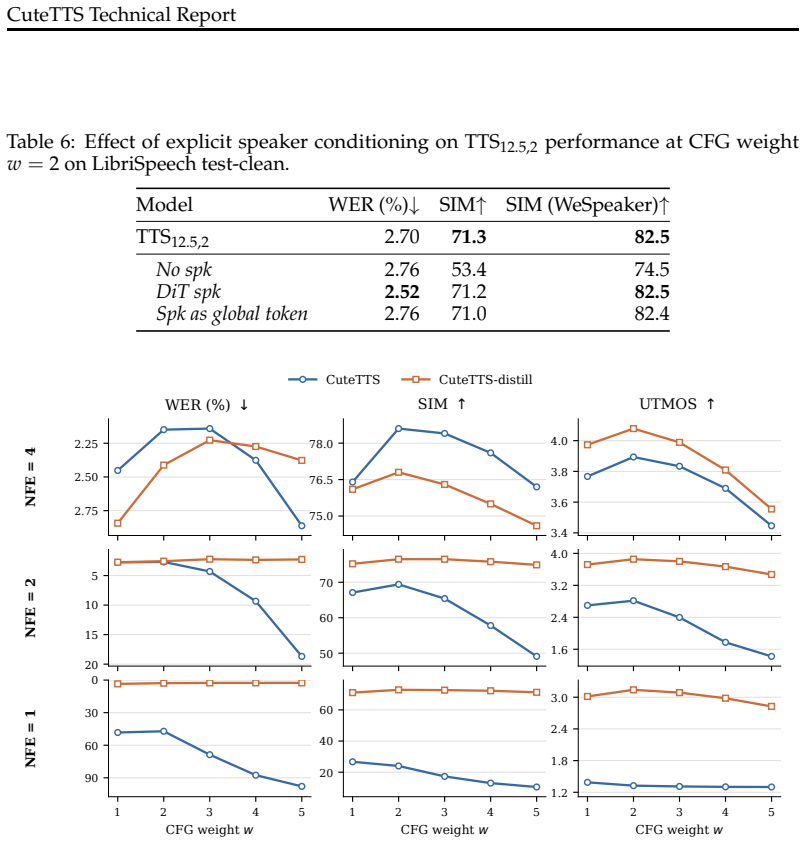
On its own terms, the paper establishes that a roughly 230M-parameter continuous-autoregressive TTS can hold its own against discrete-codec models with up to 8B parameters and against larger continuous models, with a LibriSpeech test-clean WER of 2.16% and SIM of 78.9 in zero-shot voice cloning, and comparable results on Seed-TTS English and Chinese. The enabling design is a semantically aligned causal sigma-VAE that turns 24-kHz audio into 64-dimensional latents at 12.5 Hz, grouped two frames per patch so the language model emits 6.25 tokens per second, while a compact ECAPA-style speaker encoder distilled from WavLM supplies explicit identity conditioning to both the LM and the diffusion head. The paper also claims that guidance–step distillation, which trains a student to predict the interval-averaged CFG-guided teacher velocity with the guidance scale and interval length as inputs, makes the system robust at one or two diffusion-head evaluations per patch, in regimes where the base model degrades sharply.
Load-bearing premise
The load-bearing premise is that speaker similarity measured by the fine-tuned WavLM-Large cosine evaluator reflects real voice-identity fidelity; because CuteTTS's own speaker encoder is distilled from a WavLM teacher, the paper acknowledges in Section 5.3 that representational proximity could inflate its similarity advantage over systems not trained against WavLM.
Editorial extensions
If this is right
- A 0.2B continuous-autoregressive TTS can reach intelligibility and speaker similarity near systems with 4–40 times more parameters, with LibriSpeech test-clean WER 2.16% and SIM 78.9.
- Guidance–step distillation removes the unconditional branch and most solver steps: the distilled model remains effective at 1–2 diffusion-head evaluations per patch where the base model degrades sharply.
- Under the paper's paired 50-request RTX 4090 protocol, first-audio latency falls from a 49.0 ms mean to 37.6 ms and RTF from 0.184 to 0.109, which points toward real-time streaming on consumer hardware.
- Semantic alignment of VAE latents lowers WER across CFG weights without hurting reconstruction or similarity, so representation design and generation modeling can be improved separately.
- The sweet spot for streaming continuous latents is not the highest possible frame rate: 50-Hz latents hurt intelligibility badly at patch size 1, while 12.5 Hz with patch size 2 balances WER, SIM, and UTMOS.
Reading between the lines
- Implication left implicit: because the student receives guidance scale $w$ and interval $\Delta t$ as inputs, one checkpoint could expose per-request quality-and-latency control, but the paper only demonstrates fixed 4-step inference.
- Testable extension: the rate-and-patch results suggest a transferable design heuristic—choose the highest VAE frame rate the causal backbone can still predict, then enlarge patches to recover reconstruction fidelity—which could be checked on other backbone sizes.
- Neighboring problem: the same interval-conditioned distillation objective is not specific to speech and could be applied to any autoregressive model with a flow-matching head, although CuteTTS demonstrates it only for TTS.
Signed reviews
Editorial analysis
A structured set of objections, weighed in public.
Referee Report
Summary. The paper introduces CuteTTS, a compact (approximately 0.2B parameter) continuous-autoregressive text-to-speech system that combines a semantically aligned causal σ-VAE latent representation, patch-level autoregressive modeling, explicit speaker conditioning, and a bidirectional flow-matching diffusion head. It further proposes guidance-step distillation, which trains a single student diffusion head to absorb both classifier-free guidance and multiple integration steps, thereby reducing inference cost. The main claims are: (i) on LibriSpeech test-clean and Seed-TTS-Eval, CuteTTS achieves competitive intelligibility and speaker similarity in zero-shot voice cloning, including a headline speaker-similarity advantage over larger baselines (Table 1); and (ii) under a paired efficiency protocol, the distilled model lowers mean first-audio latency by 23.3% and mean real-time factor by 40.8% relative to the base model with comparable quality (Table 2, Figure 2). The paper also reports controlled studies of representation rate, patch size, semantic alignment, and speaker conditioning.
Significance. If the central claims hold, CuteTTS would be a valuable data point for compact streaming TTS: it shows a plausible path toward reconciling high-fidelity continuous-latent generation with interactive latency. The efficiency evaluation is unusually careful: the protocol fixes 50 requests, uses the same order and seeds for paired comparisons, reports P50/P95 in addition to means, and specifies warm-cache, sequential, single-GPU conditions. The ablation studies on frame rate, patch size, semantic alignment, and distillation are systematic and informative. The main risk is the speaker-similarity evaluation: the primary SIM metric is computed with a fine-tuned WavLM-Large model, while the system's speaker encoder is itself distilled from a WavLM Large teacher; the paper discloses this proximity in §5.3 but only validates against an independent embedding model on ablations, not on the final system. Because the headline differentiator is a 4.9-point SIM advantage over VoxCPM2 in Table 1, this metric-independence issue is load-bearing for the voice-cloning claim. The intelligibility and latency results do not depend on this concern and appear well supported.
major comments (3)
- [§4.1, §3.2, §5.3, Table 6, Table 1] The headline speaker-similarity comparison in Table 1 is not secure because the primary SIM evaluator is a fine-tuned WavLM-Large model (Section 4.1), while the speaker encoder is trained by distillation from a frozen WavLM Large speaker-verification teacher (Section 3.2, Eq. 3). The manuscript acknowledges in §5.3 that 'proximity between their representation spaces could influence the measured similarity,' but the independent WeSpeaker check in Table 6 is performed only on the smaller ablation model TTS12.5,2, not on the final 0.2B CuteTTS model whose Table 1 SIM value (78.9 vs. 74.0) is the paper's headline differentiator. Moreover, Table 6 shows the effect is material: removing explicit speaker conditioning lowers WavLM SIM by 17.9 points but WeSpeaker SIM by only 8.0 points, indicating that the WavLM metric amplifies exactly what the student is trained to match. I request that the authors either report WeSpeaker (or another independent speaker-embedding metric) for the final CuteTTS and CuteTTS-distill models in Table 1, or explicitly qualify the similarity claims as holding under a WavLM-proximal metric rather than as an independent measure of voice-cloning fidelity.
- [Table 1, §4.2] The cross-system comparisons in objective evaluation are reported as single-point WER and SIM values without confidence intervals or paired significance tests. Many of the differences that support the 'competitive' claim are small, for example WER 2.16 for CuteTTS versus 1.98 for MOSS-TTS 8B and SIM 78.9 versus 74.0 for VoxCPM2. Given that the SIM metric is the one whose independence is at issue, single-point results are insufficient to establish the strength of the claim. Please provide bootstrap confidence intervals or paired tests over the fixed evaluation requests, or soften the claim to 'within the range of compared systems' until the metric-independence concern is resolved.
- [§4.2, Appendix B, Figure 2] The subjective preference evaluation is summarized only as aggregate win/tie/loss percentages. With 50 examples and 7 annotators, chance-level variation could plausibly change the direction of some comparisons, and the paper does not report inter-annotator agreement, confidence intervals, or any significance test. Since the paper uses this evidence to claim consistent sound-quality and naturalness preference over baselines, please add the missing statistics or explicitly describe the results as descriptive rather than as statistically verified differences.
minor comments (5)
- [Table 1] Several entries in Table 1 have missing spaces that obscure the numbers, e.g., '0.9177.0' for Qwen3-TTS (Seed-TTS ZH) and '0.1B1.5949.11.6350.7' for Pocket TTS; these should be fixed to display WER and SIM as separate values.
- [§5.4, Appendix A.3] The 'Sway time grid with coefficient -0.8' is used for the base model's Euler sampling, but the Sway grid is never defined or cited in the manuscript; please provide a definition or reference so that the sampling procedure is reproducible.
- [§3.4, Appendix A.2] The set of supported interval lengths D in Eq. (10) is not explicitly defined in the main text; Appendix A.2 mentions an eight-step base grid and a curriculum over 4/2/1-step targets, but the main text should state the interval set and the sampling procedure for Δt to make the distillation objective fully self-contained.
- [§4.1, Appendix C] The paper does not specify how reference utterances are selected for the zero-shot voice-cloning evaluations, such as reference duration, whether the same reference is used across systems, or whether reference text overlaps with target text; this information is important for reproducing the SIM and WER numbers.
- [Appendix C] The naming of the MOSS-TTS model is inconsistent: Table 2 lists 'MOSS-TTS (vLLM-Omni)' while Appendix C refers to 'MOSS-TTS Delay model'; please clarify whether these are the same configuration and why only RTF is reported for it.
Circularity Check
Headline SIM advantage is partially circular because the speaker encoder is distilled from WavLM while the primary SIM evaluator is a fine-tuned WavLM-Large model; the paper discloses this itself in Section 5.3.
-
fitted input called prediction
[Section 3.2 (Eq. 3) and Section 4.1 evaluation metrics, acknowledged in Section 5.3]
"Because our speaker encoder is distilled from WavLM and the primary SIM evaluator is also WavLM-based, proximity between their representation spaces could influence the measured similarity."
The speaker encoder is trained to reproduce WavLM-Large embeddings via Lcos, Lpair, and Lsoft, so the student is forced into the WavLM embedding space by construction. The headline SIM metric then measures cosine similarity in that same fine-tuned WavLM-Large space, meaning high Table 1 SIM scores partly re-measure the training target rather than independently test voice identity. The Section 5.3 caveat applies most strongly to exactly the final CuteTTS model reported in Table 1, and the WeSpeaker counter-check in Table 6 is only run on TTS12.5,2 ablations, not on the final 0.2B model. Table 6 shows the effect is material: removing explicit speaker conditioning lowers WavLM SIM by 17.9 points but WeSpeaker SIM by only 8.0 points.
full rationale
Most of the derivation is self-contained: WER is scored by external Whisper/Paraformer ASR, quality and latency are external, and the architecture and ablation claims rest on independent metrics. The one partial circularity is speaker similarity: the student speaker encoder is distilled from WavLM and the primary SIM evaluator is also WavLM-based, so the headline SIM advantage is partly an echo of the training objective. The authors disclose this exact concern in Section 5.3 and provide a WeSpeaker check, but only for ablations, not for the final model in Table 1. Because the central intelligibility and latency claims remain externally grounded, this is partial circularity rather than full collapse; score 4.
Assumptions & free parameters
free parameters (6)
- VAE frame rate r and patch size p =
r=12.5 Hz, p=2 (token rate 6.25/s)
- Posterior standard deviation sigma =
0.15
- VAE loss weights (lambda_mel, lambda_adv, lambda_feat, lambda_KL, lambda_sem) =
15, 1, 2, 0.1, 1
- CFG guidance weight w =
2
- Sway time-grid coefficient =
-0.8
- Distillation curriculum probabilities over 4/2/1-step targets =
(1,0,0) at step 0; (0.5,0.5,0) at 20K; (0.2,0.3,0.5) at 50K
assumptions (5)
- standard math Conditional flow matching training, regressing v* = P - xi, trains a model that generates from noise via integration.
- domain assumption The sigma-VAE with fixed posterior scale 0.15 avoids posterior collapse and yields latents suitable for autoregressive modeling.
- domain assumption Frozen WavLM features provide a useful alignment target for linguistic structure and a valid teacher for speaker verification.
- domain assumption The internal 550,000-hour multilingual corpus is representative enough for zero-shot TTS, and evaluation protocols from F5-TTS and Seed-TTS are reliable.
- domain assumption Automatic metrics WER (Whisper/Paraformer) and SIM (WavLM) are valid proxies for intelligibility and speaker identity.
Cite this review
Pith. "Pith review of CuteTTS: Efficient and High-Quality Speech Synthesis via Autoregressive Modeling of Continuous Latents." pith.science (2026). https://pith.science/paper/EPSHGEVV
@misc{pith2026260808638,
  author       = {Pith},
  title        = {Pith review of: CuteTTS: Efficient and High-Quality Speech Synthesis via Autoregressive Modeling of Continuous Latents},
  year         = {2026},
  howpublished = {\url{https://pith.science/paper/EPSHGEVV}},
  note         = {Machine review of arXiv:2608.08638}
}
read the original abstract
Zero-shot text-to-speech (TTS) now supports interactive assistants, personalized media, and accessibility tools. All TTS systems require faithful linguistic rendering, consistent speaker identity, and low-latency response. Yet compact streaming systems must preserve sufficient acoustic detail in a predictable low-rate latent sequence, while iterative diffusion sampling and classifier-free guidance multiply inference cost at every autoregressive step. To strike a balance between high-fidelity synthesis and low-latency inference, we present CuteTTS, a compact continuous-autoregressive TTS system. It combines semantically aligned causal VAE latents with patch-level autoregression, explicit speaker conditioning, and a bidirectional flow-matching head. We further introduce guidance-step distillation, which absorbs classifier-free guidance and multiple solver steps into a single interval-conditioned student. Evaluations on LibriSpeech and Seed-TTS-Eval demonstrate competitive intelligibility and speaker similarity in zero-shot voice cloning, while distillation lowers first-audio latency by 23.3% and real-time factor by 40.8% relative to the base model with comparable objective and subjective quality. These results provide a practical path toward continuous-autoregressive TTS that reconciles high-fidelity generation with the latency demands of real-time interaction.
Figures


Figures from the paper (3 more)


Reference graph
Works this paper leans on
-
[1]
arXiv preprint arXiv:2301.02111 , year =
Neural Codec Language Models are Zero-Shot Text to Speech Synthesizers , author =. arXiv preprint arXiv:2301.02111 , year =. 2301.02111 , archivePrefix =
-
[2]
Transactions of the Association for Computational Linguistics , volume =
Speak, Read and Prompt: High-Fidelity Text-to-Speech with Minimal Supervision , author =. Transactions of the Association for Computational Linguistics , volume =. 2023 , doi =
work page 2023
-
[3]
VoiceCraft: Zero-Shot Speech Editing and Text-to-Speech in the Wild , author =. Proceedings of the 62nd Annual Meeting of the Association for Computational Linguistics (Volume 1: Long Papers) , pages =. 2024 , doi =
work page 2024
-
[4]
Popov, Vadim and Vovk, Ivan and Gogoryan, Vladimir and Sadekova, Tasnima and Kudinov, Mikhail , booktitle =. Grad-. 2021 , url =
work page 2021
-
[5]
Advances in Neural Information Processing Systems , volume =
Voicebox: Text-Guided Multilingual Universal Speech Generation at Scale , author =. Advances in Neural Information Processing Systems , volume =. 2023 , url =
work page 2023
-
[6]
Mehta, Shivam and Tu, Ruibo and Beskow, Jonas and Sz. Matcha-. Proceedings of the IEEE International Conference on Acoustics, Speech and Signal Processing (ICASSP) , year =. 2309.03199 , url =
-
[7]
Chen, Yushen and Niu, Zhikang and Ma, Ziyang and Deng, Keqi and Wang, Chunhui and Zhao, Jian and Yu, Kai and Chen, Xie , booktitle =. F5-. 2025 , doi =
work page 2025
-
[8]
arXiv preprint arXiv:2407.05407 , year =
CosyVoice: A Scalable Multilingual Zero-Shot Text-to-Speech Synthesizer Based on Supervised Semantic Tokens , author =. arXiv preprint arXiv:2407.05407 , year =. 2407.05407 , archivePrefix =
Show all 47 references
-
[9]
arXiv preprint arXiv:2412.10117 , year =
CosyVoice 2: Scalable Streaming Speech Synthesis with Large Language Models , author =. arXiv preprint arXiv:2412.10117 , year =. 2412.10117 , archivePrefix =
-
[10]
Proceedings of the 63rd Annual Meeting of the Association for Computational Linguistics (Volume 1: Long Papers) , pages =
Autoregressive Speech Synthesis without Vector Quantization , author =. Proceedings of the 63rd Annual Meeting of the Association for Computational Linguistics (Volume 1: Long Papers) , pages =. 2025 , doi =
2025
-
[11]
arXiv preprint arXiv:2410.16048 , year =
Continuous Speech Synthesis Using Per-Token Latent Diffusion , author =. arXiv preprint arXiv:2410.16048 , year =. 2410.16048 , archivePrefix =
-
[12]
2025 , url =
Jia, Dongya and Chen, Zhuo and Chen, Jiawei and Du, Chenpeng and Wu, Jian and Cong, Jian and Zhuang, Xiaobin and Li, Chumin and Wei, Zhen and Wang, Yuping and Wang, Yuxuan , booktitle =. 2025 , url =
2025
-
[13]
2025 , doi =
Wang, Hui and Liu, Shujie and Meng, Lingwei and Li, Jinyu and Yang, Yifan and Zhao, Shiwan and Sun, Haiyang and Liu, Yanqing and Sun, Haoqin and Zhou, Jiaming and Lu, Yan and Qin, Yong , booktitle =. 2025 , doi =
2025
-
[14]
arXiv preprint arXiv:2509.06926 , year =
Continuous Audio Language Models , author =. arXiv preprint arXiv:2509.06926 , year =. 2509.06926 , archivePrefix =
-
[15]
arXiv preprint arXiv:2412.08635 , year =
Multimodal Latent Language Modeling with Next-Token Diffusion , author =. arXiv preprint arXiv:2412.08635 , year =. 2412.08635 , archivePrefix =
-
[16]
High-Fidelity Audio Compression with Improved
Kumar, Rithesh and Seetharaman, Prem and Luebs, Alejandro and Kumar, Ishaan and Kumar, Kundan , booktitle =. High-Fidelity Audio Compression with Improved. 2023 , url =
2023
-
[17]
arXiv preprint arXiv:2508.19205 , year =
VibeVoice Technical Report , author =. arXiv preprint arXiv:2508.19205 , year =. 2508.19205 , archivePrefix =
-
[18]
2025 , eprint =
An, Keyu and Zhang, Zhiyu and Gao, Changfeng and Li, Yabin and Peng, Zhendong and Wang, Haoxu and Du, Zhihao and Zhao, Han and Gao, Zhifu and Li, Xiangang , journal =. 2025 , eprint =
2025
-
[19]
2025 , eprint =
Niu, Zhikang and Hu, Shujie and Choi, Jeongsoo and Chen, Yushen and Chen, Peining and Zhu, Pengcheng and Yang, Yunting and Zhang, Bowen and Zhao, Jian and Wang, Chunhui and Chen, Xie , journal =. 2025 , eprint =
2025
-
[20]
2025 , eprint =
Wu, Chun Yat and Deng, Jiajun and Li, Guinan and Kong, Qiuqiang and Lui, Simon , journal =. 2025 , eprint =
2025
-
[21]
2025 , eprint =
Zhou, Yixuan and Zeng, Guoyang and Liu, Xin and Li, Xiang and Yu, Renjie and Wang, Ziyang and Ye, Runchuan and Sun, Weiyue and Gui, Jiancheng and Li, Kehan and Wu, Zhiyong and Liu, Zhiyuan , journal =. 2025 , eprint =
2025
-
[22]
The Eleventh International Conference on Learning Representations , year =
Flow Matching for Generative Modeling , author =. The Eleventh International Conference on Learning Representations , year =
-
[23]
arXiv preprint arXiv:2207.12598 , year =
Classifier-Free Diffusion Guidance , author =. arXiv preprint arXiv:2207.12598 , year =. 2207.12598 , archivePrefix =
-
[24]
Proceedings of the IEEE/CVF Conference on Computer Vision and Pattern Recognition , pages =
On Distillation of Guided Diffusion Models , author =. Proceedings of the IEEE/CVF Conference on Computer Vision and Pattern Recognition , pages =. 2023 , doi =
2023
-
[25]
The Tenth International Conference on Learning Representations , year =
Progressive Distillation for Fast Sampling of Diffusion Models , author =. The Tenth International Conference on Learning Representations , year =
-
[26]
Proceedings of the 40th International Conference on Machine Learning , series =
Consistency Models , author =. Proceedings of the 40th International Conference on Machine Learning , series =. 2023 , url =
2023
-
[27]
arXiv preprint arXiv:2505.13447 , year =
Mean Flows for One-Step Generative Modeling , author =. arXiv preprint arXiv:2505.13447 , year =. 2505.13447 , archivePrefix =
-
[28]
arXiv preprint arXiv:2510.07979 , year =
IntMeanFlow: Few-Step Speech Generation with Integral Velocity Distillation , author =. arXiv preprint arXiv:2510.07979 , year =. 2510.07979 , archivePrefix =
-
[29]
The Thirteenth International Conference on Learning Representations , year =
One Step Diffusion via Shortcut Models , author =. The Thirteenth International Conference on Learning Representations , year =
-
[30]
Transactions on Machine Learning Research , year =
High Fidelity Neural Audio Compression , author =. Transactions on Machine Learning Research , year =
-
[31]
2022 , doi =
Chen, Sanyuan and Wang, Chengyi and Chen, Zhengyang and Wu, Yu and Liu, Shujie and Chen, Zhuo and Li, Jinyu and Kanda, Naoyuki and Yoshioka, Takuya and Xiao, Xiong and Wu, Jian and Zhou, Long and Ren, Shuo and Qian, Yanmin and Qian, Yao and Wu, Jian and Zeng, Michael and Yu, X...
2022
-
[32]
2020 , doi =
Desplanques, Brecht and Thienpondt, Jenthe and Demuynck, Kris , booktitle =. 2020 , doi =
2020
-
[33]
2015 , doi =
Panayotov, Vassil and Chen, Guoguo and Povey, Daniel and Khudanpur, Sanjeev , booktitle =. 2015 , doi =
2015
-
[34]
Proceedings of the 40th International Conference on Machine Learning , series =
Robust Speech Recognition via Large-Scale Weak Supervision , author =. Proceedings of the 40th International Conference on Machine Learning , series =. 2023 , url =
2023
-
[35]
Anastassiou, Philip and Chen, Jiawei and Chen, Jitong and Chen, Yuanzhe and Chen, Zhuo and Chen, Ziyi and Cong, Jian and Deng, Lelai and Ding, Chuang and Gao, Lu and Gong, Mingqing and Huang, Peisong and Huang, Qingqing and Huang, Zhiying and Huo, Yuanyuan and Jia, Dongya and ...
2024
-
[36]
2023 , doi =
Wang, Hongji and Liang, Chengdong and Wang, Shuai and Chen, Zhengyang and Zhang, Binbin and Xiang, Xu and Deng, Yanlei and Qian, Yanmin , booktitle =. 2023 , doi =
2023
-
[37]
2022 , doi =
Saeki, Takaaki and Xin, Detai and Nakata, Wataru and Koriyama, Tomoki and Takamichi, Shinnosuke and Saruwatari, Hiroshi , booktitle =. 2022 , doi =
2022
-
[38]
2026 , eprint =
Gong, Yitian and Jiang, Botian and Zhao, Yiwei and Yuan, Yucheng and Chen, Kuangwei and Jiang, Yaozhou and Chang, Cheng and Hong, Dong and Chen, Mingshu and Li, Ruixiao and Zhang, Yiyang and Gao, Yang and Chen, Hanfu and Chen, Ke and Wang, Songlin and Yang, Xiaogui and Zhang, ...
2026
-
[39]
Hu, Hangrui and Zhu, Xinfa and He, Ting and Guo, Dake and Zhang, Bin and Wang, Xiong and Guo, Zhifang and Jiang, Ziyue and Hao, Hongkun and Guo, Zishan and Zhang, Xinyu and Zhang, Pei and Yang, Baosong and Xu, Jin and Zhou, Jingren and Lin, Junyang , journal =. Qwen3-. 2026 , eprint =
2026
-
[40]
arXiv preprint arXiv:2509.02020 , year =
FireRedTTS-2: Towards Long Conversational Speech Generation for Podcast and Chatbot , author =. arXiv preprint arXiv:2509.02020 , year =. 2509.02020 , archivePrefix =
-
[41]
arXiv preprint arXiv:2506.13053 , year =
ZipVoice: Fast and High-Quality Zero-Shot Text-to-Speech with Flow Matching , author =. arXiv preprint arXiv:2506.13053 , year =. 2506.13053 , archivePrefix =
-
[42]
arXiv preprint arXiv:2506.21619 , year =
IndexTTS2: A Breakthrough in Emotionally Expressive and Duration-Controlled Auto-Regressive Zero-Shot Text-to-Speech , author =. arXiv preprint arXiv:2506.21619 , year =. 2506.21619 , archivePrefix =
-
[43]
arXiv preprint arXiv:2505.17589 , year =
CosyVoice 3: Towards In-the-Wild Speech Generation via Scaling-Up and Post-Training , author =. arXiv preprint arXiv:2505.17589 , year =. 2505.17589 , archivePrefix =
-
[44]
Interspeech 2022 , pages =
Paraformer: Fast and Accurate Parallel Transformer for Non-Autoregressive End-to-End Speech Recognition , author =. Interspeech 2022 , pages =. 2022 , doi =
2022
-
[45]
2026 , eprint =
Zhou, Yixuan and Zeng, Guoyang and Liu, Xin and Li, Xiang and Yu, Renjie and Gui, Jiancheng and Wu, Jiaheng and Wang, Ziyang and Shen, Xudong and Ye, Runchuan and Zhang, Zhisheng and Zhou, Jiuyang and Bai, Bingsong and Sun, Weiyue and Deng, Mengyuan and Shi, Qundong and Wu, Zh...
2026
-
[46]
2026 , howpublished =
Pocket. 2026 , howpublished =
2026
-
[47]
2025 , howpublished =
2025
Reviewed August 14, 2026 · model on record in the stance chip above.
Discussion (0). Continue with ORCID to comment.