REVIEW 3 major objections 5 minor 12 references
DeepFreqMark: End-To-End Learnable Frequency-Domain Watermarking with Spherical Attack Simulation for Latent Diffusion Models
T0 review · 3 major / 5 minor · reviewed 2026-08-14 · deepseek-v4-flash
Pith's one-line read DeepFreqMark replaces handcrafted frequency watermarks with a learned encoder-decoder and a Slerp-based attack simulation to lower bit-error rates and scale payloads to 256 bits.
desk verdict DeepFreqMark introduces a genuinely learnable frequency-domain watermark and a Slerp attack surrogate, but the claimed superiority over baselines is not yet supported by a shared-protocol comparison. read the letter →
The pith
A machine-rendered reading of the paper's core claim, the machinery that carries it, and where it could break.
The reading
What carries the argument
The load-bearing mechanism is the Slerp-based attack simulation (Equation 10) applied to the noise latent during training. Spherical linear interpolation moves the watermarked latent $z'_T$ along the great-circle arc toward a random Gaussian vector $z_r$, with strength $s\sim U(0,S)$; because both endpoints lie on the Gaussian annulus, the interpolated latent stays on the high-dimensional sphere and preserves unit variance, avoiding the variance collapse that ordinary linear interpolation would cause. This surrogate stands in for the expensive sequence of image-level attack plus DDIM inversion, letting the encoder and decoder be optimized for robustness in each training step. The second supporting mechanism is the frequency-patch embedding: the encoder outputs a real watermark for DCT and a two-channel complex watermark for FFT, with the FFT scheme enforcing Hermitian symmetry via $F[M-k,N-l]=F[k,l]$ on a free half-region, ensuring the inverse transform is real-valued.
What would settle it
Evaluate a Slerp-trained model and a non-Slerp model under the actual DDIM-inversion pipeline with the attacks in Table I; if the Slerp-trained model does not show clearly lower BER on those real attacks, or if the BER-versus-$S$ trend in Fig. 7 does not match the MSE ranking in Table I, the surrogate-attack assumption is falsified.
Extended reading notes
Core claim
The paper's central claim is that a learnable end-to-end encoder/decoder operating in the frequency domain of the initial noise latent can outperform handcrafted frequency-domain watermarks for latent diffusion models, and that the key enabler is a Slerp-based surrogate attack. The message encoder maps a binary message to a small $32\times32$ patch in the DCT or FFT spectrum of the last channel of the noise latent; the FFT variant uses a free half-region and Hermitian symmetry to guarantee real-valued latents. During extraction, the attacked image is mapped back by DDIM inversion, cropped in the same frequency patch, and decoded. Against real-world attacks such as JPEG, Gaussian noise/blur, brightness/contrast, and neural re-compression, the FFT model trained with Slerp strength $S=0.6$ reports an average BER of $0.316\%$ versus $1.976\%$ without simulation, and the same setup reports $99.44\%$ bit accuracy at 256-bit payloads. These numbers constitute the paper's evidence that the Slerp proxy transfers to real DDIM-inversion-based decoding.
Load-bearing premise
The robustness gain rests on the unproven premise that moving the watermarked noise partway toward a random Gaussian noise during training mimics what real image attacks do to the latent after DDIM inversion, so if that proxy is wrong the reported low bit-error rates may not appear outside the training setup.
Editorial extensions
If this is right
- The training cost of attack-aware watermarking can drop sharply, because the Slerp surrogate replaces the DDIM inversion loop that would otherwise run at every iteration.
- Payload capacity for in-generation watermarks jumps from 11–72 bits in the compared handcrafted schemes to 256 bits while keeping reported bit accuracy above 99%, which makes per-user message assignment practical.
- The same learnable recipe works in both DCT and FFT domains, with the FFT variant consistently more robust, indicating that the method generalizes across spectral representations.
- Average BER below roughly 0.5% leaves room for standard error-correcting codes, so near-zero-error provenance tracking is within reach for the tested attack suite.
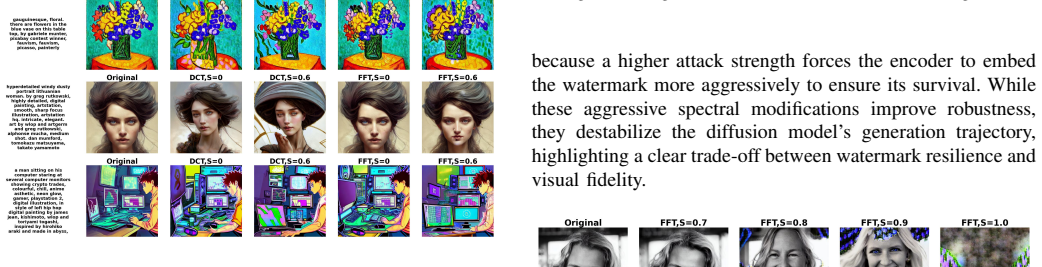
- Raising the Slerp strength lowers BER but visibly degrades image quality once $S\ge 0.8$, giving a tunable robustness-versus-fidelity dial for deployment.
Reading between the lines
- Editorial extension: the Slerp-to-real-attack mapping is not directly validated; a natural test is to calibrate the sampled $s$ against Table I's DDIM-inversion MSEs, and if no single $s$ covers all attack severities, training should sample a mixture of strengths rather than a uniform $U(0,S)$.
- Editorial extension: if the Slerp proxy transfers faithfully, the same latent-interpolation trick could be applied to other generative models whose inversion is deterministic, not only DDIM-based diffusion.
- Editorial extension: the FFT variant's consistent edge suggests that the complex phase carries much of the robust signal; perturbing phase while holding magnitude fixed would reveal whether the decoder truly exploits phase or simply the Hermitian redundancy.
Signed reviews
Editorial analysis
A structured set of objections, weighed in public.
Referee Report
Summary. The paper proposes DeepFreqMark, an end-to-end learnable frequency-domain watermarking framework for latent diffusion models. A neural encoder embeds binary messages into the DCT or FFT spectrum of the initial noise latent, and a neural decoder recovers the message after DDIM inversion. To avoid the computational cost of DDIM inversion during training, the authors introduce a Slerp-based attack simulation that perturbs the noise latent directly, with a training objective combining latent reconstruction MSE and binary cross-entropy for message recovery. Experiments with Stable Diffusion v1.5 report BER for DCT and FFT variants with and without Slerp training, and accuracy/capacity comparisons with Tree-Rings, RingID, METR, and HSTR/HSQR.
Significance. If the robustness and capacity claims were substantiated, this would be a useful contribution: it replaces handcrafted frequency patterns with a learned encoder/decoder, extends embedding to DCT as well as FFT, handles Hermitian symmetry properly, and scales to 256-bit payloads. The release of source code is a strength, and the idea of avoiding DDIM inversion during training via a latent-space surrogate is practically motivated. However, the headline BER claim is not currently supported by a shared-protocol comparison, and the Slerp surrogate's validity is not established, so the significance cannot be fully assessed.
major comments (3)
- [IV.B (Tables II and III)] The central claim in the abstract and Section I that DeepFreqMark 'achieves significantly lower Bit Error Rates (BER) than baseline methods' is not supported by the experiments as presented. Table II compares only DeepFreqMark's own DCT and FFT variants with S=0 and S=0.6; no baseline method is evaluated under the same protocol (same 100 DiffusionDB prompts, same Stable Diffusion v1.5 pipeline, same eight attacks, same DDIM-inversion extraction). Table III lists accuracy and capacity values taken from the original publications, where attack sets, image sets, message capacities, and metrics (verification accuracy vs. bit accuracy) differ, and no BER row is reported for any baseline. A head-to-head BER comparison on a shared protocol is needed to substantiate the comparative claim.
- [III.D and Table I] The Slerp-based attack simulation is a load-bearing ingredient, but the paper does not validate that Slerp on the noise latent approximates the effect of real image-level attacks after DDIM inversion. Table I reports only MSE values of DDIM-inverted latents under several attacks; it does not map a Slerp strength s to any real attack, nor does it show that models trained with S=0.6 transfer to actual DDIM-inversion attacks better than models trained without Slerp. Without such validation, the robustness improvements in Table II may reflect overfitting to the Slerp distribution rather than generalization to real-world attacks. I recommend adding a transfer experiment that compares Slerp-trained and non-Slerp-trained models under the Table I attacks, and ideally a calibration of s against attack MSE.
- [III.D, Eq. (10)] Eq. (10) writes Slerp(z'_T, z_r, s) with the standard formula for unit vectors, but z'_T and z_r are Gaussian noise latents that are not normalized in general. Applied to vectors of different norms, this formula does not preserve the norm, and the claimed 'unit variance and underlying Gaussian profile' guarantee is not justified. The authors should either define Slerp on normalized vectors and state the variance-preservation argument explicitly, or provide an alternative formula; as written, this is a technical error in the core simulation.
minor comments (5)
- [III.B, Eqs. (1)-(3)] The notation moves between Z'_T (frequency domain) and z'_T (spatial latent) without defining the inverse transform; please clarify which domain each loss operates in.
- [Table III] The 'Accuracy' column mixes verification accuracy, bit accuracy, and message accuracy across methods; please define the metric for each row or use a single shared metric for all rows.
- [Figures 7-9] No confidence intervals or number of test samples are reported; please add error bars or state the sample size at each point.
- [Figure 9] The caption says the gap between |m|=128 and |m|=256 is shortened for better visualization, but the axis appears discontinuous; please make the axis transformation explicit or plot the true scale.
- [Section IV.F and Table I] Minor typos: Section IV.F heading has an extra space ('F . Superiority'), and Table I columns are labeled 'MSE Error' though MSE is already an error measure.
Circularity Check
No circularity: training signal and evaluation protocol are distinct; the baseline-comparison gap is an evidence issue, not a circular derivation.
full rationale
Walked the derivation chain. The training objective (Eqs. 3-5) optimizes the encoder and decoder against a BCE loss on Slerp-perturbed latents (Eq. 10), while the evaluation (Section IV.A-B) applies real image attacks to generated images and performs DDIM inversion (Eqs. 6-9) to compute BER. The reported robustness numbers are therefore not equal by construction to the training loss, and no fitted parameter is renamed as a prediction. The Slerp surrogate may be an imperfect approximation, and Table III's baselines use metrics from their original publications rather than a shared protocol, but that is a validation/evidence gap, not circularity. No load-bearing self-citation appears, and the paper's central comparison is against external prior work. Hence no circular step is exhibited.
Assumptions & free parameters
free parameters (2)
- alpha
- S (Slerp attack strength bound) =
0.6
assumptions (3)
- domain assumption DDIM inversion provides a deterministic mapping from a generated image back to the initial noise latent
- ad hoc to paper Slerp of Gaussian noise latents preserves the Gaussian variance and profile
- standard math Gaussian Annulus Theorem concentration in high dimension
Cite this review
Pith. "Pith review of DeepFreqMark: End-To-End Learnable Frequency-Domain Watermarking with Spherical Attack Simulation for Latent Diffusion Models." pith.science (2026). https://pith.science/paper/65B7I5WF
@misc{pith2026260808999,
  author       = {Pith},
  title        = {Pith review of: DeepFreqMark: End-To-End Learnable Frequency-Domain Watermarking with Spherical Attack Simulation for Latent Diffusion Models},
  year         = {2026},
  howpublished = {\url{https://pith.science/paper/65B7I5WF}},
  note         = {Machine review of arXiv:2608.08999}
}
read the original abstract
The proliferation of AI-generated images produced by Latent Diffusion Models (LDMs) has raised critical concerns regarding copyright infringement and misinformation. Although existing frequency-domain watermarking methods embed handcrafted geometric patterns into the initial latent noise prior to generation, they suffer from limited capacity and rigid pattern designs. We propose DeepFreqMark, an end-to-end learnable frequency-domain watermarking framework that replaces manual pattern engineering with a neural message encoder and decoder. To circumvent the computational bottleneck caused by Denoising Diffusion Implicit Model (DDIM) inversion during training, we introduce a Spherical Linear Interpolation (Slerp)-based attack simulation. This approach operates directly on the noise latent while strictly preserving the Gaussian variance. Extensive experiments demonstrate that DeepFreqMark achieves significantly lower Bit Error Rates (BER) than baseline methods under real-world attacks and scales to 256 bits message capacity. Our source code is available at https://github.com/chenhsiu48/DeepFreqMark.
Figures


Figures from the paper (5 more)




Reference graph
Works this paper leans on
-
[1]
High-resolution image synthesis with latent diffusion models,
R. Rombach, A. Blattmann, D. Lorenz, P. Esser, and B. Ommer, “High-resolution image synthesis with latent diffusion models,” inProceedings of the IEEE/CVF Conference on Computer Vision and Pattern Recogni- tion, 2022, pp. 10 684–10 695
work page 2022
-
[2]
Sdxl: Improving latent diffusion mod- els for high-resolution image synthesis,
D. Podell et al., “Sdxl: Improving latent diffusion mod- els for high-resolution image synthesis,” inAdvances in Neural Information Processing Systems, vol. 36, 2023
work page 2023
-
[3]
Latent diffusion models for image watermarking: A review of recent trends and future directions,
H. Hur, M. Kang, S. Seo, and J.-U. Hou, “Latent diffusion models for image watermarking: A review of recent trends and future directions,”Electronics, vol. 14, no. 1, p. 25, 2024
work page 2024
-
[4]
Tree-ring watermarks: Fingerprints for diffusion images that are invisible and robust,
Y . Wen, J. Kirchenbauer, J. Geiping, and T. Gold- stein, “Tree-ring watermarks: Fingerprints for diffusion images that are invisible and robust,”arXiv preprint arXiv:2305.20030, 2023
arXiv 2023
-
[5]
METR: Image Watermarking with Large Number of Unique Messages
A. Varlamov, D. Diatlova, and E. Spirin, “Metr: Image watermarking with large number of unique messages,” arXiv preprint arXiv:2408.08340, 2024
work page Pith review arXiv 2024
-
[6]
Ringid: Rethinking tree-ring watermarking for enhanced multi- key identification,
H. Ci, P. Yang, Y . Song, and M. Z. Shou, “Ringid: Rethinking tree-ring watermarking for enhanced multi- key identification,” inEuropean conference on computer vision, Springer, 2024, pp. 338–354
work page 2024
-
[7]
S. J. Lee and N. I. Cho, “Semantic watermarking reinvented: Enhancing robustness and generation quality with fourier integrity,” inProceedings of the IEEE/CVF International Conference on Computer Vision, 2025, pp. 18 759–18 769
work page 2025
-
[8]
Denoising diffusion implicit models,
J. Song, C. Meng, and S. Ermon, “Denoising diffusion implicit models,” inInternational Conference on Learn- ing Representations, 2021
2021
Show all 12 references
-
[9]
Learned image compression with discretized gaussian mixture likelihoods and attention modules,
Z. Cheng, H. Sun, Y . Tian, and A. Vetro, “Learned image compression with discretized gaussian mixture likelihoods and attention modules,” inProceedings of the IEEE/CVF Conference on Computer Vision and Pattern Recognition, 2020, pp. 7939–7948
2020
-
[10]
Variational image compression with a scale hyperprior,
J. Ball ´e, D. Minnen, S. Singh, S. J. Hwang, and N. Johnston, “Variational image compression with a scale hyperprior,”arXiv preprint arXiv:1802.01436, 2018
2018 arXiv
-
[11]
Invisible image watermarks are provably removable using generative ai,
X. Zhao et al., “Invisible image watermarks are provably removable using generative ai,”Advances in neural information processing systems, vol. 37, pp. 8643–8672, 2024
2024
-
[12]
DiffusionDB: A large-scale prompt gallery dataset for text-to-image generative mod- els,
Z. J. Wang, E. Montoya, D. Munechika, H. Yang, B. Hoover, and D. H. Chau, “DiffusionDB: A large-scale prompt gallery dataset for text-to-image generative mod- els,”arXiv:2210.14896 [cs], 2022. [Online]. Available: https://arxiv.org/abs/2210.14896
2022 arXiv
Reviewed August 14, 2026 · model on record in the stance chip above.
Discussion (0). Continue with ORCID to comment.