REVIEW 2 major objections 5 minor 23 references
MARA: Flow-Matching-Guided Multi-Agent Resource Allocation for Computational Resource Efficient Learning
T0 review · 2 major / 5 minor · reviewed 2026-08-11 · deepseek-v4-flash
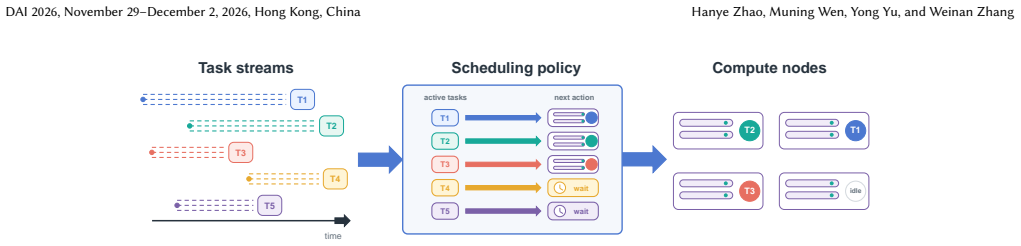
Pith's one-line read MARA predicts future loss trajectories with conditional flow matching and assigns tasks to discrete nodes via an autoregressive multi-agent transformer, completing 63.46% of tasks at its training load—8.54 points above the LARA…
desk verdict The simulator result is likely real, but the paper overclaims the flow-matching component's contribution; the real driver is the MAT allocator and dense shaping. read the letter →
The pith
A machine-rendered reading of the paper's core claim, the machinery that carries it, and where it could break.
The reading
What carries the argument
Two mechanisms carry the argument, joined by a shaping identity. The first is a conditional flow-matching (CFM) predictor: a GRU encoder turns a task's observed loss history into a context, and a velocity network learns to transport Gaussian noise to a 32-bin vector of interval-averaged future losses along the linear path $z_u = (1-u)z_0 + u z_1$; at inference, threshold crossings of sampled trajectories are decoded into remaining-batch estimates and the median is used as the demand signal. Because the target vector is threshold-independent, the same predictor can be decoded for any target loss and horizon. The second is a Multi-Agent Transformer (MAT) allocator: each node is an agent that selects tasks autoregressively in fixed order under masks that enforce the constraint that no task occupies more than one node, trained with PPO and GAE. The identity that makes dense training feedback safe is potential-based shaping: with $\gamma=1$ and zero boundary potentials, $\sum_{t=0}^{T-1} r_t = \sum_k \mathbb{I}[k \text{ succeeds}]$, so the shaped reward leaves the undiscounted completion objective unchanged.
What would settle it
A deployment or simulation that adds node heterogeneity and per-preemption switching costs to the paper's calibrated task streams and then measures the MARA-vs-LARA completion gap; if the gap collapses from the reported 8.5 points to near zero or reverses, the central transfer claim fails.
Extended reading notes
Core claim
The paper's central claim is that in discrete-node Computational Resource Efficient Learning—where tasks arrive over time, each must reach a target loss before a deadline, and each node serves one task per step—the combination of a conditional flow-matching predictor and an autoregressive multi-agent allocator yields the highest task-completion rate among realizable methods. At the training load, MARA completes 63.46% of tasks on average, surpassing LARA by 8.54 percentage points, and the margin holds between 8.43 and 8.84 points under heavier arrival loads. The authors argue the gain comes from both parts: flow matching reduces remaining-batch prediction error (52.1% lower capped MAE on in-distribution tasks than weighted least squares), and the multi-agent allocator makes better coordinated use of the predictions, since MARA outperforms LARA-FM by 2.83 points with the same predictor. A deliberately constructed stress test shows MARA matching the independent-feasibility upper bound (65%) by refusing to waste service on infeasible tasks, whereas FIFO and EDF complete none.
Load-bearing premise
The results depend on the simulated loss curves and the homogeneous, cost-free preemption and migration model faithfully representing real concurrent learning workloads; if real loss trajectories, hardware heterogeneity, or switching costs differ, the measured completion gains may not transfer to actual clusters.
Editorial extensions
If this is right
- A single trained flow-matching predictor can answer 'how many batches to target' for any loss threshold and horizon, so the same module can serve schedulers with changing service-level targets without retraining.
- The allocator trained at one arrival probability retains its completion-rate margin at heavier loads, indicating zero-shot load generalization within the simulated environment.
- The dense log-progress reward changes credit assignment but not the undiscounted completion objective, so the policy is genuinely maximizing the number of successful tasks rather than a surrogate.
- The infeasible-task stress test shows that accurate demand estimates plus coordinated matching can prevent wasted service on hopeless tasks, a failure mode that simple FIFO and EDF policies exhibit completely.
Reading between the lines
- Beyond the paper: feeding the full flow-matching distribution, not just the median crossing, to the allocator as a risk signal is a testable extension that might raise completion on the ViT OOD set where median estimates are weakest.
- Beyond the paper: the homogeneous-node, cost-free-preemption assumption is where real clusters differ; adding per-preemption penalties and node-speed heterogeneity to the simulator would reveal whether the 8.5-point margin survives switching costs.
- Beyond the paper: real training has run-to-run stochasticity, unlike the deterministic loss curves used here; training the flow predictor on noisy prefixes would test whether the median crossing decoder preserves the completion gains.
- Beyond the paper: the equal-weight average across task sets masks the small ViT OOD prediction improvement, so a dedicated study targeting slow-declining loss families could locate the method's next bottleneck.
Signed reviews
Editorial analysis
A structured set of objections, weighed in public.
Referee Report
Summary. The paper studies allocation of discrete compute nodes among concurrently arriving learning tasks whose required training effort is unknown. It proposes MARA, which couples a conditional flow-matching predictor of future loss trajectories with a multi-agent transformer allocator, trained via PPO with a potential-based dense reward. Experiments on simulated workloads derived from LARA report that MARA completes 63.46% of tasks at the training load, outperforming the adapted LARA baseline by 8.54 percentage points and remaining ahead under heavier loads and held-out task sets, while flow matching reduces remaining-resource prediction error relative to WLS.
Significance. If the reported results hold, the paper offers a useful step toward discrete-node CoRE-Learning and a clean integration of generative trajectory forecasting with cooperative multi-agent allocation. The evaluation has real strengths: shared pre-generated workloads, equal weighting of task sets, frozen evaluation curves, and a controlled stress test that separates infeasible-task waste from allocation quality. The paper also gives a transparent derivation of the potential-based shaping reward. However, the empirical support for the specific claim that flow matching drives the end-to-end gain is weak, and the objective-preserving theorem depends on an unverified terminal condition. These two issues are load-bearing for the paper's central claims.
major comments (2)
- [Section 5.3 and Section 5.8, Table 2] The paper's central attribution that improved forecasts drive end-to-end gains is not supported by the reported numbers. The controlled predictor comparison inside the same MAT allocator gives MARA 63.46% versus MARA-WLS 62.07%, a difference of 1.39 points, with sample standard deviations of 3.61 and 2.91 over the same 15 training-seed/evaluation-root combinations; no significance test is reported, and the gap is comparable to one standard error. By contrast, the MAT allocator and the dense shaping reward account for much larger margins (MARA-WLS exceeds LARA by 7.14 points; dense shaping exceeds sparse by 5.59 points). The authors should report paired tests, confidence intervals, or effect sizes for the FM-versus-WLS comparison, and if the evidence remains weak they should temper the causal claims in the abstract and contribution list.
- [Section 4.3, Eq. (15), Appendix A.3] The objective-preserving property is derived only under the assertion that the active set is empty at both episode boundaries, so Φ0=ΦT=0. The simulator description says it runs for 500 steps with Bernoulli task arrivals; tasks arriving near the end can still be active at time T and can have deadlines beyond step 500. In that case the telescoping sum in Eq. (15) leaves a residual βΦT, and the shaped return is not equal to the number of completed tasks. The authors should either restrict the workload generation so all tasks resolve before T, define the terminal state to have an empty active set, or extend the proof to account for a nonzero terminal potential.
minor comments (5)
- [Section 4.1] There are typos in the text: 'telative log targets' should be 'relative log targets' and 'separetely' should be 'separately'.
- [Equations (4)-(5)] The index range of y_j is not stated; please specify that j runs from 1 to H and explain how the boundary at j=0 is handled by the cumulative-sum initialization.
- [Section 5.4, Table 3] The stress test reports zero standard deviation for MARA and Oracle; please explain how the 15 training-seed/evaluation-root combinations are realized for this constructed scenario and why no variation is observed.
- [Section 5.7, Table 4] The operational diagnostics are reported as means with sample standard deviations, but the number of episodes and the pairing structure are not given; please provide these details so the reader can judge the precision of the comparisons.
- [Section 4.1] The phrase 'preserving multimodal future behavior' is misleading because the final remaining-demand estimate is a median of sampled trajectories; please clarify that the distribution is used only to derive a robust scalar estimate.
Circularity Check
No circular derivation: held-out prediction and shared-workload comparisons support the completion-rate claim; self-citations are architectural rather than load-bearing.
full rationale
No circular step reduces a prediction to a fitted constant or equates an output with an input. The FM predictor is trained on complete curves from a training split (Algorithm 1, Stage I) and evaluated on pre-generated frozen episodes that reveal only prefixes online (Section 5.1), so the prediction gains and completion rates are out-of-sample measurements rather than identities. The potential-based shaping (Eqs. 13-15) is a telescoping reward transformation that preserves the undiscounted completion objective exactly under the stated boundary condition Phi_0=Phi_T=0; it does not define the evaluation metric or the completion count. The self-citations to MAT [18] and the multi-agent advantage decomposition theorem [5] justify the allocator architecture but are not used to force the empirical result, which is measured against external baselines (LARA, FIFO, EDF) on shared workloads. The FM-vs-WLS ablation gap of 1.39 points (Table 2) is reported without a significance test, so the causal claim in Section 5.8 that improved forecasts affect downstream allocation is statistically weak; this is a missing-evidence concern, not circularity. The explicit simulator limitations in Section 6 (homogeneous nodes, cost-free preemption and migration) limit external validity but do not make the derivation self-referential. Score 2 reflects only the presence of non-load-bearing self-citations, consistent with a normal, non-circular derivation.
Assumptions & free parameters
free parameters (5)
- Shaping coefficient beta =
0.1
- WLS forgetting factor =
0.9
- Flow samples and Euler steps =
ID/RL: 8 samples, 4 steps; ViT: 4 samples, 1 step
- MAT checkpoint step =
10,500
- Prediction warm-up threshold =
four history points
assumptions (5)
- domain assumption The task loss curves generated by the simulator (using LARA task models and datasets, recalibrated) are representative of real concurrent learning workloads.
- domain assumption Compute nodes are homogeneous and preemption/migration between nodes has no cost.
- ad hoc to paper The fixed-length target vector y in H=32 bins, with linear interpolation of cumulative loss (Eqs. 4 to 5), faithfully represents the future loss trajectory for demand estimation.
- ad hoc to paper The median of N sampled flow trajectories is a sufficient scalar estimate of remaining demand, discarding multimodal uncertainty.
- standard math Potential-based reward shaping with gamma=1 and zero potentials at episode boundaries preserves the undiscounted task-completion objective.
Cite this review
Pith. "Pith review of MARA: Flow-Matching-Guided Multi-Agent Resource Allocation for Computational Resource Efficient Learning." pith.science (2026). https://pith.science/paper/2UUUTCG2
@misc{pith2026260809130,
  author       = {Pith},
  title        = {Pith review of: MARA: Flow-Matching-Guided Multi-Agent Resource Allocation for Computational Resource Efficient Learning},
  year         = {2026},
  howpublished = {\url{https://pith.science/paper/2UUUTCG2}},
  note         = {Machine review of arXiv:2608.09130}
}
read the original abstract
Allocating limited computation among concurrent learning tasks is difficult when each task must reach a target loss before a deadline but its required training effort is unknown. Existing approaches combine online loss prediction with adaptive resource allocation, yet commonly treat computation as continuously divisible throughput. We instead study a practical setting in which tasks arrive over time and computation is provided by discrete nodes. This setting introduces both uncertain demand and constrained sequential decisions. We propose MARA, which predicts future loss trajectories with conditional flow matching and coordinates compute nodes through a cooperative multi-agent autoregressive policy. A potential-based progress reward supplies intermediate training feedback while preserving the undiscounted task-completion objective. Across in-distribution, reinforcement-learning, and vision workloads, flow matching reduces remaining-resource prediction error relative to weighted least squares. At the scheduler's training load, MARA completes 63.46% of tasks on average, 8.54 percentage points above strong baseline Learning with Adaptive Resource Allocation (LARA), and remains ahead under unseen heavier workloads.
Figures


Figures from the paper (1 more)

Reference graph
Works this paper leans on
-
[1]
Bellemare, Yavar Naddaf, Joel Veness, and Michael Bowling
Marc G. Bellemare, Yavar Naddaf, Joel Veness, and Michael Bowling. 2013. The Arcade Learning Environment: An Evaluation Platform for General Agents. Journal of Artificial Intelligence Research47 (2013), 253–279. doi:10.1613/jair.3912
-
[2]
Tobias Domhan, Jost Tobias Springenberg, and Frank Hutter. 2015. Speeding Up Automatic Hyperparameter Optimization of Deep Neural Networks by Extrapola- tion of Learning Curves. InProceedings of the 24th International Joint Conference on Artificial Intelligence. AAAI Press, 3460–3468
work page 2015
-
[3]
Aaron Klein, Stefan Falkner, Jost Tobias Springenberg, and Frank Hutter. 2017. Learning Curve Prediction with Bayesian Neural Networks. InInternational Conference on Learning Representations
work page 2017
-
[4]
2009.Learning Multiple Layers of Features from Tiny Images
Alex Krizhevsky and Geoffrey Hinton. 2009.Learning Multiple Layers of Features from Tiny Images. Technical Report. University of Toronto. https://www.cs. toronto.edu/~kriz/learning-features-2009-TR.pdf
work page 2009
-
[5]
Jakub Grudzien Kuba, Ruiqing Chen, Muning Wen, Ying Wen, Fanglei Sun, Jun Wang, and Yaodong Yang. 2022. Trust Region Policy Optimisation in Multi-Agent Reinforcement Learning. arXiv:2109.11251 [cs.AI] https://arxiv.org/abs/2109. 11251
arXiv 2022
-
[6]
Lisha Li, Kevin Jamieson, Giulia DeSalvo, Afshin Rostamizadeh, and Ameet Talwalkar. 2018. Hyperband: A Novel Bandit-Based Approach to Hyperparameter Optimization.Journal of Machine Learning Research18, 185 (2018), 1–52. https: //www.jmlr.org/papers/v18/16-558.html
work page 2018
-
[7]
Yaron Lipman, Ricky T. Q. Chen, Heli Ben-Hamu, Maximilian Nickel, and Matt Le. 2023. Flow Matching for Generative Modeling. InInternational Conference on Learning Representations. https://openreview.net/forum?id=PqvMRDCJT9t
work page 2023
-
[8]
Xingchao Liu, Chengyue Gong, and Qiang Liu. 2023. Flow Straight and Fast: Learning to Generate and Transfer Data with Rectified Flow. InInternational Conference on Learning Representations. arXiv:2209.03003
arXiv 2023
Show all 23 references
-
[9]
Maas, Raymond E
Andrew L. Maas, Raymond E. Daly, Peter T. Pham, Dan Huang, Andrew Y. Ng, and Christopher Potts. 2011. Learning Word Vectors for Sentiment Analysis. InProceedings of the 49th Annual Meeting of the Association for Computational Linguistics: Human Language Technologies. Associati...
2011
-
[10]
Ng, Daishi Harada, and Stuart J
Andrew Y. Ng, Daishi Harada, and Stuart J. Russell. 1999. Policy Invariance under Reward Transformations: Theory and Application to Reward Shaping. In Proceedings of the 16th International Conference on Machine Learning. Morgan Kaufmann, 278–287
1999
-
[11]
OpenSLR. n.d. YESNO Speech Corpus (SLR1). Open Speech and Language Resources. Accessed 2026-08-01. https://www.openslr.org/1/
2026
-
[12]
Yanghua Peng, Yixin Bao, Yangrui Chen, Chuan Wu, and Chuanxiong Guo. 2018. Optimus: An Efficient Dynamic Resource Scheduler for Deep Learning Clusters. InProceedings of the Thirteenth EuroSys Conference. ACM, 1–14. doi:10.1145/ 3190508.3190517
2018
-
[13]
Ganger, and Eric P
Aurick Qiao, Sang Keun Choe, Suhas Jayaram Subramanya, Willie Neiswanger, Qirong Ho, Hao Zhang, Gregory R. Ganger, and Eric P. Xing. 2021. Pollux: Co-adaptive Cluster Scheduling for Goodput-Optimized Deep Learning. In15th USENIX Symposium on Operating Systems Design and Implem...
2021
-
[14]
Tabish Rashid, Mikayel Samvelyan, Christian Schroeder, Gregory Farquhar, Jakob Foerster, and Shimon Whiteson. 2018. QMIX: Monotonic Value Function Factori- sation for Deep Multi-Agent Reinforcement Learning. InProceedings of the 35th International Conference on Machine Learnin...
2018
-
[15]
Jordan, and Pieter Abbeel
John Schulman, Philipp Moritz, Sergey Levine, Michael I. Jordan, and Pieter Abbeel. 2016. High-Dimensional Continuous Control Using Generalized Advan- tage Estimation. InInternational Conference on Learning Representations
2016
-
[16]
John Schulman, Filip Wolski, Prafulla Dhariwal, Alec Radford, and Oleg Klimov
-
[17]
Jing Wang, Miao Yu, Peng Zhao, and Zhi-Hua Zhou. 2024. Learning with Adap- tive Resource Allocation. InProceedings of the 41st International Conference on Machine Learning (Proceedings of Machine Learning Research, Vol. 235), Rus- lan Salakhutdinov, Zico Kolter, Katherine Hell...
2024
-
[18]
Muning Wen, Jakub Grudzien Kuba, Runji Lin, Weinan Zhang, Ying Wen, Jun Wang, and Yaodong Yang. 2022. Multi-Agent Reinforcement Learning Is a Se- quence Modeling Problem. InAdvances in Neural Information Processing Systems, Vol. 35. 16509–16521
2022
-
[19]
Mingzhe Xing, Hangyu Mao, Shenglin Yin, Lichen Pan, Zhengchao Zhang, Zhen Xiao, and Jieyi Long. 2023. A Dual-Agent Scheduler for Distributed Deep Learning Jobs on Public Cloud via Reinforcement Learning. InProceedings of the 29th ACM SIGKDD Conference on Knowledge Discovery an...
2023
-
[20]
Chao Yu, Akash Velu, Eugene Vinitsky, Jiaxuan Gao, Yu Wang, Alexandre Bayen, and Yi Wu. 2022. The Surprising Effectiveness of PPO in Cooperative Multi- Agent Games. InAdvances in Neural Information Processing Systems, Vol. 35. doi:10.52202/068431-1787
2022 doi
-
[21]
Freedman
Haoyu Zhang, Logan Stafman, Andrew Or, and Michael J. Freedman. 2017. SLAQ: Quality-Driven Scheduling for Distributed Machine Learning. InProceedings of the 2017 Symposium on Cloud Computing. ACM, 390–404. doi:10.1145/3127479. 3127490
2017 doi
-
[22]
Zhi-Hua Zhou. 2024. Learnability with Time-Sharing Computational Resource Concerns.National Science Review11, 9 (2024), nwae204. doi:10.1093/nsr/nwae204 A Implementation and Experimental Details A.1 Task Parameters This subsection records how the inherited task configurations ...
2024 doi
-
[2017]
arXiv:1707.06347
Proximal Policy Optimization Algorithms.arXiv preprint arXiv:1707.06347 (2017). arXiv:1707.06347
2017 arXiv
Reviewed August 11, 2026 · model on record in the stance chip above.
Discussion (0). Continue with ORCID to comment.