REVIEW 3 major objections 5 minor 82 references
Geodesic structure, eikonal quasinormal modes and thermodynamic properties of a Schwarzschild-de Sitter-like black hole with global monopole in Bumblebee gravity
T0 review · 3 major / 5 minor · reviewed 2026-08-11 · deepseek-v4-flash
Pith's one-line read A Schwarzschild-de Sitter-like black hole with a global monopole in Bumblebee gravity constrains the Lorentz-violating parameter through the Carnot bound once quantum-corrected entropy is included.
desk verdict The geodesic and eikonal-QNM analysis is a solid, publishable parameter study, but the thermodynamic half—which carries the abstract's headline claim—is internally inconsistent and does not actually bound L. read the letter →
The pith
A machine-rendered reading of the paper's core claim, the machinery that carries it, and where it could break.
The reading
What carries the argument
The load-bearing object for the thermodynamic result is the modified entropy $S_{\mathrm{mod}}=\pi r_h^2-\alpha L\ln(\pi r_h^2)$, a logarithmic correction whose prefactor the paper couples to the Lorentz-violating parameter $L$ without deriving that coupling. This entropy changes the heat absorbed along the upper isobar of the heat-engine cycle, turning the classical cancellation of $1/\sqrt{1+L}$ into an $L$-dependent efficiency $\eta_{\mathrm{mod}}$, and the inequality $\eta_{\mathrm{mod}}\le\eta_C$ then yields the bound on $\alpha L$. The geodesic and quasinormal results are carried by the effective potential $V_{\mathrm{eff}}$, the eikonal formula $\omega_{\mathrm{QNM}}=\ell\Omega_{\mathrm{ph}}-i(n+1/2)\lambda$, and the Lyapunov exponent $\lambda$ for circular null orbits.
What would settle it
A direct semiclassical computation of the entropy of this black hole, say from the Euclidean action or a microstate count, that yields $\pi r_h^2$ without the $\alpha L\ln(\pi r_h^2)$ term would sever Eq. (58) from the actual Lorentz-violating parameter, because the $\alpha L$ term would not enter the heat input and the bound would constrain only the assumed correction.
Extended reading notes
Core claim
The paper's central claim is that, in this spacetime, Lorentz violation cannot be arbitrarily large once thermodynamics is taken seriously. For the classical area-law entropy, the holographic heat-engine efficiency is exactly independent of the Lorentz-violating parameter $L$, because the common factor $1/\sqrt{1+L}$ cancels between work $W$ and heat input $Q_{H,0}$. The paper introduces a modified entropy $S_{\mathrm{mod}}=\pi r_h^2-\alpha L\ln(\pi r_h^2)$ and shows that the corrected efficiency $\eta_{\mathrm{mod}}=W/Q_{H,\mathrm{mod}}$ then depends on $L$; demanding $\eta_{\mathrm{mod}}\le \eta_C$ gives the bound $\alpha L\le \frac{1}{X}\left(Q_{H,0}-\frac{W}{\eta_C}\right)$, where $X$ is a positive geometric factor fixed by the thermodynamic cycle. It also finds a new zero of the modified specific heat at $r_h=\sqrt{\alpha L/\pi}$, which it reads as the scale of a possible black-hole remnant. Alongside this, the paper argues that the global-monopole parameter $\eta$ expands the photon sphere and shadow and narrows the stable circular orbit band, while the photon-sphere radius itself is independent of $L$.
Load-bearing premise
The load-bearing premise is that the black hole's semiclassical entropy has the form $S_{\mathrm{mod}}=\pi r_h^2-\alpha L\ln(\pi r_h^2)$, with the logarithmic correction and its $\alpha L$ prefactor assumed rather than derived.
Editorial extensions
If this is right
- A measured black-hole shadow in this spacetime would trace the monopole parameter $\eta$, since both the photon-sphere radius and the critical impact parameter grow with $\eta$.
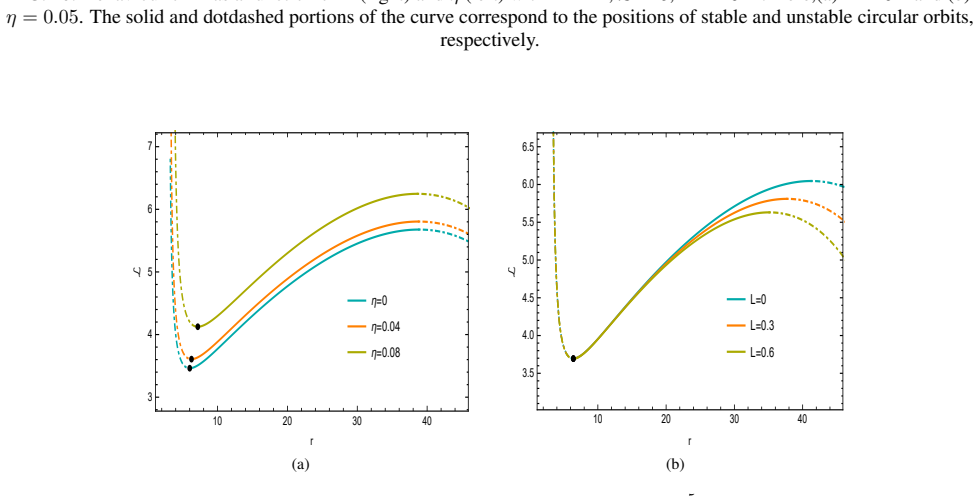
- The narrowing of the stable circular-orbit band means accretion disks would have their inner edge pushed outward as $\eta$ or $L$ increase.
- The close match between eikonal and WKB quasinormal frequencies for scalar and electromagnetic perturbations supports using photon-sphere data to predict ringdown spectra in modified gravity.
- If the modified entropy is accepted, the Carnot bound makes $L$ a parameter with a finite ceiling set by the chosen thermodynamic cycle, not a free input.
- Because classical efficiency is blind to $L$, any observed dependence of black-hole heat-engine efficiency on Lorentz violation would be a direct signature of quantum entropy corrections.
Reading between the lines
- The same logarithmic-correction construction could be applied to other Bumblebee or Lorentz-violating black holes, turning the Carnot bound into a generic mechanism that converts an entropy ansatz into a constraint on the symmetry-breaking parameter.
- The independence of $r_{\mathrm{ph}}$ from $L$ suggests a clean observational separation: shadow radius pins down mainly $\eta$, while the quasinormal damping rate, which does depend on $L$, could separately probe Lorentz violation.
- The predicted failure surface where $\eta_{\mathrm{mod}}/\eta_C$ crosses unity maps out a definite region in the $(L,\alpha)$ plane; if $\alpha$ were ever fixed independently, that surface would mark parameter values that Bumblebee gravity must exclude.
- The remnant-scale prediction $r_h=\sqrt{\alpha L/\pi}$ is not testable until $\alpha$ is specified, so the paper's bound is best read as a relation on the product $\alpha L$ rather than on $L$ alone.
Editorial analysis
A structured set of objections, weighed in public.
Referee Report
Summary. The paper analyzes a Schwarzschild-de Sitter-like black hole with a global monopole in Bumblebee gravity. It derives the effective potentials for null and timelike geodesics, studies photon spheres and shadows, ISCO/OSCO radii, epicyclic frequencies, perihelion precession, and Lyapunov stability, and compares eikonal quasinormal modes with WKB results for scalar and electromagnetic perturbations. In the second half, it treats the cosmological constant as a thermodynamic pressure, evaluates the black hole as a holographic heat engine, and claims that while classical efficiency is independent of the Lorentz-violating parameter L, a quantum-corrected modified entropy introduces L-dependence and yields a Carnot-type bound on the product αL.
Significance. If the thermodynamic derivation were sound, the paper would provide a concrete and testable link between Lorentz violation, global monopole effects, and black hole observables. The geodesic and quasinormal-mode sections are competently executed and contain useful quantitative tables; the claimed enlargement of the photon sphere and shadow with the monopole parameter, and the narrowing of stable circular orbits with L, are falsifiable predictions. The thermodynamic claim, however, is the paper's most novel assertion and it is not supported by a consistent calculation: the modified entropy is postulated rather than derived, and the heat-engine construction violates the first law. The significance of the paper therefore currently rests on the geodesic/QNM parts, while the headline thermodynamic bound on Lorentz violation requires major revision.
major comments (3)
- [§VII.C, Eqs. (46)-(53)] The modified heat-engine calculation is internally inconsistent with the first law. With M given by Eq. (46) and T by Eq. (47), along an isobar one obtains dM = [(1−κη²)/(2√(1+L)) + 4πP r_h²/√(1+L)] dr_h. For S_mod in Eq. (48), T dS_mod equals exactly that bracket minus 2αL T(r_h)/r_h dr_h, so dM − T dS_mod ≠ 0 whenever αL ≠ 0. Consequently the heat absorbed along the upper isobar is not ∫ T dS_mod. Eq. (52) defines Q_H,mod as this integral while retaining the classical enthalpy difference for Q_H,0 and W, dropping the 2αL∫T/r_h dr_h term. Hence Q_H,mod is not the heat input of the cycle, and the efficiency η_mod in Eq. (53) and the bound in Eq. (58) are not thermodynamic consequences of the Second Law. A consistent modified entropy would require a modified mass function satisfying dM = T dS_mod + V dP; no such mass function is supplied.
- [§VII.A, Eq. (48)] The modified entropy S_mod = π r_h² − αL ln(π r_h²) is introduced by asserting that thermal fluctuations and loop quantum gravity yield a logarithmic correction and that its prefactor 'must be' proportional to L. No derivation, microstate counting, or reference is provided for this specific form or for the αL coupling. Because Eqs. (52), (53), and (58) all inherit this assumption, the claimed constraint on Lorentz violation is conditional on an unproven entropy. In addition, α is a free dimensionless parameter, so Eq. (58) bounds only the product αL; the paper's conclusion that L itself cannot be arbitrarily large does not follow unless α is independently fixed.
- [§VII, Eq. (45)] The heat-engine analysis is applied to a Schwarzschild-dS-like spacetime with Λ > 0, for which Eq. (45) gives a negative thermodynamic pressure P = −Λ(1+L)/(8π). The paper uses the standard AdS rectangular P-V cycle, the enthalpy interpretation of M, and the Carnot bound without justifying that this formalism applies to a negative-pressure dS phase space, or that the chosen cycle with P1 > P4 produces positive work consistent with the stated Q_H,0. Since the thermodynamic conclusions depend on this identification, this gap should be addressed or the scope of the thermodynamic section should be restricted.
minor comments (5)
- [Eq. (14)] There is a typo in the formula for b_ph: since b_ph = r_ph/√f(r_ph), the square root should divide the prefactor 3M/(1−κη²), not multiply it. Table I uses the correct values, so the numerical results are unaffected, but the displayed equation should be corrected.
- [Table III caption] The caption says 'for various choices of L', but the rows actually vary η while L is fixed at 0.2; the caption should state η.
- [Fig. 2 and Fig. 3 captions] The vertical axis in Fig. 2b is labeled Vt although the panel shows the null effective potential, and the x-axis label of Fig. 3b is missing the variable name. These labels should be made consistent with the text.
- [§V, text near Eq. (33)] There are several typographical errors in this section, including 'can we written' before Eq. (16) and Eq. (29), 'spcatime' before Eq. (33), and 'Ł' in Table III. A careful proofreading pass is needed.
- [§VI, Eq. (43)] The eikonal QNM formula (43) is stated for spherically symmetric, static, asymptotically flat spacetimes, but the paper applies it to a dS-like spacetime. The numerical agreement in Tables III and IV is encouraging, but a sentence justifying the use of this correspondence beyond asymptotically flat backgrounds would strengthen the presentation.
Circularity Check
Thermodynamic L-coupling and the Carnot bound are built into the postulated modified entropy, while the geodesic and eikonal QNM analyses are self-contained.
-
self definitional
[Sec. VII A, Eq. (48); Sec. VII C, Eqs. (52)-(53)]
"we propose a physically consistent modified entropy for the Bumblebee framework as: Smod = πr^2_h − αL ln(πr^2_h), (48) where α is a dimensionless positive constant tracking the strength of the microstate correction induced by the Lorentz violation."
The L-dependence of the heat engine enters only through this postulate. S_mod contains the product αL by construction, so every later quantity—specific heat (Eq. 50), heat input (Eq. 52), and efficiency (Eq. 53)—inherits that dependence by direct substitution. No independent computation fixes α or establishes that the logarithmic correction couples precisely as αL for this Bumblebee spacetime; the coupling is the input, not a derived result.
-
self definitional
[Sec. VII C-D, Eqs. (52)-(53) and (58)]
"Dividing the work W by this corrected heat input Q_H,mod, the 1/√(1+L) factors completely cancel, leaving the exact modified efficiency: ηmod = ... (53) ... Rearranging Eq. (56) to isolate the parameter product αL, we obtain the strict theoretical upper bound: αL ≤ (1/X)(Q_H,0 − W/η_C). (58)"
Eq. (58) is the inequality η_mod ≤ η_C solved algebraically for αL, with η_mod itself defined through the entropy ansatz (48) via Eq. (53). The bound is therefore a rearrangement of the definition of the modified efficiency, not an independent thermodynamic constraint on L. Moreover, with S_mod, the enthalpy M of Eq. (46) does not satisfy dM = T dS_mod + V dP; one finds dM − T dS_mod = 2αL T(r_h)/r_h dr_h ≠ 0 for αL ≠ 0, so Q_H,mod is not the actual heat absorbed and the Carnot inequality applied to this ratio is an algebraic condition on the inserted parameter product.
full rationale
The geodesic and eikonal QNM sections (Secs. III-VI) are not circular: they are standard computations from the stated metric, and the WKB comparison is a substantive numerical cross-check carried out with the same spacetime but through independent perturbation equations. The circularity is concentrated in the heat-engine part of Sec. VII. Eq. (48) postulates, rather than derives, that the entropy correction is αL ln(π r_h^2); Eq. (52) integrates that entropy to define the 'corrected heat input'; Eq. (53) defines the efficiency with αL in the denominator; and Eq. (58) solves η_mod ≤ η_C for αL. Thus the paper's headline thermodynamic claim—that Lorentz violation is macroscopically constrained by the Second Law—reduces to a rearrangement of the inserted entropy ansatz. Separately, and as a correctness concern rather than a circularity, the construction is thermodynamically inconsistent because dM − T dS_mod − V dP ≠ 0 for αL ≠ 0, so the quantity called corrected heat input is not the heat absorbed by the engine. Since the central thermodynamic result is forced by the paper's own definition of S_mod, the circularity score is 8; the geodesic and QNM analyses are independent and would otherwise justify a low score.
Assumptions & free parameters
free parameters (1)
- alpha =
unspecified, treated as positive constant
assumptions (5)
- domain assumption Metric (1)-(2) is the correct Schwarzschild-dS-like Bumblebee-gravity solution with global monopole
- domain assumption Eikonal QNM correspondence omega = l Omega_ph - i(n+1/2) lambda holds for this spacetime
- domain assumption Extended phase-space identifications P = -Lambda(1+L)/(8 pi) and M_AMD = M/sqrt(1+L)
- ad hoc to paper Modified entropy S_mod = pi r_h^2 - alpha L ln(pi r_h^2)
- standard math Carnot bound eta_mod <= eta_C
invented entities (1)
-
Quantum-corrected modified entropy S_mod
Cite this review
Pith. "Pith review of Geodesic structure, eikonal quasinormal modes and thermodynamic properties of a Schwarzschild-de Sitter-like black hole with global monopole in Bumblebee gravity." pith.science (2026). https://pith.science/paper/5VEDKHP4
@misc{pith2026260809326,
  author       = {Pith},
  title        = {Pith review of: Geodesic structure, eikonal quasinormal modes and thermodynamic properties of a Schwarzschild-de Sitter-like black hole with global monopole in Bumblebee gravity},
  year         = {2026},
  howpublished = {\url{https://pith.science/paper/5VEDKHP4}},
  note         = {Machine review of arXiv:2608.09326}
}
read the original abstract
We investigate the geodesic dynamics, eikonal quasinormal modes (QNMs), and extended phase space thermodynamics of a Schwarzschild-de Sitter-like black hole coupled with a global monopole in Bumblebee gravity. Our analysis reveals that spontaneous Lorentz symmetry breaking and topological defects modify the effective radial dynamics, leading to lower effective potential barriers and a reduced magnitude of the effective force. For null geodesics, higher monopole parameters expand the photon sphere and critical impact parameter, implying an enlarged black hole shadow, while mitigating dynamical instability. For massive particles, the stable circular orbit window narrows significantly as the Outermost Stable Circular Orbit (OSCO) shrinks, alongside a marked enhancement in perihelion precession. In addition, we examine the correspondence between the eikonal QNMs and the properties of null geodesics. The excellent agreement between the eikonal approximation and the WKB method for scalar and electromagnetic perturbations supports the validity of the correspondence for the spacetime under consideration. In the extended thermodynamic phase space, we evaluate the black hole as a holographic heat engine. We demonstrate that classical efficiency is mathematically blind to Lorentz violation; however, introducing a quantum-corrected modified entropy tightly couples the macroscopic work output to the symmetry-breaking framework. Ultimately, the necessity to respect the Carnot bound imposes a strict macroscopic constraint on the Lorentz-violating parameter, safeguarding the Second Law of Thermodynamics.
Figures


Figures from the paper (23 more)






Reference graph
Works this paper leans on
-
[81]
S. Devi, R. Roy, S. Chakrabarti, Quasinormal modes and greybody factorsof the novel four dimensional Gauss-Bonnet black holes in asymptotically de Sitter space time: scalar, electromagnetic and Dirac perturbations, Eur. Phys. J. C 80 (2020) 760
work page 2020
-
[17]
J. Choudhuri, Y . P. Singh, D. J. Gogoi, T. I. Singh, Multi-spin Perturbations, Thermodynamics, and Observational Signatures of Reissner- Nordstr`‘om Black Holes in Bumblebee Gravity, arXiv:2607.20839[gr-qc]
-
[1]
Abbott et al
B.P. Abbott et al. (LIGO Scientific and Virgo Collaborations), Observation of Gravitational Waves from a Binary Black Hole Merger, Phys. Rev. Lett. 116 (2016) 061102
2016
-
[2]
Physically Valid (ηmod ≤η C)
(54) By analytically evaluating the physical limitη mod/ηC ≤1[81], it becomes evident that the subtractiveαLterm in the denom- inator of Eq. (53) substantially enhances the efficiency of the engine. Thus, spontaneous Lorentz symmetry breaking—when properly paired with quantum microstate corrections—drives the black hole heat engine strictly closer to the ...
-
[3]
B. P. Abbottet al.Multi-messenger Observations of a Binary Neutron Star Merger, Astrophys. J. Lett. 848 (2) (2017) L12 doi:10.3847/2041-8213/aa91c9 [arXiv:1710.05833 [astro-ph.HE]]
arXiv 2017
-
[4]
B. P. Abbottet al., (LIGO Scientific and Virgo Collaborations), Observation of Gravitational Waves from a 22-Solar-Mass Binary Black Hole Coalescence, Phys. Rev. Lett. 116 (2016) 241103
work page 2016
-
[5]
B. P. Abbott et al., Observation of Gravitational Waves from a Binary Neutron Star Inspiral, Phys. Rev. Lett. 119 (2017) 161101
work page 2017
-
[6]
B. P. Abbott et al., Observation of a Binary-Black-Hole Coalescence with Asymmetric Masses, Phys. Rev. D 102 (2020) 043015. 28
work page 2020
Show all 82 references
-
[7]
Abbott et al., Observation of Gravitational Waves from Two Neutron Star–Black Hole Coalescences, ApJL 915 (2021) L5
R. Abbott et al., Observation of Gravitational Waves from Two Neutron Star–Black Hole Coalescences, ApJL 915 (2021) L5
2021
-
[8]
Akiyama et al., First M87 Event Horizon Telescope Results
K. Akiyama et al., First M87 Event Horizon Telescope Results. I. The Shadow of the Supermassive Black Hole, Astrophys. J. 875 (2019) L1
2019
-
[9]
Akiyama et al., First M87 Event Horizon Telescope Results
K. Akiyama et al., First M87 Event Horizon Telescope Results. V . Physical Origin of the Asymmetric Ring, Astrophys. J. 875 (2019) L5
2019
-
[10]
Akiyama et al., First M87 Event Horizon Telescope Results
K. Akiyama et al., First M87 Event Horizon Telescope Results. VI. The Shadow and Mass of the Central Black Hole, Astrophys. J. 875 (2019) L6
2019
-
[11]
I. R. Devi, N. Media, Y .P. Singh, T.I. Singh, Strong Lensing and Quasinormal modes of black hole around global monopole, arXiv:2604.05686 [gr-qc]
-
[12]
and Bouzenada, A
Ahmed, F., Moreira, A.R.P. and Bouzenada, A. Noncommutative geometry inspired AdS black hole with a cloud of strings surrounded by quintessence-like fluid. Eur. Phys. J. C 86 (2026) 152
2026
-
[13]
Shokhzod J., Javlon R., Yunus T., Dynamics of spinning particles around a charged black-bounce spacetime, Eur. Phys. J. C. 85 (2025) 1247
2025
-
[14]
Modesto, Semiclassical Loop Quantum Black Hole, Int
L. Modesto, Semiclassical Loop Quantum Black Hole, Int. J. Theor. Phys. 49 (2010) 1649
2010
-
[15]
Alfaro, H.A
J. Alfaro, H.A. Morales-Tecotl, L.F. Urrutia, Loop quantum gravity and light propagation, Phys. Rev. D 65 (2002) 103509
2002
-
[16]
Konoplya, A
R. Konoplya, A. Zhidenko, Detection of gravitational waves from black holes: Is there a window for alternative theories?, Phys. Lett. B 756 (2016) 350-353
2016
-
[18]
Y . P. Singh, I. R. Devi, T. I. Singh, Quasinormal modes of spherically symmetric black hole with cosmological constant and global monopole in Bumblebee gravity, Nucl. Phys. B 1018 (2025) 117006
2025
-
[19]
Casana, A
R. Casana, A. Cavalcante, F. P. Poulis, E. B. Santos, Exact Schwarzschild-like solution in a Bumblebee gravity model, Phys. Rev. D 97 (2018) 104001
2018
-
[21]
Liu, W.D
J.Z. Liu, W.D. Guo, S.W. Wei, Y .X. Liu, Charged spherically symmetric and slowly rotating charged black hole solutions in Bumblebee gravity, Eur. Phys. J. C 85 (2025) 145
2025
-
[22]
C. Ding, C. Liu, R. Casana, A. Cavalcante, Exact Kerr-like solution and its shadow in a gravity model with spontaneous Lorentz symmetry breaking, Eur. Phys. J. C 80 (2020) 178
2020
-
[23]
Gullu, A
I. Gullu, A. Ovgun., Schwarzschild-like black hole with a topological defect in Bumblebee gravity, Ann. Phys. 436 (2022) 168721
2022
-
[24]
C. Ding, X. Chen, X. Fu., Einstein-Gauss-Bonnet gravity coupled to Bumblebee field in four dimensional spacetime, Nucl. Phys. B 975 (2022) 115688
2022
-
[25]
Kanzi, I
S. Kanzi, I. Sakallı, GUP modified Hawking radiation in Bumblebee gravity, Nucl. Phys. B 946 (2019) 114703
2019
-
[26]
Karmakar, D.J
R. Karmakar, D.J. Gogoi, U.D Goswami, GUP-corrected black holes: Thermodynamic properties, evaporation time and shadow con- straint from EHT Observations of M87* and Sgr A*, Physics of the Dark Universe, 41 (2023) 101249
2023
-
[27]
Z.F. Mai, R. Xu, D. Liang, L. Shao, Extended thermodynamics of the Bumblebee black holes, Phys. Rev. D 108 (2023) 024004
2023
-
[28]
An, Notes on thermodynamics of Schwarzschild-like Bumblebee black hole, Phys
Y .S. An, Notes on thermodynamics of Schwarzschild-like Bumblebee black hole, Phys. Dark Univ. 45 (2024) 101520
2024
-
[29]
Zhang, M
X. Zhang, M. Wang, J. Jing, Quasinormal modes and late time tails of perturbation fields on a Schwarzschild-like black hole with a global monopole in the Einstein-Bumblebee theory, Sci. China Phys. Mech. Astron. 66 (2023) 100411
2023
-
[30]
Gogoi, U.D
D.J. Gogoi, U.D. Goswami, Quasinormal modes and Hawking radiation sparsity of GUP corrected black holes in Bumblebee gravity with topological defects, Journal of Cosmology and Astroparticle Physics, 06 (2022) 029
2022
-
[31]
S.K. Jha, A. Rahaman., Bumblebee gravity with a Kerr–Sen like solution and its Shadow, Eur. Phys. J. C 81 (2021) 345
2021
-
[32]
Ovgun, K
A. Ovgun, K. Jusufi, I. Sakalli, Gravitational lensing under the effect of Weyl and Bumblebee gravities: Applications of Gauss-Bonnet theorem , Annals Phys. 399 (2018) 193
2018
-
[33]
Mengjie W., Zhou C., Qiyuan P. et. al., Maxwell quasinormal modes on a global monopole Schwarzschild-anti-de Sitter black hole with Robin boundary conditions, Eur. Phys. J. C 81 (2021) 469
2021
-
[34]
Kibble, Topology of cosmic domains and strings, J
T.W.B. Kibble, Topology of cosmic domains and strings, J. Phys. A 9 (1976) 1387
1976
-
[35]
Vilenkin, Phys
A. Vilenkin, Phys. Rep., Cosmic strings and domain walls, 121 (1985) 263
1985
-
[36]
and Sakallı, ˙I
Al-Badawi, A., Ahmed, F. and Sakallı, ˙I. Dunkl black hole with phantom global monopoles: geodesic analysis, thermodynamics and shadow. Eur. Phys. J. C 85, 660 (2025)
2025
-
[37]
Malik, Quasinormal Modes of the Bumblebee Black Holes with a Global Monopole, Int
Z. Malik, Quasinormal Modes of the Bumblebee Black Holes with a Global Monopole, Int. J. Theor. Phys. 63 (2024) 199
2024
-
[38]
al., Class
Mou Xu et. al., Class. Quantum Grav., Particle dynamics and optical appearance of charged spherically symmetric black holes in Bum- blebee gravity, 42 (2025) 135008
2025
-
[39]
Cardoso, A.S
V . Cardoso, A.S. Miranda, E. Berti, H. Witek, V .T. Zanchin, Geodesic stability, Lyapunov exponents, and quasinormal modes, Phys. Rev. D 79 (2009) 064016
2009
-
[40]
Ahmed, J
F. Ahmed, J. Goswami, A. Bouzenada, Positive energy density in topologically charged exponential wormholes and Regge–Wheeler potential, Eur. Phys. J. C 85 (2025) 110
2025
-
[41]
J. C. Drawer and S. Grunau, Geodesic motion around a supersymmetric AdS 5 black hole Eur. Phys. J. C 80. 6 (2020) 536
2020
-
[42]
Y . C. Ko, D. S. Lee, C. Y . Lin, Inspiral and plunging orbits in Kerr-Newman spacetimes, Phys. Rev. D 109 (2024) 084043
2024
-
[43]
K. Chen, S. W. Wei, Motion of spinning particles around a polymer black hole in loop quantum gravity, Phys. Rev. D 110 (2024) 024041
2024
-
[44]
Giri, S., Nandan, H., Joshi, L.K. et al. Geodesic stability and quasinormal modes of non-commutative Schwarzschild black hole employ- ing Lyapunov exponent. Eur. Phys. J. Plus 137 (2022) 181
2022
-
[45]
Sharif, M
M. Sharif, M. Shahzadi, Particle dynamics near kerr-mog black hole. Eur. Phys. J. C. 77(6) (2017) 363
2017
-
[46]
Kokkotas, K.D., Schmidt, B.G.: Quasi-Normal Modes of Stars and Black Holes, Living Rev. Relativ. 2 (1999)
1999
-
[47]
L.,Eduard L
Jose M. L.,Eduard L. Eikonal Quasinormal Modes, Photon Sphere and Shadow of a Charged Black Hole in the 4D Einstein-Gauss-Bonnet Gravity, International Journal of Theoretical Physics 62 (2023) 209. 29
2023
-
[48]
Konoplya, A
R.A. Konoplya, A. Zhidenko, Quasinormal modes of black holes: From astrophysics to string theory, Rev. Mod. Phys. 83 (2011) 793
2011
-
[49]
Yating P., Jia-Hui H., Scalar quasinormal modes, Lyapunov exponents and radii of null geodesics of rotating regular black holes, Eur. Phys. J. C 85 (2025) 1312
2025
-
[50]
Abbott et al
B.P. Abbott et al. (LIGO Scientific and Virgo Collaborations), Phys. Rev. Lett. 116 (2016) 221101
2016
-
[51]
Konoplya, A
R.A. Konoplya, A. Zhidenko, A.F. Zinhailo, Higher order WKB formula for quasinormal modes and greybody factors: recipes for quick and accurate calculations, Class. Quantum Gravity 36 (2019) 155002
2019
-
[52]
Media, Y .P
N. Media, Y .P. Singh, Y . O. Laxmi, T. I. Singh, Entropy correction and quasinormal modes of slowly rotating Kerr- Newman- de Sitter-like blacl hole in Bumblebee gravity, Gen. Relativ. Gravit. 57 (2025) 80
2025
-
[53]
Priyobarta, T.S
Y .S. Priyobarta, T.S. Ibungochouba, Greybody factor and quasinormal modes of scalar and Dirac field perturbation in Schwarzschild-de Sitter-like black hole in Bumblebee gravity model, Eur. Phys. J. C 84 (2024) 1245
2024
-
[54]
Singh, N
Y .P. Singh, N. Media, T. I. Singh, Strong lensing and Hawking spectra of charged black hole under Lorentz violation theory, Eur. Phys. J. C 83 (2025) 1223
2025
-
[55]
Singh, J
Y .P. Singh, J. Choudhury, T. I. Singh, Field perturbations and observables in a charged black hole within Bumblebee gravity, Eur. Phy. J. Plus 140 (2025) 11
2025
-
[56]
Dias, O.J.C., Eperon, F.C., Reall, H.S., Santos, J.E., Strong cosmic censorship in de Sitter space. Phys. Rev. D 97 (2018) 104060
2018
-
[57]
Cornish, N.J., Levin, J.J., Lyapunov timescales and black hole binaries. Class. Quant. Grav. 20 (2003) 1649
2003
-
[58]
M., Emanuele B
Vitor C., Alex S. M., Emanuele B. et. al., Geodesic stability, Lyapunov exponents, and quasinormal modes, Phys. Rev. D 79 (2009) 064016
2009
-
[59]
Alexander Roussev, Quasinormal modes for a Kerr-de Sitter black hole in the eikonal limit and a generalization to Myers-Perry-de Sitter black holes with a single rotation, Gen. Relativ. Gravit. 54 (2022) 80
2022
-
[60]
Ferrari, B
V . Ferrari, B. Mashhoon, New approach to the quasinormal modes of a black hole, Phys. Rev. D 30 (1984) 295
1984
-
[61]
Stefanov, S.S
I.Z. Stefanov, S.S. Yazadjiev, G.G. Gyulchev, Connection between Black-Hole Quasinormal Modes and Lensing in the Strong Deflection Limit, Phys. Rev. Lett. 104 (2010) 251103
2010
-
[62]
Johnson et al., Universal interferometric signatures of a black hole’s photon ring, Sci
M.D. Johnson et al., Universal interferometric signatures of a black hole’s photon ring, Sci. Adv. 6 (2020) eaaz1310
2020
-
[63]
S. Giri, H. Nandan, Stability analysis of geodesics and quasinormal modes of a dual stringy black hole via Lyapunov exponents, Gen. Relativ. Gravit. 53 (2021) 76
2021
-
[64]
S. Giri, H. Nandan, L.K. Joshi, S.D. Maharaj, Geodesic stability and quasinormal modes of non-commutative Schwarzschild black hole employing Lyapunov exponent, Eur. Phys. J. Plus 137 (2022) 181
2022
-
[65]
Bekenstein, Black holes and entropy, Phys
J.D. Bekenstein, Black holes and entropy, Phys. Rev. D 7 (1973) 2333–2346
1973
-
[66]
Hawking, Particle creation by black holes, Commun
S.W. Hawking, Particle creation by black holes, Commun. Math. Phys. 43 (1975) 199–220. [Erratum: Commun.Math.Phys. 46, 206 (1976)]
1975
-
[67]
D. J. Gogoi, N.B. Gogoi, Y . P. Singh, J. Bora, T. I. Singh, Throttling process, heat engine efficiency and thermodynamic topology of Bardeen black holes surrounded by a cloud of strings with a generalized entropy, Phys. Dark Univ. 52 (2026) 102345
2026
-
[68]
S. Rani, A. Jawad, H. Raza, S. Shaymatov, M. Muzaffar, H. Riaz, Thermodynamic properties and geometries of bardeen black hole surrounded by string clouds, Eur. Phys. J. C 84 (9) (2024) 904
2024
-
[69]
H-.Fard, M
M. H-.Fard, M. H-. Fard, H. R. Sepangi, Null geodesics and shadow of hairy black holes in Einstein-Maxwell-dilaton gravity, Phys. Rev. D 105 (2022) 124009
2022
-
[70]
M. M. Gohain, P. Phukon, K. Bhuyan, Thermodynamics and Null Geodesics of a Schwarzschild Black Hole Surrounded by a Dehnen Type Dark Matter Halo, Phys. Dark Univ. 46 (2024) 101683
2024
-
[71]
Narzilloev, J
B. Narzilloev, J. Rayimbaev, S. Shaymatov, et. al., Dynamics of geodesics around the Bardeen -AdS black hole immersed in quintessence, Phys. Rev. D 102 (2020) 104062
2020
-
[72]
M. M. Gohain, K. Bhuyan, R. Borgohain, et. al., Frolov black hole surrounded by quintessence -I: Thermodynamics, geodesics and shadows. Nucl. Phys. B 1018 (2025) 117073
2025
-
[73]
Rayimbaev et
J. Rayimbaev et. al., Test particles and quasiperiodic oscillations around Kiselev black hole with cloud of strings. Chin. Phys. C 48 (2024)055104
2024
-
[74]
M. B. J. Poshteh, Timelike orbits around accelerating black holes, Phys. Rev. D. 106 (2022) 044037
2022
-
[75]
X-Q. Li et. al., Black holes immersed in modified Chaplygin-like dark fluid and cloud of strings: geodesics, shadows and images. Chin. Phys. C 49 (2025 ) 105104
2025
-
[76]
M. M. Gohain, S. Acharjee, H. P. Saikia, K. Bhuyan, Exploring the role of Lyapunov Exponents on Null-Geodesics, Quasinormal Modes and Shadows of NLED Black Holes,
-
[77]
Mustafa, F
G. Mustafa, F. Javed, S. G. Ghosh, et al. Epicyclic frequencies around charged regular black hole: constraints using different quasars data. Eur. Phys. J. C 86 (2026) 6
2026
-
[78]
R. V . Maluf, J. C. S. Neves, Black holes with a cosmological constant in Bumblebee gravity, Phys. Rev. D 103 (2021) 044002
2021
-
[79]
G¨ull¨u, A
˙I. G¨ull¨u, A. ¨Ovg¨un, Schwarzschild-like black hole with a topological defect in Bumblebee gravity, Annals of Physics, 436 (2022) 168721
2022
-
[80]
M. S. Churilova, Analytical quasinormal modes of spherically symmetric black holes in the eikonal regime, Eur. Phys. J. C 79 (2019) 629
2019
-
[82]
Optical and thermodynamic signatures of Lorentz symmetry breaking in Bumblebee AdS black holes,
B. Eslam Panah, A. Guvendi, S. Gurtas Dogan and O. Mustafa, “Optical and thermodynamic signatures of Lorentz symmetry breaking in Bumblebee AdS black holes,” Chin. J. Phys. 103 (2026) 1698-1713
2026
-
[83]
Y . P. Singh, T. I. Singh, S. N. Singh, Maxwell’s equal area for Vaidya-Bonner-de Sitter black hole under Lorentz invariance violation, Chin. Phys. C 11 (2024) 115111
2024
Reviewed August 11, 2026 · model on record in the stance chip above.
Discussion (0). Continue with ORCID to comment.