REVIEW 4 major objections 4 minor 35 references
LEED: Local Embedding Evolution Distance for over-smoothing estimation and virtual node selection in GNN
T0 review · 4 major / 4 minor · reviewed 2026-08-11 · deepseek-v4-flash
Pith's one-line read LEED, a node-level embedding-evolution distance, claims to diagnose over-smoothing and to select virtual nodes better than classical centrality measures.
desk verdict Neat local metric idea, but the critical-node selection used in experiments is a static proxy that on featureless graphs reduces to degree centrality, so the headline claim of replacing centrality is not supported. read the letter →
The pith
A machine-rendered reading of the paper's core claim, the machinery that carries it, and where it could break.
The reading
What carries the argument
The load-bearing object is the two-hop mean evolution operator $T_2$, a degree-weighted average of a node's neighbors' one-hop averages with an added self-loop weight, applied to node embeddings. LEED defines each node's over-smoothing score through $T_2$: the minimum squared distance from a node's evolved embedding to any neighbor's evolved embedding, Eq. (4), while the critical-node score $D_i = \|T_2(x_i^{(0)}) - x_i^{(0)}\|_2$, Eq. (12), applies the same operator once to the input embeddings. The proof that $L(X)$ is bounded by a scaled Dirichlet energy, Eq. (11), connects LEED to the global over-smoothing measure. For featureless graphs, the constant-feature reduction makes $D_i$ equal to $|d_i-2|/(d_i+2)$, so selection then coincides with degree centrality.
What would settle it
Train a GCN with several random initializations on a featureful dataset like MUTAG or PROTEINS, compute the top-K nodes from the static proxy $D_i$ (Eq. 12) and from the trajectory-based LEED scores $\ell_i$ (Eq. 4), and measure their overlap; if the intersections are at chance level across most runs, the one-shot proxy is not capturing the embedding dynamics the paper says drive criticality.
Extended reading notes
Core claim
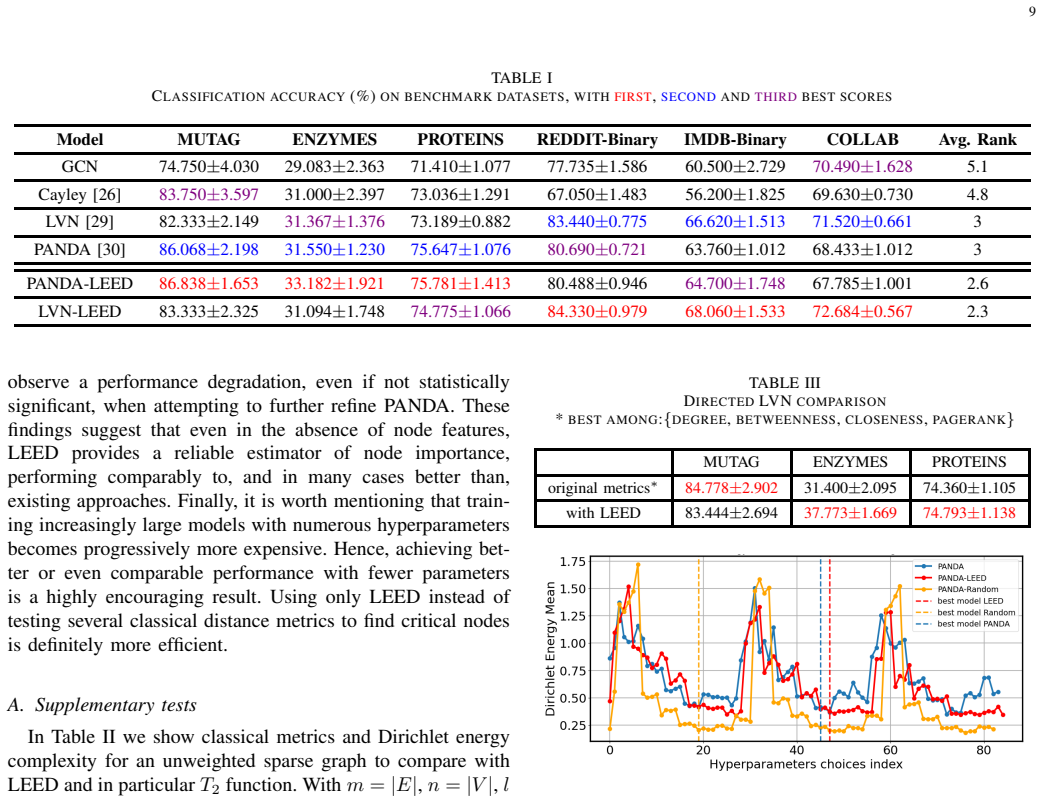
On its own terms, the paper discovers that a per-node distance computed from a two-hop mean evolution of embeddings behaves like a local Dirichlet energy, and that ranking nodes by the one-shot distance between their initial embedding and its evolved counterpart identifies the nodes most worth rewiring. LEED's local score for node $i$ is the minimum squared distance between the evolved embedding of $i$ and that of any neighbor, $\ell_i = \min_{j\in\mathcal{N}_i} \|T_2(x_i) - T_2(x_j)\|_2^2$, and its graph-level sum $L(X)$ is bounded above by a constant times the Dirichlet energy, $L(X) \le (\max_i 2/d_i) C_{\hat{T}} E(X)$. When input features are uninformative, the score reduces to a monotone function of degree, $|d_i-2|/(d_i+2)$, so the claimed advantage must come from datasets where features carry structure. In experiments, LVN with LEED-selected critical nodes achieves the best average rank across six benchmarks, and PANDA-LEED improves three of them.
Load-bearing premise
The virtual-node selection rests on the assumption that a single static application of the two-hop evolution to the initial embeddings (Eq. 12) ranks critical nodes the same way the training-trajectory LEED metric does, and that this ranking remains informative on datasets whose node features are uninformative or absent.
Editorial extensions
If this is right
- Over-smoothing can be monitored per node during training, so a practitioner can see which cliques or bridge nodes collapse first, not just the graph-wide average.
- Graph-rewiring methods such as LVN and PANDA can drop the empirical search over PageRank, betweenness, closeness, and degree; LEED alone selects the top-K critical nodes.
- Because the graph-level LEED sum is bounded by a Dirichlet-energy term, LEED could replace Dirichlet energy in regularization-based training while preserving the same global guarantees.
- On sparse graphs LEED costs $O(l\cdot n\cdot \bar{d})$, comparable to Dirichlet energy, so the added node-level resolution does not require an asymptotic complexity increase.
- The same LEED ranking improves a directed virtual-node variant, with the largest gain reported on ENZYMES.
Reading between the lines
- The reduction of LEED to degree centrality on featureless datasets means that on datasets without node features the method is, in effect, a degree-hub strategy; an explicit comparison against naive degree top-K selection would show whether the embedding-evolution machinery adds anything in those cases.
- The static proxy $D_i$ (Eq. 12) is applied once to input embeddings, whereas the LEED metric itself is defined over training trajectories; whether the one-shot ranking matches the trajectory-based ranking on deeper or randomly initialized GNNs is a testable assumption the paper does not directly evaluate.
- Because the bound constant $C_{\hat{T}}$ can become large on big graphs, the authors rely on relative trajectory similarity rather than absolute values; normalizing LEED differently might tighten the link to Dirichlet energy and change the comparability on large datasets.
- The study is confined to GCN message passing; if the same critical-node ranking transfers to attention-based or higher-order architectures, LEED could serve as an architecture-agnostic rewiring criterion, but that transfer is not demonstrated.
Editorial analysis
A structured set of objections, weighed in public.
Referee Report
Summary. The paper introduces LEED (Local Embedding Evolution Distance), a node-level metric defined in Eq. (4) as the minimum squared distance between a node's two-hop mean-transformed embedding and those of its neighbors, intended to quantify local over-smoothing. A graph-level aggregation L(X) is proposed and compared with Dirichlet energy. The paper then defines a critical-node score D_i in Eq. (12), applies it to select nodes for virtual-node insertion in LVN and width expansion in PANDA, and reports classification accuracies on six TUDataset benchmarks, concluding that LEED-based selection improves GNN performance.
Significance. If fully supported, a parameter-free local metric that both diagnoses over-smoothing and improves virtual-node placement would be a useful contribution to graph rewiring. The paper has some strengths: the LEED definition is interpretable, the complexity comparison in Table II is helpful, and experiments span six datasets with multiple runs. However, the theoretical link between L and E is not established (Eq. 11 involves an unbounded constant), the selection score D_i in Eq. (12) is not the LEED metric of Eq. (4), and on featureless graphs it reduces to a degree-based function (Eq. 15). As a result, the main empirical claims are not clearly attributable to the proposed metric. The reported gains are also modest and inconsistently significant across datasets, undercutting the 'globally better' conclusion. The core idea is interesting, but the current evidence is insufficient to support the central claims.
major comments (4)
- [Section IV-B (Eq. 11)] The claimed bound L(X^(k)) ≤ (max_i 2/d_i) C_bT E(X^(k)) does not provide a meaningful theoretical link between LEED and Dirichlet energy. C_bT is defined as a supremum of a Rayleigh quotient, and the authors themselves state that it 'can become very large for large-scale datasets' (text after Eq. 11). The proof is therefore vacuous as a bound, and the subsequent assertion that 'in practice ∃ C s.t. C·E(X) ≤ L(X)' is an empirical assumption, not a derived property. The paper should either derive a controlled bound with a graph-dependent constant that is explicitly computed, or present the similarity to Dirichlet energy as purely empirical and remove the inequality from the theoretical claims.
- [Section V (Eq. 12), Section IV-B (Eq. 4)] The critical-node score used in all experiments is D_i = ||T2(x_i^(0)) − x_i^(0)||^2, a static one-step application of T2 to the input embeddings. This is not the LEED metric of Eq. (4), which is l(x_i^(k)) = min_{j∈N_i} ||T2(x_i^(k)) − T2(x_j^(k))||^2 and is evaluated layer-by-layer during training. The score D_i contains no min over neighbors and no tracking across layers. No experiment checks whether the top-K of D_i agrees with the top-K of the layer-wise LEED scores. Without such validation (or direct use of Eq. (4) for node selection), the reported improvements from virtual-node construction cannot be attributed to LEED.
- [Section V-A (Eq. 15)] For the three datasets without node features (REDDIT-BINARY, IMDB-BINARY, COLLAB), the paper assigns a constant feature vector and derives D_i = |d_i − 2|/(d_i + 2). This depends only on the degree d_i, so the resulting ranking is a degree-based heuristic, not an embedding-evolution measure. The text claims the formula 'increases monotonically with d_i', but it does not: f(1)=1/3 > f(2)=0 and f(3)=0.2. More fundamentally, since the rank is a deterministic function of degree, the gains on featureless datasets do not demonstrate that LEED replaces classical centrality measures; they demonstrate a particular degree-based reweighting. If the authors intend to claim otherwise, they must show that the full LEED (Eq. 4) produces a different ranking on these datasets.
- [Section VII (Table I)] The conclusion 'It is clear that LVN with LEED performs globally better than any other model' is not supported by the reported results. On MUTAG, LVN-LEED (83.333±2.325) is lower than PANDA (86.068±2.198) and PANDA-LEED (86.838±1.653); on ENZYMES, LVN-LEED (31.094±1.748) is comparable to LVN (31.367±1.376) and below PANDA-LEED (33.182±1.921). The average rank of 2.3 does not reflect these pairwise differences, and no statistical significance testing (e.g., paired tests over the runs) is reported. The findings support at most 'LEED-based selection is competitive and sometimes better than existing centrality-based selection on these datasets'.
minor comments (4)
- [General / Figure 1] There are several typos: 'gragh' in the Figure 1 caption should be 'graph'; 'Another import aspect' in Section IV-A should be 'important'; 'ArXive' appears in references [26] and [29]; reference [20] uses 'ICKM' instead of 'CIKM'.
- [Section IV-B] The notation for the local score is inconsistent: Eq. (4) uses ℓ(x_i^(k)), while Eq. (8) sums over i as L(X^(k)) = Σ_i ℓ(x_i^(k)), but later text refers to a 'local score l_i'. The self-loop coefficient 2 in Eq. (6) is not justified; it is effectively a hyperparameter of T2, which is not acknowledged in the parameter-free claims.
- [Section V-A] The condition 'except when d_p << d_i, ∀p ∈ N_i' in the discussion of Eq. (15) is undefined and unexplained; it should be made precise or removed.
- [Section VI] The experimental section says 'For LVN, we extensively evaluated ... conducting 20 independent runs ... Given the lower variance reported in the original results, we retain their reported scores.' This mixing of reproduced and borrowed numbers should be clarified: for which cells in Table I are the reported means and errors taken from prior papers rather than from the authors' own runs? This matters for the statistical comparison.
Circularity Check
On featureless datasets, the 'LEED' selection rule of Eq. (12) collapses to degree centrality by Eq. (15), so the claimed replacement of centrality heuristics is partly a renaming of degree centrality; the dynamic LEED metric of Eq. (4) is not the criterion used.
-
renaming known result
[Section V, Eq. (12) and Eq. (15); experiments in Section VII, Table I]
"Let Di = ||T2(x_i^(0)) - x_i^(0)||^2, i ∈ [1,n] (12) ... For undirected graphs with a symmetric binary adjacency matrix, this simplification allows the proposed measure to be expressed in closed form, yielding the following output: Di = |d_i - 2|/(d_i + 2) (15) ... This simple formula yields a value in [0,1], that increases monotonically with d_i, the degree of node i."
The criterion used in the LVN-LEED and PANDA-LEED experiments is D_i (Eq. 12), not the layer-wise local metric ℓ(x_i^(k)) of Eq. (4), which includes a minimum over neighbors and tracks evolution across layers. For the three datasets without node features (REDDIT-BINARY, IMDB-BINARY, COLLAB), the paper assigns a constant feature vector to every node, and Eq. (15) makes D_i a strictly increasing function of degree. Consequently, the top-K set S_k of Eq. (14) is exactly the top-K by degree centrality: the proposed 'unique criterion' reduces, by the paper's own closed form, to the classical degree heuristic it claims to replace. The reported gains on those datasets are therefore not evidence for a new embedding-evolution distance.
full rationale
The over-smoothing diagnostic itself is not circular: LEED is a parameter-free local distance, Eq. (11) is an inequality (an upper bound, not an identity) linking L to Dirichlet energy, and Figure 4 is a consistency check rather than a derivation from E. There is no load-bearing self-citation and no fitted parameter renamed as prediction. The circularity is confined to the virtual-node-selection claim: because the operational selection score in featureless graphs equals degree centrality by Eq. (15), and because it is not the metric of Eq. (4), the paper's central claim that LEED replaces multiple centrality heuristics is partly a renaming of degree centrality. This affects three of the six benchmark datasets, so a moderate score, not a high one, is appropriate.
Assumptions & free parameters
free parameters (2)
- self-loop weight in T2 (coefficient 2 in Eq. 6) =
2
- top-K fraction k (Eq. 13) =
not reported
assumptions (4)
- domain assumption GCN message-passing model with symmetric binary adjacency matrix and self-loops (Section II, Eq. 1)
- domain assumption Analogy between GCN layers and a Markov diffusion kernel (Section IV-B, from [34])
- ad hoc to paper Existence of a constant C such that C*E(X) <= L(X) in practice (Section IV-B, after Eq. 11)
- domain assumption One-hot embeddings in MUTAG and ENZYMES behave like an unbiased random distribution for the expectation formula (Section V-A)
Cite this review
Pith. "Pith review of LEED: Local Embedding Evolution Distance for over-smoothing estimation and virtual node selection in GNN." pith.science (2026). https://pith.science/paper/UVN2P32I
@misc{pith2026260809596,
  author       = {Pith},
  title        = {Pith review of: LEED: Local Embedding Evolution Distance for over-smoothing estimation and virtual node selection in GNN},
  year         = {2026},
  howpublished = {\url{https://pith.science/paper/UVN2P32I}},
  note         = {Machine review of arXiv:2608.09596}
}
read the original abstract
Graph Neural Networks (GNNs) suffer from two fundamental limitations: over-smoothing, where node representations become indistinguishable with depth, and over-squashing, where long-range information is compressed through limited message-passing channels. Existing metrics such as Dirichlet energy provide global characterizations of over-smoothing but lack the resolution to analyze node-level behavior and guide architectural improvements. In this paper, we propose LEED (Local Embedding Evolution Distance), a novel local metric that quantifies over-smoothing by tracking the evolution of individual node embeddings across layers. By operating at the node level, LEED enables fine-grained analysis of representation dynamics during training, revealing heterogeneous over-smoothing patterns that are invisible to global energy-based measures. This locality induces informative node importance scores, interpreted as embedding-driven centrality measures. We leverage LEED to design a more efficient strategy for virtual node selection. Unlike existing approaches that depend on multiple heuristic centrality measures, our method uses LEED as a unique criterion to guide the construction of Local Virtual Nodes to mitigate over-squashing. Experiments show that LEED provides more informative diagnostics than Dirichlet energy while preserving global evaluation, and enables more effective virtual node integration, improving GNN performance across datasets.
Figures


Figures from the paper (4 more)


Reference graph
Works this paper leans on
-
[1]
Enhancing 5G radio planning with graph representations and deep learning,
A. Paul, S.-V . Jos ´e, L. Andra, C.-A. Albert, and B.-R. Pere, “Enhancing 5G radio planning with graph representations and deep learning,” in 5G-MeMU ’23, 2023
work page 2023
-
[2]
Fault detection in telecom networks using bi- level federated graph neural networks,
B. R ´emi and Z. Tahar, “Fault detection in telecom networks using bi- level federated graph neural networks,” in2023 IEEE International Conference on Data Mining Workshops (ICDMW), 2023
work page 2023
-
[3]
Semi-supervised classification with graph convolutional networks,
T. N. Kipf and M. Welling, “Semi-supervised classification with graph convolutional networks,”arXiv preprint arXiv:1609.02907, 2016
arXiv 2016
-
[4]
Graph neural networks in computer vision - architectures, datasets and common approaches,
K. Maciej, Łukasik Szymon, and G. A. H., “Graph neural networks in computer vision - architectures, datasets and common approaches,” in International Joint Conference on Neural Networks (IJCNN), 2022
work page 2022
-
[5]
Improving expressivity of GNNs with subgraph-specific factor embedded normalization,
C. Kaixuan, L. Shunyu, Z. Tongtian, Q. Ji, S. Yun, T. Yingjie, Z. Tongya, Z. Haofei, F. Zunlei, Y . Jingwen, and S. Mingli, “Improving expressivity of GNNs with subgraph-specific factor embedded normalization,” in ACM SIGKDD ’23, 2023
work page 2023
-
[6]
A survey on over- smoothing in graph neural networks,
R. T. Konstantin, B. M. M, and M. Siddhartha, “A survey on over- smoothing in graph neural networks,”arXiv preprint arXiv:2303.10993, 2023
arXiv 2023
-
[7]
Over-squashing in graph neural networks: A comprehen- sive survey,
S. Akansha, “Over-squashing in graph neural networks: A comprehen- sive survey,”Neurocomputing, vol. 642, p. 130389, 2025
work page 2025
-
[8]
Simplifying graph convolutional networks,
W. Felix, S. Amauri, Z. Tianyi, F. Christopher, Y . Tao, and W. Kilian, “Simplifying graph convolutional networks,” inICML’19, 2019
work page 2019
Show all 35 references
-
[9]
Graph neural networks exponentially lose expressive power for node classification,
K. Oono and T. Suzuki, “Graph neural networks exponentially lose expressive power for node classification,”arXiv preprint arXiv:1905.10947, 2019
1905 arXiv
-
[10]
Bag of tricks for training deeper graph neural networks: A comprehensive benchmark study,
C. Tianlong, Z. Kaixiong, D. Keyu, Z. Wenqing, W. Peihao, H. Xia, and W. Zhangyang, “Bag of tricks for training deeper graph neural networks: A comprehensive benchmark study,”IEEE Transactions on Pattern Analysis and Machine Intelligence, vol. 45, no. 3, pp. 2769– 2781, 2023
2023
-
[11]
Gradient rewiring for editable graph neural network training,
J. Zhimeng, L. Zirui, H. Xiaotian, Q. Feng, J. Hongye, T. Qiaoyu, Z. Kaixiong, Z. Na, and H. Xia, “Gradient rewiring for editable graph neural network training,” inNeurIPS, 2024
2024
-
[12]
Dirichlet energy constrained learning for deep graph neural networks,
Z. Kaixiong, H. Xiao, Z. Daochen, C. Rui, L. Li, C. Soo-Hyun, and H. Xia, “Dirichlet energy constrained learning for deep graph neural networks,”Advances in neural information processing systems, vol. 34, pp. 21834–21846, 2021
2021
-
[13]
Rewiring techniques to mitigate oversquashing and oversmoothing in GNNs: A survey,
H. Attali, D. Buscaldi, and N. Pernelle, “Rewiring techniques to mitigate oversquashing and oversmoothing in GNNs: A survey,”arXiv, 2024
2024
-
[14]
Reverse graph learning for graph neural network,
P. Liang, H. Rongyao, K. Fei, G. Jiangzhang, M. Yujie, S. Xiaoshuang, and Z. Xiaofeng, “Reverse graph learning for graph neural network,” IEEE Transactions on Neural Networks and Learning Systems, vol. 35, no. 4, pp. 4530–4541, 2024
2024
-
[15]
Self-supervised node representation learning via node-to-neighbourhood alignment,
D. Wei, Y . Dawei, and W. Peng, “Self-supervised node representation learning via node-to-neighbourhood alignment,”IEEE Transactions on Pattern Analysis and Machine Intelligence, vol. 46, no. 6, pp. 4218– 4233, 2024
2024
-
[16]
Rewiring with positional en- codings for graph neural networks,
G. R. Br ¨uel, Y . Mikhail, and S. Justin, “Rewiring with positional en- codings for graph neural networks,”Transactions on Machine Learning Research, 2023
2023
-
[17]
Tudataset: A collection of benchmark datasets for learning with graphs,
M. Christopher, K. N. M, B. Franka, K. Kristian, M. Petra, and N. Marion, “Tudataset: A collection of benchmark datasets for learning with graphs,” inICML’20, 2020
2020
-
[18]
Graph attention networks,
P. Velickovic, G. Cucurull, A. Casanova, A. Romero, P. Lio, and Y . Bengio, “Graph attention networks,” inICML’18, 2018
2018
-
[19]
measuring and relieving the over-smoothing problem for graph neural networks from the topological view,
D. Chen, Y . Lin, W. Li, P. Li, J. Zhou, and X. Sun, “measuring and relieving the over-smoothing problem for graph neural networks from the topological view,” inAAAI’20, 2020
2020
-
[20]
On the trade- off between over-smoothing and over-squashing in deep graph neural networks,
G. J. H., S. Konstantinos, B. Thierry, and M. F. D., “On the trade- off between over-smoothing and over-squashing in deep graph neural networks,” inACM International Conference on Information and Knowl- edge Management (ICKM, 2023
2023
-
[21]
un- derstanding virtual nodes: oversquashing and node heterogeneity,
J. Southern, F. D. Giovanni, M. Bronstein, and J. F. Lutzeyer, “un- derstanding virtual nodes: oversquashing and node heterogeneity,” in ICLR’25, 2025
2025
-
[22]
On the connection between MPNN and graph transformer,
C. Chen, H. T. Son, Y . Rose, and W. Yusu, “On the connection between MPNN and graph transformer,” inICML’23, 2023
2023
-
[23]
Fast and distributed equivariant graph neural networks by virtual node learning,
Z. Yuelin, C. Jiacheng, H. Jiaqi, and H. Wenbing, “Fast and distributed equivariant graph neural networks by virtual node learning,”IEEE Transactions on Pattern Analysis and Machine Intelligence, pp. 1–15, 2026
2026
-
[24]
Mitigating over-smoothing and over- squashing using augmentations of forman-ricci curvature,
F. Lukas and W. Melanie, “Mitigating over-smoothing and over- squashing using augmentations of forman-ricci curvature,” inLearning on Graphs Conference, 2024
2024
-
[25]
Un- derstanding over-squashing and bottlenecks on graphs via curvature,
T. Jake, D. G. Francesco, C. B. Paul, D. Xiaowen, and B. M. M, “Un- derstanding over-squashing and bottlenecks on graphs via curvature,” arXiv preprint arXiv:2111.14522, 2021
2021 arXiv
-
[26]
Cayley graph propagation,
J. Wilson, M. Bechler-Speicher, and P. Veli ˇckovi´c, “Cayley graph propagation,”ArXive, 2025
2025
-
[27]
Virtual node tuning for few-shot node classification,
Z. Tan, R. Guo, K. Ding, and H. Liu, “Virtual node tuning for few-shot node classification,” inACM SIGKDD ’23, 2023
2023
-
[28]
Topological data analysis in graph neural networks: Surveys and perspectives,
P. Phu, B. Quang-Thinh, T. N. Ngoc, K. Robert, Y . P. S., and V . Bay, “Topological data analysis in graph neural networks: Surveys and perspectives,”IEEE Transactions on Neural Networks and Learning Systems, vol. 36, no. 6, pp. 9758–9776, 2025
2025
-
[29]
Local virtual nodes for alleviating over-squashing in graph neural networks,
T. H. Karabulut and ˙Inci M. Baytas ¸, “Local virtual nodes for alleviating over-squashing in graph neural networks,”ArXive, 2025
2025
-
[30]
PANDA: Expanded width-aware message passing beyond rewiring,
J. Choi, S. Park, H. Wi, S.-B. Cho, and N. Park, “PANDA: Expanded width-aware message passing beyond rewiring,” inICML’24, 2024
2024
-
[31]
Understanding oversmoothing in diffusion-based GNNs from the perspective of operator semigroup theory,
Z. Weichen, W. Chenguang, W. Xinyan, H. Congying, G. Tiande, and Y . Tianshu, “Understanding oversmoothing in diffusion-based GNNs from the perspective of operator semigroup theory,” inACM SIGKDD ’25, 2025
2025
-
[32]
Enhanced subgraph learning in 2-FWL GNNs via local connectivity, spectral, and distance encodings,
C. Rongqin, L. Yan, W. Dan, M. Fan, Z. Shenghui, I. P. Lon, I. H. Cheong, L. Ye, and U. L. Hou, “Enhanced subgraph learning in 2-FWL GNNs via local connectivity, spectral, and distance encodings,” inACM SIGKDD ’25, 2025
2025
-
[33]
Demystifying higher-order graph neural networks,
M. B. et al., “Demystifying higher-order graph neural networks,”IEEE Transactions on Pattern Analysis and Machine Intelligence, vol. 48, no. 3, pp. 2544–2565, 2026
2026
-
[34]
Simple spectral graph convolution,
H. Zhu and P. Koniusz, “Simple spectral graph convolution,” inICLR’21, 2021
2021
-
[35]
The effectiveness of curvature- based rewiring and the role of hyperparameters in GNNs revisited,
F. Tori, V . Holst, and V . Ginis, “The effectiveness of curvature- based rewiring and the role of hyperparameters in GNNs revisited,” in ICLR’25, 2025
2025
Reviewed August 11, 2026 · model on record in the stance chip above.
Discussion (0). Continue with ORCID to comment.