REVIEW 3 major objections 5 minor 181 references
Adiabatic Perturbations in GW170817-Compatible Einstein-Gauss-Bonnet Inflation
T0 review · 3 major / 5 minor · reviewed 2026-08-11 · deepseek-v4-flash
Pith's one-line read Of the two Einstein-Gauss-Bonnet inflation models that meet CMB and GW170817 constraints, only the unconstrained class keeps perturbations adiabatic, while the constrained class generates particles and an oscillating power spectrum in the…
desk verdict The adiabaticity comparison is a legitimate new application to EGB inflation, but the main negative result for the constrained class is undercut by a parameter set whose potential goes negative before the end of inflation. read the letter →
The pith
A machine-rendered reading of the paper's core claim, the machinery that carries it, and where it could break.
The reading
What carries the argument
The machinery is the adiabaticity criterion built from the Mukhanov-Sasaki equations for EGB gravity. For each Fourier mode the perturbation equation takes the form $v_k''+\omega_k(\eta)^2 v_k=0$, with $\omega_k^2=c_A^2 k^2-z''/z$ for scalars and $c_T^2 k^2-z_t''/z_t$ for tensors; a WKB recursion gives the leading-order adiabaticity condition $|\delta_2\omega_k^{-2}|\ll 1$, which for subhorizon modes reduces to $|\dot c_A/(c_A H)|\ll 1$ and $|\dot c_T/(c_T H)|\ll 1$. The paper uses these ratios as the quantitative diagnostics, and when the criterion fails it quantifies particle production through the Bogoliubov coefficient $\beta_k=\int^t dt\, \dot\omega_k/(2\omega_k)\,e^{-2i\int^t \omega/a\, dt}$, whose growth feeds the radiation-like energy density $\rho_{pp}$ and the oscillating power spectrum.
What would settle it
Run the same adiabaticity-scan procedure on a different constrained coupling, for example $\xi(\phi)=\beta e^{\alpha\phi}$ satisfying $\ddot\xi=H\dot\xi$ with parameters tuned to the same observables; if $|\dot c_A/(c_A H)|$ stays below about $0.1$ for all $N$, the paper's class-level claim is falsified. Alternatively, check whether the potential in Eq. (4.24) with $(\nu,\gamma,\beta)=(20,5768,-13.191)$ is positive all the way to $\phi_f\simeq 6.16$; if it turns negative earlier, the numerical demonstration of non-adiabaticity is not on a physical trajectory.
Extended reading notes
Core claim
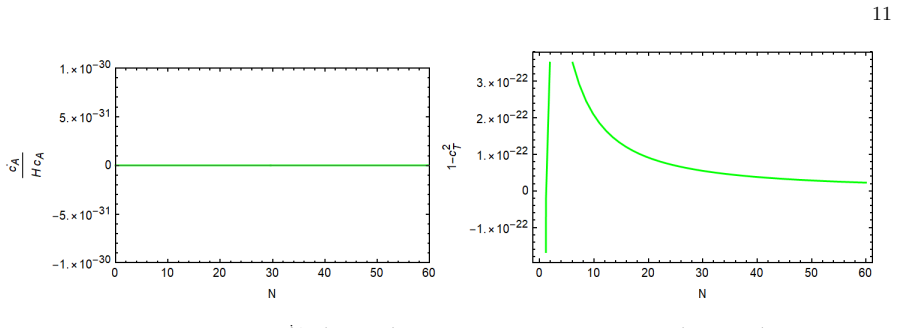
The central discovery is that the two established ways of reconciling EGB inflation with the GW170817 bound on the gravitational-wave speed split cleanly on adiabaticity. In the unconstrained formalism of Ref. [75], where the Gauss-Bonnet coupling satisfies $\xi'(\phi)=\lambda V'/V^2$ and the conditions $\kappa^2\dot\xi H\ll 1$, $\kappa^2\ddot\xi\ll 1$ hold, the scalar adiabaticity ratio $|\dot c_A/(c_A H)|$ takes values from $\sim 10^{-48}$ at horizon crossing to $\sim 10^{-33}$ at the end of inflation for the six example potentials studied; the tensor speed also stays within the GW170817 window. In the constrained formalism of Refs. [72,74], the condition $\ddot\xi=H\dot\xi$ forces the tensor speed to exactly unity, but the same condition destroys adiabaticity: for the power-law coupling $\xi(\phi)=\beta(\kappa\phi)^\nu$ with Planck-compatible parameters, $|\dot c_A/(c_A H)|$ reaches $\sim 0.0007$ at the beginning and $\sim 19$ at $N\simeq 3.1$, crossing the order-one threshold where the leading-order adiabatic approximation fails. The paper then shows the physical consequences: the Bogoliubov coefficient $\beta_k$ becomes non-negligible, particle production with radiation-like energy density occurs at the end of inflation, and the scalar power spectrum acquires sinusoidal oscillations of the form $P(k)=P_0(k)(1+2|\beta_k|^2+2\sqrt{1+|\beta_k|^2}|\beta_k|\cos(2k\eta+\phi_k))$. Because the violation happens only in the last few e-foldings, the CMB modes are unaffected, but small-scale modes and preheating are.
Load-bearing premise
The conclusion that the entire constrained EGB class violates adiabaticity assumes that the single power-law coupling $\xi(\phi)=\beta(\kappa\phi)^\nu$, with parameters adopted from earlier work, is representative of the class.
Editorial extensions
If this is right
- For the unconstrained EGB class, the adiabaticity ratio stays below roughly $10^{-33}$ across all of inflation, so the perturbations evolve in a well-defined adiabatic vacuum and no particle production occurs through this channel.
- For the constrained class, the growth of $|\dot c_A/(c_A H)|$ to $\sim 19$ near $N\simeq 3.1$ produces particles whose energy density redshifts as radiation, providing a gravitational preheating mechanism at the end of inflation that does not disturb the CMB.
- In the constrained class the scalar power spectrum acquires sinusoidal oscillations on small scales, $P(k)=P_0(k)(1+2|\beta_k|^2+2\sqrt{1+|\beta_k|^2}|\beta_k|\cos(2k\eta+\phi_k))$, which is a new feature restricted to the last few e-foldings.
- The general adiabaticity criterion for EGB gravity can be written as $|\ddot\xi/(\dot\xi H)|\cdot|\kappa^2\dot\xi H/\epsilon_1|\ll 1$, so adiabaticity is guaranteed only when the same effective-field-theory conditions that keep $c_T^2\simeq 1$ are supplemented by a slow-roll-like bound on the coupling's time variation.
- Among the two currently viable GW170817-compatible EGB inflationary classes, only the unconstrained one is free from adiabaticity pathologies.
Reading between the lines
- The paper's class-level conclusion about the constrained EGB theories rests on a single power-law coupling model; a direct test would be to scan other couplings satisfying $\ddot\xi=H\dot\xi$, since a representative that stays adiabatic would overturn the generalization.
- The oscillating power spectrum near the end of inflation is a natural source of second-order gravitational waves; computing the induced tensor spectrum from these small-scale scalar perturbations could turn the adiabaticity violation into an observable signature.
- The paper notes that a tracking solution $\dot\phi=\gamma H^{-m}$ with $m>0$ would automatically satisfy the adiabaticity condition; building an explicit EGB inflationary model with such a tracking condition would produce a third class that is adiabatic by construction.
- A closer check of the Planck-compatible benchmark parameters $(\nu,\gamma,\beta)=(20,5768,-13.191)$ is warranted, since the resulting potential in Eq. (4.24) appears to become negative for $\phi\gtrsim 1.3$ before the quoted $\phi_f\simeq 6.16$, which would put the numerical demonstration on an unphysical branch.
Editorial analysis
A structured set of objections, weighed in public.
Referee Report
Summary. The manuscript studies the adiabaticity of scalar and tensor cosmological perturbations in Einstein-Gauss-Bonnet (EGB) inflationary theories that are compatible with Planck/ACT CMB data and with the GW170817 constraint on the tensor speed. It derives a general adiabaticity criterion involving the time variation of the sound speed c_A and the tensor speed c_T, and then applies this criterion to two classes of EGB models: 'unconstrained' theories with an arbitrary Gauss-Bonnet coupling and 'constrained' theories in which a relation between the potential and the coupling enforces c_T = 1. The central claim is that unconstrained EGB theories are fully adiabatic during inflation, while constrained theories develop a strong adiabaticity violation in the last few e-foldings, leading to particle production and an oscillatory contribution to the power spectrum at the end of inflation. The paper concludes that only the unconstrained class is free from adiabaticity pathologies.
Significance. If the central claim were established, the paper would provide a new phenomenological distinction between two ways of reconciling EGB inflation with GW170817: one class would produce no spurious particle production from non-adiabaticity during inflation, while the other would, with possible observational consequences at small scales. The derivation of the Mukhanov-Sasaki equations for EGB gravity and the adiabaticity conditions is a useful presentation of known material, and the paper is explicit about the parameter choices for the unconstrained models. However, the central claim rests on a single constrained model whose scalar potential becomes negative over most of the claimed inflationary interval, so the demonstrated non-adiabaticity is computed in an unphysical background. The class-level conclusion is therefore not supported, and the paper's main claim cannot be accepted in its current form. No code or detailed numerical data are provided, which further limits the reproducibility of the numerical results.
major comments (3)
- [IV, Eq. (4.24) and parameter set below Eq. (4.33)] For the Planck-compatible constrained model, the paper quotes (nu, gamma, beta) = (20, 5768, -13.191). With kappa = 1, the potential in Eq. (4.24) is V(phi) = 3/(4 beta phi^nu + 3 gamma). The denominator vanishes at phi0 = (3*5768/(4*13.191))^(1/20) ~ 1.34, so V(phi) is negative for phi > 1.34. Since the quoted end of inflation is phi_f = sqrt(2(nu-1)) ~ 6.16 and the initial value is phi_i ~ 0.26, the potential is negative over most of the inflationary interval. A negative potential is inconsistent with the slow-roll Friedmann equation H^2 ~ kappa^2 V/3 and cannot support 60 e-folds of inflation. The paper does not flag this, yet it uses this same parameter set to quote P_zeta = 2.19673e-9 and to compute the adiabaticity ratio |dot c_A/(c_A H)| ~ 19 at N = 3.1. The non-adiabaticity demonstration is therefore performed in a background that is not a viable inflationary solution, and the claimed violation is not established.
- [Abstract and Section IV] The abstract concludes that 'only one class of viable EGB inflationary theories ... is free from adiabaticity pathologies', but Section IV tests the constrained class with only a single model, xi(phi) = beta (kappa phi)^nu, and only with the Planck-compatible parameter set. Even if that parameter set were physical, a single example cannot support a statement about the whole class. The paper provides no analytic proof that all constrained models satisfying Eqs. (4.1)-(4.11) violate adiabaticity, and no scan or additional examples are presented. The class-level claim is thus unsupported by the evidence given.
- [II.C, Eqs. (2.48)-(2.49)] The derivation of the adiabaticity criterion is logically reversed. Equation (2.48) states |dot c_A/(c_A H)| << k c_A/(a H). For subhorizon modes, k c_A/(a H) >> 1, so the inequality does not imply |dot c_A/(c_A H)| << 1; a small quantity can be much smaller than a large number without being much smaller than one. The correct statement is that |dot c_A/(c_A H)| << 1 applies at horizon crossing, where k c_A/(a H) ~ O(1). The subsequent numerical evaluation uses |dot c_A/(c_A H)| as the criterion, which is standard, but the text's derivation from (2.48) to (2.49) is incorrect as written.
minor comments (5)
- [II.B, Eq. (2.19)] Equation (2.19) defines P_zeta(k*) = k^3/(2 pi^2) P_zeta(k*), using the same symbol P_zeta on both sides; the right-hand side should be the dimensionless power spectrum or a different symbol, and the notation should be clarified.
- [Throughout] There are numerous typographical issues, including 'e-foldings' vs 'e-folds', 'thee-foldings' in Section III, missing parentheses in Eq. (2.16), and inconsistent spacing. A careful proofreading pass is required.
- [III, models (3.15)-(3.35)] The unconstrained models use extremely small values of lambda (10^-18 to 10^-20), which makes the Gauss-Bonnet correction essentially negligible. Since the adiabaticity ratio |dot c_A/(c_A H)| scales with these tiny couplings, the conclusion that these models are adiabatic is largely built into the parameter choice. The paper would benefit from a discussion of the naturalness or fine-tuning of such small couplings and whether larger couplings could still satisfy the GW170817 constraint while producing non-adiabatic perturbations.
- [IV, Fig. 7 caption and text] The text quotes |dot c_A/(c_A H)| = -19.0845 at N = 3.1, while the upper-right panel of Fig. 7 shows a very narrow range N = [3.17383, 3.17385]. The apparent discrepancy between the quoted N value and the plotted range should be reconciled.
- [V, conclusions] The conclusion states that for unconstrained EGB theories the coupling satisfies xi(phi) = -lambda/V(phi), but this follows from Eq. (3.11) only up to an integration constant; the statement is imprecise and should be qualified.
Circularity Check
No significant circularity: the adiabaticity checks are post-fit numerical evaluations, not fitted inputs, though the unconstrained-class outcome is a corollary of the assumed small GB couplings.
full rationale
The paper's central derivation chain is self-contained: it derives the Mukhanov-Sasaki equations and the adiabaticity criterion (Eqs. 2.43-2.51), then evaluates |dot c_A/(c_A H)| numerically for two model classes whose parameters are fixed by CMB and GW170817 fits. The adiabaticity ratio is not used to fit any parameter, so there is no fitted-input-called-prediction loop. For the unconstrained class, the very small values of |dot c_A/(c_A H)| follow from the assumed smallness of the Gauss-Bonnet couplings (Eq. 3.2) and the tiny values of lambda (~10^-18 to 10^-20); this makes the adiabaticity finding a corollary of the model construction rather than an independent prediction, but it is still a genuine numerical check rather than a circular restatement. For the constrained class, the non-adiabaticity at N=3.1 is a model-dependent numerical result (Fig. 7) that is not enforced by the CMB/GW170817 fit; however, the paper generalizes from a single model to the whole class, and the Planck-compatible parameter set (nu,gamma,beta)=(20,5768,-13.191) gives a negative potential V(phi) from Eq. (4.24) for phi>1.34, well before phi_f~6.16, which undermines the physical validity of the numerical demonstration. These are correctness and support concerns, not circularity. The derivation of Eq. (2.49) from Eq. (2.48) also contains a logical slip (subhorizon modes make the RHS large, so the correct criterion applies at horizon crossing), but this is a technical error rather than a circular step. Self-citations (Refs. 72-75) supply the model classes, but the adiabaticity calculation itself is new and does not reduce to those citations.
Assumptions & free parameters
free parameters (7)
- delta (or d) in unconstrained potentials =
1e-3 to 1.7
- lambda =
1e-18 to 1e-20
- M =
1.06e-10 to 6.35e-10
- beta =
2.89912e6 or -13.191
- gamma =
10.6e8 or 5768
- nu =
19.98 or 20
- N =
50, 55, or 60
assumptions (5)
- standard math Standard WKB adiabatic vacuum formalism with the recursion relation (2.3)-(2.4) and the leading-order condition (2.5).
- domain assumption Flat FRW background and slow-roll conditions (2.12) hold throughout inflation.
- domain assumption For subhorizon modes, omega_k ~ c_A k, so the adiabaticity condition reduces to |dot c_A/(c_A H)| << 1.
- ad hoc to paper The choice xi'(phi) = lambda V'(phi)/V(phi)^2 (Eq. 3.11) is an ansatz chosen for analytic convenience.
- ad hoc to paper The constrained class adopts the relation V'/V^2 + 4 kappa^4/3 xi' = 0 and the approximations (4.2), (4.5), (4.6) from Refs [72-74].
Cite this review
Pith. "Pith review of Adiabatic Perturbations in GW170817-Compatible Einstein-Gauss-Bonnet Inflation." pith.science (2026). https://pith.science/paper/TCPS3DJ3
@misc{pith2026260809783,
  author       = {Pith},
  title        = {Pith review of: Adiabatic Perturbations in GW170817-Compatible Einstein-Gauss-Bonnet Inflation},
  year         = {2026},
  howpublished = {\url{https://pith.science/paper/TCPS3DJ3}},
  note         = {Machine review of arXiv:2608.09783}
}
read the original abstract
We study the adiabaticity of the cosmological perturbations in the context of inflationary Einstein-Gauss-Bonnet theories. We focus on viable inflationary Einstein-Gauss-Bonnet theories which are compatible with the current Cosmic Microwave Background radiation experiments and also are compatible with the GW170817 observations. We derive the effects of the adiabaticity requirement on the Einstein-Gauss-Bonnet physical parameters and we show that the sound speed of the scalar perturbations and the propagation speed of the tensor perturbations are constrained. We consider two classes of inflationary viable and GW170817-compatible theories, and in the first class the adiabaticity is not violated during inflation, while in the second class the adiabaticity is violated only at the end of inflation. We discuss the effects of the adiabaticity violation in the second class of models. From our analysis, it seems that only one class of viable EGB inflationary theories, which is also compatible with the GW170817 event, is free from adiabaticity pathologies.
Figures


Figures from the paper (4 more)


Reference graph
Works this paper leans on
-
[75]
V. K. Oikonomou, Phys. Lett. B856(2024), 138890 doi:10.1016/j.physletb.2024.138890 [arXiv:2407.12155 [gr-qc]]
arXiv 2024
-
[1]
A. D. Linde, Lect. Notes Phys.738(2008) 1 [arXiv:0705.0164 [hep-th]]
arXiv 2008
-
[2]
A. D. Linde, Phys. Lett. B108(1982), 389-393 doi:10.1016/0370-2693(82)91219-9
-
[3]
Introduction to the theory of the early universe: Cosmological perturbations and inflationary theory,
D. S. Gorbunov and V. A. Rubakov, “Introduction to the theory of the early universe: Cosmological perturbations and inflationary theory,” Hackensack, USA: World Scientific (2011) 489 p
2011
- [4]
-
[5]
D. H. Lyth and A. Riotto, Phys. Rept.314(1999) 1 [hep-ph/9807278]
arXiv 1999
-
[6]
S. D. Odintsov, V. K. Oikonomou, I. Giannakoudi, F. P. Fronimos and E. C. Lymperiadou, Symmetry15 (2023) no.9, 1701 doi:10.3390/sym15091701 [arXiv:2307.16308 [gr-qc]]
arXiv 2023
-
[7]
M. H. Abitbolet al.[Simons Observatory], Bull. Am. Astron. Soc.51(2019), 147 [arXiv:1907.08284 [astro- ph.IM]]
arXiv 2019
Show all 181 references
-
[8]
Allyset al.[LiteBIRD], PTEP2023(2023) no.4, 042F01 doi:10.1093/ptep/ptac150 [arXiv:2202.02773 [astro-ph.IM]]
E. Allyset al.[LiteBIRD], PTEP2023(2023) no.4, 042F01 doi:10.1093/ptep/ptac150 [arXiv:2202.02773 [astro-ph.IM]]
2023 arXiv
-
[9]
S. Hild, M. Abernathy, F. Acernese, P. Amaro-Seoane, N. Andersson, K. Arun, F. Barone, B. Barr, M. Bar- suglia and M. Beker,et al.Class. Quant. Grav.28(2011), 094013 doi:10.1088/0264-9381/28/9/094013 [arXiv:1012.0908 [gr-qc]]
2011 arXiv
-
[10]
Baker, J
J. Baker, J. Bellovary, P. L. Bender, E. Berti, R. Caldwell, J. Camp, J. W. Conklin, N. Cornish, C. Cutler and R. DeRosa,et al.[arXiv:1907.06482 [astro-ph.IM]]
1907 arXiv
-
[11]
T. L. Smith and R. Caldwell, Phys. Rev. D100(2019) no.10, 104055 doi:10.1103/PhysRevD.100.104055 [arXiv:1908.00546 [astro-ph.CO]]
2019 arXiv
-
[12]
Crowder and N
J. Crowder and N. J. Cornish, Phys. Rev. D72(2005), 083005 doi:10.1103/PhysRevD.72.083005 [arXiv:gr- qc/0506015 [gr-qc]]
2005
-
[13]
T. L. Smith and R. Caldwell, Phys. Rev. D95(2017) no.4, 044036 doi:10.1103/PhysRevD.95.044036 [arXiv:1609.05901 [gr-qc]]
2017 arXiv
-
[14]
N. Seto, S. Kawamura and T. Nakamura, Phys. Rev. Lett.87(2001), 221103 doi:10.1103/PhysRevLett.87.221103 [arXiv:astro-ph/0108011 [astro-ph]]
2001 arXiv
-
[15]
Kawamura, M
S. Kawamura, M. Ando, N. Seto, S. Sato, M. Musha, I. Kawano, J. Yokoyama, T. Tanaka, K. Ioka and T. Akutsu,et al.[arXiv:2006.13545 [gr-qc]]
2006 arXiv
-
[16]
Weltman, P
A. Weltman, P. Bull, S. Camera, K. Kelley, H. Padmanabhan, J. Pritchard, A. Raccanelli, S. Riemer- Sørensen, L. Shao and S. Andrianomena,et al.Publ. Astron. Soc. Austral.37(2020), e002 doi:10.1017/pasa.2019.42 [arXiv:1810.02680 [astro-ph.CO]]
2020 arXiv
-
[17]
Auclairet al.[LISA Cosmology Working Group], [arXiv:2204.05434 [astro-ph.CO]]
P. Auclairet al.[LISA Cosmology Working Group], [arXiv:2204.05434 [astro-ph.CO]]
-
[18]
Agazieet al.[NANOGrav], Astrophys
G. Agazieet al.[NANOGrav], Astrophys. J. Lett.951(2023) no.1, L8 doi:10.3847/2041-8213/acdac6 [arXiv:2306.16213 [astro-ph.HE]]
2023 arXiv
-
[19]
Vagnozzi, JHEAp39(2023), 81-98 doi:10.1016/j.jheap.2023.07.001 [arXiv:2306.16912 [astro-ph.CO]]
S. Vagnozzi, JHEAp39(2023), 81-98 doi:10.1016/j.jheap.2023.07.001 [arXiv:2306.16912 [astro-ph.CO]]
2023 arXiv
-
[20]
V. K. Oikonomou, Phys. Rev. D108(2023) no.4, 043516 doi:10.1103/PhysRevD.108.043516 [arXiv:2306.17351 [astro-ph.CO]]
2023 arXiv
-
[21]
Nojiri, S
S. Nojiri, S. D. Odintsov and V. K. Oikonomou, Phys. Rept.692(2017) 1 [arXiv:1705.11098 [gr-qc]]
2017 arXiv
-
[22]
Capozziello, M
S. Capozziello, M. De Laurentis, Phys. Rept.509, 167 (2011); V. Faraoni and S. Capozziello, Fundam. Theor. Phys.170(2010)
2011
-
[23]
Nojiri, S.D
S. Nojiri, S.D. Odintsov, Phys. Rept.505, 59 (2011)
2011
-
[24]
Nojiri and S
S. Nojiri and S. D. Odintsov, Phys. Rev. D68(2003), 123512 doi:10.1103/PhysRevD.68.123512 [arXiv:hep- th/0307288 [hep-th]]
2003
-
[25]
Capozziello, V
S. Capozziello, V. F. Cardone and A. Troisi, Phys. Rev. D71(2005), 043503 doi:10.1103/PhysRevD.71.043503 [arXiv:astro-ph/0501426 [astro-ph]]
2005 arXiv
-
[26]
Capozziello, C
S. Capozziello, C. A. Mantica and L. G. Molinari, Int. J. Geom. Meth. Mod. Phys.16(2018) no.01, 1950008 doi:10.1142/S0219887819500087 [arXiv:1810.03204 [gr-qc]]
2018 arXiv
-
[27]
Capozziello, V
S. Capozziello, V. F. Cardone and M. Francaviglia, Gen. Rel. Grav.38(2006), 711-734 doi:10.1007/s10714- 006-0261-x [arXiv:astro-ph/0410135 [astro-ph]]
2006 arXiv
-
[28]
J. c. Hwang and H. Noh, Phys. Lett. B506(2001), 13-19 doi:10.1016/S0370-2693(01)00404-X [arXiv:astro- ph/0102423 [astro-ph]]
2001
-
[29]
Bamba, G
K. Bamba, G. Cognola, S. D. Odintsov and S. Zerbini, Phys. Rev. D90(2014) no.2, 023525 doi:10.1103/PhysRevD.90.023525 [arXiv:1404.4311 [gr-qc]]
2014 arXiv
-
[30]
Nojiri and S
S. Nojiri and S. D. Odintsov, Phys. Rev. D74(2006), 086005 doi:10.1103/PhysRevD.74.086005 [arXiv:hep- th/0608008 [hep-th]]
2006
-
[31]
Y. S. Song, W. Hu and I. Sawicki, Phys. Rev. D75(2007), 044004 doi:10.1103/PhysRevD.75.044004 [arXiv:astro-ph/0610532 [astro-ph]]
2007 arXiv
-
[32]
Capozziello, V
S. Capozziello, V. F. Cardone and V. Salzano, Phys. Rev. D78(2008), 063504 doi:10.1103/PhysRevD.78.063504 [arXiv:0802.1583 [astro-ph]]
2008 arXiv
-
[33]
R. Bean, D. Bernat, L. Pogosian, A. Silvestri and M. Trodden, Phys. Rev. D75(2007), 064020 20 doi:10.1103/PhysRevD.75.064020 [arXiv:astro-ph/0611321 [astro-ph]]
2007 arXiv
-
[34]
Capozziello and M
S. Capozziello and M. De Laurentis, Annalen Phys.524(2012), 545-578 doi:10.1002/andp.201200109
2012 doi
-
[35]
Faulkner, M
T. Faulkner, M. Tegmark, E. F. Bunn and Y. Mao, Phys. Rev. D76(2007), 063505 doi:10.1103/PhysRevD.76.063505 [arXiv:astro-ph/0612569 [astro-ph]]
2007 arXiv
-
[36]
G. J. Olmo, Phys. Rev. D75(2007), 023511 doi:10.1103/PhysRevD.75.023511 [arXiv:gr-qc/0612047 [gr-qc]]
2007 arXiv
-
[37]
Sawicki and W
I. Sawicki and W. Hu, Phys. Rev. D75(2007), 127502 doi:10.1103/PhysRevD.75.127502 [arXiv:astro- ph/0702278 [astro-ph]]
2007
-
[38]
Faraoni, Phys
V. Faraoni, Phys. Rev. D75(2007), 067302 doi:10.1103/PhysRevD.75.067302 [arXiv:gr-qc/0703044 [gr-qc]]
2007 arXiv
-
[39]
Carloni, P
S. Carloni, P. K. S. Dunsby and A. Troisi, Phys. Rev. D77(2008), 024024 doi:10.1103/PhysRevD.77.024024 [arXiv:0707.0106 [gr-qc]]
2008 arXiv
-
[40]
Nojiri and S
S. Nojiri and S. D. Odintsov, Phys. Lett. B657(2007), 238-245 doi:10.1016/j.physletb.2007.10.027 [arXiv:0707.1941 [hep-th]]
2007 arXiv
-
[41]
Capozziello, A
S. Capozziello, A. Stabile and A. Troisi, Phys. Rev. D76(2007), 104019 doi:10.1103/PhysRevD.76.104019 [arXiv:0708.0723 [gr-qc]]
2007 arXiv
-
[42]
Deruelle, M
N. Deruelle, M. Sasaki and Y. Sendouda, Prog. Theor. Phys.119(2008), 237-251 doi:10.1143/PTP.119.237 [arXiv:0711.1150 [gr-qc]]
2008 arXiv
-
[43]
S. A. Appleby and R. A. Battye, JCAP05(2008), 019 doi:10.1088/1475-7516/2008/05/019 [arXiv:0803.1081 [astro-ph]]
2008 arXiv
-
[44]
P. K. S. Dunsby, E. Elizalde, R. Goswami, S. Odintsov and D. S. Gomez, Phys. Rev. D82(2010), 023519 doi:10.1103/PhysRevD.82.023519 [arXiv:1005.2205 [gr-qc]]
2010 arXiv
-
[45]
V. K. Oikonomou, Phys. Rev. D103(2021) no.12, 124028 doi:10.1103/PhysRevD.103.124028 [arXiv:2012.01312 [gr-qc]]
2021 arXiv
-
[46]
V. K. Oikonomou, Phys. Rev. D103(2021) no.4, 044036 doi:10.1103/PhysRevD.103.044036 [arXiv:2012.00586 [astro-ph.CO]]
2021 arXiv
-
[47]
J. c. Hwang and H. Noh, Phys. Rev. D71(2005) 063536 doi:10.1103/PhysRevD.71.063536 [gr-qc/0412126]
2005 arXiv
-
[48]
Cognola, E
G. Cognola, E. Elizalde, S. Nojiri, S. Odintsov and S. Zerbini, Phys. Rev. D75(2007) 086002 doi:10.1103/PhysRevD.75.086002 [hep-th/0611198]
2007 arXiv
-
[49]
Nojiri, S
S. Nojiri, S. D. Odintsov and M. Sasaki, Phys. Rev. D71(2005) 123509 doi:10.1103/PhysRevD.71.123509 [hep-th/0504052]
2005 arXiv
-
[50]
Nojiri and S
S. Nojiri and S. D. Odintsov, Phys. Lett. B631(2005) 1 doi:10.1016/j.physletb.2005.10.010 [hep- th/0508049]
2005
-
[51]
Satoh, S
M. Satoh, S. Kanno and J. Soda, Phys. Rev. D77(2008) 023526 doi:10.1103/PhysRevD.77.023526 [arXiv:0706.3585 [astro-ph]]
2008 arXiv
-
[52]
Z. Yi, Y. Gong and M. Sabir, Phys. Rev. D98(2018) no.8, 083521 doi:10.1103/PhysRevD.98.083521 [arXiv:1804.09116 [gr-qc]]
2018 arXiv
-
[53]
Z. K. Guo and D. J. Schwarz, Phys. Rev. D80(2009) 063523 doi:10.1103/PhysRevD.80.063523 [arXiv:0907.0427 [hep-th]]
2009 arXiv
-
[54]
Z. K. Guo and D. J. Schwarz, Phys. Rev. D81(2010) 123520 doi:10.1103/PhysRevD.81.123520 [arXiv:1001.1897 [hep-th]]
2010 arXiv
-
[55]
P. X. Jiang, J. W. Hu and Z. K. Guo, Phys. Rev. D88(2013) 123508 doi:10.1103/PhysRevD.88.123508 [arXiv:1310.5579 [hep-th]]
2013 arXiv
-
[56]
van de Bruck, K
C. van de Bruck, K. Dimopoulos, C. Longden and C. Owen, arXiv:1707.06839 [astro-ph.CO]
-
[57]
E. O. Pozdeeva, M. R. Gangopadhyay, M. Sami, A. V. Toporensky and S. Y. Vernov, Phys. Rev. D102 (2020) no.4, 043525 doi:10.1103/PhysRevD.102.043525 [arXiv:2006.08027 [gr-qc]]
2020 arXiv
-
[58]
Vernov and E
S. Vernov and E. Pozdeeva, Universe7(2021) no.5, 149 doi:10.3390/universe7050149 [arXiv:2104.11111 [gr-qc]]
2021 arXiv
-
[59]
E. O. Pozdeeva and S. Y. Vernov, Eur. Phys. J. C81(2021) no.7, 633 doi:10.1140/epjc/s10052-021-09435-8 [arXiv:2104.04995 [gr-qc]]
2021 arXiv
-
[60]
Fomin, Eur
I. Fomin, Eur. Phys. J. C80(2020) no.12, 1145 doi:10.1140/epjc/s10052-020-08718-w [arXiv:2004.08065 [gr-qc]]
2020 arXiv
-
[61]
De Laurentis, M
M. De Laurentis, M. Paolella and S. Capozziello, Phys. Rev. D91(2015) no.8, 083531 doi:10.1103/PhysRevD.91.083531 [arXiv:1503.04659 [gr-qc]]
2015 arXiv
-
[62]
Chervon, I
Scalar Field Cosmology, S. Chervon, I. Fomin, V. Yurov and A. Yurov, World Scientific 2019, doi:10.1142/11405
2019 doi
-
[63]
Nozari and N
K. Nozari and N. Rashidi, Phys. Rev. D95(2017) no.12, 123518 doi:10.1103/PhysRevD.95.123518 [arXiv:1705.02617 [astro-ph.CO]]
2017 arXiv
-
[64]
S. D. Odintsov and V. K. Oikonomou, Phys. Rev. D98(2018) no.4, 044039 doi:10.1103/PhysRevD.98.044039 [arXiv:1808.05045 [gr-qc]]
2018 arXiv
-
[65]
Kawai, M
S. Kawai, M. a. Sakagami and J. Soda, Phys. Lett. B437, 284 (1998) doi:10.1016/S0370-2693(98)00925-3 [gr-qc/9802033]
1998 arXiv
-
[66]
Yi and Y
Z. Yi and Y. Gong, Universe5(2019) no.9, 200 doi:10.3390/universe5090200 [arXiv:1811.01625 [gr-qc]]
2019 arXiv
-
[67]
van de Bruck, K
C. van de Bruck, K. Dimopoulos and C. Longden, Phys. Rev. D94(2016) no.2, 023506 doi:10.1103/PhysRevD.94.023506 [arXiv:1605.06350 [astro-ph.CO]]
2016 arXiv
-
[68]
K. i. Maeda, N. Ohta and R. Wakebe, Eur. Phys. J. C72(2012) 1949 doi:10.1140/epjc/s10052-012-1949-6 [arXiv:1111.3251 [hep-th]]
2012 arXiv
-
[69]
W. Y. Ai, Commun. Theor. Phys.72(2020) no.9, 095402 doi:10.1088/1572-9494/aba242 [arXiv:2004.02858 [gr-qc]]
2020 arXiv
-
[70]
Easther and K
R. Easther and K. i. Maeda, Phys. Rev. D54(1996) 7252 doi:10.1103/PhysRevD.54.7252 [hep-th/9605173]
1996 arXiv
-
[71]
Codello and R
A. Codello and R. K. Jain, Class. Quant. Grav.33(2016) no.22, 225006 doi:10.1088/0264- 21 9381/33/22/225006 [arXiv:1507.06308 [gr-qc]]
2016 arXiv
-
[72]
V. K. Oikonomou, Class. Quant. Grav.38(2021) no.19, 195025 doi:10.1088/1361-6382/ac2168 [arXiv:2108.10460 [gr-qc]]
2021 arXiv
-
[73]
V. K. Oikonomou, Astropart. Phys.141(2022), 102718 doi:10.1016/j.astropartphys.2022.102718 [arXiv:2204.06304 [gr-qc]]
2022
-
[74]
S. D. Odintsov, V. K. Oikonomou and F. P. Fronimos, Nucl. Phys. B958(2020), 115135 doi:10.1016/j.nuclphysb.2020.115135 [arXiv:2003.13724 [gr-qc]]
2020
-
[76]
J. Fier, H. Han, B. Li, K. Lin, S. Mukohyama and A. Wang, [arXiv:2503.01975 [gr-qc]]
-
[77]
E. O. Pozdeeva, M. A. Skugoreva, A. V. Toporensky and S. Y. Vernov, JCAP09(2024), 050 doi:10.1088/1475-7516/2024/09/050 [arXiv:2403.06147 [gr-qc]]
2024 arXiv
-
[78]
S. D. Odintsov, V. K. Oikonomou, P. Tsyba, O. Razina and D. Rakhatov, [arXiv:2604.18861 [gr-qc]]
-
[79]
B. P. Abbottet al.[LIGO Scientific and Virgo], Phys. Rev. Lett.119(2017) no.16, 161101 doi:10.1103/PhysRevLett.119.161101 [arXiv:1710.05832 [gr-qc]]
2017 arXiv
-
[80]
B. P. Abbottet al.[LIGO Scientific, Virgo, Fermi-GBM and INTEGRAL], Astrophys. J. Lett.848(2017) no.2, L13 doi:10.3847/2041-8213/aa920c [arXiv:1710.05834 [astro-ph.HE]]
2017 arXiv
-
[81]
Multi-messenger Observations of a Binary Neutron Star Merger,
B. P. Abbottet al.“Multi-messenger Observations of a Binary Neutron Star Merger,” Astrophys. J.848 (2017) no.2, L12 doi:10.3847/2041-8213/aa91c9 [arXiv:1710.05833 [astro-ph.HE]]
2017 arXiv
-
[82]
B. P. Abbottet al.[LIGO Scientific and Virgo], Phys. Rev. D100(2019) no.6, 061101 doi:10.1103/PhysRevD.100.061101 [arXiv:1903.02886 [gr-qc]]
2019 arXiv
-
[83]
J. M. Ezquiaga and M. Zumalac´ arregui, Phys. Rev. Lett.119(2017) no.25, 251304 doi:10.1103/PhysRevLett.119.251304 [arXiv:1710.05901 [astro-ph.CO]]
2017 arXiv
-
[84]
Baker, E
T. Baker, E. Bellini, P. G. Ferreira, M. Lagos, J. Noller and I. Sawicki, Phys. Rev. Lett.119(2017) no.25, 251301 doi:10.1103/PhysRevLett.119.251301 [arXiv:1710.06394 [astro-ph.CO]]
2017 arXiv
-
[85]
Creminelli and F
P. Creminelli and F. Vernizzi, Phys. Rev. Lett.119(2017) no.25, 251302 doi:10.1103/PhysRevLett.119.251302 [arXiv:1710.05877 [astro-ph.CO]]
2017 arXiv
-
[86]
Sakstein and B
J. Sakstein and B. Jain, Phys. Rev. Lett.119(2017) no.25, 251303 doi:10.1103/PhysRevLett.119.251303 [arXiv:1710.05893 [astro-ph.CO]]
2017 arXiv
-
[87]
Boran, S
S. Boran, S. Desai, E. O. Kahya and R. P. Woodard, Phys. Rev. D97(2018) no.4, 041501 doi:10.1103/PhysRevD.97.041501 [arXiv:1710.06168 [astro-ph.HE]]
2018 arXiv
-
[88]
Akramiet al.[Planck], Astron
Y. Akramiet al.[Planck], Astron. Astrophys.641(2020), A10 doi:10.1051/0004-6361/201833887 [arXiv:1807.06211 [astro-ph.CO]]
2020 arXiv
-
[89]
P. A. R. Adeet al.[BICEP and Keck], Phys. Rev. Lett.127(2021) no.15, 151301 doi:10.1103/PhysRevLett.127.151301 [arXiv:2110.00483 [astro-ph.CO]]
2021
-
[90]
Louiset al.[ACT], [arXiv:2503.14452 [astro-ph.CO]]
T. Louiset al.[ACT], [arXiv:2503.14452 [astro-ph.CO]]
-
[91]
Calabreseet al.[ACT], [arXiv:2503.14454 [astro-ph.CO]]
E. Calabreseet al.[ACT], [arXiv:2503.14454 [astro-ph.CO]]
- [92]
-
[93]
Q. Gao, Y. Gong, Z. Yi and F. Zhang, [arXiv:2504.15218 [astro-ph.CO]]
-
[94]
L. Liu, Z. Yi and Y. Gong, [arXiv:2505.02407 [astro-ph.CO]]
- [95]
-
[96]
Z. Yi, X. Wang, Q. Gao and Y. Gong, [arXiv:2505.10268 [astro-ph.CO]]
-
[97]
Z. Z. Peng, Z. C. Chen and L. Liu, [arXiv:2505.12816 [astro-ph.CO]]
- [98]
-
[99]
C. T. Byrnes, M. Cortˆ es and A. R. Liddle, [arXiv:2505.09682 [astro-ph.CO]]
-
[100]
W. J. Wolf, [arXiv:2506.12436 [astro-ph.CO]]
-
[101]
S. Aoki, H. Otsuka and R. Yanagita, [arXiv:2504.01622 [hep-ph]]
-
[102]
Q. Gao, Y. Qian, Y. Gong and Z. Yi, [arXiv:2506.18456 [gr-qc]]
- [103]
-
[104]
E. G. M. Ferreira, E. McDonough, L. Balkenhol, R. Kallosh, L. Knox and A. Linde, [arXiv:2507.12459 [astro-ph.CO]]
- [105]
-
[106]
Choudhury, G
S. Choudhury, G. Bauyrzhan, S. K. Singh and K. Yerzhanov, [arXiv:2506.15407 [astro-ph.CO]]
-
[107]
S. D. Odintsov and V. K. Oikonomou, Phys. Lett. B868(2025), 139779 doi:10.1016/j.physletb.2025.139779 [arXiv:2506.08193 [gr-qc]]
2025
-
[108]
R. D. A. Q., J. Chagoya and A. A. Roque, [arXiv:2508.13273 [gr-qc]]
-
[109]
Y. Zhu, Q. Gao, Y. Gong and Z. Yi, [arXiv:2508.09707 [astro-ph.CO]]
-
[110]
Kouniatalis and E
G. Kouniatalis and E. N. Saridakis, [arXiv:2507.17721 [astro-ph.CO]]
-
[111]
M. Hai, A. R. Kamal, N. F. Shamma and M. S. J. Shuvo, [arXiv:2506.08083 [hep-th]]
-
[112]
Dioguardi, A
C. Dioguardi, A. J. Iovino and A. Racioppi, Phys. Lett. B868(2025), 139664 doi:10.1016/j.physletb.2025.139664 [arXiv:2504.02809 [gr-qc]]
2025
-
[113]
Yuennan, P
J. Yuennan, P. Koad, F. Atamurotov and P. Channuie, [arXiv:2508.17263 [astro-ph.CO]]
-
[114]
H. J. Kuralkar, S. Panda and A. Vidyarthi, [arXiv:2504.15061 [gr-qc]]
-
[115]
H. J. Kuralkar, S. Panda and A. Vidyarthi, JCAP05(2025), 073 doi:10.1088/1475-7516/2025/05/073 [arXiv:2502.03573 [astro-ph.CO]]
2025 arXiv
-
[116]
Modak, [arXiv:2509.02979 [astro-ph.CO]]
T. Modak, [arXiv:2509.02979 [astro-ph.CO]]
-
[117]
S. Aoki, H. Otsuka and R. Yanagita, [arXiv:2509.06739 [hep-ph]]
- [118]
-
[119]
McDonough and E
E. McDonough and E. G. M. Ferreira, [arXiv:2512.05108 [astro-ph.CO]]. 22
-
[120]
Chakraborty, M
D. Chakraborty, M. Hai, S. T. Jahan, A. R. Kamal and M. S. J. Shuvo, [arXiv:2511.19610 [hep-th]]
-
[121]
Noori Gashti, M
S. Noori Gashti, M. A. S. Afshar, M. R. Alipour, B. Pourhassan and J. Sadeghi, Eur. Phys. J. C85(2025) no.11, 1343 doi:10.1140/epjc/s10052-025-15066-0
2025 doi
-
[122]
Yuennan, F
J. Yuennan, F. Atamurotov and P. Channuie, [arXiv:2511.17216 [astro-ph.CO]]
- [123]
-
[124]
M. A. S. Afshar, S. Noori Gashti, M. R. Alipour, B. Pourhassan, I. Sakalli and J. Sadeghi, [arXiv:2510.20876 [astro-ph.CO]]
-
[125]
Ellis, M
J. Ellis, M. A. G. Garcia, K. A. Olive and S. Verner, [arXiv:2510.18656 [hep-ph]]
-
[126]
Iacconi, S
L. Iacconi, S. Bhattacharya, M. Fasiello and D. Wands, [arXiv:2511.14673 [astro-ph.CO]]
-
[127]
Yuennan, F
J. Yuennan, F. Atamurotov and P. Channuie, Phys. Lett. B872(2026), 140065 doi:10.1016/j.physletb.2025.140065 [arXiv:2509.23329 [gr-qc]]
2026
-
[128]
Q. Y. Wang, [arXiv:2512.10862 [astro-ph.CO]]
-
[129]
Z. C. Qiu, Y. H. Pang and Q. G. Huang, [arXiv:2510.18320 [astro-ph.CO]]
-
[130]
X. Wang, K. Kohri and T. T. Yanagida, [arXiv:2506.06797 [astro-ph.CO]]
-
[131]
Asaka, S
T. Asaka, S. Iso, H. Kawai, K. Kohri, T. Noumi and T. Terada, PTEP2016(2016) no.12, 123E01 doi:10.1093/ptep/ptw161 [arXiv:1507.04344 [hep-th]]
2016 arXiv
-
[132]
V. K. Oikonomou, Phys. Lett. B871(2025), 139972 doi:10.1016/j.physletb.2025.139972 [arXiv:2508.17363 [gr-qc]]
2025
-
[133]
Choudhury, S
S. Choudhury, S. K. Singh and S. K. Sahoo, [arXiv:2511.19898 [gr-qc]]
-
[134]
S. K. Singh, [arXiv:2511.05545 [hep-ph]]
-
[135]
J. Kim, X. Wang, Y. l. Zhang and Z. Ren, JCAP09(2025), 011 doi:10.1088/1475-7516/2025/09/011 [arXiv:2504.12035 [astro-ph.CO]]
2025 arXiv
-
[136]
Z. Y. Peng, H. S. Yuan, Q. Lai, J. Q. Jiang, G. Ye, J. Zhang and Y. S. Piao, [arXiv:2601.14288 [astro-ph.CO]]
-
[137]
Hounmenou, Ines G
Samson S. Hounmenou, Ines G. Salako, Biswajit Deb, Atri Deshamukhya, Annals Phys. 490 (2026) 170462 https://doi.org/10.1016/j.aop.2026.170462
2026
-
[138]
S. D. Odintsov and V. K. Oikonomou, Phys. Lett. B880(2026), 140805 doi:10.1016/j.physletb.2026.140805 [arXiv:2605.17813 [gr-qc]]
2026
-
[139]
A. G. Adameet al.[DESI], JCAP04(2025), 012 doi:10.1088/1475-7516/2025/04/012 [arXiv:2404.03000 [astro-ph.CO]]
2025 arXiv
-
[140]
D. H. Lee, W. Yang, E. Di Valentino, S. Pan and C. van de Bruck, [arXiv:2507.11432 [astro-ph.CO]]
- [141]
-
[142]
D. A. Kessler, L. A. Escamilla, S. Pan and E. Di Valentino, [arXiv:2504.00776 [astro-ph.CO]]
-
[143]
Nojiri, S
S. Nojiri, S. D. Odintsov and V. K. Oikonomou, [arXiv:2506.21010 [gr-qc]]
-
[144]
Vagnozzi, Phys
S. Vagnozzi, Phys. Rev. D102(2020) no.2, 023518 doi:10.1103/PhysRevD.102.023518 [arXiv:1907.07569 [astro-ph.CO]]
2020 arXiv
-
[145]
Pedrotti, J
D. Pedrotti, J. Q. Jiang, L. A. Escamilla, S. S. da Costa and S. Vagnozzi, Phys. Rev. D111(2025) no.2, 023506 doi:10.1103/PhysRevD.111.023506 [arXiv:2408.04530 [astro-ph.CO]]
2025 arXiv
-
[146]
J. Q. Jiang, D. Pedrotti, S. S. da Costa and S. Vagnozzi, Phys. Rev. D110(2024) no.12, 123519 doi:10.1103/PhysRevD.110.123519 [arXiv:2408.02365 [astro-ph.CO]]
2024 arXiv
-
[147]
Vagnozzi, Universe9(2023) no.9, 393 doi:10.3390/universe9090393 [arXiv:2308.16628 [astro-ph.CO]]
S. Vagnozzi, Universe9(2023) no.9, 393 doi:10.3390/universe9090393 [arXiv:2308.16628 [astro-ph.CO]]
2023 arXiv
-
[148]
S. A. Adil, ¨O. Akarsu, E. Di Valentino, R. C. Nunes, E. ¨Oz¨ ulker, A. A. Sen and E. Specogna, Phys. Rev. D 109(2024) no.2, 023527 doi:10.1103/PhysRevD.109.023527 [arXiv:2306.08046 [astro-ph.CO]]
2024 arXiv
-
[149]
Bernui, E
A. Bernui, E. Di Valentino, W. Giar` e, S. Kumar and R. C. Nunes, Phys. Rev. D107(2023) no.10, 103531 doi:10.1103/PhysRevD.107.103531 [arXiv:2301.06097 [astro-ph.CO]]
2023 arXiv
-
[150]
Gariazzo, E
S. Gariazzo, E. Di Valentino, O. Mena and R. C. Nunes, Phys. Rev. D106(2022) no.2, 023530 doi:10.1103/PhysRevD.106.023530 [arXiv:2111.03152 [astro-ph.CO]]
2022 arXiv
-
[151]
M. A. Sabogal, A. J. Iovino and S. Vagnozzi, [arXiv:2606.31362 [astro-ph.CO]]
-
[152]
V. K. Oikonomou, [arXiv:2603.11794 [gr-qc]]
-
[153]
C. Zeng, E. D. Kovetz, X. Chen, Y. Gong, J. B. Mu˜ noz and M. Kamionkowski, Phys. Rev. D99(2019) no.4, 043517 doi:10.1103/PhysRevD.99.043517 [arXiv:1812.05105 [astro-ph.CO]]
2019 arXiv
-
[154]
Dom` enech and M
G. Dom` enech and M. Kamionkowski, JCAP11(2019), 040 doi:10.1088/1475-7516/2019/11/040 [arXiv:1905.04323 [astro-ph.CO]]
2019 arXiv
-
[155]
U. H. Danielsson, Phys. Rev. D66(2002), 023511 doi:10.1103/PhysRevD.66.023511 [arXiv:hep-th/0203198 [hep-th]]
2002 arXiv
-
[156]
M. G. Jackson and G. Shiu, Phys. Rev. D88(2013) no.12, 123511 doi:10.1103/PhysRevD.88.123511 [arXiv:1303.4973 [hep-th]]
2013 arXiv
-
[157]
Kempf, Phys
A. Kempf, Phys. Rev. D63(2001), 083514 doi:10.1103/PhysRevD.63.083514 [arXiv:astro-ph/0009209 [astro-ph]]
2001 arXiv
-
[158]
Easther, B
R. Easther, B. R. Greene, W. H. Kinney and G. Shiu, Phys. Rev. D67(2003), 063508 doi:10.1103/PhysRevD.67.063508 [arXiv:hep-th/0110226 [hep-th]]
2003 arXiv
-
[159]
Martin and R
J. Martin and R. Brandenberger, Phys. Rev. D68(2003), 063513 doi:10.1103/PhysRevD.68.063513 [arXiv:hep-th/0305161 [hep-th]]
2003 arXiv
-
[160]
X. Chen, R. Easther and E. A. Lim, JCAP04(2008), 010 doi:10.1088/1475-7516/2008/04/010 [arXiv:0801.3295 [astro-ph]]
2008 arXiv
-
[161]
Flauger, L
R. Flauger, L. McAllister, E. Pajer, A. Westphal and G. Xu, JCAP06(2010), 009 doi:10.1088/1475- 7516/2010/06/009 [arXiv:0907.2916 [hep-th]]
2010 arXiv
-
[162]
L. Covi, J. Hamann, A. Melchiorri, A. Slosar and I. Sorbera, Phys. Rev. D74(2006), 083509 doi:10.1103/PhysRevD.74.083509 [arXiv:astro-ph/0606452 [astro-ph]]
2006 arXiv
-
[163]
Hamann, L
J. Hamann, L. Covi, A. Melchiorri and A. Slosar, Phys. Rev. D76(2007), 023503 23 doi:10.1103/PhysRevD.76.023503 [arXiv:astro-ph/0701380 [astro-ph]]
2007 arXiv
-
[164]
D. K. Hazra, M. Aich, R. K. Jain, L. Sriramkumar and T. Souradeep, JCAP10(2010), 008 doi:10.1088/1475- 7516/2010/10/008 [arXiv:1005.2175 [astro-ph.CO]]
2010 arXiv
-
[165]
Shafieloo and T
A. Shafieloo and T. Souradeep, Phys. Rev. D70(2004), 043523 doi:10.1103/PhysRevD.70.043523 [arXiv:astro-ph/0312174 [astro-ph]]
2004 arXiv
-
[166]
Ach´ ucarro, V
A. Ach´ ucarro, V. Atal, P. Ortiz and J. Torrado, Phys. Rev. D89(2014) no.10, 103006 doi:10.1103/PhysRevD.89.103006 [arXiv:1311.2552 [astro-ph.CO]]
2014 arXiv
-
[167]
D. K. Hazra, A. Shafieloo and T. Souradeep, JCAP11(2014), 011 doi:10.1088/1475-7516/2014/11/011 [arXiv:1406.4827 [astro-ph.CO]]
2014 arXiv
-
[168]
X. Chen, M. H. Namjoo and Y. Wang, JCAP02(2015), 027 doi:10.1088/1475-7516/2015/02/027 [arXiv:1411.2349 [astro-ph.CO]]
2015 arXiv
-
[169]
Nicholson and C
G. Nicholson and C. R. Contaldi, JCAP07(2009), 011 doi:10.1088/1475-7516/2009/07/011 [arXiv:0903.1106 [astro-ph.CO]]
2009 arXiv
-
[170]
Hunt and S
P. Hunt and S. Sarkar, JCAP12(2015), 052 doi:10.1088/1475-7516/2015/12/052 [arXiv:1510.03338 [astro- ph.CO]]
2015 arXiv
-
[171]
Braglia, X
M. Braglia, X. Chen and D. K. Hazra, JCAP06(2021), 005 doi:10.1088/1475-7516/2021/06/005 [arXiv:2103.03025 [astro-ph.CO]]
2021 arXiv
-
[172]
Braglia, X
M. Braglia, X. Chen and D. K. Hazra, Eur. Phys. J. C82(2022) no.5, 498 doi:10.1140/epjc/s10052-022- 10461-3 [arXiv:2106.07546 [astro-ph.CO]]
2022 arXiv
-
[173]
Antony and S
A. Antony and S. Jain, Eur. Phys. J. C82(2022) no.8, 687 doi:10.1140/epjc/s10052-022-10616-2 [arXiv:2110.06837 [astro-ph.CO]]
2022 arXiv
-
[174]
D. K. Hazra, A. Antony and A. Shafieloo, JCAP08(2022) no.08, 063 doi:10.1088/1475-7516/2022/08/063 [arXiv:2201.12000 [astro-ph.CO]]
2022 arXiv
-
[175]
Antony, F
A. Antony, F. Finelli, D. K. Hazra and A. Shafieloo, Phys. Rev. Lett.130(2023) no.11, 111001 doi:10.1103/PhysRevLett.130.111001 [arXiv:2202.14028 [astro-ph.CO]]
2023 arXiv
-
[176]
Silverstein and A
E. Silverstein and A. Westphal, Phys. Rev. D78(2008), 106003 doi:10.1103/PhysRevD.78.106003 [arXiv:0803.3085 [hep-th]]
2008 arXiv
-
[177]
McAllister, E
L. McAllister, E. Silverstein and A. Westphal, Phys. Rev. D82(2010), 046003 doi:10.1103/PhysRevD.82.046003 [arXiv:0808.0706 [hep-th]]
2010 arXiv
-
[178]
S. R. Behbahani, A. Dymarsky, M. Mirbabayi and L. Senatore, JCAP12(2012), 036 doi:10.1088/1475- 7516/2012/12/036 [arXiv:1111.3373 [hep-th]]
2012 arXiv
-
[179]
X. Wang, B. Feng, M. Li, X. L. Chen and X. Zhang, Int. J. Mod. Phys. D14(2005), 1347 doi:10.1142/S0218271805006985 [arXiv:astro-ph/0209242 [astro-ph]]
2005 arXiv
-
[180]
Easther, B
R. Easther, B. R. Greene, W. H. Kinney and G. Shiu, Phys. Rev. D66(2002), 023518 doi:10.1103/PhysRevD.66.023518 [arXiv:hep-th/0204129 [hep-th]]
2002 arXiv
-
[181]
Bozza, M
V. Bozza, M. Giovannini and G. Veneziano, JCAP05(2003), 001 doi:10.1088/1475-7516/2003/05/001 [arXiv:hep-th/0302184 [hep-th]]
2003 arXiv
Reviewed August 11, 2026 · model on record in the stance chip above.
Discussion (0). Continue with ORCID to comment.