REVIEW 3 major objections 4 minor 15 references
MedPixel: A Unified Pixel-Language Model for Medical Reasoning and Segmentation
T0 review · 3 major / 4 minor · reviewed 2026-08-11 · deepseek-v4-flash
Pith's one-line read MedPixel shows that a single model can handle referring, reasoning, interactive, and explanatory segmentation plus medical VQA from one shared language-to-mask interface.
desk verdict Solid systems paper with a useful synthetic dataset and a sensible preference objective, but the in-house reasoning benchmark numbers are likely inflated by template-matched test prompts. read the letter →
The pith
A machine-rendered reading of the paper's core claim, the machinery that carries it, and where it could break.
The reading
What carries the argument
The load-bearing object is the language–mask interface centered on a special segmentation token. When the language model generates this token, a learnable projection maps its hidden state into the prompt-embedding space of a SAM2-style mask decoder, so mask prediction is conditioned on whatever language and image context preceded the token. Interactive segmentation injects a point or box through a reference token that is embedded into the same multimodal sequence, letting the segmentation token integrate spatial and semantic cues before decoding. Around this interface, MedPLG-440K supplies supervision by extracting seven visual descriptors (location, size, shape, components, boundary, contrast, uniformity) from each ground-truth mask and combining them with curated templates into referring, reasoning, interactive, and explanatory formats. Stage 1 trains the whole system with joint language and segmentation losses; Stage 2 freezes the decoder and uses mask Dice as an offline reward to re-rank responses with direct preference optimization.
What would settle it
Ask clinicians to type free-form queries for the same held-out images and compare MedPixel against template-based prompts: if the Dice gap on reasoning and explanatory segmentation drops toward the non-template baselines, the gains reflect template familiarity rather than generalizable medical reasoning.
Extended reading notes
Core claim
On the paper's own terms, the discovery is that a special segmentation token can serve as a shared interface that makes language generation and pixel decoding mutually reinforcing. The vision-language model emits the token where a mask is required, and its hidden state is projected into the prompt-embedding space of a mask decoder, so every task that can be phrased as language can also end in a dense mask. The second stage, Pixel-Level Preference Optimization, uses ground-truth masks as offline verifiers: candidate responses are decoded to masks, scored by Dice, and turned into chosen/rejected pairs optimized with direct preference optimization, aligning what the model says with how well the resulting mask matches. The reported numbers—85.0 Dice on explicit referring segmentation, 66.7 on implicit reasoning segmentation, 75.9 on interactive segmentation, 76.5 on explanatory segmentation, and 47.5/58.1 on medical VQA multiple choice—support the paper's conclusion that unification does not force a trade-off against specialized performance.
Load-bearing premise
The load-bearing premise is that the T2 and T4 test prompts, generated with the same template pipeline as the training data, are representative of real clinical language; if they are not, the reported reasoning and explanation gains mostly show that the model memorized its own templates.
Editorial extensions
If this is right
- A hospital-facing tool could use one model for an image-level question and a click-to-segment action, because the same backbone and mask path serve both.
- Adding language to promptable segmentation makes dense prediction robust to imprecise clicks or boxes: MedPixel's Dice degrades only about 10 points under strong joint box perturbations, while SAM-family models drop 50–70 points.
- Segmentation masks, which already exist in large repositories, become a reusable source of language supervision, so new modalities need only masks, not hand-written QA pairs.
- Scaling the language backbone from 3B to 7B improves reasoning, explanation, and VQA without hurting explicit grounding, suggesting the interface itself is stable as capacity grows.
- Preference optimization aligned with masks (PLPO) can replace a learned reward model for pixel-grounded generation, since ground-truth masks are naturally available in segmentation.
Reading between the lines
- Editorial inference: The same template-based evaluation that makes training cheap may make the T2/T4 numbers optimistic; a real deployment would need to measure performance on free-form clinical language to see how much of the +29 to +40 Dice gain survives.
- Editorial inference: The synthesis recipe is not tied to medicine—any domain with masks and category metadata could be turned into referring, reasoning, interactive, and explanatory pixel-language data, and the mask-as-verifier idea could serve other dense prediction outputs such as depth or panoptic masks.
- Editorial inference: Because only 0.4% of preference pairs favor a reasoning-incorrect response, Dice-based preference may be a useful reward signal for thinking-alignment in medical imaging beyond the template setting.
Signed reviews
Editorial analysis
A structured set of objections, weighed in public.
Referee Report
Summary. MedPixel proposes a unified medical pixel-language model that couples Qwen2.5-VL with a SAM2 mask-decoding branch through a special <SEG> token and a spatial <REF> prompt interface. To provide supervision, the paper introduces MedPLG-440K, a dataset synthesized from existing segmentation annotations by extracting visual descriptors and applying task-specific templates for referring, reasoning, interactive, and explanatory segmentation, together with medical VQA data. Training consists of multi-task supervised fine-tuning followed by Pixel-Level Preference Optimization (PLPO), which uses ground-truth masks as offline verifiers to rank candidate responses by Dice and then applies DPO. The paper reports strong in-domain results across five tasks (e.g., 85.0 Dice on T1, 66.7 on T2, 76.0 on T3, 76.5 on T4, and 47.5/58.1 on T5 for the 7B model), zero-shot transfer to MeCoVQA-G+ and U-MRG-14K, and robustness to imperfect box prompts.
Significance. If the results hold, MedPixel is a useful contribution: it unifies explicit grounding, reasoning segmentation, interactive segmentation, grounded explanation, and medical VQA in a single architecture, and it provides an unusually transparent data-synthesis pipeline with concrete thresholds, templates, and composition details in Appendix B. The PLPO idea is simple and sensible, and the box-perturbation study is instructive. The main reservation is that the two headline reasoning tasks are evaluated on prompts that come from the same template-generation pipeline used to create the training data, so the significance of the reported gains depends on whether they transfer to naturally occurring clinical language. The external U-MRG-14K result is far below the in-domain T2 score, which supports the concern that a substantial part of the T2/T4 advantage is distribution match rather than generalizable reasoning.
major comments (3)
- [Section 4.1, Appendix D.1, Section 3.2] According to the manuscript's pipeline description, the T2 and T4 evaluation prompts are generated from the held-out BiomedParse test split using the same visual-attribute-extraction and task-specific-template procedure used to build MedPLG-440K, and Appendix D.1 describes only mask sampling, not any independent prompt source. The test set therefore matches the training distribution on prompt structure, descriptor vocabulary, and reasoning-trace format. Consequently, the +29.2 Dice gain on T2 and +40.7 Dice gain on T4 over baselines in Table 1 may reflect template familiarity rather than general clinical reasoning, and the fact that the same model achieves only 37.91 Dice on U-MRG-14K in Table 3 is consistent with a substantial distribution-match component. Please add an evaluation on naturally phrased or independently authored prompts, either human-written or from an external corpus, applied to the same held-out masks, and report results separately for each clue family and prompt family. If the T2/T4 test prompts are in fact not generated by the same pipeline, the manuscript should state explicitly how they were constructed.
- [Section 3.3, Eq. (7)-(11); Table 4] Stage 2 PLPO uses Dice against the ground-truth training masks as the preference score in Eq. (7) and then reports Dice gains on T2 and T4 in Table 4. Because the preference pairs are sampled from the same template-generated T2 distribution that is used for the test set, the reported improvement is partly an optimization of the evaluation metric rather than an independent demonstration of better language-mask alignment. Since the segmentation projector and mask decoder are frozen during Stage 2, the changes are in the response distribution and <SEG> representations, which is a reasonable design, but the paper should show that the improvement persists when preferences are mined from a different distribution or when the evaluation uses a metric or benchmark not used in training. Reporting TGA and METEOR is helpful, but those are also computed against template reference responses and are essentially flat.
- [Table 1 vs. Table 14] There is an internal inconsistency in the T3 interactive-segmentation numbers. Table 1 reports MedSAM at 43.6 Dice on T3, whereas Table 14 reports MedSAM at 83.97 Dice at s=1.00 on what Section E.5 calls the same 1,000-sample box subset used in the T3 evaluation. These two values cannot be reconciled under a single protocol. Since MedPixel-7B is 71.65 Dice at s=1.00 on the same subset, the main-text claim that MedPixel is competitive with specialized promptable segmenters in Section 4.2 is not supported unless the Table 1 protocol uses perturbed or otherwise different prompts. Please clarify the exact T3 protocol for every baseline, including whether prompts are perturbed and whether language is provided, and correct the reported numbers accordingly.
minor comments (4)
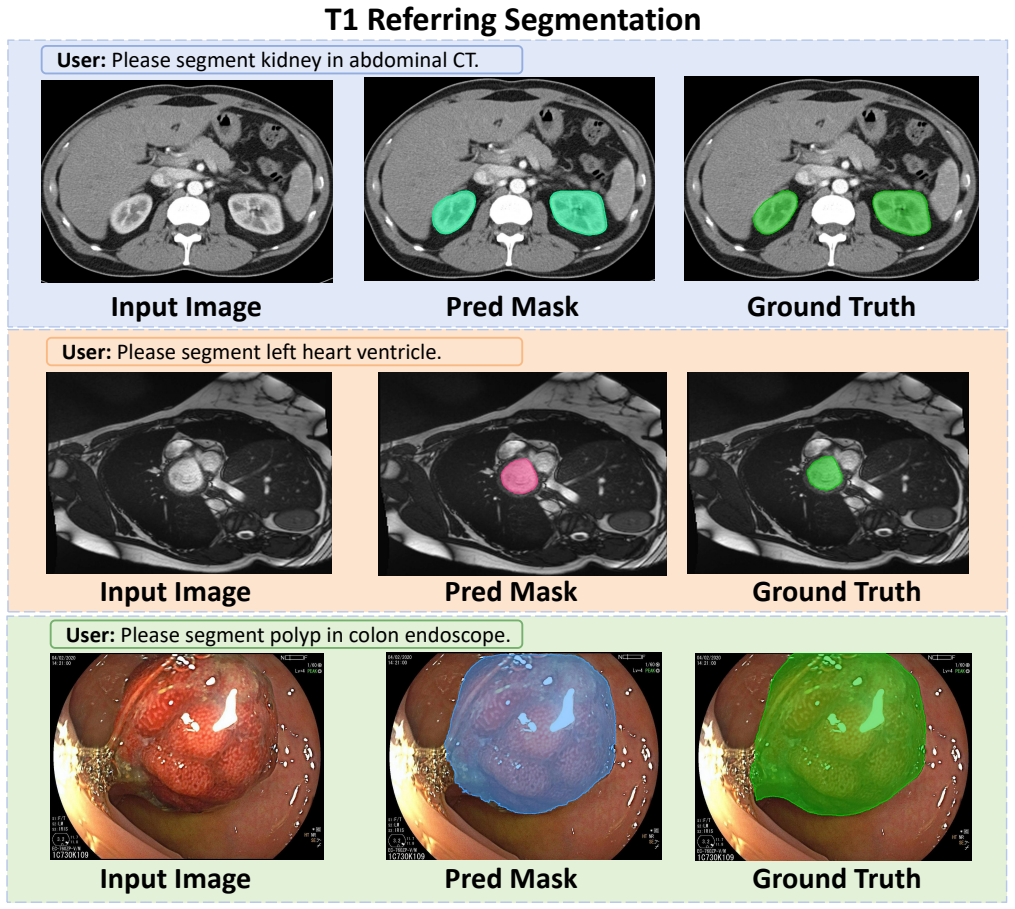
- [Section 4.2] The sentence 'Representative examples are shown in Figure 1' appears to refer to qualitative segmentation outputs, but Figure 1 shows the task interface; if the intended reference is one of the qualitative figures in Appendix F, please correct it.
- [Appendix E.3] The Dice-reasoning alignment analysis relies on gpt-5.6-sol as a judge, but no annotation sample, agreement statistic, or human-verification subset is reported; a small human check would strengthen the claim that Dice-based preferences align with target-level reasoning.
- [Table 3] The U-MRG-14K comparison mixes protocols: other MLLMs generate spatial prompts for a fixed MedSAM2 segmenter, while MedPixel outputs masks directly; this protocol difference should be stated in the main text rather than only in the table caption so that the 'comparable performance' claim can be correctly interpreted.
- [Section 2.2] There is a typographical artifact in 'MedSeg-Rreasonsovercomplexclinicalinstructions'; please fix the spacing and capitalization.
Circularity Check
No significant circularity found: PLPO preference pairs are mined from the training branch and evaluated on held-out test splits, so the reported gains are not forced by construction.
full rationale
The paper's derivation chain is not circular in the sense defined here. MedPLG-440K is synthesized from existing segmentation masks via deterministic visual attribute extraction and template banks (Section 3.2, Appendix B); this is a data-construction step, not a result that reduces to its own inputs. PLPO (Section 3.3, Stage 2) ranks candidate responses by Dice against ground-truth masks (Eq. 7), filters pairs by quality thresholds (Eq. 8), and optimizes the DPO objective (Eq. 11). The preference pairs are explicitly mined from the T2 training branch (Appendix C.3: 'resulting in 1,786 preference pairs from the T2 training branch'), while the T2/T4 evaluations are held-out samples from the official BiomedParse test split (Appendix D.1). Using the same metric for reward and evaluation is standard reward-aligned training, not circularity, because the model must generalize to unseen prompts; the reported improvements are empirical generalization results. The template-matched construction of the T2/T4 test prompts is a benchmark-validity concern, and the paper itself concedes in Section 5 that 'language generated from rules and templates is less diverse than natural clinical interactions,' but this does not make any reported number equal to a training input by construction. There is no load-bearing self-citation chain and no imported uniqueness theorem; the external U-MRG-14K and MeCoVQA-G+ evaluations provide independent, out-of-distribution evidence. Accordingly, no circular step is identified.
Assumptions & free parameters
free parameters (7)
- size_ranges =
0.02, 0.08, 0.20, 0.45
- shape_thresholds =
eta=0.45, rho=1.3, 2.0
- boundary_score_thresholds =
C>0.75, V>0.90, R<4.5, etc.
- contrast_thresholds =
1.15, 0.85
- uniformity_thresholds =
12, 30, 55
- PLPO_pair_filters =
tau_min=0.30, tau_gap=0.10
- PLPO_hyperparameters =
beta=0.25, lambda_nll=0.05, N=8, temperatures 0.3/0.7
assumptions (6)
- domain assumption Masks are an underused source of structured pixel-language supervision.
- domain assumption Template-generated visual descriptors are clinically meaningful and sufficient for training.
- domain assumption Ground-truth masks are valid offline verifiers of response quality for preference optimization.
- domain assumption BiomedParse test split, processed with the same template pipeline, is a valid evaluation of reasoning segmentation.
- domain assumption Qwen2.5-VL and SAM2 can be coupled through a linear projection into a shared language-mask interface.
- domain assumption Dice is an appropriate measure of mask quality for preferential ranking.
Cite this review
Pith. "Pith review of MedPixel: A Unified Pixel-Language Model for Medical Reasoning and Segmentation." pith.science (2026). https://pith.science/paper/KHKY5CRW
@misc{pith2026260809818,
  author       = {Pith},
  title        = {Pith review of: MedPixel: A Unified Pixel-Language Model for Medical Reasoning and Segmentation},
  year         = {2026},
  howpublished = {\url{https://pith.science/paper/KHKY5CRW}},
  note         = {Machine review of arXiv:2608.09818}
}
read the original abstract
Reliable medical image understanding requires models to connect clinical language and visual reasoning with pixel-level grounding. Yet medical vision-language models often lack precise localization, whereas medical segmenters typically rely on explicit target categories or precise spatial prompts. This divide is reinforced by a supervision mismatch: segmentation datasets provide precise masks but little language supervision, whereas medical vision-language data rarely pair language with dense spatial annotations. To address this gap, we present MedPixel, a unified medical pixel-language model built around a shared language--mask interface. To provide scalable supervision, we introduce MedPLG-440K, comprising approximately 440K pixel-language task samples constructed through a clinically motivated synthesis process without external LLM annotation. MedPixel is trained with joint multi-task supervised fine-tuning followed by Pixel-Level Preference Optimization, which uses ground-truth masks as offline verifiers to derive response preferences from mask quality. MedPixel supports a broad spectrum of tasks spanning explicit grounding, implicit reasoning, spatial interaction, grounded explanation, and medical VQA. Across this task spectrum, MedPixel achieves strong performance in both pixel-level prediction and response generation, together with effective zero-shot transfer to external grounding benchmarks and robustness to imperfect spatial prompts. Code and model checkpoints will be released at https://github.com/yhy-whu/Medpixel.
Figures


Figures from the paper (11 more)




Reference graph
Works this paper leans on
-
[2]
Samples without pixel-levelannotationsareoptimizedonlywiththelanguage modeling loss. TheLoRAdropoutissetto0.1.Thelanguage-andvision- sideLoRAadapters,multimodalandtask-specificprojection modules, token embeddings, and language output head use a learning rate of1.5×10 −5. The SAM2 image encoder, prompt encoder, and mask decoder are jointly optimized with a...
-
[3]
Towardsamultimodallargelanguagemodel with pixel-level insight for biomedicine
Huang,X.;Shen,L.;Liu,J.;Shang,F.;Li,H.;Huang,H.;and Yang,Y.2025a. Towardsamultimodallargelanguagemodel with pixel-level insight for biomedicine. InProceedings of the AAAI Conference on Artificial Intelligence, volume 39, 3779–3787. Huang,Y.;Peng,Z.;Zhao,Y.;Yang,P.;Yang,X.;andShen, W.2025b.Medseg-r:Reasoningsegmentationinmedicalim- ageswithmultimodallargel...
-
[4]
Med-GLIP: Advancing medi- cal language-image pre-training with large-scale grounded dataset.arXiv preprint arXiv:2508.10528. FreedomIntelligence.2025. Medical-R1-Distill-Data. https: //huggingface.co/datasets/FreedomIntelligence/Medical- R1-Distill-Data. SFT data distilled from DeepSeek-R1 on HuatuoGPT-o1 verifiable medical problems. Hu,E.J.;Shen,Y.;Walli...
arXiv 2025
-
[8]
arXiv preprint arXiv:2504.03600
Med- sam2: Segment anything in 3d medical images and videos. arXiv preprint arXiv:2504.03600. Pal, A.; Umapathi, L. K.; and Sankarasubbu, M
-
[9]
Direct preference optimization: Your language model is secretly a reward model.Advances inneuralinformationprocessingsystems,36:53728–53741. Ravi, N.; Gabeur, V.; Hu, Y.-T.; Hu, R.; Ryali, C.; Ma, T.; Khedr,H.;Rädle,R.;Rolland,C.;Gustafson,L.;etal.2025. Sam 2: Segment anything in images and videos. InInter- national Conference on Learning Representations,...
work page 2025
-
[10]
Medgemma technical report.arXiv preprint arXiv:2507.05201. Wang, G.; Gao, M.; Yang, S.; Zhang, Y.; He, L.; Huang, L.; Xiao, H.; Zhang, Y.; Li, W.; Chen, L.; et al. 2025a. Citrus: Leveragingexpertcognitivepathwaysinamedicallanguage modelforadvancedmedicaldecisionsupport.arXivpreprint arXiv:2502.18274. Wang, G.; Zhao, J.; Liu, X.; Liu, Y.; Cao, X.; Li, C.; ...
arXiv 2025
-
[11]
Zhang, X.; Wu, C.; Zhao, Z.; Lin, W.; Zhang, Y.; Wang, Y.; and Xie, W
Lisa++: An improved baseline for reasoning segmentation with large language model.arXiv preprint arXiv:2312.17240. Zhang, X.; Wu, C.; Zhao, Z.; Lin, W.; Zhang, Y.; Wang, Y.; and Xie, W
-
[12]
Zhao, T.; Gu, Y.; Yang, J.; Usuyama, N.; Lee, H
Pmc-vqa: Visual instruction tun- ing for medical visual question answering.arXiv preprint arXiv:2305.10415. Zhao, T.; Gu, Y.; Yang, J.; Usuyama, N.; Lee, H. H.; Nau- mann, T.; Gao, J.; Crabtree, A.; Abel, J.; Moung-Wen, C.; etal.2024. Biomedparse:abiomedicalfoundationmodelfor image parsing of everything everywhere all at once.arXiv preprint arXiv:2405.129...
arXiv 2024
Show all 15 references
-
[14]
In contrast, strongly con- tracted boxes may remove essential target regions and pro- vide insufficient spatial evidence
Enlarged boxes preserve the complete target and mainly introduce additional background, which MedPixel can largely suppress. In contrast, strongly con- tracted boxes may remove essential target regions and pro- vide insufficient spatial evidence. This effect is especially visi...
-
[15]
For the localized polyp, MedPixel continues to recover the target contour even when the perturbed box is visibly displaced or asymmetrically resized. The lung ex- ample reveals a more difficult failure mode: when the box excludes a substantial portion of the bilateral anatomy,...
2024
-
[2005]
InProceedings of the acl workshop on intrinsic and extrinsic evaluation measures for machine translation and/or summarization, 65–72
METEOR: An auto- matic metric for MT evaluation with improved correlation with human judgments. InProceedings of the acl workshop on intrinsic and extrinsic evaluation measures for machine translation and/or summarization, 65–72. Bannur, S.; Bouzid, K.; Castro, D. C.; Schwaigh...
2024 arXiv
-
[2021]
In2021IEEE 18thinternationalsymposiumonbiomedicalimaging(ISBI), 1650–1654
Slake: A semantically-labeled knowledge-enhanced datasetformedicalvisualquestionanswering. In2021IEEE 18thinternationalsymposiumonbiomedicalimaging(ISBI), 1650–1654. IEEE. Liu,Y.;Ma,Z.;Pu,J.;Qi,Z.;Wu,Y.;Shan,Y.;andChen,C. 2026.Unipixel:Unifiedobjectreferringandsegmentationfor ...
2026
-
[2023]
arXiv preprint arXiv:2308.16184
Sam-med2d. arXiv preprint arXiv:2308.16184. Deng, Z.; He, R.; Liu, J.; Wang, Y.; Meng, Z.; Jiang, S.; Xie, Y.; and Liu, Z
-
[2024]
InFindingsofthe Association for Computational Linguistics: EMNLP 2024, 8745–8760
Mmedagent: Learning to usemedicaltoolswithmulti-modalagent. InFindingsofthe Association for Computational Linguistics: EMNLP 2024, 8745–8760. Li,C.;Wong,C.;Zhang,S.;Usuyama,N.;Liu,H.;Yang,J.; Naumann,T.;Poon,H.;andGao,J.2023. Llava-med:Train- ing a large language-and-vision as...
2024
-
[2025]
Banerjee, S.; and Lavie, A
Qwen2.5-VL Technical Report.arXiv preprint arXiv:2502.13923. Banerjee, S.; and Lavie, A
Reviewed August 11, 2026 · model on record in the stance chip above.
Discussion (0). Continue with ORCID to comment.