REVIEW 4 major objections 5 minor 57 references
Off-Axis, On Purpose: Where a Transformer Computes Concepts and Why it Does So
T0 review · 4 major / 5 minor · reviewed 2026-08-14 · deepseek-v4-flash
Pith's one-line read A transformer's hidden states sit nearly perpendicular to its answer on purpose, and that off-axis frame can be prescribed before training.
desk verdict Off-axis insulation is a real, well-measured result; fix the logit-lens inconsistency and release code before betting too hard on the frame-prescription story. read the letter →
The pith
A machine-rendered reading of the paper's core claim, the machinery that carries it, and where it could break.
The reading
What carries the argument
The argument runs on four linked instruments. (1) The read-out axis: the direction(s) the tied unembedding reads, the fixed reference every angle is measured against. (2) The write-angle measurement: each sublayer's residual write is sent through the final layer-norm and tied unembedding (the logit lens) and its angle to the final logits computed; a value near $90^\circ$ means the write lives in a subspace the unembedding discards. (3) The insulation experiment: a small rotation of attention's values toward the read-out, compared against a matched random rotation and against the same rotation with cross-token averaging removed, isolating the cost of mixing on-axis values. (4) The frame device: a fixed orthogonal rotation (dense Haar quarter-turn or sparse signed permutation) inserted once at the concept/token boundary, which hands the model an off-axis frame instead of requiring it to grow one under loss pressure. Two supporting measurements carry the load: the participation ratio counts the effective dimensionality of the workspace, and the orthogonal Procrustes decomposition separates rotation from freshly written content across a span of layers.
What would settle it
Recompute the layer-by-layer write angles and the commit-span Procrustes split using per-layer learned translators (the tuned lens) instead of the frozen final decoder on layers 1–7; if early writes then point substantially toward the answer (angles far below $75$ degrees) or the commit $R^2$ rises well above $0.38$, the off-axis insulation and additive-commit claims would be artifacts of the read-out rather than properties of the model.
Extended reading notes
Core claim
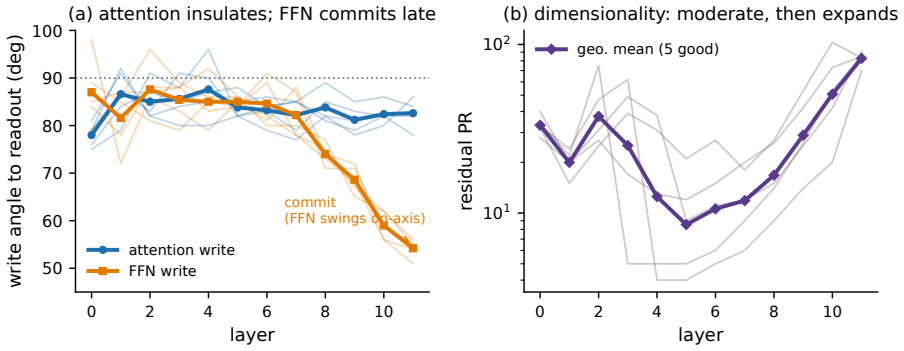
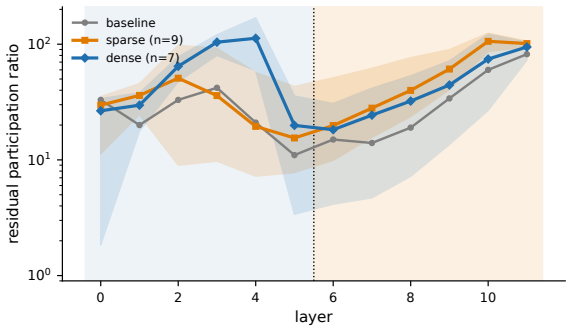
On a 12-layer GPT-2-class transformer trained on OpenWebText, the paper claims, computation splits into two phases with a functional geometry. Through the concept phase (roughly layers 0–8), every sublayer writes into a subspace held near-orthogonal to the unembedding read-out: attention's writes sit $75$–$96^\circ$ off it at every depth, and feed-forward writes about $84^\circ$ until the last four layers. The off-axis position is not incidental: rotating attention's values onto the read-out is $64$–$84\times$ more damaging to next-token loss than a matched random rotation, and a matched control that removes cross-token averaging collapses the asymmetry to about $1\times$. The paper reads this as insulation: attention can average values across token positions without blurring vocabulary predictions, because the averaging happens in a subspace the unembedding discards. The answer is assembled additively and late—over the commit span a best-fit rotation explains only $R^2 = 0.38$ of the change, $64\%$ of the committed state is newly written content, the residual norm grows by $1.74\times$, and the final prediction first becomes the top decoded token at layer $9.2$ on average. The paper further claims the frame is a free gauge: $25$ runs across $13$ distinct $90^\circ$ rotations reach the same quality, two baselines from different seeds hold concepts in frames about $90^\circ$ apart while agreeing on their read-outs, and a basis drawn at random and prescribed before training is adopted with quality unchanged. Supplying a fixed rotation at the phase boundary—dense Haar or sparse signed permutation—makes the prescribed geometry reliably trainable: convergence under the loss-only step schedule rises from $2/8$ seeds to $7/8$ (dense) or $9/9$ (sparse) at baseline quality, while forcing every layer on-axis, as early-exit training does, matches perplexity, LAMBADA, and BLiMP but collapses the concept-phase workspace from about $25$ to $14$ effective dimensions.
Load-bearing premise
The angle measurements assume that reading every layer's write through the model's final output decoder tells you where that write points, even in early and middle layers where the paper itself says direct decoding shows little; if early writes are only legible through per-layer translators, the measured off-axis angles could be an artifact of the decoder's blind spot.
Editorial extensions
If this is right
- A read-out-alignment penalty can force a transformer on-axis, but the resulting model writes the answer by near-cancellation: feed-forward contributes $+9103$ to the answer logit while attention writes $-8113$ against it, so on-axis quality is real but the model is a caution, not a solution.
- Training for early exit (pressing every layer onto the read-out) can match perplexity, LAMBADA, and BLiMP while halving the concept-phase effective dimensionality from about $25$ to $14$; benchmarks alone would not detect the change.
- Prescribing an off-axis/on-axis two-phase schedule through the loss alone is a lottery ($2/8$ seeds converge), while inserting one fixed rotation at the boundary makes the same schedule land reliably ($7/8$ dense, $9/9$ sparse) at baseline quality.
- The $90^\circ$ frame is a free gauge: thirteen distinct rotations across $25$ runs yield the same model, two same-recipe baselines land in near-orthogonal concept frames, and a randomly drawn prescribed basis is adopted without quality loss.
- If the geometry is what the paper claims, the off-axis position is a control surface: models can be trained into a chosen frame, making intermediate representations directly comparable across runs and across models.
Reading between the lines
- The insulation account predicts that increasing attention's mixing pressure (more heads, higher temperature, or longer contexts) should push the converged geometry closer to $90^\circ$; a seed sweep varying mixing strength would test this without new machinery.
- The gauge-freedom result suggests a cheap comparability trick the paper does not fully exploit: training a family of models into one prescribed basis would let differences in concept geometry be read directly as differences in computation, rather than being aligned away post hoc.
- The sparse-device convergence edge ($9/9$ vs $5/9$) points beyond interpretability: fixing an absorbable signed-permutation rotation at mid-depth may serve as a general training-stabilization intervention for transformers, testable at larger scales where from-scratch divergence rates are higher.
- The invisible workspace collapse under early-exit pressure raises a testable concern: models that match quality on next-token benchmarks while losing half their effective dimensionality may degrade on tasks that use the removed directions, such as long-range dependency or compositional generalization.
Editorial analysis
A structured set of objections, weighed in public.
Referee Report
Summary. This paper trains 12-layer GPT-2-small-class models on OpenWebText and studies the geometry of the residual stream relative to the tied unembedding. It reports that attention writes 75–96 degrees off the read-out at every depth, that rotating attention values toward the read-out is 64–84 times more damaging than a matched random rotation only when cross-token mixing is active, and that the final prediction is committed late by additive writes rather than by rotation of accumulated off-axis content. It then shows that forcing every layer on-axis reaches benchmark parity while reducing the concept-phase participation ratio, that prescribing the off-axis/on-axis phase structure through a loss is a lottery (2/8 seeds), and that inserting a fixed rotation at the phase boundary makes the prescription reliable (7/8 dense, 9/9 sparse) without changing quality. Finally it presents evidence that the choice of 90-degree frame is a free gauge: different device rotations produce the same quality, two baselines' concept frames are nearly orthogonal, and a randomly prescribed basis is adopted during training.
Significance. If the central claims hold, the paper reframes off-axis intermediate representations from an obstacle into a functional insulation mechanism and demonstrates that the off-axis frame is a prescribable gauge. The experimental design is stronger than is typical: matched random-rotation controls, an inserted-rotation control that recovers R^2=1.00, foreign-basis controls, explicit convergence-rate reporting, and candid limitation statements in Section 9.4. The paper also identifies that effective-dimensionality changes are invisible to standard benchmarks, which is a useful methodological point. The main risks are instrument validity and reproducibility: the headline angle measurements use the logit lens despite the paper's own statement that it fails before the last layers, a key intervention's target direction is underspecified, and the L_frame coefficient is missing. No code or data release is mentioned.
major comments (4)
- [Section 2.1 and Section 10] The write-angle statistic is defined by sending each sublayer write through the final LayerNorm and tied unembedding (the logit lens), and the headline claim that attention writes 75–96 degrees off the read-out at every depth (Figure 2a) comes from this statistic. However, Section 10 states that the logit lens 'fails on early and middle layers' and names the tuned lens as 'our reading instrument,' and Table 1 lists the tuned lens as the instrument for reading the concept phase. No calibration of the two instruments is reported for the write-angle measurement. If early- and mid-depth writes live in per-layer bases that the frozen final unembedding projects into or near its null space, the reported angles could be an artifact of the decoder rather than a property of the writes. Please either justify why the logit lens is the correct instrument for the angle-to-read-out claim (as opposed to reading latent predictions), or report the same angles under the tuned lens and show they agree.
- [Section 3.1, Figure 3] The insulation experiment is the load-bearing evidence for the paper's central functional claim, but the target direction used to 'rotate each attention head's value vectors toward the read-out' is never specified. It is not stated whether the target is the unembedding row of the next token, the direction of the final logits at that position, a projection of the value vector through the logit lens, or a global read-out subspace. The interpretation of the 64–84 times damage ratio as showing that read-out-aligned values are dangerous only when mixed depends on this construction, and the matched random-rotation control cannot compensate for an underspecified target. Please give the exact perturbation rule, including how the angle and axis are computed at each position and head.
- [Section 8.3, Eq. (8)] The frame-prescription experiment does not report the coefficient with which L_frame is added to the cross-entropy objective, despite Section 2's statement that all loss terms are added with a fixed coefficient. The claim that a randomly drawn basis is adopted with quality unchanged cannot be reproduced, and its sensitivity to the coefficient cannot be assessed, without this value. Please report the coefficient and, ideally, a small sweep or at least the convergence/failure count for the chosen value.
- [Sections 3.2–3.3] The object whose motion is measured as the 'concept constellation' is never defined. The rigidity rotation is fitted to token residual states, but the text reports R^2=0.93 for carrying 'the whole concept constellation' from layer to layer and a 29-degree turn per layer. Without an explicit definition of the concept directions or the concept constellation, these numbers are statements about token residual clouds, and the inference that 'the frame the concept phase computes in' rotates is not supported as stated. Please define the concept directions used in the Procrustes/rigidity analysis, or rephrase the claims in terms of the token residual states that were actually measured.
minor comments (5)
- [Section 6.1] The sentence 'because it is orthogonal it preserves the residual norm and the participation ratio exactly' is true only at the instant of application; after training, the dense-device models show a concept-phase PR near 54 versus 24 for the baseline. Please reword to avoid implying the trained model's PR is preserved.
- [Table 4 and Figure 15] The table caption and figure text describe the concept-phase participation ratio as an average over layers 0–6, but Equation 4 defines the concept phase as layers 0–5 with the boundary at layer 6. Please resolve this inconsistency and state which layer set is used in the reported PR means.
- [Section 8.1] The statement 'Across all twenty-five, LAMBADA spans...' followed by 'Two further dense runs are set aside' is ambiguous as to whether the twenty-five includes the set-aside runs; please state the total number of runs, the number excluded, and the reason for exclusion in one place.
- [Section 4.3] The coefficient used for the angle constraint (Equation 3) is not stated; 'the same coefficient' refers back to a sweep reported for the distributional penalty, but the reader cannot tell which value was used for the fifteen-seed experiment. Please state it explicitly.
- [Reproducibility] No code or data release is mentioned; given the number of bespoke interventions (rotations, losses, schedules, screening criteria), a public release of the training and analysis code would substantially strengthen the paper.
Circularity Check
No significant circularity: the central geometric claims are empirical, measured against matched nulls, with the functional account explicitly labeled as inference.
full rationale
The paper's derivation chain is self-contained. Write angles are defined against the fixed tied unembedding (Section 2.1), the insulation experiment compares read-out-aligned rotations against matched random rotations of the same magnitude and a no-mixing control (Section 3.1), and the additive-commit conclusion uses orthogonal Procrustes with an inserted-rotation control recovering R2_rot = 1.00 (Section 3.2). The rigidity rotation is fitted to the token stream and judged against a no-motion null (Sections 3.2-3.3). The device and frame-prescription results are explicitly training targets or fixed interventions; the non-trivial content is the empirical convergence and quality invariance, not the realization of the prescribed geometry. The only by-construction element is the manipulation check that a loss explicitly minimizing off-diagonal energy in B produces low off-diagonal energy in B; the paper's non-trivial claim there is that quality is unchanged, which is empirical. The single self-citation [35] only contextualizes benchmark levels and is not load-bearing. Section 9.4 explicitly states that the functional-insulation account is an inference from the causal measurement rather than an independent result, further reducing circularity risk. The logit-lens/tuned-lens discrepancy raised by the skeptic is a measurement-validity concern about the read-out instrument, not a case of a claimed result reducing to its input by construction.
Assumptions & free parameters
free parameters (5)
- Read-out alignment penalty coefficient alpha for L_KL and L_cos =
Swept 0.1 to 10; primary reported runs at coefficient 3
- Frameless step angle schedule theta_l = 90/0 degrees =
90 degrees for layers 0-5, 0 degrees for layers 6-11
- Phase boundary layer =
6
- L_frame coefficient for basis-diagonality loss =
Not stated
- Concept-phase layer set for participation-ratio averages =
Layers 0-6
assumptions (4)
- domain assumption Residual stream is additive: each block contributes a write to a shared residual, and these writes can be attributed linearly to final logits via a shared final normalization.
- domain assumption The final layer-norm and tied unembedding, applied directly to intermediate states, give a valid angular read-out to the vocabulary axis.
- standard math For non-Gaussian residual states, the best linear predictor of a layer's write is a valid stand-in for the layer's linear response; Stein's lemma connects it to the mean Jacobian only under Gaussian input.
- domain assumption Orthogonal Procrustes with a no-motion null is sufficient to distinguish rotational from additive change in residual states.
Cite this review
Pith. "Pith review of Off-Axis, On Purpose: Where a Transformer Computes Concepts and Why it Does So." pith.science (2026). https://pith.science/paper/XFJSBDYJ
@misc{pith2026260810251,
  author       = {Pith},
  title        = {Pith review of: Off-Axis, On Purpose: Where a Transformer Computes Concepts and Why it Does So},
  year         = {2026},
  howpublished = {\url{https://pith.science/paper/XFJSBDYJ}},
  note         = {Machine review of arXiv:2608.10251}
}
read the original abstract
A transformer's answer lives on one axis: the direction its unembedding reads. Its intermediate states largely do not, and that off-axis position is usually treated as an obstacle to interpretation. We show it is functional. A 12-layer model computes in two phases. Through the first, every sublayer writes into a subspace held near-orthogonal to the read-out, attention 75 to 96 degrees off it at every depth. Moving attention's values onto the read-out is 64 to 84 times more damaging than a matched random rotation, and the damage is entirely in cross-token mixing: the subspace insulates composition from the vocabulary. Beneath it the frame itself turns rigidly with depth. In the second phase the answer arrives on-axis, late, and by addition rather than by turning accumulated content onto the read-out. Pressing every layer onto the read-out instead, as training for early exit does, matches the baseline on perplexity, LAMBADA and BLiMP while cutting the concept-phase workspace from about twenty-five effective dimensions to fourteen, a change none of those benchmarks register. The geometry can also be imposed, though not by asking for it. Prescribing it through the loss is a lottery: six of eight seeds collapse, because a model told to null its read-out projection obeys most cheaply by discarding dimensions. Inserting one fixed rotation at the phase boundary lands it instead, at baseline quality. A sparse rotation the surrounding weights can absorb converges on all nine seeds, against five of nine for ordinary training. Which rotation is immaterial: twenty-five runs across thirteen distinct ones reach the same quality, and two baselines from different seeds hold their concepts in near-orthogonal frames while agreeing on their read-outs. That freedom is usable: a basis drawn at random and prescribed before training is adopted across the concept phase, with quality unchanged.
Figures


Figures from the paper (15 more)



Reference graph
Works this paper leans on
-
[1]
Mohammad R. Abu Ayyash. Three-phase transformer.arXiv preprint arXiv:2604.14430, 2026. 33
work page Pith review arXiv 2026
-
[2]
Croci, Marcelo Gennari do Nascimento, Torsten Hoefler, and James Hensman
Saleh Ashkboos, Maximilian L. Croci, Marcelo Gennari do Nascimento, Torsten Hoefler, and James Hensman. SliceGPT: Compress large language models by deleting rows and columns. InInternational Conference on Learning Representations (ICLR), 2024. arXiv:2401.15024
arXiv 2024
-
[3]
Converting mlps into polynomials in closed form.arXiv preprint arXiv:2502.01032, 2025
Nora Belrose and Alice Rigg. Converting mlps into polynomials in closed form.arXiv preprint arXiv:2502.01032, 2025
arXiv 2025
-
[4]
Nora Belrose, Zach Furman, Logan Smith, Danny Halawi, Igor Ostrovsky, Lev McKinney, Stella Biderman, and Jacob Steinhardt. Eliciting latent predictions from transformers with the tuned lens.arXiv preprint arXiv:2303.08112, 2023
arXiv 2023
-
[5]
An Analysis of Residual-Stream Geometry Across Transformer Depth
Sunit Bhattacharya and Ravi Shankar Kolli. An analysis of residual-stream geometry across transformer depth.arXiv preprint arXiv:2607.18348, 2026
work page Pith review arXiv 2026
-
[6]
Trenton Bricken, Adly Templeton, Joshua Batson, Brian Chen, Adam Jermyn, et al. Towards monosemanticity: Decomposing language models with dictionary learning.Transformer Cir- cuits Thread, 2023.https://transformer-circuits.pub/2023/monosemantic-features/ index.html
work page 2023
-
[7]
Adam optimizer causes privileged basis in transformer lan- guage model residual stream
Diego Caples and rrenaud. Adam optimizer causes privileged basis in transformer lan- guage model residual stream. LessWrong, 2024.https://www.lesswrong.com/posts/ yrhu6MeFddnGRSLtQ/adam-optimizer-causes-privileged-basis-in-transformer-lm
work page 2024
-
[8]
Aakanksha Chowdhery, Sharan Narang, Jacob Devlin, Maarten Bosma, Gaurav Mishra, Adam Roberts, PaulBarham, HyungWonChung, CharlesSutton, SebastianGehrmann, etal. PaLM: Scaling language modeling with pathways.Journal of Machine Learning Research, 24(240): 1–113, 2023. arXiv:2204.02311
arXiv 2023
Show all 57 references
-
[9]
A bias bound for least squares linear regression.Statistica Sinica, 1(1):127–136, 1991
Naihua Duan and Ker-Chau Li. A bias bound for least squares linear regression.Statistica Sinica, 1(1):127–136, 1991
1991
-
[10]
A mathematical framework for transformer circuits.Transformer Circuits Thread, 2021.https://transformer-circuits
Nelson Elhage, Neel Nanda, Catherine Olsson, Tom Henighan, Nicholas Joseph, Ben Mann, Amanda Askell, Yuntao Bai, Anna Chen, Tom Conerly, et al. A mathematical framework for transformer circuits.Transformer Circuits Thread, 2021.https://transformer-circuits. pub/2021/framework/...
2021
-
[11]
Toy models of superposition.Transformer Circuits Thread, 2022.https:// transformer-circuits.pub/2022/toy_model/index.html
Nelson Elhage, Tristan Hume, Catherine Olsson, Nicholas Schiefer, Tom Henighan, et al. Toy models of superposition.Transformer Circuits Thread, 2022.https:// transformer-circuits.pub/2022/toy_model/index.html
2022
-
[12]
Privileged bases in the transformer residual stream
Nelson Elhage, Robert Lasenby, and Christopher Olah. Privileged bases in the transformer residual stream. Transformer Circuits Thread, 2023.https://transformer-circuits.pub/ 2023/privileged-basis/index.html
2023
-
[13]
Layerskip: Enabling early exit inference and self-speculative decoding
Mostafa Elhoushi, Akshat Shrivastava, Diana Liskovich, Basil Hosmer, Bram Wasti, Liangzhen Lai, Anas Mahmoud, Bilge Acun, Saurabh Agarwal, Ahmed Roman, Ahmed Aly, Beidi Chen, and Carole-Jean Wu. Layerskip: Enabling early exit inference and self-speculative decoding. InProceedi...
2024 arXiv
-
[14]
Dynamics of the transformer residual stream: Coupling spectral geometry to network topology.arXiv preprint arXiv:2605.14258, 2026
Jesseba Fernando and Grigori Guitchounts. Dynamics of the transformer residual stream: Coupling spectral geometry to network topology.arXiv preprint arXiv:2605.14258, 2026. 34
2026 arXiv
-
[15]
A theory of multineuronal dimensionality, dynamics and measurement
Peiran Gao, Eric Trautmann, Byron M Yu, Gopal Santhanam, Stephen Ryu, Krishna Shenoy, and Surya Ganguli. A theory of multineuronal dimensionality, dynamics and measurement. bioRxiv preprint 214262, 2017
2017
-
[16]
Transformer feed-forward layers are key-value memories
Mor Geva, Roei Schuster, Jonathan Berant, and Omer Levy. Transformer feed-forward layers are key-value memories. InProceedings of the 2021 Conference on Empirical Methods in Natural Language Processing (EMNLP), 2021. arXiv:2012.14913
2021 arXiv
-
[17]
Transformer feed-forward layers build predictions by promoting concepts in the vocabulary space
Mor Geva, Avi Caciularu, Kevin Ro Wang, and Yoav Goldberg. Transformer feed-forward layers build predictions by promoting concepts in the vocabulary space. InProceedings of the 2022 Conference on Empirical Methods in Natural Language Processing (EMNLP), 2022. arXiv:2203.14680
2022 arXiv
-
[18]
Openwebtext corpus.http://Skylion007.github.io/ OpenWebTextCorpus, 2019
Aaron Gokaslan and Vanya Cohen. Openwebtext corpus.http://Skylion007.github.io/ OpenWebTextCorpus, 2019
2019
-
[19]
Verbalizable representations form a global workspace in language models.Transformer Circuits Thread, 2026.https://transformer-circuits.pub/2026/workspace/, ICLR 2026
Wes Gurnee, Nicholas Sofroniew, Adam Pearce, Mateusz Piotrowski, Isaac Kauvar, et al. Verbalizable representations form a global workspace in language models.Transformer Circuits Thread, 2026.https://transformer-circuits.pub/2026/workspace/, ICLR 2026
2026
-
[20]
The concept allocation zone: Tracking how concepts form across transformer depth.arXiv preprint arXiv:2605.24856, 2026
James Henry. The concept allocation zone: Tracking how concepts form across transformer depth.arXiv preprint arXiv:2605.24856, 2026
2026 arXiv
-
[21]
Geometric evolution maps: Extracting stable concept probes from transformer residual streams.arXiv preprint arXiv:2605.25848, 2026
James Henry. Geometric evolution maps: Extracting stable concept probes from transformer residual streams.arXiv preprint arXiv:2605.25848, 2026
2026 arXiv
-
[22]
Decomposing representation space into interpretable sub- spaces with unsupervised learning
Xinting Huang and Michael Hahn. Decomposing representation space into interpretable sub- spaces with unsupervised learning. InInternational Conference on Learning Representations (ICLR), 2026. arXiv:2508.01916; ICLR 2026; preprint arXiv:2508.01916
2026 arXiv
-
[23]
Residual connections encourage iterative inference
Stanisław Jastrzębski, Devansh Arpit, Nicolas Ballas, Vikas Verma, Tong Che, and Yoshua Bengio. Residual connections encourage iterative inference. InInternational Conference on Learning Representations (ICLR), 2018
2018
-
[24]
Unraveling token prediction refinement and identifying essential layers in language models.arXiv preprint arXiv:2501.15054, 2025
Jaturong Kongmanee. Unraveling token prediction refinement and identifying essential layers in language models.arXiv preprint arXiv:2501.15054, 2025
2025 arXiv
-
[25]
Similarity of neural network representations revisited
Simon Kornblith, Mohammad Norouzi, Honglak Lee, and Geoffrey Hinton. Similarity of neural network representations revisited. InProceedings of the 36th International Conference on Machine Learning (ICML), volume 97 ofPMLR, pages 3519–3529, 2019. arXiv:1905.00414
2019 arXiv
-
[26]
The remarkable robustness of LLMs: Stages of inference? InarXiv preprint arXiv:2406.19384, 2024
Vedang Lad, Wes Gurnee, and Max Tegmark. The remarkable robustness of LLMs: Stages of inference? InarXiv preprint arXiv:2406.19384, 2024
2024 arXiv
-
[27]
To FP8 and back again: Quantifying reduced precision effects on LLM training stability.arXiv preprint arXiv:2405.18710, 2024
Joonhyung Lee, Jeongin Bae, Byeongwook Kim, Se Jung Kwon, and Dongsoo Lee. To FP8 and back again: Quantifying reduced precision effects on LLM training stability.arXiv preprint arXiv:2405.18710, 2024
2024 arXiv
-
[28]
Regression analysis under link violation.The Annals of Statistics, 17(3):1009–1052, 1989
Ker-Chau Li and Naihua Duan. Regression analysis under link violation.The Annals of Statistics, 17(3):1009–1052, 1989
1989
-
[29]
Optimal degrees of synaptic connectivity.Neuron, 93(5):1153–1164, 2017
Ashok Litwin-Kumar, Kameron Decker Harris, Richard Axel, Haim Sompolinsky, and L F Abbott. Optimal degrees of synaptic connectivity.Neuron, 93(5):1153–1164, 2017. 35
2017
-
[30]
A geometric perspective on next-token prediction in large language models: Three emerging phases.arXiv preprint arXiv:2605.09011, 2026
Gianfranco Lombardo, Giuseppe Trimigno, and Stefano Cagnoni. A geometric perspective on next-token prediction in large language models: Three emerging phases.arXiv preprint arXiv:2605.09011, 2026
2026 arXiv
-
[31]
Residual connections and the causal shift: Uncovering a structural misalignment in transformers.arXiv preprint arXiv:2602.14760, 2026
Jonathan Lys, Vincent Gripon, Bastien Pasdeloup, Axel Marmoret, Lukas Mauch, Fabien Cardinaux, and Ghouthi Boukli Hacene. Residual connections and the causal shift: Uncovering a structural misalignment in transformers.arXiv preprint arXiv:2602.14760, 2026
2026
-
[32]
Morcos, Maithra Raghu, and Samy Bengio
Ari S. Morcos, Maithra Raghu, and Samy Bengio. Insights on representational similarity in neural networks with canonical correlation. InAdvances in Neural Information Processing Systems (NeurIPS), 2018
2018
-
[33]
Do wide and deep networks learn the same things? uncovering how neural network representations vary with width and depth
Thao Nguyen, Maithra Raghu, and Simon Kornblith. Do wide and deep networks learn the same things? uncovering how neural network representations vary with width and depth. In International Conference on Learning Representations (ICLR), 2021. arXiv:2010.15327
2021 arXiv
-
[34]
Interpreting GPT: The logit lens
nostalgebraist. Interpreting GPT: The logit lens. LessWrong, 2020.https://www.lesswrong. com/posts/AcKRB8wDpdaN6v6ru/interpreting-gpt-the-logit-lens
2020
-
[35]
Legible-by-construction: Attention and end-to-end transformers.arXiv preprint arXiv:2607.04319, 2026
Mark Oskin. Legible-by-construction: Attention and end-to-end transformers.arXiv preprint arXiv:2607.04319, 2026
2026 arXiv
-
[36]
EE-Tuning: An eco- nomical yet scalable solution for tuning early-exit large language models.arXiv preprint arXiv:2402.00518, 2024
Xuchen Pan, Yanxi Chen, Yaliang Li, Bolin Ding, and Jingren Zhou. EE-Tuning: An eco- nomical yet scalable solution for tuning early-exit large language models.arXiv preprint arXiv:2402.00518, 2024
2024 arXiv
-
[37]
The LAM- BADA dataset: Word prediction requiring a broad discourse context
Denis Paperno, Germán Kruszewski, Angeliki Lazaridou, Ngoc Quan Pham, Raffaella Bernardi, Sandro Pezzelle, Marco Baroni, Gemma Boleda, and Raquel Fernández. The LAM- BADA dataset: Word prediction requiring a broad discourse context. InProceedings of the 54th Annual Meeting of ...
2016
-
[38]
The linear representation hypothesis and the geometry of large language models
Kiho Park, Yo Joong Choe, and Victor Veitch. The linear representation hypothesis and the geometry of large language models. InProceedings of the 41st International Conference on Machine Learning (ICML), volume 235 ofPMLR, pages 39643–39666, 2024. arXiv:2311.03658
2024 arXiv
-
[39]
Language models are unsupervised multitask learners.OpenAI Technical Report, 2019
Alec Radford, Jeffrey Wu, Rewon Child, David Luan, Dario Amodei, and Ilya Sutskever. Language models are unsupervised multitask learners.OpenAI Technical Report, 2019
2019
-
[40]
SVCCA: Singu- lar vector canonical correlation analysis for deep learning dynamics and interpretability
Maithra Raghu, Justin Gilmer, Jason Yosinski, and Jascha Sohl-Dickstein. SVCCA: Singu- lar vector canonical correlation analysis for deep learning dynamics and interpretability. In Advances in Neural Information Processing Systems (NeurIPS), 2017
2017
-
[41]
Steering llama 2 via contrastive activation addition
Nina Rimsky, Nick Gabrieli, Julian Schulz, Meg Tong, Evan Hubinger, and Alexander Matt Turner. Steering llama 2 via contrastive activation addition. InAnnual Meeting of the Asso- ciation for Computational Linguistics (ACL), 2024. arXiv:2312.06681
2024 arXiv
-
[42]
The effective rank: A measure of effective dimensionality
Olivier Roy and Martin Vetterli. The effective rank: A measure of effective dimensionality. In 2007 15th European Signal Processing Conference (EUSIPCO), pages 606–610. IEEE, 2007
2007
-
[43]
A generalized solution of the orthogonal Procrustes problem.Psychome- trika, 31(1):1–10, 1966
Peter H Schönemann. A generalized solution of the orthogonal Procrustes problem.Psychome- trika, 31(1):1–10, 1966. 36
1966
-
[44]
Tran, Yi Tay, and Donald Metzler
Tal Schuster, Adam Fisch, Jai Gupta, Mostafa Dehghani, Dara Bahri, Vinh Q. Tran, Yi Tay, and Donald Metzler. Confident adaptive language modeling. InAdvances in Neural Informa- tion Processing Systems 35 (NeurIPS), pages 17456–17472, 2022. arXiv:2207.07061
2022 arXiv
-
[45]
Confidence regulation neurons in language models
Alessandro Stolfo, Ben Wu, Wes Gurnee, Yonatan Belinkov, Xingyi Song, Mrinmaya Sachan, and Neel Nanda. Confidence regulation neurons in language models. InAdvances in Neural Information Processing Systems (NeurIPS), 2024. arXiv:2406.16254
2024 arXiv
-
[46]
RoFormer: Enhancedtransformerwithrotarypositionembedding.arXiv preprint arXiv:2104.09864, 2021
Jianlin Su, Yu Lu, Shengfeng Pan, Ahmed Murtadha, Bo Wen, and Yunfeng Liu. RoFormer: Enhancedtransformerwithrotarypositionembedding.arXiv preprint arXiv:2104.09864, 2021
2021 arXiv
-
[47]
Signed-permutation coordinate transport for RMSNorm transformers.arXiv preprint arXiv:2606.31963, 2026
John Sweeney. Signed-permutation coordinate transport for RMSNorm transformers.arXiv preprint arXiv:2606.31963, 2026
2026 arXiv
-
[48]
Alex Tamkin, Mohammad Taufeeque, and Noah D. Goodman. Codebook features: Sparse and discrete interpretability for neural networks. InProceedings of the 41st International Conference on Machine Learning (ICML), volume 235 ofPMLR, pages 47535–47563, 2024. arXiv:2310.17230
2024 arXiv
-
[49]
Vazquez, Ulisse Mini, and Monte MacDiarmid
Alexander Matt Turner, Lisa Thiergart, Gavin Leech, David Udell, Juan J. Vazquez, Ulisse Mini, and Monte MacDiarmid. Activation addition: Steering language models without opti- mization.arXiv preprint arXiv:2308.10248, 2023
2023 arXiv
-
[50]
PolyPythias: Stabilityandoutliersacrossfiftylanguage model pre-training runs
Oskar van der Wal, Pietro Lesci, Max Müller-Eberstein, Naomi Saphra, Hailey Schoelkopf, WillemZuidema, andStellaBiderman. PolyPythias: Stabilityandoutliersacrossfiftylanguage model pre-training runs. InInternational Conference on Learning Representations (ICLR),
-
[51]
Gomez, Lukasz Kaiser, and Illia Polosukhin
Ashish Vaswani, Noam Shazeer, Niki Parmar, Jakob Uszkoreit, Llion Jones, Aidan N. Gomez, Lukasz Kaiser, and Illia Polosukhin. Attention is all you need. InAdvances in Neural Infor- mation Processing Systems (NeurIPS), 2017
2017
-
[52]
BLiMP: The benchmark of linguistic minimal pairs for English
Alex Warstadt, Alicia Parrish, Haokun Liu, Anhad Mohananey, Wei Peng, Sheng-Fu Wang, and Samuel R Bowman. BLiMP: The benchmark of linguistic minimal pairs for English. Transactions of the Association for Computational Linguistics (TACL), 8:377–392, 2020
2020
-
[53]
Liu, Lechao Xiao, Katie Everett, Alex Alemi, Ben Adlam, John D
Mitchell Wortsman, Peter J. Liu, Lechao Xiao, Katie Everett, Alex Alemi, Ben Adlam, John D. Co-Reyes, Izzeddin Gur, Abhishek Kumar, Roman Novak, Jeffrey Pennington, Jascha Sohl- Dickstein, Kelvin Xu, Jaehoon Lee, Justin Gilmer, and Simon Kornblith. Small-scale proxies for larg...
2024 arXiv
-
[54]
Jump to conclusions: Short-cutting transformers with linear transformations
Alexander Yom Din, Taelin Karidi, Leshem Choshen, and Mor Geva. Jump to conclusions: Short-cutting transformers with linear transformations. InProceedings of the 2024 Joint In- ternational Conference on Computational Linguistics, Language Resources and Evaluation (LREC-COLING)...
2024 arXiv
-
[55]
Haeffele, and Yi Ma
Yaodong Yu, Sam Buchanan, Druv Pai, Tianzhe Chu, Ziyang Wu, Shengbang Tong, Ben- jamin D. Haeffele, and Yi Ma. White-box transformers via sparse rate reduction. InAdvances in Neural Information Processing Systems (NeurIPS), 2023. arXiv:2306.01129. 37
2023 arXiv
-
[56]
Haeffele, and Yi Ma
Yaodong Yu, Sam Buchanan, Druv Pai, Tianzhe Chu, Ziyang Wu, Shengbang Tong, Druv Pai, Benjamin D. Haeffele, and Yi Ma. White-box transformers via sparse rate reduction: Compres- sion is all there is?Journal of Machine Learning Research (JMLR), 2024. arXiv:2311.13110
2024 arXiv
-
[57]
OPT: Open pre-trained transformer language models.arXiv preprint arXiv:2205.01068, 2022
Susan Zhang, Stephen Roller, Naman Goyal, Mikel Artetxe, Moya Chen, Shuohui Chen, Christopher Dewan, Mona Diab, Xian Li, Xi Victoria Lin, et al. OPT: Open pre-trained transformer language models.arXiv preprint arXiv:2205.01068, 2022. 38
2022 arXiv
Reviewed August 14, 2026 · model on record in the stance chip above.
Discussion (0). Continue with ORCID to comment.