REVIEW 4 major objections 6 minor 67 references
DriveVLA-M0: Failure-Aware Memory Augmentation for Autonomous Driving
T0 review · 4 major / 6 minor · reviewed 2026-08-15 · deepseek-v4-flash
Pith's one-line read DriveVLA-M0 claims a driving VLA can correct its planning at test time by retrieving structurally similar failures from latent memory and adapting only low-rank decoders, scoring 94.1 PDMS and 47.0 EPDMS without retraining the backbone.
desk verdict Promising memory-TTT system with solid ablations, but the headline SOTA number leans on a synthetic-memory run whose provenance and test-overlap checks aren't reported. read the letter →
The pith
A machine-rendered reading of the paper's core claim, the machinery that carries it, and where it could break.
The reading
What carries the argument
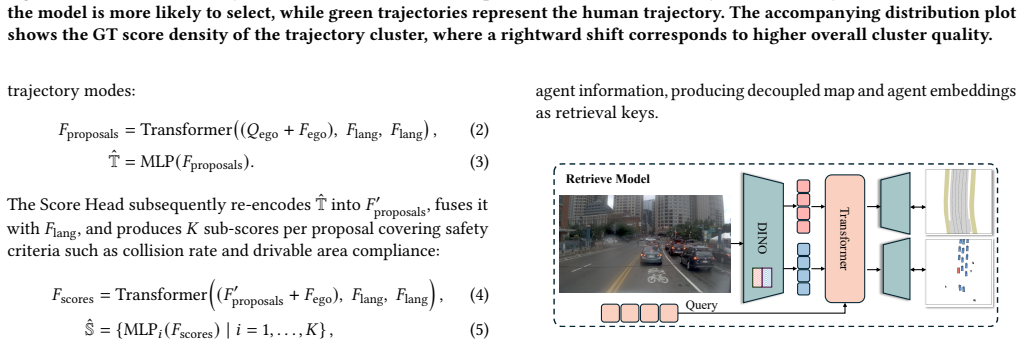
The load-bearing machinery is the latent failure memory and the decoupled LoRA test-time training that reads from it. Each memory entry stores retrieval keys (map and agent embeddings produced by a Retrieve Model built on a self-supervised visual encoder with separate LoRA branches), adaptation inputs (compressed language features, ego-status embedding, and the base model's trajectory cluster), and supervision targets (the expert trajectory and oracle PDM scores). At inference, the Retrieve Model emits decoupled map and agent keys; a cosine-similarity trigger decides whether test-time training runs at all; top-$k$ cases then fine-tune the map and agent LoRA branches on the action decoder, and the two branches' score predictions are fused according to which sub-metric they govern. Low-rank adapters are small trainable low-rank matrices that update a module without changing its pretrained weights.
What would settle it
Build a memory pool from scenes that are provably disjoint from the NAVSIM test scenes, such as memory drawn only from a held-out city or sim environment, and re-run the evaluation; if the PDMS and EPDMS gains largely disappear, the retrieval is exploiting near-duplicates rather than generalizing structurally.
Extended reading notes
Core claim
The central claim is that retrieval-augmented test-time adaptation of the action decoder, keyed on static road topology and dynamic agent interactions rather than language features, transfers failure knowledge into better driving decisions. On NAVSIMv1 the paper reports 92.3 PDMS for the base configuration and 94.1 PDMS when memory is expanded to 10K synthetic cases; on NAVSIMv2 it reports 47.0 EPDMS, where EPDMS extends PDMS with lane-keeping, direction, traffic-light, and comfort sub-scores. The same base model without memory scores 91.0 PDMS, and ablations show that language-feature retrieval slightly hurts while map-plus-agent retrieval is what lifts the score. Injection is done by decoupled LoRA branches, one for static sub-scores and one for dynamic sub-scores, trained for three gradient steps per scenario, which the paper reports as nearly matching full action-decoder fine-tuning at 26.44 ms versus 55.42 ms backward latency.
Load-bearing premise
The scores depend on the premise that the retrieved failure cases resemble the test scene structurally without being near-duplicates of it; if the memory pool overlaps the test distribution, the stored expert trajectories can directly encode the correct output and the gains would come from memorization rather than from the test-time correction mechanism.
Editorial extensions
If this is right
- If the central claim holds, a deployed driving VLA can be corrected in the field by appending new failure memories; no backbone retraining or offline post-training is needed for each new scenario type.
- Language-space retrieval is not just neutral but slightly harmful in the ablations, giving 90.7 PDMS versus 91.0 for the base model, while map-plus-agent retrieval gives 92.3; retrieval keys should encode scene structure and dynamics.
- Selective triggering is a safety dial: too permissive a threshold injects noisy supervision and drops the score below baseline, while too restrictive a threshold skips needed corrections, so the trigger must be tuned per deployment.
- Decoupled LoRA test-time training offers a practical latency-safety trade, reaching 92.3 PDMS at 26.44 ms backward pass versus 92.4 for full action-decoder test-time training at 55.42 ms.
- Memory expansion behaves like a data-scaling law for failures: going from about 4K to 10K stored cases raises PDMS from 92.3 to 94.1 with the same base model, so performance can grow with stored experience rather than compute.
Reading between the lines
- Editorial inference: the cleanest way to separate genuine correction from memorization is to build memory from scenes structurally similar to, but disjoint from, the evaluation set, for example memory from one city or sensor configuration and testing on another; the paper does not report this separation, and its memory is built from past training data plus synthetic scenarios from a simulator whos
- Editorial inference: if the mechanism transfers, it suggests a general case-based safety principle for embodied agents, where any oracle-scored failure log from simulators or fleet data can be converted into corrective memory, making coverage of failure modes the scarce resource rather than model capacity.
- Editorial inference: the decoupled static and dynamic retrieval could be reused in motion forecasting or robot navigation, where scene geometry and actor layout are the deciding factors; a testable extension is to replace the driving-specific score fusion with task-appropriate metric heads.
- Editorial inference: the scaling result conflates memory size with memory diversity; a follow-up that holds the number of cases fixed while varying scenario diversity, or vice versa, would reveal which factor actually drives the gains.
Signed reviews
Editorial analysis
A structured set of objections, weighed in public.
Referee Report
Summary. The paper proposes DriveVLA-M0, a retrieval-augmented vision-language-action (VLA) model for autonomous driving that stores failure cases in a latent memory and, at test time, retrieves structurally similar cases (decoupled map/agent embeddings) and adapts the action decoder via decoupled LoRA-based test-time training (TTT). The method is evaluated on NAVSIMv1 and NAVSIMv2, reporting 94.1 PDMS on Navtest and 47.0 EPDMS on Navhard, with ablations on retrieval key design, injection strategy, trigger threshold, and TTT hyperparameters, plus a latency breakdown. The authors claim that memory expansion with synthetic data enables training-free performance gains.
Significance. If the results are free of test-set leakage, the combination of failure-aware memory, structurally grounded retrieval, and decoupled LoRA TTT is a novel and practically useful contribution for driving VLAs. The paper ships a full ablation suite that validates design choices individually: language-space retrieval hurts performance, map+agent retrieval helps, decoupled LoRA matches full TTT, and the trigger threshold has a clear optimum. The code release is a further strength that makes the experiments machine-checkable. The reported 26.44 ms TTT backward-pass overhead, if reproducible, would make the approach deployment-relevant. The main uncertainty is not internal inconsistency but the provenance of the Scale configuration's memory and the lack of a contamination check, which directly affects whether the headline SOTA claim is valid.
major comments (4)
- [Abstract / Section 4.2, Table 1] The headline number 94.1 PDMS is produced by the Scale configuration, which expands memory to 10K cases using SimScale synthetic data, whereas the Base configuration (4K memory) reaches 92.3 PDMS, below DriveSuprim (93.5) and Centaur (92.6). The abstract states that DriveVLA-M0 achieves 94.1 PDMS without separating these two configurations, so the 'state-of-the-art' claim rests on a configuration whose memory provenance is not independently verified. Please state Base and Scale results separately in the abstract and conclusion.
- [Section 3.3 / Algorithm 1] The paper reports no contamination check between the memory pool and the NAVSIM test split. The cosine-similarity deduplication in Section 3.3 is described only as checking against existing memory entries; if a test scenario or a near-duplicate is already present in memory, the stored expert trajectory and oracle PDM scores can directly supervise the TTT loss, inflating metrics regardless of the proposed correction mechanism. Please report the maximum (or percentile) cosine similarity between memory retrieval keys and test-set keys, or otherwise demonstrate that retrieved cases are not near-duplicates of test scenes.
- [Section 4.2, reference [40]] The Scale configuration's memory expansion uses SimScale synthetic scenarios, but the paper does not describe the simulator's distribution, the scenario generation protocol, or the relationship between SimScale scenes and the NAVSIM test set. Since memory entries contain ground-truth trajectories and oracle scores (Equations 8-10) and the TTT loss regresses to those labels, the 94.1 PDMS result cannot be interpreted unless the synthetic data is shown to be disjoint from the test distribution. Please describe the generation protocol, the splits used, and a similarity histogram between memory entries and test scenes.
- [Section 3.4 / Algorithm 1] The TTT loss LTTT used in Algorithm 1 (line 20) is never defined. The text mentions trajectory and score losses but gives no equations for how the retrieved cases' labels adapt the decoupled LoRA branches, nor how the two branches are jointly or separately optimized. Please provide the explicit loss terms, their weighting, and the exact optimization procedure.
minor comments (6)
- [Table 2 caption] The word 'Comparision' is misspelled; it should be 'Comparison'.
- [Reference [20]] The venue string 'arxiV'26' should be 'arXiv'26' for consistency with other references.
- [Abstract and table captions] The benchmark names are inconsistently spaced: the abstract uses 'NA VSIMv1' and 'Na VSIMv2', while the body uses 'NAVSIMv1' and 'NAVSIMv2'; please unify the notation.
- [Section 4.2] The sentence 'our approach consistently outperforms prior methods' is too strong for the Base configuration, which is below DriveSuprim in Table 1; please qualify the claim by configuration or by metric.
- [Table 6 / Section 4.2] Table 6 states the latency measurement uses a memory of 4,000 cases, while Section 4.2 says the Base memory size is 'approximately 4K entries'; please report the exact memory size used in the deployment measurements.
- [Algorithm 1] In Algorithm 1, line 15 returns 'base trajectory τ_0' but the symbol τ_0 is not defined earlier; please introduce it in Section 3.4 or use the same symbol as in the surrounding text.
Circularity Check
No significant circularity: the memory-augmented TTT pipeline is an empirical transductive-learning system, and the SimScale provenance concern is a validity risk rather than a definitional reduction.
full rationale
The claimed derivation chain is empirical, not analytic. Memory entries are constructed from 'past training or external data' (Section 3.3) with retrieval keys extracted by a separately trained Retrieve Model; the stored supervision labels are the expert trajectory and oracle PDM scores (Equations 8-10). At inference, retrieved cases are used to fine-tune decoupled LoRA branches (Algorithm 1, lines 18-24). This is transductive test-time learning: the test scene's own labels never appear in memory by construction, and no equation in the paper identifies a retrieved memory entry with the current test scene. The Base configuration (92.3 PDMS in Table 1) is obtained without the SimScale-augmented memory and already exceeds the no-memory base model (91.0 in Tables 3-5), so the central retrieval-plus-TTT mechanism has independent support. The abstract's headline 94.1 is produced by the Scale configuration, which expands memory using SimScale synthetic scenarios (Section 4.2, reference [40], which shares co-author Junli Wang with this paper). That is a legitimate provenance and potential contamination concern, but the paper does not reduce the scaling result to the citation: the gain is measured, not derived, and no fitted parameter is renamed as a prediction. The trigger-sensitivity ablations (Table 5) and TTT hyperparameter ablations (Table 8) further show that adding or retrieving more memory is not assumed to help by definition. Accordingly, no load-bearing step reduces by construction to its own input, and no circularity score above zero is warranted.
Assumptions & free parameters
free parameters (7)
- Failure threshold beta =
0.5
- Trigger threshold lambda =
0.9
- Retrieve loss weight alpha =
10
- TTT learning rate =
2e-4
- TTT steps =
3
- Memory size (Base/Scale) =
4K / 10K
- Top-k retrieval (k1, k2) =
9, 3
assumptions (4)
- domain assumption The oracle PDM simulation score is a reliable indicator of planning quality and of which scenarios are failures.
- domain assumption Occupancy-grid supervision on static map and dynamic agents yields retrieval embeddings that capture planning-relevant structure.
- domain assumption Expert trajectories from retrieved similar scenes provide valid supervision for test-time adaptation.
- standard math InternVL3 and DINOv2 pretrained weights are treated as fixed, reliable feature extractors.
Cite this review
Pith. "Pith review of DriveVLA-M0: Failure-Aware Memory Augmentation for Autonomous Driving." pith.science (2026). https://pith.science/paper/PBISJFD3
@misc{pith2026260810413,
  author       = {Pith},
  title        = {Pith review of: DriveVLA-M0: Failure-Aware Memory Augmentation for Autonomous Driving},
  year         = {2026},
  howpublished = {\url{https://pith.science/paper/PBISJFD3}},
  note         = {Machine review of arXiv:2608.10413}
}
read the original abstract
Vision-Language-Action (VLA) models have recently emerged as a promising paradigm for end-to-end autonomous driving by enabling unified reasoning across perception, language, and planning. However, existing approaches lack mechanisms to exploit past failures or adapt to distribution shifts, causing the model to persistently underperform on similar scenarios where it has previously failed. In this paper, we propose DriveVLA-M0, a retrieval-augmented VLA with failure-aware latent memory. We construct a latent memory pool that stores failure cases along with their structure scene representations and expert trajectory labels, and design a dedicated Retrieve Model that decouples static road structure and dynamic agent interactions to enable structurally grounded retrieval. At inference time, retrieved cases are injected into the model via a lightweight decoupled LoRA-based test-time training (TTT) mechanism, allowing targeted and scenario-specific correction without modifying the backbone. Extensive experiments on NAVSIMv1 and NAVSIMv2 benchmark demonstrate that our approach consistently outperforms prior methods, achieving 94.1 PDMS on Navtest and 47.0 EPDMS on Navhard with only 26.44 ms TTT backward latency overhead. Furthermore, we show that DriveVLA-M0 scales effectively with additional memory, enabling training-free performance gains through memory expansion. The code is available at https://github.com/ZebinX/DriveVLA-M0.
Figures


Figures from the paper (5 more)



Reference graph
Works this paper leans on
-
[40]
Haochen Tian, Tianyu Li, Haochen Liu, Jiazhi Yang, Yihang Qiu, Guang Li, Junli Wang, Yinfeng Gao, Zhang Zhang, Liang Wang, Hangjun Ye, Tieniu Tan, Long Chen, and Hongyang Li. 2026. SimScale: Learning to Drive via Real-World Simulation at Scale.CVPR(2026)
work page 2026
-
[1]
Ali Behrouz, Peilin Zhong, and Vahab Mirrokni. 2024. Titans: Learning to Memo- rize at Test Time.NeurIPS(2024)
work page 2024
-
[2]
Matthew M Botvinick, Todd S Braver, Deanna M Barch, Cameron S Carter, and Jonathan D Cohen. 2001. Conflict monitoring and cognitive control.Psychological review108, 3 (2001), 624
work page 2001
-
[3]
Joshua W Brown and Todd S Braver. 2005. Learned predictions of error likelihood in the anterior cingulate cortex.Science307, 5712 (2005), 1118–1121
work page 2005
-
[4]
Wei Cao, Marcel Hallgarten, Tianyu Li, Daniel Dauner, Xunjiang Gu, Cao- jun Wang, Yakov Miron, Marco Aiello, Hongyang Li, Igor Gilitschenski, Boris Ivanovic, Marco Pavone, Andreas Geiger, and Kashyap Chitta. 2025. Pseudo- Simulation for Autonomous Driving.CoRL(2025)
work page 2025
-
[5]
Shaoyu Chen, Bo Jiang, Hao Gao, Bencheng Liao, Qing Xu, Qian Zhang, Chang Huang, Wenyu Liu, and Xinggang Wang. 2026. VADv2: End-to-End Vectorized Autonomous Driving via Probabilistic Planning.ICLR(2026)
work page 2026
-
[6]
Kashyap Chitta, Aditya Prakash, Bernhard Jaeger, Zehao Yu, Katrin Renz, and Andreas Geiger. 2023. TransFuser: Imitation with Transformer-Based Sensor Fusion for Autonomous Driving.IEEE Transactions on Pattern Analysis and Machine Intelligence45, 11 (2023), 12878–12895. doi:10.1109/TPAMI.2022.3200245
-
[7]
Daniel Dauner, Marcel Hallgarten, Andreas Geiger, and Kashyap Chitta. 2023. Parting with Misconceptions about Learning-based Vehicle Motion Planning. CoRL(2023)
work page 2023
Show all 67 references
-
[8]
Daniel Dauner, Marcel Hallgarten, Tianyu Li, Xinshuo Weng, Zhiyu Huang, Zetong Yang, Hongyang Li, Igor Gilitschenski, Boris Ivanovic, Marco Pavone, Andreas Geiger, and Kashyap Chitta. 2024. NAVSIM: Data-Driven Non-Reactive Autonomous Vehicle Simulation and Benchmarking.NeurIPS(2024)
2024
-
[9]
Haoyu Fu, Diankun Zhang, Zongchuang Zhao, Jianfeng Cui, Dingkang Liang, Chong Zhang, Dingyuan Zhang, Hongwei Xie, Bing Wang, and Xiang Bai. 2025. ORION: A Holistic End-to-End Autonomous Driving Framework by Vision- Language Instructed Action Generation.ICCV(2025)
2025
-
[10]
Yinfeng Gao, Deqing Liu, Yupeng Zheng, Qichao Zhang, Da-Wei Ding, and Dongbin Zhao. 2026. SoAD: Safety-Oriented Value Estimation for Enhanced Closed-Loop End-to-End Autonomous Driving.IEEE Transactions on Systems, Man, and Cybernetics: Systems56, 8 (2026), 4942–4955. doi:10.11...
2026 doi
-
[11]
Ke Guo, Haochen Liu, Xiaojun Wu, Jia Pan, and Chen Lv. 2025. iPad: Iterative Proposal-centric End-to-End Autonomous Driving.arXiv:2505.15111(2025)
2025 arXiv
-
[12]
Hu, Yelong Shen, Phillip Wallis, Zeyuan Allen-Zhu, Yuanzhi Li, Shean Wang, Lu Wang, and Weizhu Chen
Edward J. Hu, Yelong Shen, Phillip Wallis, Zeyuan Allen-Zhu, Yuanzhi Li, Shean Wang, Lu Wang, and Weizhu Chen. 2022. LoRA: Low-Rank Adaptation of Large Language Models.ICLR(2022)
2022
- [13]
-
[14]
Yihan Hu, Jiazhi Yang, Li Chen, Keyu Li, Chonghao Sima, Xizhou Zhu, Siqi Chai, Senyao Du, Tianwei Lin, Wenhai Wang, Lewei Lu, Xiaosong Jia, Qiang Liu, Jifeng Dai, Yu Qiao, and Hongyang Li. 2023. Planning-Oriented Autonomous Driving. CVPR(2023)
2023
-
[15]
Syed Talal Imam, Marwan Afifi, Joydeep Ghosh, et al . 2025. Test-Time Low Rank Adaptation via Confidence Maximization for Zero-Shot Generalization of Vision-Language Models.W ACV(2025)
2025
-
[16]
Bo Jiang, Shaoyu Chen, Qian Zhang, Wenyu Liu, and Xinggang Wang. 2025. AlphaDrive: Unleashing the Power of VLMs in Autonomous Driving via Rein- forcement Learning and Reasoning.arXiv:2503.07608(2025)
2025 arXiv
-
[17]
Napat Karnchanachari, Dimitris Geromichalos, Kok Seang Tan, Nanxiang Li, Christopher Eriksen, Shakiba Yaghoubi, Noushin Mehdipour, Gianmarco Bernasconi, Whye Kit Fong, Yiluan Guo, and Holger Caesar. 2024. Towards learning-based planning: The nuPlan benchmark for real-world aut...
2024
-
[18]
Yuto Kojima, Jiarui Xu, Xueyan Zou, and Xiaolong Wang. 2025. LoRA-TTT: Low-Rank Test-Time Training for Vision-Language Models.ICML(2025)
2025
-
[19]
Junnan Li, Dongxu Li, Silvio Savarese, and Steven Hoi. 2023. BLIP-2: Boot- strapping Language-Image Pre-training with Frozen Image Encoders and Large Language Models.ICML(2023)
2023
-
[20]
Xidong Li, Mingyu Guo, Chenchao Xu, Bailin Li, Wenjing Zhu, Yangang Zou, Rui Chen, and Zehuan Wang. 2026. MTDrive: Multi-turn Interactive Reinforcement Learning for Autonomous Driving
2026
-
[21]
Yingyan Li, Shuyao Shang, Weisong Liu, Bing Zhan, Haochen Wang, Yuqi Wang, Yuntao Chen, Xiaoman Wang, Yasong An, Chufeng Tang, Lu Hou, Lue Fan, and Zhaoxiang Zhang. 2026. DriveVLA-W0: World Models Amplify Data Scaling Law in Autonomous Driving.ICLR(2026)
2026
-
[22]
Yongkang Li, Kaixin Xiong, Xiangyu Guo, Fang Li, Sixu Yan, Gangwei Xu, Lijun Zhou, Long Chen, Haiyang Sun, Bing Wang, Kun Ma, Guang Chen, Hangjun Ye, Wenyu Liu, and Xinggang Wang. 2026. ReCogDrive: A Reinforced Cognitive Framework for End-to-End Autonomous Driving.ICLR(2026)
2026
-
[23]
Zhenxin Li, Wenhao Yao, Zi Wang, Xinglong Sun, Joshua Chen, Nadine Chang, Maying Shen, Zuxuan Wu, Shiyi Lan, and Jose M. Alvarez. 2025. Generalized Trajectory Scoring for End-to-end Multimodal Planning.arXiv:2506.06664(2025)
2025 arXiv
-
[24]
Bencheng Liao, Shaoyu Chen, Haoran Yin, Bo Jiang, Cheng Wang, Sixu Yan, Xinbang Zhang, Xiangyu Li, Ying Zhang, Qian Zhang, and Xinggang Wang. 2025. DiffusionDrive: Truncated Diffusion Model for End-to-End Autonomous Driving. CVPR(2025)
2025
-
[25]
Min Lin, Xiwen Liang, Bingqian Lin, Liu Jingzhi, Zijian Jiao, Kehan Li, Yu Sun, Weijia Liufu, Yuhan Ma, Yuecheng Liu, Shen Zhao, Yuzheng Zhuang, and Xiaodan Liang. 2025. EchoVLA: Robotic Vision-Language-Action Model with Synergistic Declarative Memory for Mobile Manipulation.a...
2025 arXiv
-
[26]
Yuejiang Liu, Supreeth Kothandaraman, Kiana Wadhwa, et al . 2021. TTT++: When Does Self-Supervised Test-Time Training Fail or Thrive?NeurIPS(2021)
2021
-
[27]
Zeting Liu, Zida Yang, Zeyu Zhang, and Hao Tang. 2025. EvoVLA: Self-Evolving Vision-Language-Action Model.arXiv:2511.16166(2025)
2025
-
[28]
Yuechen Luo, Qimao Chen, Fang Li, Shaoqing Xu, Jaxin Liu, Ziying Song, Zhi xin Yang, and Fuxi Wen. 2026. Unleashing VLA Potentials in Autonomous Driving via Explicit Learning from Failures.CVPR(2026)
2026
-
[29]
Yiming Luo, Haoran Zhang, Xiaosong Chen, Feng Zhao, and Zhiqi Wang. 2025. MTRDrive: Memory-Tool Synergistic Reasoning for Robust Autonomous Driving in Corner Cases.arXiv:2502.14329(2025)
2025 arXiv
-
[30]
Yiwen Ma, Songjun Tu, Qichao Zhang, Dong Li, Linjing Li, and Dongbin Zhao
-
[31]
Francesco Marchetti, Federico Becattini, Lorenzo Seidenari, and Alberto Del Bimbo. 2020. MANTRA: Memory Augmented Networks for Multiple Trajectory MM ’26, November 10–14, 2026, Rio de Janeiro, Brazil Xing and Zheng et al. Prediction.CVPR(2020)
2020
-
[32]
Martin Memmel, Zhiqi Wang, Xiaosong Chen, et al. 2025. STRAP: Robot Sub- Trajectory Retrieval for Augmented Policy Learning.ICLR(2025)
2025
-
[33]
OpenScene Contributors. 2023. OpenScene: The Largest Up-to-date 3D Oc- cupancy Prediction Benchmark in Autonomous Driving. https://github.com/ OpenDriveLab/OpenScene
2023
-
[34]
Maxime Oquab, Timothée Darcet, Théo Moutakanni, Huy Vo, Marc Szafraniec, Vasil Khalidov, Pierre Fernandez, Daniel Haziza, Francisco Massa, Alaaeldin El-Nouby, Mahmoud Assran, Nicolas Ballas, Wojciech Galuba, Russell Howes, Po-Yao Huang, Shang-Wen Li, Ishan Misra, Michael Rabba...
2024
-
[35]
Hao Shao, Yuxuan Hu, Letian Wang, Guanglu Song, Steven L Waslander, Yu Liu, and Hongsheng Li. 2024. Lmdrive: Closed-loop end-to-end driving with large language models.CVPR(2024)
2024
-
[36]
Hao Shi, Bin Xie, Yingfei Liu, Lin Sun, Fengrong Liu, Tiancai Wang, Erjin Zhou, Haoqiang Fan, Xiangyu Zhang, and Gao Huang. 2026. MemoryVLA: Perceptual- Cognitive Memory in Vision-Language-Action Models for Robotic Manipulation. ICLR(2026)
2026
-
[37]
Chonghao Sima, Kashyap Chitta, Zhiding Yu, Shiyi Lan, Ping Luo, Andreas Geiger, Hongyang Li, and Jose M. Alvarez. 2025. Centaur: Robust End-to-End Autonomous Driving with Test-Time Training.arXiv:2503.11650(2025)
2025 arXiv
-
[38]
Efros, and Moritz Hardt
Yu Sun, Xiaolong Wang, Zhuang Liu, John Miller, Alexei A. Efros, and Moritz Hardt. 2020. Test-Time Training with Self-Supervision for Generalization under Distribution Shifts.ICML(2020)
2020
-
[39]
Zhipeng Tang, Sha Zhang, Jiajun Deng, Chenjie Wang, Guoliang You, Yuting Huang, Xinrui Lin, and Yanyong Zhang. 2025. VLMPlanner: Integrating Visual Language Models with Motion Planning.ACM MM(2025)
2025
-
[41]
Xiaoyu Tian, Junru Gu, Bailin Li, Yicheng Liu, Yang Wang, Zhiyong Zhao, Kun Zhan, Peng Jia, Xianpeng Lang, and Hang Zhao. 2024. DriveVLM: The Con- vergence of Autonomous Driving and Large Vision-Language Models.CVPR (2024)
2024
- [42]
- [43]
-
[44]
Dequan Wang, Evan Shelhamer, Shaoteng Liu, Bruno Olshausen, and Trevor Darrell. 2021. TENT: Fully Test-Time Adaptation by Entropy Minimization.ICLR (2021)
2021
-
[45]
Junli Wang, Zhihua Hua, Xueyi Liu, Zebin Xing, Haochen Tian, Kun Ma, Hangjun Ye, Guang Chen, Long Chen, and Qichao Zhang. 2026. Beyond Imitation: Learning Safe End-to-End Autonomous Driving from Hard Negatives.ECCV(2026)
2026
-
[46]
Junli Wang, Yinan Zheng, Xueyi Liu, Zebin Xing, Pengfei Li, Guang Li, Kun Ma, Guang Chen, Hangjun Ye, Zhongpu Xia, Long Chen, and Qichao Zhang
-
[47]
Shihao Wang, Zhiding Yu, Xiaohui Jiang, Shiyi Lan, Min Shi, Nadine Chang, Jan Kautz, Ying Li, and Jose M. Alvarez. 2025. OmniDrive: A Holistic Vision-Language Dataset for Autonomous Driving with Counterfactual Reasoning.CVPR(2025)
2025
-
[48]
MeanFuser: Fast One-Step Multi-Modal Trajectory Generation and Adaptive Reconstruction via MeanFlow for End-to-End Autonomous Driving.CVPR(2026)
2026
-
[49]
Zihan Wang, Qianqian Chen, Zhaopeng Ma, et al. 2024. The Survey: Memory Management in Large Language Models.arXiv:2405.05579(2024)
2024 arXiv
-
[50]
Zihao Wang, Shaofei Cai, Anji Liu, Yonggang Jin, Jinbing Hou, Bowei Zhang, Haowei Lin, Zhaofeng He, Zilong Zheng, Yaodong Yang, Xiaojian Ma, and Yitao Liang. 2023. JARVIS-1: Open-World Multi-task Agents with Memory-Augmented Multimodal Language Models.NeurIPS(2023)
2023
-
[51]
Zebin Xing, Xingyu Zhang, Yang Hu, Bo Jiang, Tong He, Qian Zhang, Xiaoxiao Long, and Wei Yin. 2025. GoalFlow: Goal-Driven Flow Matching for Multimodal Trajectories Generation in End-to-End Autonomous Driving.CVPR(2025)
2025
-
[52]
Xinyu Xia, Xingjun Ma, Yunfeng Hu, Ting Qu, Hong Chen, and Xun Gong
-
[53]
Chenxin Xu, Weibo Mao, Wenjun Zhang, and Siheng Chen. 2022. Remember Intentions: Retrospective-Memory-based Trajectory Prediction.CVPR(2022)
2022
-
[54]
Pengxuan Yang, Yupeng Zheng, Deheng Qian, Zebin Xing, Qichao Zhang, Linbo Wang, Yichen Zhang, Shaoyu Guo, Zhongpu Xia, Qiang Chen, Junyu Han, Lingyun Xu, Yifeng Pan, and Dongbin Zhao. 2026. DreamerAD: Efficient Rein- forcement Learning via Latent World Model for Autonomous Dri...
2026
-
[55]
Zebin Xing, Yupeng Zheng, Qichao Zhang, Zhixing Ding, Pengxuan Yang, Songen Gu, Zhongpu Xia, and Dongbin Zhao. 2026. Mimir: Hierarchical Goal-Driven Diffusion With Uncertainty Propagation for End-to-End Autonomous Driving. IEEE Robotics and Automation Letters11, 2 (2026), 2178...
2026
-
[56]
Jiahao Yao et al. 2026. DriveSuprim: A Robust End-to-End Autonomous Driving Framework.AAAI(2026)
2026
-
[57]
Guibin Zhang, Muxin Fu, and Shuicheng Yan. 2026. MemGen: Weaving Genera- tive Latent Memory for Self-Evolving Agents.ICLR(2026)
2026
-
[58]
Ziqin Yang, Zhiqi Wang, Xiaosong Chen, et al. 2024. Diffusion-ES: Gradient-free Planning with Diffusion Models.CVPR(2024)
2024
-
[59]
Yupeng Zheng, Pengxuan Yang, Zhongpu Xia, Qichao Zhang, Yuhang Zheng, Songen Gu, Bu Jin, Teng Zhang, Ben Lu, Chao Han, Xianpeng Lang, and Dong- bin Zhao. 2026. Data Scaling Laws for Imitation Learning-Based End-to-End Autonomous Driving.ICRA(2026)
2026
-
[60]
Yupeng Zheng, Pengxuan Yang, Zebin Xing, Qichao Zhang, Yuhang Zheng, Yinfeng Gao, Pengfei Li, Teng Zhang, Zhongpu Xia, Peng Jia, and Dongbin Zhao. 2025. World4Drive: End-to-End Autonomous Driving via Intention-aware Physical Latent World Model.ICCV(2025)
2025
-
[61]
Yupeng Zheng, Zebin Xing, Qichao Zhang, Bu Jin, Pengfei Li, Yuhang Zheng, Zhongpu Xia, Kun Zhan, Xianpeng Lang, Yaran Chen, and Dongbin Zhao. 2026. PlanAgent: A Multi-modal Large Language Agent for Closed-loop Vehicle Motion Planning.IEEE Transactions on Cognitive and Developm...
2026
-
[62]
Xingcheng Zhou, Xuyuan Han, Feng Yang, Yunpu Ma, Volker Tresp, and Alois Knoll. 2025. OpenDriveVLA: Towards End-to-end Autonomous Driving with Large Vision-Language-Action Model.arXiv:2503.23463(2025)
2025
-
[63]
Zhao, Yun Zhang, Zhiyu Huang, Bolei Zhou, and Jiaqi Ma
Zewei Zhou, Tianhui Cai, Seth Z. Zhao, Yun Zhang, Zhiyu Huang, Bolei Zhou, and Jiaqi Ma. 2025. AutoVLA: A Vision-Language-Action Model for End-to-End Autonomous Driving with Adaptive Reasoning and Reinforcement Fine-Tuning. NeurIPS(2025)
2025
-
[64]
Huichi Zhou, Yihang Chen, Siyuan Guo, Xue Yan, Kin Hei Lee, Zihan Wang, Ka Yiu Lee, Guchun Zhang, Kun Shao, Linyi Yang, and Jun Wang. 2025. Memento: Fine-tuning LLM Agents without Fine-tuning LLMs.arXiv:2508.16153(2025)
2025 arXiv
-
[67]
Jinguo Zhu, Weiyun Wang, Zhe Chen, Zhaoyang Liu, Shenglong Ye, Lixin Gu, Hao Tian, Yuchen Duan, Weijie Su, Jie Shao, Zhangwei Gao, Erfei Cui, Xuehui Wang, Yue Cao, Yangzhou Liu, Xingguang Wei, Hongjie Zhang, Haomin Wang, Weiye Xu, Hao Li, Jiahao Wang, Nianchen Deng, Songze Li,...
2025 arXiv
-
[2025]
From Failures to Fixes: LLM-Driven Scenario Repair for Self-Evolving Autonomous Driving.ACM MM(2025)
2025
- [2026]
Reviewed August 15, 2026 · model on record in the stance chip above.
Discussion (0). Continue with ORCID to comment.