REVIEW 2 major objections 5 minor 17 references
PBD-AG: Persistent Baseline-Delta Active Graphs with Uncertainty-Aware Inspection for Long-Horizon Service Robots
T0 review · 2 major / 5 minor · reviewed 2026-08-15 · deepseek-v4-flash
Pith's one-line read This paper claims that a baseline–delta scene graph with visibility-gated negative evidence gives long-horizon robots persistent, identity-stable world models, reporting coarse F1 0.866±0.102 and event recall 11/12 in simulation.
desk verdict A genuinely new baseline-delta architecture for persistent robot scene graphs with well-designed controlled comparisons; the main issues are missing artifacts, an unshown active-inspection experiment, and hand-tuned thresholds — not the exact-match anomaly the stress test flagged. read the letter →
The pith
A machine-rendered reading of the paper's core claim, the machinery that carries it, and where it could break.
The reading
What carries the argument
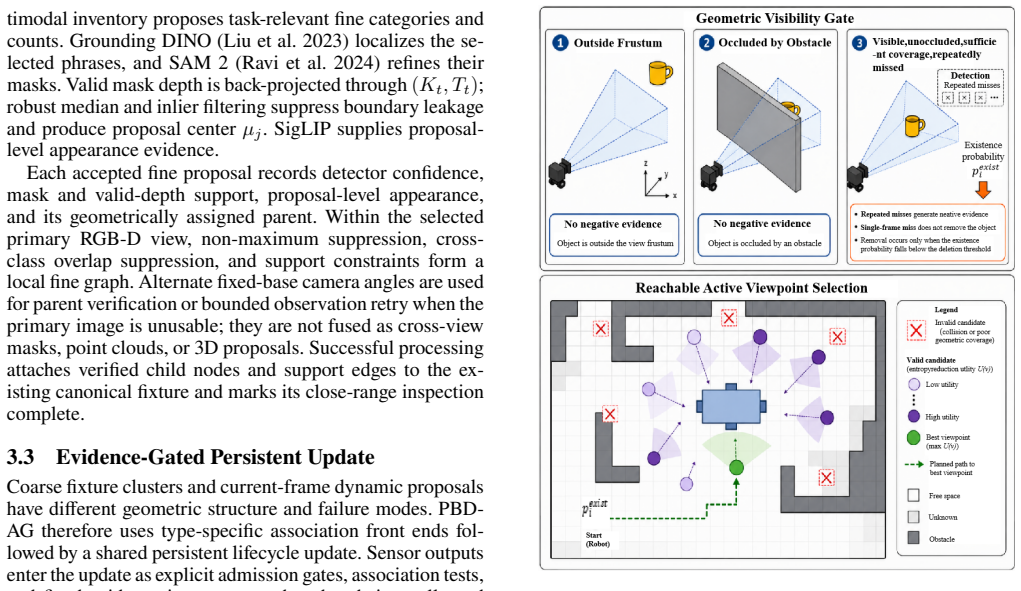
The central object is the baseline–delta graph, a persistent runtime track table $M_t$ with a canonical-fixture view $eB_t$ and an ordered audit-event stream $E_{1:k_t}$. Each track holds class and existence beliefs, a 3D center with recent-position covariance, support-parent belief, an appearance embedding, and a persistent identity $h_i$ with a lifecycle state. The load-bearing mechanism is the geometric visibility gate in the existence update: unmatched tracks receive negative evidence only when $V_i(t)=1$, which requires at least two samples of the projected 3D bounding box to be in range, inside the image, and to pass $d_{\mathrm{meas}} + 0.15\,\mathrm{m} \geq d_{\mathrm{expected}}$. This gate is what converts the system's claim about persistence into a concrete algorithm, because it decides when a missed detection counts as evidence that an object is gone.
What would settle it
Replay the controlled dynamic benchmark while injecting a known localized camera-pose error of 5–10 cm during the disappearance event; if a still-present object is removed because its stored bounding box projects to the two required samples and the depth check passes despite the pose error, the visibility gate's depth tolerance is too tight for real localization noise. Concretely, compare the false-absence rate against the reported 0.014 under this injected error.
Extended reading notes
Core claim
The central claim is that the occlusion-versus-absence problem—whether a missed detection means an object is gone or merely hidden—can be resolved by conditioning negative evidence on geometric observability, and that the right representation for persistence is a baseline–delta split: a frozen canonical-fixture view plus an ordered event stream. Concretely, PBD-AG maintains for each persistent track an existence log-odds updated by fixed increments for positive observation, cached confirmation, unmatched track, and cached rejection; the unmatched-track term is multiplied by a visibility indicator that is 1 only when at least two samples of the stored 3D box are in valid range, inside the image, and pass the depth-consistency check $d_{\mathrm{meas}} + 0.15\,\mathrm{m} \geq d_{\mathrm{expected}}$. Under shared evidence the paper reports coarse F1 of 0.868±0.102, exceeding DynaMem-adapted and ConceptGraphs-adapted by 11.1 and 17.2 points, respectively, while in the dynamic protocol it achieves IDF1 0.833±0.029 with 11/12 event recall and zero identity switches. The ablation without the visibility gate raises false absence from 0.014 to 0.262 and cuts event recall from 11/12 to 6/12, which is the paper's main evidence that the gate is the load-bearing component.
Load-bearing premise
The low false-absence rate depends on the geometric visibility gate: a stored 3D bounding box is treated as observable when at least two samples are in range, inside the image, and satisfy measured depth plus 0.15 m at least expected depth; if this depth-window test mistakes occlusion or bounding-box drift for visibility, present objects receive negative evidence and can be demoted or removed.
Editorial extensions
If this is right
- Long-horizon robot deployments could maintain a compact, traceable world model without re-mapping the whole space after object changes; only the event suffix attached to the frozen baseline needs updating.
- Planners can trust object identity and support relations across sessions, because the system reports zero identity switches in the controlled dynamic benchmark and an audit trail of typed events.
- The visibility gate gives a principled rule for when repeated misses justify removal, which should reduce the classic failure where a robot deletes a present object because a detector or viewpoint failed.
- Active inspection guided by graph uncertainty can concentrate bounded sensing and model-call budgets on unresolved fixtures rather than exhaustive re-scanning.
Reading between the lines
- One testable extension is calibrating the gate's depth tolerance (the fixed 0.15 m buffer) and the two-sample threshold; the paper's fixed choices imply an operating point on a curve trading event recall against false absence that is not explored.
- The baseline–delta representation may transfer to other domains where absence evidence is unreliable, such as inventory or surveillance, wherever the core ambiguity is distinguishing 'gone' from 'hidden'.
- Because identity association uses SigLIP cosine similarity above 0.78 with a unique-class fallback, identity stability is likely to degrade for appearance-similar object classes; the paper does not quantify that boundary.
- The size of the improvement over adapted baselines suggests that the representation and memory-update rules, rather than detector quality or sensing, are the main drivers of persistence performance in these benchmarks.
Signed reviews
Editorial analysis
A structured set of objections, weighed in public.
Referee Report
Summary. PBD-AG proposes a persistent baseline-delta scene graph for service robots: the robot bootstraps stable fixtures through frontier exploration and RGB-D observations, verifies them with close-range inspection, and maintains dynamic object states through evidence-gated persistent tracks with a geometric visibility gate to avoid false deletions under occlusion. The paper evaluates the approach in OmniGibson across three scenes with three seeds each (nine rollouts), reports coarse/fine F1 in Table 3, compares against DynaMem-adapted and ConceptGraphs-adapted controls under shared evidence in Table 1, and runs a controlled dynamic-memory protocol with 12 scheduled events across three Hotel sequences in Table 2, plus component ablations and a qualitative physical-robot demonstration.
Significance. If the reported numbers hold, the paper makes a useful empirical contribution: the shared-evidence comparisons in Tables 1 and 2 are thoughtfully designed, the component ablations isolate the visibility gate and persistent-ID contributions, and the fixed-parameterization claim across three environments is a practical strength. The dynamic protocol's 11/12 event recall and zero identity switches for PBD-AG are concrete, falsifiable results. The qualitative physical-robot demonstration supports the system-integration claim. The main gap is missing quantitative support for the active-inspection scheduler, which the manuscript asserts in the conclusions but does not actually present.
major comments (2)
- [§4.1, §5] The manuscript repeatedly promises a third controlled protocol—paired independent active rollouts—and §5 asserts that 'Paired acquisition experiments further support graph-conditioned fixture prioritization under bounded budgets,' but no such experiment, table, or numeric result appears in §4 or in the provided text. Since active inspection is one of the four listed contributions, this is a load-bearing unsupported claim. The authors must either report the paired active-acquisition results (e.g., a table comparing PBD-AG's scheduler with random, frontier-only, or coverage baselines under a fixed inspection budget, with means and standard deviations over seeds) or explicitly remove this claim from the conclusions.
- [§3.3–§3.4, §4.2] The headline results depend on a dozen hand-set parameters—the evidence increments (η_o, η_c, η_m, η_r) in Eq. (3), the lifecycle thresholds (0.72, 0.30, 0.12), the visibility-gate depth tolerance (0.15 m) and two-sample rule, the weights w in Eq. (4), and the cost coefficients in Eq. (6). The paper states that a single parameterization is held fixed across scenes, which is good, but it does not provide any sensitivity or perturbation analysis. Given that the claimed 0.014 false-absence rate and the 11/12 event recall are direct consequences of the visibility gate, a small sweep over the depth tolerance and existence-increment magnitudes is needed to show that the results are not an artifact of a narrow operating point.
minor comments (5)
- [§4.1, Table 1/Table 3] Please state explicitly whether the PBD-AG row in Table 1 was recomputed on the shared-evidence subset and report the per-scene ground-truth counts of that subset. I do not see literal reuse of Table 3 (Table 3 contains no MAE column, and the P/R values differ), but the near-identical F1 mean and standard deviation (0.868±0.102 vs 0.866±0.102) will confuse readers without a clarifying sentence.
- [§4.1, Table 2] The false-absence metric is computed 'over eligible post-acquisition checkpoints,' but the eligibility rule is never defined in the main text. Please specify the checkpoint-selection rule (time window, object state, visibility conditions) so the 0.014 false-absence result is reproducible.
- [§3.2] The sentence 'Successful processing attaches verified child nodes and support edges to the existing canonical fixture and marks its close-range inspection complete' appears twice in Section 3.2; please remove the duplicate.
- [§4.3] Please clarify whether the three Hotel sequences in the dynamic protocol of Table 2 are the same runs as the Hotel rollouts in Table 3, and state whether event times were chosen a priori or post hoc.
- [Reproducibility] The manuscript mentions 'development and run-selection provenance, resolved configurations, and artifact hashes' in the supplementary material, but that material is not included in the arXiv text; if this provenance is part of the reproducibility claim, it should be made available on the project page.
Circularity Check
No significant circularity; the results are empirical measurements on external benchmarks with fixed update rules.
full rationale
PBD-AG's central claims are empirical system measurements obtained on the external OmniGibson/BEHAVIOR benchmark and on shared grounded 3D streams. The update equations (3)--(6) use fixed, disclosed increments and weights (e.g., eta_o=1.0, eta_c=1.8, w=(.20,.30,.10,.15,.10,.15)) that the paper states are fixed before evaluation; there is no fitted parameter that is subsequently relabeled as a prediction. The controlled comparisons give all methods identical observation streams, so the reported F1, IDF1, event-recall, and false-absence numbers are outcomes of running the compared update rules, not identities forced by the metric definitions or by the equations. The paper relies on external baseline citations for components (SigLIP, Grounding DINO, SAM 2, ConceptGraphs, DynaMem) and does not invoke any self-citation or author-imported uniqueness theorem as a load-bearing premise. The consistency concern that Table 1's PBD-AG MAE might numerically match a full-run value from Table 3 is a potential experimental-reporting issue rather than a circular derivation: the paper itself cautions that the shared-evidence subset may be smaller than the full-scene ground truth, and no equation or definition in the paper makes the shared-evidence result equal to the full-run result by construction. Hand-set visibility thresholds are a robustness and generalization concern, but they are not fitted to the test labels and do not make the reported event recall or false-absence rates tautological. Accordingly, no circular step is identified.
Assumptions & free parameters
free parameters (6)
- Existence evidence increments eta_o, eta_c, eta_m, eta_r =
(1.0, 1.8, 0.70, 2.20)
- Existence lifecycle thresholds =
publish at or above 0.72, demote below 0.30, remove at or below 0.12 after at least three admissible misses
- Uncertainty and scheduler weights =
w=(0.20,0.30,0.10,0.15,0.10,0.15); 0.8u plus 0.2 Prox; J weights 0.08, -0.20, 4.0; d_pref=0.90 m
- Dynamic association gates =
center distance below 0.8 m; SigLIP cosine above 0.78; motion event at or above 0.35 m
- Coarse fixture proposal thresholds =
class-specific similarity and margin thresholds, DBSCAN parameters, footprint gates (supplementary)
- Visibility gate parameters =
at least two valid samples; 5x5 depth window; 0.15 m depth margin
assumptions (4)
- domain assumption The shared world frame and occupancy map are sufficiently accurate, and in simulation the camera poses used for RGB-D registration are trusted.
- domain assumption The pretrained open-vocabulary modules (SigLIP, Grounding DINO, SAM 2) yield acceptable semantics, boxes, and masks for the fixed taxonomy.
- domain assumption The adapted DynaMem and ConceptGraphs implementations are faithful capability-matched controls under the common interface.
- ad hoc to paper The fixed thresholds and weights generalize across scenes without environment-specific tuning.
Cite this review
Pith. "Pith review of PBD-AG: Persistent Baseline-Delta Active Graphs with Uncertainty-Aware Inspection for Long-Horizon Service Robots." pith.science (2026). https://pith.science/paper/LX3N7L6A
@misc{pith2026260810449,
  author       = {Pith},
  title        = {Pith review of: PBD-AG: Persistent Baseline-Delta Active Graphs with Uncertainty-Aware Inspection for Long-Horizon Service Robots},
  year         = {2026},
  howpublished = {\url{https://pith.science/paper/LX3N7L6A}},
  note         = {Machine review of arXiv:2608.10449}
}
read the original abstract
Long-horizon service robots require persistent world models that can be built autonomously in unseen environments and revised as task-relevant objects change. Existing methods rely on online mapping, which accumulates localization and observation errors, static scene representations that cannot capture persistent object changes, or holistic vision-language predictions that lack verifiable 3D geometric evidence. We present PBD-AG, a persistent baseline-delta active graph framework that decouples robot-verified stable fixtures from revisable dynamic object events. Under our framework, the robot autonomously bootstraps the structural baseline from onboard exploration and inspects discovered fixtures to ground hierarchical object beliefs. PBD-AG maintains reliability-weighted object states over geometry, semantics, identity, existence, and support relations, utilizing a geometric visibility gate to mitigate false deletions under occlusion. Inspection viewpoints are selected by a graph-conditioned policy that balances target coverage, travel cost, collision risk, and redundant observation. Simulation experiments in multiple environments and under controlled dynamic evaluation show higher aggregate coarse-fixture F1 than capability-matched controls, as well as stronger identity continuity and event recall. A qualitative physical-robot demonstration further illustrates integration with onboard sensing, providing a traceable world model for long-horizon robotic perception. The project page of PBD-AG is available at https://shuobao214.github.io/PBD-AG/
Figures


Figures from the paper (3 more)


Reference graph
Works this paper leans on
-
[1]
Brian Yamauchi , title =. Proceedings of the IEEE International Symposium on Computational Intelligence in Robotics and Automation , pages =
-
[2]
International Conference on Learning Representations , year =
Devendra Singh Chaplot and Dhiraj Gandhi and Saurabh Gupta and Abhinav Gupta and Ruslan Salakhutdinov , title =. International Conference on Learning Representations , year =
-
[3]
IEEE International Conference on Robotics and Automation , pages =
Chenguang Huang and Oier Mees and Andy Zeng and Wolfram Burgard , title =. IEEE International Conference on Robotics and Automation , pages =
-
[4]
Krishna Murthy Jatavallabhula and Alihusein Kuwajerwala and Qiao Gu and Mohd Omama and Tao Chen and Alaa Maalouf and Shuang Li and Ganesh Iyer and Soroush Saryazdi and Nikhil Keetha and Ayush Tewari and Joshua B. Tenenbaum and Celso Miguel de Melo and Madhava Krishna and Liam Paull and Florian Shkurti and Antonio Torralba , title =. Robotics: Science and ...
-
[5]
Tenenbaum and Antonio Torralba and Florian Shkurti and Liam Paull , title =
Qiao Gu and Alihusein Kuwajerwala and Sacha Morin and Krishna Murthy Jatavallabhula and Bipasha Sen and Aditya Agarwal and Corban Rivera and William Paul and Kirsty Ellis and Rama Chellappa and Chuang Gan and Celso Miguel de Melo and Joshua B. Tenenbaum and Antonio Torralba and Florian Shkurti and Liam Paull , title =. IEEE International Conference on Rob...
-
[6]
Hierarchical Open-Vocabulary 3D Scene Graphs for Language-Grounded Robot Navigation , booktitle =
Abdelrhman Werby and Chenguang Huang and Martin B. Hierarchical Open-Vocabulary 3D Scene Graphs for Language-Grounded Robot Navigation , booktitle =
-
[7]
Robotics: Science and Systems , year =
Nathan Hughes and Yun Chang and Luca Carlone , title =. Robotics: Science and Systems , year =
-
[8]
Robotics: Science and Systems , year =
Dominic Maggio and Yun Chang and Nathan Hughes and Matthew Trang and Dan Griffith and Carlyn Dougherty and Eric Cristofalo and Lukas Schmid and Luca Carlone , title =. Robotics: Science and Systems , year =
Show all 17 references
-
[9]
arXiv preprint arXiv:2411.04999 , year =
Peiqi Liu and Zhanqiu Guo and Mohit Warke and Soumith Chintala and Chris Paxton and Nur Muhammad Mahi Shafiullah and Lerrel Pinto , title =. arXiv preprint arXiv:2411.04999 , year =
-
[10]
IEEE International Conference on Robotics and Automation , year =
Naoki Yokoyama and Sehoon Ha and Dhruv Batra and Jiuguang Wang and Bernadette Bucher , title =. IEEE International Conference on Robotics and Automation , year =
-
[11]
Sharma and Ilija Hadzic and Matthew Andrews , title =
Junyu Mao and Sara Ayoubi and Vishnu D. Sharma and Ilija Hadzic and Matthew Andrews , title =. arXiv preprint arXiv:2606.06721 , year =
-
[12]
arXiv preprint arXiv:2303.05499 , year =
Shilong Liu and Zhaoyang Zeng and Tianhe Ren and Feng Li and Hao Zhang and Jie Yang and Qing Jiang and Chunyuan Li and Jianwei Yang and Hang Su and Jun Zhu and Lei Zhang , title =. arXiv preprint arXiv:2303.05499 , year =
-
[13]
arXiv preprint arXiv:2408.00714 , year =
Nikhila Ravi and Valentin Gabeur and Yuan-Ting Hu and Ronghang Hu and Chaitanya Ryali and Tengyu Ma and Haitham Khedr and Roman R. arXiv preprint arXiv:2408.00714 , year =
-
[14]
IEEE/CVF International Conference on Computer Vision , pages =
Xiaohua Zhai and Basil Mustafa and Alexander Kolesnikov and Lucas Beyer , title =. IEEE/CVF International Conference on Computer Vision , pages =
-
[15]
arXiv preprint arXiv:2403.09227 , year =
Chengshu Li and Ruohan Zhang and Josiah Wong and Cem Gokmen and Sanjana Srivastava and Roberto Mart. arXiv preprint arXiv:2403.09227 , year =
-
[16]
European Conference on Computer Vision Workshops , pages =
Ergys Ristani and Francesco Solera and Roger Zou and Rita Cucchiara and Carlo Tomasi , title =. European Conference on Computer Vision Workshops , pages =
-
[17]
Dynamic Open-Vocabulary 3D Scene Graphs for Long-Term Language-Guided Mobile Manipulation , year=
Yan, Zhijie and Li, Shufei and Wang, Zuoxu and Wu, Lixiu and Wang, Han and Zhu, Jun and Chen, Lijiang and Liu, Jihong , journal=. Dynamic Open-Vocabulary 3D Scene Graphs for Long-Term Language-Guided Mobile Manipulation , year=
Reviewed August 15, 2026 · model on record in the stance chip above.
Discussion (0). Continue with ORCID to comment.