REVIEW 3 major objections 6 minor
INSIDE the Student's Mind: Jointly Modeling Latent Reasoning and Action in LLM Student Simulators
T0 review · 3 major / 6 minor · reviewed 2026-08-15 · deepseek-v4-flash
Pith's one-line read By conditioning code generation on reconstructed internal dialogue, an LLM student simulator can match real students' code distributions and explain up to 57.9 percent of their edits.
desk verdict A useful simulator framework that generates rationalizations aligned with code edits, but the 'thinks like them' claim overreaches the evidence. read the letter →
The pith
A machine-rendered reading of the paper's core claim, the machinery that carries it, and where it could break.
The reading
What carries the argument
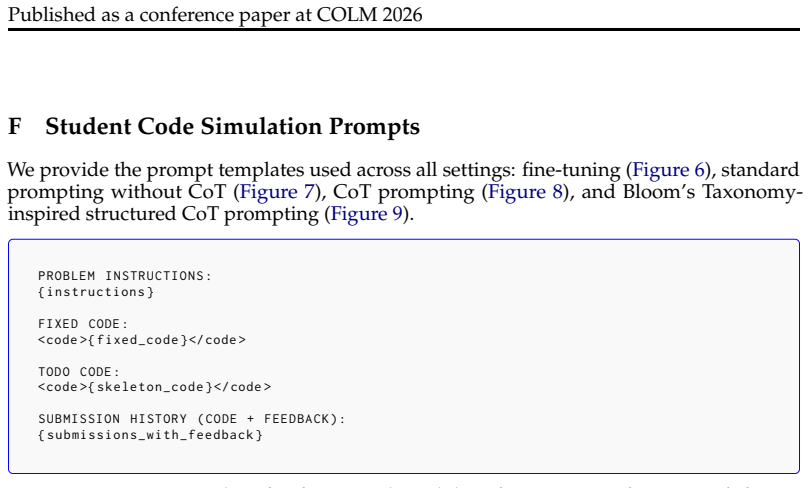
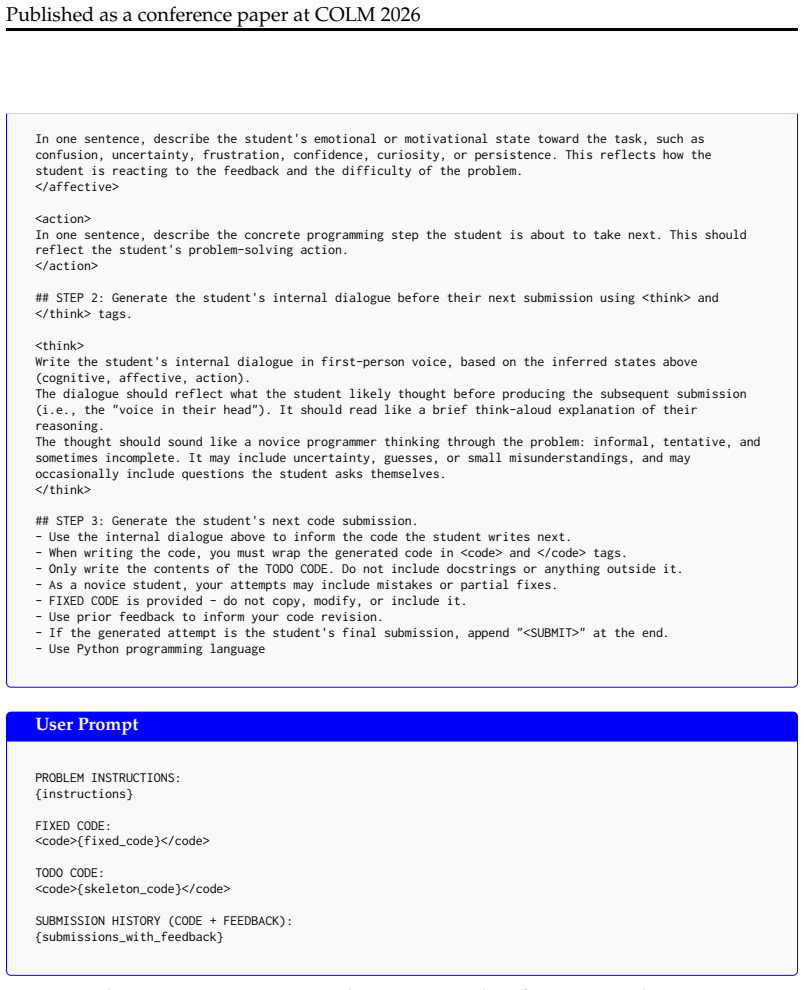
The load-bearing object is the internal dialogue (think trace): a first-person chain-of-thought, written in the student's voice, that states what the student intends before the next submission. In training, a teacher model reconstructs these traces retrospectively from the observed next code edit, organizing them into cognitive, affective, and action states drawn from Bloom's Taxonomy; in inference, the fine-tuned model generates the trace first and then generates code conditioned on it. The dialogue is what carries the claim: it turns an unobservable latent state into a supervised training signal, so action fidelity and reasoning alignment can be jointly optimized and evaluated.
What would settle it
Collect in-the-moment think-aloud protocols from students solving the same programming problems, align each verbalization to the submission that follows, and score INSIDE's generated dialogues against those recordings with the same claim-level judge; if alignment is no better than a BloomCoT prompt baseline or near chance, the retrospective reconstruction of latent reasoning is not faithful.
Extended reading notes
Core claim
INSIDE's central claim is that conditioning code generation on an explicit internal-dialogue layer makes simulated students behave more like real students and, at the same time, produces a readable proxy of the invisible reasoning behind each submission. On the action side, fine-tuned INSIDE models achieve the lowest Wasserstein distances on test_OP across pass rate, code length, AST depth, AST width, and PEP 8 violations; on test_NP they remain comparable to SFT. On the reasoning side, their think traces achieve the highest alignment with ground-truth code edits, up to 57.9% for Qwen3-8B-INSIDE on test_NP, while larger prompt-only models such as GPT-5 score lower, suggesting stronger general reasoning does not by itself produce student-like reasoning.
Load-bearing premise
The paper's central premise is that the internal monologue a large language model writes after seeing the student's real next submission is a faithful stand-in for what the student actually thought before submitting.
Editorial extensions
If this is right
- AI tutors can be evaluated on whether they resolve the misconceptions revealed by a simulated student's internal dialogue, not only on whether the simulated code eventually passes tests.
- Counterfactual tutoring interventions become testable: change the feedback given to the simulator and inspect how the reconstructed reasoning and the next edit both shift.
- On familiar problems, INSIDE removes much of the over-competence bias that makes prompted simulators start at artificially high pass rates; on new problems it matches the behavior-only SFT baseline, so adding reasoning costs little action fidelity.
- Because INSIDE's internal dialogue and code are evaluated against the same ground-truth edit, high self-consistency alone (prompting models score up to 99%) no longer suffices; a model must also match what real students actually did.
Reading between the lines
- A direct test of the reconstruction premise would pair INSIDE with think-aloud recordings: students verbalize while solving the same homework problems, and the reconstructed dialogues are scored against these recordings instead of against code diffs.
- The same structure should transfer to other domains where an observable action hides a latent state, such as medical triage or customer-support diagnosis, by replacing Bloom's Taxonomy with a domain-specific set of state dimensions.
- The alignment metric could be converted into a reward for reinforcement learning: rather than imitating teacher-written traces, the model could search for dialogues that explain the student's actual next edit, potentially closing the gap between the teacher's near-perfect 95.2% and INSIDE's roughly 58%.
- The finding that larger, more capable models score lower on reasoning alignment suggests that student-like reasoning is a distinct target from expert reasoning; a practical extension is to deliberately select training data and objectives that preserve novice errors rather than optimizing toward correctness.
Signed reviews
Editorial analysis
A structured set of objections, weighed in public.
Referee Report
Summary. This paper introduces INTERNAL STUDENT DIALOGUE (INSIDE), a framework for LLM-based student simulation in which a base model is fine-tuned to first generate a first-person 'internal dialogue' (a think trace grounded in Bloom's Taxonomy) and then produce the next code submission. The training traces are produced by a teacher LLM (GPT-5) that performs retrospective inference conditioned on the student's prior submissions, tutor feedback, and the ground-truth next submission. The authors evaluate on two dimensions: action fidelity, measured by Wasserstein distances between model-generated and real student code on pass rate, LOC, AST depth/width, and PEP 8 violations; and reasoning alignment, measured by an LLM judge (GPT-5-mini) that checks whether each claim in the generated dialogue is reflected in the ground-truth code diff. The paper reports that INSIDE achieves the lowest Wasserstein distances on test_OP, comparable performance to SFT on test_NP, and the highest alignment scores (up to 57.9%).
Significance. The problem is timely and the dataset is a genuine asset: a semester-based train/test split, careful IRB handling, a released codebase, and a candid limitations section are all strengths. If the reasoning-alignment metric were validated against actual student cognition, the framework would be an important step toward student simulators that produce interpretable reasoning alongside behavior. As it stands, the contribution is better characterized as improving the explanatory coherence of simulated student behavior with observed code edits, rather than establishing fidelity to latent reasoning. The qualitative failure-mode analysis in Appendix H is a useful addition and partly offsets the lack of a stronger quantitative validation of the reasoning component.
major comments (3)
- [§5.1, Table 1; Abstract] The abstract's claim that INSIDE 'improves simulation fidelity in both action fidelity' is not supported on test_NP. In Table 1b, INSIDE and SFT are effectively tied across metrics; for example, Qwen2.5-7B-INSIDE has pass-rate distance 0.04 versus 0.01 for Qwen2.5-7B-SFT, and Qwen3-8B-SFT is better on AST width (0.28 vs 0.40) and PEP 8 (0.12 vs 0.18). Additionally, the Wasserstein distances are reported as point estimates from 500 bootstrap resamples without confidence intervals or significance tests, so even the test_OP improvements (e.g., pass rate 0.05 vs 0.14) may not be statistically reliable. Please report bootstrap CIs and pairwise significance tests, and qualify the action-fidelity claim by split.
- [§4.2, §3.3, Appendix C] The 'reasoning alignment' metric cannot by itself support the central claim that INSIDE models students' latent cognition. Section 3.3 generates training traces by conditioning the teacher (GPT-5) on the ground-truth next submission, and Section 4.2 evaluates alignment with an LLM judge (GPT-5-mini) from the same model family against the same ground-truth diff; high alignment therefore measures post-hoc explanatory fit to observed code edits, not agreement with unobserved student reasoning. The n=25 human agreement check (88%, κ=0.754) validates only whether claims are reflected in diffs, and the n=209 teacher-trace check does the same at a larger scale. Appendix C's self-consistency results (86.9–99.0% for prompting models with poor action fidelity) further show that consistency with code changes is not evidence of student-like reasoning. The paper's own Section 6 concedes that traces 'may reflect more coherent or structured reasoning than what real students exhibit.' At minimum, the abstract and conclusion should be reframed, and ideally the alignment metric should be validated against think-aloud or retrospective verbalization data.
- [§5.2, Table 2] The reported alignment differences are often within sampling error. On test_NP, Qwen3-8B-INSIDE scores 57.9% (SE 2.0) versus 56.0% (SE 2.3) for the best BloomCoT baseline; on test_OP, 51.8% (0.8) versus 50.5% (0.8). Given the standard errors, these gaps are not clearly significant, and no significance tests or effect sizes are reported. The claim of 'the highest alignment across models' therefore needs paired statistical testing or a more modest statement.
minor comments (6)
- [Abstract] The abstract should be qualified: on test_NP, INSIDE is comparable to SFT, so 'improves simulation fidelity in both action fidelity' is too strong.
- [Table 1] The caption says 'Bolded and underlined values' but does not explain what underlining indicates; specify the role of underlining or remove it.
- [§4.2] The displayed formula for Alignment_t is typeset incorrectly (the summation is missing an index); please fix the notation.
- [§5 / §4.1] Please report the inference protocol: sampling temperature, number of generations per instance, seed, and how a single 'next-attempt' is drawn; this is needed to interpret the Wasserstein estimates and MAE values.
- [Figure 2] The alignment procedure for submission steps (final submissions mapped to a shared terminal step) should be described in the caption or text; otherwise the comparison of trajectories of different lengths is not well defined.
- [§3.1] State how many students were excluded for non-consent and whether the AI tutor was offered to all students; this affects the generalizability of the training distribution.
Circularity Check
Reasoning-alignment claim is partially circular: teacher dialogue is reconstructed from the very code edit used as the alignment target, so 'thinks like them' reduces to fitting post-hoc rationalizations to observed actions.
-
renaming known result
[Section 1 (Introduction) vs. Section 3.3, Eq. (2)]
"In contrast, INSIDE introduces internal dialogue as an intermediate cognitive layer that precedes student actions during learning interactions, capturing the intent that leads to each attempt rather than only explaining mistakes after the fact. ... When generating the training data, we perform retrospective inference with a teacher model T , where the teacher conditions on the interaction context x_t and the observed (ground-truth, student-generated) next submission: z_t ∼ T(·|x_t, c_t)."
The dialogue that is claimed to precede the student's action is in fact generated from that same action: Eq. (2) conditions the teacher's reconstruction on the ground-truth next submission c_t. This is precisely the post-hoc, reconstructive style the paper attributes to Ross & Andreas. Renaming a c_t-conditioned rationalization as 'internal dialogue that precedes student actions' does not create an independent cognitive layer; the target is derived from the outcome it is supposed to explain.
-
self definitional
[Section 4.2 (Quality of Internal Dialogue); Abstract]
"We evaluate the quality of the generated internal dialogue through alignment: whether the generated internal dialogue reflects the real student's code changes. Higher alignment suggests a closer approximation of the reasoning process underlying the student's observed behavior."
Reasoning quality is defined as consistency with code diffs, not as agreement with any directly observed cognition. The abstract's claim that the model is trained to 'think like them' is therefore read off a metric that, by definition, measures only action consistency. Since two students can make identical code edits for entirely different reasons, the alignment metric cannot distinguish those cases; it can only certify that generated claims are reflected in the diff, which is a weaker, action-level property.
1 more flagged steps
-
fitted input called prediction
[Section 3.3, Section 4.2 (judge validation), Section 5.2]
"To validate the labels assigned by the LLM judge, we evaluate it on the internal dialogue generated by the teacher model in Section 3.3, paired with their corresponding code edits, where the judge should ideally assign full coverage. On a sample of code submissions from the training data (n= 209), the judge assigns an average alignment score of 95.2% ..."
The 95.2% judge validation is computed on teacher traces that were themselves conditioned on c_t, so high coverage is baked in rather than being independent evidence of validity. INSIDE is then trained on these same c_t-conditioned traces and evaluated with the same judge against the same c_t diffs. The reported 51.8–57.9% alignment therefore largely measures how faithfully the model imitates the teacher's post-hoc rationalization style, not whether the traces correspond to any real student's latent cognition.
full rationale
The action-fidelity half of the paper is self-contained and not circular: Wasserstein distances are computed between generated code and held-out real student code, and the improvements of INSIDE over SFT on test_OP are empirical, not definitional. The circularity is concentrated in the reasoning-alignment axis. Training targets are produced by retrospective inference conditioned on the ground-truth next submission (Eq. 2), so the 'internal dialogue' is a post-hoc rationalization of the very action it is claimed to precede; the paper's own contrast with Ross & Andreas (reconstructive vs. preceding) is contradicted by this construction. The alignment metric then scores generated dialogue against the same ground-truth code diff, and the judge validation (95.2%) is performed on teacher traces that were constructed to explain those diffs, so it validates only that claims reflect diffs, not that they reflect student cognition. Section 6 concedes that traces 'may reflect more coherent or structured reasoning than what real students exhibit,' which further supports the reading that the 57.9% alignment figure is about consistency with observed edits rather than fidelity to latent student thought. The score is 6 rather than lower because the central 'thinks like them' claim partially reduces to a fitted rationalization target, while the action-fidelity results remain independently meaningful.
Assumptions & free parameters
free parameters (5)
- LoRA rank r =
16
- LoRA alpha =
32
- Learning rate =
1e-4
- Training epochs =
2
- Context window k =
up to 10 prior submissions
assumptions (5)
- domain assumption GPT-5's retrospective reconstructions of internal dialogue, conditioned on ground-truth next submissions, are an acceptable proxy for real student latent reasoning.
- domain assumption Bloom's Taxonomy cognitive, affective, and action dimensions are a valid structuring for student internal reasoning.
- domain assumption The LLM judge (GPT-5-mini) can reliably decompose internal dialogue into atomic claims and determine whether each claim is reflected in a code diff.
- domain assumption The autograder test suite and code metrics (LOC, AST, PEP 8) from Miroyan et al. (2025) adequately measure student code fidelity.
- domain assumption Students in the Spring 2024 and Spring 2025 Berkeley CS1 course are representative of the target population for student simulation.
invented entities (1)
-
Internal dialogue (INSIDE think trace)
Cite this review
Pith. "Pith review of INSIDE the Student's Mind: Jointly Modeling Latent Reasoning and Action in LLM Student Simulators." pith.science (2026). https://pith.science/paper/JFTACVAB
@misc{pith2026260810492,
  author       = {Pith},
  title        = {Pith review of: INSIDE the Student's Mind: Jointly Modeling Latent Reasoning and Action in LLM Student Simulators},
  year         = {2026},
  howpublished = {\url{https://pith.science/paper/JFTACVAB}},
  note         = {Machine review of arXiv:2608.10492}
}
read the original abstract
Large Language Model (LLM)-based simulators often reproduce observable actions but fail to capture the underlying reasoning behind them. In education, where student simulation is increasingly used for various applications such as evaluating tutoring systems, this gap is especially pronounced. Two students may submit identical submissions for entirely different reasons. We present INTERNAL STUDENT DIALOGUE (INSIDE), a student modeling framework that fine-tunes LLMs not only to act like students but also to think like them. INSIDE generates internal dialogue grounded in Bloom's Taxonomy across cognitive, affective, and action dimensions, and fine-tunes models on paired think traces and actions. We baseline against different prompting frameworks and evaluate on two axes: fidelity of simulated actions and quality of generated internal dialogue. Our evaluations show that INSIDE improves simulation fidelity in both action fidelity, matching code generation of real students, and reasoning alignment, achieving the highest alignment across models up to 57.9%.
Figures


Figures from the paper (11 more)






Reviewed August 15, 2026 · model on record in the stance chip above.
Discussion (0). Continue with ORCID to comment.